Lively, entertaining reviews of, and essays on, old and newer films and everything relating to them, written by professional author William Schoell.

Thursday, November 11, 2021

CRACK-UP

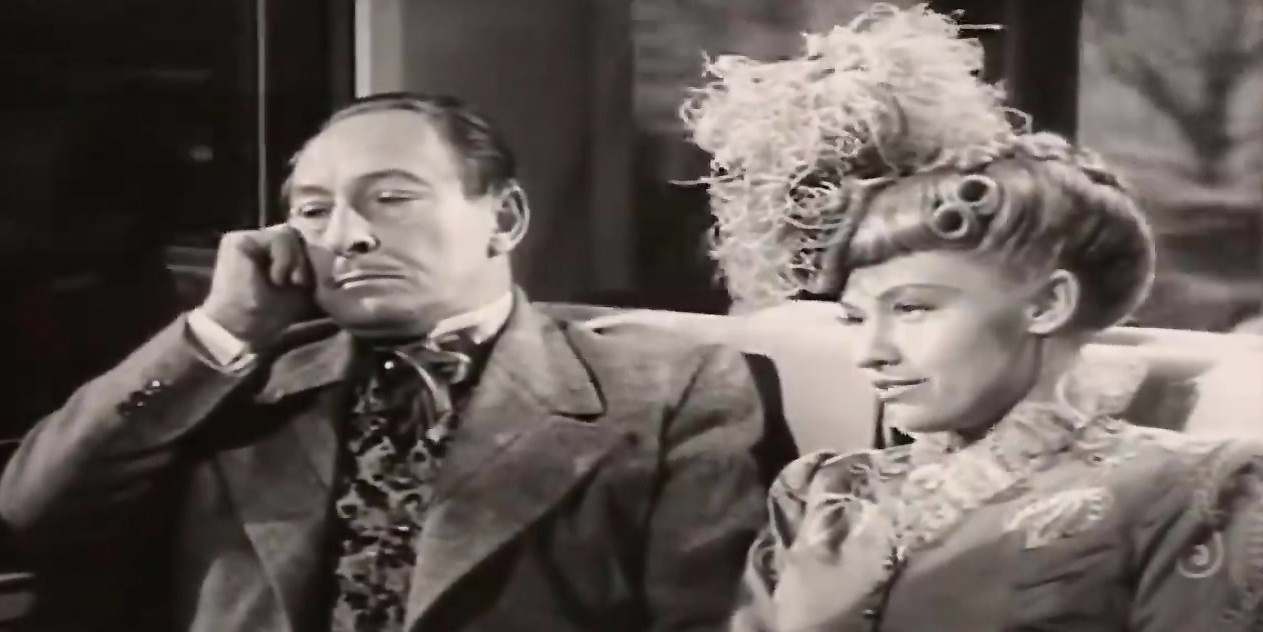
Herbert Marshall, Pat O'Brian and Claire Trevor
CRACK-UP (1946). Director: Irving Reis. 

Art lecturer George Steele (Pat O'Brian) breaks into a museum, acting all crazy, and insists that he was just in a tremendous train wreck and barely survived. Cops, museum staff, and sort-of girlfriend Terry (Claire Trevor) are worried by his behavior, even more so when they learn that there has been no news of any train wreck. George tries to retrace his steps, and even takes a train from Grand Central, the same train he thinks he took earlier, to try and figure out what happened to him. There is talk of a missing or forged art masterpiece. When his friend and colleague Stevenson (Damian O'Flynn) is found murdered, George goes on the run. 

Ray Collins ministers to O'Brian
Based on a short story by Fredric Brown, Crack-Up is a fair suspense story that in the long run doesn't really deliver. This is too bad, because the picture begins very well, is well-acted, and has a couple of terrific scenes, especially a creepy one when George goes back on the train, sees another train slowly approaching from the other direction, and is terrified -- as is the audience --  that there is going to be a crash. But the rest is just a ho hum mish mosh that just doesn't distinguish itself from the competition, despite good photography by Robert De Grasse and a score by Leigh Harline that adds heft to certain sequences. The climax is criminally flat as well. 

O'Brian and Trevor
In addition to the actors already named, we've got Herbert Marshall wasted as an alleged romantic rival for Terry's affections, Ray Collins as a concerned colleague, Wallace Ford as a not-so-concerned police officer, Dean Harens as a handsome art aficionado, Mary Ware as the timid secretary, Mary, and Robert Bray as a silent and sinister figure on the train and elsewhere. While there are good performances and sequences in the movie, one can also understand why this is one bit of film noir that is almost completely forgotten. 

Verdict: Initially intriguing but ultimately minor crime drama. **1/4. 

Thursday, October 28, 2021

HAPPY HALLOWEEN -- AGAIN!

HAPPY HALLOWEEN 2021.

Make some pumpkin pie -- so easy even I can do it -- put some whipped cream on it, cook up the cocoa (with more whipped cream) and watch a nice scary horror movie on Halloween! Maybe one of the movies reviewed in the posts below.

Have fun! 


HOUSE OF THE DAMNED

Merry Anders 
HOUSE OF THE DAMNED (1963). Director: Maury Dexter. 

Architect Scott Campbell (Ron Foster of The Music Box Kid) is hired to survey Rochester Castle and bring his wife and partner, Nancy (Merry Anders), along. Eventually lawyer Joseph Schiller (Richard Crane of No Man's Woman) and his excitable wife, Loy (Erika Peters), also arrive on the scene. There are 13 keys for the house and a variety of rooms, as well as strange people skulking about in the shadows. Then Loy is chased by a giant figure (Richard Kiel of "To Serve Man" on Twilight Zone) and disappears, until Merry seems to find her headless corpse ...

Peters, Crane, Foster, Anders
Be warned that the above description makes House of the Damned sound a lot better than it is. The whole project just seems so languid and mediocre. It was as if this great location, the castle, were chosen first and then a script was hastily -- very hastily -- scripted around it, so there are no real characters and only one genuinely creepy moment, when some thing sneaks into the bedroom and borrows those keys. The house is beautiful, but it's not enough to save the movie. You might groan when you discover exactly who or what is behind the "horror." 

Ron Foster was a handsome and talented actor who chiefly appeared in "B" movies, and despite the fact that this was produced by 20th Century Fox in CinemaScope, this is no different; he couldn't catch a break. Henry Vars has contributed a nice and eerie theme, but otherwise the score is just too lethargic.   

Verdict: Promises a lot but delivers very little. **.   

MAN BEAST

Lloyd Nelson, Asa Maynor, Tom Maruzzi
MAN BEAST (1956). Director: Jerry Warren. 

Connie (Asa Maynor), has come to the Himalayas with her friend Hudson (Lloyd Nelson) in search of her brother, who is on an expedition with Dr. Erickson (George Wells Lewis). They hope to find a Yeti, or abominable snowman, in the higher altitudes. Connie and Hud, with the aid of Steve Cameron (Tom Maruzzi), manage to catch up with the expedition, but instead of her brother they find a man named Varga (George Skaff), who they deem suspicious. They are right to feel this way, as Varga turns out to be have a special relationship with the Yeti who turn up and threaten the others. And Varga has special -- and rather horrifying -- plans for Connie. 

One of the Yeti
Man Beast can't compare to the British Abominable Snowman that came out the following year, but while it's not a particularly good movie it does have its points of interest. The acting can best be described as adequate but George Skaff actually turns in a more than decent performance. Out of all of the performers he unsurprisingly racked up the most credits, although Maynor and Nelson also had more work after appearing in this picture. This was the sole film appearance for both Maruzzi and Lewis, and "Rock Madison" was just a made-up marquee name with producer/director Jerry Warren hoping audiences would think they were getting Rock Hudson or Guy Madison for their money -- there is no such actor. The picture's main strength, aside from its short length, is the atmospheric filming (with the slopes of California filling in for the Himalayas) of snowy vistas, deadly crevasses, avalanches, and the like, although undoubtedly stock footage was also employed. A scene when the Yeti come after the group inside a cave (there is no set, just surrounding blackness) is amateurishly staged and awkwardly shot, although I must say the first appearance of the Yeti is a mite startling. The soundtrack consists of very well-chosen stock musical cues. Jerry Warren also directed The Incredible Petrified World, which was similarly low-budget but a much better picture. 

Verdict: Not nearly as awful as its reputation, but not worth missing an episode of your favorite TV series. **. 

WEB OF THE SPIDER

Klaus Kinski and Anthony Franciosa
WEB OF THE SPIDER (aka Nella stretta morsa del ragno/1971). Director: Antonio Margheriti.

While Edgar Allan Poe (Klaus Kinski of Slaughter Hotel) is visiting London, he is approached by an American reporter named Alan Foster (Anthony Franciosa of Tenebrae). Lord Blackwood (Enrico Osterman) offers Foster money if he can spend one night in his supposedly haunted estate from which no one has ever returned. Once there, Foster meets two beautiful women: Elisabeth (Michele Mercier) and jealous Julia (Karin Field), who has a hankering for the former. Dr. Carmus (Peter Carsten) appears out of nowhere and shows Foster visions of what transpired in the past: the sexual intrigues of Elisabeth, her husband, William (Silvano Tranquilli), her lover Herbert (Raf Baldassarre), and, of course, the horny Julia. It slowly dawns on Foster that he may be in a house of ghosts, or worse, vampires ... 

Franciosa with Mercier
Web of the Spider begins in an intriguing fashion, but it soon becomes apparent that its mess of a script is a stew of barely coherent cliches that hardly holds together. By the final quarter you're just hoping it will hurry up and end already. The tenuous connection of Poe -- who only appears at the opening and the very end -- is almost insulting, as this has nothing to do with the writer, despite the creepy house and the screwed up family who inhabit it -- this is no Fall of the House of Usher

Karin Field
Franciosa gives a decent, if dubbed, performance, the other actors are all fine, and the film can be quite good to look at. The trouble is that the movie is so over-lit that the atmosphere evaporates and it becomes comical how bright everything is when you're in a house at night with a couple of candles (sometimes no candles), and there isn't much moonlight, either. Sure, you want the audience to get a look at the sets, the superior art direction, and the attractive color schemes, but a few realistic shadows wouldn't have hurt that much. For all the ghosts running around the house, the film never works up an especially spooky ambiance. The picture does have a satisfactorily ironic conclusion for those willing to stick around until the end. Antonio Margheriti also directed Battle of the Worlds and many other lousy movies.

Verdict: Watch Tony in Career instead. **. 

THE WASP WOMAN -- IN COLOR!

Wasp woman goes on the attack! 
THE WASP WOMAN (1959). Colorized. Directed by Roger Corman. 

Sales for Janice Starlin's (Susan Cabot) cosmetic company have been dropping since she stopped using herself in advertisements, but as she's on the wrong side of forty, she figures she has no choice. But when elderly Professor Zinthrop (Michael Mark) tells her that he has come up with an age-defying formula using royal jelly from wasps, she has hope and insists he use her as a guinea pig. At first the results are miraculous, with Janice looking as if she's in her twenties (Cabot was 32 at the time), but when she uses more and more of the formula to remain young, the results are less than felicitous. Janice turns into a horribly mutated wasp woman who attacks and feeds upon various people around her, including a solicitous nurse (Lani Mars) and a very obese night watchman (Bruno VeSota). 

Susan Cabot with Michael Mark
I have always gotten a kick out of this fun Corman cheapie-creepy, and I enjoyed it even more in well-done color! In addition to Cabot's excellent performance, this time around I appreciated Lynn Cartwright as the saucy secretary Maureen, who is given some amusing dialogue and runs with it. Fred Katz' jazzy musical score is a little odd, but it works well enough, and the film is full of a whole host of interesting B movie players: Anthony Eisley of Hawaiian Eye; Roy Gordon from Attack of the Fifty Foot Woman; Barboura Morris from Bucket of Blood; the aforementioned VeSota; and even Aron Kincaid [The Girls on the Beach] as a briefly-seen beekeeper, Roger Corman himself also shows up briefly as a doctor, so briefly that I didn't even notice him! I love the scene when Cabot and Morris have excited, happy girl talk over Janice's new youthful appearance. 

Verdict: Be careful what you wish for! ***.

Thursday, October 14, 2021

GASOLINE ALLEY

Scotty Becket and Susan Morrow
GASOLINE ALLEY (1951). Written and directed by Edward Bernds. 

Corky Wallet (Scotty Becket) is out of college and newly married to Hope (Susan Morrow). Corky's father, Walt (Don Beddoe), hopes that Corky will join his father's firm, but Corky wants to make his own mark in the world. A stint as a dishwasher leads to him buying his own diner with financial help from his brother, Skeezix (Jimmy Lydon), and waitress assistance from Hope. When a businessman makes the landlord an offer he can't refuse, Corky has to come up with a plan to save the diner after all of his hard work. 

Don Beddoe and Jimmy Lydon
"Gasoline Alley" was a very long-running newspaper comic strip by Frank O. King in which the characters aged normally as they would in the real world. The strip began with bachelor Walt Wallet discovering an infant boy, Skeezix, on his doorstep. Walter eventually got married and had two more natural children, including Corky, who also married. Skeezix  married and had children as well, including Skipper the sailor. Reading the strip as a child I remember it as being a pleasant comedy-drama but nothing out of the ordinary. I'm afraid the same is true for this low-budget theatrical version of the comic strip.

Director Edward Bernds keeps the pic moving but he should have allowed someone else to do the script, which is mediocre and full of old gags. Scotty Becket, the very talented child actor of My Son, My Son and others, is fine and sympathetic but kind of wasted, as his was a very strong talent. Jimmy Lydon [Strange Illusion], famous for the Henry Aldrich films, is also good but isn't given much to do. The other assorted players are all okay -- especially Byron Foulger as a customer -- but the material is pretty much beneath everyone. There was one sequel, Corky of Gasoline Alley. These were Beckett's last starring roles although he did a few pictures afterward until tragically succumbing to a drug overdose at age 38.

Verdict: Probably not as good as the comic strip. **. 

RAIDERS OF GHOST CITY

Wanda McKay, Joe Sawyer, and Dennis Moore
RAIDERS OF GHOST CITY (13 chapter Universal serial/1944). Directed by Lewis D. Collins and Ray Taylor. 

Near the end of the Civil War an organization of Confederate spies is actually the front for gold thieves operating out of Oro Grande, California. But even these desperadoes are being double-crossed by a couple of Prussian agents who need the gold so that they can buy Alaska! Trying to thwart their efforts is Captain Steve Clark (Dennis Moore) of the U.S. Secret Service, aided by Idaho Jones (Joe Sawyer), a Wells Fargo detective, and Cathy Haines (Wanda McKay), a Wells Fargo county agent. 

Lionel Atwill and Virginia Christine
Their main antagonists are Erich von Rugen (Lionel Atwill of Captain America) and the deliciously ruthless Countess Elsa von Merck (Virginia Christine of Three Brave Men), who doubles as a saloon singer named Trina Dessard. They report to a Count Manfried von Richten (Emmett Vogan of Docks of New Orleans). Regis Toomey is Captain Clay Randolph, a legitimate rebel who doesn't realize what the others are up to and only wants the gold to aid the war effort.

Moore, Christine and Sawyer
Westerns have never been my favorite serial genre, but I must say that Raiders of Ghost City -- the title refers to a ghost town not far from Ora Grande -- has made a believer of me, for this is quite well-made, with an especially flavorful screenplay. In cliffhanger sequences a runaway stage coach falls into a river, and Steve is trapped in a cave with rapidly rising water. Chapter eight features a thrilling, expertly-edited chase scene with an entire gang in pursuit of Idaho. The first and tenth chapters have the best cliffhangers: an uncoupled car begins rolling backwards towards disaster during a frantic fist fight; and Idaho is nearly drawn and quartered by Modoc Indians in a very suspenseful sequence. The four main players are all excellent and the supporting players are well cast. 

Verdict: Very exciting, well-made, and well-played Columbia serial. ***1/4. 

THE BRIEF, MADCAP LIFE OF KAY KENDALL

THE BRIEF, MADCAP LIFE OF KAY KENDALL. Eve Golden with Kim Kendall. University Press of Kentucky; 2002.

Since most if not all of the major stars have been covered ad nauseam, many publishers have come out with books on 2nd, 3rd and 4th tier celebrities. British actress and comedienne Kay Kendall [Les Girls; Wings of Danger), who did indeed have a brief life and career, fits into the lattermost of those categories. Kendall was talented and tragic, dying young of leukemia, which her husband and family tried very hard to keep her from knowing until nearly the end. Her husband was Rex Harrison, and Kendall would have probably been forgotten by all but her most obsessive fans, however many, if it had not been for that association with a much bigger star. Kendall's marriage to Harrison played out during a time when the latter was ascendant due to his triumphs in both the stage and screen versions of My Fair Lady. Eve Golden's entertaining and page-turning book won't necessarily have you admiring Kendall's character, although she was probably no worse than a lot of other husband-stealing, rather "trampy" and superficial starlets; Kendall also became full of herself. (Kendall stole Harrison from Lilli Palmer, who had herself broken up an earlier marriage to Harrison. Harrison claimed that he primarily married Kendall only because she was dying.) Kendall was great friends with Dirk Bogarde and his partner, Anthony Forwood. Biographer Golden does a very good job dissecting Kendall's films and performances while never neglecting her interesting personal life. 

Verdict: Good read for those interested in this talented if minor British actress. ***. 

INVASION OF THE BODY SNATCHERS (1978)

Leonard Nimoy and Donald Sutherland

INVASION OF THE BODY SNATCHERS (1978). Director: Phil Kaufman.

San Francisco health inspector Matthew Bennell (Donald Sutherland) is carrying a torch for his colleague Elizabeth Driscoll (Brooke Adams). Elizabeth is convinced that her live-in boyfriend, Geoff (Art Hindle), is not himself, that he's actually become a different person. Matthew's friend, David Kidner (Leonard Nimoy), a pop psychologist and author, says that other people are also claiming their loved ones are not their loved ones. Things take an even darker turn when a weird body turns up in the mud baths operated by Jack (Jeff Goldblum) and Nancy (Veronica Cartwright), a half-finished body that greatly resembles Jack. It seems that virtually everyone in the city has succumbed to this ghastly invasion of space seeds, which destroys humans and replaces them with unemotional duplicates ...  

Veronica Cartwright
On its own terms this remake of the classic fifties film of the same name is entertaining, and if this is one's first introduction to the story -- based on "The Body Snatchers" by Jack Finney -- it will probably give you a bit of the chills. But be forewarned that if you watch it back to back with the original it greatly suffers in comparison. Switching the locale from a small town to a big city does not do too much damage, but a bigger problem is that the film too often resembles a clumsy parody of the first film. Sutherland, Nimoy and Adams are okay, but Goldblum is irritating and Cartwright overacts almost from the first (compare her to a splendid Carolyn Jones in the first film). Some of the chase scenes just seem so stilted. 

Brooke Adams
Aside from the electronic noises during sequences with the pods -- the FX here are quite good -- the musical score only detracts from the film's effectiveness. Some of the other changes in this version are welcome: Elizabeth's "transformation" is handled much better and much more logically than Becky's "conversion" in the first film, and the weird way the aliens point and screech at ordinary humans is acceptably unnerving. A clever bit -- although it doesn't quite work -- has Elizabeth screaming when she sees a dog with a man's head (as opposed to Becky screaming when a dog is nearly run over), but the inclusion of Kevin McCarthy, acting much the way he does at the climax of the original film, while cute, also ruins the mood, coming off more comical than anything else. Director Philip Kaufman tries to create an air of disquiet by putting odd people in the backgrounds -- the aliens beginning to assert themselves, one supposes -- the oddest of whom is Robert Duvall, herein cast as a non-speaking priest on a child's swing. The director of the original, Don Siegel, plays a cab driver.

Verdict: Nice try, but the original is much, much better. **3/4. 

THE TRIP TO BOUNTIFUL

THE TRIP TO BOUNTIFUL (1985). Director: Peter Masterson. 

A lovely, low-key movie and character study about an elderly woman, Carrie Watts (Geraldine Page, who won and deserved an Oscar), who desperately wants to go back to her childhood home for at least one last look. Carrie lives with her son, Ludie (John Heard) and daughter-in-law Jessie Mae (Carlin Glynn) in a small home and sometimes there is a definite strain. Based on Horton Foote's play (he also wrote the screenplay), the mood piece is moving because it invokes feelings of lost youth, distant times of (alleged) happiness, past regrets and wasted chances, and all the things that most human beings feel as they grow older. Still, the film primarily works because of Page's superb performance. She makes a woman that many of us would find quite tiresome in real life (what with her hymns and dumb religious assertions) perhaps more interesting than she deserves to be. Still she comes off as a very real person. Heard and Glynn are also quite good. Rebecca De Mornay and Richard Bradford are also notable as a fellow bus passenger and the local sheriff, respectively. One could quibble about certain things, but this is all about mood. 

Verdict. Quietly touching. ***.

Thursday, September 30, 2021

MURDER SHE SAID

 MURDER SHE SAID (1961). Director: George Pollock. 

Jane Marple (Agatha Christie) is on a train when she happens to glance out the window and see a couple on another train passing by. She witnesses the man strangling the lady just before the train moves on ahead and is lost to view! Miss Marple can't convince the authorities that anyone has actually been killed -- there's no body, for instance -- so she decides the corpse must have been thrown off the train at a certain point and may be secreted at a nearby estate. The plucky oldster decides to get employment as a maid at this estate, find the dead body, and figure out which of the people associated with the estate could be responsible for the murder. We have crusty old Ackenthorpse (James Robertson Justice), his daughter Emma (Muriel Pavlow), his sons Cedric (Thorley Walters) and Harold (Conrad Phillips), and son-in-law Eastley (Ronald Howard). Others involved with the family include the creepy hand Albert (Gerald Cross); the cook, Mrs. Kidder (Joan Hickson, who later played Miss Marple herself and probably offered the best interpertation of the character); the family doctor, Quimper (Arthur Kennedy); and Eastley's strange son, Alexander (Ronnie Raymond; dubbed by Martin Stephens). Inspector Craddock (Charles Tingwell) doesn't appreciate Miss Marple's poking her nose into things, and she has a couple of nasty moments -- and more murders -- before she uncovers the truth. 

Margaret Rutherford with husband Stringer Davis
Murder She Said
 was the first of four films starring Rutherford as Miss Marple. Agatha Christie did not approve of the casting and didn't especially care for the movie, but she eventually became an admirer and friend of Rutherford's. Rutherford cast her husband, Stringer Davis, as Miss Marple's friend and romantic interest Mr. Stringer in all four of the movies, three of which were based on Christie novels. This film was based on "4:50 from Paddington." The American title was "What Mrs. McGillicuddy Saw," as it was this character, an old friend of Jane's, who actually sees the murder on the train. 

Joan Hickson later played Miss Marple to great effect
Murder She Said
 is an entertaining, well-played picture and it doesn't stray that far from Christie's novel (except Miss Marple has a helpmate take the position on the estate, reporting to her, instead of doing it herself, and there's an additional murder). While not as good as Christie's book, it is a worthwhile picture, and may offer up a surprise or two for those unfamiliar with the original. While not the perfect representation of Miss Marple, Rutherford is still marvelous. The novel was more of a black comedy than anything else, so it makes sense that the tone of this picture is similar. 


Verdict: Fun! ***

THE BUDDY HOLLY STORY

Maria Richwine and Gary Busey

THE BUDDY HOLLY STORY (1978). Director: Steve Rash. 

In Lubbock Texas in 1956 Buddy Holly (Gary Busey in an Oscar-nominated performance) and two friends -- Jesse (Don Stroud) and Ray Bob (Charles Martin Smith) -- perform at the local skating rink but their "Negro"-influenced music may be too much for the advertisers on the radio station. Buddy and the "Crickets," as the other two fellows are called, travel to Nashville but discover they will have to sing for a studio band of country musicians who pretty much ruin a great song like "That'll Be the Day." Buddy almost has the same problem in New York, but is able to convince record executive Ross Turner (Conrad Janis) to produce the group's albums and maintain the correct sound. As the group has one hit record after another -- "Love Like Yours," 'It's So easy to Fall in Love' "Oh, Baby!" and others -- Buddy falls for and marries secretary Maria Elena (Maria Richwine) and he and the boys have a falling out. One night on a fateful tour with Richie Valens and the Big Bopper, Buddy meets his tragic destiny ... 

Charles Martin Smith and Busey
While it helps if you like this kind of old-time rock 'n' roll -- which I do -- I found The Buddy Holly Story to be quite entertaining, if minor. One could argue that you don't necessarily get to know any of the people in the film all that well, but the acting across the board is excellent. One could also argue that Gary Busey is much more charismatic and energetic than the real Buddy Holly, but I admit this is only based on seeing a couple of the latter's live performances. Dick O'Neill as Sol Gittler and Paul Mooney as Sam Cooke, among others, are also notable. One of Holly's last compositions was the very lovely, even touching, ballad "True Love Ways," for which his voice -- which works on loud rock songs -- wasn't that well suited. I believe it was released posthumously. 

Verdict: Upbeat rock biopic with a downbeat conclusion. ***.

CECIL B. DEMILLE'S HOLLYWOOD

CECIL B. DEMILLE'S HOLLYWOOD. Robert S. Birchard. University Press of Kentucky; 2004. Reissued in trade paperback in 2021.

Not a biography in the formal sense, Cecil B. Demille's Hollywood nevertheless presents much information about the famous director's life, films, working methods and career high and lowlights in this excellent volume. The movies he directed include everything from the silent Ten Commandments to its color and sound remake, other biblical spectacles such as Samson and Delilah, masterpieces such as Cleopatra and near-masterpieces like The Sign of the Cross, as well as the occasional mediocrity such as The Greatest Show on Earth and the rare stinker like Four Frightened People (which author Birchard makes a stab at defending). The book makes clear DeMille's influence on Hollywood and filmmaking in general, and goes behind the scenes of every single one of his movies. Although there are some critical notes in the text, this is not quite a work of film criticism as much as it is a career study, and works very well on that level. For some of the films, I would have liked more of a synopsis to fully understand the picture under discussion, but that's a quibble. This is a well-written, very well-researched tome that will ignite the reader's interest in the late director and his films even as it keeps the pages turning. 

Verdict: Be ready for your close-up with this book! ***1/2.  
 

JUST BETWEEN FRIENDS

Mary Tyler Moore and Christine Lahti
JUST BETWEEN FRIENDS (1986). Written and directed by Allan Burns. 

Holly (Mary Tyler Moore), who is happily married to seismologist Chip (Ted Danson of Mad Money), becomes fast friends with Sandy (Christine Lahti), a woman she meets at gym class. The two women really bond, but both are unaware that Sandy's new lover is actually Holly's husband; an awkward situation develops when Holly invites Sandy to dinner. Holly is still unaware of the truth when tragedy strikes, but will the revelation of the affair destroy the two women's very real friendship?

Sam Waterston and Ted Danson
Just Between Friends was clearly inspired by the so-called "women's pictures" of the thirties and forties, and is just as clearly inferior to most of them. The death of a major figure undercuts the whole triangle situation, and the film even has the audacity to introduce yet another cliche -- when one of the other characters gets pregnant (guess who?). While initially entertaining, the picture utterly collapses with the pregnancy bit, turns into a bore that will have you longing to hit the fast forward button, and culminates in a sort of "feel good" ending that is completely contrived.  

Lahti and Danson
The acting helps put the whole thing over. Although she occasionally falls back on "Mary Richards" mannerisms from her sitcom (no surprise in that this is a sitcom), Moore is fine as the bushwhacked wife. (One big distraction is the cosmetic surgery that lifted Moore's face but widened her mouth to such a degree that it seems like the biggest maw in creation!) Lahti, whose appearance in this only led to a career on episodic television, is also quite good. Ted Danson is basically Ted Danson. Sam Waterston [Hannah and Her Sisters] does his best as Chip's co-worker and best friend, who cares for Holly and feels guilt over constantly covering for him. One senses Chip is not worthy of either woman. Salome Jens of Seconds is cast as the owner of the gym and Jane Greer makes the least of her role as Holly's mother. There is one nice moment, when Sandy lovingly touches Chip's suit hanging in the closet. 

Verdict: Director Allan Burns should have hired someone besides himself to write the script! **1/2.

Thursday, June 24, 2021

SUBSCRIPTIONS

GREAT OLD MOVIES will be back on a regular schedule shortly. 

In the meantime anyone who has subscribed to the blog will need to do it again as I am using a new system for subscriptions. It's easy -- just sign up by entering your email address below the "subscribe by email/Get New Posts By Email" notice on the right hand side of the blog under the "welcome" notice. 

Thanks to past subscribers and new subscribers!

Bill

P.S. You can also re-subscribe to B Movie Nightmare

Thursday, June 10, 2021

SUMMER VACATION 2021

GREAT OLD MOVIES is going on summer vacation.

We'll be back before you know it!

In the meantime, enjoy some classic and not-so-classic movies and explore the archives here and at B Movie Nightmare

Bill

Thursday, May 27, 2021

THE HOODLUM

Brothers on and off screen: Lawrence and Edward Tierney
THE HOODLUM (1951). Director: Max Nosseck.

Vincent Lubeck (Lawrence Tierney), an inmate that the warden believes is irredeemable, is up for parole. His mother (Lisa Golm) gives an impassioned defense to the parole board and her son is released. Unfortunately Mrs. Lubeck's faith in her son is completely misplaced, and before long Vincent, who works for his brother, Johnny (Tierney's real-life brother, Edward) at the latter's gas station, is not only planning a robbery of the bank next door but moving in on his brother's hapless fiancee, Rose (Allene Roberts). This will lead to more than one tragedy. 

Lisa Golm and Lawrence Tierney
The Hoodlum isn't well known today, but it deserves to be. Snappy, fast-paced and well-acted, it boasts a fine score by Darrell Calker in addition to those excellent performances by the entire cast. Lawrence Tierney, following up his equally sociopathic role in Born to Kill, gives another dynamic turn as the villain of the piece, and he gets solid support from his brother, Allene Roberts as the tragic Rose, and especially Lisa Golm as the mother. She is given an outstanding speech late in the picture, brilliantly delivered, in which she -- heartbroken as well as furious -- finally and absolutely realizes Victor's true nature -- it is raw and powerful. (NOTE: Lawrence and Edward Tierney's real-life brother is Scott Brady.) 

Verdict: Terrific crime drama. ***1/4.  

EVERYTHING YOU ALWAYS WANTED TO KNOW ABOUT SEX BUT WERE AFRAID TO ASK

EVERYTHING YOU ALWAYS WANTED TO KNOW ABOUT SEX BUT WERE AFRAID TO ASK
(1972). Director: Woody Allen. 

Woody Allen took some questions from the book of the same name and filmed several segments supposedly relating to these questions. "Do aphrodisiacs work?" is a very funny medieval sketch where Allen winds up with his hand locked in the chastity belt of his horny married queen (an excellent Lynn Redgrave). "What is Sodomy?" actually looks at bestiality as Gene Wilder plays a doctor who falls in love with a sheep. It's a bit yucky, like anything pertaining to the subject, but it has its moments. 

"Why do some women have trouble reaching orgasm?" is a spoof of Italian movies with Allen discovering that his wife (Louise Lasser) only gets turned on in public places. "Are transvestites homosexual?" presents Lou Jacobi (who's terrific) as a husband who gets caught wearing the clothing of his hostess at a dinner party. "What are sex perverts?" first has a homoerotic hair tonic ad, and then presents an episode of the TV show What's My Perversion? an erotic take on What's My Line? "Are Sex Research Findings Accurate?" has John Carradine letting loose a giant breast upon the world in a spoof of monster movies. In "What happens during ejaculation?" Woody plays a nervous sperm who doesn't really like the idea of being thrust out into the big wide womb. This is probably the most inventive segment. Everything You Always Wanted to Know is certainly not for all tastes but it has its share of laughs and holds the attention. You'll probably learn no more about sex than you did from the book. 

Verdict: Watch out for giant boobs! ***.

FOREIGN INTRIGUE

Robert Mitchum and Genevieve Page
FOREIGN INTRIGUE (1956). Produced, written and directed by Sheldon Reynolds.  

"Did he say anything before he died?" -- numerous characters

Dave Bishop (Robert Mitchum) works for a millionaire philanthropist named Danemore (Jean Galland). When Danemore dies of a sudden heart attack, Bishop realizes that he knows very little of the past of his employer. A mysterious letter and a sealed package to be opened only if Danemore's death was suspicious ignites Bishop's interest. His curiosity brings him into contact with a bald little man named Spring (Frederic O'Brady), who may be much more sinister than he seems. Bishop is involved with two women: Danemore's widow (Genevieve Page), who discovers that her marriage of convenience may not have as big a pay-off as she'd hoped for; and Brita (Ingrid Thulin) -- the daughter of another widow, Mrs. Lindquist (Inga Tidblad) -- who quickly falls in love with Dave. Bishop is then contacted by various government agents who convince him to pretend to be a blackmailer so he can get the goods on several men who each betrayed their country. 

Ingrid Thulin with Mitchum
Foreign Intrigue is greatly bolstered by a solid and engaging performance by Robert Mitchum, who always seems interested in what's happening even when at least half the audience has stopped giving a damn. The movie has a fairly decent premise but few outstanding incidents nor indeed any sequences that stand out in the mind (except perhaps when a little boy gives Mitchum a playful kick in the leg); there is no style, suspense or tension and after while you just want it to be over. Both Genevieve Page and Ingrid Thulin (billed as Ingrid Tulean) were "introduced" in this film, and they are both attractive and more than competent, although neither -- in this film, at least -- is especially distinctive. Thulin [Return from the Ashes] had appeared in several Swedish films previously, and of course worked with Ingmar Bergman a few years later. Genevieve Page [Youngblood Hawke] had also appeared in numerous films previously and had a lengthy international career. Paul Durand's score is interesting if not always appropriate. In Eastmancolor.

Verdict: You can miss Mitchum speaking French! **.

GREAT DAY IN THE MORNING

GREAT DAY IN THE MORNING
(1956). Director: Jacques Tourneur. 

In the period just before the Civil War, Owen Pentecost (Robert Stack) comes to town and promptly becomes the new owner of the saloon after smitten "Boston"  Grant (Ruth Roman) fixes a card game in his favor. Then there's big "Jumbo" Means (Raymond Burr), who hates it when anybody calls him fat, especially if it's a female. Ann Alaine (Virginia Mayo) also takes a shine to Owen, although she pretends that she couldn't care less about him. Owen bonds with the young son of a man he killed in a gunfight. And so on. Great Day in the Morning is a sporadically interesting western with under-developed characters and a "storyline" that's all over the lot. It seems to build primarily to the scene where the two women confront each other over Owen. The actors all handle this stuff more than competently, although Stack, playing it stoic, seems a little wooden in most of his scenes. Regis Toomey is the town preacher. 

Verdict: Half-baked western with some interesting players. **1/2.

STINGAREE

STINGAREE (1934). Director: William Wellman. "

You'll be just as safe here -- as you want to be." 

Bizarre but likable comedy-drama-musical-what-the hell? with Irene Dunne as Hilda Bouverie, who desperately wants a career as a singer, and Richard Dix as "Stingaree," a notorious 1874 Australian bandit who wants to make it happen for her -- even if at gunpoint. Unintentional hilarity ensues when Dunne begins singing Lucia di Lammermoor (off-screen) at all the great opera houses -- Dunne has a lovely, perhaps even an operetta-type voice, but Renata Tebaldi she ain't! However, she's as charming as ever in this film. What can one say about Richard Dix except that he's devoid of looks and insouciance and is more at home in those Whistler movies. The movie needed a Tyrone Power type and that Dix is not, although he's at least professional. As others have noted, nobody wants to see the delightful Mary Boland as a mean-spirited bitch, which she is in this film. When she sings (a dubbed voice that is not operatic-great but hardly terrible) another character says: "Being shot right now would be a blessed relief!" Jealous of Hilda's youth and talent, Boland is the type of singer who blames the accompanist for her own inadequacies. There are many amusing moments in the film, an interesting sequence when Hilda hears off-stage gunshots (has her beloved been shot?) at a concert, and the songs, especially "Tonight is Mine," are lovely. So fast-paced that it doesn't give you much time to ponder the absurdity of it all. Una O'Connor is fun as ever as a maid-companion. 

Verdict: Stupid but cute. ***.

Thursday, May 13, 2021

AROUND THE WORLD UNDER THE SEA

Wynn, Eaton, Kelly, McCallum, Bridges and Thompson
AROUND THE WORLD UNDER THE SEA (1966). Produced and directed by Andrew Marton.  Produced by Ivan Tors. 

An increasing danger of undersea quakes that could endanger millions on land causes scientists to decide to implant special sensors in various places on the sea bottom, providing a sort of early warning system. To achieve this Doug Standish (Lloyd Bridges) and Craig Mosby (Brian Kelly) gather a team to occupy their sub, the Hydronaut, and voyage around the world. The team members consist of Hank Stahl (Keenan Wynn), Dr. Orin Hillyard (Marshall Thompson), Dr. Maggie Hanford (Shirley Eaton), and Philip Volker (David McCallum), who agrees to help only if they go on a salvage operation that could net millions once all the sensors are planted. But this operation is interrupted by an eruption, and the crew of the Hydronaut may find themselves in really hot water ... 

Shirley Eaton and Brian Kelly
Around the World Under the Sea may have been intended as producer Ivan Tors' answer to Irwin Allen's Voyage to the Bottom of the Sea, but it certainly falls short of providing the same entertainment value. Although there is much talk of the ever-present danger of quakes and the necessity of planting the sensors, there is no sense of urgency and no real suspense until, perhaps, the final sequence. The actors are competent enough for the most part, but not quite up to the challenge in their most intense scenes. 

Lloyd Bridges and Brian Kelly
Tors filled the movie with such TV stars as Bridges from Sea Hunt, Kelly from Flipper, Thompson from Daktari, McCallum from The Man from U.N.C.L.E., who affects the same accent he used as Ilya in that series, and then throws in the irascible Keenan Wynn and the sexy Shirley Eaton to cause some minor tension among the boys. Eaton and Thompson seem to be romantically involved at the beginning of the movie, but halfway through she shifts her attention to Kelly, but there's no major reaction from Thompson. Although one could argue that this avoids a cliche -- although there are plenty in this movie -- it also strips the movie of any melodrama, which it could have used. We do get a gigantic eel that shows up and sniffs around the sub, but the problem with this is that it doesn't really seem to be endangering it or the people aboard. (I thought I spotted a few moments of 3D animation during this sequence and stop-motion expert Jim Danson is listed in the credits.)

David McCallum appeals to Shirley Eaton
The science of the film is suspect as well. At the climax, the water around the sub should have been boiling from the heat, and other things don't make much sense. However, some viewers might enjoy that Shirley Eaton loses the top of her bathing suit at one point where it floats outside of a porthole (or whatever they call it on a sub), and Harry Sukman's score has its effective moments. The screenplay is not well-constructed and hardly takes advantage of a very workable premise. There is no real characterization to speak of. 

Verdict: By no means dreadful, but too blah to be memorable. **1/4. 

THE WAYWARD BUS

Jayne Mansfield, Delores Michaels, Rick Jason

THE WAYWARD BUS (1957). Director: Victor Vicas. 

Johnny Chicoy (Rick Jason of This is My Love) drives his bus on a route across the border into San Juan while his wife, Alice (Joan Collins of Land of the Pharaohs), runs the truck stop diner where the passengers embark. Both are afraid that they are not truly loved by their spouse. As Johnny walks out in anger, he gets involved with some of the passengers, who include the dyspeptic Van Brunt (Will Wright); Mr. and Mrs. Pritchard (Larry Keating and Kathryn Givney); their daughter Mildred (Delores Michaels), who has a yen for Johnny; travelling salesman Ernest Horton (Dan Dailey); and erotic entertainer Camille Oaks (Jayne Mansfield), who dodges passes from both Horton and Pritchard but winds up falling for the former. Not only is there the question of whether or not the passengers' assorted issues can be resolved, but if they'll even survive the trip when very dangerous weather conditions threaten their very lives. 

Rick Jason and Joan Collins
The Wayward Bus, taken from a John Steinbeck novel, is an unusual, imperfect, but ultimately worthwhile picture. With his handsome, masculine features and decided acting ability -- he gives a very strong performance in this -- Rick Jason should have become a major star, but the film was not a big hit. Almost completely deglamorized for this role of a drab housewife and cook, Joan Collins is less miscast than you might imagine and is effective. The romance between Dailey and Mansfield is never convincing, although Dailey is winning and Mansfield is at least competent, but there are dozens of actresses, Monroe included, who would have been stronger. Delores Michaels is lovely in the movie -- making much more of an impression than Mansfield -- but she only had a few credits after this. In addition to the actors already named, we have nice performances from Betty Lou Keim, as Norma the counter girl, and (Mr.) Dee Pollock as Kit, the teenager who assists Johnny and Alice; he had a long career. Robert Bray makes an impression as Morse, who has a hankering for Alice. 

In addition to some very good acting, The Wayward Bus has other plusses, such as the widescreen cinematography by Charles G. Clarke and a fine, evocative and highly interesting musical score by Leigh Harline. There is also a splendid action sequence when the bus must travel over a very, very long and crumbling wooden bridge directly over rushing rapids  -- this sequence is a nail-biter. The film was undoubtedly made just to take advantage of the publicity for the earlier Bus Stop, which starred Monroe, also featured bus trips and truck stops, and even had Robert Bray in the cast. 

Verdict: Memorable "lost" film with some very good performances. ***. 

JAYNE MANSFIELD: THE GIRL COULDN'T HELP IT

JAYNE MANSFIELD: THE GIRL COULDN'T HELP IT. Eve Golden. University Press of Kentucky; 2021. 

Let's face it. Jayne Mansfield, a triumph of tenacity and publicity, didn't have much of a career. She did only a couple of films for major studios, but the rest of her film "career" consisted of a few Grade B to Grade D stinkers, each one more embarrassing than the one before. Focused almost exclusively on being famous for being famous, she loved her children without necessarily being a great mother, and was said to be kind to everyone, although the wives of the men she had affairs with would probably disagree. Had she lived she would undoubtedly have descended into a morass of alcohol and sleaze or wound up on Dr. Phil in her dotage. 

Biographer Eve Golden makes a case that Mansfield was her own worst enemy. Using her most obvious assets, she became a publicity-hound of the first order, and it was this that eventually turned her into a national joke, a boob not just in name only. Her own frenetic publicity-seeking ensured that no one would ever take her seriously, and the very few performances that some people thought had merit were either ignored or not even seen by her detractors. Although she was often compared with Marilyn Monroe, Monroe managed to give some fine performances in genuinely memorable pictures, and she was too adorable to be really vulgar. This was not the case with Mansfield. Frankly, Mansfield has more in common with Anna Nicole Smith than Monroe. Her marriage to Micky Hargitay was based more on hormones and press clippings than anything else, although it may be true that he, at least, genuinely loved Jayne or at least became attached to her. Can narcissists ever really love anyone but themselves? 

Mansfield died in a horrible accident in which two others were killed (but rarely mentioned), the teen boy who was driving (and who had a child and fiancee), and Mansfield's latest boyfriend, a ground slug who left his crippled wife to be with the blond boob. But her life had pretty much become a disaster even before the accident -- she spent more time opening supermarkets than appearing in movies, her nightclub act was seen as a joke by most sensible people, and her brief days of stardom at 20th Century-Fox, the studio that dropped her, were long since over. For much of this book you have to slog through pages and pages of Mansfield's appearances at store openings and other venues to get to the meat, but in spite of that the book is generally entertaining and readable. While clearly being a fan, Golden maintains some objectivity, tries to explain Mansfield's motives and character, separates facts from fan press fiction, and does her best to present the actress as someone deserving of a certain sympathy if not a reappraisal. If some readers may feel that she doesn't quite succeed at some of these goals, it's not for lack of trying. 

Verdict: Interesting, rather exhaustive (and sometimes exhausting), look at a show business casualty and tireless self-promoter. ***. 

THE TIME MACHINE

The Time Traveler in his machine
THE TIME MACHINE (1960). Director: George Pal. 

A Victorian-era scientist in England (Rod Taylor) insists to a gathering of his friends, that he has invented a machine that can break through the fourth dimension -- time. Using his machine to go into the future, he witnesses more than one war and man's destruction of man. Trapped inside rock by a lava flow, he pushes way ahead to the far-flung future and winds up in 802,701 A.D. There he discovers that the human race has divided into two segments: the mindless, bovine Eloi and the meat-eating Morlocks, who live underground, care for the Elois' needs, and use them for their food supply. Weena (Yvette Mimieux), a pretty Eloi, is saved from drowning by the scientist, and shows signs of the humanity that seems to have been bred out of people in this era. 

Morlocks!
The Time Machine
 is a colorful and entertaining picture, although it is essentially a kiddie version of H. G. Wells' novel, which was a masterpiece of both horror as well as of science fiction. The best sequences in the film, which still hold up today, are the depictions of time travel done with time-lapse photography and the like. The Morlocks, alas, look more like the boogie men of Laurel and Hardy's March of the Wooden Soldiers than they do the dark and sinister creatures of Wells' brilliant book. Rod Taylor plays an undeveloped part as well as possible; Mimieux is effective in the nearly mute role of Weena. The film is well photographed by Paul Vogel, and boasts an eerie and attractive score by Russell Garcia. Four years earlier Taylor appeared in another time travel movie, a rip off of Time Machine, entitled World Without End

Verdict: Fun, but hopefully not the last film version of Wells' great novel. ***. 

THE JAYNE MANSFIELD STORY

Loni Anderson
THE JAYNE MANSFIELD STORY (1980 telefilm). Director: Dick Lowry. 

Jayne Mansfield (Loni Anderson), a newly-divorced mom with a young daughter, tries to take Hollywood by storm and succeeds -- for a time. Jayne appears on Broadway in Will Success Spoil Rock Hunter? and is lucky enough to get cast in the film adaptation. Overdoing the publicity bit while waiting for future assignments from her studio, 20th Century-Fox, she discovers that few people take her seriously, except perhaps her new husband, Mickey Hargitay (Arnold Schwarzenegger). Becoming one of those celebrities who would "go to the opening of an envelope," her career rapidly goes on the downslide, doing nude scenes in cheap Grade D movies and club acts in dives.

Arnold Schwarzenegger and Loni Anderson
Although one might wonder if the story of a minor show business casualty is even worth the telling, this telepic succeeds because of some very good performances. Although she overdoes the squealing a bit, Loni Anderson probably gives a better performance than the real Mansfield ever did, turning the actress from a kewpie doll into a pathetic figure who garners some sympathy. (While there may be people far more deserving of our pity, self-absorbed actors who are desperate to stay relevant and employed do suffer in their own way, as evidenced by Mansfield's excessive drinking.) Arnold Schwarzenegger gives a surprisingly appealing and sensitive -- if such a term can be used in conjunction with the body builder -- performance, and Ray Buktenica and Kathleen Lloyd score as, respectively, Mansfield's agent and her friend and companion. G. D. Spradlin also makes an impression as Mansfield's liaison at the studio. 

Verdict:  Possibly more than the poor Mansfield deserves. ***.