Lively, entertaining reviews of, and essays on, old and newer films and everything relating to them, written by professional author William Schoell.

Thursday, September 24, 2026

I SAW WHAT YOU DID (1965)

A drink before death: John Ireland; Joan Crawford
I SAW WHAT YOU DID (1965). Produced and directed by William Castle. Colorized.  

Two teenage girls -- Libby (Andi Garrett) and Kit (Sara Lane), plus Libby's younger sister, Tess (Sharyl Locke) -- play a foolish phone game where they either call up and pretend to be a man's mistress (a rather cruel thing to do to the wife) or say "I saw what you did and I know who you are." This causes consternation in one Steve Marak (John Ireland), who has just finished slaughtering his wife, Judith (Joyce Meadows of The Girl in Lover's Lane). The girls drive by Steve's house to see what he looks like, whereupon Libby is violently accosted by Steve's jealous neighbor, Amy (Joan Crawford), who has a hankering for Steve that stays just as strong even after she figures out what he did. Steve discovers that killing is easy for him, and decides to see just what Libby knows about what happened. Just as she's convinced him that she really knows nothing, the truth comes out and the murderous chase is on ... 

Joyce Meadows standing in for Janet Leigh
I Saw What You Did
, while not one of Castle's best films, is still better than I remembered it. Despite the fact that the film seems geared for teens, the most interesting sequence is when Castle attempts to duplicate the Psycho shower murder -- which he didn't even do in his Psycho rip-off Homicidal -- when Marak murders Judith. Judith approaches the shower stall where Steven is apparently showering, then he suddenly opens the door, pulls her in, and stabs her repeatedly, finally pushing her out through -- and shattering -- the glass shower door. This is all effective enough, but hardly as cinematic as the scene in Psycho -- Castle's shower murder has only 24 shots. 

Lane, Locke, and Garrett
Crawford gives her customary authoritative performance in this, and one suspects her character was probably not in the novel the film was based on, but was inserted to give Crawford some marquee value. Although Ireland gives one of his better performances, he radiates little actual menace. (Crawford and Ireland also appeared together in Queen Bee, in which the former also lusted for the latter.) Lane and Garrett, introduced in this film, give good performances, and little Sharyl Locke is adorable as Tess. (None of the three went on to have long careers, however.) Others in the cast include Patricia Breslin of Homicidal and Leif Erickson of Strait-Jacket as Libby's parents, and John Archer of Destination Moon as Kit's father. Russ Bender has a bit as a police sergeant. I Saw What You Did is entertaining and fast-moving enough, but it's also a bit "cutesy" and Van Alexander's terrible score is absolutely no help. 

Verdict: Crawford gives it a touch of class. **3/4. 

KINGS ROW

"Where's the rest of me?" Ann Sheridan &  Ronald Reagan
KINGS ROW (1942). Director: Sam Wood.

"He went to a place in my heart that was waiting for him."

Small-town boys and buddies Parris Mitchell (Robert Cummings) and Drake McHugh (Ronald Reagan) have misadventures and romantic entanglements; a climactic crisis develops when the latter loses his legs in the movie's most famous sequence. When Warner Brothers decided to do an adaptation of Henry Bellamann's controversial novel -- the Peyton Place of its day -- they first had to bowdlerize it to please the production code, then made grievous mistakes in casting and choosing the director. Although Sam Wood had directed a few "serious" films before, his best movies were comedies like the magnificent "A Night at the Opera," and he wasn't a wise choice for this particular production. While actors such as Bob Cummings, Ronald Reagan and Ann Sheridan could be perfectly swell in lighter parts, and are competent enough in Kings Row, they are hardly the best choices for the leads, giving the film a hollow center. 

But worse, the movie is talky and ponderous and its "big" moments don't really work at all. Charles Coburn is given one of his most loathsome characterizations after In This Our Life and Claude Rains doesn't even have a real character to play as the movie removed the incestuous relationship between him and his daughter (Betty Field); he now kills her and then himself because she wanted to leave home and was "mental" -- what a guy! The most powerful and haunting sequence in the movie has nothing to do with the main storyline but shows a miserable little boy, Willie, weeping hysterically on a stoop as his father, being operated on without anesthetic, screams out from the house behind him. Willie was played by the talented child actor, Henry Blair (in fact it might be said that the other child actors, Scotty Beckett and Douglas Croft, who play Parris and Drake as boys, out-act their adult counterparts. The following year Croft was the first actor to play Robin in the Batman serial.) The best thing about the movie is Erich Wolfgang Korngold's  theme music: it's a good thing it's so beautiful because it's repeated and repeated and repeated throughout the movie. Scripter Casey Robinson contributed some decent dialogue but it's generally mouthed by the wrong actors. The improbable ending suffers from its being rushed as well as from Reagan's insufficient acting.

Verdict: Listen to the opening credits, wait for Willie's scene, and then turn it off. **.

THE BIG SHAKEDOWN

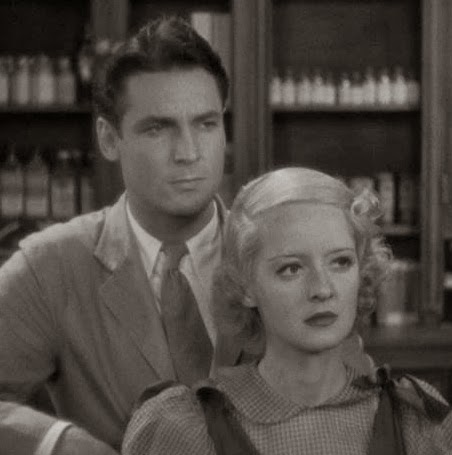
Charles Farrell and Bette Davis
THE BIG SHAKEDOWN (1934). Director: John Francis Dillon.

Jimmy Morrell (Charles Farrell) owns a neighborhood drug store and employs his sweetheart Norma (Bette Davis) behind the counter. Along comes smooth operator and racketeer Dutch Barnes (Ricardo Cortez), who discovers that Jimmy can make toothpaste just the same and just as good as the best-selling brand. Jimmy agrees to go to work making duplicate toothpaste and other stuff for Barnes, but he assumes they'll be marketed under a new brand name. Instead Barnes simply puts the bogus stuff into tubes with the label of the original brand on them and distributes them as the real thing. Jimmy is nervous about this development, but he keeps making fake toiletries and cosmetics for Barnes to distribute, until one day Barnes decides to duplicate a famous antiseptic -- only without the specific ingredient that makes it antiseptic -- and there are worse things to come. 

The Big Shakedown
has a good premise and there are some dramatic developments, but the picture doesn't present them with any flair or intensity. Farrell is fine, but while Cortez plays the very suave and polished villain with his usual aplomb, it's also a distinctly superficial portrait. This was one of the thankless roles that Bette Davis -- top-billed with Farrell although she hasn't much to do -- was handed in the early days. She looks cute and is quite adept; Glenda Farrell has a somewhat larger role as a girlfriend of Barnes' who gets into a zesty hair-pulling match with Renee Whitney as her rival Mae LaRue. Perhaps the best thing in the picture is Barnes' flamboyant death scene, even if it doesn't make too much sense. Many years later Charles Farrell was Gale Storm's father on My Little Margie; he was not related to Glenda Farrell.

Verdict: This had possibilities but it's nearly a snooze. *1/2.

LIFE BEGINS AT EIGHT-THIRTY

Ida Lupino and Monty Woolley
LIFE BEGINS AT EIGHT-THIRTY (1942). Director: Irving Pichel.

"On the stage you're still a god. Off, you're still a hairy monster." 

Kathy Thomas is a lame young lady who lives and cares for her actor father, Madden Thomas (Monty Woolley), an irascible chap who is rather too fond of his liquor. Madden figures that he's all washed up in the theater, but he's offered a job by a neighbor, composer Robert Carter (Cornel Wilde), and then has a chance to star in a new production of "King Lear." But will he muff his chances for success with his usual self-destructiveness, and will his selfless daughter wind up an unloved spinster caring for her father for the rest of his life? 

Life Begins at Eight-Thirty
doesn't dodge the tough questions about being a caregiver, especially for someone you love but find exasperating, and also ponders how much of a person's life they should give up for another's. (Of course, Madden is not exactly ready for a nursing home.) The worst dialogue is given to Wilde, who's quite stiff as Robert and offers one of the least romantic proposals ever seen on film. Lupino and Woolley are excellent, but the picture is nearly stolen by Sara Allgood, perennial supporting player, who has one of her best and longest roles as Robert's wealthy aunt, who has been carrying a torch for Madden for many years.

Verdict: Entertaining comedy-drama with equal parts cliche and insight. ***.

DIARY OF A MAD HOUSEWIFE

The not so happy couple arrive at a party
DIARY OF A MAD HOUSEWIFE (1970). Director: Frank Perry.

"Do you realize our party is only nine days away?" -- Jonathan

"Can't you do something about that godawful hair of yours?" -- ditto.

"I came here to get help with my very real and troubling problems. She has a husband, a lover, and an eight-room apartment on the park. Why does she need help?" -- woman at encounter group.

Tina Balser (Carrie Snodgress) is an unassertive Upper East Side housewife whose self-absorbed husband Jonathan (Richard Benjamin) treats her more like a child or servant than a beloved spouse. He is fixated more on social climbing than in fulfilling her needs. But Tina goes from the frying pan into the fire when she begins a supposedly for-sex-only affair with author George Prager (Frank Langella), who is condescending, epicene, and sexually ambiguous to boot. Tina's other problems include a horribly chauvinistic psychiatrist and her two little girls, one of whom, Sylvie (Lorraine Cullen), is rude and obnoxious beyond words. 

Snodgress gives an imperfect but mostly effective performance (albeit Oscar-nominated); Langella, who is quite good, seems to be channeling his inner Bette Davis at times; and Benjamin nearly walks off with the movie with his excellent, three-dimensional portrait of the not entirely unlikable Jonathan. Tina starts off as a drip but becomes more empowered as the movie progresses. As George, Langella radiates such a negative aura that it's a wonder Tina is attracted to him, but he is a famous writer and more sophisticated than her husband. Based on a novel by Sue Kaufman (with a screenplay by the director's then-wife, Eleanor Perry), Diary of a Mad Housewife is one of the few topical late sixties/early seventies films that still holds up today. It was also one of the first "modern-day" movies to present the problems of the comparatively wealthy, and there were many movies to follow about the sufferings of neglected upper east side and Hampton wives. The final scene set at an encounter group that Tina attends is hilarious. A party scene at the Balsers is also very funny. Well-directed by Perry.

Verdict: Very amusing and very entertaining. ***1/2.

Thursday, September 10, 2026

AMERICAN PSYCHO

AMERICAN PSYCHO
(2000). Director: Mary Herron.

This is a rare case of a movie being better than the book it's based upon -- in this case Bret Easton Ellis' shlocky, pseudo-literary pop novel -- although it's still no great shakes. Patrick Bateman (Christian Bale, who also plays Batman) works for an investment firm and enjoys killing people whenever he feels like it. Sometimes it's people he can't stand or who have annoyed him in some way; on other occasions he's just in the mood to off someone. Bateman feigns concern for minorities and the poor, but is actually a typical, over-bearing, insufferably smug over-privileged jerk who thinks he's better than everyone else. The social commentary is fairly thick and obvious, so the movie gets no points for that. As a thriller it is passably entertaining, with a certain degree of suspense, but Herron is hardly a Hitchcock. The movie is certainly more entertaining than the novel, possibly because it doesn't seem to take itself as seriously, among other reasons. Bale gives an excellent performance, and in general is better than the material. Reese Witherspoon plays his fiancee; Willem Dafoe is an investigator looking into the "disappearance" of one of Bateman's colleagues. The picture looks good, but whatever its merits, it's ultimately as empty and unsatisfying as its unsatisfied lead character. Chloe Sevigny scores as Bateman's likable secretary, Jean, and there are several other good performances.

Verdict: You'll probably forget it the minute it's over. **.

LOVE HAPPY

"Some men are following me:" Groucho and the Adorable One
LOVE HAPPY (1949). Director: David Miller.

The Marx Brothers get embroiled with a penniless theatrical company when the evil Madame Egelichi (Ilona Massey of Frankenstein Meets the Wolfman) learns that a stolen necklace she covets is in a can of sardines lifted by Harpo, who brings food to the actors. Groucho is a private detective who narrates the story and in one brief sequence dallies with Marilyn Monroe in a cameo that was not her first film appearance. (She had a big part in Ladies of the Chorus with Adele Jergens the previous year, for one thing.) Chico is a wannabe performer who adopts the theater company, or vice versa. 

Love Happy
is not a comedy classic like A Night at the Opera; in fact, it's not a very good movie and wastes the talents of its stars. As the femme fatale of the piece, Ilona Massey certainly has a voluptuous figure -- in one outfit her nipples look like loaded weapons -- but hasn't the face to match, giving her all the sex appeal of Margaret Hamilton. At first chubby-cheeked ingenue Vera-Ellen (Three Little Words) seems so squeaky clean she makes Doris Day look like a dominatrix, but she also has a good figure -- and is a very good dancer -- and when she plays Sadie Thompson in a production number she's not as bad as one might think. Paul Valentine makes little impression as the director/producer of the show-within-the-show. The songs by Ann Ronell are best described as forgettable, especially the lousy title tune and a truly dreadful number called "Who Stole the Jam?" which is performed by Marion Hutton (In Society), Betty's less successful sister, as Bunny. Raymond Burr plays -- and plays well-- one of Massey's thug cohorts, resulting in a bizarre moment when Harpo slaps Perry Mason in the face! There are some funny moments, especially relating to Harpo's coat from which voluminous items are pulled in one great gag, but Love Happy is mostly a sad comedown for the clowns and kind of tedious to boot. Director Miller also helmed Sudden Fear with Joan Crawford and many others.

Verdict: Not such a happy affair. **.

THE HONEYMOONERS SPECIALS

Ralph and Ed Norton do drag!
THE HONEYMOONERS SPECIALS

"Just what I always suspected! I'm calling Anita Bryant in the morning!" -- Alice's mother after seeing Ralph rubbing Ed's back. 

"The Honeymooners: Second Honeymoon" (1976). Director: Jackie Gleason.
"The Honeymooners Christmas Special" (1978). Director: Jackie Gleason.
"The Honeymooners Valentine Special" (1978). Director: Jackie Gleason. 

Jackie Gleason brought back most of the cast of the original Honeymooners  -- Jane Kean of the Color Honeymooners replaced Joyce Randolph -- for four reunion specials in the late seventies, three of which are available on DVD. In "Second Honeymoon" Ralph (Jackie Gleason) and Alice (Audrey Meadows) are going to renew their vows at the raccoon lodge when Ralph gets the mistaken impression that Alice is pregnant. In the Christmas special, Ralph gets another hare-brained idea and uses his savings, his mother-in-law's social security check, and Norton's Xmas bonus to buy hundreds of lottery tickets. 

Trixie and Ed and Ralph and Alice
In the Valentine special, the funniest of the three, Ralph is convinced that Alice is plotting to murder him due to a gigolo she's met, and he and Ed (Art Carney) dress in drag to trap this other man. Some of the routines in these are over-familiar, the apartment looks especially stark on a large stage and in color, and Ralph and Alice still don't have a phone or most modern conveniences, but the cast's timing is still impeccable and there are a lot of laughs. Eileen Heckart [The Bad Seed; Miracle in the Rain] plays Ralph's mother-in-law in the Valentine special, and while she's a fine actress, she's not really suitable for the role. Templeton Fox is a little more on the mark, but neither of them can compare to Ethel Owen, who really nailed the role in the original series in the fifties. The fourth special had Ralph putting on "A Christmas Carol" for the Raccoon lodge, but this has not yet been released on DVD. Jane Kean was in the right time and place when these reunions were announced and got the part of Trixie again, but in all fairness it should have gone to Joyce Randolph, the original Trixie, as these were "reunions."

Verdict: Everyone's a little grayer, but the magic is still there. ***.

MAN OF STEEL

Superman carries Lois Lane to safety, naturally
MAN OF STEEL (2013). Director: Zack Snyder.

Shot to Earth as an infant from dying Krypton by his father, scientist Jor-El (Russell Crowe), Kal-El (Henry Cavill) is adopted by the Kents and faces his greatest challenge before he's even begun his career as Superman proper: General Zod (Michael Shannon), an evil Krptonian despot, has escaped from the Phantom Zone and wants the codex that can make Krypton live again. Unfortunately, this will result in Earth and its inhabitants being destroyed. Superman sets out to stop him with the aid of the military, but it's an uphill battle. There's the germ of a good idea in Man of Steel, but its execution is highly disappointing. The story isn't told in a linear fashion but is interrupted with frequent annoying flashbacks, giving the whole project a disjointed continuity that pulls you out of the story instead of pulling you in. There are also some pretty stupid moments, such as when Jonathan Kent (Kevin Costner) simply allows himself to die so that Superman won't reveal himself too soon (even though Superman can move super-fast, and the awful effect Kent's death will  have on his wife)! The prologue on Krypton is overlong and relatively uninteresting, and dead Jor-El (or rather his "consciousness") seems to pop up all the time, more to make use of Crowe than for any other logical reason. The movie has a kind of Marvel X-Men flavor to it, especially in Superman's uneasy relationship with the authorities. 

Handsome Cavill strikes the right note as a Superman at the very start of his career, but the rest of the casting is problematic. A lady reporter doesn't always have to be aggressive and perky to a fault, but Amy Adams is a bit too drab as Lois Lane. Laurence Fishburne as an African-Amerrican Perry White is adequate, but he wasn't that great as a leading man, let alone a character actor. Crowe, Costner, and Diane Lane as Martha Kent are okay, but Christopher Meloni quit Law and Order: Special Victims Unit for only a small role as an Army man? You don't really see enough of Ayelet Zurer to judge her performance as the evil Krptonian Lara Lor-Van. As Zod, Shannon isn't terrible, but he's somewhat lacking in dramatic flair but for a couple of sequences (after all, this is a comic book movie, not a drama, and a little overplaying is allowable). The best thing in the movie -- and virtually the only time it really comes alive -- is when Zod and Superman take to the skies and have a lively, protracted fight to the death. Otherwise, this Man of Steel rarely flies. The original Christopher Reeve version may have had its flaws, but it was better than this. Man of Steel is about on the level of the equally disappointing Superman Returns. As I predicted Man of Steel is much less entertaining than the excellent animated feature, Superman vs. the Elite.  Cavill reprised the role of Superman in Batman vs. Superman, and played Napoleon Solo in the terrible big-screen version of The Man from U.N.C.L.E.; he was also in the crappy Immortals.

Verdict: The really great Superman movie has yet to be made. **1/2.

CONFLICT

Bogart contemplates his actions
CONFLICT (1945). Director: Curtis Bernhardt.

Richard Mason (Humphrey Bogart) has a bit of a problem. He's married to the somewhat demanding Kathryn (Rose Hobart of Mr. and Mrs. North), but hopelessly in love with her beautiful younger sister, Evelyn (Alexis Smith). What to do? What to do? The audience learns early on that Mason intends to murder his wife, but the fun is waiting to see how he does it, if he succeeds, and how and if he'll get caught. Bogart had no problem playing (somewhat sympathetic) villainous roles, as he also did in The Two Mrs. Carrolls (also with Alexis Smith), which his homely mug might have forced him to do in some alternate universe anyway. Bogart is fine, but he has formidable (in every sense of the word) competition from Sydney Greenstreet, as Dr. Hamilton, a friend of the Masons; Hobart and Smith are also good. The twists in the picture lead to a predictable but satisfying conclusion. Charles Drake plays a young professor who's in love with Evelyn, and you may not believe whom she prefers. Conflict is a smooth, well-played, and well-paced time-passer, thanks to director Bernhardt, and while not in the league of a Hitchcock classic, the picture holds the attention and has some suspense. Supposedly Jack Warner offered this script to Joan Crawford for her first Warner Brothers assignment and wanted her to play the role of Kathryn, which is really just a supporting part -- she wisely took Mildred Pierce instead. It would have been interesting to see Bogart and Crawford together, however.

Verdict: Bogie is a bad boy. **1/2.