Lively, entertaining reviews of, and essays on, old and newer films and everything relating to them, written by professional author William Schoell.
Showing posts with label crime drama. Show all posts

Thursday, April 9, 2026

THE PHENIX CITY STORY

THE PHENIX CITY STORY (1955). Director: Phil Karlson.

"Where do you want us to send the body?"

Based on a true story, this movie begins with some of the real-life participants being interviewed on camera. No actors' names are presented during the credits so it's a surprise to see such familiar figures pop up as Edward Andrews, Kathryn Grant, and, especially, Richard Kiley. The story has to do with corruption in Phenix City, Alabama, where anyone who disagrees with or tries to fight against the mob boss Tanner (an effective Andrews) winds up beaten up or murdered. Grant works for Tanner in his gambling den, and Kiley is the son of the solid citizen Al Patterson (John McIntire) who decides to run for state D.A. and take on his old friend Tanner. At the beginning of the film, interviewer/announcer Clete Roberts promises some shocking stuff, and even though the film was made 70 years ago, his promise is fulfilled, especially in a scene when a little black girl is horribly murdered. The lead performers are all quite good, and there's also excellent work from Lenka Peterson as Kiley's wife and James Edwards as Zeke, whose daughter is killed. While Phenix City is pretty unknown today, many years later Karlson directed a very popular -- and somewhat similar -- film, Walking Tall. Hard-hitting. 

Verdict: Powerful stuff. ***1/2.

Thursday, February 26, 2026

KISS TOMORROW GOODBYE

KISS TOMORROW GOODBYE
(1950). Director: Gordon Douglas.

Ralph Cotter (James Cagney) escapes from prison with the help of Holiday Carleton (Barbara Payton), the sister of another inmate, who dies during the break out. With the help of a shifty lawyer named Mandon (Luther Adler), Cotter blackmails a corrupt police inspector named Weber (Ward Bond) into using his resources into committing crimes. All goes smoothly until Cotter falls for Margaret Dobson (Helena Carter), the wealthy daughter of a powerful man ... This is a rather fascinating suspense/crime film, bolstered by excellent performances from the entire cast. Cagney is as mesmerizing as ever, and the tragic Payton, whose private life often overshadowed her acting achievements, proves that she did have genuine talent. The scene when she clings to Cagney and intones "I'm so alone, I'm so alone" is quite affecting. Helena Carter is also quite good in a less showy role. The force of the ending is a bit blunted by the production code, but this is still a very entertaining movie. Kenneth Tobey from It Came from Beneath the Sea, John Litel, and Barton MacLane are also in the cast, and William Frawley from I Love Lucy scores as a nasty if good-humored prison guard.

Verdict: Nifty crime drama with outstanding lead performance and highly creditable supporting cast. ***.

Thursday, March 14, 2024

THE LONG HAUL

Diana Dors and Victor Mature
THE LONG HAUL (1957). Director/co-screenplay: Ken Hughes. Colorized

American ex-GI Harry Miller (Victor Mature) lives in England with his wife, Connie (Gene Anderson) and little boy, Butch (Michael Wade). Desperate to find work he comes afoul of crooked trucker, Joe Easy (Patrick Allen of Night Creatures) and Easy's "easy" girlfriend, Lynn (Diana Dors), who transfers her affections to Harry after Joe is brutal with her. Naturally this doesn't sit well with either Connie or Joe. Still Joe, Harry and Lynn wind up driving a truck full of stolen furs to the river for an illicit rendezvous. They've been told they must get on the ship and sail to America with the furs to avoid prosecution, but Harry may not be able to leave his wife and child behind no matter what ...

Patrick Allen with Mature
The Long Haul
 is a very good example of British film noir with all of the usual elements. Of course these elements -- desperate man pulled into crime, a tug of war between wife and mistress, sexy femme fatale with redeemable features -- are all quite familiar to the viewer, but they are all blended together quite well and bolstered by some fine acting. In the right role, as this is, Mature can certainly deliver and his portrait of this weak, confused man is right on target. Dors proves that she isn't just big breasts and blond hair. Patrick Allen is also terrific as the slimy Joe, calculating the odds until the last. Liam Redmond and Peter Reynolds are also notable as two ill-fated gentlemen, Casey and Lynn's brother, Frank. Trevor Duncan has crafted an exciting score as well. Reynolds and Dors both appeared in Man Bait. Ken Hughes also wrote and directed Heatwave

Verdict: Absorbing, well-acted British crime thriller. ***. 

Thursday, May 11, 2023

KANSAS CITY CONFIDENTIAL

John Payne
KANSAS CITY CONFIDENTIAL (1952). Director: Phil Karlson. 

Joe Rolfe (John Payne) is trying to rebuild his life after a brief stir in prison, but he has no idea that a certain individual has gathered together three desperate criminals to help him pull off a bank job. Rolfe, who drives a flower delivery truck, becomes the patsy in this scheme and winds up being questioned by police. Then the action switches to Mexico, where Rolfe tries to infiltrate the gang, which consists of Boyd Kane (Neville Brand), Peter Harris (Jack Elam), and Tony Romano (Lee Van Cleef of The Big Combo). Rolfe romances Helen (Coleen Gray of Kiss of Death), daughter of retired cop Tom Foster (Preston Foster of I, the Jury), while trying to uncover the identity of the mysterious leader and clear his name.

Lee Van Cleef with Payne
Kansas City Confidential
 is an excellent piece of film noir, with Payne in top form, and everyone else giving top-notch performances. Lee Van Cleef certainly makes his mark in this as the sinister Tony Romano, and it's easy to see why his formidable screen presence eventually had him hitting it big overseas; this is one of his best performances in an American flick. Jack Elam is effective in a different way, less menacing and more on a perpetual verge of panicking. Coleen Gray makes a feisty and credible leading lady, and Dona Drake of Beyond the Forest saunters sexily and brazenly through her scenes as resort employee Teresa. The film is well photographed by George E. Diskant, and Paul Sawtell, never quite considered in the league of the great film composers, contributes an evocative and exciting score.

Payne with Coleen Gray
Of course Kansas City Confidential mustn't be examined too closely. The leader of the gang wears a mask to hide his identity, but when he shows up later in the movie it's hard to believe that his associates wouldn't recognize his voice and physical shape, nor that they wouldn't recognize each other. I watched this on Amazon Prime where they were offering a colorized version, but the next day when I went to finish it, the color version had disappeared and I watched the rest in black and white. Strange. Vivi Janiss, who played one of the members of the "Ladies Fang and Claw Society" on I Love Lucy, has a small role as a resort guest. John Payne was involved romantically with Coleen Gray in-between his last two marriages.

Verdict: Suspenseful, with an intriguing plot and some impressive acting. ***. 

Thursday, February 16, 2023

HELL ON FRISCO BAY

Alan Ladd
HELL ON FRISCO BAY (1955). Director: Frank Tuttle. 

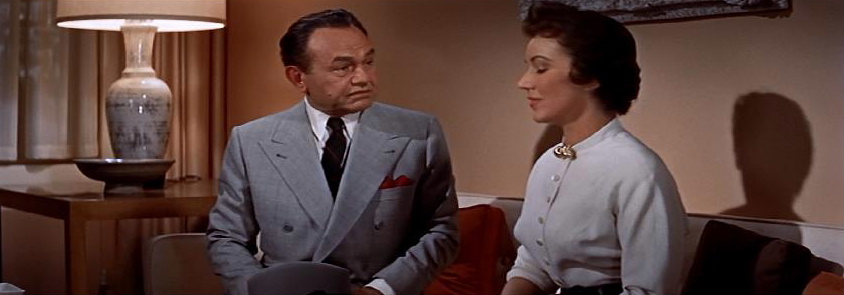
Ex-cop Steve Rollins (Alan Ladd) was framed for a murder he didn't commit and sent to prison for five years. When he gets out he is determined to find out who really murdered the victim and clear his name. He pretty much ignores his wife, Marcia (Joanne Dru), because he wants to protect her and also because she dared to dally with a gentleman out of loneliness when Steve wouldn't even let her come to see him. The San Francisco docks are controlled by a nasty man named Victor Amato (Edward G. Robinson), who has a good right hand, Joe (Paul Stewart), and a good-for-nothing nephew, Mario (Perry Lopez), who loves the ladies. Joe spends his nights with a former movie star named Kay (Fay Wray) while Victor is stuck with his pious wife, Anna (Renata Vanni), who treats Mario like a son and thinks he should be a priest. Steve talks to assorted individuals in the hopes they can give him information that might help him, but when Amato offers him a job, and Steve turns him down, he vows to make him pay -- painfully. 

Robinson and Fay Wray
Hell on Frisco Bay
 is a fast-paced and entertaining film noir thriller with many intriguing elements and a highly interesting cast. Ladd could probably play this kind of role in his sleep by now, but he manages to stay awake and acquits himself nicely. A deceptively cheery Robinson slowly unveils the layers of corruption and evil until he reveals the slimy lizard at his core, going so far as to order Joe to murder his own nephew. Stewart is excellent as the hired gun who's trying to get out from under Robinson's thumb. Fay Wray scores as Kay, and one of the best scenes is between Wray and Robinson as Amato makes a pass at her and gets angry when she turns him down, hitting her. "Get out, you filthy peasant!" she screams. Joanne Dru is acceptable as Marcia, giving solid line readings that don't always hit the emotional mark. 

William Demarest and Rod Taylor
The film is also full of flavorful performances by a wide variety of supporting players. William Demarest is a cop and friend of Steve's while Willis Bouchey is the police lieutenant who has to be convinced of Steve's innocence. Rod Taylor plays a hood who may have committed the murder Steve was sent away for with Tina Carver as his girlfriend. Peter Hansen [When Worlds Collide] is the corrupt cop, Connors, and Anthony Caruso [The Asphalt Jungle] is especially notable as a fisherman who is scared that if he talks to Steve his young son, George (Peter J. Votrian, who is also good) may come to harm. Renata Vanni probably made a career out of playing long-suffering wives or mothers. Nestor Paiva plays another dock worker who tries to work things out with Amato and only winds up dead. Perry Lopez [The Steel Jungle] plays the sexy but weak nephew to perfection. Jayne Mansfield plays his date.

Paul Stewart with Robinson
Ladd is manhandled by the chubby gunsel Hammy (Stanley Adams) in one scene and turns the tables on him, beating him up and telling Joe to "get your pig outa here!" The film has a boat chase at the end that is exciting although not quite on the level of similar scenes in those old cliffhangers. Although this might not be listed among Max Steiner's greatest scores, it is effective and thrilling when it needs to be. The screenplay is good, but one wishes the picture crackled with tension -- although it comes close at times -- but director Frank Tuttle doesn't make the film quite as explosive as it could have been. Still, it's quite well-played and snappy.

Verdict: Memorable crime drama with some outstanding performances. ***. 

Thursday, February 2, 2023

THE GLASS KEY

Alan Ladd
THE GLASS KEY (1942). Director: Stuart Heisler. 

Politician Paul Madvig (Brian Donlevy), essentially a crook, is trying to clean up his reputation for re-election by going after hood Nick Varna (Joseph Calleia). Paul has formed an alliance with wealthy Ralph Henry (Moroni Olsen), and also fallen in love with Henry's daughter, Janet (Veronica Lake). Meanwhile Paul's sister, Opal (Bonita Granville), is head over heels for Janet's brother, Taylor (Richard Denning), a gambling addict with serious debts. Paul's associate and best friend, Ed Beaumont (Alan Ladd), stumbles across Taylor's dead body, and wonders if Paul, who hated Taylor and his influence over his sister, could possibly be responsible. Apparently both Opal and Janet think that he is. The truth may be a little more complicated.

Ladd and Lake
Based on the novel by Dashiell Hammett, The Glass Key is a reasonably absorbing but rather unpleasant bit of film noir. For one thing, there isn't a single really likable major character; even the hero played by Ladd is a creep. Ladd is as swell at the hardboiled routine as anyone, but he never quite comes off as a real person. He's handsome, but almost as bland and artificial as a Ken doll. Brian Donlevy is as good and forceful as ever, but it's a typically brusque and bristling Donlevy performance like he gives in virtually every movie, including The Creeping Unknown. Similarly Joseph Calleia is excellent in his very familiar gangster role. Veronica Lake has been seen to better advantage in other movies (such as I Married a Witch). 

"Let's have a drink." William Bendix with Ladd
Part of the problem is that the characters in this are mostly one-dimensional and the actors can't do enough to flesh them out. One exception is William Bendix, who honestly steals the movie as the sadistic gunsel who nearly beats Ed to death. Bendix also has a splendid scene, again with Ladd, when they sort of share a drink together as a semi-drunken Bendix tells Ladd what horrible things he's going to do to him. It's not in the script, but Bendix makes this miserable character come alive and almost makes your flesh crawl. (Why Ed would want to be anywhere near the psychopath who put him in the hospital is another question.) Before he became the lovable hero of TV's Life of Riley, Bendix frequently played distinctly malevolent characters and played them superbly.

Tramp and Dickhead: Margaret Hayes and Ladd
A tip of the hat also must go to Margaret Hayes, who briefly plays Eloise Matthews, the trampy wife of a newspaper publisher who makes a play for Ladd right in front of the man after she learns her hubby is flat broke. A true gentleman -- not -- Ladd fervently responds to her sexual entreaties. Again, even with this character being played by the pleasant and inoffensive- looking Ladd it can't disguise what an utter dickhead Ed is! Others in the cast include Frances Gifford as a friendly nurse; Donald MacBride as the easily-influenced district attorney; and Billy Benedict as an office boy. Bonita Granville does a nice job as the grieving girlfriend of the dead Denning.

Verdict: If ever a "hero" didn't deserve a happy ending! **1/4. 

Thursday, November 10, 2022

GOOD NEW MOVIE: THE BATMAN (2022)

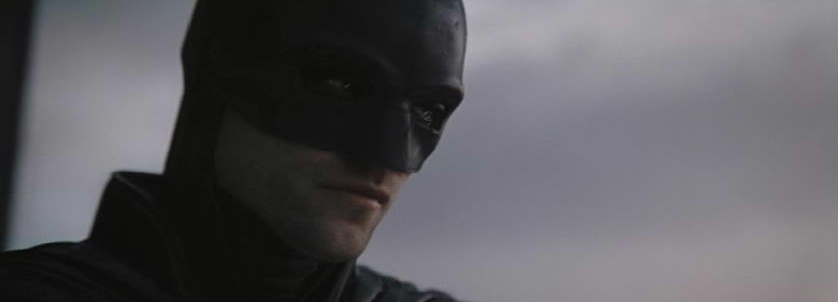
The Batman in a contemplative mood
THE BATMAN (2022). Director: Matt Reeves. 

In a Gotham City wracked by corruption and vice, the determined Batman tracks down a serial killer whose victims include the mayor. That's the essentials of the plot of this movie, which turns out to be far better and more entertaining than I would have imagined. Effectively directed by Matt Reeves, The Batman boasts a terrific look -- thanks to cinematographer Greig Fraser and some excellent art direction -- and despite a few variations manages to get into the spirt of the comic books. Michael Giacchino has also contributed a creepy score that adds immeasurably to the picture.

Pattinson as Bruce Wayne
And then there's Robert Pattinson, who plays the Batman and Bruce Wayne and is incredibly intense in the part. One could argue that Pattinson makes absolutely no distinction between Bats and Bruce -- in the comics Wayne did his best to act like a frivolous playboy to keep people from suspecting the truth -- but The Batman makes it clear that Batman is the real person and Bruce is the phony identity. In any case, Pattinson's performance works beautifully. In this movie Batman is so grim that he often scares the very people that he's just saved (as often happened in the comics). 

Pattinson with Zoe Kravitz
There are other good performances as well. Zoe Kravitz as Selina Kyle (Catwoman); Andy Serkis as Alfred the butler; Paul Dano (of Prisoners) as the Riddler; Jeffrey Wright (of Casino Royale) as Lt. James Gordon; and John Turturro as Carmine Falcone. Colin Farrell makes a weird, unrecognizable Penguin. The film has a deliberate pace -- and one too many anti-climaxes -- but it held my attention, and I have to say I was delighted to see not a trace of camp. Matt Reeves also directed Cloverfield

Verdict: The Dark Knight done right. *** 1/4. 

Thursday, October 13, 2022

THE MONEY TRAP

Rita Hayworth and Glenn Ford
THE MONEY TRAP
(1965). Director: Burt Kennedy. 

Cop Joe Baron (Glenn Ford) is married to Lisa (Elke Sommer), and they have serious money troubles. When Dr. Horace Van Tilden (Joseph Cotten) shoots a burglar in his house, it turns out that the burglar's wife is Baron's old girlfriend, Rosalie (Rita Hayworth). Then there's Baron's partner, Pete (Ricardo Montalban), who would also like to get his hands on some green. I won't give away any of the twists or plot developments because that's about all this picture has going for it. Despite the gun play, love scenes, and so on, this is remarkably dull. Elke Sommer is as inadequate as ever, but the rest of the cast, especially Hayworth, is fine. This just never really comes to life. 

Verdict: A waste of money. *1/2.

Thursday, August 4, 2022

THE MAN WITH TWO FACES

Edward G. Robinson and Mary Astor
THE MAN WITH TWO FACES
(1934), Director: Archie Mayo. 

"The second act is still a fine piece of Limburger." 

Actor Damon Welles (Edward G. Robinson)is appalled to learn that his brother-in-law Stanley Vance (Louis Calhern), isn't dead after all, but has come back into his sister Jessica's (Mary Astor) life and is exerting a seriously unhealthy influence over her. So he cooks up a scheme to disguise himself and ... This dull and predictable movie, based on a minor stage play, wastes the talents of its excellent cast, who give it more than it deserves. Ricardo Cortez plays a theatrical producer and John Eldredge is a playwright. Robinson has such a distinctive face, figure and aura that, fine actor that he is, it's difficult for him to successfully disguise himself. Crisp, well-composed photography is another bonus but nothing can overcome that creaky plot. 

Verdict: Robinson is always worth watching. **.

Thursday, July 21, 2022

THE SCARFACE MOB

Eliot Ness and his Untouchables
THE SCARFACE MOB (1959). Director: Phil Karlson. 

With bootlegging gangsters like Al Capone (Neville Brand of Eaten Alive) -- nicknamed Scarface -- taking over Chicago, it is decided that Federal agent Eliot Ness (Robert Stack) will put together a special squad of incorruptible operatives soon to be known as the "Untouchables" because they cannot be bribed. One of the squad members is Joe Fuselli (Kennan Wynn of The Fuzzy Pink Nightgown), who served time for armed robbery but is anxious to make amends. Frank Nitti (Bruce Gordon) runs operations while Capote is temporarily in jail. George Ritchie (Joe Mantell), wants to impress his flirtatious wife, stripper Brandy (Barbara Nichols) -- whose uncle is a bookkeeper for Capone -- by volunteering to get info for Ness. Meanwhile the Feds set out smashing breweries, and more than one "untouchable" may come to a bad end. Ness also finds that his fiancee, Betty (Pat Crowley of There's Always Tomorrow), is in danger from the mob. 

Ness vs. Nitti: Stack with Bruce Gordon
Released in theaters, The Scarface Mob was actually the pilot for the TV show The Untouchables, originally shown in two parts on Westinghouse Desilu Playhouse and introduced by both Desi Arnaz and Walter Winchell, who provided snappy narration for the series. As a stand-alone movie, The Scarface Mob is a good if minor crime drama. Stack makes the perfect Ness, and the normally stoic actor even sheds tears when one of his operatives is killed. Pat Crowley is excellent as his fiancee turned wife, who marries Ness as much for protection as out of love (I don't believe Ness' wife was ever seen again on the TV series, although he called her on the phone frequently.) Brand, Gordon, Mantell, Wynn, and Nichols are all on target as well. Bill Williams also plays one of the Untouchables and is fine. 

Prohibition was undoubtedly one of the worst ideas in American politics. It only led to gangsters taking over the now-illegal alcohol industry and badly increased all manner of crime in Chicago and elsewhere. It was finally repealed due to public demand. 

Verdict: Credible and entertaining mob movie with very good performances. ***. 

Thursday, April 28, 2022

BONNIE AND CLYDE

Warren Beatty and Faye Dunaway
BONNIE AND CLYDE (1967). Director: Arthur Penn. 

Bonnie and Clyde go on a crime spree robbing banks in the 1930's and become folk heroes to part of the population, but their days are numbered. This film was quite polarizing when it first came out, with some finding it slick and cinematic; others repellent and empty -- both viewpoints have validity. Warren Beatty [Splendor in the Grass] isn't bad as Clyde Barrow, the leader of a group of depression-era bank robbers, but he's never quite believable, either. The same could be said of Faye Dunaway [Mommie Dearest]  as Bonnie Parker, although she certainly demonstrates star-making vitality. The trouble with both of the leads is that they never seem quite as stupid as the people they're playing. Gene Hackman, Estelle Parsons and Michael J. Pollard as relatives and fellow gang members are perhaps more on the mark. 

Estelle Parsons and Gene Hackman
Today Bonnie and Clyde seems almost benign next to Goodfellas and similar movies. The picture doesn't really glorify these murdering robbers so much as it shows how pathetic and desperate they and their self-absorbed lives really are. But the movie can't really be considered a serious examination of these people because the characters lack dimension and the film can't seem to make up its mind whether or not to take them -- or itself, in fact -- seriously. In any case, the picture is generally entertaining and well-done, but it goes on about half an hour too long and is very Hollywood-ized to say the least. One could make a strong case that William Witney's The Bonnie Parker Story, made ten years earlier, is the better picture. 

Verdict: Okay, but maybe watch Little Caesar instead. **1/2.

Thursday, February 17, 2022

THE WITNESS CHAIR

Walter Abel and Ann Harding
THE    WITNESS CHAIR     (1936). Director: George Nichols Jr. 

Stanley Whit-taker (Dou-glass Dumbrille) is found dead of a gunshot in his office. Although he left a suicide note admitting to embezzlement, the police determine that his death was really a homicide. Whittaker's associate, Jim Trent (Walter Abel of Fired Wife) is put on trial for the murder, but other suspects and interested parties include secretary Paula Young (Ann Harding of When Ladies Meet), bookkeeper Grace Franklin (Margaret Hamilton), office boy Benny Ryan (Billy Benedict), and even Trent's daughter, Constance (Frances Sage), who inexplicably wanted to run off with the much older and not especially attractive Whittaker. During the trial, the truth behind the murder eventually comes out. 

William "Billy" Benedict
The Witness Chair is an entertaining if very minor crime/court-room drama with generally good performances and a tidy if unspectacular screenplay. Ann Harding is as efficient as ever, even if her performance is of the long-suffering, hand-wringing variety. Back in the day, Harding was a major star -- this is a lesser vehicle for her -- but today she is known only to film buffs. Like Kay Francis and others, her films didn't show up on the late show until the days of TCM. Walter Able, a fine actor, was a leading man who later became a supporting player. The prolific Billy Benedict almost steals the film with his comic turn as the office boy, who hopes for a singing career and is annoyed that he gets such a short time in the witness chair. Margaret Hamilton is snappy as the outraged bookkeeper who insists that her boss, Whittaker, was innocent of theft. 

Verdict: Smooth easy watching if nothing to get excited about. **1/2. 

Thursday, November 11, 2021

CRACK-UP

Herbert Marshall, Pat O'Brian and Claire Trevor
CRACK-UP (1946). Director: Irving Reis. 

Art lecturer George Steele (Pat O'Brian) breaks into a museum, acting all crazy, and insists that he was just in a tremendous train wreck and barely survived. Cops, museum staff, and sort-of girlfriend Terry (Claire Trevor) are worried by his behavior, even more so when they learn that there has been no news of any train wreck. George tries to retrace his steps, and even takes a train from Grand Central, the same train he thinks he took earlier, to try and figure out what happened to him. There is talk of a missing or forged art masterpiece. When his friend and colleague Stevenson (Damian O'Flynn) is found murdered, George goes on the run. 

Ray Collins ministers to O'Brian
Based on a short story by Fredric Brown, Crack-Up is a fair suspense story that in the long run doesn't really deliver. This is too bad, because the picture begins very well, is well-acted, and has a couple of terrific scenes, especially a creepy one when George goes back on the train, sees another train slowly approaching from the other direction, and is terrified -- as is the audience --  that there is going to be a crash. But the rest is just a ho hum mish mosh that just doesn't distinguish itself from the competition, despite good photography by Robert De Grasse and a score by Leigh Harline that adds heft to certain sequences. The climax is criminally flat as well. 

O'Brian and Trevor
In addition to the actors already named, we've got Herbert Marshall wasted as an alleged romantic rival for Terry's affections, Ray Collins as a concerned colleague, Wallace Ford as a not-so-concerned police officer, Dean Harens as a handsome art aficionado, Mary Ware as the timid secretary, Mary, and Robert Bray as a silent and sinister figure on the train and elsewhere. While there are good performances and sequences in the movie, one can also understand why this is one bit of film noir that is almost completely forgotten. 

Verdict: Initially intriguing but ultimately minor crime drama. **1/4. 

Thursday, May 27, 2021

THE HOODLUM

Brothers on and off screen: Lawrence and Edward Tierney
THE HOODLUM (1951). Director: Max Nosseck.

Vincent Lubeck (Lawrence Tierney), an inmate that the warden believes is irredeemable, is up for parole. His mother (Lisa Golm) gives an impassioned defense to the parole board and her son is released. Unfortunately Mrs. Lubeck's faith in her son is completely misplaced, and before long Vincent, who works for his brother, Johnny (Tierney's real-life brother, Edward) at the latter's gas station, is not only planning a robbery of the bank next door but moving in on his brother's hapless fiancee, Rose (Allene Roberts). This will lead to more than one tragedy. 

Lisa Golm and Lawrence Tierney
The Hoodlum isn't well known today, but it deserves to be. Snappy, fast-paced and well-acted, it boasts a fine score by Darrell Calker in addition to those excellent performances by the entire cast. Lawrence Tierney, following up his equally sociopathic role in Born to Kill, gives another dynamic turn as the villain of the piece, and he gets solid support from his brother, Allene Roberts as the tragic Rose, and especially Lisa Golm as the mother. She is given an outstanding speech late in the picture, brilliantly delivered, in which she -- heartbroken as well as furious -- finally and absolutely realizes Victor's true nature -- it is raw and powerful. (NOTE: Lawrence and Edward Tierney's real-life brother is Scott Brady.) 

Verdict: Terrific crime drama. ***1/4.  

Thursday, March 18, 2021

LITTLE CAESAR

Edward G. Robinson
LITTLE CAESAR
(1931). Director: Mervyn Leroy. 

 "Mother of mercy -- is this the end of Rico?" 

 The great Edward G. Robinson became a star with this exciting and entertaining gangster flick. Rico (Robinson) wants to be somebody and have everything while his buddy Joey (Douglas Fairbanks, Jr., who comes off convincingly lower-class) just wants to be a dancer. The two should have just gone their separate ways, but Rico seems obsessed with his pal (any homoerotic aspects of this go unexplored). Rico rises in the rackets until he takes over an important gang, and forces his old pal Joey to help him rip off the establishment where he entertains with his girlfriend, Olga (Glenda Farrell). Rico gets bigger and bigger but there are forces conspiring against him ... Robinson is just terrific, and he has a solid supporting cast, including the aforementioned performers as well as Thomas Jackson as Sgt. Flaherty; William Collier Jr. as Tony; and Sidney Blackmer (who had an important role many years later in Rosemary's Baby) as "Big Boy." 

Verdict: Fun to watch Robinson rise and fall. ***1/2.

Thursday, September 17, 2020

EDGE OF DOOM

Farley Granger and Dana Andrews
EDGE OF DOOM (1950). Director: Mark Robson.

Father Thomas (Dana Andrews) tells a colleague (Robert Karnes)  -- who wants to leave this impoverished parish and go elsewhere -- the story of young Martin Lynn (Farley Granger), and how meeting him helped renew his faith. Martin's father was a criminal who committed suicide, and he hates the church because he was denied a Christian burial. Now Martin needs a raise to send his ill mother out of town, but his boss can't afford it. When the mother dies, Martin insists that old Father Kirkman (Harold Vermilyea of Manhandled) -- the one who denied the burial -- make up for all the money his mother gave to the church by paying for an elaborate funeral. Kirkman objects and things go downhill from there.

Granger with Mala Powers
Edge of Doom doesn't exactly take an intellectual approach to the material -- few "religious" movies ever do -- but it is nevertheless an interesting picture, and not as simple-minded as it might at first sound. An interesting aspect is the depiction of Father Kirkman. While he is not quite an ogre, he is also not the beneficent Bing Crosby-type of priest, being generally grumpy (and not in a cute way) and unpleasant, out of touch with his parishioners -- I wonder what the Catholic church thought of how he was portrayed. It would also be all too easy to dismiss Father Thomas as a bleeding heart who confuses reasons (for a person's behavior) with excuses, but it is easy to see why he has sympathy for Martin despite the young man's actions. Oddly, virtually no sympathy is expressed for the victim, despite his being an elderly priest! But this is typical of movies that focus more on troubled-young-men who become killers than they do on the ones they kill (especially if the killers are handsome).

In deep trouble: Farley Granger
The performances in the film are generally good. Granger at 25 may be a little old for the part but he certainly has affecting moments. Andrews is solid and convincing in an unusual role for him. Mala Powers is sensitive and effective as Martin's girlfriend. There is also good work from Paul Stewart as a neighbor, Robert Keith as a detective, Vermilyea as the older priest, Houseley Stevenson [Dark Passage] as Martin's boss at the flower shop, and Mabel Paige as an old woman who sees the priest killer outside the rectory and becomes a witness. Adele Jergens is a bit unsatisfactory as Stewart's girlfriend, however, especially in a scene she has with Andrews and Granger at the rectory. Douglas Fowley and Ellen Corby have smaller roles. Oddly Joan Evans, who was with Granger in Roseanna McCoy the previous year, receives top billing with him and Andrews but only has a small and relatively unimportant role as Father Kirkman's niece; she has one tiny scene with Granger. NOTE: Apparently the scenes with Andrews telling Martin's story were added after the film's initial release, as some feel the whole point of the movie and the novel it is based on is that the Church really can't do much to solve the problems of its parishioners.

Verdict: Imperfect but interesting crime drama. ***.

Thursday, June 25, 2020

FOUR BOYS AND A GUN

Hinnant, Franciscus, Sutton, and Green -- with the gun
FOUR BOYS AND A GUN (1957). Director: William Berke.

Four young neighborhood buddies have their problems. Eddie (Tarry Green) learns that his girlfriend, Marie (Diana Herbert), is dating their boss, who fires him. Ollie (Frank Sutton) has gambling debts that could get his legs broken. Johnny (James Franciscus of I Passed for White), who has a wife and baby on the way and has high hopes for a boxing career, is told he's strictly an amateur with no future. Stanley (William Hinnant) is a little nerd who can't get a girlfriend. To make matters worse, the proceeds for a dance they put together, hundreds of dollars, are stolen by some hoods.

James Franciscus
The "boys" -- with the exception of Johnny -- go on a nasty spree where they mug a cab driver and walk out of an expensive restaurant without paying. They then importune Johnny in joining them in a robbery of the arena where he had his last fight. Unfortunately, during the botched robbery, a police officer with a family is shot and killed. Although technically all four of the participants are guilty of murder, the DA wants to know specifically which one fired the gun. Amidst flashbacks showing events leading up to the robbery, the boys contemplate their future and try to blame each other for what happened.

Frank Sutton and Tarry Green
Four Boys and a Gun is an unusual feature with an intriguing storyline. None of the characters are especially likable, however, even the more sympathetic Stanley and the more mature Johnny. In fact, most of them come off like total creeps. The boys develop some very unlikely nobility at the end, which is otherwise uncompromising. The dialogue as they analyze each other's shortcomings in crude fashion rings true, although the legal aspects are suspect. The performances are too stagy at times, with Sutton making the best impression. Of the four actors, Franciscus had the biggest career, although Sutton eventually played the nasty marine on Gomer Pyle. This was the only film Tarry Green appeared in, although he did have a couple of TV credits. William Hinnant had a few more credits and also did a lot of stage work. He died at 42 in a drowning accident. Smaller roles are played by Frank Campanella as a cop, Nancy Devlin as Eddie's sister, who likes Ollie, and Patricia Bosworth as Johnny's pregnant wife.

Verdict: Something different. **3/4. 

Thursday, June 11, 2020

ODDS AGAINST TOMORROW

Harry Belafonte and Ed Begley
ODDS AGAINST TOMORROW (1959). Director: Robert Wise.

With some difficulty ex-cop Dave Burke (Ed Begley of Sweet Bird of Youth) puts together a small team to pull a bank job in the town of Melton. There is initial resistance from musician Johnny Ingram (Harry Belafonte), and especially Earle Slater (Robert Ryan), a racist who at first refuses to work with a black man. But Ingram's family has been threatened by Bacco (Will Kuluva of To Trap a Spy), to whom he owes money, and Slater is tired of his wife, Lorry (Shelley Winters) paying all the bills, so they ultimately decide to go along with the plan. Everything seems to go like clockwork, until the actual robbery.

Robert Ryan and Shelley Winters
Odds Against Tomorrow, like all good caper films, spends a lot of time concentrating on its characters, so their fates have a little more meaning. There are still things we don't learn about these three men, however. The performances help make them three-dimensional: Begley is superb; Ryan again proves what an excellent and under-rated actor he was; and Belafonte also proves that there's more to him than just good looks and musical ability. Shelley Winters, in the early phases of her slovenly phase, is also excellent, and there is a very, very well-played scene between Ryan and Gloria Grahame [Blood and Lace], playing a lusty neighbor, in the former's apartment. Will Kuluva scores big in a fine turn as the menacing Bacco.  Richard Bright is cast as Coco, an associate of Bacco's who is clearly meant to be an old-fashioned pre-Stonewall "faggot" -- nasty and queeny -- not the only element that at times makes Odds seem a bit dated. Coco makes flirtatious comments to Johnny, who only looks upon him with homophobic disdain. (Not the first or last time a movie looks at one minority group with sympathy while being unsympathetic towards another.)

Robert Ryan
Kim Hamilton, a lovely actress, makes an impression as Ingram's ex-wife, who couldn't put up with his gambling and the type of people it put him into conflict with. There are also smaller roles played by people who would go on to bigger parts: Wayne Rogers as a tippling soldier, and Zohra Lampert as a young lady he's trying to impress in a bar. Hefty black songstress Mae Barnes also has a good scene when Belafonte cuts into her act. I also spotted Cicely Tyson as a bartender. Joseph C. Brun's cinematography of New York City and environs, including the Hudson river and Melton, is of a high order, and there is an interesting and quirky score by John Lewis, full of dissonance, which occasionally veers into uncomfortable shrillness. Odds is fast-paced but conversely takes its time telling its story. It has a literally explosive finish, although at the end some viewers, along with the characters, might think it was all a little pointless. A slightly jarring note is the too comic delivery of an actor who plays a man whose car is somewhat demolished during a gun battle. Watching the scenes in "Melton," I was pretty sure they were filmed in Hudson, NY, and it turns out I was right.

Verdict: Highly interesting, absorbing and extremely well-acted caper film with a difference. ***. 

BORN TO KILL

Lawrence Tierney and Claire Trevor
BORN TO KILL (1947). Director: Robert Wise.

In Reno for a divorce, Helen Brent (Claire Trevor) encounters Sam Wilde (Lawrence Tierney), an aptly-named sociopath who murders a rival for his girlfriend, Laurie's (Isabel Jewell), affections, and then kills her, too. Helen discovers the bodies but keeps mum about it so as not to upset high-toned fiance Fred Grover (Phillip Terry). Helen's foster sister Georgia (Audrey Long) is rolling in dough but Helen, the poor relation, sees Fred as her ticket into prosperity. But the animal magnetism of Mr. Wilde -- "most men are turnips, but you're not a turnip," she tells him -- upsets her equilibrium to such an extent that she covers for him no matter how disturbed she becomes over what she finds out about his true nature.

Esther Howard and Walter Slezak
Born to Kill is what might be called ferocious film noir. Once it starts it never lets up under Robert Wise's adroit and classy direction. Lawrence Tierney probably delivers the best performance of his career, and Claire Trevor nearly walks off with the movie with her sterling portrait of the psychologically damaged Helen Brent, who is terribly afraid that her association with Wilde will allow her to give full vent to her very worst instincts. Walter Slezak [Lifeboat] scores as the casually amoral private detective hired by landlady Mrs. Kraft (Esther Howard), a friend of the late Laurie, to find her killer, while Howard herself offers a fascinating portrayal of the beer-tippling, likable, but rather off-putting old woman. Phillip Terry [The Lost Weekend] again proves that he was more than just one of Joan Crawford's exes, and Isabel Jewell and Tony Barrett (as her ill-fated date, Danny) are also notable. Although he seems artificial at first Elisha Cook Jr. makes a decidedly positive impression as Wilde's best friend, although a lot about him remains unexplored. Audrey Long is fine as the fairly superficial heiress who comes to marry Wilde.

Claire Trevor and Phillip Terry
The film is full of memorable sequences, such as the chilling and well-handled double murder of Laurie and Danny, and especially a great sequence when the feisty and tenacious Mrs. Kraft nearly meets her maker in an isolated sand dune. In general the film is taut and fast-paced and holds the attention throughout. I do have a couple of quibbles, however. The police do not make their presence known until the closing moments of the film, but surely there would have been an investigation into the aforementioned double murder, and surely Mr. Wilde would have been the chief suspect. The private eye is clued in to this but not the police? Another problem is that the ending to the film seems rushed and overly melodramatic. It also should be noted that Sam Wilde is also one of your dumber sociopaths; just the fact that he's so unconcerned over his actions and their repercussions makes this abundantly clear. Still, Born to Kill is an exciting and suspenseful picture with some unpredictable moments. The contributions of composer Paul Sawtell and cinematographer Robert de Grasse should also be noted. Both gentlemen also worked on Bodyguard, which also starred Lawrence Tierney.

Verdict: Memorable crime drama with some sensational performances. ***1/2. 

Thursday, April 30, 2020

SLIGHTLY SCARLET

Rhonda Fleming and John Payne
SLIGHTLY SCARLET (1956). Director: Allan Dawn.

June Lyons (Rhonda Fleeming), who is secretary and more to mayoral candidate Frank Jansen (Kent Taylor), brings her sister, Dorothy (Arlene Dahl) home after the latter gets out of prison. Both women get involved with Ben Grace (John Payne), who is the brains behind a criminal outfit run by Solly Caspar (Ted de Corsia), who has had to take it on the lam. Now Ben tries to take over and get all his ducks in a row, including Jansen, the police chief, and the two attractive ladies -- although things get a bit dicey when Solly suddenly returns from Mexico ...

Such devoted sisters? Dahl and Fleming
Slightly Scarlet is entertaining enough but it has a script that goes all over the place, and Allan Dwan's direction is not strong enough to make up for it. What we're left with is some vivid emoting from Payne, going through his bad guy (but not that bad) film noir phase, a solid Fleming, a vivacious and sluttish Dahl making the most of her scenes, and de Corsia also making an impression as the decidedly nasty and nearly psychopathic Solly. Although Payne does a good job in playing Ben, the screenplay never seems to get a true handle on the guy, so there doesn't really seem to be anyone to root for in this mess. Kent Taylor has a few scenes as the man who becomes mayor but he isn't developed enough to be much of a factor. June seems overly devoted to her sister, a trampy shoplifter and worse who doesn't even seem to care when Solly makes it clear that he's going to murder June.

Payne and Dahl at that beach house
Other players include Ellen Corby as June's very pleasant housekeeper, Roy Gordon [War of the Colossal Beast] as a crusader against Solly who meets a horrible fate, George Wallace [Radar Men from the Moon] as a sullen member of Solly's gang, and Myron Healey [Hot Rod] as another colleague who tries to ventilate Ben to his regret. Solly owns a beach house that can best be described as "fabulous." This is based on as novel by James M. Cain. An RKO-Radio production, it was filmed in "Superscope."

Verdict: Not as much fun as the plot might suggest, but fun enough if you're in an undemanding mood. **1/2.