Lively, entertaining reviews of, and essays on, old and newer films and everything relating to them, written by professional author William Schoell.
Showing posts with label Claire Trevor. Show all posts

Thursday, January 16, 2025

THE HIGH AND THE MIGHTY

THE HIGH AND THE MIGHTY (1954). Director: William A. Wellman.

"The youth of man will never die unless he murders it."

NOTE: Some plot details are revealed in this review.This was a [near] disaster film made before the era of disaster films, based on a novel by the once-popular Ernest K. Gann. On a flight from Honolulu to San Francisco, various passengers share their stories, as some unspecified troubles begin, culminating in the loss of an engine and the possibility that they might not have enough fuel to make it to land --  which means they might wind up in the drink. No one can say with any certainty if the plane will float until help arrives, or break up and sink. On board we have a honeymoon couple, middle-aged couples, a woman who's in love with her boss, an aging gal, Sally (Jan Sterling), meeting her future, younger husband for the first time, and so on. One thing the plane doesn't have is any chivalrous men. When Sally explains how nervous she is about meeting her guy considering she's a bit older than the only picture he has of her, neither the pilot Sullivan (Robert Stack) or another male passenger ever tell her that she's still considerably attractive -- gee, what nice guys! When another woman, May (Claire Trevor), betrays her terror of aging -- "no one's whistled at me in years" -- her male companion offers no compliments, either, despite her own good looks. The younger women, including the pretty and efficient stewardess (Julie Bishop) and the darling Miss Chen (Joy Kim) fare a bit better. 

Sidney Blackmer of Rosemary's Baby is aboard for a little melodrama involving his wife and her alleged lover, David Brian, and there's also Paul Kelly as a disaffected scientist. Loraine Day is a wealthy woman disgusted with her husband's financial decisions, Phil Harris and Ann Doran are disappointed middle-aged tourists; all are fine. William Campbell [Dementia 13] has one of his best roles as an obnoxious younger pilot. The performances and the characterizations are actually pretty good, but The High and the Mighty is only sporadically entertaining and suspenseful, and at nearly two and half hours in length is much too long and in fact fairly tedious for long stretches. But the main problem is that the movie has no pay-off and no real climax. John Wayne -- did I forget to mention him? -- saves the day and that's that. You're happy for the characters but disappointed that there's so little life or death action. Wayne plays an older pilot who is haunted by the death of his wife and boy in a crash that he survived. When he thinks back on this event in a flashback, he furrows his brow to show that he's allegedly "haunted." He's better in scenes when he has to firmly and kindly reassure the passengers; in fact, for the most part he's not bad at all. Dimitri Tiomkin's Oscar-winning music score does most of the work in this movie, however.

Verdict: This is by no means a classic. **1/2.

Thursday, November 11, 2021

CRACK-UP

Herbert Marshall, Pat O'Brian and Claire Trevor
CRACK-UP (1946). Director: Irving Reis. 

Art lecturer George Steele (Pat O'Brian) breaks into a museum, acting all crazy, and insists that he was just in a tremendous train wreck and barely survived. Cops, museum staff, and sort-of girlfriend Terry (Claire Trevor) are worried by his behavior, even more so when they learn that there has been no news of any train wreck. George tries to retrace his steps, and even takes a train from Grand Central, the same train he thinks he took earlier, to try and figure out what happened to him. There is talk of a missing or forged art masterpiece. When his friend and colleague Stevenson (Damian O'Flynn) is found murdered, George goes on the run. 

Ray Collins ministers to O'Brian
Based on a short story by Fredric Brown, Crack-Up is a fair suspense story that in the long run doesn't really deliver. This is too bad, because the picture begins very well, is well-acted, and has a couple of terrific scenes, especially a creepy one when George goes back on the train, sees another train slowly approaching from the other direction, and is terrified -- as is the audience --  that there is going to be a crash. But the rest is just a ho hum mish mosh that just doesn't distinguish itself from the competition, despite good photography by Robert De Grasse and a score by Leigh Harline that adds heft to certain sequences. The climax is criminally flat as well. 

O'Brian and Trevor
In addition to the actors already named, we've got Herbert Marshall wasted as an alleged romantic rival for Terry's affections, Ray Collins as a concerned colleague, Wallace Ford as a not-so-concerned police officer, Dean Harens as a handsome art aficionado, Mary Ware as the timid secretary, Mary, and Robert Bray as a silent and sinister figure on the train and elsewhere. While there are good performances and sequences in the movie, one can also understand why this is one bit of film noir that is almost completely forgotten. 

Verdict: Initially intriguing but ultimately minor crime drama. **1/4. 

Thursday, June 11, 2020

BORN TO KILL

Lawrence Tierney and Claire Trevor
BORN TO KILL (1947). Director: Robert Wise.

In Reno for a divorce, Helen Brent (Claire Trevor) encounters Sam Wilde (Lawrence Tierney), an aptly-named sociopath who murders a rival for his girlfriend, Laurie's (Isabel Jewell), affections, and then kills her, too. Helen discovers the bodies but keeps mum about it so as not to upset high-toned fiance Fred Grover (Phillip Terry). Helen's foster sister Georgia (Audrey Long) is rolling in dough but Helen, the poor relation, sees Fred as her ticket into prosperity. But the animal magnetism of Mr. Wilde -- "most men are turnips, but you're not a turnip," she tells him -- upsets her equilibrium to such an extent that she covers for him no matter how disturbed she becomes over what she finds out about his true nature.

Esther Howard and Walter Slezak
Born to Kill is what might be called ferocious film noir. Once it starts it never lets up under Robert Wise's adroit and classy direction. Lawrence Tierney probably delivers the best performance of his career, and Claire Trevor nearly walks off with the movie with her sterling portrait of the psychologically damaged Helen Brent, who is terribly afraid that her association with Wilde will allow her to give full vent to her very worst instincts. Walter Slezak [Lifeboat] scores as the casually amoral private detective hired by landlady Mrs. Kraft (Esther Howard), a friend of the late Laurie, to find her killer, while Howard herself offers a fascinating portrayal of the beer-tippling, likable, but rather off-putting old woman. Phillip Terry [The Lost Weekend] again proves that he was more than just one of Joan Crawford's exes, and Isabel Jewell and Tony Barrett (as her ill-fated date, Danny) are also notable. Although he seems artificial at first Elisha Cook Jr. makes a decidedly positive impression as Wilde's best friend, although a lot about him remains unexplored. Audrey Long is fine as the fairly superficial heiress who comes to marry Wilde.

Claire Trevor and Phillip Terry
The film is full of memorable sequences, such as the chilling and well-handled double murder of Laurie and Danny, and especially a great sequence when the feisty and tenacious Mrs. Kraft nearly meets her maker in an isolated sand dune. In general the film is taut and fast-paced and holds the attention throughout. I do have a couple of quibbles, however. The police do not make their presence known until the closing moments of the film, but surely there would have been an investigation into the aforementioned double murder, and surely Mr. Wilde would have been the chief suspect. The private eye is clued in to this but not the police? Another problem is that the ending to the film seems rushed and overly melodramatic. It also should be noted that Sam Wilde is also one of your dumber sociopaths; just the fact that he's so unconcerned over his actions and their repercussions makes this abundantly clear. Still, Born to Kill is an exciting and suspenseful picture with some unpredictable moments. The contributions of composer Paul Sawtell and cinematographer Robert de Grasse should also be noted. Both gentlemen also worked on Bodyguard, which also starred Lawrence Tierney.

Verdict: Memorable crime drama with some sensational performances. ***1/2. 

Thursday, January 23, 2020

THE STRIPPER

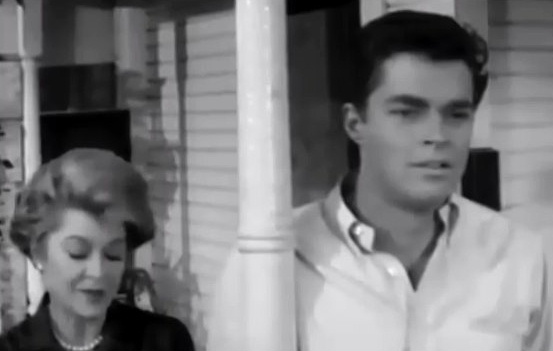
Richard Beymer and Joanne Woodward
THE STRIPPER (1963). Director: Franklin J. Schaffner. Based on the stage play "A Loss of Roses" by William Inge.

Along with her associates in a traveling magic act, Lila Green (Joanne Woodward) comes to the town where she lived as a child, but then is stranded when her boyfriend, Ricky (Robert Webber), runs off to greener pastures with all of their cash. Lila gets a room with a widow, Helen (Claire Trevor), who was her neighbor years ago, and who has a grown son named Kenny (Richard Beymer). Kenny and Lila develop an undeniable attraction to one another, but considering the age difference -- Woodward was eight years older than Beymer -- and everything else, Lila is afraid of being hurt and lonely once again. Then Ricky comes back into her life with a proposition ...

Claire Trevor and Richard Beymer
The Stripper is a lovely and absorbing film with three excellent lead performances. Although never considered a great beauty as such, Woodward [From the Terrace] has never looked better and she is excellent as Lila. (Marilyn Monroe, who was superb in the film adaptation of Inge's Bus Stop and was four years older than Woodward, might have been considered for this role had she not died tragically the previous year.) Beymer [Five Finger Exercise] gives a sensitive and intelligent performance as well, and Trevor [The Velvet Touch] is as adept as ever. Webber makes a very effective slime ball, and others in the cast include Gypsy Rose Lee and the odd Louis Nye as his associates (neither of them are especially memorable) and Carol Lynley, who makes a nice impression as a neighbor who has a crush on Beymer. Michael J. Pollard brings his own brand of quirkiness as a strange buddy of Kenny's who seems to have a thing for Lila but gets nowhere with her. The film could have used more scenes depicting the growing relationship between Kenny and Lila, but otherwise this is a very good movie.

Verdict: Strong cast and interesting situations add up to a memorable picture. ***1/2. 

Thursday, January 24, 2019

SECOND HONEYMOON

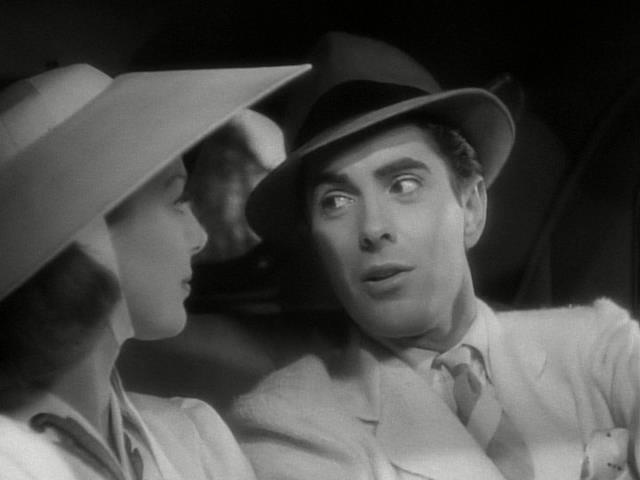
Loretta Young and Tyrone Power
SECOND HONEYMOON (1937). Director: Walter Lang.

Vicky Benton (Loretta Young of The Accused) and her second husband Bob (Lyle Talbot of Jail Bait) are on vacation in Florida when they run into Vicky's first husband, Raoul (Tyrone Power), who is still in love with her. Vicky has nagging feelings of affection for Raoul as well, but tries to suppress them. Then Bob is called to New York on business and Vicky stays behind. From the very first frame you know whom Vicky will wind up with, I mean -- Tyrone Power vs Lyle Talbot? If only the audience had been spared sitting through the 80 minutes that it takes for the two leads to realize whom they really wanted to be with.

Ty Power
Second Honeymoon aspires to be a frenetic screwball comedy, but the script is pedestrian, unfunny, and hopeless. Casting very, very skilled comic actors might have helped a bit, but Young, Power and Talbot are not highly skilled comic actors, although they certainly do the best they can with the material, and Talbot isn't quite as dull as usual. Surely Vicky had very good reasons for divorcing Raoul in the first place, but the movie glosses over them -- sex appeal triumphs as usual! Aside from a possible tendency to chase other women, second husband Bob doesn't seem that bad, at least not bad enough to deserve all the derision that is heaped upon him at the end. But he's not as good-looking as Power, so of course the film must make him the scapegoat.

Violet the raccoon goes a callin'
The film has only one laugh, and that is when Violet, Raoul's pet raccoon (given him by Bob) gets loose on an airplane and crawls curiously all over an old lady. Other actors trapped in this cinematic loser include Stuart Erwin as Raoul's valet; Claire Trevor (!) as Vicky's married friend, Marcia; and Marjorie Weaver as Joy, a personality-plus type gal who inexplicably marries Erwin. With her too-big lips and rather out-sized teeth, Young is definitely not as pretty as Power, but at least the raccoon is cute. The DVD of this is beautiful to look out, sharply remastered, but the movie is just pitiful. Mary Treen has a bit role as Joy's friend and co-worker. Walter Lang directed a great many much better movies, including Desk Set.

Verdict: One honeymoon too many. *. 

Thursday, January 10, 2019

HOW TO MURDER YOUR WIFE

Jack Lemmon and Terry Thomas
HOW TO MURDER YOUR WIFE (1965). Director: Richard Quine.

Confirmed bachelor Stanley Ford (Jack Lemmon), the very successful writer-artist of a popular newspaper strip, Brash Brannigan -- Secret Agent, lives in a fabulous Manhattan townhouse with his devoted butler/houseman Charles (Terry-Thomas of The Vault of Horror). One night at a bachelor party for a friend, Stanley gets drunk and wakes up in the morning married to a stranger (Virna Lisi) who speaks only Italian and turns out to be the gal who jumped out of the cake. With the help of his lawyer Harold (Eddie Mayehoff of Off-Limits) and his wife, Edna (Claire Trevor of The Velvet Touch), Mrs. Ford begins taking over the house, the kitchen, and threatens to fly her mother in from Italy. When Charles quits in disgust, Stanley decides it's time to take action. But when he kills off Brash's wife in the comic strip and the real Mrs. Ford disappears, he finds himself in very hot water ...

Jack Lemmon and Eddie Mayehoff
The first thing that must be said about How to Murder Your Wife is that in the style of many films of the sixties it is outrageously misogynistic. Sure there are men who resent their wives' interference in their lives and miss their bachelor days, but the thesis of George Axlerod's incredibly sexist screenplay is that all men hate married life, every wife is a battle axe (despite the fact that Mrs. Ford seems like an ideal spouse in many ways) and if men could only push a button to get rid of them they would all do so with glee. The film not only ignores all the men who are perfectly happy with their spouses, but all the women who have had to put up with horrible husbands, not to mention the sexism many women have had to endure even before the days of #metoo.  True, How to Murder Your Wife is not supposed to be taken seriously, but even so! A courtroom scene is staggeringly -- even shockingly -- chauvinistic.

Mary Wickes, Lemmon, Claire Trevor
On the other hand, despite this major problem, the movie is often very funny, bolstered by fine performances from the entire cast. Mary Wickes even manages to practically steal a scene when she's playing Harold's secretary and gets drunk on champagne. Sidney Blackmer is also notable as the drunken Judge Blackstone, as is Jack Albertson as Stanley's doctor. One might wonder why Stanley almost seems to cringe whenever his sexy wife gets affectionate, even if the ending suggests that it is sex -- certainly not love -- that makes him decide that he may prefer to stay married. In other words, the only way to enjoy this movie -- and it is enjoyable -- is to recognize its dated qualities and take it on its own terms. The funny thing about misogynous males is that they want women for sex and nothing else, but develop the screaming mimis if anyone dares suggest they might prefer the more-than-company of other guys, but then there's always been a link between sexism and homophobia.

Verdict: Women-hatred at its worst, but with a few chuckles and adept performances. **3/4. 

Thursday, March 29, 2018

MARJORIE MORNINGSTAR

Natalie Wood and Gene Kelly
MARJORIE MORNINGSTAR (1958). Director: Irving Rapper.

Marjorie Morgenstern (Natalie Wood) takes a job at a summer resort and falls in love with the theater director, Noel Airman (Gene Kelly). At first Noel, who hides his Jewish roots, tries to convince himself that Marjorie is just another "Shirley," a typical Jewish American Princess, and her middle-class desires would never fit in with his plans. Still, over the years the two can't pull themselves away from each other, and their on-again/off-again relationship is beset with problems. Herman Wouk's novel has been reduced to an entertaining, slick soap opera that has some very good performances. Wood gets high marks as Marjorie, really giving a first-rate and honest portrayal of a tormented young lady. Gene Kelly just can't seem to get that far away from Gene Kelly, and his anguish over his failings both as an artist and a man just don't ring true -- he's too much of a winner for it to work. It's a perfectly good "Hollywood" performance but nothing more. As Marjorie's parents, Everett Sloane [The Big Knife] and especially Claire Trevor [The Velvet Touch] are more on the money, and Ed Wynn [Son of Flubber] makes his mark as Marjorie's beloved Uncle Samson. Carolyn Jones as Marjorie's best friend has a terrific scene when she nearly has a meltdown just before her wedding (as she's marrying Jesse White one can completely understand!). There are also good, if brief, performances from Martin Balsam as a doctor who falls for Marjorie; Edd Byrnes (billed as Edward Byrnes) as Marjorie's first boyfriend, Sandy; Martin Milner, as a playwright who carries a torch for Marjorie for years; Ruta Lee as a gal pal of Noel's; and others. Max Steiner has contributed a pleasant romantic score which helps a bit in putting this over.

Verdict: At least Wood and Kelly have definite chemistry! **1/2.

Thursday, July 10, 2014

THE VELVET TOUCH

Sydney Greenstreet and Rosalind Russell
THE VELVET TOUCH (1948). Director: John Gage (Jack Gage).

"You've produced so many bad plays you're beginning to believe them."

Broadway actress Valerie Stanton (Rosalind Russell) wants to break away from her usual producer, Gordon Dunning (Leon Ames) and the treacle he has her appear in, and try "Hedda Gabler," but he only laughs at her. Dunning, who refuses to let her go and is carrying a torch for her as well,  threatens her, and during a struggle Valerie bops him on the head and kills him. This is followed by a long flashback during which Valerie meets new love Michael Morrell (Leo Genn of Personal Affair), who is not only unimpressed by her status but is positively condescending -- and unattractive to boot; nevertheless Valerie falls for him. The third part of the film brings in Sydney Greenstreet as the corpulent Captain Danbury, who is a fan of Val's and is investigating the murder. The front runner in suspects is not Val but Marian Webster (Claire Trevor), who has been pining for Dunning for years, hates Val, and is incredibly bitter. Will Valerie come clean about what happened, or let Marian take the rap? The Velvet Touch is no All About Eve -- made two years later -- but it is a very entertaining backstage drama with an outstanding performance by Russell and fine support from Trevor [The High and the Mighty], Ames, and Greenstreet. Irving Bacon scores as a chatty waiter at Sardi's, and Lex Barker is also in the cast as a young actor.

Verdict: Strangely compelling. ***.

Thursday, July 18, 2013

RAW DEAL

Dennis O'Keefe will have to deal with John Ireland
RAW DEAL (1948). Director: Anthony Mann.

Lawyer Ann Martin (Marsha Hunt of Smash Up) visits Joe Sullivan (Dennis O'Keefe of Hold That Kiss) in jail to talk about parole, but she's as attracted to him as he is to her. Joe took the rap for a big wheel named Rick (Raymond Burr) who promised him big money if he served his sentence. But Joe's faithful girlfriend, Pat (Claire Trevor of Crossroads), somehow breaks Joe out of jail in a million to one chance (the exact details are completely glossed over!), and the big lug brings her to -- Ann's apartment. In an interesting development, Joe forces Ann to go along with him and Pat as they drive past police blockades and try to get out of the city, which doesn't exactly sit well with the jealous Pat. Ann at first grows to hate the man she is attracted to, but then ... Yes, this is the type of movie in which the protagonist is a complete loser, but gets away with a lot because he's passably good-looking and has a slight -- very slight -- modicum of sensitivity. Raw Deal should have been more interesting than it is -- although it does pose a heart-rending moral question for Pat at the very end -- but the characters are unsympathetic (although one almost feels sorry for Pat) and the movie never quite rises above its second-rate film noir atmosphere. Hunt and Trevor are excellent, however, and O'Keefe got one of the best roles of his career and runs with it. Raymond Burr is also fine as Rick, who is so sadistic that he throws a flaming food dish in a woman's face because she accidentally spilled a drink on his jacket. John Ireland is a nasty henchman of Rick's who is sent to kill Joe, and Regis Toomey is the cop in pursuit of him. The versatile Whit Bissell has a memorable cameo as a murderer being chased by a posse who just happens to make his way to the same place that Joe and company are hiding out in. John Alton's moody cinematography doesn't hurt. Mann also directed the excellent Furies with Barbara Stanwyck.

Verdict: Very good showcase for O'Keefe with some interesting situations. **1/2.

Monday, April 14, 2008

CROSSROADS


CROSSROADS (1942). Director: Jack Conway.

Parisian government official David Talbot (William Powell) winds up in the center of a mystery when a man who tried to blackmail him claims that he is actually petty thief Jean Pelletier, who appropriated Talbot's identity after a train crash. As Talbot has amnesia, even he can't be certain that he isn't Pelletier. This situation is complicated by Henri Sarrou (Basil Rathbone) who claims that he and Pelletier committed a robbery that resulted in a man's murder, and Michelle Allaine (Claire Trevor), who says that she and Pelletier -- Talbot -- were once lovers. This last is especially distressing to Talbot's wife Lucienne (Hedy Lamarr). The suspenseful film doesn't reveal the truth about Talbot until nearly the end, and the acting is great. Powell and Lamarr play very well together, Powell a bit more intense than usual and Lamarr giving one of her loveliest interpretations. Rathbone is perfection as the oily Sarrou, and Trevor is tough and saucy as Michelle. Margaret Wycherly nearly steals the picture from everyone as Pelletier's old mother, however.

Verdict: Very engaging mystery. ***.