Lively, entertaining reviews of, and essays on, old and newer films and everything relating to them, written by professional author William Schoell.
Showing posts with label musical biopic. Show all posts

Thursday, May 25, 2023

THE I DON'T CARE GIRL

Bob Graham and Mitzi Gaynor
THE I DON'T CARE GIRL (1953). Director: Lloyd Bacon.  Produced by George Jessel.

The real George Jessel is trying to produce a picture about old vaudeville star Eva Tanquay (Mitzi Gaynor of Anything Goes) and importunes his scriptwriters (Warren Stevens and Craig Hill) to locate people who knew the entertainer. These include Ed McCoy (David Wayne), supposedly the man who discovered her as well as her former partner; Charles Bennett (Oscar Levant of The Barkleys of Broadway), a composer; and Larry Woods (Bob Graham), another composer-performer who falls in love with Eva but is married. Larry is separated from his wife but a bigger problem is the seductive Stella Forest (Hazel Brooks of Sleep, My Love), who wants to star in Larry's operetta. Will true love win out over all?

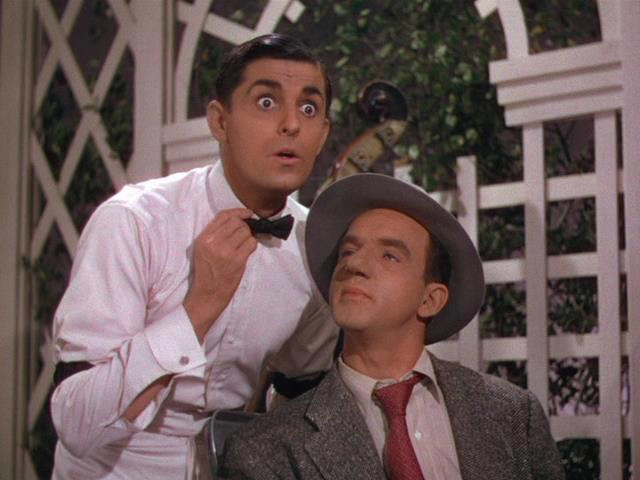
David Wayne, Warren Stevens, Craig Hill
Hollywood is famous for coming out with biopics that have little to do with the real lives of their subjects, but The I Don't Care Girl takes the cake, as there's very little -- but the bare basics -- that have anything to do with Ms. Tanquay. The movie is really just an excuse to show off the admitted skills of Mitzi Gaynor, who gives a good performance, sings quite well, and is a sensational dancer with sensational gams. Ms. Gaynor is featured in some creative -- some might say overly creative -- big production numbers that have very little to do with anything ever seen on a vaudeville stage and everything to do with fifties fashion. 

Mitzi Gaynor and Oscar Levant
The title of the picture comes from Ms. Tanquay's most famous number, "I Don't Care." (Judy Garland, somewhat mimicking Tanquay,  arguably gives the best performance of this song in In the Good Old Summertime.) As for Tanquay, she was certainly a more interesting character than the sanitized version we see in this picture. Essentially forgotten today, she was once a tremendous international star, an early feminist, an absolutely relentless self-promoter, and had two or possibly three husbands as well as at least one affair. For a publicity stunt, she "married" a cross-dresser and wore a tuxedo while he wore the wedding dress. You can bet you won't see that in this movie! 

As for Bob Graham, the fellow is handsome, has a great baritone voice, and makes a smooth, likable leading man. But this was his last picture out of seven. What happened? Even the Internet Movie Data Base has very little information on him, including his date of birth and death. He is not to be confused with another actor named Robert Graham. 

Verdict: The story is just a mass of cliches but the cast is game and the dancing is great. ***.   

Thursday, December 22, 2022

ELVIS (1979)

Kurt Russell as Elvis
ELVIS (1979 telefilm). Director: John Carpenter.

Elvis Presley (Kurt Russell), inspired by black musicians, develops his own singing style and frenetic dancing movements. He rises to the top of the recording and film industry with the help of Colonel Tom Parker (Pat Hingle), but is frustrated by the insipid scripts that he is given. Marrying Priscilla (Season Hubley), whom he meets when she is fourteen, he develops a dependency on prescription drugs that alter his personality and make him paranoid. He attempts a comeback by appearing at the International Hotel and Casino in Las Vegas, but will this lead to a revitalization of his career or will he fall flat on his face as hundreds of fans await his entrance?

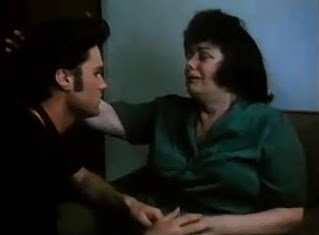
Russell with Shelly Winters
Kurt Russell gives a terrific performance as Elvis in this long but entertaining telefilm, which also stars Shelley Winters as Elvis' mom, and Bing Russell (Kurt's real-life father) as Elvis' dad. (To keep it all in the family Kurt Russell later had a short marriage to Season Hubley, who plays Elvis' wife). There's way too much of Winters in the first half of the movie, especially as she is giving one of her kind of twitchy  and breathless performances in what one could call her fat and whiny period. Pat Hingle isn't really given much to do as Parker, his character being shunted into the background most of the time, unlike in the 2022 Elvis

Russell with Season Hubley
The last fifteen minutes or so of the movie are given over to Elvis' triumphant concert at the International, where Russell performs the pants out of songs like "Burning Love" and displays the King of Rock at his most energetic. Credit also must be given to Ronnie McDowell, who does a fine job providing Elvis' singing voice. Ironically, the first movie Kurt Russell ever appeared in was an Elvis flick, It Happened at the World's Fair, where the king asks a boy (Russell) to kick him in the shins. This telefilm began a long association between Kurt Russell and John Carpenter, who also directed him in The Thing and many others. 

Verdict: Good approximation of the King. ***. 

OK NEW MOVIE: ELVIS

Austin Butler as Elvis
ELVIS (2022). Director: Baz Luhrmann. 

"Every dream I ever dreamed has come true a hundred times." -- Elvis.

Influenced by black musicians, Elvis Presley (Austin Butler) rises from obscurity to become one of the most famous men in the world, his career as singer and actor guided by "Colonel Tom Parker" (Tom Hanks), a mysterious figure who turns out to be ripping him off and making bad decisions due to a secret he has. Elvis' devotion to his fans and his love of performing cause problems in his marriage to Priscilla (Olivia DeJonge), and he may have more trouble breaking away from the Colonel than he thinks. 

Tom Hanks as the alleged colonel
There is only one way to take Elvis and that is as a tribute to a very influential and talented performer. That's really the only way the movie works as it is far too superficial to work as a biopic. Director Baz Luhrmann throws images at the viewer as in a rock video, and there is some creativity in the way the film is presented, although the overly busy style is initially off-putting. Austin Butler is a terrific Elvis impersonator -- although the real Presley has a better voice --  but if you're hoping to find a more in-depth look at Presley the Man you'll be disappointed. I'm not sure what to make of Tom Hanks, who affects a kind of Dutch accent that Parker actually did not have in real life (interviews with the man attest to this -- didn't Hanks do his research?) Other than that Hanks' performance is okay but it often seems little more than a stunt. 

Priscilla (Olvia DeJonge) with Elvis
Elvis is more interested in spectacle and presenting an overview of Elvis' life and career than anything else so there aren't that many truly dramatic scenes -- one of them, which is well played, has Elvis firing his manager, the colonel, while performing on stage in Las Vegas. The movie spends all of two minutes on Elvis' film career, which is strange as he did give some fine performances in early movies and even the later campy flicks had their highlights. Elvis recreates the singer's last performance singing Unchained Melody -- I believe halfway through the scene the real Elvis is substituted for Butler. The ending is undeniably moving, and Elvis fans will undoubtedly find themselves choking up. 

Verdict: Not really a  great biopic but admirable as a tribute to Elvis. ***.  

Thursday, September 30, 2021

THE BUDDY HOLLY STORY

Maria Richwine and Gary Busey

THE BUDDY HOLLY STORY (1978). Director: Steve Rash. 

In Lubbock Texas in 1956 Buddy Holly (Gary Busey in an Oscar-nominated performance) and two friends -- Jesse (Don Stroud) and Ray Bob (Charles Martin Smith) -- perform at the local skating rink but their "Negro"-influenced music may be too much for the advertisers on the radio station. Buddy and the "Crickets," as the other two fellows are called, travel to Nashville but discover they will have to sing for a studio band of country musicians who pretty much ruin a great song like "That'll Be the Day." Buddy almost has the same problem in New York, but is able to convince record executive Ross Turner (Conrad Janis) to produce the group's albums and maintain the correct sound. As the group has one hit record after another -- "Love Like Yours," 'It's So easy to Fall in Love' "Oh, Baby!" and others -- Buddy falls for and marries secretary Maria Elena (Maria Richwine) and he and the boys have a falling out. One night on a fateful tour with Richie Valens and the Big Bopper, Buddy meets his tragic destiny ... 

Charles Martin Smith and Busey
While it helps if you like this kind of old-time rock 'n' roll -- which I do -- I found The Buddy Holly Story to be quite entertaining, if minor. One could argue that you don't necessarily get to know any of the people in the film all that well, but the acting across the board is excellent. One could also argue that Gary Busey is much more charismatic and energetic than the real Buddy Holly, but I admit this is only based on seeing a couple of the latter's live performances. Dick O'Neill as Sol Gittler and Paul Mooney as Sam Cooke, among others, are also notable. One of Holly's last compositions was the very lovely, even touching, ballad "True Love Ways," for which his voice -- which works on loud rock songs -- wasn't that well suited. I believe it was released posthumously. 

Verdict: Upbeat rock biopic with a downbeat conclusion. ***.

Thursday, March 19, 2020

SOMEBODY LOVES ME

Ralph Meeker and Betty Hutton
SOMEBODY LOVES ME (1952). Director: Irving Brecher.

Blossom Seeley (Betty Hutton of Spring Reunion) becomes a top vaudeville entertainer and sees a trio performing in a club one night. Spying the handsome crooner Benny Fields (Ralph Meeker of Jeopardy) -- one of the trio --  she decides "that's for me!" and hires all of them for her act. This arrangement doesn't work for long, until Benny proposes and becomes her accompanist. But soon he's "Mr. Seeley" and feels like a kept man. But did he marry Blossom for love or other motives?

Billie Bird and Cheetah? 
Although pretty much forgotten today, the real-life Seeley and Fields were once as famous as Jack Benny and Burns and Allen. This biopic revived their careers in the fifties. Betty Hutton gives one of her best performances in this, bold and brassy when she needs to be, and more subdued and lovely at other moments. Although generally one would hardly think of Ralph Meeker for the leading role in a musical, he's fine in this flick, and while he's really not a dancer, he sexily shakes his booty in one number. Robert Keith and Billie Bird [The Cat Burglar] are both first-rate as Blossom's manager and her best friend, who was once an entertainer herself. Adele Jergens also scores in an early sequence when she's a condescending headliner who gets undone by Bird and an adorable chimpanzee (who reads Variety no less). Jack Benny has a famous cameo as himself as a master of ceremonies.

Ralph Meeker
The film has some lively dance numbers and a good score comprised of classic tunes (like Gershwin's title song) and a few new numbers by Livingstone and Evans. The highlights are "I Cried Over You;" "Jealous;" "When I Was a Kid in Dixie;" and "Dixie Dreams." Meeker's voice was probably dubbed by Fields himself, as it sounds like him. An interesting scene has Benny admitting to Blossom that their marriage was essentially a career move, although according to this film he did fall in love with her later on. Hutton did only one more film after this one and then had a few TV appearances.

Verdict: Nice music, excellent performances, put over this lively musical biopic. ***. 

Thursday, October 17, 2019

THE EDDY DUCHIN STORY

Tyrone Power and Kim Novak
THE EDDY DUCHIN STORY (1956). Director: George Sidney.

Eddy Duchin is a brash, talented pianist who comes from Boston to New York to play with a band, but discovers it's not as easy as he thought. Nevertheless he works his way up to becoming a bandleader (although how he does this is never quite shown). He also marries a socialite, Marjorie (Kim Novak), and the two have a son, Peter. Life seems wonderful for Eddy, but he doesn't know that there is more than one tragedy in his future.

Rex Thompson as Peter Duchin
The Glenn Miller Story (starring Jimmy Stewart) had already been filmed two years earlier, and eventually other musicians besides bandleaders, such as Gene Krupa, would get the biopic treatment. Although The Eddy Duchin story is heavily fictionalized with a lot of dramatic license, most of the basic facts of Duchin's life are presented unflinchingly, and in fact this is one "musical" that is quite depressing. There are many contrived, if moving, sequences in the film, such as one with Duchin bonding with a little Asian boy while in the service. Power's performance is good, but it's Hollywood acting, not the kind of consummate emoting that would signify a really great performance. Kim Novak is lovely and adept as Marjorie, and Rex Thompson is excellent as young Peter at about age ten. A sequence when Eddy has to give his son some particularly disturbing news has Thompson out-acting Power.

Victoria Shaw and Tyrone Power
Eddy Duchin also has a superior supporting cast, with James Whitmore as a club owner and loyal associate of Duchin's; Frieda Inescort and Shepperd Strudwick as relatives of Marjorie's who raise the boy; and Victoria Shaw [The Crimson Kimono] as Chiquita, another relative who befriends Peter and eventually becomes his mother. I wondered where Gloria Holden of Dracula's Daughter might be, then realized at the end that she had played  Eddy's mother (quite well by the way)! The film is greatly bolstered by a score by George Duning and especially Harry Stradling's superb widescreen cinematography.

One thing the film ignores, which might have contributed more drama to the screenplay, is that Duchin was Jewish, and Marjorie was bounced out of the social register when she married him.

Tyrone Power was 43 when he made this film, two years older than Duchin was when he died of leukemia. Power himself would be dead in two years. Even with make up and Hollywood lighting, Power, although still handsome, generally looks in his fifties or older.

Verdict: Moving if manufactured biopic with good performances and a beautiful and classy look to it, thanks to Harry Stradling. ***. 

Thursday, July 26, 2018

THE EDDIE CANTOR STORY

Keefe Brasselle (Cantor) and Jackie Barnett (Durante)
THE EDDIE CANTOR STORY (1953). Director: Alfred E. Green.

Even as a boy Eddie Cantor (Richard Monda) knew he wanted to be an entertainer. When a foolish do-gooder named Berk (David Alpert) wants to pack the kid off to an orphanage, claiming that his sturdy grandmother Esther (Aline MacMahon) can't take care of him, Eddie is fortunate to wind up with a theatrical couple who sponsor a children's revue instead. As Eddie (now played by Keefe Brasselle) falls in love with his childhood sweetheart, Ida (Susan Odin, and then Marilyn Erskine), he struggles to make a name for himself as an adult singing and dancing comedian. But the more famous Eddie gets, the more he neglects his wife, whose loneliness is palpable despite her having (eventually) five daughters to raise. Then serious health issues crop up and it looks like Cantor's career is over ... Eddie Cantor was still alive when this film came out, so the worst thing the movie says about the comic is that he was overly ambitious and addicted to applause and stardom, a fact that had a negative impact on his family life. The Eddie Cantor Story sticks to the basic facts about the man, even it it remains somewhat on a superficial level. However, Brasselle [Bannerline], outfitted with pop eyes and bigger teeth that generally disguise the actor's handsomeness. gives an excellent, well-studied impression of the famous performer. (One could argue that Brasselle, as is often the case in biopics, impersonates the man as he acts while performing as opposed to how he acts off-stage, but somehow this approach works.) Using the real Cantor's voice, Brasselle expertly recreates his routines from the Ziegfeld Follies as well as from such Broadway shows as Whoopee. The film boasts another excellent performance from Marilyn Erskine, who generally worked in television but should be much better known, as the grown-up Ida. Erskine explores every nuance of the character with her sensitive and splendid emoting. Aline MacMahon [The Young Doctors] is sterling as the loving, supportive grandmother, and there is very nice work from Arthur Franz [The Atomic Submarine] as a doctor who remains a loyal friend of the couple through thick and thin. Jackie Barnett does an amusing imitation of Jimmy Durante, and Will Rogers Jr. is cast as his father. Richard Monda is very winning and effective as Cantor as a child. Smaller roles are enacted by the likes of Chick Chandler (as a talent show host); Marie Windsor (as a jealous star); Gerald Mohr (as an old friend and bootlegger); Alix Talton (as a reporter;) as well as Ann Doran and Arthur Space. One is struck by the similarity between Cantor and friendly rival Al Jolson, who also performed in blackface. In his later years, Cantor did film and television work, and also became a spokesman for the March of Dimes. Cantor and his wife appear in the film's framing sequence, and he is given a classic closing line: "I've never looked  better in my life." Although two actors are credited with playing Cantor's parents (who died when he was an infant), they are either seen only in photographs, or their scenes were cut.

Verdict: Delightful biopic with top performances and snappy musical numbers. ***.  

Thursday, March 23, 2017

LILLIAN RUSSELL

Alice Faye as Lillian Russell
LILLIAN RUSSELL (1940). Director: Irving Cummings.

A young lady with singing talent reinvents herself as "Lillian Russell" to hide the fact that she's on the stage from her mother (Dorothy Peterson), but mama always knows. Like her mother, Lillian is an early feminist as well as a major theatrical performer with thousands of fans and a host of suitors, including Diamond Jim Brady (Edward Arnold) and "J. L." (Warren William of Dr. Monica), but she marries composer Edward Solomon (Don Ameche). Their marriage ends in tragedy, but waiting in the wings is reporter turned newspaper publisher Alexander Moore (Henry Fonda). Russell was actually married four times, and Solomon didn't die as in the movie, but turned out to be a (perhaps inadvertent) bigamist. As Faye herself noted, in this handsomely-produced (but oddly, black and white) movie, nobody ever ages no matter how many decades go by. Although Faye's singing voice could best be described as "pleasant" (and a little too deep at times), she gives a very good performance as Russell, wisely underplaying many of her more emotional scenes. Arnold is excellent in his portrait of the happy go lucky but broken-hearted Brady, and there are good turns from Ameche and William; Helen Westley [Million Dollar Baby] as Grandma Leonard; Joseph Cawthorn as vocal coach Leopold Damrosch; Ernest Truex as Lillian's father (who in real life was actually separated from his wife); and Nigel Bruce as William Gilbert (of Gilbert and Sullivan fame). Aside from the many musical highlights, there is grandma's recounting of a romantic story involving a mystery gift she once received, and a well-played scene between Arnold and William talking about their feelings toward Lillian. Henry Fonda [The Long Night], who usually leaves me cold, is quite good in this, although this was not an assignment he coveted. Old-time vaudevillians Joe Weber and Lew Fields, playing themselves, almost stop the movie dead with their long comedy routine, but as they happen to be very funny it doesn't matter. Eddie Foy Jr. plays his dad in a brief bit.

Verdict: Despite some inaccuracies, this is a highly entertaining and well-acted biopic. ***1/2.

Thursday, January 19, 2017

WORDS AND MUSIC

Mickey as Lorenz Hart and Judy as herself
WORDS AND MUSIC (1948). Director: Norman Taurog.

"... strange places with strange people ..."

Richard Rodgers (Tom Drake) and Lorenz Hart (Mickey Rooney) become a highly popular song-writing duo and a theatrical force to be reckoned with. This is a heavily fictionalized biography that completely suppresses Hart's homosexuality and alcoholism, and instead makes the man unlucky in love. The highlights of the film are the musical interludes: Judy Garland, playing herself, singing "I Wish I Were In Love Again" with Mickey; and doing a solo on "Johnny One-Note." Lena Horne scores with "Where or When? " and "The Lady is a Tramp,"  and Mel Torme does "Blue Moon." Then there's the excellent "Slaughter on Tenth Avenue" from On Your Toes with Gene Kelly at the top of his game. Rooney is as superb as ever, Drake [Betrayed Women] is fine as Rodgers, and Marshall Thompson plays associate Herbert Fields. Perry Como plays a fictional character in the film, and while his acting isn't bad, his singing style (at that time) apes Bing Crosby shamelessly. Janet Leigh has a nice turn as Rodgers' wife, as does Ann Sothern as Joyce, but the best one can say about Betty Garrett is that she's utterly unexciting. The picture is very handsomely produced, but the narration is unnecessary. To cap it all off we've got "With a Song in My Heart," one of Rodgers most beautiful melodies.

Verdict: Not the real story but colorful and entertaining. ***.

Thursday, July 21, 2016

TILL THE CLOUDS ROLL BY

Ol' Blue-eyes sings "Ol' Man River" 
TILL THE CLOUDS ROLL BY (1946). Director: Richard Whorf.

Till the Clouds Roll By purports to be a biopic of composer Jerome Kern (Robert Walker). It opens with a twenty minute recreation of the opening night of Kern's masterpiece, Show Boat, and then goes downhill -- at least in the dramatic sense -- from there. It would have been better for all concerned to forget the fictionalized "plot" and simply present one number after another. Some of the basic facts of Kern's life are accurate: oversleeping kept him off of the ill-fated Lusitania upon which he was to sail with impresario Charles Frohman; and he did meet his wife, Eva (Dorothy Patrick of House by the River), in England, although under somewhat different circumstances. But the movie invents a completely fictional character, James Hessler (Van Heflin), a widower-arranger, who works with Kern and helps him to become a major success. Equally fictional is Hessler's daughter, Sally, who is played by Joan Wells as a child and Lucille Bremer as an adult (both are very good), and a lot of dumb drama is worked up over show biz aspirant Sally losing her big number to star Marilyn Miller (Judy Garland) and running off to unknown parts because of it. None of it has anything to do with Kern. But while this aspect of the film is dull, there are still some memorable moments in the movie, such as: Lena Horne singing "Can't Help Lovin' That Man" from Show Boat and "Why Was I Born?"; Angela Lansbury and chorus cuties on swings for "How'd You Like to Spoon with Me?"; the dancing for the title tune, which features June Allyson and Ray McDonald; Garland as Maxwell interpreting "Look for the Silver Lining;" "I Won't Dance" with Van Johnson and the aforementioned Bremer [Ruthless]; and Tony Martin doing "Make Believe" and "All the Things You Are." You wouldn't think that Frank Sinatra, however wonderful he was, could do much with "Ol' Man River" but he delivers in his own inimitable style. Other performers include Kathryn Grayson as Magnolia in Show Boat; Virginia O'Brien doing her frozen face shtick; and Dinah Shore doing a couple of numbers nicely without quite being on everyone else's level. The absolute low-light of the film is June Allyson croaking out a song about "Cleopatterer." Walker is okay as Kern, but looks nothing like him, while Heflin does more than his best with his character, and Paul Langton [Murder is My Beat] is fine as lyricist Oscar Hammerstein. Ironically, five years later the same studio, MGM, did a full-length version of Show Boat but instead of Lena Horne hired the completely Caucasian Ava Gardner to play the mulatto character of Julie; Kathryn Grayson, of course, remained as Magnolia. All of the musical numbers in this were expertly staged by Robert Alton except for Garland's numbers, which were handled for her by Vincente Minelli.

Verdict: There's still much to admire in this half-baked supposed biography. **1/2.