Lively, entertaining reviews of, and essays on, old and newer films and everything relating to them, written by professional author William Schoell.
Showing posts with label John Carradine. Show all posts

Thursday, October 13, 2022

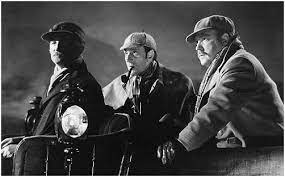
THE HOUND OF THE BASKERVILLES (1939)

On the moors with Holmes and Watson
THE HOUND OF THE BASKERVILLES
(1939). Director: Sidney Lanfield. 

"Oh, Watson, the needle." 

This is the first of two Sherlock Holmes films made by Twentieth Century-Fox and the first in which the wonderful Basil Rathbone created perhaps the definitive movie portrayal of the famous detective -- he is simply outstanding. The plot has to do with Holmes and Watson (Nigel Bruce) trying to save the life of an heir (Richard Greene) while dealing with rumors of the huge title beast roaming the foggy moors where the story takes place. John Carradine has a small role as a servant, and Wendy Barrie is the love interest. Lionel Atwill, who played Holmes' nemesis Professor Moriarty in a later film, Sherlock Holmes and the Secret Weapon, is excellent in the more sympathetic role of Dr. Mortimer. Mary Gordon played Mrs. Hudson for the first time in this picture. Barlowe Borland scores as the cranky, litigious old Frankland. Morton Lowry is fine as John Stapleton. The 1959 color remake is also quite creditable, and some may feel it has the slight edge. Followed by The Adventures of Sherlock Holmes. 

Verdict: Fine introduction to the Rathbone portrayal. ***.

Thursday, May 27, 2021

EVERYTHING YOU ALWAYS WANTED TO KNOW ABOUT SEX BUT WERE AFRAID TO ASK

EVERYTHING YOU ALWAYS WANTED TO KNOW ABOUT SEX BUT WERE AFRAID TO ASK
(1972). Director: Woody Allen. 

Woody Allen took some questions from the book of the same name and filmed several segments supposedly relating to these questions. "Do aphrodisiacs work?" is a very funny medieval sketch where Allen winds up with his hand locked in the chastity belt of his horny married queen (an excellent Lynn Redgrave). "What is Sodomy?" actually looks at bestiality as Gene Wilder plays a doctor who falls in love with a sheep. It's a bit yucky, like anything pertaining to the subject, but it has its moments. 

"Why do some women have trouble reaching orgasm?" is a spoof of Italian movies with Allen discovering that his wife (Louise Lasser) only gets turned on in public places. "Are transvestites homosexual?" presents Lou Jacobi (who's terrific) as a husband who gets caught wearing the clothing of his hostess at a dinner party. "What are sex perverts?" first has a homoerotic hair tonic ad, and then presents an episode of the TV show What's My Perversion? an erotic take on What's My Line? "Are Sex Research Findings Accurate?" has John Carradine letting loose a giant breast upon the world in a spoof of monster movies. In "What happens during ejaculation?" Woody plays a nervous sperm who doesn't really like the idea of being thrust out into the big wide womb. This is probably the most inventive segment. Everything You Always Wanted to Know is certainly not for all tastes but it has its share of laughs and holds the attention. You'll probably learn no more about sex than you did from the book. 

Verdict: Watch out for giant boobs! ***.

Thursday, November 23, 2017

THE CAT CREATURE

Gale Sondergaard and Meredith Baxter
THE CAT CREATURE (1973 telefilm). Director: Curtis Harrington.

Joe Sung (Keye Luke) steals a cat-medallion from a recently opened Egyptian casket, and begins a chain of deaths from a clawed creature that counts him among its victims. The trail leads to Hester Black (Gale Sondergaard), a shady lady who runs an occult shop. Lt March (Stuart Whitman of Eaten Alive), aided by egyptologist Roger Edmonds (David Hedison of The Lost World), investigates the case, which also embroils Hester's new assistant, Rena Carter (Meredith Baxter). While it's fun at first seeing such veteran actors as Kent Smith [Cat People], John Carradine, Luke, Milton Parsons (as a coroner, naturally), and especially an excellent and criminally wasted Sondergaard [The Letter], The Cat Creature is pretty bad, with one of Robert Bloch's least inspired scripts. Tabbie cats are not exactly fearsome animals, for one thing. "Peter Lorre Jr." -- actually a man named Eugene Weingand who pretended to be Lorre's son -- has a small role as a murdered pawnbroker. Baxter is given a pretty embarrassing role to play.

Verdict: Great to see Sondergaard still in top form, but the movie is terrible. *1/2. 

Thursday, November 9, 2017

THE CULT OF ULMER

Edgar G, Ulmer
THE CULT OF ULMER: DIRECTOR EDGAR G. ULMER, KING OF THE "B'S"

I don't remember why, but years ago when I was in grade school, our teacher let us watch a movie on television. It was called The Man from Planet X and we children were enthralled. Unfortunately, we weren't able to see the ending, and decades went by before I finally got to see the movie in its entirety.

It turned out to be a not-bad B movie, and I guess it got me interested in seeing Ulmer's other movies -- at least when I'd see his name listed as director of an unfamiliar movie, I would sit up and pay attention. Ulmer seemed to specialize in genre films: horror, mystery, science fiction, which especially interested me as a kid, although he did other types of pictures as well. I enjoyed Daughter of Dr. Jekyll, which I found atmospheric and creepy, and Bluebeard with John Carradine has its moments. Murder is My Beat is a notable example of film noir. His best picture, however, may be the Zachary Scott melodrama, Ruthless.

Ulmer did more than his share of stinkers, such as Girls in Chains and the oddly-admired but perfectly awful Strange Illusion. He may have directed all of them, but the Ulmer pictures that work the best are the ones with the best scripts. One could argue that this is true of any director, of course. Ulmer's fans have argued that he was a great director who only needed better opportunities and the bigger budgets of major studios. In my opinion, Ulmer was a workmanlike director who had moments of inspiration, and who managed to helm some rather interesting pictures along the way.

Some members of what I call "the Cult of Ulmer" find genius in every frame. They wildly overpraise such movies as Strange Illusion. There has been more than one book on Ulmer, and some film scholars are taking his work very seriously. I like Ulmer -- at least many of his movies -- but I'm not necessarily convinced of his "greatness." He did come out with one certified near-classic, the fascinating Detour, the film he is most famous for.

Anyway, you can make up your own mind. His films tend to be hit or miss. This week you can read about some of these films, good or bad, as well as an excellent biography of the director.

Thursday, October 26, 2017

SHOCK WAVES

Brooke Adams and Luke Halpin
SHOCK WAVES (1977). Director: Ken Wiederhorn.

A group of people out on a short chartered boat tour might not wind up on Gilligan's Island, but they probably wish they had. Instead they wind up on an island that is home to an elderly Nazi scientist (Peter Cushing) who tells them how they created unkillable super-soldiers who were meant to be the ultimate weapons. Dead already, these soldiers can stay underwater for hours and stalk the enemy with ultra-extreme stealth. The tourists, including Rose (Brooke Adams), Norman (Jack Davidson) and Beverly (D. J. Sidney),  team up with crew members Keith (Luke Halpin) and Dobbs (Don Stout) and try to get off the island before the zombie Nazis can slay them. Shock Waves has a damned good premise but its execution is below mediocre, with too many slack stretches, no real suspense or surprises, and not nearly enough exciting sequences. Of the major younger cast members, Adams makes the best impression and was the only one to have a fairly big career. Of the veterans, Peter Cushing has one of his least interesting roles, and John Carradine, as the captain of the tour boat, is killed off early on. Halpin [Island of the Lost] was most famous for the TV show Flipper.

Verdict: Pretty much a waste of a good idea. **.

Thursday, May 25, 2017

THE LAST HURRAH

Spencer Tracy
THE LAST HURRAH (1958). Director: John Ford.

Mayor Frank Skeffington (Spencer Tracy) runs for one last term, and is up against a younger family man (Charles B. Fitzsimons) who seems the pawn of more experienced politicians. Frank's son, Junior (Arthur Walsh), is a fifties-type jazz baby who has little interest in politics or much else. Frank is closer to his nephew, Adam (Jeffrey Hunter), whose boss at a newspaper, Amos Force (John Carradine), and father-in-law Roger Sugure (Willis Bouchey), both detest Frank. Frank is an old-fashioned Irish-American politician who has survived decades due to his old cronies who love him, but it's a new world out there and Frank may get a surprise on election night ... The Last Hurrah could be picked apart on certain levels -- the characterization is quite superficial at times --  but it works because of its acting and Ford's smooth, professional direction. Tracy is excellent, and he gets fine support from Hunter, Walsh, Carradine, and especially Basil Rathbone in a scene-stealing turn as a banker who comes afoul of Frank and vice versa. (The whole sequence with Rathbone's lisping, clearly mentally-deficient son, who is cruelly used to blackmail Rathbone, is in questionable taste, to say the least.) Other cast stand-outs include Ricardo Cortez as Sam, the campaign manager; Donald Crisp as the cardinal; Basil Ruysdael as Bishop Gardner; and Jane Darwell as Delia Boylan, whose chief occupation seems to be to go to funerals and cackle. Edward Brophy [Romance on the Run] is also notable as "Ditto," Frank's old pal, a rather sad figure (whom we learn little about) who's given the last appearance in the picture. Anna Lee [Summer Storm] scores as Gert, a widow, in one of the film's most interesting sequences. Gert keeps repeating "he was a good man, Frank, a good man," when it's clear that her husband didn't even bother to see how she would get along after his death and left no insurance. Bob Sweeney is fine as a funeral director, as are Ken Curtis [Don Daredevil Rides Again] as Monsignor Killian, Dianne Foster as Adam's conflicted wife, and Frank Albertson as the opponent's manager, Jack Mangan. O. Z. Whitehead is quite good in the thankless role of Rathbone's son, Norman Jr. Harry Lauter, Edmund Lowe, Tom Neal; William Hudson all have smaller, generally non-speaking roles. Spencer Tracy was only 58 when  he did this picture, but looks years older, and his character was actually 72 in Edward O'Connor's source novel. Sure, make up could have been used to make Tracy look older, but I think years of heavy drinking had taken their toll.

Verdict: An excellent lead performance and a smooth production make this worthwhile. ***.
Thursday, October 27, 2016

THE HOUSE OF SEVEN CORPSES

Faith Domergue and John Ireland
THE HOUSE OF SEVEN CORPSES (1974). Director/co-writer: Paul Harrison.

"Not exactly the Beverly Hilton, is it?" -- Gayle.

Seven murders or suicides took place in an old house where a filmmaker, Eric Hartman (John Ireland of Raw Deal), has come with his cast and crew to make a movie about these events. David (Jerry Strickler) finds a copy of the Tibetan Book of the Dead, and star Gayle Dorian (Faith Domergue) reads incantations from it in  the character of a witch. Unfortunately, these incantations get something stirring underneath the ground in the cemetery ... The House of Seven Corpses has a not-bad screenplay but its execution is mediocre. Domergue [Cult of the Cobra] offers the best performance as the likable diva whose career, like Domergue's, is on the downslide. John Carradine [Munster, Go Home!] plays the caretaker of the estate, and Charles Macaulay is vivid as the male lead, Christopher Millan. (He amassed 82 credits and later played both a judge and a district attorney on some of the Perry Mason telefilms.) Carole Wells plays the ingenue, Anne, who is David's girlfriend. Ron Foreman, the make up man and art designer, was drafted to basically play himself. The movie has atmosphere and a few lively moments, but at times it's disjointed and confusing, and the lighting schemes can cause eyestrain. Some amusing dialogue helps. This was filmed at the Utah State Historical Society in Salt Lake City, who probably hoped something a bit better might have come of it. This was the only film directed by Harrison.

Verdict: Watchable but inferior horror flick. **1/2.

Thursday, May 7, 2015

FIVE CAME BACK

Patric Knowles and Joseph Calleia
FIVE CAME BACK (1939). Director: John Farrow.

A plane flying over South America crash lands in the jungle, but only five people can fly back when the plane is fixed, and there are headhunters in the area. Will it be the convict who faces execution (Joseph Calleia), or the blowsy brunette (Lucille Ball) who feels she hasn't got much of a future? Professor Spengler (C. Aubrey Smith) and his peppery wife (Elisabeth Risdon)? Crimp (John Carradine), who is delivering his prisoner but uses no handcuffs or takes any precautions? Or Pete (Allen Jenkins) who is traveling with his murdered boss's little boy, Tommy? Then there's the eloping couple, Judson (Patric Knowles) and Alice (Wendy Barrie), and the two pilots, played by Chester Morris [The She-Creature] and Kent Taylor [Gangbusters]. Five Came Back certainly features an interesting situation, but it's contrived, and the acting, while professional, is generally of the second-rate Hollywood variety. However, "Lucy" isn't bad as Peggy, and Knowles makes an impression as Jud, while Barrie does her best with the part she's given. At least in this earlier version the horrible death of a steward is remarked upon at some point. Farrow directed the remake Back from Eternity some years later, but it wasn't much of an improvement. This is not one of the great movies of 1939.

Verdict: Maybe more headhunters would have livened this up. **.

Thursday, April 2, 2015

THANK YOU MR. MOTO

Peter Lorre and Sig Ruman
THANK YOU, MR. MOTO (1937). Director: Norman Foster.

Charlie Chan had been appearing in motion pictures for some years when 20th Century-Fox and Monogram came out with competing series about Oriental sleuths. Boris Karloff's Mr. Wong appeared in films released by Monogram, while Mr. Moto had the more prestigious Fox at the wheel. Mr. Moto (Peter Lorre) is a "confidential investigator" but his real profession, he claims, is "importer." Another character describes Moto as "an adventurer, an explorer, a soldier of fortune." In any case, Moto never quite seems altogether on the up and up although in essence he's a good guy. In this second Mr. Moto film, he is in Peping when it develops that certain parties wish to obtain scrolls that will lead to the hidden tomb of Genghis Khan in the Gobi desert and all of its treasures. Prince Chung (Philip Ahn) and his mother Madame Chung (Pauline Frederick) own the scrolls and will not part with them at any price because they fear the Great Khan's (!) tomb will be desecrated. Assorted individuals are murdered for the scrolls by an unknown party, but Thank You, Mr. Moto is less a mystery than a film of action and intrigue. Characters include Colonel Chernov (Sig Ruman), who tries to purchase the scrolls from the prince; his wife, Madame Chernov (Nedda Harrigan of Charlie Chan at the Opera); Periera (John Carradine), an antique dealer who knows more than he's telling; and Eric Koerger (Sidney Blackmer of The House of Secrets). The romantic interest is supplied by Thomas Beck and Jayne Regan. Lorre is fine as Moto, and Blackmer, Ruman, Harrigan and Carradine are also notable. The best performances, however, come from Ahn as the prince and Frederick as his mother; there's an especially good scene when the prince tries to keep his mother from being tortured. Philip Ahn [Red Barry] was an extremely talented actor, one of those who graces every film he appears in. There is a moving conclusion as well.

Verdict: Creditable if imperfect Moto vehicle. **1/2.

Thursday, December 11, 2014

FALLEN ANGEL

Alice Faye and Dana Andrews
FALLEN ANGEL (1945). Producer/director: Otto Preminger.

" ... and love alone can make the fallen angel rise,  for only two together can enter paradise."

In a small coastal town not far from San Francisco, ex-publicity man Eric Stanton (Dana Andrews) has set his sights on the wealthy June Mills (Alice Faye), whose sister, Clara (Anne Revere), may be a tougher nut to crack. Then there's sexy waitress, Stella (Linda Darnell), who may throw a monkey wrench into Eric's schemes if he's not careful. A murder investigation ensues, which brings in tough detective Mark Judd (Charles Bickford), and a suspect named Dave Atkins (Bruce Cabot). Fallen Angel can be looked upon as a mystery, film noir, or whatever you want to call it, but it's full of such good performances and nice moments that it emerges as a strong (if flawed) and compelling drama. In a different role for her, Faye [On The Avenue] is excellent as a woman who loves someone unconditionally -- she has a particularly good moment telling Eric how she feels about him  --  Darnell [Day-Time Wife] is vivid and vital as the saucy waitress, and Andrews [Boomerang] gives another sharp and solid performance, playing a man who is more complex than he first appears. Revere, Cabot, Bickford, as well as John Carradine as a professor and Percy Kilbride as a cafe owner with feelings for Stella, are all on the mark. The story is, perhaps, wrapped up a bit too neatly, but this is an engrossing and interesting movie.

Verdict: One of Preminger's better efforts. ***.

Thursday, December 19, 2013

MUNSTER, GO HOME!

Al Lewis camps it up with John Carradine
MUNSTER, GO HOME! (1966). Director: Earl Bellamy.

"See what sandpaper skin and a touch of malnutrition can do for the complexion?"

The Munsters TV series, NBC's answer to ABC's The Addams Family, but more watchable, aired for two seasons from 1964 - 66. Its swan song was this theatrical feature which was released in 1966. In the movie, Herman Munster (Fred Gwynnne) learns that an uncle has died, making him the new Lord Munster, and heir to a British estate. Herman's English relatives, who reside in the estate, aren't too thrilled with this development. In fact, Freddie Munster (Terry-Thomas) tries to kill them off while they're still sailing across the ocean. Freddie's fellow conspirators include his mother, Lady Effigie (Hermione Gingold), and sister, Grace (Jeanne Arnold), the butler, Cruikshank (John Carradine), and a mysterious figure known only as the Griffin. Gwynne, Yvonne De Carlo as his wife, and Al Lewis as Grandpa are excellent in their roles, and they get good support from classy veterans Gingold, Terry-Thomas, Arnold, and Carradine. Butch Patrick and Debbie Watson are also notable as the Munster children, Eddie and Marilyn, with Robert Pine effective as an affected fellow who falls for Marilyn but whose family strenuously objects to the Munsters from any coast. It all leads to Herman becoming a contestant in a race that is frenetic but not especially funny. There are a few amusing moments throughout the movie, and kids may find more chuckles than the rest of us, but this basically proves that when it comes to TV sitcoms, no matter how cute and charming, less is definitely more.

Verdict: For Munster fanatics. **1/2.

Thursday, December 13, 2012

THE LUCY SHOW SEASON TWO

Lucy and Viv try to get the "world famous Thunderbolt" to move
THE LUCY SHOW Season 2.1963.

The first season of The Lucy Show had its moments but was certainly no I Love Lucy. The second season also has some laughs, but there isn't a single really outstanding episode. The more memorable ones feature Jay Novello as a safe cracker; Robert Alda and John Carradine as art student and instructor [and a very clever bit involving the Mona Lisa]; Lucy's all-woman fire department putting out a fire at the bank; Lucy and Viv opening a restaurant [though it can't compare to "The Diner" episode on I Love Lucy]; Lucy working with Mr. Mooney [Gale Gordon, who is introduced on the fourth episode of the season] at the same bank; the gals competing in a bake-off; and the frenetic couple organizing kiddie parties [the funniest bit has the gals trying to get a recalcitrant dog, "the world-famous Thunderbolt" -- see photo -- to just get up and move]. The problem with The Lucy Show is that everyone thinks that all Ball needs is a little shtick to be hilarious, but the episode with her conducting an orchestra is just plain bad, and there are other overly silly and unfunny episodes with labored and poor material that even the talents of Ball and Vance can't save. However, the gals get some good support from Gale Gordon, Mary Jane Croft, Kathleen Freeman, and others. Ball's second husband, comic Gary Morton, appears in one episode and is quite good. Season three was slightly better. In the introduction to the show, there are nuermous photos of Lucy, and only one of Vivian Vance, who is still billed only as a "co-star."

Verdict: "Ethel Mertz" is one thing, but you can really miss her teaming up with Ethel Merman. **.  

Thursday, October 18, 2012

THE NIGHT STRANGLER

Darren McGavin and Simon Oakland
THE NIGHT STRANGLER (1973). Producer/director: Dan Curtis. Written by Richard Matheson.

Reporter Carl Kolchak (Darren McGavin) from The Night Stalker is back, this time working with old boss and nemesis Tony Vincenzo (Simon Oakland) on a paper in Seattle. More women are being murdered, and Kolchak discovers these type of killings have been occurring every twenty years since the 19th century. There's a hideous, sinister figure who lives in the ruins of Old Seattle underneath the city proper. The best scenes take place in this very eerie under-earth atmosphere. McGavin and Oakland are perfect, and they get fine support from the likes of Jo Ann Pflug (one of the worst names in show business) as a dancer; Wally Cox as a researcher; Margaret Hamilton as a professor of the arcane; Scott Brady as a cop; Al Lewis as a derelict in the underground; and John Carradine as a publisher. Nina Wayne is fun as a dopey stripper whose lover is a butch lesbian stereotype apparently added for dumb comic relief. Richard Anderson is also good in an unusual and pivotal role. This is basically a variation of The Man in Half Moon Street and The Man Who Could Cheat Death. Superior to The Night Stalker, this telefilm was successful enough to get Kolchak his own series.

Verdict: Love that Old Seattle! ***.

Thursday, April 8, 2010

THE FACE OF MARBLE

THE FACE OF MARBLE (1946). Director: William Beaudine. 

In an isolated country manor two doctors experiment with bringing the dead back to life. Dr. Randolph's (John Carradine) wife Elaine (Claudia Drake) is falling for his assistant David (Robert Shayne), even though he has a fiancee, Linda (Maris Wrixon), who comes for a visit at Randolph's request. Then there's Elaine's overly faithful old family retainer Maria (Rosa Rey), who practices voodoo and wants Linda out of the way, causing disaster. The title comes from the fact that when the doctors try to bring a drowned sailor back to life he has a stark white face, a "face of marble." When Randolph experiments with Elaine's pet dog, Brutus, the animal comes back to life with the highly illogical ability to walk through walls and a craving for blood. The problem with this oddly compelling horror film is that its many disparate elements don't quite jell. Willie Best is the butler, Shadrach, and Thomas E. Jackson is Inspector Norton. The funniest scene has Elaine giving a lingering birthday kiss on the mouth to David right in front of her husband. The acting is competent but little else. Neither Drake nor the oddly-named Maris Wrixon had many subsequent credits, although Wrixon had amassed quite a few previously. 

Verdict: Stupid but interesting. **1/2.

Thursday, March 4, 2010

THE INCREDIBLE PETRIFIED WORLD

THE INCREDIBLE PETRIFIED WORLD (1957). Director: Jerry Warren.

A group descends in a new-type diving bell which breaks loose from its cable at 1700 feet. Escaping from the bell, the four people inside somehow make their way into an underground cavern (the logistics of this are never made clear, and it is never explained why they didn't make their way to the surface.) Inside these immense caverns (actually the Colossal Cave in Tucson, Arizona), which are illuminated by phosphorescence in the walls, the group discover an old man who claims to have been trapped there for fourteen years! Although this is a very cheap movie, it does manage to work up a disquieting sense of claustrophobia and despair, and the acting -- especially from Phyllis Coates of The Adventures of Superman TV fame, again playing a reporter -- adds to its veracity. Robert Clarke from The Man from Planet X and John Carradine are also in the cast. The battling monsters in the ads are in reality represented by a quick cut of a lizard that is not only not in the same frame as the actors but doesn't really seem to be in the same movie!

Verdict: Not for people who hate cheap movies, but this has atmosphere to spare. ***.

Thursday, February 26, 2009

CHAD HANNA


CHAD HANNA (1940). Director: Henry King.

"Why don't you go back to your pigs -- and stay there!"

In 1841 young Chad Hanna (Henry Fonda) runs off with a small, struggling circus to avoid a sheriff and to court pretty bare back rider Albany Yates (Dorothy Lamour). Caroline (Linda Darnell) also joins the circus to get away from her hateful father (Olin Howlin in a bigger role than usual) and winds up falling for Chad. However, this isn't the usual triangle as both women seem to like and respect one another and there is no stereotypical "bitchiness" between them. Chad Hanna is an amiable comedy-drama detailing the assorted tribulations of the circus as Chad tries to figure out whom he's in love with. Guy Kibbee and Jane Darwell are amusing and excellent as the owner and his wife. Lamour is solid, Darnell gives a lovely performance, and Fonda plays Chad as if the young man were slightly "touched" in the head. Ted North, John Carradine, and Frank Conlon are also notable. Charles Middleton isn't given enough to do as the barely-seen sheriff. Very pleasant and absorbing, and with a memorable score by David Buttolph. Funniest bit has a very hefty Darwell sizing up an elephant and saying "If he ever develops a taste for meat ..."

Verdict: Charming and different. ***.

Wednesday, July 9, 2008

HOUSE OF FRANKENSTEIN

HOUSE OF FRANKENSTEIN (1944). Director: Erle C. Kenton.

Frankenstein Meets the Wolf Man teamed the two title characters. This sequel (sixth in the Frankenstein series and third in the Wolf Man series) brings those two back and throws Dracula into the mix. Boris Karloff plays not the monster, but mad scientist Dr. Niemann, who escapes from jail with his hunchback servant, Daniel (J. Carroll Naish), eager to get revenge on the men who spoke out against him at his trial. Along the way the twosome encounter Lampini (George Zucco), a traveling showman who has acquired the bones of Dracula (John Carradine). In a relatively brief episode, Niemann inadvertently brings Dracula back to life (the vampire never meets the monster or the Wolf Man). Although the climax to Frankenstein Meets the Wolf Man took place in Visaria, the locale for that is conveniently switched to the village of Frankenstein, where Niemann and Daniel uncover Larry Talbot (Lon Chaney) and the monster. A romantic triangle develops between Daniel, Talbot and Ilonka, (Elena Verdugo), a cute little gypsy girl. Although Niemann hopes to revivify the monster, cure Talbot of his curse, and even give Daniel a hunky new body, the best laid plans ... The monster (Glenn Strange) doesn't really come to life until the final moments of the film. Nevertheless this is a fast-paced, dramatic, well-directed, generally well-acted, and highly entertaining monster fest. Karloff is fine, Chaney uneven, Carradine okay (if nothing special), but Naish pretty much steals the picture with his half evil/half pathetic portrait of Daniel. Ever-reliable Lionel Atwill is again on hand as Arnz. Followed by House of Dracula.

Verdict: Hang on for a fun ride! ***.

HOUSE OF DRACULA

HOUSE OF DRACULA (1945). Director: Erle C. Kenton.

Sequel to House of Frankenstein ignores the fact that both Dracula and The Wolf Man seemingly died at the end of that film and has both Larry Talbot(Lon Chaney Jr.) and Count Dracula (improbably) asking decent Dr. Edelman (Onslow Stevens) to cure them of their respective curses. Conveniently, Frankenstein's monster (Glenn Strange) is found in the caverns below Edelman's sanitarium, along with the skeleton of Dr. Niemann from House of Frankenstein. Before long Dracula (John Carradine) is up to his old tricks, infecting Edelman (who becomes a sort of vampire without dying) with his evil -- Talked out of reviving the monster by his kindly hunchbacked assistant Nina (Jane Adams), he now decides to bring the creature back to life in the climax. Strangely compelling horror film plays fast and loose with supernatural legends, but offers a kind of scientific explanation for both vampirism (parasites in the blood) and lycanthropy (something to do with self-hypnosis, overactive hormones, and pressure in the cranial cavity). Lionel Atwill is back as another police inspector. The Wolf Man and Dracula are in the same room only for a few seconds. They would interact more -- and Dracula would actually meet The Monster -- in Abbott and Costello Meet Frankenstein.

Verdict: Great fun! ***.

Wednesday, July 2, 2008

THE INVISIBLE MAN'S REVENGE

THE INVISIBLE MAN'S REVENGE (1944). Director: Ford Beebe.

Although it employs concepts and character names from previous Universal Invisible Man flicks, The Invisible Man's Revenge goes off in a new direction. In this John Carradine plays Dr. Peter Drury, and it is he who has invented an invisibility formula. The lead character, played by Jon Hall (of The Invisible Agent) is named Robert Griffin -- the same as the original Invisible Man -- but only happens upon the professor and his formula by accident. However, he is just as miserable a person as the Griffin of the novel and the first film. Griffin has been left for dead by partners in an African mine (Lester Matthews and Gale Sondergaard, who has little to do), and use his invisibility to try to get revenge on them. The wonderful Leon Errol plays a mischievous old man who assists Griffin -- the scene when Griffin helps him win at darts and confounds everyone in the pub is memorable. This is the only Invisible Man film that plays up the horror aspects of the material, as Griffin must drain people's bodies entirely of blood in order to regain visibility. Unpredictable, fast-paced, and well-acted by all, this is the best of the Invisible Man series. Alan Curtis and Evelyn Ankers play young lovers. Grey Shadow, a beautiful German shepherd, also makes an impression as Carradine's invisible dog, Brutus, who becomes visible later in the picture. Good show!

Verdict: Well worth a viewing. ***.

Wednesday, June 25, 2008

THE MUMMY'S GHOST

THE MUMMY'S GHOST (1944). Director: Reginald LeBorg.

In this sequel to The Mummy's Tomb, the town of Mapleton is having more problems with Kharis, the Living Mummy, who is still alive and up to trouble. Even High Priest Andoheb (George Zucco) is somehow still alive, and this time sends Yousef Bey (John Carradine) to take up where his last emissary left off. Inexplicably, the town's museum is displaying the mummy of Kharis' beloved, Ananka (although Steve Denning never actually found her in The Mummy's Hand) and Bey and Kharis are out for vengeance on those who committed this desecration -- or something like that. What really matters are the still creepy scenes of Kharis (Lon Chaney Jr.) shuffling around and strangling infidels. Barton MacLane is Inspector Walgreen, who does his best to stop Kharis, and Robert Lowery is the boyfriend of Amina (Ramsay Ames), the woman who -- very conveniently -- turns out to be the reincarnation of Ananka. Lowery later played the Caped Crusader in the Batman and Robin serial. The decorative Ames doesn't have to do too much acting, but even the little she's required to do is somewhat beyond her. The music (by Frank Skinner, with some themes probably by Hans Salter) does a lot of the work. This has a surprisingly downbeat ending. Followed by The Mummy's Curse.

Verdict: There's life in the old mummy yet! **1/2.