Lively, entertaining reviews of, and essays on, old and newer films and everything relating to them, written by professional author William Schoell.
Showing posts with label Leigh Harline. Show all posts

Thursday, November 11, 2021

CRACK-UP

Herbert Marshall, Pat O'Brian and Claire Trevor
CRACK-UP (1946). Director: Irving Reis. 

Art lecturer George Steele (Pat O'Brian) breaks into a museum, acting all crazy, and insists that he was just in a tremendous train wreck and barely survived. Cops, museum staff, and sort-of girlfriend Terry (Claire Trevor) are worried by his behavior, even more so when they learn that there has been no news of any train wreck. George tries to retrace his steps, and even takes a train from Grand Central, the same train he thinks he took earlier, to try and figure out what happened to him. There is talk of a missing or forged art masterpiece. When his friend and colleague Stevenson (Damian O'Flynn) is found murdered, George goes on the run. 

Ray Collins ministers to O'Brian
Based on a short story by Fredric Brown, Crack-Up is a fair suspense story that in the long run doesn't really deliver. This is too bad, because the picture begins very well, is well-acted, and has a couple of terrific scenes, especially a creepy one when George goes back on the train, sees another train slowly approaching from the other direction, and is terrified -- as is the audience --  that there is going to be a crash. But the rest is just a ho hum mish mosh that just doesn't distinguish itself from the competition, despite good photography by Robert De Grasse and a score by Leigh Harline that adds heft to certain sequences. The climax is criminally flat as well. 

O'Brian and Trevor
In addition to the actors already named, we've got Herbert Marshall wasted as an alleged romantic rival for Terry's affections, Ray Collins as a concerned colleague, Wallace Ford as a not-so-concerned police officer, Dean Harens as a handsome art aficionado, Mary Ware as the timid secretary, Mary, and Robert Bray as a silent and sinister figure on the train and elsewhere. While there are good performances and sequences in the movie, one can also understand why this is one bit of film noir that is almost completely forgotten. 

Verdict: Initially intriguing but ultimately minor crime drama. **1/4. 

Thursday, May 13, 2021

THE WAYWARD BUS

Jayne Mansfield, Delores Michaels, Rick Jason

THE WAYWARD BUS (1957). Director: Victor Vicas. 

Johnny Chicoy (Rick Jason of This is My Love) drives his bus on a route across the border into San Juan while his wife, Alice (Joan Collins of Land of the Pharaohs), runs the truck stop diner where the passengers embark. Both are afraid that they are not truly loved by their spouse. As Johnny walks out in anger, he gets involved with some of the passengers, who include the dyspeptic Van Brunt (Will Wright); Mr. and Mrs. Pritchard (Larry Keating and Kathryn Givney); their daughter Mildred (Delores Michaels), who has a yen for Johnny; travelling salesman Ernest Horton (Dan Dailey); and erotic entertainer Camille Oaks (Jayne Mansfield), who dodges passes from both Horton and Pritchard but winds up falling for the former. Not only is there the question of whether or not the passengers' assorted issues can be resolved, but if they'll even survive the trip when very dangerous weather conditions threaten their very lives. 
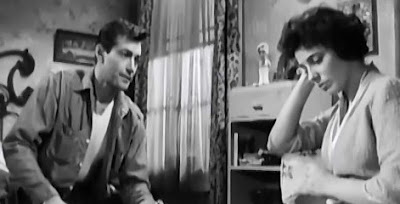
Rick Jason and Joan Collins
The Wayward Bus, taken from a John Steinbeck novel, is an unusual, imperfect, but ultimately worthwhile picture. With his handsome, masculine features and decided acting ability -- he gives a very strong performance in this -- Rick Jason should have become a major star, but the film was not a big hit. Almost completely deglamorized for this role of a drab housewife and cook, Joan Collins is less miscast than you might imagine and is effective. The romance between Dailey and Mansfield is never convincing, although Dailey is winning and Mansfield is at least competent, but there are dozens of actresses, Monroe included, who would have been stronger. Delores Michaels is lovely in the movie -- making much more of an impression than Mansfield -- but she only had a few credits after this. In addition to the actors already named, we have nice performances from Betty Lou Keim, as Norma the counter girl, and (Mr.) Dee Pollock as Kit, the teenager who assists Johnny and Alice; he had a long career. Robert Bray makes an impression as Morse, who has a hankering for Alice. 

In addition to some very good acting, The Wayward Bus has other plusses, such as the widescreen cinematography by Charles G. Clarke and a fine, evocative and highly interesting musical score by Leigh Harline. There is also a splendid action sequence when the bus must travel over a very, very long and crumbling wooden bridge directly over rushing rapids  -- this sequence is a nail-biter. The film was undoubtedly made just to take advantage of the publicity for the earlier Bus Stop, which starred Monroe, also featured bus trips and truck stops, and even had Robert Bray in the cast. 

Verdict: Memorable "lost" film with some very good performances. ***. 

Thursday, May 2, 2019

THE BOTTOM OF THE BOTTLE

Van Johnson and Ruth Roman
THE BOTTOM OF THE BOTTLE  (1956). Director: Henry Hathaway.

Near the Mexican border, lawyer "P. M." Martin (Joseph Cotten) gets an unwelcome visitor, his brother Donald (Van Johnson), who has just escaped from prison with five years to serve on a sentence for manslaughter. Donald can't cross the border to Mexico, where he wants to be reunited with his wife and children, because of rushing flood waters, and hopes PM will somehow get money to his family who are about to be put out on the street. Meanwhile Donald, using a fake name, meets his ultimately sympathetic sister-in-law, Nora (Ruth Roman of Lightning Strikes Twice), and the partying neighbors, while PM hopes Donald can resist temptation and not take a drink, the very thing that got him into trouble in the first place ...

Joseph Cotten and Ruth Roman
The Bottom of the Bottle certainly sets up an interesting situation, but at times it comes close to sinking under its contrivances. While not perfect casting for the rough-hewn, stupid, and rather unlikable and self-justifying Donald, Van Johnson [The Big Hangover] gives an excellent performance, with Cotten and Roman just a cut below in their portrayals. Johnson has an especially good scene when he's talking to his wife and small children on the phone, his heart clearly breaking from his being separated from them as well as his desperate circumstances.

Jack Carson, Van Johnson and Margaret Hayes
Jack Carson and Margaret Hayes are cast as neighbors, the Breckinridges, who hold frequent parties, with the wife almost recoiling from her husband's touch, setting up the dime store psychological notion that he's out to get Donald (when the latter robs a store of guns and liquor) out of some kind of sexual frustration. (Carson briefly affects a limp wrist as he leads the posse, whatever the heck that means.) There is an unintentionally comical moment when Johnson has a positive, even scary screaming meltdown in front of the Breckinridges and their reaction to this -- because the script has him being thrown out of their home at a somewhat later point -- is hardly what one would expect given his behavior. One gets the sense that most of the characters in this are acting the way they do because the script demands it of them, not because they are real people behaving in a realistic fashion. For instance, Nora's motivations for some of her lines and actions are not satisfactorily explained by her dissatisfaction with her marriage.

Despite its flaws, The Bottom of the Bottle isn't too easily dismissed, not just because of Johnson's performance, but because of the high-quality of Lee Garmes' widescreen cinematography and an effective score by Leigh Harline. There is some amazing stunt work when Donald is nearly run over by a train, and an exciting climatic battle between the two brothers on horseback in the raging river. The film also has a moving wind-up, although many things have not quite been resolved.

Verdict: Not exactly East of Eden, but not without its interesting aspects, and a fine dramatic performance from Van Johnson. **3/4. 

Thursday, April 11, 2019

GOOD MORNING, MISS DOVE

Prune-face: Jennifer Jones as Miss Dove
GOOD-MORNING, MISS DOVE (1955). Director: Henry Koster.

55-year-old geography teacher Miss Dove (Jennifer Jones) has to go into the hospital for tests, and uses the time to reflect upon her life and her influence upon her students. Known as "the terrible Miss Dove" by certain townspeople, she is a rather grim and completely humorless, outwardly unemotional old maid, but despite her demeanor she can be kind to her pupils, especially a young boy named William who grows up to become a cop (Chuck Connors). Both her nurse (Peggy Knudsen) and doctor (Robert Stack) and his wife (Kipp Hamilton of War of the Gargantuas), as well as the town priest (Biff Elliot) are also former students.

Chuck Connors with Jones
There are several moving sequences in Good Morning, Miss Dove, but while I generally admire sentiment in old movies, this picture becomes a bit too unrealistic. With her unpleasant personality it's hard to believe that that many townspeople would care that much about this persnickety, disapproving and prune-faced spinster, giving this an ending that is pure Hollywood. Jones, who realistically ages from about twenty to middle-age, gives a very good performance, but there are huge gaps that fail to explain exactly why she's become the way she is. An early sequence shows her regretfully turning down a suitor's (Marshall Thompson) proposal as she has a family obligation that forces her to work and repay a debt, but we never learn why there were apparently no other suitors during her youth. There is also some bad sitcom-like nonsense about a student who grows up to become a petty crook and escapes from jail.

Priest and doctor: Biff Elliot and Robert Stack

In addition to Jones, most of the cast members (including some marvelous child actors) acquit themselves nicely, with Thompson notable in his one sequence with Jones, and there's also good work from Connors [South Sea Woman] , Stack, etc. and especially Peggy Knudsen [Hilda Crane] as the nurse Billie Jean, who had a child out of wedlock. Leigh Harline has contributed a pleasant and soapy score that is effective for the picture. Good Morning, Miss Dove is quite similar to the 1941 movie Cheers for Miss Bishop, which also examines a small town and the life of a teacher, but is a much, much better movie.

Verdict: Good night, Miss Dove. **1/2.