Lively, entertaining reviews of, and essays on, old and newer films and everything relating to them, written by professional author William Schoell.
Showing posts with label 1944. Show all posts

Thursday, April 9, 2026

BEAUTIFUL BUT BROKE

Joan Davis
BEAUTIFUL BUT BROKE (1944). Director: Charles Barton. 

Dottie Duncan (Joan Davis) works for a talent agency run by Waldo Main (John Eldredge). Since war broke out, Main has had trouble putting together bands for clients, so Dottie offers him an all-female orchestra. Waldo winds up giving the agency to Dottie, who puts together a band with the help of friends Sally (Jane Frazee of Hellzapoppin) and Sue (Judy Clark of Junior Prom). Through a series of misadventures, the threesome and the band members wind up in a small town after Dottie loses their train tickets, and they provide entertainment so as to raise cash for a day care. Sally and Sue fall in love, with Army men Bill (John Hubbard) and Jack (Bob Haymes of Blonde from Brooklyn) respectively, so it's a question if Dottie can get them to fulfill their contract in Cleveland. 

Judy Clark swings it!
Beautiful But Broke
 is amiable nonsense with a patriotic slant and some amusing sequences, such as when the women, thrown out of their hotel, wind up in a house that's on a field being tested for missiles! Joan Davis gives her usual spirited performance, and Frazee and Clark are decorative and have some pep, but are otherwise stuck in a minor key. There is a lot of generally forgettable if snappy swing music. A protracted scene in which Joan, with her foot stuck to a plank, interacts with some construction men and causes more destruction than anything else, seems to go on for half the movie and isn't even funny. 

Verdict: As usual, Davis could use better material. **1/4. 

Thursday, June 8, 2023

BELLE OF THE YUKON

Randolph Scott and Gypsy Rose Lee
BELLE OF THE YUKON (1944).  Director: William A. Seiter. 

Former con man "Honest" John Calhoun (Randolph Scott of Captain Kidd) owns an Alaskan nightclub and saloon which is managed by Pop Candless (Charles Winninger). Pop's daughter, Lettie (Dinah Shore), is breathlessly in love with handsome piano player, Steve (William Marshall), but there is a rumor that Steve may have a wife and children. Then John's old girlfriend, an entertainer named Belle De Valle (Gypsy Rose Lee), turns up as the star attraction at the saloon  -- and with marriage in mind. When Honest John decides to open a bank and importunes everyone to put their money in it, the trouble really begins. 

Dinah Shore and William Marshall
Belle of the Yukon is one of those movies that is perfectly pleasant while it's unfolding, but when it's over you realize that there really wasn't much to it. There's no great plot to speak of aside from the misunderstandings between Lettie and Steve and John and Belle, and attempts to make off with the bank's gold engineered by George (Robert Armstrong) and Sheriff Maitland (Guinn "Big Boy" Williams). The songs by Burke and Van Heusen [Duffy's Tavern] are no great shakes although "A Slay Ride in July" is one that could grow on you. Scott is stalwart but not really a deft comedian; Gypsy Rose Lee (the subject of Gypsy) is okay but nothing that special; Dinah Shore sings quite well and is reasonably appealing; and William Marshall has little to do but look quite dreamy and now and then punch out the sheriff. Charles Winninger and Florence Bates as Lee's companion easily walk off with the movie, which so often was the case. 

Verdict: Amiable if minor-league piffle with some good performances. **1/2. 

Thursday, May 25, 2023

SAN FERNANDO VALLEY

SAN FERNANDO VALLEY (1944). Director: John English. 

At his ranch in the San Fernando Valley, crusty old Cyclone (Andrew Tombes of Meet the Boyfriend) finds his cowboys goofing off again to hang out and sing with his grand-daughter, Betty Lou (Jean Porter of Cry Danger). Disgusted, Betty Lou's older sister, Dale (Dale Evans), fires them all and replaces them with women, figuring Betty Lou will no longer hang around and distract the ranch hands. Dale nearly runs Roy Rogers (Roy Rogers) over with her car -- this take place in "modern" times -- and he tries to get a date to no avail. However, when Betty Lou, a mere child, gets a crush on Roy, Dale decides to have Roy romance her so that she will get over it. Naturally, the two fall in love. 

Meanwhile poor Oliver (Charles Smith) hopes to have Betty Lou fall in love with him, and the equally crusty Hattie (Dot Farley), sort of a den mother to the cowgirls, just might develop a yen for Cyclone. Roy and Dale, along with Bob Nolan and the Sons of the Pioneers, sing a few numbers, including the catchy title tune and "You're Too Good to be True." Oh yes, there's a plot of sorts when fired cowboy Matt (LeRoy Mason) and a buddy "borrow" some of Cyclone's valuable horses supposedly to get their jobs back but actually to get a lot of cash. Speaking of cash Roy's friend Keno (Edward Gargan of Behind the Mask) also wants to recover some money that was stolen from him, also by Matt. 

San Fernando Valley is amiable enough. It's more of a musical comedy than a western, although it does have some horse chases and gunplay and a couple of fistfights. It's funny that Roy and his horse Trigger are billed above the title but Dale Evans isn't. That would change in the future. As for Roy, his natural charm always helped carry his movies be they fair or foul. 

Verdict: Modestly entertaining Roy Rogers Movie. **3/4. 

Thursday, March 30, 2023

HOME IN INDIANA

Lon McCallister and Jeanne Crain
HOME IN INDIANA (1944). Director: Henry Hathaway. 

"If you'd been a boy we'd have been the greatest pals!" 

Orphaned "Sparke" Thornton (Lon McCallister), who got into some unspecified trouble in the big city, comes to live on his aunt and uncle's farm in Indiana. His first impulse is to run out the back door but then he discovers there's a stables and track -- and two pretty girls -- next door. His Uncle "Thunder" Bolt (Walter Brennan) himself has only one old and blind filly left, but Sparke contrives to secretly mate this animal with the neighbor's prize stallion, resulting in a possibly champion racing horse. It isn't long before Sparke, with the help of Thunder, "Char" (Jeanne Crain) and the more glamorous "Cri-Cri" (June Haver) -- not to mention stable boy Mo' (Willie Best) and employee Tuppy (George Reed) -- is off to the races! 

Charlotte Greenwood with McCallister
The performances -- by those named as well as a wonderful Charlotte  Greenwood as Aunt Penny -- greatly help put over this somewhat entertaining but unriveting horse drama. It seems Lon McCallister was too often teamed up with horses (The Boy from Indiana) and mules (Scudda Hoo!, Scudda Hey!, which reteamed him with Haver and Brennan) as often as he was with the ladies. He's earnest and appealing in that "gosh oh golly" way of his. He, Haver and Crain, although all three had had bit parts in previous films, were "introduced" in this movie.  McCallister plays very well with both Crain and Haver, although his switching his affections from one to the other occurs rather abruptly and without any real explanation. The girls' fathers are played by Ward Bond and Charles Dingle. Remade as April Love with Pat Boone.

Verdict: Horse lovers will get more of a kick out of this. **1/2. 

Thursday, January 19, 2023

FANNY BY GASLIGHT

Stewart Granger and Phyllis Calvert
FANNY BY GASLIGHT (aka Man of Evil/1944). Director: Anthony Asquith. 

In 19th century London young Fanny (Phyllis Calvert of Madonna of the Seven Moons) is unaware that her father, Hopwood (John Laurie), isn't her real father, and that he owns the brothel next door. When he is killed by a disgruntled patron, Lord Manderstroke (James Mason), the truth comes out and Fanny and her mother are ostracized. Fanny eventually reunites with her biological father, a cabinet minister named Clive Seymour (Stuart Lindsell) whose marriage to Fanny's mother was annulled by the family. After another tragedy, Fanny draws close to her father's business partner, Harry Somerford (Stewart Granger), but his hateful sister Kate (Cathleen Nesbitt) may destroy their plans for a union. Then there is Lord Manderstroke, who keeps popping up in Fanny's life when she least expects it ...

Margaretta Scott and James Mason
Fanny By Gaslight, is a good, old-fashioned, British "will our Fanny ever find happiness" rags to riches tale that is absorbing, entertaining, and very well-played. In addition to the actors already named, there is also good work from Margaretta Scott [Crescendo] as Seymour's unfaithful wife, Alicia, and Amy Veness as Mrs. Heaviside, the loving servant and former nanny to Clive, among others. If the convoluted plot weren't enough, there are also hookers doing the can can, a ballet sequence, and a duel with pistols outside Paris. Although sinister Mason doesn't have that much screen time, he nearly steals the show. Anthony Asquith also directed The Browning Version and many others. 

Verdict: Solid cast in an engaging melodrama. ***. 

Thursday, October 13, 2022

SEVEN DAYS ASHORE

SEVEN DAYS ASHORE
(1944). Director: John H. Auer. 

Daniel Arland (Alan Dinehart) goes to sea engaged to two different women -- Carol (Virginia Mayo) and Lucy (Amelita Ward) -- but his heart really belongs to Annabelle (Elaine Shepard). He has two buddies played by the strikingly mediocre team of dull Wally Brown and the thick-lipped, especially repellent Alan Carney. There's a midget-like girl singer named Dot Diamond (Marcy McGuire) who sings a snappy number now and then. But the most memorable scene in this mostly unmemorable movie is when Margaret Dumont, the Marx Brothers' favorite foil, warbles "Far Over the Waves" and is deliberately awful. 

Verdict: Seven days too many. **.

Thursday, August 18, 2022

ALI BABA AND THE FORTY THIEVES

Jon Hall as Ali
ALI BABA AND THE FORTY THIEVES (1944). Director: Arthur Lubin. 

Prince Ali (Scotty Becket) of Baghdad is the son of the king and has a little girlfriend in Amara (Yvette Duguay),  with whom he makes a blood pact. When the King is betrayed by Amara's father, Cassim (Frank Puglia of 20 Million Miles to Earth), Ali manages to escape. Cassim is working with Hulagu Kahn (Kurt Katch of The Mask of Dimitrios), leader of the Mongul hordes and the new king of Baghdad. Ali stumbles upon the cave where the forty thieves keep their booty, and is adopted by them, especially old Baba (Fortunio Bonanova) and the grumpy Abdullah (Andy Devine of Never Say Die), who resents being a "nurse maid" to the boy. The years go by and young Ali Baba, as he is now known, has managed to turn the thieves into freedom fighters (!) who strike swiftly at the Mongolians. Cassin's beautiful daughter, now grown (and played by Maria Montez), is betrothed to Kahn, but falls for the handsome thief, Ali Baba. Eventually they will realize who the other one really is, but in the meantime Kahn is determined to kill one and marry the other ... 
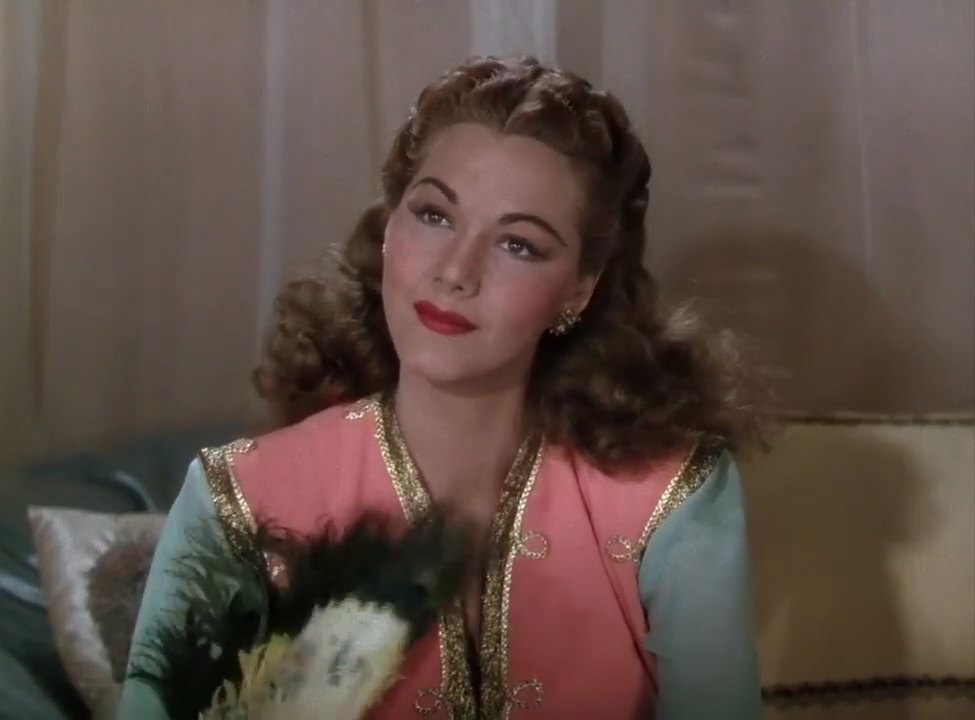
Maria Montez
Ali Baba takes the story from "The Thousand and One Nights" and does its best to turn it into a tale of WW2-style oppression and resistance although it never really loses its fantastic flavoring. Part of this is the casting of Montez -- the only actor with her name above the title despite the fact that even she complained that it was Hall's picture -- and again she proves more than adequate for the proceedings, although much of her part consists of merely reacting to what is going on around her. Hall gives a good performance, as adept at the derring do as he is at pitching the woo. Scotty Becket, as always, is just as good as Ali as a boy. Devine, Bonanova, Puglia, and especially Kurt Katch as the loathsome Kahn, head up the supporting cast, along with Turban Bey, who is fine as a slave boy who assists both Amara and Ali. Like the earlier Arabian Nights, Universal pulled out all the stops for this flick, which is bathed in rich technicolor and has an exciting score by Edward Ward. Arthur Lubin's direction is not quite on the same level but he does keep things moving. 

Verdict: Colorful fantasy flick -- open sesame! ***. 

Thursday, October 14, 2021

RAIDERS OF GHOST CITY

Wanda McKay, Joe Sawyer, and Dennis Moore
RAIDERS OF GHOST CITY (13 chapter Universal serial/1944). Directed by Lewis D. Collins and Ray Taylor. 

Near the end of the Civil War an organization of Confederate spies is actually the front for gold thieves operating out of Oro Grande, California. But even these desperadoes are being double-crossed by a couple of Prussian agents who need the gold so that they can buy Alaska! Trying to thwart their efforts is Captain Steve Clark (Dennis Moore) of the U.S. Secret Service, aided by Idaho Jones (Joe Sawyer), a Wells Fargo detective, and Cathy Haines (Wanda McKay), a Wells Fargo county agent. 

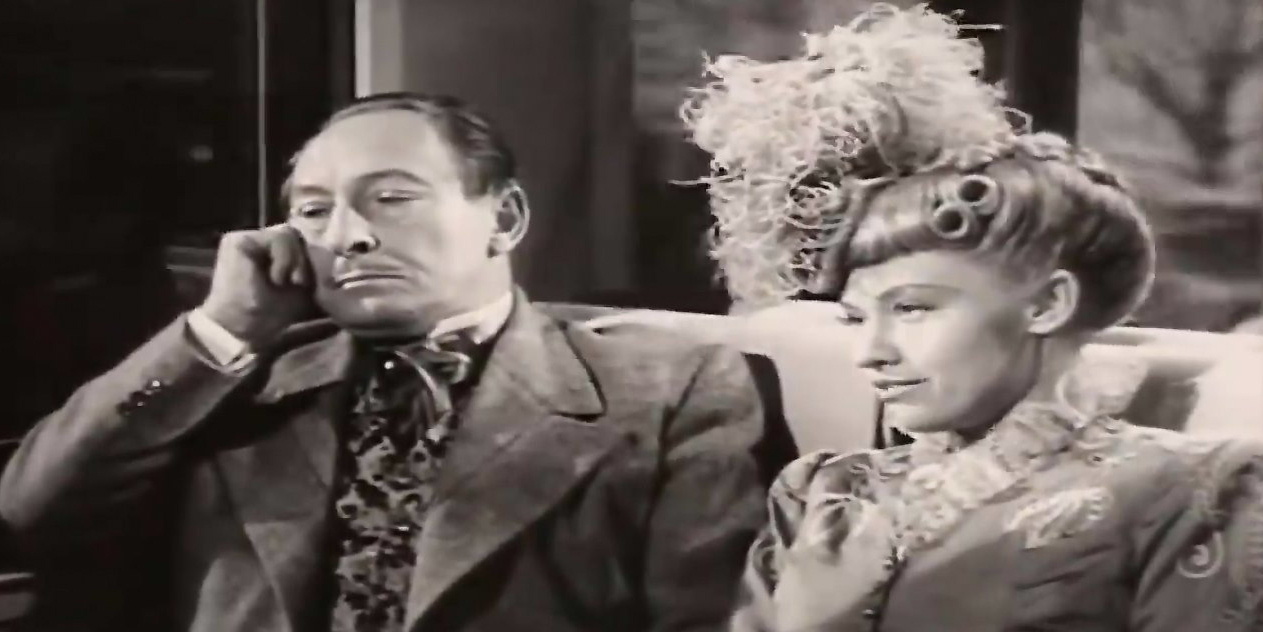
Lionel Atwill and Virginia Christine
Their main antagonists are Erich von Rugen (Lionel Atwill of Captain America) and the deliciously ruthless Countess Elsa von Merck (Virginia Christine of Three Brave Men), who doubles as a saloon singer named Trina Dessard. They report to a Count Manfried von Richten (Emmett Vogan of Docks of New Orleans). Regis Toomey is Captain Clay Randolph, a legitimate rebel who doesn't realize what the others are up to and only wants the gold to aid the war effort.

Moore, Christine and Sawyer
Westerns have never been my favorite serial genre, but I must say that Raiders of Ghost City -- the title refers to a ghost town not far from Ora Grande -- has made a believer of me, for this is quite well-made, with an especially flavorful screenplay. In cliffhanger sequences a runaway stage coach falls into a river, and Steve is trapped in a cave with rapidly rising water. Chapter eight features a thrilling, expertly-edited chase scene with an entire gang in pursuit of Idaho. The first and tenth chapters have the best cliffhangers: an uncoupled car begins rolling backwards towards disaster during a frantic fist fight; and Idaho is nearly drawn and quartered by Modoc Indians in a very suspenseful sequence. The four main players are all excellent and the supporting players are well cast. 

Verdict: Very exciting, well-made, and well-played Columbia serial. ***1/4. 

Thursday, August 23, 2018

UP IN ARMS

UP IN ARMS (1944). Director: Elliott Nugent.

Danny Weems (Danny Kaye, in his film debut) is a hopeless hypochondriac who not only thinks he has every ailment imaginable but convinces others as well (in the film's funniest sequences). Danny is also hopelessly smitten with pretty Mary (Constance Dowling) who only has eyes for Danny's buddy, Joe (Dana Andrews of Where the Sidewalk Ends). Meanwhile, nurse Virginia (Dinah Shore of Follow the Boys) is unrequitedly in love with Danny. Then Danny and Joe get drafted and the two gals join up as nurses, wherein all four find themselves on a ship sailing into the Pacific war zone. Up in Arms is supposedly a remake of Eddie Cantor's Whoopee, with the setting transferred from the wild west to WW2, where the sight of singing and dancing on a ship sailing into combat seems pretty silly. Indeed, although the movie starts off quite well, it soon becomes a little too silly, although Kaye is a wonderful performer and emerged a major star after this. Andrews, Dowling and Shore are marvelous support, and Shore gets to sing two memorable numbers, "Wildest Dreams" and "I Had a Man." A very odd sequence occurs when the two men and the two gals are sitting back to back on a bus, carrying on a conversation while pretending (according to military edict) not to know one another, with the result that it appears as if Kaye and Andrews -- and Dowling and Shore -- are wooing one another! The decidedly homophobic reactions from the other passengers, considering the time period, are a little discomfiting! Other cast members include Lyle Talbot (typically bland as a sergeant); Louis Calhern as a colonel; Margaret Dumont [Shake, Rattle and Roll], looking rather slender in a scene in a movie theater lobby; Elisha Cook Jr., Benny Baker, and George Mathews as fellow sailors; and Virginia Mayo as one of the beauteous Goldwyn Girls -- in short order Mayo would be deservedly co-starring with Kaye in several pictures. Constance Dowling (sister of Doris Dowling) was a pretty, perfectly competent actress, somewhat reminiscent of Veronica Lake, who made her debut in this film and made just a few others, often in Italy.

Verdict: Amiable nonsense that has little to do with the actual war. **1/2. 

BROADWAY RHYTHM

George Murphy and Ginny Simms
BROADWAY RHYTHM (1944). Director: Roy Del Ruth.

John Demming (George Murphy) is a Broadway producer and dancer who is planning a new show and hoping to get film star Helen Hoyt (Ginny Simms) for the lead. For her part, Helen thinks John's script is too "arty" and she can't afford a flop, but she is importuned by John's father Sam (Charles Winninger), to appear in his production, a show about the illustrious Demming family itself. John's sister, Patsy, (Gloria DeHaven) also gets into the act. Broadway Rhythm is a sort of oddity, a backstage musical with a creaky "let's put-on-a-show" plot that is filmed in startling Technicolor. The songs feature the work of a number of composers, but except for a couple of old standards, they are mostly forgettable. The film's musical highlights include Lena Horne (playing a character instead of herself but getting little dialogue) singing "Somebody Loves Me," and Charles Winninger and Tommy Dorsey teaming for "I Love Corny Music." Murphy [No Questions Asked] is smooth and pleasant, as is Simms [Night and Day] in one of her infrequent film appearances; DeHaven is also notable. Charles Winninger [Destry Rides Again] is as winning as ever, and whether singing or clowning Nancy Walker is delightfully deadpan throughout. Others in the cast include perky singer Kenny Bowers; Eddie "Rochester" Anderson; the excellent dancer Walter B. Long (his only film appearance); Sara Haden (in an unbilled bit as a school headmistress); and Ben Blue as Felix. Dean Murphy certainly makes an "impression" as a farmhand who is also an expert impressionist, imitating everyone from Mortimer Snerd to Jimmy Stewart to Cary Grant to (hilariously) Bette Davis! The Ross Sisters do an awful number called "Potato Salad," but they are certainly skilled contortionists if nothing else. Tommy Dorsey proves as personable as rival band leader Kay Kyser in this.

Verdict: Oddball but entertaining musical. **1/2. 

Thursday, July 19, 2018

ZORRO'S BLACK WHIP

Linda Stirling and George J. Lewis
ZORRO'S BLACK WHIP (12 chapter Republic serial/1944). Directors: Spencer Gordon Bennet; Wallace Grissell.

Newspaper editor and publisher Randy Meredith (Jay Kirby of Rockin' in the Rockies) not only rails against the lawlessness of 1889 Idaho in his paper, but dresses up as the Black Whip to fight the bad guys. When he is murdered, his sister Barbara (Linda Stirling) takes over the role, and she proves to be mighty handy with a whip. The evil banker Hammond (Francis McDonald) is secretly leading a group of criminals who desperately want to prevent Idaho from becoming a state, which would interfere with their plans to enrich their own coffers. Barbara is helped by a secret government agent, Vic Gordon (George J. Lewis), who disguises himself as the Black Whip at one point to fool the crumb bums when they have almost figured out Barbara's secret identity. The one thing that's missing in this exciting serial is the character of Zorro, whose name is used for marquee value but who does not appear, although one could argue that the Black Whip is a variation on that character (along with many others, of course). Cliffhanger highlights include a wagon rolling over the edge of a cliff; Barbara being locked in a bank vault with a bomb that's about to go off; the bad guys ordering Barbara to "take off that mask!" or else they'll shoot Gordon; and especially the sequence when a whole mountain seems to come down on the cabin they're in, as well as a terrific bit when Barbara and Gordon are trapped in a mine with burning oil flooding towards them. Stirling was never a great actress, but she's more than competent for this type of material; Lewis has a certain degree of charm and ability; McDonald [Burn 'Em Up Barnes] makes an effective and oily two-faced villain, and Hal Taliaferro (who looks a bit and sounds a lot like Ben Johnson) is also good as his bad right hand, Baxter. Lucien Littlefield [Reducing] makes his mark as "Ten Point," the nervous little guy who works in the newspaper office. John Hamilton is one of the townspeople dedicated to ridding the town of the criminal element; Marshall Reed and Ken Terrell also have smaller roles. Zorro's Black Whip has a great climax with the gang attacking the town in an attempt to alter the election results, and loathsome Hammond is given a satisfying death scene. Zorro's Black Whip may not be a top-notch Republic serial -- and is quite short as serials go -- but it is exciting and entertaining. George J. Lewis played a villain in Federal Operator 99, and Taliaferro was his henchman. Stirling appeared in The Purple Monster Strikes and many other serials.

Verdict: This gal wields a mean whip! ***. 

Thursday, April 12, 2018

IN THE MEANTIME, DARLING

Jeanne Crain and Frank Latimore
IN THE MEANTIME, DARLING (1944). Produced and directed by Otto Preminger.

Maggie (Jeanne Crain of State Fair) is a somewhat spoiled, upper-class gal who arrives at a seedy hotel off base to marry Lt. Daniel Ferguson (Frank Latimore). Maggie loves Danny, but she is dismayed by the lack of privacy and living conditions in the hotel, which is run by the widow Armstrong (Jane Randolph), whose husband was killed overseas. Maggie tries to pitch in with the other gals but finds she has little training for anything. Then Danny mistakenly believes that Maggie has gotten pregnant ... In the Meantime, Darling is a minor but still significant film that looks at the problems of women who every day have to face the fact that their husbands may go off to war and never come back, and there is an air of poignancy and sorrow because of it. There is an especially lovely and sobering scene when Maggie goes into Mrs. Armstrong's apartment and sees the wedding pictures and other photos, then comes upon the announcement of her husband's posthumous awards from the Army. Crain and Latimore both give excellent performances as the lead couple, and there is nice work from Gail Robbins [The Fuller Brush Girl] as another wife named Shirley. (One can't realistically imagine this marriage lasting, however, as Shirley's husband, Phil, played by Stanley Prager, is not only fat and homely but rather insensitive to his wife's needs as well.) Clarence Muse is also notable as Henry, the black porter for the hotel, who does not play in a subservient fashion and whose character's son is also in the Army overseas. Henry is treated as a three-dimensional African-American character, a rarity in this time period. Other cast members include Eugene Pallette, Mary Nash (as an especially disagreeable mother-in-law), Olin Howland, Elisabeth Risdon, Glenn Langan, and even Blake Edwards in the acting phase of his career in an uncredited bit. This was the first picture for Latimore, who also appeared in 13 Rue Madeleine with James Cagney, Shock with Vincent Price, and ultimately amassed 70 credits.

Verdict: Warm and sentimental in the right way, and very well-performed. ***.

Thursday, February 15, 2018

MEN ON HER MIND

Mary Beth Hughes
MEN ON HER MIND (1944). Director: Wallace Fox.

Making her debut on the radio, singer Lily Durrell (Mary Beth Hughes) thinks back on her involvement with several men who fell in love with her on her pathway to success. These include a trucker, Joe (Lyle Lytell); a music teacher and aspiring songwriter named Jim (Ted North); a wealthy socialite named Jeff (Edward Norris of Jungle Queen); and a rich patron of the arts named Roland Palmer (Alan Edwards). Along the way Lily also gets involved in murder, an alleged jewel theft, and poses as a phys ed teacher at an all-girls' school. Breaking a number of hearts along the way, she eventually settles on the right man ... Men On Her Mind is an entertaining, if minor, PRC light drama with a winning performance by Hughes [Dressed to Kill], who managed to amass over a hundred credits in films and on television. The beautiful actress also had an excellent singing voice, and does a nice job with both "Ave Maria" and the movie's one new tune, "Heaven on Earth." Hughes was married to Ted North when the film was made, but their union only lasted three years. Wallace Fox also directed Pillow of Death and a number of cliffhanger serials.

Verdict: By PRC standards this isn't too shabby. **1/2.

Friday, October 13, 2017

HOLLYWOOD CANTEEN

Davis, Leslie, Garfield and Hutton
HOLLYWOOD CANTEEN (1944). Director: Delmer Daves.

Corporal Slim Green (Robert Hutton) and his buddy Sergeant Nowland (Dane Clark) are on leave in LA when they drop by the Hollywood Canteen. The canteen was started by Bette Davis and John Garfield, and both stars play a prominent role in the film, which is basically built around Slim wanting to meet actress Joan Leslie, playing herself, and the romance that ensues. During this, a number of stars either appear or do numbers. Among the highlights: Dennis Morgan and Joe E. Brown sing "You Can Always Tell a Yank;" The Andrews Sisters perform "We're Getting Corns for Our Country;" Jack Benny and Joseph Szigeti have a comical duel of violins; Joan McCracken does a jazz ballet production number; a Spanish dance number from Rosario and Antonio; and Kitty Carlisle singing "Sweet Dreams, Sweetheart." Peter Lorre and Sydney Greenstreet have an amusing cameo, and there are lots of guest appearances by a host of stars, some of whom you may miss if you blink (Eleanor Parker, for instance). Davis and Garfield are wonderful playing themselves; Dane Clark has an affecting moment when his character realizes that he no longer needs to use his cane; and Robert Hutton is excellent as the shy, sensitive small-town fellow who develops quite a crush on Leslie, who gives a winning performance as well. Zachary Scott and Barbara Stanwyck have notable cameos, and Janis Paige makes a decided impression as a studio messenger who pretends to be an actress. Corporal Green addresses his fellow fighting men and allies at one point, and mentions "our own colored boys" as it flashes to a shot of several black soldiers. Good. Although Hutton never became a major star (this was his fourth picture) he did amass 90 credits in his long career. However, the one single actor who has the most sheer presence in the two hour film is the formidable Joan Crawford.

Verdict: Entertaining, and ultimately quite moving. ***.

DUET FOR BUGS

Bugs Bunny and the Fabulous Elmer Fudd
STAGE DOOR CARTOON (1944). Director: Friz Freleng.
HERR MEETS HARE (1945). Director: Friz Freleng.

The DVD for Hollywood Canteen features two vintage wartime Bugs Bunny cartoons. In the first, Stage Door Cartoon, the "wascally wabbitt" is chased by Elmer Fudd into a theater, where the luckless hunter is forced to perform on stage for an audience, including a bit where he does a frightfully high dive into a very, very small glass of water. In Herr Meets Hare, Bugs takes a wrong turn at Albuquerque and winds up in Germany, where he encounters a Nazi hunter and even Adolf Hitler. At one point Bugs pretends to be a diva in a Wagnerian opera (recalling the classic What's Opera, Doc?). As usual, Mel Blanc does his brilliant voice characterizations.

The strange thing is that the latter cartoon features a disclaimer from TCM (which released the DVD) about ethnic and racial stereotyping, but the only stereotypes in the cartoon are of Nazis. Have we become so ridiculously politically correct that we have to worry about offending Nazis? Oy vey!

Verdict: Amusing, fluid, and well-done cartoons. ***.

Thursday, October 5, 2017

ABROAD WITH TWO YANKS

Battling Beauties? William Bendix and Dennis O'Keefe
ABROAD WITH TWO YANKS (1944). Director: Allan Dwan.

"I came over here to wear a uniform, not a girdle!" -- Biff

Biff (William Bendix) and Jeff (Dennis O'Keefe), two marines on leave in Australia,  are more or less friendly rivals (although the casting of the handsome O'Keefe doesn't exactly level the playing field!), especially when it comes to women. Jeff pretends to be Biff so he can get in good with Joyce (Helen Walker), who is anxious to meet Biff because he saved the life of family friend, Cyril (John Loder). The first half of the film, in which Jeff tries to maintain the impersonation while Biff suggests to Joyce that his "pal" has mental troubles, is pretty average and even silly, but the picture certainly picks up in the second half. For unaccountable reasons the Marine sergeant wants some of the guys to dress up as gals during a show, but both Biff and Jeff take off in drag with the latter intent on proposing to Joyce while the former wants Cyril to have a shot at it. There are hilarious developments as these two gals romp around a social event trying to get the better of the other one. William Bendix [The Big Steal], always a fine actor in either comedy or drama, has a ball playing the sensitive, likable but feisty Biff, while O'Keefe also offers a fine comic performance as his hated buddy. A highlight is watching Bendix warbling "All I Need is a Man!" Helen Walker [Nightmare Alley] might seem an odd choice for this kind of material but she's winning throughout. John Loder is blandly professional, as usual. Walker and O'Keefe also appeared in Brewster's Millions, in  which they were not nearly as effective.

Verdict: After a slow start, this is a very funny service comedy. ***.

Thursday, May 18, 2017

ONE MYSTERIOUS NIGHT

Richard Lane as Inspector Farraday
ONE MYSTERIOUS NIGHT (1944). Director: Budd Boetticher.

When the famous Blue Star of the Nile diamond is stolen, Boston Blackie (Chester Morris) becomes a suspect. In an unexpected development considering their past relationship, Inspector Farraday (Richard Lane) deputizes Boston because he thinks he can solve the crime. He even says " From now on, no matter what happens, I'll never misjudge you again." Unfortunately, this is the only unusual or interesting thing that happens in the movie, which is saved primarily by the acting. Morris [Pursuit]  makes an excellent Blackie, and does a few impersonations, and the supporting cast includes Janis Carter [Slightly French] as reporter Dorothy Anderson; Mark Roberts (aka Robert E. Scott) as store employee George Daley; an utterly unrecognizable Dorothy Malone (in her brunette phase) as George's sister, Eileen; and William Wright, who would later play the Lone Wolf in one picture, as bad guy Paul Martens. The best performances seem to come from bit players: (Ms.) Early Cantrell as a switchboard operator; Anne Loos as a newsstand clerk; and Minerva Urecal [Gobs and Gals] as a clerk at a women's hotel. There's a quick laugh involving a Murphy bed in which Boston and the Runt (George E. Stone) are secreted. Like many of these programmers, this one has no real suspense or surprises.

Verdict: Not nearly "mysterious" enough. **.


Thursday, April 27, 2017

TO HAVE AND HAVE NOT

Lauren Bacall and Hoagy Carmichael
TO HAVE AND HAVE NOT (1944). Director: Howard Hawks.

Charter boat captain Harry Morgan (Humphrey Bogart) meets up with adventuress Marie (Lauren Bacall) in Martinique just after France has fallen. Needing money, Harry agrees to bring two members of the French resistance, De Bursac (Walter Szurovy) and his wife (Delores Moran of Old Acquaintance), into Martinique, but he comes afoul of the corpulent Captain Renard once they arrive. Renard wants their whereabouts, and captures Harry's old sot friend, Eddie (Walter Brennan) to achieve his ends. But Harry may have a trick  or two up his sleeve ...  If you're expecting a serious or faithful version of Ernest Hemingway's novel of the same name, look elsewhere, for this movie is pure Hollywood and little else. Bogart and Bacall, who fell for each other while making this movie -- they were married the following year -- certainly had a unique chemistry despite the difference in ages and attractiveness. This was Bacall's first picture, and she's fine, probably due in no small measure to Hawks' special tutoring . Dan Seymour [Return of the Fly] is just plain strange as Renard, but amusing, speaking in musical cadences as he makes silent threats with his eyes and belly. Walter Brennan is Walter Brennan. The presence of real-life songwriter Hoagy Carmichael as Crickett, the piano player in a club, almost turns this into a semi-musical. The best thing about the movie is the ending, with both Bacall and Brennan boogieing their way out of the club, albeit in entirely different manners. As a thriller, if that's what it is, To Have and Have Not is almost a complete failure, as scenes that should crackle with tension are flat (if well-acted). The movie holds the attention for the most part, but it's a little too odd and Hollywood-ish to be effective. This was remade as The Breaking Point, which is a much better and much more serious picture.

Verdict: Not much to do with Ernest Hemingway. **1/2.

Thursday, April 13, 2017

FOUR JILLS IN A JEEP

Martha Raye, Carole Landis, Kay Francis, Mitzi Mayfair
FOUR JILLS IN A JEEP (1944). Director: William A. Seiter.

Loosely based on the wartime experiences of the four leading ladies, this has them playing themselves as they go on an entertainment tour for the fighting GI's. Kay Francis, who can't sing or dance, acts as the mistress of ceremonies, while Carole Landis sings, Mitzi Mayfair dances, and Martha Raye (who was not a bad singer herself) mugs and makes the usual jokes about her appearance. John Harvey [The Man with My Face]  plays Landis' love interest, who marries her during the film (Landis did marry an Army man during the war but the union only lasted two years). Phil Silvers plays the Army jeep driver who escorts the ladies everywhere and tries to get a date with Raye. Dick Haymes [Irish Eyes are Smiling] is cast as Mayfield's love interest and he offers a smooth delivery of a couple of romantic ballads. Bandleader Jimmy Dorsey [Lost in a Harem] is pleasant playing himself. Landis' apprehension when Harvey, a flier, is late in coming back from a mission is well delineated, but it leads to an odd sequence. One of the other pilots crashes off-screen and literally a second later Harvey shows up for a clinch., but neither of them ever say a word about the flier who was presumably killed, making them seem cold-blooded to say the least. The film's highlights include Mayfair's scintillating dance numbers; Betty Grable singing "Cuddle Up a Little Closer;" the drag queen-like Carmen Miranda dancing and warbling in her inimitable manner; and especially Alice Faye's moving rendition of  her haunting signature tune, "You''ll Never Know." Another terrific number, Rayes' "With a Wing and a Prayer," was left on the cutting room floor but can be seen on the DVD along with Miranda's rendition of "Mama yo quero." The songs were by McHugh and Adamson. Mayfair was essentially a Broadway tap dancer and made few films. She's cute, perky, and talented, and could have had a nice career playing second leads in romantic musicals.

Verdict: For what it is, a kind of time capsule with good performances from all. ***.

Thursday, March 23, 2017

GASLIGHT (1944)

Boyer and Bergman
GASLIGHT (1944). Director: George Cukor.

Paula Alquist (Ingrid Bergman) lived in a house in London with her aunt, a famous opera singer who was strangled to death. Years later she comes back to that house with her new husband, Gregory Anton (Charles Boyer). The autocratic Anton berates Paula for her bad memory and for losing things and inexplicably taking pictures from the wall and hiding them. Is Paula going crazy or is there something more sinister going on? Gaslight doesn't make any attempt to disguise the identity of the bad guy in this, but the film is suspenseful in spite of it. Bergman won her well-deserved first Oscar for her portrayal of the confused Paula, and Boyer is equally expert and fascinating. In her first film role, Angela Lansbury [A Life at Stake] scores as the saucy, borderline rude maid, Nancy, and Dame May Whitty is charming as the nosy old biddy, Miss Thwaites. Joseph Cotten offers another effective portrait as a policeman who once met Paula's aunt and is struck by the resemblance; against orders, he takes a new interest in the case. Barbara Everest is also notable as the cook, Elizabeth. The best scene in the film is when Paula nearly has a nervous breakdown at a piano concert. Although Cukor was not a suspense specialist along the lines of Hitchcock, he still manages to craft a nifty thriller, as he did with A Woman's Face. Bergman and Boyer re-teamed for much less felicitous results in Arch of Triumph, as the chemistry just wasn't right for those particular characterizations. At one point Paula shows her husband a glove worn by her aunt and signed by no less than Charles Gounod, in whose Romeo and Juliet she had performed -- what a memento! This is far superior to the 1940 British version of the story.

Verdict: A mesmerizing performance by a resplendent Bergman and fine support from Boyer, Cotten, and Lansbury.  ***1/2.