Lively, entertaining reviews of, and essays on, old and newer films and everything relating to them, written by professional author William Schoell.
Showing posts with label musical. Show all posts

Thursday, June 18, 2026

I COULD GO ON SINGING

Garland sings with the school boys
I COULD GO ON SINGING (1963). Director: Ronald Neame.

"I've held on to every bit of rubbish in life, and thrown all the good bits away."

"Alone. It's an awful word. And I know what it means."

Jenny Bowman (Judy Garland) had a child with lover David Donne (Dirk Bogarde) years before, but wouldn't give up her singing career to marry him or care for their child. Now she's a big success doing a tour in London, Donne is also a successful doctor, and their son is a charming young lad, Matt (Gregory Phillips) in boarding school. Once she meets Matt, Jenny realizes she wants the boy to be part of her life on a permanent basis, but is that the best thing for the boy and is it possible for David to forget -- and forgive -- the past? 

Garland's final film is clearly fashioned for her talents -- at times you get the distinct impression she's only playing a variation of herself (although playing it well) --  and she comes through with flying colors, and Bogarde is also excellent; the two play marvelously together. They get fine support from Phillips as the boy and Jack Klugman as Jenny's manager. One could quibble that this is primarily a showcase for Garland's singing talents, and that the characters and storyline could use a lot more fleshing out, but the film boasts beautiful widescreen photography and handsome production values to go with the first-rate performances. As for Garland's singing, this film probably illustrates why her fans found her legendary even when she was near the end of her life. Her performances of the title tune, "All By Myself," and especially "It Never Was You" and "Hello, Bluebird, Hello" make it clear that the gal was one hell of a gifted singer with strong interpretive skills to say the least. A very charming scene has Garland at the piano singing along with the British schoolboys, including her son, who have just given a performance of "H.M.S. Pinafore." Some of Garland's dialogue sounds like snippets from her own life.  This film presents the Garland mystique far better than End of the Rainbow. This was Garland's last movie.

Verdict: A fitting filmic swan song for Judy Garland. ***.  

Thursday, January 29, 2026

CHU CHIN CHOW

Fritz Kortner and Anna May Wong
CHU CHIN CHOW (1934). Director: Walter Forde. Colorized.  

Now here is a weird one! Chu Chin Chow was originally a highly popular British operetta with music by Frederick Norton that played for years, but is now more or less forgotten. This very interesting film version has only one cast member whose name may be familiar to modern-day film buffs -- Anna May Wong -- although the other players were all well-known in their day. This adaptation uses some of Norton's wonderful (at times Puccinesque) music but drops some of his best songs. It is a version of the story of Ali Baba and the forty thieves. 

Pearl Argyle and John Garrick
Ali Baba (George Robey) is the brother of the much more successful merchant Kasim (Lawrence Hanray). One day looking for firewood in the Dark Forest, Ali discovers the supposedly magic words to open the entrance to the cave of Abu Hasan (Fritz Kortner of Somewhere in the Night) and his band of thieves and cutthroats. Ali makes off with as much booty as he can and becomes one of the richest men in town. Meanwhile Abu and his men waylay the party of the Chinese Chu Chin Chow and kill everyone, even burying the Chinese man alive; Abu impersonates the dead man, planning to sack the palace. Ali's son Nur-al-din (John Garrick) is in love with the gorgeous slave Marjanah (Pearl Argyle) while another slave, Zahrat (Anna May Wong of Daughter of Shanghai), is the beloved of the evil Abu. These characters all come into conflict with one another in unpredictable fashion until Abu secrets his men in large jars of olive oil planning to attack -- until his plans are stymied in violent fashion.

Lawrence Hanray and George Robey
Chu Chin Chow
 is strange because it is essentially a light-hearted operetta but has some decidedly grim and bloody developments. When Kasim discovers how his brother got his money, he enters Abu's cave only to be dismembered by forty slashing scimitars (although this is not shown graphically). Later a cobbler has to literally sew the pieces together (!) so the corpse can be presentable. Ali, not an especially likable character, immediately moves in on his brother's fat and unmournful widow. (The song about her, "When a pullet is plump," is dropped). The climax, with dancing girls, an initially unimpressed Caliph (Francis L. Sullivan), a knife attack by a vengeful Zahrat, and the jars allegedly filled with olive oil being dropped down a well followed by flaming liquid, is very well-done and exciting. 

An interesting notion is that the cave door is not opened by magic. When someone shouts out "Open O Sesame" a bunch of Abu's prisoners, starved, whipped and tied to a gigantic wheel, revolve this wheel to open the entrance. When Abu wrongly thinks that Zahrat has betrayed him, he ties her to the wheel until she effects an escape and enacts her revenge. The score includes "The Cobbler's Song," the thieves march, "Anytime's Kissing Time," "Marjanah,"  the title tune (sung briefly), as well as a song about the variety of slaves in the market and even one about olive oil, but doesn't include Norton's two best numbers "I Long for the Sun" and "I Love Thee So." Another version of the famous story is Ali Baba and the Forty Thieves starring Jon Hall and Maria Montez.

Verdict: Rather fascinating and unusual musical. ***. 

Thursday, March 30, 2023

APRIL LOVE

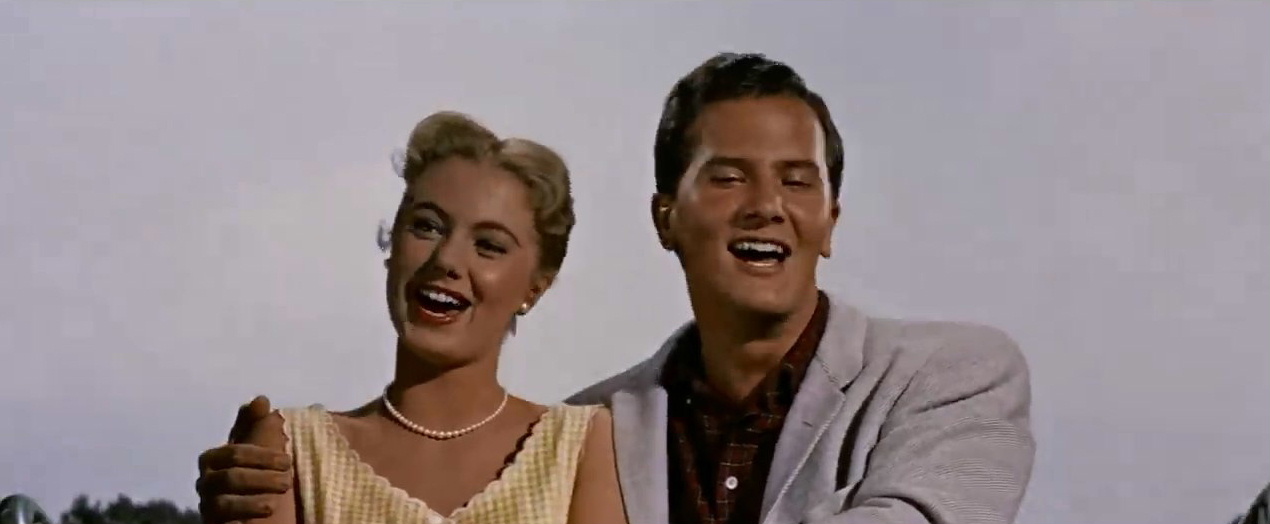
Sing out: Shirley Jones and Patty Boone
APRIL LOVE (1957). Director: Henry Levin. 

Nick Conover (Pat Boone of State Fair) is supposedly a "bad boy" who was sent from Chicago to Kentucky by his mother after his being arrested for taking a joy ride. Living with his Aunt Henrietta (Jeanette Nolan) and grumpy Uncle Jed (Arthur O'Connell of Anatomy of a Murder) on their farm, he fixes the old man's tractor and develops a crush on the neighbor gal, Fran (Delores Michaels). This doesn't sit well with Fran's sister, Liz (Shirley Jones), who develops a yen for Nick herself. And besides, Fran already has a boyfriend in Dan (Matt Crowley). Before a major triangle can develop, however, Nick bonds with a beautiful horse named Tugfire, who used to belong to Jed's son (who was killed in the war), and before you know it he's off to the races! But will his bad behavior back in Chicago catch up with him? 

Off to the races!
Hardly a classic, April Love succeeds on sheer amiability and the likability of its players. With a credible Boone in the lead the film becomes a musical, with him and others warbling several numbers. A couple of these are instantly forgettable but "A Gentle Girl" and the title tune are pleasant numbers, very well-sung by Boone, who now and then reminds one of Crosby. Delores Michaels [The Wayward Bus] was an attractive and talented actress who had a limited number of credits. Second lead Matt Crowley mostly had television credits. Henry Levin was a very busy director who worked with Boone on three films. 

NOTE:  April Love is a remake of Home in Indiana, which has a bit more pathos and sentiment but is not as smooth and entertaining as this. This version turns the two rivals for the hero's affections into sisters, and also gives the uncle a son who died in the war. It eliminates the likable if stereotypical black characters. There are no musical numbers in the original film.  

Verdict: The horse nearly steals the show! ***. 

Thursday, August 18, 2022

WAKE UP AND DREAM

Jun Haver and John Payne
WAKE UP AND DREAM (1946). Director: Lloyd Bacon. 

Jeff Cairn (John Payne) lives with his little sister, Nella (Connie Marshall), on a farm during WW2. Although he could get a deferment, he enlists in the Navy and says good-bye to his sort of sweetheart, waitress Jenny (June Haver). Then a notice comes saying that Jeff is Missing in Action. Nella and Jenny, in convoluted fashion that never quite makes sense, wind up on a drydocked boat built by the old curmudgeon, Henry Pecket (Clem Bevans). With the aid of Howard Williams (John Ireland), Peckett is able to set sail (sans permit or any special plan) and Jenny, Nella and Howard go with him. Nella is hoping they will sail to some beautiful island where she will be reunited with her brother, but instead they wind up literally stuck in the mud. 

Haver with John Ireland 
Say one thing for Wake Up and Dream, one of the oddest musicals I've ever seen, it is unpredictable. Oh it's no great surprise that Jeff turns up alive after missing most of the movie (a pretty much wasted role for Payne),  but other events are not so certain. Payne introduces the song "Give Me the Simple Life" early in the picture, and Haver warbles the pretty "I Wish I Could Tell You" but then in a much later sequence a chorus starts singing "We're Off to See the Wizard" [!] as the group trek into the swamp after a hermit that Nella has discovered. One could argue that the movie offers a message of hope, but when you consider that most men listed as missing in action were actually dead, it's perhaps not in the best of taste. In any case, all of the performances are quite good, including Charlotte Greenwood as a widow who takes in boarders and Irving Bacon as a toll gate attendant. Lee Patrick is in the picture but I must have blinked and completely missed her. Based on a novel by Robert Nathan, this has all the earmarks of a screenplay that was cut and pasted together. Some good dialogue, however. 

Verdict: 20th Century-Fox was no MGM when it came to (semi) musicals. **1/2. 

Thursday, May 27, 2021

STINGAREE

STINGAREE (1934). Director: William Wellman. "

You'll be just as safe here -- as you want to be." 

Bizarre but likable comedy-drama-musical-what-the hell? with Irene Dunne as Hilda Bouverie, who desperately wants a career as a singer, and Richard Dix as "Stingaree," a notorious 1874 Australian bandit who wants to make it happen for her -- even if at gunpoint. Unintentional hilarity ensues when Dunne begins singing Lucia di Lammermoor (off-screen) at all the great opera houses -- Dunne has a lovely, perhaps even an operetta-type voice, but Renata Tebaldi she ain't! However, she's as charming as ever in this film. What can one say about Richard Dix except that he's devoid of looks and insouciance and is more at home in those Whistler movies. The movie needed a Tyrone Power type and that Dix is not, although he's at least professional. As others have noted, nobody wants to see the delightful Mary Boland as a mean-spirited bitch, which she is in this film. When she sings (a dubbed voice that is not operatic-great but hardly terrible) another character says: "Being shot right now would be a blessed relief!" Jealous of Hilda's youth and talent, Boland is the type of singer who blames the accompanist for her own inadequacies. There are many amusing moments in the film, an interesting sequence when Hilda hears off-stage gunshots (has her beloved been shot?) at a concert, and the songs, especially "Tonight is Mine," are lovely. So fast-paced that it doesn't give you much time to ponder the absurdity of it all. Una O'Connor is fun as ever as a maid-companion. 

Verdict: Stupid but cute. ***.

Thursday, April 1, 2021

MURDER AT THE VANITIES

MURDER AT THE VANITIES (1934). Director: Mitchell Leisen.

On opening night at Earl Carroll's Broadway revue, the Vanities, a dead body is found far up above the stage dripping blood on chorus girls. Lt. Murdock (Victor McLaglen) investigates while producer Jack Oakie throws a panic. Kitty Carlisle is the star of the show, Ann Ware, who's engaged to the European import -- and her co-star -- Eric Lander (Carl Brisson). Jessie Ralph is the wardrobe mistress-with-a-secret, and Gertrude Michael is the supremely bitchy performer, Rita Ross (she does a lively number on "Marijuana!") Even Charles Middleton -- Ming the Merciless of the Flash Gordon serials -- shows up as another member of the cast. At one point his orchestra playing Liszt is hijacked by a swing/jazz band and he gets even by firing a (prop) machine gun at everyone on stage. Dorothy Stickney, who years later would play the Queen in the Julie Andrews version of Cinderella, steals the show as Norma, Rita's long-suffering maid and punching bag. Danish Brisson was a former boxer who should have stayed with that profession -- his singing voice is grating on the ears (especially in duet with Carlisle's beautiful tones) and he only made a half dozen or so movies. He had a pleasant enough personality and some little acting ability, but major star material he was not.

Verdict: Not exactly murder to sit through but no world-beater, either. **.

Thursday, November 14, 2019

GOOD NEWER MOVIE: LA LA LAND

Ryan Gosling and Emma Stone 
LA LA LAND (2019). Written and directed by Damien Chazelle.

Mia (Emma Stone of The Amazing Spider-Man) is an aspiring actress going on auditions and working as a barista in L.A. She encounters jazz musician Sebastian (Ryan Gosling of All Good Things), who proves quite obnoxious at first. Gradually the two warm up to one another and begin a relationship. But both have ambitions that may interfere with the permanency of their union. And their idea of success may not be the same. Periodically they and others break into song.

Emma Stone
First let me make it clear that La La Land is not on the list of really superb musicals a la Singin' in the Rain. When Stone and Gosling dance you won't in any sense of the word be reminded of Fred and Ginger or Gene Kelly, and they both have mediocre voices. But if you take it on its own terms La La Land has its rewards. The two leads, neither of whom is conventionally attractive, give very good performances and the songs they warble are at least pleasant.

Stone and Gosling 
Linus Sandgren's cinematography is first-class, and there's an interesting opening production number on the freeway. La La Land gets high marks for being visually arresting. But the chief thing I liked about the movie is its coda, a long sequence in which Emma encounters Sebastian years later -- and as people will do -- imagines what her life would have been like had she married him instead of her husband. I think it is this finale that resonates with most viewers and has perhaps led many people to over-rate the movie. Still, it's romantic, well-acted, and good to look at. Damien Chazelle also directed Whiplash. Ryan Gosling is not to be confused with Ryan Reynolds [Green Lantern] even though they look alike.

Verdict: Not a classic but entertaining enough. ***. 

Thursday, August 22, 2019

THOSE REDHEADS FROM SEATTLE

Gene Barry and Rhonda Fleming
THOSE REDHEADS FROM SEATTLE (1953). Director: Lewis R. Foster.

Mrs. Edmonds (Agnes Moorehead) brings her four daughters from Seattle to the Klondike to meet up with her husband, a reformer who is trying to clean up the town during the gold rush. Unfortunately, when they arrive they discover that the man has been murdered. The chief suspect is saloon owner Johnny Kisco (Gene Barry of Burke's Law), who does what he can for the ladies, including giving one daughter, Patricia (Teresa Brewer) a job as an entertainer in his club. Her sister Katherine (Rhonda Fleming of The Killer is Loose) falls for Johnny and vice versa, but she can't deal with the rumors about his part in her father's death. Patricia winds up on the outs with the rest of her family as Katherine, taking over her late father's newspaper, does her best to run Johnny out of town.

Teresa Brewer
With a storyline like that you wouldn't think that Those Redheads from Seattle would be a musical, but it is; unfortunately it was produced by Paramount and not MGM. The songs are by a variety of composers and lyricists, some of whom went on to better things. But the big problem is that you would think the movie would have employed some famous musical stars, but neither of the two leads really do any singing (Barry later wound up starring on Broadway in La cage aux folles, but he was no great shakes as a singer). Teresa Brewer can sing, more or less, but the less said about her overbearing style the better -- as actress she is more palatable, but this was her only movie. There's only one halfway memorable song anyway, "I Guess It Was You All the Time," very well sung by Guy Mitchell, who plays Johnny's buddy, Joe. This was Mitchell's first movie. Essentially a vocalist, he had only a few credits on TV and in pictures.

Moorehead with Fleming, Brewer and one Bell Sister
Barry and Fleming make a pretty good team, even if they barely talk to one another throughout most of the movie. Moorehead is as terrific as ever as the somewhat feisty widow. The other two daughters in the film are played by "The Bell Sisters," about which little is known -- this was their only movie. The last few minutes of the film are taken up with a shoot out between Johnny and the real murderer as he tries to bring him in to clear his name, an abrupt shift in tone that doesn't bring nearly enough excitement to the proceedings. On a whole, the movie is pleasant enough, but aside from some of the performances there's little to distinguish it from numerous mediocre musicals. NOTE: This was originally released in 3D, probably the first musical to do so. Not that it helped that much.

Verdict: If we must have western-melodrama-musicals, this one will do until something better comes along. **1/2. 

Thursday, July 11, 2019

JUPITER'S DARLING

George Sanders and Esther Williams -- in the same movie!
JUPITER'S DARLING (1955). Director: George Sidney.

"If Hannibal attacks and Rome is destroyed, we can be buried together as man and wife." -- Fabius.

In 216 B.C. Hannibal (Howard Keel of Seven Brides for Seven Brothers) is marching toward Rome with hundreds of men and sixty elephants to sack the city. Inside the city, the dictator Fabius (George Sanders) tries his best to marry his recalcitrant fiancee Amytis (Esther Williams) while hoping he can hold the barbarians at bay. Amytis and her maid, Meta (Marge Champion), sneak off to grab a peek at the elephants -- and handsome Hannibal -- and before you know it they are captured by Hannibal's men. Now it's a question if Hannibal will murder Amytis as a spy or fall in love with her.

Howard Keel as the lusty Hannibal
Jupiter's Darling is a real oddity. First we have Esther Williams and George Sanders in the same movie, although it must be said that they play perfectly well together, although it's no question that despite Williams adroitness in this kind of stuff Sanders is the better actor. Then we have to take into consideration that this is, after all, an Esther Williams Musical and she does manage to get in a fair amount of swimming. Jupiter's Darling is also a kind of war movie (although the climactic battle never quite takes place) as well as a romance and action story. Everything but the kitchen sink. It would be all too easy to laugh at the picture if we were meant to take it seriously, but we're obviously not, and although the picture was a financial bomb for MGM -- it probably cost a fortune to make --  it is also quite entertaining and quite successful on several levels.

The magnificence of Rome
First there is the look of the picture. The cinematography by Paul Vogel and Charles Rosher is outstanding and the movie -- filmed in CinemaScope and Eastman color -- is great to look at throughout, thanks also to art direction by Cedric Gibbons [Tarzan and His Mate] and Urie McCleary. There is especially stunning underwater photography, and the underwater sequences are in every way splendid. Esther dances with some statues that come to life, and later is chased by three of Hannibal's men in an exciting and protracted sequence wherein you wonder when the participants managed to get some oxygen. The songs by Harold Adamson [Change of Heart] and Burton Lane are more than pleasant, with Keel warbling "The Road to Rome," "I Never Trust a Woman," and "Don't Let This Night Get Away." The soldiers come out with "Hannibal, Oh Hannibal," on more than one occasion. Although a dubbed Williams gets to sing "I Had a Dream", the duet she later sings with an un-dubbed Sanders, as well as a dance number for Marge and Gower Champion (playing another slave/soldier) was criminally cut, although it can be seen on the DVD.

Marge and Gower Champion dance with Hannibal's elephants
Speaking of the dancing, although his number about how he loves being a slave is in questionable taste, Gower delivers some fancy footwork in this sequence. Gower and his wife Marge really show off in a subsequent number in which they dance with a group of well-trained and talented elephants. (For the end of the film, the elephants were dyed different colors!) Hermes Pan did the lively choreography for the film. Keel, Williams, and especially Sanders, all offer good performances (albeit nothing Oscar-worthy), and they get excellent support from Norma Varden as Fabius' disapproving mother, Richard Hadyn as an historian, and Douglass Dumbrille as one of Fabius' generals.  An interesting aspect of the movie is that the heroine is essentially a traitress, although she does not kill anyone as some people have wrongly suggested. Another interesting aspect is that there's no way even audiences of the time could get around the fact that Hannibal and Amytis -- who fears becoming a vestial virgin -- are really shaking up that tent as Hannibal keeps postponing the sacking of Rome to satisfy his lusty appetites!

Verdict: Say what you will, this is an entertaining, colorful, and occasionally sexy MGM romp. ***. 

Thursday, June 27, 2019

UNTAMED YOUTH

Mamie Van Doren, Jeanne Carmen, Lori Nelson
UNTAMED YOUTH (1957). Director: Howard W. Koch.

Two sisters heading for Hollywood -- Penny (Mamie Van Doren of The Girl in Black Stockings) and Jane (Lori Nelson) -- are arrested for vagrancy and sent to a work farm for thirty days by Judge Steele (Lurene Tuttle). The farm is owned by Russ Tropp (John Russell), whose housekeepers are girls who offer certain services in exchange for "special privileges." Tropp orders his latest "housekeeper," Lillibet (Jeanne Carmen) back to the barracks with the other girls, resulting in a catfight. The judge sends her son, Bob (Don Burnett), to work at the farm as a regular employee -- he doesn't know that his mother and Tropp are secretly married. And the judge doesn't know about the deplorable conditions at the farm ...

Cougar? The judge (Tuttle, right) hankers for Russell
Untamed Youth is a hoot. Wayward girls, handsome guys, Mamie Van Doren, John Russell, catfights, a female judge who's a cougar -- all this and the movie is a musical, too! Yes, there are several snappy if unmemorable rock 'n' roll numbers supposedly warbled by Van Doren, who zestily shows off her impressive figure when dancing all over the place. The matronly Tuttle and hunky Russell certainly make a comically mismatched pair, Carmen is vivid as Lillibet, and Burnett [Damon and Pythias] is appealing as the sensitive Bob, who falls for Jane.

Mother and son: Don Burnett and Lurene Tuttle
And then there's Mamie, in a role best suited for her talents. In this she's a good girl, not a slut, and she resists advances by Russell. Her performance is more than adequate and she has an out-sized personality that helped her get a minor foothold in Hollywood B movies. Lurene Tuttle gives the best performance as the middle-aged woman who falls in love not at all wisely but well. Wally Brown makes his mark as the deceptively sympathetic cook, Pinky (even if he feeds the kids dog food!) and Michael Emmet [Attack of the Giant Leeches] shows up as a kindly doctor who treats one ill-fated pregnant girl, Baby (Yvonne Lime of Dragstrip Riot).

With a better script Untamed Youth might have emerged a credible melodrama instead of the somewhat campy exploitation picture it is. But on that level, the movie is fun.

Verdict: Catch Mamie doing "Slimy as a Salamander!" **1/2. 

Thursday, March 21, 2019

MR. IMPERIUM

Ezio Pinza as the prince
MR. IMPERIUM (1951). Director: Don Hartman.

Showgirl Fredda Barlo (Lana Turner) is performing in a nightclub in Italy when she encounters a dashing stranger named Mr. Imperium (Ezio Pinza). Imperium is actually Prince Alexis, heir to the throne of an unspecified nation, as well as the widowed father of a twelve-year-old boy. Alexis' father dies and he is called to duty. Several years later, Alexis makes plans to abdicate and  reunites with Fredda, who is now a famous movie star, in Palm Springs. They stay in separate rooms at an inn run by Mrs. Cabot (Marjorie Main) and her niece, Gwen (Debbie Reynolds). But just as the two lovers are planning their film-making future together, they get a visitor from the dour prime minister (Sir Cedric Hardwicke) with bad news ...

Pinza ands Lana Turner
Mr. Imperium was a starring vehicle for famous Metropolitan opera bass Ezio Pinza, who had also conquered Broadway with his role in South Pacific (he died the same year the film version was released). Pinza and Lana Turner, while obviously not the perfect pairing, still play well together, and both give good performances, as do the other actors in the film, including Barry Sullivan as Lana's producer and would-be lover. A more subdued Marjorie Main and a very young Debbie Reynolds are also notable. One problem with the picture is that in the earlier part of the film the prince nearly comes off as a kind of creepy stalker, overly confident of his somewhat oily charm and appeal. The situation at the end has its moving aspects, but the script is a bit too superficial to make this more than a reasonably pleasant time-passer. Pinza gets to sing some nice songs, including "Let Me Look at You" and "Andiamo," a duet with a dubbed Turner. Has the usual MGM gloss but it doesn't look like this had a tremendous budget.

Verdict: Always a pleasure to hear Pinza sing. **3/4. 

Friday, December 28, 2018

STAR!

Daniel Massey, Julie Andrews, Richard Crenna
STAR! (1968). Director: Robert Wise.

It must have seemed like a good idea back in the sixties. Let's take the director of the mega hit The Sound of Music, Robert Wise, and team him up with Julie Andrews, the star of not only that film but of Mary Poppins. This was the period of big, long "road show" movie musicals, and everyone must have figured Star! would be one of the biggest and most successful of them all. Boy, were they wrong! Let's get one thing straight at the start. Star! didn't fail because tastes had changed (even if they had); it failed because it was bad.

"Poor Jenny" from Lady in the Dark
Even if The Sound of Music hadn't been based on a hit musical, it had a compelling story line. Star! is not based on anything but the life of Gertrude Lawrence, best known to those of us today as the star, with Yul Brynner, of the wonderful Rodgers and Hammerstein Broadway musical The King and I. She had only a few film appearances, and while she was well-known in theatrical circles, she was perhaps not quite a household name. So Star! was already lacking built-in pre-appeal. Then there was the fact that the only thing Lawrence and Andrews had in common is that they were British; Andrews simply wasn't able to successfully approximate the real Gertrude Lawrence. The sketches and songs early in the picture that are meant to be funny fall completely flat because Andrews, despite her talent, is no Lucille Ball  -- nor Lawrence. Andrews makes a good try at coming off like a tempestuous and difficult diva (which is how the film tries to portray Lawrence ) but she just can't get that far away from Maria Von Trapp.

Spending spree at Cartier's 
Star! provides some basic facts of Lawrence's life, although it fictionalizes and exaggerates a lot and combines two suitors, a banker and a small-time producer, into one character (Richard Crenna). Her other suitors include a military captain (Michael Craig), another actor named Charles (Robert Reed), a show biz type briefly essayed by Anthony Eisley, and a husband named Jack (John Collin), who is nothing much like Lawrence's actual first husband. Her closest relationship is probably with Noel Coward, played herein by a de-sexualized Daniel Massey. (The production saved money no doubt by casting male actors who couldn't command large fees.) The film also details her troubles with debts and taxes that nearly landed her in jail, and one of the best scenes has her dramatically declaiming before a a judge (Murray Matheson of Wall of Noise) in bankruptcy court. Lawrence spent much more than she earned, thinking nothing of, say, dropping into Cartier's to buy whatever she fancied.

"He Never Said He Loved Me"
There are several production numbers in the film, staged by actor-choreographer Michael Kidd [It's Always Fair Weather], but most of them are unmemorable, campy, too-weird, or all three. The "Poor Jenny" number from Lady in the Dark is at least lively, but also staged in a way that is more stupid than inventive. There is a silly number set in a Limehouse brothel that could have used more dancing. The one production number I enjoyed, very well performed by Andrews, was one in which she appears to be a harem girl singing about how her doctor loves all of her separate parts but "He Never Said he Loved Me." It has the whimsy that the rest of the film is lacking. At another point Andrews sings a simple love song on a bare stage and nails it beautifully.

The movie makes the mistake of proceeding as a documentary of Lawrence's life which the lady herself is watching and commenting on. Although this is a widescreen picture, about half the movie uses about only a third of the screen to reproduce black and white newsreels. It's a dumb and pointless approach. But then the whole project was ultimately pointless, laying an egg at the box office, almost killing off Andrews' career, incurring the wrath of bored critics, and doing little to revive interest in the real Gertrude Lawrence, considered one of the greatest theatrical talents of the 20th century -- more's the pity. The movie never even mentions her appearance in the film version of The Glass Menagerienor --shockingly -- her triumph in The King and I. 

Verdict: Ten good minutes out of three hours (!) is not enough to save this movie. **. 

Thursday, December 13, 2018

GIGI

Louis Jourdan and Leslie Caron
GIGI (1958). Director: Vincente Minelli.

Gigi (Leslie Caron) is a young French girl (of about sixteen?) who is being raised by her grandmother, Madame Alvarez (Hermione Gingold). She is also taught lessons in deportment by her Aunt Alicia (Isabel Jeans), as it seems the girl is being groomed to be the courtesan to some wealthy man to avoid a life of comparative poverty. Gigi's mother is not in the picture.


The title tune: "What miracle has made you the way you are?
Gigi and her grandmother have been befriended by wealthy sugar manufacturer and playboy Gaston Lachaille (Louis Jourdan), who thinks Gigi is just a charming child until ... Could Gaston be the man who will wind up keeping Gigi, but will the independent-minded Gigi even go for this arrangement? Gigi first came to life in a 1944 novella by the French writer Colette. It was made into a film in 1949 in France, and then turned into a 1951 Broadway play starring Audrey Hepburn. Lyricist and librettist Alan Jay Lerner and composer Frederick Loewe turned it into a musical film in 1958 (not bringing it to Broadway until 1973),

"I Remember It Well"
Leslie Caron made the perfect choice to play the lead role. (Hepburn was a little too old at that time and certainly not French.) One could argue that the storyline is slight, an inferior variation on Lerner and Loewe's My Fair Lady, and there are other things you could quibble about, but it has a pleasant score and is extremely well-acted by Caron and everyone else. This, of course, includes Maurice Chevalier [Love Me Tonight], who plays Gaston's uncle, and gets to sing "Thank Heaven for Little Girls" and "I'm Glad I'm Not Young Anymore," as well as the amusing and sentimental number "I Remember It Well," a duet with Gingold. Arguably the two most memorable songs are the bouncy "The Night They Invented Champagne" and the soaring title tune sung by Gaston. Eva Gabor [The Mad Magician] and Jacques Bergerac [Twist of Fate] are fun as Gaston's lover Liane, and her skating instructor, with whom she has the audacity to have a romantic rendezvous.

Despite the satisfying ending are there perhaps undertones of misogyny behind the ever-so-polite and genteel goings-on? One doesn't think too much of the grandmother and aunt who expect Gigi to be, in some ways, little better than a prostitute. And Gaston, a wealthy man in Paris who sings about being eternally bored, is not very sympathetic. Rich and living in Paris -- and bored! What the f--k is his problem?  Like many early CinemaScope movies there is a scarcity of close-ups that might pull the viewer more into the action and the movie is only on occasion cinematic. And what on earth was Minelli thinking in the second scene at Maxim's where he allows an anxious extra -- a lady at the next table -- to repeatedly distract the audience's attention away from Gaston and Gigi? Still Gigi is entertaining and classy, and if you can ignore its hokier aspects you may find it charming. It won the Best Picture Oscar.

Verdict: A sugary confection. ***1/2. 

Thursday, August 9, 2018

HOT SUMMER

Frank Schobel
HOT SUMMER (aka Heisser Sommer/1968). Director: Joachim Hasler.

If you've ever wondered -- and who hasn't? -- what an AIP Beach Party movie would look like if it was made in East Germany, look no further. In Hot Summer a group of gals and guys go off on separate vacations and are initially dismayed when they run into each other, but then those pesky hormones kick in. The gals are annoyed that the boys, who play various jokes on them, are so immature, so it takes awhile for romance to come into play. Then a triangle situation develops with Brit (Regine Albrecht) coming between hunky friends Kai (Frank Schobel) and Wolf (Hanns-Michael Schmidt). The way they carry on in such jealous fashion you would think they were in committed relationships or marriages instead of mere summer flings! The movie features many, many song numbers, most of which are awful, although Kai warbles one nice ballad, and his number "I Found the One" is also pleasant. The choreography is terrible. With his matinee idol looks Frank Schobel gets most of the male close ups while the majority of the female close ups go not to Albrecht so much as Chris Doerk as Stupsi, a loud young lady with a big face and mouth and very large teeth, cast in the Connie Francis role of the gal who doesn't land the guy. (Interestingly enough, pop star Doerk and Schobel were married when this picture was made, although they divorced in 1974). Any attempts at feminist enlightenment are sort of washed away by the scene when some white mice, let loose by the boys, have the girls jumping up on their beds and screaming! Despite this coming from a Communist country, its sensibilities aren't much different from American musicals of the sixties.

Verdict: If you've seen one East German teen movie you've probably seen them all. **. 

Thursday, May 31, 2018

AN AMERICAN IN PARIS

Gene Kelly and Nina Foch
AN AMERICAN IN PARIS (1951). Director: Vincente Minnelli.

Jerry Mulligan (Gene Kelly) is a struggling American painter working in Paris. His friend, Adam (Oscar Levant) -- "the world's oldest child prodigy" -- is a struggling composer who dreams of conducting his own symphony. Adam is friends with musical star Henri (Georges Guetary), who is engaged to waif-like Lise (Leslie Caron, in her film debut). Lise was taken in and protected from the Nazis by Henri, and she feels that she owes him. The trouble is that Lise falls for Jerry when she meets him, and vice versa, even as his patroness, Milo (Nina Foch), is falling for him. This is all played out in Alan Jay Lerner's screenplay in gorgeous Technicolor, with lots of dancing and some vintage songs by the Gershwins. Highlights include Kelly, Guetary and Levant performing "By Strauss;" Kelly tap-dancing with a group of children to "I Got Rhythm;" Kelly and Caron dancing by the Seine (or what passes for same) to "Our Love is Here to Stay;" Kelly and Guetary singing "S'wonderful," both unaware that they're singing about the same woman; and the long, beautiful climactic ballet with Caron [Valentino] and Kelly as the principals. Guetary, born in Egypt but of Greek heritage, was a handsome and charming entertainer who mostly did films in Europe. His big number in this is "Stairway to Paradise," where he comes off like a French Desi Arnaz -- in other words, he can put over a song but he hasn't got much of a voice, which is much too high and even shrill at times. The role of Henri was supposed to be a much older man, and even putting some gray in Guetary's hair doesn't make him look older than Kelly, who was his senior by a couple of years. Kelly and Caron are excellent; Levant [The Cobweb] is good if typically (and tiresomely?) dsypepetic; Nina Foch [St. Benny the Dip] adds some substance to her thankless role of Milo; and there are brief appearances by Noel Neill and Madge Blake, the latter of whom appears to good advantage in a charming scene in a perfume shop. I don't think it's giving anything away to say that the two lovers get together at the end, but whether their union will actually work in the long run is highly questionable. Others have noted that the other people in love with Caron and Kelly are treated somewhat shabbily. If they withdraw their financial support, the two lovers may indeed find themselves starving on the streets of Paris!

Verdict: Very enjoyable musical with a lot of talent on display. ***.

Thursday, March 15, 2018

BRIGADOON (1966)

Peter Falk, Robert Goulet and Sally Ann Howes
BRIGADOON (1966 ABC television special). Produced and directed by Fielder Cook. Music and lyrics by Alan Jay Lerner and Frederic Loewe.

In this television adaptation of the famous Broadway musical, American friends Tommy Albright (Robert Goulet) and Jeff Douglas (Peter Falk) stumble upon an 18th century Scottish village that only appears every hundred years (the logistics of this are impossible to really figure out so don't even try). Jean (Linda Howe) has decided to marry Charlie (Thomas Carlisle) over Harry (Edward Villella), putting him in a funk that leads to tragedy. While milkmaid Meg (Marlyn Mason) pitches woo at Jeff, the also unmarried Fiona (Sally Ann Howes) develops feelings for Tommy and vice versa. But is Tommy willing to make what might seem to any reasonable person an insane sacrifice for love that can never be rescinded? Even this shortened and adapted version of Lerner's libretto gets across the intense romance (in every sense of the word) of the story, as well as both the poetic and nightmarish aspects of Brigadoon and the curse that hangs over it. Peter Falk [Luv] is terrific in this, but thank goodness he doesn't have to do any singing. That's left to Howes [Dead of Night], who has a beautiful voice, and Carlisle, who is also a splendid singer. Goulet has a fine voice as well, but although he appeared in Broadway shows (such as Lerner and Loewe's Camelot), he sings in a typically sixties pop style that doesn't quite ruin such superb numbers as "Almost Like Being in Love" and "There But for You Go I" but doesn't compliment them, either. (The original Broadway cast album has the best versions of these songs.) Marlyn Mason [That Certain Summer] is excellent as Meg, and does a fine rendition of "My Mother's Wedding Day." Interestingly the last two lines of the song -- "It was a mess beyond compare/I ought to know 'cause I was there" -- which were cut from the original cast album were reinstated for this TV special. Ballet dancer Edward Villella does a very nice job as the jilted Harry and dances a sword dance as well. The Lerner and Loewe score is one of their finest, and can almost be described as American opera. The 1957 feature film was a big disappointment.

Verdict: Interesting adaptation of this enduring and beautiful musical. ***.

Thursday, February 15, 2018

NIGHT AND DAY

Cary Grant and Alexis Smith
NIGHT AND DAY (1946). Director: Michael Curtiz.

"Love can be a delight, a dilemma, a disease, or a disaster." -- Monty Woolley.

Over his grandfather's objections, Cole Porter (Cary Grant) decides to leave Yale and pursue a career as a songwriter instead of as a lawyer. Things don't go smoothly at first, with WW1 interrupting things, but eventually he becomes a big success. Unfortunately, his marriage to his neglected wife, Linda (Alexis Smith), hits the rocks, and he has a horse riding accident that requires operations. Will the rather self-centered composer and his wife ever be reunited? Actually, if there was any threat to Porter's marriage, it was because he preferred gentlemen, but the film glosses over this except for one moment when Porter's friend, Monty Woolley, (played by Monty Woolley, who had indeed been a friend of Porter's and was also closeted) tells him he probably shouldn't have gotten married in the first place. The rest of the film is a mix of truths and half-truths and outright fabrication, little of which is very compelling.

Therefore we're left with Porter's music, of which there is quite a lot: "Miss Otis Regrets;" "In the Still of the Night;" 'I've Got You Under My Skin;" "I Get a Kick Out of You;" "You're the Top;" and many, many others. Jane Wyman [All That Heaven Allows] makes a positive impression as performer Gracie Harris, and Ginny Simms [Hit the Ice], who has a lovely voice, made a bid for stardom as another performer, Carole Hill. Mary Martin  plays herself to perform her signature tune "My Heart Belongs to Daddy" and there are several lively, TechniColor production numbers, including one on the lawn of Porter's massive estate.

As for the acting, Alexis Smith [The Sleeping Tiger] actually fares better than Grant, who is adequate, but seems oddly listless and unconvincing; Porter himself was still alive when the film was made and died in 1964. Eve Arden shows up as a French chanteuse to warble one number. I didn't even recognize Dorothy Malone as Porter's cousin, Nancy. Years later Kevin Kline played Porter in a film that was franker, but not necessarily better.

Verdict: The music is all that matters. **1/2.

Friday, October 13, 2017

HOLLYWOOD CANTEEN

Davis, Leslie, Garfield and Hutton
HOLLYWOOD CANTEEN (1944). Director: Delmer Daves.

Corporal Slim Green (Robert Hutton) and his buddy Sergeant Nowland (Dane Clark) are on leave in LA when they drop by the Hollywood Canteen. The canteen was started by Bette Davis and John Garfield, and both stars play a prominent role in the film, which is basically built around Slim wanting to meet actress Joan Leslie, playing herself, and the romance that ensues. During this, a number of stars either appear or do numbers. Among the highlights: Dennis Morgan and Joe E. Brown sing "You Can Always Tell a Yank;" The Andrews Sisters perform "We're Getting Corns for Our Country;" Jack Benny and Joseph Szigeti have a comical duel of violins; Joan McCracken does a jazz ballet production number; a Spanish dance number from Rosario and Antonio; and Kitty Carlisle singing "Sweet Dreams, Sweetheart." Peter Lorre and Sydney Greenstreet have an amusing cameo, and there are lots of guest appearances by a host of stars, some of whom you may miss if you blink (Eleanor Parker, for instance). Davis and Garfield are wonderful playing themselves; Dane Clark has an affecting moment when his character realizes that he no longer needs to use his cane; and Robert Hutton is excellent as the shy, sensitive small-town fellow who develops quite a crush on Leslie, who gives a winning performance as well. Zachary Scott and Barbara Stanwyck have notable cameos, and Janis Paige makes a decided impression as a studio messenger who pretends to be an actress. Corporal Green addresses his fellow fighting men and allies at one point, and mentions "our own colored boys" as it flashes to a shot of several black soldiers. Good. Although Hutton never became a major star (this was his fourth picture) he did amass 90 credits in his long career. However, the one single actor who has the most sheer presence in the two hour film is the formidable Joan Crawford.

Verdict: Entertaining, and ultimately quite moving. ***.

Thursday, July 6, 2017

THE DOLLY SISTERS

June Haver, Betty Grable and John Payne
THE DOLLY SISTERS (1945). Director: Irving Cummings.

Latsie Dolly (S. Z. Sakall) brings his two nieces from Hungary to America where Jenny (Betty Grable) and Rosie (June Haver) become a popular singing and dancing sister act. Jenny falls for entertainer Harry Fox (John Payne) but their romance hits a couple of snags. Lest you think that the Dolly Sisters were a mere invention of 20th Century-Fox, these gals actually existed, and a true story of their lives would have shocked the hell out of staid 1940's movie house patrons. In this sanitized version of their backstage history, the focus is on the love affair and marriage of Jenny and Harry -- Harry Fox was also a real person -- but the latter was only one of Jenny's husbands -- and lovers. This movie completely ignores the fact that the two gals became more famous for gambling and bed-hopping with wealthy men than they did for their singing and dancing! A car crash which necessitated plastic surgery for Dolly is presented in the movie, and would seem like a lame attempt to add "drama" were it not for the fact that it actually happened. Reginald Gardiner [Black Widow] plays a duke who dallies with Jenny after she and Harry part ways, and Frank Latimore [Shock] is a real-life store owner, Irving Netcher, who marries Rosie. Trudy Marshall [Mark of the Gorilla] has a nice bit as Lenora, a woman who has the misfortune of falling for Harry even though he's still in love with Jenny. While the screenplay is mediocre, The Dolly Sisters is bolstered by sumptuous Technicolor, high-class cinematography from Ernest Palmer, professional performances (from Sig Ruman and others), and some pleasant songs (Gordon and Monaco), although the best numbers are standards such as "I'm Always Chasing Rainbows." Two ladies who make an impression are Collette Lyons as (fictional?) entertainer Flo Daly and an uncredited chorus cutie who plays "Rosie Rouge" in a production number devoted to make up. (This song, in particular, has a weird off-kilter melody, if you can even call it that.) I have no idea what they were like in real life, but as embodied by Haver and Grable, the Dolly Sisters come off as a decorative but not terribly mesmerizing or especially talented vaudeville act.

Verdict: Smooth and entertaining and good to look at it nothing else. ***.

Thursday, April 13, 2017

FOUR JILLS IN A JEEP

Martha Raye, Carole Landis, Kay Francis, Mitzi Mayfair
FOUR JILLS IN A JEEP (1944). Director: William A. Seiter.

Loosely based on the wartime experiences of the four leading ladies, this has them playing themselves as they go on an entertainment tour for the fighting GI's. Kay Francis, who can't sing or dance, acts as the mistress of ceremonies, while Carole Landis sings, Mitzi Mayfair dances, and Martha Raye (who was not a bad singer herself) mugs and makes the usual jokes about her appearance. John Harvey [The Man with My Face]  plays Landis' love interest, who marries her during the film (Landis did marry an Army man during the war but the union only lasted two years). Phil Silvers plays the Army jeep driver who escorts the ladies everywhere and tries to get a date with Raye. Dick Haymes [Irish Eyes are Smiling] is cast as Mayfield's love interest and he offers a smooth delivery of a couple of romantic ballads. Bandleader Jimmy Dorsey [Lost in a Harem] is pleasant playing himself. Landis' apprehension when Harvey, a flier, is late in coming back from a mission is well delineated, but it leads to an odd sequence. One of the other pilots crashes off-screen and literally a second later Harvey shows up for a clinch., but neither of them ever say a word about the flier who was presumably killed, making them seem cold-blooded to say the least. The film's highlights include Mayfair's scintillating dance numbers; Betty Grable singing "Cuddle Up a Little Closer;" the drag queen-like Carmen Miranda dancing and warbling in her inimitable manner; and especially Alice Faye's moving rendition of  her haunting signature tune, "You''ll Never Know." Another terrific number, Rayes' "With a Wing and a Prayer," was left on the cutting room floor but can be seen on the DVD along with Miranda's rendition of "Mama yo quero." The songs were by McHugh and Adamson. Mayfair was essentially a Broadway tap dancer and made few films. She's cute, perky, and talented, and could have had a nice career playing second leads in romantic musicals.

Verdict: For what it is, a kind of time capsule with good performances from all. ***.