Lively, entertaining reviews of, and essays on, old and newer films and everything relating to them, written by professional author William Schoell.
Showing posts with label Robert Bray. Show all posts

Thursday, November 11, 2021

CRACK-UP

Herbert Marshall, Pat O'Brian and Claire Trevor
CRACK-UP (1946). Director: Irving Reis. 

Art lecturer George Steele (Pat O'Brian) breaks into a museum, acting all crazy, and insists that he was just in a tremendous train wreck and barely survived. Cops, museum staff, and sort-of girlfriend Terry (Claire Trevor) are worried by his behavior, even more so when they learn that there has been no news of any train wreck. George tries to retrace his steps, and even takes a train from Grand Central, the same train he thinks he took earlier, to try and figure out what happened to him. There is talk of a missing or forged art masterpiece. When his friend and colleague Stevenson (Damian O'Flynn) is found murdered, George goes on the run. 

Ray Collins ministers to O'Brian
Based on a short story by Fredric Brown, Crack-Up is a fair suspense story that in the long run doesn't really deliver. This is too bad, because the picture begins very well, is well-acted, and has a couple of terrific scenes, especially a creepy one when George goes back on the train, sees another train slowly approaching from the other direction, and is terrified -- as is the audience --  that there is going to be a crash. But the rest is just a ho hum mish mosh that just doesn't distinguish itself from the competition, despite good photography by Robert De Grasse and a score by Leigh Harline that adds heft to certain sequences. The climax is criminally flat as well. 

O'Brian and Trevor
In addition to the actors already named, we've got Herbert Marshall wasted as an alleged romantic rival for Terry's affections, Ray Collins as a concerned colleague, Wallace Ford as a not-so-concerned police officer, Dean Harens as a handsome art aficionado, Mary Ware as the timid secretary, Mary, and Robert Bray as a silent and sinister figure on the train and elsewhere. While there are good performances and sequences in the movie, one can also understand why this is one bit of film noir that is almost completely forgotten. 

Verdict: Initially intriguing but ultimately minor crime drama. **1/4. 

Thursday, May 13, 2021

THE WAYWARD BUS

Jayne Mansfield, Delores Michaels, Rick Jason

THE WAYWARD BUS (1957). Director: Victor Vicas. 

Johnny Chicoy (Rick Jason of This is My Love) drives his bus on a route across the border into San Juan while his wife, Alice (Joan Collins of Land of the Pharaohs), runs the truck stop diner where the passengers embark. Both are afraid that they are not truly loved by their spouse. As Johnny walks out in anger, he gets involved with some of the passengers, who include the dyspeptic Van Brunt (Will Wright); Mr. and Mrs. Pritchard (Larry Keating and Kathryn Givney); their daughter Mildred (Delores Michaels), who has a yen for Johnny; travelling salesman Ernest Horton (Dan Dailey); and erotic entertainer Camille Oaks (Jayne Mansfield), who dodges passes from both Horton and Pritchard but winds up falling for the former. Not only is there the question of whether or not the passengers' assorted issues can be resolved, but if they'll even survive the trip when very dangerous weather conditions threaten their very lives. 
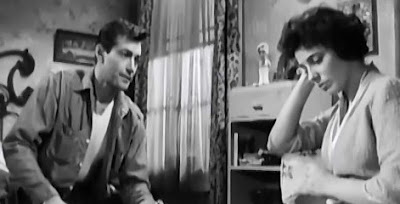
Rick Jason and Joan Collins
The Wayward Bus, taken from a John Steinbeck novel, is an unusual, imperfect, but ultimately worthwhile picture. With his handsome, masculine features and decided acting ability -- he gives a very strong performance in this -- Rick Jason should have become a major star, but the film was not a big hit. Almost completely deglamorized for this role of a drab housewife and cook, Joan Collins is less miscast than you might imagine and is effective. The romance between Dailey and Mansfield is never convincing, although Dailey is winning and Mansfield is at least competent, but there are dozens of actresses, Monroe included, who would have been stronger. Delores Michaels is lovely in the movie -- making much more of an impression than Mansfield -- but she only had a few credits after this. In addition to the actors already named, we have nice performances from Betty Lou Keim, as Norma the counter girl, and (Mr.) Dee Pollock as Kit, the teenager who assists Johnny and Alice; he had a long career. Robert Bray makes an impression as Morse, who has a hankering for Alice. 

In addition to some very good acting, The Wayward Bus has other plusses, such as the widescreen cinematography by Charles G. Clarke and a fine, evocative and highly interesting musical score by Leigh Harline. There is also a splendid action sequence when the bus must travel over a very, very long and crumbling wooden bridge directly over rushing rapids  -- this sequence is a nail-biter. The film was undoubtedly made just to take advantage of the publicity for the earlier Bus Stop, which starred Monroe, also featured bus trips and truck stops, and even had Robert Bray in the cast. 

Verdict: Memorable "lost" film with some very good performances. ***. 

Thursday, August 8, 2019

BUS STOP

Monroe and Don Murray
BUS STOP (1956). Director: Joshua Logan. Based on the play by William Inge.

"Ain't it wonderful when somebody so terrible turns out to be so nice." -- Cherie.

Bo Decker is a young rancher who has a lot of energy but little experience with life or women. With his foreman and best friend, Virgil (Arthur O'Connell), he travels to Phoenix, Arizona to compete in a rodeo. He is certain that he will meet the right gal for him, and is convinced that that is just what's happened when he runs into nightclub entertainer Cherie (Marilyn Monroe). The trouble is that while Cherie may think Bo is handsome, she has no intention of marrying a complete stranger that she has just met. Bo, unfortunately, simply won't take no for an answer ...

Don Murray as Bo
Bus Stop was based on a stage play by William Inge, and it was opened up by screenwriter George Axelrod. Joshua Logan also directed the film version of Inge's Picnic the same year, although he had not directed the stage version of Bus Stop as he did Picnic. The movie benefits from inspired casting. Marilyn Monroe is simply outstanding as Cherie -- possibly the best performance of her career -- and is able to bring out the pathos and confusion in her character as well as her more comical aspects. Her interpretation of "That Old Black Magic" which she deliberately sings off-key in the saloon is very funny. Don Murray [Advise and Consent], whose first theatrical film this was, is also excellent, just perfect in fact, as Bo, managing to make a man who seems nearly psychotic at times a bit vulnerable and greatly appealing in some instances.

Arthur O'Connell and Monroe
As for the rest of the cast, Arthur O'Connell offers another of his spot-on performances as father surrogate Virgil. Betty Field [Seventeen] makes an impression, and seems to be channeling Mae West a bit, as the coffee shop owner, Grace. Robert Bray [Never Love a Stranger] has possibly his best role as the bus driver, Carl, who has a yen for Grace, and who has a fateful encounter with Bo. Eileen Heckart and Hope Lange are also effective in smaller roles as, respectively, Cherie's friend and co-worker and a young woman on the bus who befriends Cherie. Like Picnic, this romance has a bittersweet conclusion. Murray was nominated for an Oscar (supporting); Monroe should have been. The TV series Bus Stop was very loosely based on this movie.

Verdict: Very entertaining and well-acted comedy drama. ***. 

Thursday, February 2, 2017

VOODOO TIGER

VOODOO TIGER (1952). Director: Spencer Gordon Bennet.

Jungle Jim (Johnny Weissmuller) comes across a tribe of cannibals who sacrifice people to their tiger god. Phyllis Bruce (Jean Byron of Daddy-O) has come to Africa to study tigers, and meets up with Sgt. Bono (Rick Vallin) and Major Green (Robert Bray of Never Love a Stranger), the latter of whom is attracted to Phyllis and vice versa. Into their midst literally drops a plane load of chorus girls led by Shalimar (Jean Dean), whose act includes a tiger (that is also on the plane), and the ex-Nazi, Professor Schultz (Michael Fox of The Lost Planet). Then there is a gang of crooks who are hoping to find a cache of stolen paintings. But can any of them hope to get away from the hungry cannibals? Voodoo Tiger at least seems a little more involved and eventful than the average Jungle Jim entry, and this one is rather entertaining. Shalimar does a rather good and sexy dance to briefly appease the natives. Tamba the chimp has a lot to do and is wonderful.

Verdict: Fun with Jungle Jim  and Shalimar! **1/2.

Thursday, October 8, 2015

NEVER LOVE A STRANGER

NEVER LOVE A STRANGER (1958). Director: Robert Stevens.

Now where have you heard this before? In the 1920's two friends grow up on the wrong side of the tracks, with one becoming a criminal and the other a prosecutor, until their paths cross violently once again. This story was old when co-producer Harold Robbins wrote his bestseller, "Never Love a Stranger" in the fifties, and there's nothing new or original in the film version. Frankie Kane (John Drew Barrymore) is an orphan raised by Catholics who doesn't realize he's actually Jewish, like his buddy Martin (Steve McQueen). Frank becomes "gray and bitter before his time," as the tiresome narrator tells us, but we're not shown what makes him so. In any case, he becomes a career criminal and Martin an assistant D.A. Whatever its flaws, Never Love a Stranger is watchable for no other reason than the cast. Barrymore [High School Confidential] proves that talent runs in his famous family with an excellent performance as the protagonist, and Steve McQueen [The Towering Inferno] is also admirable as his old buddy turned nemesis. Lita Milan and Robert Bray are also notable as Frankie's girlfriend and a mob boss whom he eventually supplants. John Drew Barrymore [aka John Barrymore, Jr.] was the son of John Barrymore, and the father of Drew Barrymore and John Blyth Barrymore, both actors. John Drew Barrymore's erratic behavior prevented him from building on his early promise, as he had the looks and talent to have a more than satisfactory career. Another adaptation of a Harold Robbins potboiler was The Carpetbaggers.

Verdict: Passable melodrama with some very good performances. **1/2.