Lively, entertaining reviews of, and essays on, old and newer films and everything relating to them, written by professional author William Schoell.
Showing posts with label Rod Taylor. Show all posts

Thursday, February 16, 2023

HELL ON FRISCO BAY

Alan Ladd
HELL ON FRISCO BAY (1955). Director: Frank Tuttle. 

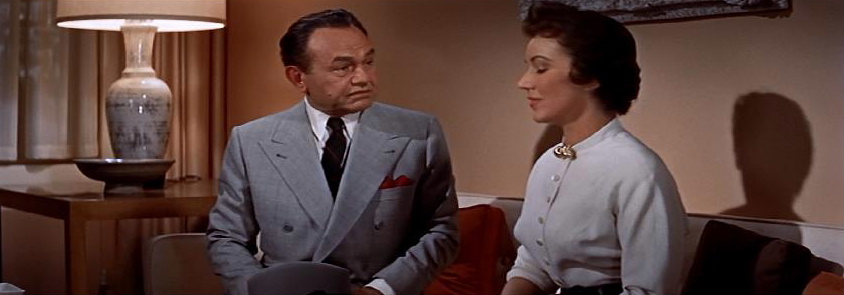
Ex-cop Steve Rollins (Alan Ladd) was framed for a murder he didn't commit and sent to prison for five years. When he gets out he is determined to find out who really murdered the victim and clear his name. He pretty much ignores his wife, Marcia (Joanne Dru), because he wants to protect her and also because she dared to dally with a gentleman out of loneliness when Steve wouldn't even let her come to see him. The San Francisco docks are controlled by a nasty man named Victor Amato (Edward G. Robinson), who has a good right hand, Joe (Paul Stewart), and a good-for-nothing nephew, Mario (Perry Lopez), who loves the ladies. Joe spends his nights with a former movie star named Kay (Fay Wray) while Victor is stuck with his pious wife, Anna (Renata Vanni), who treats Mario like a son and thinks he should be a priest. Steve talks to assorted individuals in the hopes they can give him information that might help him, but when Amato offers him a job, and Steve turns him down, he vows to make him pay -- painfully. 

Robinson and Fay Wray
Hell on Frisco Bay
 is a fast-paced and entertaining film noir thriller with many intriguing elements and a highly interesting cast. Ladd could probably play this kind of role in his sleep by now, but he manages to stay awake and acquits himself nicely. A deceptively cheery Robinson slowly unveils the layers of corruption and evil until he reveals the slimy lizard at his core, going so far as to order Joe to murder his own nephew. Stewart is excellent as the hired gun who's trying to get out from under Robinson's thumb. Fay Wray scores as Kay, and one of the best scenes is between Wray and Robinson as Amato makes a pass at her and gets angry when she turns him down, hitting her. "Get out, you filthy peasant!" she screams. Joanne Dru is acceptable as Marcia, giving solid line readings that don't always hit the emotional mark. 

William Demarest and Rod Taylor
The film is also full of flavorful performances by a wide variety of supporting players. William Demarest is a cop and friend of Steve's while Willis Bouchey is the police lieutenant who has to be convinced of Steve's innocence. Rod Taylor plays a hood who may have committed the murder Steve was sent away for with Tina Carver as his girlfriend. Peter Hansen [When Worlds Collide] is the corrupt cop, Connors, and Anthony Caruso [The Asphalt Jungle] is especially notable as a fisherman who is scared that if he talks to Steve his young son, George (Peter J. Votrian, who is also good) may come to harm. Renata Vanni probably made a career out of playing long-suffering wives or mothers. Nestor Paiva plays another dock worker who tries to work things out with Amato and only winds up dead. Perry Lopez [The Steel Jungle] plays the sexy but weak nephew to perfection. Jayne Mansfield plays his date.

Paul Stewart with Robinson
Ladd is manhandled by the chubby gunsel Hammy (Stanley Adams) in one scene and turns the tables on him, beating him up and telling Joe to "get your pig outa here!" The film has a boat chase at the end that is exciting although not quite on the level of similar scenes in those old cliffhangers. Although this might not be listed among Max Steiner's greatest scores, it is effective and thrilling when it needs to be. The screenplay is good, but one wishes the picture crackled with tension -- although it comes close at times -- but director Frank Tuttle doesn't make the film quite as explosive as it could have been. Still, it's quite well-played and snappy.

Verdict: Memorable crime drama with some outstanding performances. ***. 

Thursday, January 19, 2023

SEPARATE TABLES

Rita Hayworth and Burt Lancaster

SEPARATE TABLES (1958). Director: Delbert Mann.

"I have no curiosity about the working classes." -- Mrs. Railton-Bell.

"Being alone in a crowd -- it's so painful ... frightening." -- Ann Shankland.

At the seaside Beauregard Hotel in Bournemouth, England -- where several people are permanent residents -- certain little dramas are unfolding. The highly snobbish Mrs. Railton-Bell (Gladys Cooper) has discovered the inappropriate behavior of Major Angus Pollock (David Niven), who has bored everyone with fictional stories of his allegedly heroic wartime exploits. Mrs. R-B gathers the other residents to vote on whether or not to insist that the man be thrown out of the hotel. Mrs. R-B's neurotically shy daughter, Sibyl (Deborah Kerr), who is exceptionally fond of the major, undergoes an emotional crisis when she learns of his illicit activities. Meanwhile, the proprietress, Pat Cooper (Wendy Hiller), who has become the lover of American resident John Malcolm (Burt Lancaster), discovers that his ex-wife, Ann (Rita Hayworth) is still in love with him and has taken a room in the hotel.   

David Niven and Deborah Kerr
Separate Tables
 was originally two plays by Terence Rattigan, sharing several supporting characters, that took place in the same location and were presented together on one evening in the theater, Although Rattigan was importuned to change this before the play debuted, the Major was originally a closeted homosexual and not a pervert who bothered women in a movie theater. (Although the movie is quite sympathetic to the major, it's a question how this would play in these post- MeToo days.) 

Separate tables indeed
The two plays have been intelligently put together and opened up (but not too much) and the film never appears stage bound or too talky, undoubtedly because Rattigan's dialogue is often excellent and perceptive. David Niven won a Best Actor Oscar for his portrayal and Deborah Kerr, who is outstanding, should have won but was only nominated. (Niven is quite good but a cut below Kerr. Hiller won Best Supporting Actress but was surprised by this, as she isn't onscreen very long and complained that her best scenes were cut.) Playing a comparatively superficial if vulnerable character, Rita Hayworth is effective as Ann, as is Burt Lancaster, although he really can't compare to some of these venerable British actors. Gladys Cooper and Cathleen Nesbitt as her friend are exemplary, as are Hiller, Felix Aylmer as Mr. Fowler, and Mary Hallatt as the brisk and self-sufficient Miss Meacham. Rod Taylor and Audrey Dalton have the thankless roles of a young couple temporarily staying in the hotel, their lines undoubtedly cut back to make room for the emoting of Hayworth and Lancaster.  Delbert Mann also directed the beautiful Middle of the Night and many others. 

Verdict: Superior British drama with some excellent performances. ***1/4. 

Thursday, May 13, 2021

THE TIME MACHINE

The Time Traveler in his machine
THE TIME MACHINE (1960). Director: George Pal. 

A Victorian-era scientist in England (Rod Taylor) insists to a gathering of his friends, that he has invented a machine that can break through the fourth dimension -- time. Using his machine to go into the future, he witnesses more than one war and man's destruction of man. Trapped inside rock by a lava flow, he pushes way ahead to the far-flung future and winds up in 802,701 A.D. There he discovers that the human race has divided into two segments: the mindless, bovine Eloi and the meat-eating Morlocks, who live underground, care for the Elois' needs, and use them for their food supply. Weena (Yvette Mimieux), a pretty Eloi, is saved from drowning by the scientist, and shows signs of the humanity that seems to have been bred out of people in this era. 

Morlocks!
The Time Machine
 is a colorful and entertaining picture, although it is essentially a kiddie version of H. G. Wells' novel, which was a masterpiece of both horror as well as of science fiction. The best sequences in the film, which still hold up today, are the depictions of time travel done with time-lapse photography and the like. The Morlocks, alas, look more like the boogie men of Laurel and Hardy's March of the Wooden Soldiers than they do the dark and sinister creatures of Wells' brilliant book. Rod Taylor plays an undeveloped part as well as possible; Mimieux is effective in the nearly mute role of Weena. The film is well photographed by Paul Vogel, and boasts an eerie and attractive score by Russell Garcia. Four years earlier Taylor appeared in another time travel movie, a rip off of Time Machine, entitled World Without End

Verdict: Fun, but hopefully not the last film version of Wells' great novel. ***. 

Thursday, October 1, 2020

HOTEL

Catherine Spaak and Rod Taylor
HOTEL (1967). Director: Richard Quine. Based on the novel by Arthur Hailey.

The beautiful and stately St. Gregory's hotel in New Orleans is in danger of shutting its doors forever. The owner, Warren Trent (Melvyn Douglas), is fielding two offers, the most aggressive of which comes from Curtis O'Keefe (Kevin McCarthy) who isn't above playing a few dirty tricks, such as using his girlfriend, Jeanne (Catherine Spaak), to get information from the hotel manager, Peter McDermott (Rod Taylor of The Liquidator). While this is going on there is a thief (Karl Malden) loose in the hotel, and a Count (Michael Rennie) and Countess (Merle Oberon) are being blackmailed by the house dick (Richard Conte) because they ran over a child in their expensive car. 

Kevin McCarthy and Taylor
Hotel is basically sixties schlock, devoid of deep characterization or any meaning whatsoever. At one point, when a dignified black couple is turned away at the desk of the St. Gregory according to the hotel's long-standing racist policy and their unproven fear that it will cost them clientele, it looks as if there might be something of substance to say. But everyone seems much more upset at what bad publicity will do to their coffers than their unfair and dated policy toward "Negroes." It's a case of "this is bad for the hotel" as opposed to "this is just plain bad." Peter may not be a racist but his employer definitely is.

Michael Rennie and Merle Oberon
In spite of all this, the film is smooth and mildly entertaining, with good performances. Taylor is commanding and pleasant, McCarthy and Douglas are solid pros, and Rennie and Oberon, especially the latter, nearly walk off with the movie. We never learn anything about the boy who was killed, nor do either of these privileged people ever express the slightest feeling about the child's death! Although we're supposed to believe that McDermott is a great manager, he doesn't shut down an elevator that is acting funny (resulting in the liveliest scene in the movie and undoubtedly a major lawsuit for the hotel) and seems to spend more of his time imbibing cocktails in the bar than anything else. Spaak and Malden both appeared in Cat O' Nine Tails.

Verdict: Watch Grand Hotel instead. **1/2.                                                                                                 

Thursday, May 17, 2018

THE GLASS BOTTOM BOAT

Doris Day
THE GLASS BOTTOM BOAT (1966). Director: Frank Tashlin.

Widow Jennifer Nelson (Doris Day) works as a tour guide at a space research center, where she runs into scientist Bruce Templeton (Rod Taylor) only days after he hooks her mermaid suit with a fishing rod. Attracted to Jennifer, Bruce gives her an assignment to get close to her, and pretends he's working on something called Project: Venus. In truth, he has developed a device called Gizmo. Some of Bruce's associates, such as his partner, Zach (Dick Martin) and General Bleecker (Edward Andrews), are convinced Jennifer is a Russian spy who's after the secret plans for Gizmo. This leads into all sorts of complications, some of which are quite funny, and others not so much. Instead of doing The Graduate, which might have led into more mature and serious roles for Day, she did stuff like The Glass Bottom Boat, which made use of her talents as a comic actress (although not on a Lucille Ball level) but little else. Still, she's good in the picture, as is her co-star Rod Taylor, who handles the silliness with aplomb after already appearing with Day in Do Not Disturb. The movie tries to tie into the spy trends of the period with gadgets and the like, and Robert Vaughn of The Man from U.N.C.L.E even shows up for literally a second. Martin, Andrews, and Dom DeLuise [Fail-Safe] adeptly add some fun to the proceedings, although Paul Lynde [Bye Bye Birdie] is given the single funniest moment, which is the priceless expression on his face when he observes Martin and Andrews inadvertently in bed with one another. He also does a comical drag routine, especially when he's interacting with Day in a ladies room. Alice Pearce [The Belle of New York] and George Tobias play Day's neighbors, and essentially essay the same roles as the ones they play on TV's Bewitched, which debuted two years earlier. Arthur Godfrey is cast as Day's father, who owns the titular boat and has his daughter playing mermaid now and then to justify the title; he adds nothing to the picture. The movie is about half an hour too long, and hasn't enough of director Tashlin's trademark cartoon-like humor, although there are some amusing scenes such as a comical encounter between Day, DeLuise, a cake, and a trash can. It's amazing that nobody noticed that the song sung over the opening credits, "The Deep Blue Sea," is basically a knock-off of "Mockingbird." This was the last of Day's films to make money, after which she fled to television.

Verdict: Punctuated with enough laughs to keep you watching, but never a real riot. **1/2.

Thursday, October 23, 2014

WORLD WITHOUT END

WORLD WITHOUT END (1956). Director: Edward Bernds.

Four American astronauts on a trip to observe but not land on Mars, wind up caught in a super-speed time warp and arrive on Earth in 2508 AD. There they find that one-eyed mutates rule over savage humans who roam the countryside, while the dregs of intelligent humanity hide inside a mountain HQ. The men are old and eunuch-like and wear hideous outfits, while the younger women are clad in glamorous gowns that show up sexy legs. Yes, welcome to the future -- or rather 1956! The astronauts also encounter two giant mutated spiders -- unconvincing mock-ups -- in a cavern. World Without End has a few ideas -- it's not as dumb, say, as Queen of Outer Space, also directed by Edward Bernds -- but most of them are recycled. Like Queen, this is also decked out in CinemaScope and Technicolor. The astronauts are played by Hugh Marlowe, Rod Taylor (who would have somewhat similar adventures in The Time Machine a few years later), Nelson Leigh (The Adventures of Sir Galahad), and Christopher Dark, while the attractive ladies are Nancy Gates, Shawn Smith (The Land Unknown), and Lisa Montell. Everett Glass plays aged Timmek, who rules the underground society, and Booth Colman is Mories, who can hardly wait to take over. The credits for most of these actors were largely on television. Not enough is made of the fact that the astronauts will never see their loved ones or time period again, but then this isn't exactly intellectual material. Very influential, for better or worse, on such later movies as Beyond the Time Barrier.

Verdict: Even big spiders can't save this from being rather boring. **.

Thursday, February 16, 2012

FATE IS THE HUNTER

FATE IS THE HUNTER (1964). Director: Ralph Nelson.

When a plane crashes killing all aboard except a stewardess (Suzanne Pleshette), an investigator for the airline, Sam McBane (Glenn Ford), tries to determine what went wrong. You'd think this would make for a compelling film, but most of the running time has McBane delving into the character of the pilot [and old friend] Jack Savage (Rod Taylor), whose irresponsibility is being blamed for the tragedy, with lots of flashbacks. McBane discovers that there was much more to Savage than met the eye. Nancy Kwan and Dorothy Malone are two of the many ladies in Savage's life, and Wally Cox and Mark Stevens [in a fine turn] are pals of his whom he's helped over the years. Mary Wickes has an interesting cameo as a landlady. Constance Towers is McBane's secretary, Nehemiah Persoff is his rival, and Jane Russell appears as herself in a flashback scene entertaining the troops. This culminates in a fairly ridiculous courtroom sequence, and then in a climax in which McBane and others try to recreate the circumstances of the crash up in the air. The picture is contrived and illogical, has little tension or suspense, and is more talky and dull than anything else. Ernest K. Gann, who wrote the novel upon which the film is based, reportedly disavowed the whole production. Ford gives a fine performance but is saddled with the screwiness of his character; the rest of the cast is very good, and Pleshette is excellent although she has only a few lines.

Verdict: This kind of movie should not be a snooze-fest. **.

Thursday, September 16, 2010

ONE HUNDRED AND ONE DALMATIANS


ONE HUNDRED AND ONE DALMATIANS [aka 101 Dalmatians/1961. Directors: Several. Walt Disney Studios.

This wonderful Walt Disney animated movie is timeless. The dalmatian Pongo (voice of Rod Taylor) arranges for his "pet," the songwriter Roger (Ben Wright) and for himself to find mates: Anita (Lisa Davis) and lady dalmatian Perdito (Cate Bauer). Unfortunately Anita's old school mate Cruella De Vil (Betty Lou Gerson), a witchy, hideous apparition with no love for animals, wants to buy Pongo and Perdito's 15 puppies, and when Roger and Anita refuse, decides to kidnap them -- along with dozens of others. Her goal: several dalmatian fur coats. Tom Conway [brother of George Sanders] does the voices of the collie and of the quizmaster who appears on the funny "What"s My Crime?" TV show parody watched by the puppies. You don't have to be a child to enjoy this movie, which is charming and well-done on all levels. There are even quite a few harrowing and suspenseful sequences. Cruella De Vil remains a fascinating Disney creation, and the image of her tooling about in her out-sized automobile looking for puppies to kill and skin stays with you.

Verdict: A certified Disney masterpiece. ***1/2.

Thursday, February 26, 2009

RAINTREE COUNTY


RAINTREE COUNTY (1957). Director: Edward Dmytryk.

John Shawnessy (Montgomery Clift) lives in a Northern county which has the legend of a mysterious, magical raintree in the swamps, which he tries to find but fails. He is loved by Nell (Eva Marie Saint) but winds up married to a neurotic Southern gal named Susanna (Elizabeth Taylor), who fears that her true mother was a Cuban black woman with whom her father supposedly had an affair. What's worse -- for essentially racist Susanna -- John is an abolitionist ... and then the Civil War breaks out. If this all sounds interesting be warned that it's stretched out to a tedious 2 hours and 48 minutes and the movie never really jells. Part of the problem is a meandering script without any major focus, but director Dmytryk isn't much help, either. Clift gives a good performance, but it was clearly affected by the shattering car accident he was in that occurred during filming. Elizabeth Taylor deserves an A for effort but she's not really up to playing a character that has so many different facets and psychological problems. Rod Taylor is good as a swaggering rival of John's, and Lee Marvin certainly scores as the charismatic Flash, with whom John has a race and who winds up in the Army with him. But the best performance is from Eva Marie Saint, who stands by John through thick and thin, and who is better than the picture deserves. DeForest Kelley shows up briefly as a rebel soldier. Fine cinematography by Robert Surtees and a good score by Johnny Green, but this is mostly a bore.

Verdict: Three hours of your life you can never get back. **.