Lively, entertaining reviews of, and essays on, old and newer films and everything relating to them, written by professional author William Schoell.

Thursday, March 24, 2016

THE PUBLIC ENEMY

James Cagney and Jean Harlow
THE PUBLIC ENEMY (1931). Director: William A. Wellman.

Tom Powers (James Cagney) and his pal, Matt (Edward Woods), grow up in a tough part of the city, and get in with a bad crowd. Tom becomes a gangster and killer during prohibition, earning the enmity of his brother, Mike (Donald Cook), who has little but contempt for him. Tom is such a creep that at one point he even shoots a horse! Tom and Matt work for Nails Nathan (Leslie Fenton) and Paddy Ryan (Robert Emmett O'Connor), and get involved with such "broads" as Gwen Allen (Jean Harlow), Mamie (Joan Blondell), Kitty (Mae Clarke), who gets a grapefruit in the face, and Nail's unnamed girlfriend (Dorothy Gee), who earns Tom's scorn by getting him drunk and going to bed with him. The Public Enemy is refreshingly frank and well-acted, with Cagney getting high marks, along with Fenton [The House of Secrets], O'Connor, and Beryl Mercer [Jane Eyre] as Ma Powers. Harlow was still considered a lousy actress this early in her career, but she's actually competent, if unexceptional, and her performance is satisfactory. Frankie Darro and "Junior" Coghlan (Frank Coghlan, Jr.) play Matt and Tom as boys and are both good. One of the best scenes is a dinner at the Powers house where ex-soldier Mike can no longer control his anger at his brother and bootleg beer goes flying, and the death of Putty Nose (Murray Kinnell of Charlie Chan in Paris) is also well-handled. That said, The Public Enemy has not really worn well with time -- especially when you take into account the many superior gangster films that came later --   but it still remains an interesting picture. The great final scene of the movie almost makes the whole movie! Handsome Edward Woods was supposed to play Tom Powers, the lead role, but it was given to Cagney instead,; he became a star and Wood's career eventually faded out after only 13 credits.

Verdict: Cagney holds the attention. *** out of 4.

DONOVAN'S BRAIN

DONOVAN'S BRAIN (1953). Director: Felix Feist.

Irresponsible scientist Patrick Cory (Lew Ayres) removes the brain from a dead plane crash victim, and decides to keep it alive for study. It never occurs to him the living hell into which he has put his victim -- sort of alive and conscious, but unable to see, move, hear etc. (none of which is dealt with in this dumb movie) -- which is why it seems like ironic justice when the brain takes over Cory's mind. The dead man was a very wealthy and ruthless character, and he tries to get back his life and fortune by possessing the hapless Cory. Meanwhile, the brain starts inexplicably growing in size inside its tank...  Ayres gives a good performance in this clap trap, along with Nancy Davis (later Nancy Reagan) as his wife, while Gene Evans [The Giant Behemoth] is a cut below as an alcoholic associate of Cory's. The performers should be credited with playing their roles in this absurd film with straight-faced conviction. Steve Brodie is also fine as a blackmailing reporter who comes afoul of "the Brain." The music  by Eddie Dunstedter does a lot of the work. One good thing about the movie is that Cory doesn't just walk away from things without being held accountable for his actions. Feist also directed The Man Who Cheated Himself.

Verdict: As far as disembodied brain movies go, this isn't nearly as much fun as The Brain from Planet Arous. ** out of 4.

KING OF THE CARNIVAL

KING OF THE CARNIVAL (12 chapter Republic serial/1955). Director: Franklin Adreon.

Bert King (Harry Lauter) is a former paratrooper who is now a high-wire trapeze artist with a circus run by Jess Carter (Robert Shayne), who is also the ringmaster. His former army buddy and fellow paratrooper Art Kerr (Rick Vallin), now an agent with the Department of the Treasury, has tracked down a gang of counterfeiters to the circus and environs. Art sort of deputizes both Bert and his partner, June (Fran Bennett), to help with the investigation and spy on suspicious characters within the circus. The HQ of the gang is in a water-tight compartment on what appears to be a sunken ship, with gang members entering through a water lock. Although he is not the big boss -- there is little attempt to disguise his identity -- a foreign agent named Zorn (Gregory Gaye) is the one who manufacturers the counterfeit bills, with which he hopes to flood Europe. There are some decent cliffhangers involving high-wire performers dangling over a circle of lions, and a bit with a rushing train, as well as a good mid-chapter sequence with a gasoline fire on a water tank. Much of the serial was cobbled together from stock footage, but it still manages to be entertaining -- Adreon's direction is snappy and fast-paced -- although it does become a little tedious towards the end. Lauter and Shayne are fine, although Fran Bennett, mostly a TV actress, has a somewhat flat delivery. Robert Clarke, Stuart Whitman, and Tom Steele have smaller roles. This was the last Republic serial ever made.

Verdict: Handsome Harry handles the hoodlums! **1/2.

MAN-TRAP

David Janssen and Jeffrey Hunter
MAN-TRAP (1961 ) Director: Edmond O'Brien.

"Lipstick on your chin is almost a sign of innocence. If he wasn't innocent all the lipstick would have been wiped off."

Matt (Jeffrey Hunter) saves Vince's (David Janssen) life on a Korean battlefield, so Vince tries to repay the favor by cutting him in on a deal. Matt works for his father-in-law and is married to an adulterous borderline shrew, Nina (Stella Stevens), but he is having his own affair with a sympathetic woman named Liz (Elaine Devry), who also works for his father-in-law's firm. Fed up with Nina, and wanting to run off with Liz, Matt agrees to Vince's suggestion to steal a suitcase of money which is supposedly to be used to buy guns for a South American revolution. However, this caper is not nearly as simple as Vince has led him to believe ... Man-Trap is a completely unpredictable thriller with interesting developments and twists and turns throughout its running time. Hunter and Janssen both offer excellent performances, and are at least matched by Steven's [The Mad Room] vital portrayal (making the woman much more dimensional in her way than a lesser actress might have done) and Devry, who gets across all of the conflicted feelings her character has about Matt. Virginia Gregg [Crime in the Streets] is also wonderful as Ruthie, Matt and Nina's housekeeper, and one of the best scenes in the movie is her ugly confrontation with Nina. Another memorable scene has Nina taking a poker to her husband's head and nearly being strangled because of it. The robbery sequence is well-handled and even a bit chilling. Bob Crane and Frank Albertson have smaller roles. Nina and her drunk friends are fond of running around with water pistols full of booze. Actor Edmond O'Brian only directed two films -- the less interesting Shield for Murder was co-directed by Howard W. Koch --  but he does such a good job with this one it's too bad he didn't direct others.

Verdict: Very snappy and absorbing crime thriller with fine performances. ***.

SUPERHUMAN: THE BRONZE AGE OF COMICS

SUPERHUMAN: THE BRONZE AGE OF COMICS. Timbre Books; 2016.

Shameless promotion time again.

Here at last is my follow up to The Silver Age of Comics. In this tome you will learn:

* How feminist hero Ms. Marvel told off her teammates on the Avengers when they seemed to think all she needed was a good lay to settle  her down.
* How Marvel's first African-American super-hero, the Black Panther, went from being King of Wakanda to a strange Jack Kirby fantasy creation.
* How the X-Men's Jean Grey turned into the Phoenix, who wiped out an entire galaxy with nary a thought.
* Why Batman and Robin split up -- only to get back together again. Did it have something to do with Catwoman, or Ra's al Ghul's daughter, Talia?
* How black superhero Luke Cage, aka Power Man, teamed up with blond and blue-eyed martial arts master Iron Fist.
* Why Brainiac-5 of the futuristic Legion of Super-Heroes went nuts.
* How Spider-Man's frail Aunt May went into a nursing home, died, then came back again!
* Why Brother Blood, arch-enemy of the New Teen Titans, wound up in a war with the disembodied Brain and his Brotherhood of Evil.
* How the Justice League of America took on hungry mutated animals who slayed humans in a bloody arena, and helped bring the golden age's Justice Society back into prominence.
* How Wonder Woman finally lost her virginity -- and to whom.
* Why the Flash was put on trial for murdering the woman who killed his wife!
* The differences between Marvel and DC Comics competing undersea kings, Aquaman and Namor, the Sub-Mariner.
* Why Thor's father, Odin, tried to murder his son -- more than once!
* Why Black Goliath and Black Lightning used the word "black" in their names even though it was obvious they were African-American.
* What did Shang-Chi, the Master of Kung Fu, have to do with venerable villain Fu Manchu?

For the answers read SUPERHUMAN: The Bronze Age of Comics, available on Amazon in a spanking new Kindle edition. [Also downloadable on computers and mobile devices.] Naturally many of these comic book characters appeared in movies and TV shows decades after they were created for the comics.


GUILTY AS SIN

Don Johnson and Rebecca De Mornay
GUILTY AS SIN (1993). Director: Sidney Lumet.

"He chose me to defend him before he murdered his wife."

Rising attorney Jennifer Haines (Rebecca De Mornay) takes on a client who is handsome if immoral, a gigolo named David Greenhill (Don Johnson) who has been accused of pushing his wealthy wife out of a window. Jennifer takes Greenhill's case against her better judgment, regrets it, tries to back out, but is told by a judge (Dana Ivey) that dropping pro bono cases is a no no. Meanwhile her friend and investigator Moe Plimpton (Jack Warner) discovers some disturbing things about her client, who seems to have been obsessed with Jennifer for quite some time. Then Jennifer's boyfriend, Phil (Stephen Lang), is brutally attacked, and worse things are in store for other of Jennifer's associates. Guilty as Sin is an entertaining, if far-fetched, thriller with good performances -- Johnson and De Mornay, make a good team, if that's what it can be called -- although Larry Cohen's screenplay has Jennifer doing things that she seems too smart to do. Norma Dell'Agnese makes her mark as Jennifer's secretary, Emily, as do Christina Grace and Barbara Eve Harris as two of David's "admirers." Stephen Lang [Save Me] is fine as Phil, and gets the bedroom scenes that, oddly, they never give Johnson, who was considered a sex symbol (along with De Mornay) at the time. Don Johnson [The Hot Spot] is quite good and exhibits star appeal, but never quite made it as a major movie star; he's now back on television in Oil. De Mornay's [The Trip to Bountiful] career is also more low-profile these days, with much television work as well. As for director Sidney Lumet [Child's Play], this is a minor work in his canon. A death-by-fire scene is one of the liveliest in the movie.

Verdict: Improbable at times, but well-acted and engaging. ***.

SECRET FILE HOLLYWOOD

Robert Clarke
SECRET FILE HOLLYWOOD (1962). Director: Ralph Cushman (Rudolph Cusumano).

After an incident in a bar during which someone is shot, private eye Max Carter (Robert Clarke) loses his license. He gets mixed up with a shady lady named Nan (Francine York), who says she'll pay cash if he helps her set up a married director, James Cameron (John Warburton), with a babe and takes pictures for a scandal sheet. Gay takes her orders from a mysterious person who leaves instructions on audio tapes like something out of an old-time movie serial (although then they used records). The "babe" in the set-up is actually an actress named Gay Shelton (Maralou Gray), who simply wants to audition for Cameron in his home and has no idea of how she's to be used. When this whole business blows up in everyone's faces, a TV personality named Rutherford (uncredited) excoriates the scandal sheets on his show. Max and Gay team up to uncover the perpetrator behind the whole sleazy scheme. Secret File Hollywood is a cheap movie -- you can see the boom mike hovering overhead in half of the shots -- with a supporting cast of amateurs, but it is entertaining, and Clarke [Outrage; The Hideous Sun Demon], handsome and more than competent in the role, is perfect as Carter; he would have made a great lead in a private eye TV show.  York, Warburton. Gray, and Sydney Mason as "Hap," an associate of Nan's to whom Max owes money, also give good performances.

Verdict: Some good acting puts this over and Clarke is always appealing. **1/2.

FIFTY SHADES OF GREY

Jamie Dornan and Dakota Johnson in the tub
FIFTY SHADES OF GREY (2015). Director: Sam Taylor-Johnson.

"I don't make love. I fuck. Hard." -- Christian. 

Anastasia Steele (Dakota Johnson) interviews handsome 27-year-old billionaire Christian Grey (Jamie Dornan) and eventually falls into a romance with him -- of sorts. Christian is a "dominant" who needs to be with a "submissive" and goes so far as to show Ana his s&m playroom. Ana turns out to be a virgin -- quite literally -- making her perhaps not the best person to be a happy candidate for the kink and fetish scene. Another problem is that Christian tells Ana that he's not really looking for a romance, doesn't like to be touched (without permission) and draws up a contract for her to sign detailing her rights and responsibilities as to being his submissive. Now most women not into the kink scene would run screaming into the night at this point, but dumb Ana (or not so dumb, remember Chris is a handsome billionaire) continues to see Chris, although she holds off on signing that contract. Clearly things will not go well for this couple ... Despite the erotic trappings, Fifty Shades of Gray is old-fashioned at its core, does nothing to explore the scene with any depth, and amounts to little more than a romantic fantasy crafted by the book's author, E. L. James, who is highly unlikely to be lusted after by a handsome billionaire. This is only the umpteenth movie to have a heroine falling for a guy who wants no entanglements (at least at first) and there's even a point when he tells her what amounts to "don't get hooked on me, baby!" That said, Fifty Shades of Grey is not as cheesy as it sounds, because the actors are quite good, the production gloss high, and the direction solid. I'll leave it to others to judge if this is a sad story of a man unable to commit due to his kinks, or a clueless woman who can't deal with the fact that the man she loves has kinks (what in a less enlightened era would be called "perversions") in the first place. Conventional at its heart, there is nothing that risky or edgy to the movie [it might have been fun to have Ana find Christian in bed with his hunky chauffeur.] While Dakota Johnson is attractive and appealing, by Hollywood standards she is comparatively plain, which may or may not be the point, but makes the sex scenes less sizzling than they are, perhaps, meant to be. No less than two sequels are being filmed even as I post.

Verdict: This might have worked better if it had been played as a wild and campy comedy. **1/2.

Thursday, March 17, 2016

BRING ON THE DINOSAURS!

The Valley of Gwangi
BRING ON THE DINOSAURS!

This week we've got a round-up of movies featuring those delightfully dangerous dinosaurs, beginning with One Million B.C.; going on to Valley of the Dragons, which consisted primarily of stock footage from One Million B.C.; then examining that film's remake with Raquel Welch as a cave woman (!) and its sequel When Dinosaurs Ruled the Earth; then an entire Planet of Dinosaurs; Ray Harryhausen's excellent Valley of Gwangi; and finally the much more recent Jurassic World.

And for those who like their dinosaurs in books as well as in the movies, check out the novelMonster World, as well as the non-fiction study Creature Features: Nature Turned Nasty in the Movies, which covers many of these flicks in more detail.

ONE MILLION B.C.

ONE MILLION B.C. (1940). Director: Hal Roach; Hal Roach, Jr.

A young couple take refuge in a cave, where they are told the ancient story of two lovers, Tumak (Victor Mature) and Loana (Carole Landis). The two come from different tribes -- the Rock people and the Shell people --  with Tumak's people being the more bestial of the two. Tumak is literally thrown out of their cavern by his own father, then makes his way alone until he encounters Loana. In addition to dealing with assorted human passions and jealousies, there are also a variety of carnivorous monsters to deal with. When an especially large and voracious dinosaur corners a group of Loana's people in their cavern, members of both tribes team up to banish the beast. One Million B.C. ignores the fact that human beings and dinosaurs did not ever co-exist, but tells a lively story anyhow, and there are plenty of monsters. The T-Rex -- actually someone wearing a T Rex outfit -- is laughable, but there are also the giant armadillo, a big gator in a fight with a huge lizard, and the humongous creature that shows up at the finale. The optical work is good for the most part, with an exciting earthquake (featuring a great shot showing a lava stream engulfing a woman as she tries to cross in front of it), and there's a very good score by Werner R. Heymann. The aforementioned lava stream shot, the battling giants, and the creature at the cave all turned up in numerous subsequent movies as stock footage. Mature [Kiss of Death] and Landis [Out of the Blue] give good performances, and Lon Chaney Jr. is effective as Akhoba. Remade by Ray Harryhausen in the seventies. Hal Roach also directed The Devil's Brother with Laurel and Hardy.

Verdict: Stone age lovers versus monsters! ***.

VALLEY OF THE DRAGONS

VALLEY OF THE DRAGONS (1961). Director: Edward Bernds.

In 1881 Algeria two men, Hector Servadac (Cesare Danova) and Michael Denning (Sean McClory) are about to fight a duel over a woman when the earth shakes in a great cataclysm that they manage to survive. After a time they realize that a comet grazed the earth, as it has time and again in the past, and taken a bit of the planet into space with it, along with a chunk from the prehistoric past. When Servadac and Denning realize what has happened to them, they don't seem all that upset, a problem with both the screenplay and the acting. Most of the movie consists of stock footage of One Million B.C. with Danova [Honeymoon with a Stranger] and Clory [Them] cleverly inserted  into the action. Again we have two warring tribes, two women (Joan Staley, Danielle De Metz), and the big lizard cornering some natives in a big cavern in a hill and gulping down and chewing one of the luckless warriors. Three clips from Rodan are also used to fill in for pterodactyls, as well as what appears to be a prop spider from Bernds' World Without End. Joan Staley is a Ruta Lee lookalike. The premise of the film is good, taken from Jules Verne's novel "Hector Servadac" aka "Career of a Comet," although that did not include prehistoric monsters.

Verdict: The producers wrote the book on "How to Make One Movie Out of Another." **.

ONE MILLION YEARS B.C.

Tumak (John Richardson) kills an allosaurus
ONE MILLION YEARS B.C. (1966). Director: Don Chaffey.

In this color remake of One Million B.C., which uses the same story more or less, Tumak (John Richardson) is thrown out of his prehistoric rock tribe and wanders around until he encounters Loana (Raquel Welch) and her tribe, the shell people. The shell people are a kinder, gentler tribe who could teach the rock people a thing or two, which they try to do with Tumak when they all go fishing with spears. The first "dinosaur" we encounter is a positively gargantuan real-life lizard who tries to make a snack out of Tumak, and then there's a giant stop-motion turtle that fails to impress. But FX wizard Ray Harryhausen really gets into his stuff with an attack on the shell people's camp by a hungry allosaurus, a marvelous sequence, as well as a battle between a T-rex (or ceratosaurus, which it resembles) and a triceratops, not to mention the pterodactyl that snatches Welch off of the beach and tries to feed her to the flying monster's young'uns. Despite the big improvement in special effects work since the 1940 version, this is not as compelling as the original, with Harryhausen's stop-motion effects work being virtually the only point of interest. Martine Beswick [From Russia with Love] has a lively "cat fight" with Welch. Mario Nascimbene's "epic" if sleepy score doesn't really do that much for the movie. Photographed by Wilkie Cooper. As the lovers, Richardson [She] and Welch [Fantastic Voyage] do what they can. A Hammer-7 Arts production.

NOTE: On the imdb.com page for this movie it is listed as a "goof" that a ceratosaurus fights a triceratops when these creatures lived in different eras of the prehistoric world. Considering this movie illogically puts human beings and dinosaurs in the same time period -- not to mention Raquel Welch as a cavewoman -- that hardly seems like a legitimate complaint!

Verdict: Some lively monsters in a disappointing remake. **1/2.

THE VALLEY OF GWANGI

Gwangi goes to church
THE VALLEY OF GWANGI (1969). Director: James O'Connolly.

T.J. (Gila Golan) runs a circus in turn of the century Mexico with her older friend, Champ (Richard Carlson). Back into their lives comes T.J.'s old boyfriend, Tuck (James Franciscus), who ran out on T.J. some time before. T.J. has a new act, a cute little horse (or prehistoric eohippus) who was found in the desert. But this attraction is nothing compared to the animals inside a hidden valley where the tiny horse came from. There are pterodactyls, a belligerent triceratops, and most of all, Gwangi, a fearsome combo of allosaurus and T Rex that chomps on one luckless fellow (Gustavo Rojo) and is ready for more before a rock slide helps Tuck and the others capture him. This is another in a long line of movies (stretching from before King Kong to Jurassic World and beyond) in which a dangerous creature is put on display and breaks out of confinement, causing havoc. The chief selling point of this is some absolutely amazing stop-motion effects work by Ray Harryhausen, clearly working on all cylinders. Gwangi is a wonderful creation, angry, confused, hungry, snapping and tearing at anything in its way. The sequence when the cowboys attempt to lasso the monster is superb, seamless -- I mean, who needs CSI? Another stunning sequence has the monster entering a huge Cathedral and stalking Tuck and the others while its heavy footsteps reverberate all through the building. There is the infrequent use of unconvincing props of assorted creatures, but generally the FX work is fluid and exacting. The story is based on a script put together by stop-motion specialist Willis O'Brien (King Kong), and it is serviceable. Carlson [Riders to the Stars] and Franciscus [Great White] are fine, as is Laurence Naismith as a paleontologist. Gila Golan appears to be dubbed, along with little Curtis Arden as the orphan boy, Lope. As for the film's romance between Tuck and T.J., one can only imagine the real melodrama will come afterward considering what happens to the circus.

The DVD for the movie has a featurette in which several CGI (Computer Generated Imagery) specialists are highly complimentary of Harryhausen's influential work on this film, of which they certainly should be.

Verdict: Lively Gwangi, and some superb stop-motion effects, make this a winner. ***1/2.

WHEN DINOSAURS RULED THE EARTH

WHEN DINOSAURS RULED THE EARTH (1970). Writer/director: Val Guest.

In another impossible world where humans and dinosaurs interact in the same time period, a pretty blond woman, Sanna (Victoria Vetri), finds she is to be sacrificed to the sun. Due to a fluke, she manages to escape, where she encounters handsome Tara (Robin Hawden), who belongs to another tribe. Trouble begins because Tara prefers Sanna to his chosen mate, and in due course he earns the enmity of most of his tribe. In the meantime Sanna runs off, takes shelter during a storm inside an eggshell, and finds herself befriended by a newly-hatched dinosaur even as it gets larger and larger. Reunited, Tara and Sanna wind up on the run from his tribe, until a cataclysm signals the creation of the moon.

Essentially a sequel or remake of Hammer's One Million Years, B.C., this is not really a better movie but it got more attention and better reviews,with some critics charmed by the business with Sanna and her pet dinosaur. When I first saw this in theaters on a double-bill with The Valley of Gwangi, I was confused, because it looked like a Ray Harryhausen movie but as soon as a triceratops thundered out of a cave, I could immediately see that the animation wasn't as good. That's because the animation wasn't done by Harryhausen but by Jim Danforth, who was certainly not untalented but never quite as good as the Master. While the animation of the aforementioned triceratops lacks that certain fluidity that marks the best of Harryhausen's work, there are still some very good sequences in this, including Sanna's "pet," who reminds one a bit of The Beast from 20,000 Fathoms, and some deadly scuttling crabs the size of large dogs who even seem to have a bit of nasty personality. There aren't enough monsters in the movie, so a couple of clips from the 1960 Lost World are thrown in for good measure. Vetri, Hawden and the others manage some very effective pantomiming, and there's some limited language among the cave people. Oddly these savages seem to care for one another at times. Mario Nascimbene's score is better than the one he did for One Million Years, B.C., although his overuse of a sound like sticks hitting one another is annoying.

Victoria Vetri had quite a few credits before this picture under the name "Angela Dorian," including Rosemary's Baby. She appeared in Playboy and sort of reinvented herself as Vetri, winning a lead role in Dinosaurs that did nothing for her career. She later shot her husband and is in jail for involuntary manslaughter until 2020. Robin Hawden was essentially a British TV actor who later turned playwright and novelist. In this picture he had a lean, attractive swimmer's built but might have had an entirely different career if he'd had a few muscles! Val Guest directed The Abominable Snowman and many other movies.

Verdict: You get a little bored waiting for the dinosaurs to show up, but there are some good FX. **1/2.

PLANET OF DINOSAURS

PLANET OF DINOSAURS (1977). Director: James K. Shea.

A spaceship has to make an emergency landing on a planet that is still in the prehistoric era, complete with lots of dinosaurs. (As usual in movies like this, the characters spend virtually no time talking about their loved ones back home that they might never see again.) A conflict breaks out because Captain Norsythe (Louie Lawless) is cautious and concerned with protecting his crews' lives when it comes to dinosaurs, while his chief opponent, Jim (James Whitworth) feels any risk is acceptable to become master of the monsters. (His attitude is actually more negative than the captain's, because he's assuming they will never be rescued.) As they bicker, they run into a brontosaurus, a big spider, and a battle between a stegosaurus and T Rex, then finally work together to kill an allosaurus (pictured) who keeps attacking their camp. The visual effects artists include Jim Danforth and Doug Beswick, and some of the stop-motion work isn't badly done. There is some attempt at characterization in the film, and some more-than-adequate actors, such as Lawless and Pamela Bottaro as Nyla. Harvey Baylor (Harvey Shain) is the obnoxious businessman who hired the space shuttle and is finally killed off in one of the movie's better moments. One crewman, Chuck, (Chuck Pennington) walks around shirtless throughout the entire movie as if he needed to show off his muscles. None of the people who are killed off ever seem to be mourned by anyone. Of the actors, Whitworth and handsome Max (Michael) Thayer as another crewman amassed the most credits.

Verdict: Not terrible space saga with some decent effects work. **1/2.

JURASSIC WORLD

The "Indominus Rex" faces down the cast
JURASSIC WORLD (2015). Director: Colin Trevorrow.

Jurassic Park has been rebuilt and sightseers flock to it in droves. Everything seems safe and secure. But an animal worker named Owen (Chris Pratt) is alarmed to learn that the new star attraction, a creature called "Indominus Rex," may be much more dangerous and intelligent than expected. Naturally, this creature breaks out of confinement, along with all manner of dinosaurs, and the body count begins. As usual, there are young kids involved in the action, the nephews of an administrator named Claire (Bryce Dallas Howard). When a nice assistant who tries to help the boys is tossed around for what seems like hours by hungry pterodactyls and a sea beast, which eventually devours her, it seems incredibly sadistic (and perhaps her boss would have made a better victim) -- worse, neither the kids nor anyone else ever express the slightest remorse about her death; but then the characterization in this is minimal, a problem the actors do little to resolve. The effects are excellent, the Indominus makes quite a villain, the movie is fast-paced and entertaining, but while the dinosaurs may be warm-blooded some of the humans behind it aren't. The third highest grossing movie ever! Chris Pratt is the once-chubby sitcom actor who reinvented himself as a lean, if thick-necked, "hunk." This is not as good as Jurassic Park III.

Verdict: Exciting if dumb creature feature. **1/2.

Thursday, March 10, 2016

CAMELOT

Richard Harris as King Arthur
CAMELOT (1967). Director: Joshua Logan.

"Perhaps one day I will see forgiveness in your eyes. But I won't be there. I won't see it." -- a tearful Guenevere

Noble King Arthur (Richard Harris) of Camelot is trying to bring civilization and order to a barbaric society. Despite some opposition, things are going swimmingly until two major factors interfere. One is Arthur's reptile of a son, Modred (David Hemmings of Deep Red), who conspires against his father behind the scenes. The other is the triangle that develops between Arthur,  Queen Guenevere (Vanessa Redgrave), and the proud, handsome knight, Lancelot (Franco Nero), which causes tremendous complications. The sad thing about this film adaptation of the hit Broadway Lerner and Loewe musical is that much of it is excellent. In fact, one might think that it's a pity that the movie didn't end at the intermission. The first half, showing the meeting and growing love of Arthur and Guenevere, as well as the creation of the Round Table, and ending with Arthur's sad realization of the feelings between his queen and Lancelot, plays very well for the most part. Things go awry in the second half however, with too many scenes that would have played perfectly well in the theater but don't go over at all on the big screen. Like most of the roadshow musicals of the period, Camelot goes on too long, with unnecessary sequences that add nothing to the movie.

The performances are problematic as well. Harris [Mutiny on the Bounty] has some excellent moments, but seems to be playing Arthur as a kind of "camp" through much of the movie. It is possible he was inspired by Richard Burton's performance in the stage play, but whereas Burton can get away with being "cute," the more serious Harris can not. While Arthur is an admirable character in many ways, one does get annoyed that, despite his internal anguish, he never displays some simple rage over being cuckolded by the two people he cares for the most, making him seem rather weak. One doesn't expect Arthur to chop off their heads as other kings might have done, but some expression of anger might have been appropriate. Vanessa Redgrave [Mary Queen of Scots] is simply lovely and excellent as Guenevere while Franco Nero manages to get by without being much of an actor, at least in this. although he does have one very fine moment. Harris did his own singing, which isn't any better than Burton's, Redgrave's own voice is just passable, and Nero is dubbed.

Whatever its flaws, Camelot boasts a fascinating and moving story -- one man's dream destroyed by others' passions -- and music and lyrics by Lerner and Loewe, including "Camelot" [the orchestrations for the chorus of this song are especially wonderful]; "If Ever I Would Leave You;" and others. And there are some splendidly touching moments, such as Lancelot sobbing over the corpse of Sir Dinadan (Anthony Rogers); Arthur's soliloquy about the love between the queen and Lancelot; and the final good-bye between Arthur and Guenevere, one of the best scenes in the movie.

Lionel Jeffries is his usual bumbling self as Arthur's adviser, Pellinore, and Laurence Naismith is fine as the magician Merlyn. Estelle Winwood shows up briefly as Lady Clarinda, who accompanies Guenevere to Camelot. (The latter wonders "Was there ever a more inconvenient marriage of convenience?") Gary Marsh has a nice turn as the young Tom of Warwick, who gives Arthur hope at the end.

Verdict: Half a good movie. ***.

HARLOW (1965) vs. HARLOW (1965)

Mike Connors and Carroll Baker
HARLOW (1965). Director: Gordon Douglas.
HARLOW (1965). Director: Alex Segal.

"All the best things in life have to be done alone" -- "Marie Dressler" in Harlow II

In 1965 there were two "dueling" biopics about the star Jean Harlow, who died tragically young at 26, but neither of these films give the actress her due. Right off the bat, it seems like unfair competition, as Harlow I is a technicolor, widescreen epic with the highly publicized Carroll Baker [The Carpetbaggers] in the lead. Harlow II stars the perhaps lesser light Carol Lynley [The Shuttered Room], and was essentially a black and white television production (shot in Electrovision) and blown up to theatrical proportions. The chief difference, among many, is that Baker plays the role so that Harlow comes off as fresh and appealing, while Lynley is in "big bitch" mode throughout most of the movie, making one wonder why anyone would want to work with her. Harlow's mother is played in the first film by a marvelous Angela Lansbury, and Ginger Rogers is also quite good as the mother in Harlow II. In both films Harlow has a shiftless Italian stepfather, Marino. Raf Vallone [A View from the Bridge] is excellent as the character in the first film, while Barry Sullivan, despite not being Italian, manages to score in the second film as well. Both movies are rather slanderous (by 1960's standards as well as 1930's) in the character of first/second husband Paul Bern, who appears at least to be impotent and, it is suggested, homosexual. In the first film Peter Lawford barely registers, while a superb Hurd Hatfield [The Picture of Dorian Gray] gives the best performance in either picture as the same character. Bern had a common law wife who is never seen in the first film, and is played quite well by Audrey Totter in the second; she tells Harlow's mother that although she is Bern's mistress, they have never had physical contact. In both pictures Harlow is so dejected/depressed by the Paul Bern business that she turns herself into a "slut." Harlow I is based on a bio by Irving Shulman that was found by subsequent biographers to be heavily fictionalized. Unfortunately, Shulman's version of Harlow and her circle seems to be the unofficial basis for the second film as well.

Carol Lynley as Jean Harlow
In Harlow I Leslie Nielsen as "Richard Manley" is cast in the Howard Hughes role, while Efrem Zimbalist Jr. [A Fever in the Blood]  plays the counterpart to William Powell in the second; Zimbalist actually gives one of his best performances while Nielsen is acceptable. His near-rape of Harlow in his over-opulent bedroom is one of the best scenes in Harlow I, while Harlow II boasts a funny sequence which depicts her screen test with each take ruined because she can't stand to have the dour, disapproving Zimbalist watching her. There is also a very good scene between Rogers and Totter arguing over Paul Bern. The second version has some famous old actors being impersonated, such as Hermione Baddeley doing a not-bad Marie Dressler, and Celia Lovsky much less successful as a supposed Maria Ouspenskaya. There are interesting performances by Red Buttons and Hanna Landy in the first film, and Michael Dante, Lloyd Bochner, and especially John Williams in the second. Martin Balsam plays a studio head in Harlow I and gives one of his rare unconvincing performances.

As for the leading ladies, both give competent if second-rate performances (especially in the case of Baker), with both failing to capture the essence of Harlow -- her voice, her attitude, that surly, sexy, lovable demeanor that made her so famous. The ladies do the best they can, but as both versions say over and over again, there's only one Jean Harlow. [Both movies fail to get across that Harlow was a good actress.] An unintentionally comical scene occurs at the end of Harlow I when the doctor administering to a very ill Harlow exhibits as much compassion to her mother as a sociopathic iceberg. Oddly, the doctor in the second film is similarly cold, if not quite so stone-faced. In Harlow I Baker/Harlow disgustedly smears cold cream all over her image in her mirror, a scene that also occurs in the earlier Queen Bee with Crawford.

Verdict: Two smutty movies that don't have that much to do with the real Harlow. Both versions: **1/2 out of 4.

BLANCHE FURY

Stewart Granger and Valerie Hobson
BLANCHE FURY (1948). Director: Marc Allegret.

Because of her parents' deaths, Blanche Fuller (Valerie Hobson), is forced to work as a domestic, but then she hears from her formerly estranged Uncle Simon (Walter Fitzgerald) that he wants her to come to his estate and be governess to his widower-son's little girl, Lavinia (Suzanne Gibbs). Blanche finds herself in grand surroundings, and meets two men: Lawrence (Michael Gough), who is Simon's son and Lavinia's father; and bitter Philip (Stewart Granger), who is the illegitimate son of a Fury, has no claim on the estate, and runs it for the others. Our heroine is rechristened Blanche Fury at her uncle's direction. As Philip tries to find proof of a possible marriage between his father and mother, which would change everything, he finds himself falling in love with Blanche and vice versa. A marriage takes place, but perhaps one that isn't based on love ... Blanche Fury has interesting characters and situations, fine cinematography by Guy Green, and a good score by Clifton Parker, but it suffers from the fact that its two lead actors are only so so. Philip is basically an intense Heathcliff-type character, but aside from a couple of moments, Granger [Footsteps in the Fog] plays him so laid-back as to be laughable. Hobson [Werewolf of London] is better, but it's still not a great performance. Fitzgerald, Gough [Konga], and the assorted character actors do nicely, however.

Verdict: It holds the attention but never quite convinces, although it has an uncompromising ending. **1/2 out of 4.

THE ASPHYX

Robert Powell and Robert Stephens
THE ASPHYX (1972). Director: Peter Newbrook.

Sir Hugo Cunningham (Robert Stephens) is a scientist who is interested in capturing pictures of the soul leaving the body after death. He comes upon an odd apparition or creature that seems to appear just before death, realizing this when he sees pictures of his natural son, Clive (Ralph Arliss), and fiancee, Anna (Fiona Walter), just before they die in a boating accident. Heartbroken, Hugo turns to his adopted son, Giles (Robert Powell of Asylum), for help in isolating the creature so that immortality can be achieved by capturing it. Alas, things don't always work out the way you intended, especially when Hugo tries to make his daughter, Christina (Jane Lapotaire), immortal, leading to a horrific climax. The Asphyx boasts an interesting idea, even it if seems influenced by certain E.C. horror comics, and it's also well-acted, especially by Stephens and Lapotaire [Crescendo], with good work from Powell as well. It is also not as predictable as you might imagine. Director Peter Newbrook was also a cinematographer for such films as In the Cool of the Day, but he did not do the photography for this film.

Verdict: Not entirely successful, but different. ***.

HIT PARADE OF 1943 aka CHANGE OF HEART

John Carroll and Susan Hayward
HIT PARADE OF 1943 (aka Change of Heart/1943). Director: Albert S. Rogell.

"Their cover charge reads like my social security number!"

Aspiring songwriter Jill Wright (Susan Hayward of I'll Cry Tomorrow) discovers that her publisher, Rick Farrell (John Carroll) has appropriated her song for himself and retitled it. Considering that said song is a dreadful concoction called "Tohmboombah" one would think Jill would be happy that someone else took credit. Still she is importuned by Rick into writing more songs for him, planning to step forward and take credit when the songs become hits. They are both hopeful with a forgettable romantic ditty entitled "Change of Heart," which became the film's new title in re-release. Hit Parade of 1943 is amiable enough, although it ends with the heroine's self-abnegation when Rick tries to tell the truth about their songs on the radio. [Wanna bet Jill will change her tune when Rick starts cheating on her, as he will?] Hayward is terrific in the film, with very good support from Carroll, as well as Walter Catlett [Fired Wife] as Rick's dyspeptic associate, and Gail Patrick [Up in Mabel's Room] as the wealthy woman Rick uses in his career ambitions. Eve Arden is fun as always as Jill's friend, who doesn't think much of Rick (along with most of the audience.) The lyrics are by Jule Styne of "Funny Girl" fame and the music by Harold Adamson -- too bad this wasn't reversed, although "Who Took Me Home Last Night?" is a cute number and ""Do These Old Eyes Deceive Me?" isn't bad. A very young Dorothy Dandridge sings with Count Basie's orchestra, and you wouldn't recognize her as the sophisticated beauty she later became. As for Hayward, it was clear she had something special right from the start.

Verdict: A standard Republic musical with some good performances. **1/2.

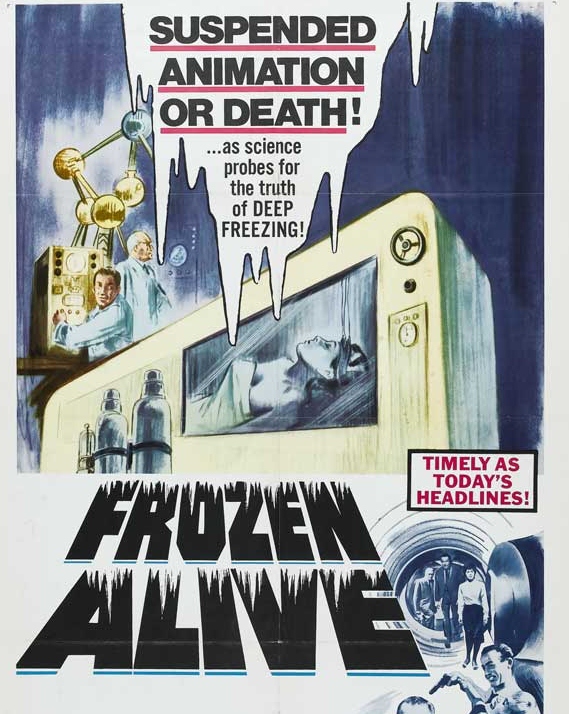
FROZEN ALIVE

FROZEN ALIVE (aka Der Fall X701/1964). Director: Bernard Knowles.

Dr. Frank Overton (Mark Stevens) is working on a project involving suspended animation via very low temperatures with another scientist named Helen (Marianne Koch). Overton's wife, Joan (Delphi Lawrence), is very jealous of Helen, and suspects her husband is having an affair with her, even as she carries on her own casual fling with her friend, Tony (Joachim Hansen). This leads to rather melodramatic but entertaining complications, including Overton being accused of murder. The highlight of the film is when one of the participants is frozen as an experiment, and there is some trouble bringing him out of the deep freeze -- a very suspenseful sequence. However, one problem with the climax is that Helen's actions, although her motivations are somewhat understandable, are enough to get her forever thrown out of the medical profession  -- she's a nut! The performances in this are very good, especially handsome Stevens [Fate is the Hunter], who gives a very sympathetic performance that makes it clear why the two ladies in his life are so crazy about him.  Knowles also directed Space Flight IC-1 and A Place of One's Own with James Mason. A West German production.

Verdict: Unusual romance/science-fiction melodrama with a very good cast. ***.


WEB OF LIES

Majanda Delfino and Andrew W. Walker
WEB OF LIES (2009 telefilm). Director: Tristan Dubois.

Abby Turner (Majandra Delfino) works for an Internet security firm and has just come up with a state-of-the-art new system. Alas she discovers that this system may have been compromised after her boyfriend, Josh (Andrew W. Walker) is killed and the FBI informs her that he was a cyber-criminal. Afraid they will think she's involved, Abby does her own investigating, hooking up with a female hacker named Spider (the impossibly named Kaniehtiio Horn); dodging agents Wilcox (Michael Mando) and Anderson (Tara Nicodemo); and consulting with her boss, Michael (Ted Whittall). Then she re-discovers a totally unexpected ally from the past that she's not certain she can trust. While Web of Lies stretches credulity at times, it is fast-paced and absorbing for the most part, with good performances from Delfino, Walker, Horn, and the others. Tyler Hall and Jesse Rath are also notable in supporting roles. There aren't enough suspects of the Really Big Bad Guy, but there's still one very surprising twist near the end.

Verdict: Credible suspense telefilm. *** out of 4.

Thursday, March 3, 2016

THREE SMART GIRLS

THREE SMART GIRLS (1936). Director: Henry Koster.

Dorothy Craig (Nella Walker) has been divorced from her wealthy husband, Judson (Charles Winninger) for years, when she discovers that he's keeping company with a marriage-minded gal named Donna (Binnie Barnes). Her three daughters, who haven't seen their father in ten years, jet from Switzerland to New York City -- along with nanny-maid Martha (Lucile Watson) -- to break Judson and Donna up and reunite their parents. Three Smart Girls sort of glosses over the fact that there's no excuse for a father not to see his own daughters in a decade, but as he's played by the "lovable" Winninger, it's made more palatable, if not quite excusable. You have to wonder why Judson would have the slightest interest in seeing his wife again let alone remarrying her. The three sisters are Joan (Nan Grey of Dracula's Daughter), who falls for her father's associate, Bill (John King of Charlie Chan in Honolulu); mousy Kay (Barbara Read), who is unaccountably pursued by Lord Michael Stuart (Ray Milland); and Penny (Deanna Durbin), who is the youngest and most high-spirited of the bunch. Universal obviously put the publicity push strictly behind Durbin, giving her several song numbers to showcase her glorious voice, and letting the other two gals sink or swim. Grey had quite a few credits before Three Smart Girls, while this was the first picture for Read, who had a few later credits. Except for a short, this was also Durbin's first movie. Whatever its flaws, Three Smart Girls is amusing, entertaining and well-acted by all, with Barnes especially good as Donna, and Alice Brady [Beauty for Sale] scoring as her mother. Mischa Auer is quite funny as a man hired by the girls to romance Donna. Followed by Three Smart Girls Grow Up.

Verdict: Cute picture with a winning Durbin and others. ***.

DEAR MURDERER

DEAR MURDERER (1947). Director: Arthur Crabtree.

Lee Warren (Eric Portman of Daybreak) discovers that his wife, Vivian (Greta Gynt of The Hooded Terror), has taken a lover, Richard (Dennis Price of She Played with Fire) while he is away for months on business. Warren concocts a clever scheme to do away with his love rival, but there are numerous complications, including the fact that apparently Vivien had already moved on from Richard to new boyfriend, Jimmy (Maxwell Reed, who also appeared with Portman in Daybreak). With one lover dead and another accused of murder, what is Vivien to do? Meanwhile Lee plays cat and mouse with police Inspector Penbury (Jack Warner). Dear Murderer is based on a play, but it is neither stage-bound nor opened up too unrealistically, and the movie has real suspense. The acting is excellent from all, although one can't help but wonder what the picture might have been like had Vivien been played by a perhaps more interesting actress such as Bette Davis or Linda Darnell. Hazel Court is cast as the murdered Richard's sister, Avis, and she is fine. There is a strange moment when Lee is about to confront his wife in the bedroom not long after he returns from his business trip, but the movie cuts away to the next scene at the crucial spot. The picture has a nice score by Ben Frankel and a very satisfying wind-up.

Verdict: Some pleasant company spent with a murderer. ***.

ORSON WELLES'S LAST MOVIE: The Making of "The Other Side of the Wind"

ORSON WELLES'S LAST MOVIE: The Making of The Other Side of the Wind. Josh Karp. St. Martin's Press; 2015.

"Orson Welles's Last Movie" pretty much begins with a meant-to-be-funny-but-isn't anecdote in which Welles is confronted by a homophobic Ernest Hemingway and reacts by acting like a "faggot" in front of him, leading to a battle and then the two collapsing into laughter. The anecdote may be apocryphal but it does somewhat figure in this convoluted story of Orson Welles and his attempts to finish -- or not finish -- The Other Side of the Wind. The book almost unfolds like a mystery as the reader wonders why few people have ever seen the completed footage of the film despite the fact that there is quite a lot of it. Disgusted with interference from studios who took final cut away from him for The Magnificent Ambersons and other films, Welles decided to go the independent route, and hired several people to help him who were devoted to the charismatic actor/director and willing to work insanely long hours for a comparative pittance. (Meanwhile Welles continued to live quite well and indulge his enormous appetite.) The plot of The Other Side of the Wind deals with a film director who, much like Welles, is making what he believes will be his final film while his world falls apart around him. Welles reportedly based the lead character on "macho men" like Hemingway and director John Huston, who plays the lead in Welles' movie. The Big Reveal at the end is that the director, who has affairs with most of his leading ladies, is actually more attracted to his leading men, and in love with the latest male star who has, apparently, only been using him. The big butch guy who is secretly gay and kills himself was a stereotype even in the seventies -- even The Sergeant came out earlier -- so Welles may not have been as ahead of his time as he thought he was. How self-revealing Welles was being with his screenplay (which was mostly in his head) is also open to debate. In any case, due to legal entanglements and the fact that the owners of the film won't release the rights (without a huge pay out, one suspects), it is unlikely the general public or film enthusiasts will ever see any of the movie. Those who have seen the footage claim that certain sequences have the same remarkable imagery and camera work of Citizen Kane, but whether it's as good a movie is another question [one suspects it has moments of brilliance but may not have added up to a whole even if it was finished; and the gay angle sounds awkward]. Author Karp isn't a film scholar, but Orson Welles's Last Movie is well-written and well-reported, and is a completely absorbing look at a gifted, difficult artist trying to make a movie outside of the studio system and putting it together like a patchwork quilt.

Verdict: Very good read with interesting details and a "cast" of dozens really pulls you along. ***1/2.

HELL BOUND

HELL BOUND (1957). Director: William J. Hole, Jr.

Jordan (John Russell) is a ruthless criminal who is putting together a gang for a caper: robbing a ship of millions of dollars of drugs. His confederates include: suffering addict Stanley (George Mather), whom Jordan slaps around brutally; obese and diabetic Herbie (Stanley Adams); tough moll Jan (Margo Woode of Somewhere in the Night); and sexy Paula (June Blair), who is not as bad as she seems. Harry Quantro (Frank Fenton) is another nasty associate of Jordan's. As part of her assignment Paula must play nurse to a paramedic, Eddie (Stuart Whitman of Sands of the Kalahari), who doesn't know that he's part of the robbery scheme. When a little boy is killed at an accident scene attended by Eddie and Paula, she is very disturbed by the child's death. Later her resolve to help commit the robbery weakens, but most of the other conspirators have equal problems. Hell Bound is a lively and absorbing crime movie about a bunch of truly inept criminals, and features good locations, some supremely screwed-up characters, and a highly satisfying wind-up. The prologue seems to depict the robbery itself but is only a film made by Jordan to show to his confederates. Whitman and Blair give very good performances, Woode and Mather are fine, and Russell is quite effective as the rough and determined ringleader. Jordan calls himself "Mr. Natas," an obvious reference to his evil nature. One scene that's supposed to take place on a boat looks like it was filmed on a staircase in an office building! William H. Hole Jr. was primarily a television director. Richard Landau also wrote the screenplay for The Quatermass Xperiment.

Verdict: Low-budget, but vivid, exciting, and well-acted. ***.

HELL'S HALF ACRE

HELL'S HALF ACRE (1954). Director: John H. Auer.

Donna Williams (Evelyn Keyes) has always thought that her husband of a short time died during the war. But then she sees a story about a man named Chet Chester (Wendell Corey) who has been arrested for murder in Hawaii and who greatly resembles the dead man. Chester is a deserter, black marketeer, and shady criminal, and when Donna confronts him he insists that he is not her husband. Can Donna get the man she apparently still loves to tell the truth? Meanwhile her poking her nose into Chet's business is bringing her to the attention of assorted nefarious elements. "Hell's Half Acre" refers to a dangerous, crime-infested section of Honolulu where much of the action takes place. While the movie has an intriguing premise, Hell's Half Acre isn't very good. Knowing what she knows about "Chet," it seems incredible that she wouldn't just walk away from the creep, especially when she finds out he was a deserter. The scenes between Donna and Chet don't work because the two actors just walk through their roles, perhaps because even they weren't convinced by the script. Philip Ahn plays a gangster who slaps around Marie Windsor, and Elsa Lanchester [Les Miserables] is a spirited lady cab driver. Keye Luke is the police chief, and Jesse White, annoying and unimpressive as ever, plays another hood who comes to a bad end. Windsor [Swamp Women] probably comes off the best with her typically vital portrayal. John H. Auer also directed The Crime of Dr. Crespi and quite a few melodramas and musicals.

Verdict: Not half as interesting as it sounds. **.