Lively, entertaining reviews of, and essays on, old and newer films and everything relating to them, written by professional author William Schoell.
Showing posts with label Mike Connors. Show all posts

Thursday, December 6, 2018

TIGHTROPE

Mike Connors
TIGHTROPE (1959). Half-hour television crime drama. One season. 37 episodes.

In this taut and memorable crime series, Mike Connors [Day the World Ended] stars as a man known only as Nick, an undercover police officer who can have few friends and only furtive romances as he goes from city to city establishing phony identities so he can infiltrate the mob in one dangerous assignment after another. As part of his cover, Nick often has to treat innocent people pretty badly, but I imagine he figures the ends justify the means. These episodes were very tightly-plotted and fast-paced and always put Nick into intriguing and suspenseful situations.

Gangsters Daughter with Leslie Parrish
Among the more memorable episodes: "Cracking Point" features Richard Jaeckel [The Dark] as a man blackmailed into robbing a bank, with Simon Oakland as guest-star; "Two Private Eyes" features two sleazy gumshoes who get the business when they look for a missing wife; "Cold Ice" is a mini-suspense masterpiece about the cutting of a perfect stolen diamond; "The Model and the Mobster" has Nick taking on a monstrous hoodlum very well-played by Bruce Gordon; Mike Mazurki scores in " "Long Odds," wherein Nick tries to find out which mob boss ordered a hit on a cop; Margaret Field and Jimmy Lydon guest-star in "Brave Pigeon," in which a hit is put on an innocent man who is able to identify a certain criminal; "The Gangster's Daughter" presents the cultured daughter (Leslie Parrish of The Money Jungle) of a wealthy mobster (Barton MacLane) with an overly ambitious nephew; "Bullets and Ballet" has Nick investigating why a top hood has come to town, with the excellent Doris Singleton (Carolyn Appleby on I Love Lucy) as a guest-star. Arguably the best episode of the series is "Man in the Middle" with Nick coming between a newly-released mob boss (Marc Lawrence) who's in deadly conflict with a younger rival (Gerald Mohr). Mike Connors went on to greater success with his hit P.I. show Mannix, which lasted several seasons.

Verdict: This show rarely dips below a "B+" level in quality and there are a lot of "A" episodes as well. ***. 

Thursday, May 25, 2017

SHAKE, RATTLE & ROCK

Holloway, Dumbrille, Dumont and Helton
SHAKE, RATTLE & ROCK (1956). Director: Edward L. Cahn.

"Rock 'n' Roll is destroying the youth of our nation."

DJ Gary Nelson (Mike "Touch" Connors) is the host of a teen rock and roll program which inspires the ire of a group of old fogies who are offended by its alleged vulgarity. They form the Society for the Prevention of Rock and Roll and the Corruption of American Youth or SPRACAY. The most interesting thing about the movie is that the members of this group include no less than Margaret Dumont [Little Giant], Douglass Dumbrille, and Percy Helton [The Crooked Way], all of whom are marvelous (Dumbrille is especially wonderful in his comic portrayal, but the others score as well). Unfortunately, while these veterans are aware that they are in a comedy, the same cannot be said for Mike Connors and Lisa Gaye as his girlfriend, who display little skill at humor. As Connor's good right hand, Sterling Holloway [Wild Boys of the Road] is pure camp as an early "Maynard G. Krebs" type. Shake, Rattle & Roll tries to have it both ways by trying to be "serious" at times, but it certainly doesn't work in this picture. The movie displays its own prejudices when it introduces a lisping nerd as the voice of classical music (although even he ends up "rockin'" at the end). Some rock and "swing" movies (from an earlier decade) respected classical and operatic music while celebrating the new type of sounds, while others got defensive and put down classical stuff the same way others derided rock 'n' roll; this is in the latter category. Raymond Hatton is fun as Dumont's hen-pecked but eventually liberated husband, Clarence Kolb plays a judge, and Fats Domino sings a couple of numbers. Much more screen time should have been given to Dumont, who can be very, very funny.

Verdict: Very amusing at times, but the fun eventually peters out and a lot of opportunities for great comedy are muffed. **1/2.

Thursday, May 11, 2017

DAY THE WORLD ENDED

"You're dimestore, Ruby, you're cheap!" Adele Jergens and "Touch" Connors
DAY THE WORLD ENDED (1955). Produced and directed by Roger Corman.

"He's a mutation, Rick, a freak of this new atomic world of ours."

After nuclear holocaust, a taciturn fellow named Maddison (Paul Birch) holes up in his valley home with his daughter, Louise (Lori Nelson), whose fiance is missing and presumed dead. Unwelcome visitors looking for food and shelter include hoodlum Tony (Mike Connors, billed as "Touch"), his moll and former striptease "artist" Ruby (Adele Jergens), old prospector Pete (Raymond Hatton of The Three Musketeers) and his mule; and the radioactive, supposedly dying Radek (Paul Dubov of Girls' Town), who is developing a taste for raw meat. A more welcome addition is geologist Rick (Richard Denning), who is able to handle Tony and has a mutual attraction for Louise. Meanwhile a strange mutated creature (Paul Blaisdell) roams the grounds as the others wonder if the threatening rainfall will wipe them all out with radiation sickness. Day the World Ended may use some of the same settings as Attack of the Crab Monsters, but it doesn't have that film's cleverness, imaginative touches, and creepy atmosphere. Jergens offers the zestiest performance as the ill-fated Ruby. Like many films of the period, it suggests that a person can't be decent unless he or she is religious. There's a vague twist ending involving the "dead" fiance, but nothing much comes of this. Filmed in widescreen "Superscope."

Verdict: Even mutations can only do so much. **.

Thursday, March 10, 2016

HARLOW (1965) vs. HARLOW (1965)

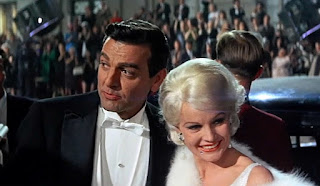
Mike Connors and Carroll Baker
HARLOW (1965). Director: Gordon Douglas.
HARLOW (1965). Director: Alex Segal.

"All the best things in life have to be done alone" -- "Marie Dressler" in Harlow II

In 1965 there were two "dueling" biopics about the star Jean Harlow, who died tragically young at 26, but neither of these films give the actress her due. Right off the bat, it seems like unfair competition, as Harlow I is a technicolor, widescreen epic with the highly publicized Carroll Baker [The Carpetbaggers] in the lead. Harlow II stars the perhaps lesser light Carol Lynley [The Shuttered Room], and was essentially a black and white television production (shot in Electrovision) and blown up to theatrical proportions. The chief difference, among many, is that Baker plays the role so that Harlow comes off as fresh and appealing, while Lynley is in "big bitch" mode throughout most of the movie, making one wonder why anyone would want to work with her. Harlow's mother is played in the first film by a marvelous Angela Lansbury, and Ginger Rogers is also quite good as the mother in Harlow II. In both films Harlow has a shiftless Italian stepfather, Marino. Raf Vallone [A View from the Bridge] is excellent as the character in the first film, while Barry Sullivan, despite not being Italian, manages to score in the second film as well. Both movies are rather slanderous (by 1960's standards as well as 1930's) in the character of first/second husband Paul Bern, who appears at least to be impotent and, it is suggested, homosexual. In the first film Peter Lawford barely registers, while a superb Hurd Hatfield [The Picture of Dorian Gray] gives the best performance in either picture as the same character. Bern had a common law wife who is never seen in the first film, and is played quite well by Audrey Totter in the second; she tells Harlow's mother that although she is Bern's mistress, they have never had physical contact. In both pictures Harlow is so dejected/depressed by the Paul Bern business that she turns herself into a "slut." Harlow I is based on a bio by Irving Shulman that was found by subsequent biographers to be heavily fictionalized. Unfortunately, Shulman's version of Harlow and her circle seems to be the unofficial basis for the second film as well.

Carol Lynley as Jean Harlow
In Harlow I Leslie Nielsen as "Richard Manley" is cast in the Howard Hughes role, while Efrem Zimbalist Jr. [A Fever in the Blood]  plays the counterpart to William Powell in the second; Zimbalist actually gives one of his best performances while Nielsen is acceptable. His near-rape of Harlow in his over-opulent bedroom is one of the best scenes in Harlow I, while Harlow II boasts a funny sequence which depicts her screen test with each take ruined because she can't stand to have the dour, disapproving Zimbalist watching her. There is also a very good scene between Rogers and Totter arguing over Paul Bern. The second version has some famous old actors being impersonated, such as Hermione Baddeley doing a not-bad Marie Dressler, and Celia Lovsky much less successful as a supposed Maria Ouspenskaya. There are interesting performances by Red Buttons and Hanna Landy in the first film, and Michael Dante, Lloyd Bochner, and especially John Williams in the second. Martin Balsam plays a studio head in Harlow I and gives one of his rare unconvincing performances.

As for the leading ladies, both give competent if second-rate performances (especially in the case of Baker), with both failing to capture the essence of Harlow -- her voice, her attitude, that surly, sexy, lovable demeanor that made her so famous. The ladies do the best they can, but as both versions say over and over again, there's only one Jean Harlow. [Both movies fail to get across that Harlow was a good actress.] An unintentionally comical scene occurs at the end of Harlow I when the doctor administering to a very ill Harlow exhibits as much compassion to her mother as a sociopathic iceberg. Oddly, the doctor in the second film is similarly cold, if not quite so stone-faced. In Harlow I Baker/Harlow disgustedly smears cold cream all over her image in her mirror, a scene that also occurs in the earlier Queen Bee with Crawford.

Verdict: Two smutty movies that don't have that much to do with the real Harlow. Both versions: **1/2 out of 4.

Thursday, May 8, 2014

LIVE FAST, DIE YOUNG

"Touch" Connors and Troy Donahue
LIVE FAST, DIE YOUNG (1958). Director: Paul Henreid.

After his days as a romantic lead were over, Paul Henreid became a director of mostly television and often bad B movies such as this. Live Fast, Die Young concerns two sisters (Mary Murphy and Norma Eberhardt) who have a series of misadventures after striking out on their own, with one, Jill, meeting the wrong men and eventually becoming embroiled in criminal activities. Murphy managed to amass 67 credits, including The Mad Magician, while Eberhardt did mostly TV work after this. More interesting cast members include Joan Marshall, who starred in Homicidal as "Jean Arless," Troy Donahue, and Michael [formerly "Touch"] Connors as a couple of bad guys. Gordon Jones [The Green Hornet] plays the girls' unpleasant father. The movie is too tedious to have much entertainment value. Among Henreid's better directorial efforts are the zesty Girls on the Loose with Mara Corday and Dead Ringer with Bette Davis.

Verdict: Moves slow, dies fast. *.

Thursday, June 28, 2012

SWAMP WOMEN

SWAMP WOMEN (1956). Director: Roger Corman.

An undercover policewoman, Lt. Lee Hampton (Carole Matthews), poses as a convict in order to find out where the female Nardo gang hid a fortune in diamonds. Put in the same cell as the three tough members of the gang  -- Josie (Marie Windsor), Vera (Beverly Garland), and Billie (Jill Jarmyn) -- Hampton breaks them all out and they head for the diamonds -- secreted in the Louisiana bayou! Along the way the ladies pick up two hostages, spoiled heiress Marie (Susan Cummings) and her supposed boyfriend Bob (Touch Conners, later to be known as Mike Connors). This is actually a fast-paced and very entertaining melodrama bolstered by Corman's brisk direction, some good performances (especially from Beverly Garland as the biggest bitch in the bunch), a few very zesty female-female fight scenes (okay, cat fights!), and lots of swampy atmosphere. A good showcase for "B" movie queens Garland and Windsor, and Jill Jarmyn also makes an impression as the resident sexpot. Matthews isn't bad, but Connors does little else but look good in his rolled-up sleeves. Jonathan Haze of The Little Shop of Horrors has a nice cameo as a pickpocket who pretends to be drunker than he is.

Verdict: This one is a lot of fun and has some suspense to boot. ***. 

Thursday, July 28, 2011

VOODOO WOMAN

VOODOO WOMAN (1957). Director: Edward L. Cahn.

"We're going into the jungle to bring back a secret recipe for borscht -- there's millions in it, ha, ha, ha!"

For reasons that are never quite delineated, Dr. Roland Gerard (Tom Conway) is trying to make a grotesque, super-strong gorilla-like monster (Paul Blaisdell) out of a pretty native girl, Zuranda (Jean Davis) in the jungle; his wife, Susan (Mary Ellen Kay), has come to realize that her husband is seriously disturbed. In the meantime, a cold-blooded woman named Marilyn (Marla English) has enlisted a guide, Ted (Mike Connors) to take her deep into the jungle looking for treasure -- and a fateful meeting with Dr. Gerard. This is an utterly absurd, but highly entertaining horror flick featuring a vivid Marla English, who also starred in Cahn's The She-Creature and the Bel-Air production Three Bad Sisters. This would be a perfect double-bill with Voodoo Island.

Verdict: Lively, fast-paced, and a lot of fun. ***.