Lively, entertaining reviews of, and essays on, old and newer films and everything relating to them, written by professional author William Schoell.
Showing posts with label mystery. Show all posts

Thursday, June 4, 2026

BEDELIA

Margaret Lockwood
BEDELIA (1946). Director: Lance Comfort. 

Bedelia and Charlie Carrington (Margaret Lockwood of The Wicked Lady and Ian Hunter of The Girl from 10th Avenue) are on their honeymoon in Monte Carlo when they encounter the artist Ben Chaney (Barry K. Barnes) and they all become friends. Charlie hires Ben to do a portrait of Bedelia, which she objects to, complaining of headaches when she's forced to pose. Ben seems to have a too-intense interest in the pretty woman, and follows the couple to Charlie's home town where the artist is set up in a studio. Ben's mere presence makes Bedelia nervous, and suspicion of the man is also ignited in Ellen (Anne Crawford of They Were Sisters), Charlie's business partner. But is Bedelia keeping secrets herself? 

Ian Hunter with Lockwood
Bedelia
is based on a novel by American writer Vera ("Laura") Casbury. The story originally took place in Connecticut but was moved to England for this British production, with the time period updated from shortly after the turn to the century to a contemporary period. Casbury felt that this compromised her theme of the changing gender roles of the time. Whatever the case, Bedelia is a well-acted and very suspenseful story with a darkly fascinating heroine and very interesting supporting characters. Others in the cast include Jill Esmond as Nurse Harris, called in when Charlie suffers food poisoning, Beatrice Varley of Hatter's Castle as the maid Mary, and Barbara Blair as the chatty party guest, Sylvia. Barnes and Lockwood also appeared together in The Girl in the News

Verdict: Intriguing British suspense flick. ***. 

SUSPENDED ALIBI

Naomi Chance and Patrick Holt
SUSPENDED ALIBI (1957). Director: Alfred Shaughnessy. 

Editor Paul Pearson (Patrick Holt of The Unholy Four) has been playing around with a fashion writer, Diana (Naomi Chance of Wings of Danger), despite his having a loving wife, Lynn (Honor Blackman), and young son, Bobby (Toby Winterbottom). He is trying to call it off with Diana, and uses a buddy, Bill (Bryan Coleman) as a beard. Unfortunately Bill is stabbed to death and Paul becomes a suspect. He tells the police he spent most of his time away from home with Diana, but when questioned she refuses to give him an alibi. Just in case she might change her mind, the real killer pays a call on Diana ... and then Paul is really in trouble.  

Patrick Holt and Honor Blackman
In some ways Suspended Alibi plays like something made twenty years earlier. The characters are not developed very well, and there are no scenes where the impossibly understanding wife has a strong confrontation with her adulterous husband -- he seems to get a free pass. There is a little suspense at the end as the police rush to apprehend the killer, but otherwise the film is watchable but has little tension. Another murder scene in which someone gets thrown out of a window is laughably muffed. Others in the cast include Andrew Keir as a reporter-friend of Paul's; Valentine Dyall as Inspector Kayes; and Lloyd Lamble as the neighbor Waller. 

Verdict: Distinctly minor-league British mystery that could have been developed into something much more worthwhile. **1/4. 

Thursday, April 23, 2026

NIGHT WITHOUT SLEEP

June Vincent and Gary Merrill
NIGHT WITHOUT SLEEP (1952). Director: Roy Ward Baker.

Broadway composer Richard Morton (Gary Merrill of Another Man's Poison) wakes up from a bender with a vague idea that he might have killed a woman. His shrink has already suggested that he's capable of violence, especially when he's drinking. There are three women in his life: his wife, Emily (June Vincent of Shed No Tears), who backed his last show on the condition that he marry her if the show was successful; his girlfriend, Lisa (Hildegarde Knef), who is in despair that she can't maintain a hold on him; and movie star Julie Bannon (Linda Darnell of Star Dust), who was in his last show before she became a star, and whom he basically forgot until re-encountering her at a party. Since the film consists of many flashbacks, the audience has to wonder if one of these ladies will wind up dead or not. 

Merrill with Linda Darnell
Night Without Sleep
 is full of over-familiar noir elements, but manages to entertain in spite of it. The acting is good all around, although it's not easy to be sympathetic to the somewhat unlikable Morton, who can be a self-righteous jerk. Cast in a role all too typical for her, Vincent is adept as the always-in-control wife, Knef is appealing in her vulnerability as Lisa (even if it's hard to root for her), and Darnell displays her usual star power as the surprisingly naive and even somewhat gullible Julie. Others in the cast include Hugh Beaumont as Merrill's friend, Donald Randolph as the psychiatrist, and Steven Geray as a restaurant owner. 

Verdict: Noir flick holds the attention and is well-acted. ***. 

LURED

LURED
(1947). Director: Douglas Sirk. 

"I am an unmitigated cad." 

 George Sanders, Boris Karloff, Charles Coburn -- and Lucille Ball -- all in the same movie? Not only that but George Zucco and Sir Cedric Hardwicke, too? Too bad it's such a lousy movie. Lucy is a show girl of sorts whose friend disappears after answering a romantic personal ad. The police employ her as a decoy who will answer different ads and hopefully bring the murderer of several young women, the friend included, to light. George Sanders is a theatrical agent who takes a shine to Lucy. Boris Karloff is a weird, mentally ill clothing designer, Zucco is a police officer (as is Alan Napier of Batman TV fame), and Joseph Calleia is an even weirder friend of Karloff's. Charles Coburn is miscast as a Scotland Yard inspector -- it's one of the few times this wonderful character actor fails to make much of an impression, although he does have his moments (such as a scene with Hardwicke). Lucille Ball does make an impression -- but in the wrong way. 

Although her Lucy characterization was four years in the future, at times the movie resembles "Lucy Meets Jack the Ripper." Her comic gifts and timing are much in evidence, but in the wrong movie. And her whole persona is much too contemporary to be convincing in a period piece. On the other hand, she's the only bright note in the movie, despite solid performances from Sanders and some of the others. However, in no way can it be considered a memorable dramatic performance. There are some atmospheric shots, but Douglas Sirk is no Hitchcock and the music is all wrong. A hilarious aspect is that early in the film one of the victims describes the (fairly obvious) killer as being "handsome." Well ... wait and see, if you care to. 

Verdict: Seems like five hours. *1/2.

Thursday, January 15, 2026

THE UNSUSPECTED

THE UNSUSPECTED
(1947). Director: Michael Curtiz.

"I detest scenes not of my own making."

Roslyn, the secretary of radio star Victor Grandison (Claude Rains), who narrates tales of mystery and the macabre, is found hanging in the study, apparently the victim of a suicide. Meanwhile, Grandison's niece, Matilda (Joan Caulfield), who was supposedly lost at sea, shows up alive and well, as does Steven Howard (Michael/Ted North), a man she doesn't remember who claims he's her husband. Other members of this strange household include another viperish niece, Althea (Audrey Totter), her husband Oliver (Hurd Hatfield), whom she stole away from Matilda, and snappy assistant Jane (Constance Bennett), not to mention Press (Jack Lambert) a hooligan employed by Grandison. Based on a novel by Charlotte Armstrong, this seems an odd fit for director Curtiz (despite his work on such films as Mildred Pierce) and while it holds the attention and has a fairly exciting finale, otherwise it never quite comes alive. Nice work by Claude Rains (although he seems less inspired by this material than he was in, say, Deception). Audrey Totter is vivid, as usual, as is Constance Bennett. Caulfield is just okay, no more.

Verdict: Okay suspenser. **1/2.

Thursday, August 14, 2025

THE BLACK ABBOTT (1963)

The Black Abbott on the prowl
THE BLACK ABBOTT (aka Der schwarze Abt/1963). Director: Franz Josef Gottlieb. 

Lord Harry Chelford (Dieter Borsche of Dead Eyes of London) lives on his estate -- which is reputed to be haunted by a Black-robed Abbott -- and is engaged to Leslie (Grit Boettcher), although she clearly prefers her fiance's cousin, Dick Alford (Joachim Fuchsberger). Leslie's brother, Arthur (Harry Wustenhagen), has a great deal of debts, and is taken advantage of by his employee, Fabian Gilder (Werner Peters) -- Arthur either talks his sister into marrying Gilder, or he will send Arthur to prison. In the meantime, Gilder, Mary (Eva Ingeborg Scholz) who wants Lord Chelford for herself, and others -- including the berobed abbott -- are searching the grounds of the Chelford estate for a rumored treasure of gold. Someone has already been stabbed to death -- who will be next?

Kinski with Fuchsberger
The Black Abbott is based on an old novel by Edgar Wallace which is convoluted and dull and which I never did manage to finish. This film version -- there have been several -- is almost too faithful to the story and is also convoluted and dull. Frankly, although I generally love West German krimi (crime) movies based on Edgar Wallace novels, if this had been the first one I watched I probably wouldn't have sat through the others. Fuchsberger and Peters are familiar players -- Klaus Kinski (of Web of the Spider) is also in this, playing a sinister butler with a criminal history -- and we are also plagued by the presence of the awful Eddi Arent in his usual role of police bumpkin and alleged comedy relief.  

Mismatch: Werner Peters with Grit Boettcher
The Black Abbott has some atmosphere but not much suspense despite so many different characters running around to little effect. More than one of them dress up as the Black Abbott on different occasions, although there usually isn't much sense to it. There was a British film version of the novel in the thirties, and other krimi movies were based on it afterwards (such as The College-Girl Murders in 1967), although these took a lot of liberties. If you're looking for a horror film with a sinister monk beheading people, this isn't it. What you will get instead is a tedious mystery film that fades from memory even as you're watching it. 

Verdict: Could have killed the West German Edgar Wallace sub-genre practically at the starting gate. *. 

Thursday, February 13, 2025

BLACK WIDOW (1954)

BLACK WIDOW (1954). Writer/director: Nunnally Johnson.

Broadway producer Peter Denver (Van Heflin), who is married to actress Iris Denver (Gene Tierney), befriends a struggling young writer named Nanny (Peggy Ann Garner) and eventually wishes he hadn't. Ginger Rogers (Dreamboat) plays his star Carlotta Marin and Reginald Gardiner is her husband, Brian. Possibly attempting to approximate the success of All About Eve, Nunnally Johnson took a story by mystery writer Patrick Quentin (actually Hugh Wheeler) with a Broadway background and concocted another story of an aging affected actress and opportunistic young'n. There the resemblance to All About Eve ends as, to be fair, Black Widow goes in its own direction, but while the first quarter is unpredictable the rest is sadly familiar. Also, Black Widow is vastly inferior to All About Eve and Ginger Rogers is pretty inadequate doing a lower-case Bette Davis. Heflin is as good as ever, but the material is far beneath him, and Gardiner, usually at his best in comedies, is comically miscast in this. Gene Tierney is also good, but she, too, is pretty much wasted. Virginia Leith, Otto Kruger and an unrecognizable Cathleen Nesbitt are excellent in supporting parts. George Raft is simply an embarrassment as a police detective, but Peggy Ann Garner scores as Nanny. The main trouble with Johnson's script is that he hasn't created characters, only trotted out an assortment of types.

Verdict: Watch out for movies in which Reginald Gardiner plays a romantic figure. **.

Thursday, January 2, 2025

THE CASE OF THE FRIGHTENED LADY (1940)

Dudley-Ward, Haye, Goring, Barr
THE CASE OF THE FRIGHTENED LADY (aka The Frightened Lady/1940). Director: George King. Colorized

In this British version of an Edgar Wallace story, Inspector Tanner (George Merritt) investigates when the chauffeur, Studd (John Warwick), of the redoubtable Lady Lebanon (Helen Haye) is found strangled on the grounds. Suspects include the shady Dr. Amersham (Felix Aylmer of The Chalk Garden), who knew Studd in India; Architect Ferraby (Patrick Barr), who has taken a shine to Lady Lebanon's secretary, Isla (Penelope Dudley-Ward); the grounds man Tilling (an unrecognizable Torin Thatcher); and Lady Lebanon's son Willie (Marius Goring of The Barefoot Contessa), whom she wants Isla to marry. Then there's another murder ... 

Haye and Dudley-Ward
The Case of the Frightened Lady 
was filmed many times both theatrically and for television. West Germany came out with a version called The Indian Scarf in the sixties, which made quite a few changes to the story. The performances in this version, especially from Haye and Goring, are quite good, and there's a degree of suspense as well. The screenplay has a subtext of keeping up appearances -- and bloodlines -- at all costs, no matter how reprehensible this may be. George Blake also directed Sexton Blake and the Hooded Terror.

Verdict: Edgar Wallace strikes again. ***. 

Thursday, November 7, 2024

THE RED CIRCLE

The mysterious "red circle" with Renate Ewert
THE RED CIRCLE (aka Der rote Kreis/1960). Director: Jurgen Roland.

A condemned man is saved from the guillotine because the executioner forgets to remove the nail that keeps the blade from descending. Sent to Devil's Island, he escapes and takes up residence in London as the hooded criminal mastermind the Red Circle (who resembles the Shadow). Chief Inspector Parr of Scotland Yard (Karl-Georg Saebisch) and bumbling assistant Haggett (Eddi Arent) are out to stop him as he makes his way through numerous victims including Lady Dorringham (Edith Mill) and Mr. Beardmore (Alfred Schlageter). The latter's handsome nephew, Jack Beardmore (Thomas Alder), is carrying on a romance with suspected jewel thief Thalia Drummond (Renate Ewert) and becomes a suspect along with several others. Meanwhile slick private eye Derrick Yale (Klausjurgen Wussow) does his best to help Inspector Parr, who is given a deadline to unmask the Red Circle or else. 

Thomas Alder, Karl-Georg Saebisch, Klausjurgen Wussow
The Red Circle is another adaptation of an Edgar Wallace story made in West Germany. It is one of the best examples of the genre. Suspenseful, fast-paced, well-acted, and exciting, it maintains suspense and has several surprises, including a couple of twists at the end. True, not everything is cleared up and the resolutions may confuse you, but the whole thing is so damn entertaining it doesn't really matter. Renate Ewert makes a wonderful impression as the irrepressible Thalia who keeps you guessing as to exactly whose side she's on. Tragically, both she and Thomas Alder committed suicide while in their early thirties. 

Verdict: Top-notch West German thriller or Krimi. ***.

Thursday, September 26, 2024

FEAR NO MORE

Mala Powers appeals to Jacques Bergerac for help
FEAR NO MORE (1961). Director: Bernard Wiesen. 

Sharon Carlin (Mala Powers of Edge of Doom) is having a bad day. A man points a gun at her in a train compartment and accuses her of murdering the dead blonde whose body is nearby. This man disappears and a police officer (Robert Karnes) shows up and tries to take her into custody. When she runs off she is nearly run over by Paul Colbert (Jacques Bergerac of Twist of Fate), who is travelling with his young son. Paul eventually comes to care about Sharon and tries to help her figure out what's going on, especially when her employer, Milo Seymour (John Harding), denies all knowledge of sending Sharon on that train trip. Then Mrs. Seymour, for whom Sharon was hired as  a companion, shows up but is a completely different woman (Helena Nash). Still Paul supports Sharon until he learns that she was in a mental institution and may have murdered her last elderly employer. Still, something just doesn't sit right with Paul ... 

Powers with Jon Baer
Fear No More
 will hold your attention as it maneuvers the various twists and turns of the interesting plot, although Sharon's actions are often stupid, and a lot of the details of the alleged plot she's gotten herself into don't make much sense when all is said and done. However, Powers gives a good accounting of herself and she gets good support from Bergerac, Harding, Nash, and John Baer [Terry and the Pirates] as Keith, a tippling friend of hers who comes to an bad end. Anna Lee Carroll is also good as Paul's ex-wife, Denise. The picture leads up to a tense confrontation at a cabin in the woods. 

Verdict: Intriguing if imperfect mystery-thriller with a good cast. ***. 

Thursday, April 25, 2024

THE SECRET OF THE PURPLE REEF

Brothers: Richard Chamberlain; Jeff Richards 
THE SECRET OF THE PURPLE REEF (1960). Director: William Witney. 

When a ship disappears in the Caribbean, and their brother is presumed dead, Mark Christophe (Jeff Richards of Born Reckless) and his other brother, Dean (Richard Chamberlain), try to find out what happened. Does it have something to do with another ship that was scuttled in that area around the same time? And is a man named Tom Weber (Peter Falk of Penelope) somehow mixed up in this? With the help of their late brother's pal, Tobias (Robert Earl Jones), they try to get information from the shifty loner Ashby (Terence de Marney) and from Weber's girlfriend, Rue Amboy (Margia Dean). But are the brothers asking too many questions? 

Peter Falk and Margia Dean
The Secret of the Purple Reef
 seems to have everything going for it: attractive leads, beautiful scenery, an interesting Calypso score, a fairly intriguing plot, and an experienced action director in serial specialist William Witney [King of the Mounties]. But the script is a bit of a letdown and the movie never really catches fire. As well the action sequences lack that great exciting touch that Witney brought to his cliffhangers and other movies. Peter Falk gives an excellent performance, with de Marney and Jones (the father of James Earl Jones) also notable. Chamberlain and Richards look great and are competent. Margia Dean, sort of the love interest, is middle-aged, matronly, and completely miscast. This picture needed a really sexy lady to complement the two handsome leads. 

Verdict: Such possibilities, but this just doesn't quite work. **. 

MYSTERY OF MARIE ROGET

Maria Montez as Marie Roget
MYSTERY OF MARIE ROGET (1942). Director: Phil Rosen.

Notorious actress Marie Roget (Maria Montez of Arabian Knights) goes missing in Paris, and Inspector Gobelin (Lloyd Corrigan) and the famous Dr. Dupin (Patric Knowles of Five Came Back), who solved the case of the Murders in the Rue Morgue, are called in to investigate. After a few days Marie turns up alive, and her grandmother, Cecile (Maria Ouspenkaya of Frankenstein Meets the Wolfman) suspects that Marie's stepsister, Camille (Nell O'Day) may be the subject of a devious murder plot. There is also a faceless corpse of a woman in the river. Dupin accompanies Camille to a party, but when another dead body turns up in the river it may be a surprise to everyone whose it is. Dupin, with the help/interference of the Inspector, uncovers the murderer and his motive. 

Knowles and Corrigan
Mystery of Marie Roget
 is very loosely based on the famous short story by Edgar Allan Poe, which in turn was inspired by a real murder case -- the first mystery story to do this -- although the murder occurred in New York and not in Paris. One problem with this film adaptation is that there aren't enough suspects, which include John Litel as the family lawyer, and Edward Norris as Camille's shady fiance, and even the old grandmother herself. Although the film still has some suspense in spite of this, the solution doesn't come as much of a surprise. As for the cast, Corrigan is as fun as ever, Knowles makes a credible Dupin, Ouspenkaya is suitably peppery (and borderline bitchy with the Inspector), Montez looks classy and actually gives a perfectly good performance, and Litel and Norris are on-target throughout the proceedings. The film is well-paced under Phil Rosen's direction and well-produced. Rosen directed several Charlie Chan movies and many others. 

Verdict: Not Poe perhaps, but entertaining, atmospheric, and well-made. ***.  

Thursday, December 8, 2022

THE ROSARY MURDERS

Wary in the confessional: Donald Sutherland
THE ROSARY MURDERS (1987). Director: Fred Walton.

"We're saving souls -- not lives."

Father Robert Koesler (Donald Sutherland of Invasion of the Body Snatchers) discovers that someone is targeting members of the clergy, shooting a priest and faking a nun's suicide. In a steal from Hitchcock's I Confess, the killer confronts Father Koesler in the confessional, and after surviving the encounter, the priest does his own investigation. He learns who the killer probably is but doesn't inform the police, not wishing to betray the sanctity of the confessional. (While it makes sense that a more conservative priest, like Father Nabors, played by Charles Durning of Sisters, would adhere to canonical law, Koesler is portrayed as being more liberal.) Because of his inaction, there are several more deaths, for which Lt. Koznicki (Josef Sommers) clearly blames him. 

Charles Durning
The Rosary Murders, based on the novel by former priest William X. Kienzle, has an interesting storyline, but there's something strangely unsatisfying about the movie. The film is directed by Fred Walton, best known for When a Stranger Calls -- he also co-wrote the screenplay with Elmore Leonard -- but you get the feeling that he's holding back, that he really wanted to craft an all-out horror film instead of a suspense picture, but felt too restricted. There are a couple of creepy scenes in the movie, but a kind of almost amateurish sheen that makes the whole project seem second-rate, despite its good points and the fact that it is fast-paced and absorbing. The movie completely lacks a sense of urgency, even though people, including police officers, are dropping like flies! (I would have loved to have seen what Italian giallo director Dario Argento could have done with this material!)

James Murtaugh
Another problem is that Donald Sutherland isn't well cast and gives an unremarkable performance, possibly because the character is irritating in some ways and contradictory. Durning is fine, as always, and James Murtaugh scores as a parishioner whose teenage daughter committed suicide. Belinda Bauer is given the thankless role of a reporter who becomes friends with Father Koesler and apparently falls in love with him -- one of the least convincing "romances" in the history of the movies ( and which should have been left on the cutting room floor). The movie at times seems vastly over-scored. Kienzle wrote many more books in the Father Koesler series, turning the priest into an amateur sleuth, and engendering the Protestant Reverend Randollph novels as well. 

Verdict: Intriguing plot carries this along despite deficiencies. ***.

Thursday, October 13, 2022

THE HOUND OF THE BASKERVILLES (1939)

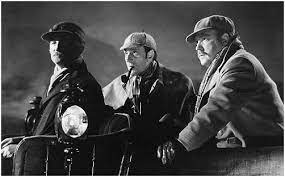
On the moors with Holmes and Watson
THE HOUND OF THE BASKERVILLES
(1939). Director: Sidney Lanfield. 

"Oh, Watson, the needle." 

This is the first of two Sherlock Holmes films made by Twentieth Century-Fox and the first in which the wonderful Basil Rathbone created perhaps the definitive movie portrayal of the famous detective -- he is simply outstanding. The plot has to do with Holmes and Watson (Nigel Bruce) trying to save the life of an heir (Richard Greene) while dealing with rumors of the huge title beast roaming the foggy moors where the story takes place. John Carradine has a small role as a servant, and Wendy Barrie is the love interest. Lionel Atwill, who played Holmes' nemesis Professor Moriarty in a later film, Sherlock Holmes and the Secret Weapon, is excellent in the more sympathetic role of Dr. Mortimer. Mary Gordon played Mrs. Hudson for the first time in this picture. Barlowe Borland scores as the cranky, litigious old Frankland. Morton Lowry is fine as John Stapleton. The 1959 color remake is also quite creditable, and some may feel it has the slight edge. Followed by The Adventures of Sherlock Holmes. 

Verdict: Fine introduction to the Rathbone portrayal. ***.

Thursday, August 4, 2022

THE MAN WITH TWO FACES

Edward G. Robinson and Mary Astor
THE MAN WITH TWO FACES
(1934), Director: Archie Mayo. 

"The second act is still a fine piece of Limburger." 

Actor Damon Welles (Edward G. Robinson)is appalled to learn that his brother-in-law Stanley Vance (Louis Calhern), isn't dead after all, but has come back into his sister Jessica's (Mary Astor) life and is exerting a seriously unhealthy influence over her. So he cooks up a scheme to disguise himself and ... This dull and predictable movie, based on a minor stage play, wastes the talents of its excellent cast, who give it more than it deserves. Ricardo Cortez plays a theatrical producer and John Eldredge is a playwright. Robinson has such a distinctive face, figure and aura that, fine actor that he is, it's difficult for him to successfully disguise himself. Crisp, well-composed photography is another bonus but nothing can overcome that creaky plot. 

Verdict: Robinson is always worth watching. **.

Thursday, July 21, 2022

THEY ONLY KILL THEIR MASTERS

THEY ONLY KILL THEIR MASTERS
(1972). Director: James Goldstone. 

Chief of Police Marsh (James Garner) investigates when a woman is found dead and it is at first assumed that she was the victim of a Doberman Pinscher. But it turns out that she was murdered by a much more human adversary. Her husband (Peter Lawford) says she told him she was going to leave him for another woman. Interestingly enough, she was also pregnant at the time of her death. Suspects include a vet (Hal Holbrook), his assistant (Katherine Ross), who becomes involved with Marsh, and the vet's wife (June Allyson, who is quite good in a brief sequence). Edmond O'Brien plays the owner of a liquor store, and Tom Ewell and Ann Rutherford have supporting roles as well; Harry Guardino is another cop. This is typical of slick TV-like movies released theatrically in the seventies that try to be "hip" by adding homoerotic elements, but Lane Slate's script is pretty dated when it comes to the subject of homo and bisexuality and swinging. Garner is Garner; Ross is pretty. The best scene has the Doberman going a little nutty when Garner and Ross are in bed. 

Verdict: If you're a swinger you gotta die. **.

Thursday, May 12, 2022

AGNES OF GOD

Meg Tilly and Jane Fonda
AGNES OF GOD (1985). Director: Norman Jewison. 

A young nun, Sister Agnes (Meg Tilly), is arrested for manslaughter when her strangled baby is found in a waste basket at the convent. Dr. Martha Livingstone (Jane Fonda), a psychiatrist, is brought in to assess the nun's mental condition. She has some problems in this due to the nun's reticence in talking about or even acknowledging her pregnancy, and the Mother Superior, Miriam (Anne Bancroft). has objections as well. Martha is a lapsed Catholic and Miriam accuses her of hating the Church. Martha decides to do some investigating and find out who the father of the baby is, and if somebody else strangled the infant. She discovers there's a secret exit from -- and entrance into -- the convent.

Anne Bancroft and Jane Fonda
The film version of Agnes of God, which was based on a stage play by John Pielmeier (who also wrote the screenplay) was packaged in movie houses as a murder mystery. If viewers, especially non-Catholic and non-religious viewers, knew it was actually a kind of dopey exploration of faith and the immaculate conception, there probably would have been even less of them in the theater. The film has a visual gloss to it due to Sven Nykvist's cinematography, some nice music by Georges Delarue, and the acting from the three leads can not be faulted, yet ... Most sensible viewers will feel that Sister Agnes definitely needs a psychiatrist! This is a study of severe mental illness masquerading as an examination of faith.

Verdict: Beatific looks can't help put this one over. **.  

ENDLESS NIGHT

Hywel Bennett and Hayley Mills
ENDLESS NIGHT (1972). Director: Sidney Gilliat. 

Michael Rogers (Hywel Bennett) drives wealthy people across Europe but wants a better life for himself. He greatly admires a piece of property called Gypsy's Acre in a small English village, and dreams of having his dying architect friend, Santonix (Per Oscarsson), design a house for him there. Dreams do come true after Michael meets and falls for Ellie Thomson (Hayley Mills), a lovely young woman who turns out to be an American heiress. Michael is disturbed by the discrepancy in their incomes, but Ellie is determined to marry him, despite her family's and advisors' objections. She is helped in her goal by her friend, Greta (Britt Ekland), who becomes an unwelcome presence in the couple's lives after they tie the knot. Santonix does design a magnificent house for them on the desired property, but events occur which make them feel ill at ease. Then there's a death ... 

Bennett with George Sanders
Endless Night is based on the novel by Agatha Christie, one of the author's personal favorites, and it is a suspenseful and especially well-written book which is told, as in the film version, from the point of view of Michael. Endless Night is quite well-acted by all the participants -- George Sanders adds a touch of class as a deceptively friendly lawyer -- the house is something to see (particularly the inside of it), and the viewer may or may not catch on to the twist that occurs at the finale. 

Britt Ekland with Mills
The trouble is that Endless Night is just blah. There's only one possible twist, not a lot of serious suspects, and the whole production just comes off as second-rate. Even Bernard Herrmann's score seems to consist of snatches from other and better movies. Bennett and Mills first worked together in The Family Way, then reunited for Twisted Nerve and then this film. Hayley Mills married Roy Boulting, who was 33 years older than her, and it is said that his choices for her all but ruined her career. Mills is still acting although her profile is comparatively low today. Bennett passed away in 2017. Britt Ekland's [The Wicker Man] last credit was in 2006. 

Verdict: Read the novel instead. **1/2.

Thursday, March 31, 2022

POSTHUMOUS

POSTHUMOUS

My latest thriller, for people who love movies, celebrities, psychos, and suspense fiction, is entitled POSTHUMOUS. Below is a description. It's available in hardcover, trade paperback, and inexpensive kindle editions on amazon.

"Anna Corrigan, the daughter of the late movie star and entertainer Mavis Edwards, has spent years trying to deal with the emotional fall out from the decades she spent with her often difficult and neurotic mother. Anna attends her sister Estelle's singing showcase at a tiny supper club uptown, where she encounters some of her mother's "friends" from the past. These include a crooked business manager named Louie Mayhew; her old co-star Jerry Giddings, who has fallen on hard times; her bitchy rival Marjorie Easterbrook; choreographer “Busy” Borroway, an unrepentant child molester who numbered Mavis Edwards among his victims; and George Kelker, a director who refused to hire Mavis Edwards for an important production many years before. George is only the first of these individuals to be horribly murdered by a crazed female intruder who, Kelker's wife insists, looks just like Mavis Edwards! There had always been nutty stories in the tabloids about Mavis Edwards being alive and hidden in a sanitarium and with all these reports of a crazy lady who resembles her beginning to surface, Anna wonders if it could possibly be true. But as the murders continue and Anna finds her life unraveling, she learns that the truth is far more terrible than she could ever even imagine."

"POSTHUMOUS is a movie lover's thriller, dissecting one impossible star's neurotic behavior and the effect it has even years later on her children."

Is "Mavis Edwards" meant to be Bette Davis, Joan Crawford, Judy Garland, or someone else? Read the book to find out!  

Thursday, March 3, 2022

ONE OF MY WIVES IS MISSING

James Franciscus and Jack Klugman
ONE OF MY WIVES IS MISSING  (1976 telefilm). Director: Glenn Jordan.

Daniel Corban (James Franciscus) is on his honeymoon in a small town when he tells Inspector Levine (Jack Klugman) that his wife walked out after a minor argument and hasn't been seen since. The laid-back Levine tries to be sympathetic but doesn't think there's much to worry about, especially when Mrs. Corban (Elizabeth Ashley) walks in and announces that she's back. The only problem is that Corban insists that he has never seen this woman before and that she is not Elizabeth Corban! Although Corban thinks of every way he can to convince the inspector that he's telling the truth, his "wife" counters his every move, and the situation truly begins to look desperate ... 

Elizabeth Ashley
Three good lead performances are at the heart of One of My Wives, a twisty tale that has been told before and afterwards. Anne Baxter was the harried honeymooner in Chase a Crooked Shadow (1958), then Janet Leigh in Honeymoon with a Stranger (1969). In 1986 came yet another telefilm, Vanishing Act, which starred Elliot Gould as the honeymooning husband. These were all official or uncredited versions of Robert Thomas' stage play "Trap for a Single Man." Like other versions, One of My Wives is suspenseful and intriguing, bolstered by Klugman's pleasant cop, Ashley's increasingly sinister and witchy portrayal, and Franciscus' credibly mounting fear, confusion and alarm. There is also good work from Joel Fabiani as a priest, Milton Selzer as a grocer, and the ever-lovable Ruth McDevitt as a neighbor. 

Verdict: Good version of this oft-told tale. ***.