Lively, entertaining reviews of, and essays on, old and newer films and everything relating to them, written by professional author William Schoell.
Showing posts with label Hermione Baddeley. Show all posts

Thursday, February 13, 2025

PASSPORT TO PIMLICO

The wonderful Margaret Rutherford
PASSPORT TO PIMLICO (1949). Director: Henry Cornelius.

After discovering a cache of treasure hidden under the streets, the residents of the district of Pimlico in Post-WW2 London discover documents that (in a convoluted way) actually make them residents of Burgundy. Then a handsome Duke of Burgundy (Paul Dupuis) shows up and begins romancing one of the local women. At first the residents playfully refuse to follow certain British rules -- such as shutting the pubs down at a certain hour -- because, after all, they aren't Londoners but Burgundians.  Unfortunately, this excites and dismays the British parliament and before long the residents of Pimlico find themselves mired in red tape and having to cross customs just to leave or enter their own district. In true British fashion, they decide to fight back and display their English tenaciousness. Okay. This is a cute idea and it does have some amusing sequences, but it gets bogged down way before its over, and its attempt to create characters you actually care about don't quite hit the mark. Most of the cast is unknown on American shores with the exception of Hermione Baddeley, Stanley Holloway, and the wonderful Margaret Rutherford, who plays a historian with her customary panache and enlivens every scene she's in. If only there were more of them!

Verdict: One of those quaint British movies that you can either take or leave. **1/2.

Friday, December 28, 2018

A CHRISTMAS CAROL (1951)

Alistair Sim as Ebenezer Scrooge
A CHRISTMAS CAROL (1951). Director: Brian Desmond Hurst. NOTE: The colorized version, which I watched, is also known as Scrooge.

Ebenezer Scrooge (Alistair Sim) is a tightwad and rather heartless individual whose only response to the holiday season is "humbug!" On Christmas Eve the ghost of his late partner, Marley (Michael Hordern), appears to him, warns him that he's facing a dark future, and tells him that three more ghosts will appear, those of Christmas Past, Christmas Present, and Christmas Days to Come. Scrooge sees visions of his past and the pivotal events that shaped him, such as selling out his employer, Fezziwig (Roddy Hughes)  and losing the love of Alice, (Rona Anderson), the only woman he wanted to marry. He sees the plight of the poor and his own future, as well as that of his employee, Bob Crachit (Mervyn Johns) and his crippled son, Tim (Glyn Dearman). With these increasingly depressing visions, the true spirit of Christmas -- practicing kindness instead of cruelty -- finally takes possession of Ebenezer Scrooge.

"God bless us, everyone." Tiny Tim
A Christmas Carol is a wonderful movie, bolstered by a superb performance from Sim [The Belles of St. Trinian's], great supporting performances, a fine Richard Addinsell score, and superior direction from Hurst.  Every time the film comes near to being a trifle cloying, the next second I'd have a lump in my throat. In other words, you don't need to be Christian or even religious to enjoy and be moved by this picture and Charles Dickens' great story. George Cole plays young Scrooge; Patrick Macnee [The Avengers] is Marley as a young man; Hermione Baddeley is Crachit's wife; Kathleen Harrison is the hysterical Mrs. Dilber; and Ernest Thesiger is notable as Marley's anxious undertaker. Hurst also directed the dull Hungry Hill.

Verdict: Beautiful! ***1/2. 

Thursday, November 10, 2016

THE WOMAN IN QUESTION

Dirk Bogarde and Susan Shaw
THE WOMAN IN QUESTION (aka Five Angles on Murder/1950). Director: Anthony Asquith.

Agnes Huston (Jean Kent), a woman who has a fortune-telling act as "Madame Astra," is found strangled in her home. Supt. Lodge (Duncan Macrae) and Inspector Butler (Joe Linnane) interview assorted suspects and seem to get very different impressions of the woman. A neighbor, Mrs. Finch (Hermione Baddeley), sees her as a warm and classy lady, while her sister, Catherine (Susan Shaw of Pool of London) sees her as a crude and hateful antagonist. Then there's Bob Baker (Dirk Bogarde of I Could Go On Singing), who wants to do a mind-reading act with Agnes but winds up engaged to Catherine. The kindly Albert Pollard (Charles Victor) does lots of favors for Agnes and becomes smitten with her, and the sailor Michael Murray (John McCallum) has a hankering for her as well. The Woman in Question is an absorbing mystery-drama that features excellent performances from the entire cast, with a special nod to Jean Kent, who also appeared to good advantage in The Browning Version the following year. The film illustrates the fact that every person we know or meet forms a different impression of us depending on their own personality, circumstances, and a variety of other factors. The killer may not come as a big surprise, but the film is still quite watchable. With his good looks and acting skill, Bogarde was clearly destined for major stardom and was already on his way. McCallum was not well-known to American audiences.

Verdict: Noteworthy British mystery with top-notch performances. ***.

Thursday, March 10, 2016

HARLOW (1965) vs. HARLOW (1965)

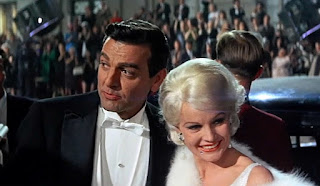
Mike Connors and Carroll Baker
HARLOW (1965). Director: Gordon Douglas.
HARLOW (1965). Director: Alex Segal.

"All the best things in life have to be done alone" -- "Marie Dressler" in Harlow II

In 1965 there were two "dueling" biopics about the star Jean Harlow, who died tragically young at 26, but neither of these films give the actress her due. Right off the bat, it seems like unfair competition, as Harlow I is a technicolor, widescreen epic with the highly publicized Carroll Baker [The Carpetbaggers] in the lead. Harlow II stars the perhaps lesser light Carol Lynley [The Shuttered Room], and was essentially a black and white television production (shot in Electrovision) and blown up to theatrical proportions. The chief difference, among many, is that Baker plays the role so that Harlow comes off as fresh and appealing, while Lynley is in "big bitch" mode throughout most of the movie, making one wonder why anyone would want to work with her. Harlow's mother is played in the first film by a marvelous Angela Lansbury, and Ginger Rogers is also quite good as the mother in Harlow II. In both films Harlow has a shiftless Italian stepfather, Marino. Raf Vallone [A View from the Bridge] is excellent as the character in the first film, while Barry Sullivan, despite not being Italian, manages to score in the second film as well. Both movies are rather slanderous (by 1960's standards as well as 1930's) in the character of first/second husband Paul Bern, who appears at least to be impotent and, it is suggested, homosexual. In the first film Peter Lawford barely registers, while a superb Hurd Hatfield [The Picture of Dorian Gray] gives the best performance in either picture as the same character. Bern had a common law wife who is never seen in the first film, and is played quite well by Audrey Totter in the second; she tells Harlow's mother that although she is Bern's mistress, they have never had physical contact. In both pictures Harlow is so dejected/depressed by the Paul Bern business that she turns herself into a "slut." Harlow I is based on a bio by Irving Shulman that was found by subsequent biographers to be heavily fictionalized. Unfortunately, Shulman's version of Harlow and her circle seems to be the unofficial basis for the second film as well.

Carol Lynley as Jean Harlow
In Harlow I Leslie Nielsen as "Richard Manley" is cast in the Howard Hughes role, while Efrem Zimbalist Jr. [A Fever in the Blood]  plays the counterpart to William Powell in the second; Zimbalist actually gives one of his best performances while Nielsen is acceptable. His near-rape of Harlow in his over-opulent bedroom is one of the best scenes in Harlow I, while Harlow II boasts a funny sequence which depicts her screen test with each take ruined because she can't stand to have the dour, disapproving Zimbalist watching her. There is also a very good scene between Rogers and Totter arguing over Paul Bern. The second version has some famous old actors being impersonated, such as Hermione Baddeley doing a not-bad Marie Dressler, and Celia Lovsky much less successful as a supposed Maria Ouspenskaya. There are interesting performances by Red Buttons and Hanna Landy in the first film, and Michael Dante, Lloyd Bochner, and especially John Williams in the second. Martin Balsam plays a studio head in Harlow I and gives one of his rare unconvincing performances.

As for the leading ladies, both give competent if second-rate performances (especially in the case of Baker), with both failing to capture the essence of Harlow -- her voice, her attitude, that surly, sexy, lovable demeanor that made her so famous. The ladies do the best they can, but as both versions say over and over again, there's only one Jean Harlow. [Both movies fail to get across that Harlow was a good actress.] An unintentionally comical scene occurs at the end of Harlow I when the doctor administering to a very ill Harlow exhibits as much compassion to her mother as a sociopathic iceberg. Oddly, the doctor in the second film is similarly cold, if not quite so stone-faced. In Harlow I Baker/Harlow disgustedly smears cold cream all over her image in her mirror, a scene that also occurs in the earlier Queen Bee with Crawford.

Verdict: Two smutty movies that don't have that much to do with the real Harlow. Both versions: **1/2 out of 4.