Lively, entertaining reviews of, and essays on, old and newer films and everything relating to them, written by professional author William Schoell.
Showing posts with label Audrey Totter. Show all posts

Thursday, January 15, 2026

THE UNSUSPECTED

THE UNSUSPECTED
(1947). Director: Michael Curtiz.

"I detest scenes not of my own making."

Roslyn, the secretary of radio star Victor Grandison (Claude Rains), who narrates tales of mystery and the macabre, is found hanging in the study, apparently the victim of a suicide. Meanwhile, Grandison's niece, Matilda (Joan Caulfield), who was supposedly lost at sea, shows up alive and well, as does Steven Howard (Michael/Ted North), a man she doesn't remember who claims he's her husband. Other members of this strange household include another viperish niece, Althea (Audrey Totter), her husband Oliver (Hurd Hatfield), whom she stole away from Matilda, and snappy assistant Jane (Constance Bennett), not to mention Press (Jack Lambert) a hooligan employed by Grandison. Based on a novel by Charlotte Armstrong, this seems an odd fit for director Curtiz (despite his work on such films as Mildred Pierce) and while it holds the attention and has a fairly exciting finale, otherwise it never quite comes alive. Nice work by Claude Rains (although he seems less inspired by this material than he was in, say, Deception). Audrey Totter is vivid, as usual, as is Constance Bennett. Caulfield is just okay, no more.

Verdict: Okay suspenser. **1/2.

Thursday, June 25, 2020

THE SET-UP

Robert Ryan
THE SET-UP (1949). Director: Robert Wise.

Bill Stoker (Robert Ryan) is a 35-year-old boxer at the end of his game. He rarely if ever wins his matches, but he still has dreams even though he knows that 35 is old for a fighter. His wife, Julie (Audrey Totter), whose heart breaks for him, can't stand to see him being literally and figuratively beaten up in the ring and wishes he'd do anything else for a living. Although Bill wants her there, Julie resists going to the ring -- Paradise City in Atlantic City -- that night. Unbeknownst to Bill, his manager, Tiny (George Tobias), has made a deal with fight promoter "Little Boy" (Alan Baxter) for Bill to take a dive during his fight with newcomer Tiger Nelson (Hal Baylor of This Is My Love). Tiny is sure that Stoker hasn't got a chance against Tiger, but the determined Stoker may give everyone a surprise. But this may come with a terrible cost.

Audrey Totter and Ryan
The Set-Up, beautifully directed by Robert Wise, is one of the best boxing films ever made. With sharply observed vignettes of other boxers and hangers-on, fight fans, promoters and others, it pulls us into this insane bloody world of triumph and defeat and never lets go. The film is supposed to take place in real time -- 73 minutes for both him and the audience -- although this may not be entirely accurate. Whatever the case, Robert Ryan, who was actually forty at the time of filming, gives perhaps his most outstanding performance. Whether he's mirroring the disappointment he feels when he sees his wife's empty chair or dredging up untapped reserves in order to fight his much younger opponent, he is on top of every scene. Tall and handsome, with the look of a winner, Ryan is still able to get across his character's desperation and fear of being a loser. Totter is also excellent, especially in a silent sequence over a railroad track when you can nonetheless tell everything that she must be feeling as she ponders her future with the man she loves and seems unable to help. Her smile when she sees something amusing in an arcade, a smile that fades when things remind her of her life and marriage, is touching.

Baylor vs. Ryan
There are also good turns from George Tobias, Baxter, and Baylor, as well as Wallace Ford [The Breaking Point] as Gus, who oversees things backstage; David Clarke as the sadly defeated Gunboat; Percy Helton cast in another sympathetic part as Tiny's associate, Red; Darryl Hickman as young boxer Shanley; and James Edwards as black boxer, Luthor Hawkins; among others. The film also benefits from Milton R. Krasner's expert cinematography. Absorbing and well-detailed, The Set-Up also boasts a satisfying and moving conclusion, and the match itself is quite exciting and even suspenseful -- both Ryan and Baylor had done some boxing in real life. The script was inspired by a poem about an African-American boxer.

Verdict: More powerful than Raging Bull and half as long. ***1/2. 

Thursday, January 24, 2019

LADY IN THE LAKE

Audry Totter and Robert Montgomery's reflection
LADY IN THE LAKE (1946). Director: Robert Montgomery.

Philip Marlowe (Robert Montgomery) submits a short mystery story based on truth to a pulp magazine and is invited in to meet the editor, a woman named Adrienne (Audrey Totter). She is more interested in hiring Marlowe to look for her boss, Derace Kingsby's (Leon Ames), wife, who has supposedly run off with a man named Chris (Dick Simmons of Man with the Steel Whip). This leads into a series of murders and a kind of strange affair between Marlowe and Adrienne, whom the private eye doesn't quite trust. Then he starts tripping over bodies ...

Man in the mirror: Marlowe gets first aid
Lady in the Lake is one of six films directed by star Montgomery, who decided to shoot this as an ill-advised stunt. Except for three brief sequences in which he addresses the camera to move the plot along, Marlowe/Montgomery is only seen in mirrors. While the plot and acting is interesting enough to keep the viewer entertained for most of the film's length, the gimmick gets a little tiresome and one longs for a more traditional approach. Another problem is that Montgomery is miscast as Marlowe (the detective's first name is misspelled as "Phillip"); he's as gruff and obnoxious as the script requires but he doesn't make a convincing Marlowe.

Audrey Totter and Leon Ames
On the other hand, Audrey Totter steals the picture as Adrienne, giving a fascinating and multi-leveled performance, a snarling bitch one minute, a cloying child the next, belting out orders and disdain in equal measure with one hand, and purring kittenishly with the other. She lacks the raw sex appeal of, say, Veronica Lake, but she's extremely effective nevertheless. Leon Ames, Tom Tully [A Kiss for Corliss] as a police captain, and especially Lloyd Nolan [Sergeant Ryker] as a vicious cop are all terrific. Jayne Meadows also has some fine moments, although she isn't always completely convincing in her portrayal. Dick Simmons makes a positive impression as the oddly likable gigolo, Chris.

One has to pay careful attention while watching this picture, because at the end you still may not be certain who did what to whom and why. Raymond Chandler's source novel undoubtedly spelled it out in more detail. In any case, the movie is suspenseful, and there's at least one creepy scene when Marlowe searches inside a bathroom.

Verdict: Watch for Totter if nothing else. **3/4. 

Thursday, March 10, 2016

HARLOW (1965) vs. HARLOW (1965)

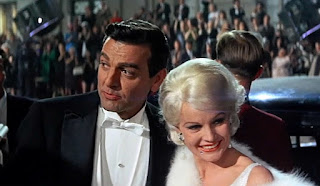
Mike Connors and Carroll Baker
HARLOW (1965). Director: Gordon Douglas.
HARLOW (1965). Director: Alex Segal.

"All the best things in life have to be done alone" -- "Marie Dressler" in Harlow II

In 1965 there were two "dueling" biopics about the star Jean Harlow, who died tragically young at 26, but neither of these films give the actress her due. Right off the bat, it seems like unfair competition, as Harlow I is a technicolor, widescreen epic with the highly publicized Carroll Baker [The Carpetbaggers] in the lead. Harlow II stars the perhaps lesser light Carol Lynley [The Shuttered Room], and was essentially a black and white television production (shot in Electrovision) and blown up to theatrical proportions. The chief difference, among many, is that Baker plays the role so that Harlow comes off as fresh and appealing, while Lynley is in "big bitch" mode throughout most of the movie, making one wonder why anyone would want to work with her. Harlow's mother is played in the first film by a marvelous Angela Lansbury, and Ginger Rogers is also quite good as the mother in Harlow II. In both films Harlow has a shiftless Italian stepfather, Marino. Raf Vallone [A View from the Bridge] is excellent as the character in the first film, while Barry Sullivan, despite not being Italian, manages to score in the second film as well. Both movies are rather slanderous (by 1960's standards as well as 1930's) in the character of first/second husband Paul Bern, who appears at least to be impotent and, it is suggested, homosexual. In the first film Peter Lawford barely registers, while a superb Hurd Hatfield [The Picture of Dorian Gray] gives the best performance in either picture as the same character. Bern had a common law wife who is never seen in the first film, and is played quite well by Audrey Totter in the second; she tells Harlow's mother that although she is Bern's mistress, they have never had physical contact. In both pictures Harlow is so dejected/depressed by the Paul Bern business that she turns herself into a "slut." Harlow I is based on a bio by Irving Shulman that was found by subsequent biographers to be heavily fictionalized. Unfortunately, Shulman's version of Harlow and her circle seems to be the unofficial basis for the second film as well.

Carol Lynley as Jean Harlow
In Harlow I Leslie Nielsen as "Richard Manley" is cast in the Howard Hughes role, while Efrem Zimbalist Jr. [A Fever in the Blood]  plays the counterpart to William Powell in the second; Zimbalist actually gives one of his best performances while Nielsen is acceptable. His near-rape of Harlow in his over-opulent bedroom is one of the best scenes in Harlow I, while Harlow II boasts a funny sequence which depicts her screen test with each take ruined because she can't stand to have the dour, disapproving Zimbalist watching her. There is also a very good scene between Rogers and Totter arguing over Paul Bern. The second version has some famous old actors being impersonated, such as Hermione Baddeley doing a not-bad Marie Dressler, and Celia Lovsky much less successful as a supposed Maria Ouspenskaya. There are interesting performances by Red Buttons and Hanna Landy in the first film, and Michael Dante, Lloyd Bochner, and especially John Williams in the second. Martin Balsam plays a studio head in Harlow I and gives one of his rare unconvincing performances.

As for the leading ladies, both give competent if second-rate performances (especially in the case of Baker), with both failing to capture the essence of Harlow -- her voice, her attitude, that surly, sexy, lovable demeanor that made her so famous. The ladies do the best they can, but as both versions say over and over again, there's only one Jean Harlow. [Both movies fail to get across that Harlow was a good actress.] An unintentionally comical scene occurs at the end of Harlow I when the doctor administering to a very ill Harlow exhibits as much compassion to her mother as a sociopathic iceberg. Oddly, the doctor in the second film is similarly cold, if not quite so stone-faced. In Harlow I Baker/Harlow disgustedly smears cold cream all over her image in her mirror, a scene that also occurs in the earlier Queen Bee with Crawford.

Verdict: Two smutty movies that don't have that much to do with the real Harlow. Both versions: **1/2 out of 4.

Thursday, February 7, 2013

WOMEN'S PRISON

WOMEN'S PRISON (1955). Director: Lewis Seiler.

"They never get things right in prison pictures."

Convicted of vehicular manslaughter after accidentally killing a child, neurotic Helene (Phyllis Thaxter of The Sign of the Ram) is sent to a women's prison adjacent to a men's penitentiary. Her fellow inmates include Joan (Audrey Totter of The Saxon Charm), whose husband manages to cross over to see [and impregnate] her, returnee Brenda (Jan Sterling of Johnny Belinda), Mae (Cleo Moore of One Girl's Confession), and Dottie (Vivian Marshall) who does pretty bad impressions of Bette Davis and others but does a fairly good job of imitating Ida Lupino, who just happens to play the neurotic and slightly evil Amelia van Zandt, a prison official who lords it over the women's compound. All hell breaks loose when van Zandt is told she better find out how Joan's husband, Glen (Warren Stevens) managed to get in to see her [we never find out] and she begins slapping around the pregnant woman, raising the inmates' ire and leading to a fairly exciting climax. Women's Prison is the kind of junk movie that pretends to have some kind of social conscience while parading superficial platitudes and one-dimensional characters who have little basis in reality. Ida Lupino, with her mostly arch overplaying, does the best she can with terrible material; her real-life husband, Howard Duff (Dante), comes off much better and is quite good as the compassionate prison psychiatrist who thinks van Zandt is a psychopath. Thaxter is fine, but except for scenes when she's victimized gets little chance to etch a real character, and Ross Elliott is also good in his brief turn as her husband. Sterling and Totter aren't bad and Cleo Moore is Cleo Moore. The big trouble with this picture is that it isn't even very entertaining.

Verdict: A pretty bad "Bad Girls" picture. **.

Thursday, December 13, 2012

THE POSTMAN ALWAYS RINGS TWICE (1946)

Garfield and Turner
THE POSTMAN ALWAYS RINGS TWICE (1946). Director: Tay Garnett.

Cora Smith (Lana Turner) and her husband Nick (Cecil Kellaway) run a combination gas station and cafe, but their placid lives become unsettled when Nick hires a drifter named Frank (John Garfield) to help around the place. Cora and Frank are attracted to one another, and suddenly she can't see herself spending the rest of her life with her much older and unattractive husband, especially when he abruptly tells her that they're selling the restaurant (for which Cora had a lot of plans), moving in with his sister, and Cora will have to be nursemaid for the paralyzed woman for the rest of her life. (In other words, Nick is almost begging to be killed. His complete disregard for his wife's feelings makes him quite unsympathetic). What happens next is a black comedy of errors, accusations, recriminations -- and murder. Although Lana Turner gave some good performances in later years, such as in A Life of Her Own, she's a little too unseasoned to make the most of Cora, although she isn't terrible. Garfield and Kellaway come off much better, of course (although they're hardly as pretty!) and they have some solid support from the likes of Leon Ames as a D.A., Hume Cronyn as a lawyer, and Audrey Totter as a gal who briefly dallies with Frank. The Postman Always Rings Twice is a good, entertaining picture -- much better than the dreadful remake with Jessica Lange and Jack Nicholson -- but somehow it's not quite a classic like the superior Double Indemnity, which was also taken from a James M. Cain novel. This Hollywood version takes a lot of liberties with the plot and characters, the usual case with Cain. For instance, in the novel the lovers were practically kids.

Verdict: Not the best adaptation of a Cain novel, but certainly not without merit. ***.

Thursday, November 15, 2012

THE SAXON CHARM

THE SAXON CHARM (1948). Writer/director: Claude Binyon.

"Yes, my flatulent Florence Nightingale, and close the door on your way out!" -- Charming Matt Saxon to nurse.

Janet (Susan Hayward), the wife of a successful novelist-turned-playwright, Eric Busch (John Payne), is warned by the unfortunately-named  entertainer Alma Wragg (Audrey Totter) that she may well regret it if her husband allows producer Matt Saxon (Robert Montgomery), Alma's boyfriend, to produce his play. For Saxon doesn't seem to know or especially care that other people have personal lives and may not want to be at his constant beck and call like a bunch of babies. Saxon even tries to order for everyone in a restaurant and throws a fit when things are not to his liking. However, Saxon not only has charm, but he isn't stupid: "Nothing that's good and has a purpose is old-fashioned," he says. Still he's almost responsible for wrecking the Busch marriage and his need for control goes a little too far when it comes to Alma and her career. While The Saxon Charm hasn't quite got the bite and strong plot of the later backstage drama All About Eve, and the marital difficulties of the Busch's seem a bit contrived, it is nevertheless well-acted by all of the principles and quite entertaining as well. A nice score by Walter Scharf  is a bonus. Harry Morgan, Harry Von Zell, Heather Angel, Chill Wills and Kathleen Freeman all score in smaller roles. Binyon also directed Dreamboat with Clifton Webb and many other movies.

Verdict: It's worth spending some time with this "charm boy," who is all too typical of many theatrical types and others. ***.

Thursday, October 8, 2009

TENSION

TENSION (1949). Director: John Berry. 

When pharmacist Warren Quimby's (Richard Basehart) skank wife Claire (Audrey Totter) leaves him for another man (Lloyd Gough), he cooks up a plan to take on another identity and get revenge. Of course, things don't work out exactly as planed. Barry Sullivan and William Conrad are two homicide detectives who at first don't even realize that Quimby and his alter ego are the same person even though all he's done is exchange his glasses for contacts! Cyd Charisse plays the loyal woman who falls in love with Quimby's new identity. For much of its length Tension is absorbing, but when all is said and done it doesn't create enough suspects in its murder mystery and everyone's actions seem a trifle inexplicable. In the long run, there isn't much tension in this or much else, although it's decently acted, and Totter is certainly vivid. 

Verdict: Mediocre suspenser. **1/2.