Lively, entertaining reviews of, and essays on, old and newer films and everything relating to them, written by professional author William Schoell.
Showing posts with label Angela Lansbury. Show all posts

Thursday, July 2, 2026

IN THE COOL OF THE DAY

Lansbury, Fonda and Finch amidst scenic Grecian splendor
IN THE COOL OF THE DAY (1963). Director: Robert Stevens.

"Murray and I already call each other by our first names. It happens fast in America." -- Christine

"I hear everything does." -- Sybil

Murray Logan (Peter Finch) is married to a bitter woman, Sybil (Angela Lansbury), who was scarred in the car accident in which their son was killed. Murray becomes friendly with Christine (Jane Fonda), the wife of his old friend Sam Bonner (Steven Hill); both men are in the publishing business. Sam treats Christine, who has major medical problems, as if she were a fragile child, and this is threatening their marriage. Christine gets the idea that the two couples should go off to Greece and have a great vacation. Surprisingly, Sybil agrees, but at the last minute Sam can't make it. Will the attraction that Murray and Christine feel for each other move up a notch when they're in Greece? What do you think? In the Cool of the Day could be dismissed -- and probably was -- as a soap opera or travelogue or both, but it's actually not a bad movie, in large part due to the interesting characters and the performances of the ladies; Fonda is simply outstanding and Lansbury, although she has a less sympathetic role, is also excellent. Finch was a fine actor but he doesn't have that much chemistry with Fonda (luckily she makes up for this) and at times seems completely disinterested in the proceedings. Constance Cummings is Christine's mother and Alexander Knox plays Sam's father, Frederick. If you don't care for the story you can always enjoy Peter Newbrook's photography of Athens and Delphi, as well as Francis Chagrin's flavorful musical score. It's hard for movies like this, based on novels where the author can describe the internal feelings of the characters, to work, but this is quite effective at times.

Verdict: Very interesting picture with a wonderful lead performance from Fonda. ***.

Friday, December 28, 2018

SAMSON AND DELILAH

Hedy Lamarr and Victor |Mature
SAMSON AND DELILAH (1949). Produced and directed by Cecil B. DeMille.

In Gaza in 1000 B.C. the Danite Samson (Victor Mature), who is a hero to his people, dares to fall in love with Semadar (Angela Lansbury), even though she is a Philistine. Semadar's younger sister, Delilah (Hedy Lamarr) wants Samson for herself, and she is embittered over his rejection of her. When Samson's wedding to Semadar doesn't quite come off, it leads to violence and bloodshed, and Delilah vows to have her revenge.

Lamarr as Delilah
Samson and Delilah is an entertaining movie, but for most of its length it's curiously flat. Some of the minor supporting actors speak their lines as if they were in an old Republic serial and even for 1949 the whole production has an old-fashioned, even cheesy, tone to it. Neither Victor Mature nor even the beautiful Lamarr are especially well-cast. Their performances are good enough by old Hollywood standards, but there are other actors who could have done much, much more with the roles. (Mature would do more costume dramas such as The Robe in the future and his work in them would greatly improve.) Supporting players such as Lansbury; Henry Wilcoxon (as Ahtur, another of Semadar's suitors); Fay Holden as Samson's mother; Olive Deering [Caged] as Miriam, who loves Samson unrequitedly; Julia Faye as the maid Hisham; little Russ Tamblyn [Tom Thumb] as young Saul; and most notably, George Sanders as the Saran of Gaza, come off much better, with Sanders pretty much stealing the show.

The best acting comes from George Sanders
However, Samson and Delilah is worth the price of admission for no other reason than the last ten minutes, in which a humiliated Samson gathers his strength (why did the Dagon-worshipping Philistines let him grow his hair back?) and manages to literally bring the house down on the Philistines. Well-directed and edited, with good FX work, this sequence is a stunner even today. If only the whole movie had been on this level! Victor Young's score is disappointing, but the Oscar-winning costume designs by Edith Head and others are exquisite. The art direction also won an Oscar.

Others in the huge cast include Tom Tyler, Nils Asther, Claire Du Brey, Dorothy Adams, and -- of course --Pierre Watkin. George Reeves shows up as an injured messenger and is good, but he looks so different that I didn't even think this was the same actor who would play Superman a few years later. DeMille himself does the pompous narration that opens the film.

Verdict: Wait -- and wait -- for that great temple sequence! **3/4. 

Thursday, March 8, 2018

DEATH ON THE NILE

Bette Davis, David Niven, Peter Ustinov
DEATH ON THE NILE 
(1978). Director: John Guillermin.

"It's been my experience that men are least attracted to women who treat them well."

Following the success of the first screen adaptation of Agatha Christie's Murder on the Orient Express, it was decided to do another big-scale, star-studded, somewhat overblown adaptation of a Christie novel with Peter Ustinov taking over the role of the great Belgian detective Hercule Poirot. This has an interesting hook: Having stolen away her friend Jacqueline's (Mia Farrow) boyfriend, Simon (Simon MacCorkindale of Jaws 3-D), Linnet Ridgeway (Lois Chiles) finds herself and her new spouse being followed everywhere by Jackie while on their Egyptian honeymoon. Poirot, also on the same tour, warns Jacqueline that she may be heading for disaster, and indeed there's foul play afoot and more than one murder. In her modest and entertaining novel, Christie was wise enough not to make virtually everyone on board the ship a suspect, but screenwriter Anthony Shaffer makes the mistake of giving almost everyone a motive, as unlikely as that sounds. Death on the Nile is way too long, but it is handsomely produced, well-photographed by Jack Cardiff, and has a very nice score by Nino Rota. Ustinov is not the perfect Poirot, but he is acceptable. Among the very large cast, the stand-outs are Maggie Smith [Clash of the Titans], as Bette Davis' put-upon nurse-servant, and Angela Lansbury as the soused authoress, Salome Otterbourne. Everyone else is competent enough, but unremarkable. Bette Davis doesn't so much give a performance, but play "Grand Lady," one suspects as much for the cast and crew as for the audience. One could argue that Mia Farrow seems to give better performances in Woody Allen movies than in ones she makes with other directors. Christie later used a certain similar plot device in Evil Under the Sun. NOTE: A remake of this film is scheduled for 2019.

Verdict: Quite entertaining mystery is good to look at with a few fun performances and humor. ***.  

Thursday, March 23, 2017

GASLIGHT (1944)

Boyer and Bergman
GASLIGHT (1944). Director: George Cukor.

Paula Alquist (Ingrid Bergman) lived in a house in London with her aunt, a famous opera singer who was strangled to death. Years later she comes back to that house with her new husband, Gregory Anton (Charles Boyer). The autocratic Anton berates Paula for her bad memory and for losing things and inexplicably taking pictures from the wall and hiding them. Is Paula going crazy or is there something more sinister going on? Gaslight doesn't make any attempt to disguise the identity of the bad guy in this, but the film is suspenseful in spite of it. Bergman won her well-deserved first Oscar for her portrayal of the confused Paula, and Boyer is equally expert and fascinating. In her first film role, Angela Lansbury [A Life at Stake] scores as the saucy, borderline rude maid, Nancy, and Dame May Whitty is charming as the nosy old biddy, Miss Thwaites. Joseph Cotten offers another effective portrait as a policeman who once met Paula's aunt and is struck by the resemblance; against orders, he takes a new interest in the case. Barbara Everest is also notable as the cook, Elizabeth. The best scene in the film is when Paula nearly has a nervous breakdown at a piano concert. Although Cukor was not a suspense specialist along the lines of Hitchcock, he still manages to craft a nifty thriller, as he did with A Woman's Face. Bergman and Boyer re-teamed for much less felicitous results in Arch of Triumph, as the chemistry just wasn't right for those particular characterizations. At one point Paula shows her husband a glove worn by her aunt and signed by no less than Charles Gounod, in whose Romeo and Juliet she had performed -- what a memento! This is far superior to the 1940 British version of the story.

Verdict: A mesmerizing performance by a resplendent Bergman and fine support from Boyer, Cotten, and Lansbury.  ***1/2. 

Thursday, July 21, 2016

TILL THE CLOUDS ROLL BY

Ol' Blue-eyes sings "Ol' Man River" 
TILL THE CLOUDS ROLL BY (1946). Director: Richard Whorf.

Till the Clouds Roll By purports to be a biopic of composer Jerome Kern (Robert Walker). It opens with a twenty minute recreation of the opening night of Kern's masterpiece, Show Boat, and then goes downhill -- at least in the dramatic sense -- from there. It would have been better for all concerned to forget the fictionalized "plot" and simply present one number after another. Some of the basic facts of Kern's life are accurate: oversleeping kept him off of the ill-fated Lusitania upon which he was to sail with impresario Charles Frohman; and he did meet his wife, Eva (Dorothy Patrick of House by the River), in England, although under somewhat different circumstances. But the movie invents a completely fictional character, James Hessler (Van Heflin), a widower-arranger, who works with Kern and helps him to become a major success. Equally fictional is Hessler's daughter, Sally, who is played by Joan Wells as a child and Lucille Bremer as an adult (both are very good), and a lot of dumb drama is worked up over show biz aspirant Sally losing her big number to star Marilyn Miller (Judy Garland) and running off to unknown parts because of it. None of it has anything to do with Kern. But while this aspect of the film is dull, there are still some memorable moments in the movie, such as: Lena Horne singing "Can't Help Lovin' That Man" from Show Boat and "Why Was I Born?"; Angela Lansbury and chorus cuties on swings for "How'd You Like to Spoon with Me?"; the dancing for the title tune, which features June Allyson and Ray McDonald; Garland as Maxwell interpreting "Look for the Silver Lining;" "I Won't Dance" with Van Johnson and the aforementioned Bremer [Ruthless]; and Tony Martin doing "Make Believe" and "All the Things You Are." You wouldn't think that Frank Sinatra, however wonderful he was, could do much with "Ol' Man River" but he delivers in his own inimitable style. Other performers include Kathryn Grayson as Magnolia in Show Boat; Virginia O'Brien doing her frozen face shtick; and Dinah Shore doing a couple of numbers nicely without quite being on everyone else's level. The absolute low-light of the film is June Allyson croaking out a song about "Cleopatterer." Walker is okay as Kern, but looks nothing like him, while Heflin does more than his best with his character, and Paul Langton [Murder is My Beat] is fine as lyricist Oscar Hammerstein. Ironically, five years later the same studio, MGM, did a full-length version of Show Boat but instead of Lena Horne hired the completely Caucasian Ava Gardner to play the mulatto character of Julie; Kathryn Grayson, of course, remained as Magnolia. All of the musical numbers in this were expertly staged by Robert Alton except for Garland's numbers, which were handled for her by Vincente Minelli.

Verdict: There's still much to admire in this half-baked supposed biography. **1/2.

Thursday, March 10, 2016

HARLOW (1965) vs. HARLOW (1965)

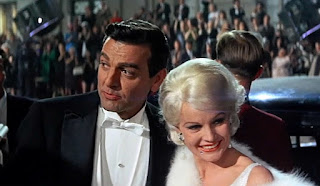
Mike Connors and Carroll Baker
HARLOW (1965). Director: Gordon Douglas.
HARLOW (1965). Director: Alex Segal.

"All the best things in life have to be done alone" -- "Marie Dressler" in Harlow II

In 1965 there were two "dueling" biopics about the star Jean Harlow, who died tragically young at 26, but neither of these films give the actress her due. Right off the bat, it seems like unfair competition, as Harlow I is a technicolor, widescreen epic with the highly publicized Carroll Baker [The Carpetbaggers] in the lead. Harlow II stars the perhaps lesser light Carol Lynley [The Shuttered Room], and was essentially a black and white television production (shot in Electrovision) and blown up to theatrical proportions. The chief difference, among many, is that Baker plays the role so that Harlow comes off as fresh and appealing, while Lynley is in "big bitch" mode throughout most of the movie, making one wonder why anyone would want to work with her. Harlow's mother is played in the first film by a marvelous Angela Lansbury, and Ginger Rogers is also quite good as the mother in Harlow II. In both films Harlow has a shiftless Italian stepfather, Marino. Raf Vallone [A View from the Bridge] is excellent as the character in the first film, while Barry Sullivan, despite not being Italian, manages to score in the second film as well. Both movies are rather slanderous (by 1960's standards as well as 1930's) in the character of first/second husband Paul Bern, who appears at least to be impotent and, it is suggested, homosexual. In the first film Peter Lawford barely registers, while a superb Hurd Hatfield [The Picture of Dorian Gray] gives the best performance in either picture as the same character. Bern had a common law wife who is never seen in the first film, and is played quite well by Audrey Totter in the second; she tells Harlow's mother that although she is Bern's mistress, they have never had physical contact. In both pictures Harlow is so dejected/depressed by the Paul Bern business that she turns herself into a "slut." Harlow I is based on a bio by Irving Shulman that was found by subsequent biographers to be heavily fictionalized. Unfortunately, Shulman's version of Harlow and her circle seems to be the unofficial basis for the second film as well.

Carol Lynley as Jean Harlow
In Harlow I Leslie Nielsen as "Richard Manley" is cast in the Howard Hughes role, while Efrem Zimbalist Jr. [A Fever in the Blood]  plays the counterpart to William Powell in the second; Zimbalist actually gives one of his best performances while Nielsen is acceptable. His near-rape of Harlow in his over-opulent bedroom is one of the best scenes in Harlow I, while Harlow II boasts a funny sequence which depicts her screen test with each take ruined because she can't stand to have the dour, disapproving Zimbalist watching her. There is also a very good scene between Rogers and Totter arguing over Paul Bern. The second version has some famous old actors being impersonated, such as Hermione Baddeley doing a not-bad Marie Dressler, and Celia Lovsky much less successful as a supposed Maria Ouspenskaya. There are interesting performances by Red Buttons and Hanna Landy in the first film, and Michael Dante, Lloyd Bochner, and especially John Williams in the second. Martin Balsam plays a studio head in Harlow I and gives one of his rare unconvincing performances.

As for the leading ladies, both give competent if second-rate performances (especially in the case of Baker), with both failing to capture the essence of Harlow -- her voice, her attitude, that surly, sexy, lovable demeanor that made her so famous. The ladies do the best they can, but as both versions say over and over again, there's only one Jean Harlow. [Both movies fail to get across that Harlow was a good actress.] An unintentionally comical scene occurs at the end of Harlow I when the doctor administering to a very ill Harlow exhibits as much compassion to her mother as a sociopathic iceberg. Oddly, the doctor in the second film is similarly cold, if not quite so stone-faced. In Harlow I Baker/Harlow disgustedly smears cold cream all over her image in her mirror, a scene that also occurs in the earlier Queen Bee with Crawford.

Verdict: Two smutty movies that don't have that much to do with the real Harlow. Both versions: **1/2 out of 4.

Thursday, July 24, 2014

A LIFE AT STAKE

Keith Andes and Angela Lansbury
A LIFE AT STAKE (1954). Director: Paul Guilfoyle.

An out-of-work architect named Edward Shaw (Keith Andes) is given an attractive business proposal by wealthy Doris Hillman (Angela Lansbury) and her older husband, Gus (Douglass Dumbrille). The catch is that Shaw will have to be insured for a very large sum of money, with Gus being the beneficiary. Shaw's paranoia over this aspect of the alliance only increases when he is drawn into a romance with Doris, and can't tell if she really loves him or is just waiting for hubby to collect on the insurance. Then there are the suspicious "accidents" ...  Andes [Clash By Night] makes a compelling, if understandably grumpy, leading man, and Dumbrille [Mr. Deeds Goes to Town] is typically excellent. Lansbury [Please Murder Me] gives a good performance as well, but while attractive, she is not quite convincing as the sexy, femme fatale type. [Ironically, a less talented "B" actress probably could have filled the bill better.] Jane Darwell is fine if a bit wasted as a landlady. A Life at Stake holds the attention and is not entirely predictable.

Verdict: Watch out for spiked coffee! **1/2.

Thursday, September 26, 2013

THE MAN FROM U.N.C.L.E. Season Two

Napoleon Solo and Illya Kuryakin -- in color
THE MAN FROM U.N.C.L.E. Season Two. 1965.

Napoleon Solo (Robert Vaughn) and Illya Kuryakin (David McCallum) came back for a second season of the generally light-hearted spy show, this time in color and "armed" with special pen communicators. There was more humor this season, with some rather stupid episodes, but quite a few were memorable. The two-part "Alexander the Greater Affair" features Rip Torn as a megalomaniac out to rule the world. "The Foxes and Hounds Affair" presents an amusing -- and explosive --  rivalry between two Thrush agents played by Patricia Medina and a wonderful Vincent Price. "The Dippy Blonde Affair" has a Thrush executive falling for the girlfriend (Joyce Jameson) of a colleague he murdered after she's enlisted by UNCLE to play along and find out what she can. Thrush develops a strain of deadly and nearly invisible bees in "The Birds and the Bees Affair," in which Illya and a lovely companion are subjected to torture by sonics. "The Bridge of Lions Affair" features Maurice Evans, Bernard Fox and Vera Miles in a tale of artificial rejuvenation and the power plays surrounding it. The season's best episode, "The Waverly Ring Affair," is a suspenseful business in which the agents must figure out which co-worker, Larry Blyden or Elizabeth Allen, is a traitor working for Thrush. Other good episodes include "The Ultimate Computer;" "Discotheque Affair;" "Re-Collectors;" "Arabian Affair;" "Adriatic Express;" "Project Deephole;" "Minus X Affair" with Eve Arden; and "The Children's Day Affair," in which Jeanne Cooper plays Mother Fear, who runs a boy's school and is training the little fellows to wipe out agents at a special conference. The worst episode is probably "The Deadly Toys Affair," which guest-stars an overbearing Angela Lansbury in one of her least memorable performances; way too much camp. Vaughn and McCallum are perfect and Leo G. Carroll nearly steals the show as their boss, Alexander Waverly. The souped-up theme music is pretty neat. NOTE: The big-screen adaptation of the show due in 2014 will not star Tom Cruise but rather Henry Cavell of The Man of Steel.

Verdict: Cool show if too often on the edges of camp. ***. 

Thursday, May 2, 2013

THE MIRROR CRACK'D

Novak, Hudson and Taylor
THE MIRROR CRACK'D (1980).  Director: Guy Hamilton.  Based on "The Mirror Crack'd From Side to Side" by Agatha Christie.

"Chin up, darling -- both of them!"

Move star Marina Gregg (Elizabeth Taylor) and her director husband Jason Rudd (Rock Hudson) have taken over a British country estate while in England to film Marina's comeback film when during a party a young fan (Maureen Bennett) talking to Marina is given a poisoned drink and dies. It isn't long before it is determined that Marina was the true target of the poison -- or was she?  Miss Marple (Angela Lansbury) asks questions while her nephew, an Inspector (Edward Fox), investigates, but it's sure bet who'll solve the case first. Agatha Christie got the germ of her idea from an actual tragic incident that happened to actress Gene Tierney, although Marina does not seem otherwise based on that particular movie star. Taylor is perfect casting as the difficult, whiny, needy fading actress going to fat, but that is not to say her performance is any more than passable. Kim Novak is better and much more fun as a movie rival of Marina's who trades bitchy remarks with her. Hudson is okay, if a bit dour and superficial, and Tony Curtis is fun enough as a vulgar producer.  Geraldine Chaplin is Rudd's suspicious secretary, and Charles Gray is his butler. This is better than another adaptation done on Masterpiece Mystery in 2010. Lansbury looks more like Miss Marple than Margaret Rutherford did, but she's not as funny nor meant to be.

Verdict: At least it has an interesting cast and Novak looks sensational. ***.

Thursday, February 7, 2013

STATE OF THE UNION

STATE OF THE UNION (1948). Director: Frank Capra.

"We even had a democrat in that bed one night!" -- housekeeper Margaret Hamilton.

"If I've got to listen to speeches, you'd better make me another sazerac right away!" -- Lulubelle Alexander

Newspaper publisher Kay Thorndyke (Angela Lansbury) and long-time politico Jim Conover (Adolph Menjou) work together to get plane manufacturer Grant Matthews( Spencer Tracy) to toss his hat in the Republican ring. Although she has reservations -- particularly regarding the participation of Kay, who is carrying a torch for Grant -- Matthews' wife Mary (Katharine Hepburn) agrees to go along on the campaign trail, hoping her husband will win the party's nomination. But as the weeks go by she watches in horror as Grant succumbs to the manipulations of Kay and Jim, compromising to the point where he's turning his back on what he really believes in just so he has a chance at the white house. Something's gotta give, and boy does it! This wonderful, still topical movie features top-notch performances from the actors named, as well as from Van Johnson as a snappy reporter named Spike. Margaret Hamilton has an amusing supporting part as a housekeeper who has a yen for Spike, and Maidel Turner is a riot as Lulubelle Alexander, a judge's wife who loves her sazerac cocktails; Charles Dingle, Raymond Walburn, Howard Smith and Irving Bacon also score. Hepburn's first name is misspelled in the opening credits, there are a couple of stupid moments, but everything else is just about perfect!

Verdict: Another Capra winner! ***1/2.


Thursday, June 16, 2011

SOMETHING FOR EVERYONE

SOMETHING FOR EVERYONE (1970). Director: Harold Prince.

"Let's not talk about the Nazis. It was bad enough when they were all over the place, strutting around, inviting themselves to dinner." -- the countess.

"You can sleep with anyone, can't you?" -- Helmuth.

"If I have to -- but I have my preferences." -- Konrad.

A sociopathic charmer named Konrad Ludwig (Michael York) arrives in the picturesque town of Ornstein and uses his body, wits, and homicidal tendencies to take over the household of Countess Von Ornstein (Angela Lansbury), who lives in a big castle with her children -- but also lives mostly on bluff (by her standards at least). Eliminating anyone who might get in the way of his plans, Konrad beds and romances both the daughter, Anneliese (Heidelinde Weis), of a wealthy couple and the countess' attractive son, Helmuth (Anthony Corlan AKA Anthony Higgins). His plans to marry them both off to one another go awry but the clever fellow may have yet another idea up his sleeve ... The performances and story are compelling in this very darkly amusing comedy-suspense film, although some might feel the ending -- if outrageous and comical -- isn't entirely satisfying. Jane Carr is good if a little weird as the countess' strange and homely daughter, Lotte, who's wiser than she lets on -- at first. Wolfreid Lier makes an impression as the stern  major domo, Klaus. Despite the free-wheeling sensuality, the movie seems to have a kind of old-fashioned sensibility to it. This was loosely based on a novel by Harry Kressing entitled "The Cook;" the screenplay is by Hugh Wheeler, who wrote many musical librettos, and who was also well-known as mystery novelist Patrick Quentin. Stage specialist Harold Prince only directed one other theatrical film and one television movie. Score by John Kander and some nice scenery as well.

Verdict: Fun and games with an ambisexual twist. ***. 

Thursday, April 7, 2011

PLEASE MURDER ME


PLEASE MURDER ME (1956). Director: Peter Godfrey.

Attorney Craig Carlson (Raymond Burr) and Myra Leeds (Angela Lansbury), the wife of his best friend Joe (Dick Foran), who saved his life during the war, have fallen in love. When Joe finds out about it Myra claims that he attacked her in a rage and she had to shoot him in self-defense. In a highly unlikely if not ludicrous [albeit intriguing] scenario, her lover Carlson defends her against a murder charge in court, leading to a number of interesting complications. Despite its improbable aspects, Please Murder Me is absorbing and features two terrific lead performances from Burr and Lansbury. Foran is solid as ever as the husband, and Lamont Johnson is appealing as a likable struggling painter. [As an actor, Johnson appeared mostly in TV shows; he later became a successful director.] John Dehner does his usual fine job as the D.A. prosecuting the case. Please Murder Me could he seen as Burr's feature-length audition for Perry Mason as he was cast in his most famous role the following year.

Verdict: Minor perhaps but with some sterling performances and vivid moments. ***.

Thursday, February 19, 2009

THE PICTURE OF DORIAN GRAY

THE PICTURE OF DORIAN GRAY (1945). Directed by Albert Lewin. 

"I adore simple pleasures. They're the last refuge of the complex." 

This adaptation of Oscar Wilde's brilliant novel of fantasy and manners may have made some changes from the book -- it's been awhile since I read it -- but it's still a fascinating story and an excellent movie. Hurd Hatfield gives a memorable performance as the young Dorian Gray, who wishes a bit too fervently that he would always stay young while his portrait ages, which is just what happens. His life becomes increasingly wicked (although some of the stuff he's up to surely wouldn't raise an eyebrow in 2009!) but the severity of his crimes intensifies as his portrait becomes increasingly hideous. George Sanders gets to deliver in his inimitable style some of Wilde's wittiest ripostes, such as "When her third husband died her hair turned quite gold from grief" and "To get back my youth I'd do anything except get up early, exercise, and be respectable." Angela Lansbury, Richard Fraser, and Lowell Gilmore are also noteworthy, as are many of the other supporting performers. The various technicolor shots of Dorian's portrait are striking and eventually quite horrific. Completely absorbing, handsomely produced, and adroitly directed. Top-notch! 

Verdict: "To regain one's youth, one most only repeat one's follies." ***1/2.

Tuesday, January 15, 2008

ALL FALL DOWN


ALL FALL DOWN (1962). Director: John Frankenheimer.

Young Clinton Willart (Brandon De Wilde) idolizes his older brother, the oddly-named Berry-Berry (Warren Beatty), until it finally comes home to him how much the older man mistreats women after a tragedy occurs. This is an interesting picture, the kind of movie that passed for “adult drama” back in the sixties, but it hasn't worn well with time. The characters aren't developed enough and we never really learn the reason for Berry-Berry's torment (although it's fairly easy to guess at, given the film is based on a novel by James Leo Herlihy and the screenplay is by William Inge); the whole business has a rather suspect psychology behind it. Angela Lansbury and Karl Malden play the parents, Annabelle and Ralph, and while both actors are good, neither of them could chalk this up as one of their more memorable performances. Beatty offers an effective performance, however, if hardly a brilliant one, and Brandon De Wilde comes off the best and most sensitive out of the major players. But the acting honors have to go to Barbara Baxley as the unnamed teacher who gives Beatty a ride and gets taken for one herself; she's just terrific. Otherwise, this just doesn't make much of an impression today.

Verdict: Only if you're curious or a real big Beatty fan. **.