Lively, entertaining reviews of, and essays on, old and newer films and everything relating to them, written by professional author William Schoell.
Showing posts with label Sidney Lumet. Show all posts

Thursday, January 5, 2023

THE GROUP

THE GROUP (1963). Director: Sidney Lumet. 

"Who'da thunk it?" -- various.

"Sacrifice is dated. You don't reform a man. They just drag you down." -- Dottie.

In 1933 a group of women friends graduate from Vassar. The first to get married is Kay (Joanna Pettet), whose husband is a philandering playwright named Harald (Larry Hagman) whose mistress, Norine (Carrie Nye), also went to Vassar (but is not part of the group). Helena (Kathleen Widdoes) is the one who sends out a newsletter detailing the activities of the others. Priss (Elizabeth Hartman of The Beguiled) gets married to a controlling doctor, while Dottie (Joan Hackett) disillusioned by her first lover (Richard Mulligan), marries a much older man. Although she seems man-hungry, the bitchy Libby (Jessica Walter) reveals that she's a virgin when one suitor tries to assault her. Lakey (Candice Bergen) turns out to be a committed lesbian who comes back from Europe with a German baroness in tow. Polly (Shirley Knight) dallies with a married publisher (Hal Holbrook) before uniting with a doctor (James Broderick) who befriends her somewhat unusual father (Robert Emhardt). Pokey (Mary Robin-Redd) is a friendly and plump gal who seems a bit on the fringes of the group.  As the years go by the women interact, have babies, divorces, break-ups and react to world events such as communism and Hitler. Then one of their lives takes a decided and tragic turn for the worse. 

Lidia Prochnicka as the baroness with Bergen 
The Group
 is an interesting if very talky movie with some well-drawn characters and excellent performances. In the early scenes, of course, the actors all seem too old for their parts, but that isn't a problem in the later sequences. You expect -- and get -- memorable  performances from such as Joan Hackett, Jessica Walter (although perhaps a bit too arch and brittle at times), Kathleen Widdoes, and Hartman, but there's also good work from Candice Bergen and excellent work from Joanna Pettet, who is essentially the main character and is on top of things every step of the way. 

Bill Fletcher (seated) with some of the ladies
Larry Hagman has some good moments, as do the other fellows, with Broderick perhaps getting the most time on screen. Doreen Lang (of The Birds) makes a highly sympathetic nurse in one sequence. Bill Fletcher makes an impression as a rude actor who takes on Harald at a party. Sidney Buchman's screenplay seems to be fairly faithful to the novel (judging by a synopsis) while Sidney Lumet's direction covers the action competently but isn't especially inspired. There are no wipes, dissolves or other segues in the movie and nothing whatsoever to denote the passage of time, although there is period atmosphere. The ladies all had many credits after this film, with Bergen, Hackett, Knight, and Walter having the highest profiles. Kathleen Widdoes did work on the soaps. 

Verdict: If you can take all the cute nicknames -- what, no "Pukey?" -- this is an absorbing film with some fine performances. ***.  

Thursday, March 15, 2018

MURDER ON THE ORIENT EXPRESS

Albert Finney as Hercule Poirot
MURDER ON THE ORIENT EXPRESS (1974). Director: Sidney Lumet.

Famous Belgian detective Hercule Poirot (Albert Finney of Tom Jones) takes over the investigation after a man using an assumed name is murdered, and there turns out to be a whole train load of suspects. In her novel, Agatha Christie's starting off point was the murder of the Lindbergh baby, and the victim was involved in the kidnapping of the child, herein named Daisy Armstrong. In both book and movie Poirot perhaps doesn't exhibit quite as much incredulity as he might have when he learns at least two people on the train just happen to have had ties to the victim (as well as others whose deaths were a direct result of little Daisy's murder). And then things get even stranger, but there's a method to Christie's madness ... This was the first of the big-budget, all-star adaptations of the works of Christie, and it's entertaining if unspectacular. Oscar winner for Best Actor, Finney is nothing like Poirot, but if this is a "stunt" performance, I must say it's an excellent one, although he isn't as good as David Suchet, who later made the role his own. Wendy Hiller gives a positively weird, and one assumes, intentionally comic performance as the aged Princess Dragomiroff. Ingrid Bergman is fine but her very small role hardly deserved the supporting Oscar she received. Similarly, Sir John Gielgud is wonderful, but he's on-screen for only a few minutes; he won a BAFTA award. (Surely Oscars should be reserved for actors who are very much outside their comfort zone, which Finney definitely was). In a terrible performance, Anthony Perkins literally twitches all over the place as the secretary to the dead man; Sean Connery has one strong scene explaining himself to Poirot; Rachel Roberts scores as the princess' maid; Richard Widmark is fine as the victim; Vanessa Redgrave [Camelot] is perfect and lovely as Connery's paramour; and Martin Balsam is a delight as a representative of the train line and a personal friend of Poirot's. Richard Rodney Bennett provided the pastiche Porter score, which lacks the suspense this type of picture requires. Many of the cast members, especially Lauren Bacall as the loud American lady, seem self-conscious.

In addition to the 2017 remake, there have been other adaptations of the famous story. Alfred Molina played Poirot in a 2001 television version. David Suchet again essayed Poirot in a 2010 TV movie  which added a prologue, with an adulteress being stoned to death, that was not in the novel, and an epilogue wherein Poirot expresses moral outrage over the murder on the train which he does not express in the book; later he softens his attitude due to the murder of that woman at the opening. Suchet is especially excellent in this and it's amusing to see Hugh Bonneville of Downton Abbey playing a mere valet. Finally, a Japanese mini-series based on the novel appeared in 2015.

Verdict: Take this train ride or not -- it's up to you. **1/2.

.

Thursday, August 10, 2017

FAIL-SAFE

Frank Overton
FAIL-SAFE (1964). Director: Sidney Lumet.

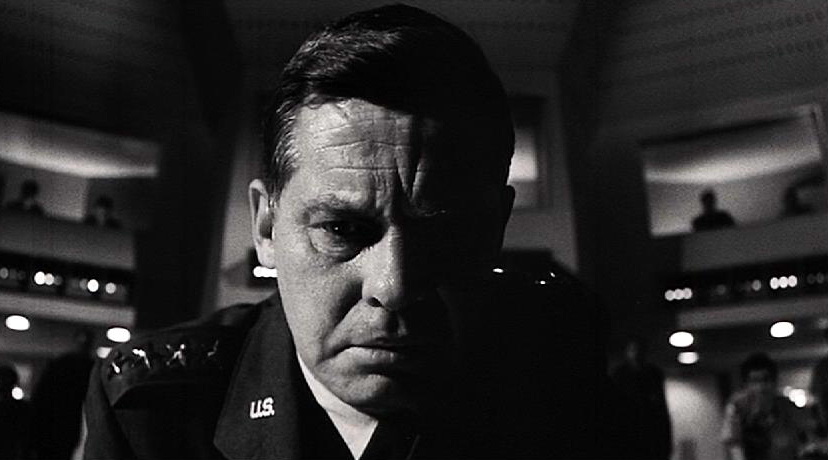
The American president (Henry Fonda) discovers that the U.S. air force accidentally launched a bomber squadron against Moscow. Now his job is two-fold: to convince his Russian counterpart that this strike was indeed accidental and prevent retaliation; and to stop or even shoot down the U.S. planes before they can drop the bombs and start WW3. The tension is thick as various characters react to what is an untenable and horrifying situation. The acting from the entire cast is first-class: Dan O Herlihy  [King of the Roaring 20's] as General Black, who must discharge the most distasteful duty of his career, to put it mildly; Fritz Weaver (who was introduced in this film) as Colonel Cascio, who is nearly driven mad by the situation and has a violent breakdown; Walter Matthau (in one of his early dramatic roles) as Groeteschele, who is coldly pragmatic when it comes to the numbers of projected casualties and the like; and especially Frank Overton [Desire Under the Elms], in the performance of his career, as the conflicted but duty-bound General Bogan. Janet Ward certainly scores in a small but pivotal role as Mrs. Grady, who desperately tries to tell her husband, the lead pilot, to turn back before it's too late. Nancy Berg, Dom DeLuise [Diary of a Bachelor]  and Larry Hagman (as a translator), among others, also do well in some flavorful supporting roles. One of the best scenes has Bogan reacting after the men in the war room cheer the downing of one of the planes -- "this isn't a football game!" I don't know if I find the controversial ending to this to be especially believable, but it certainly packs a wallop. I have no doubt that when this was released people left the theater shivering in shocked silence. This was released the same year as the satirical Dr. Strangelove, which has more or less the same plot, but the more somber Fail-Safe has the edge on it. The movie could have been cut by ten or so minutes and tightened a bit, however.

Verdict: Disturbing, high-impact, and infinitely depressing. ***1/2.

Thursday, March 24, 2016

GUILTY AS SIN

Don Johnson and Rebecca De Mornay
GUILTY AS SIN (1993). Director: Sidney Lumet.

"He chose me to defend him before he murdered his wife."

Rising attorney Jennifer Haines (Rebecca De Mornay) takes on a client who is handsome if immoral, a gigolo named David Greenhill (Don Johnson) who has been accused of pushing his wealthy wife out of a window. Jennifer takes Greenhill's case against her better judgment, regrets it, tries to back out, but is told by a judge (Dana Ivey) that dropping pro bono cases is a no no. Meanwhile her friend and investigator Moe Plimpton (Jack Warner) discovers some disturbing things about her client, who seems to have been obsessed with Jennifer for quite some time. Then Jennifer's boyfriend, Phil (Stephen Lang), is brutally attacked, and worse things are in store for other of Jennifer's associates. Guilty as Sin is an entertaining, if far-fetched, thriller with good performances -- Johnson and De Mornay, make a good team, if that's what it can be called -- although Larry Cohen's screenplay has Jennifer doing things that she seems too smart to do. Norma Dell'Agnese makes her mark as Jennifer's secretary, Emily, as do Christina Grace and Barbara Eve Harris as two of David's "admirers." Stephen Lang [Save Me] is fine as Phil, and gets the bedroom scenes that, oddly, they never give Johnson, who was considered a sex symbol (along with De Mornay) at the time. Don Johnson [The Hot Spot] is quite good and exhibits star appeal, but never quite made it as a major movie star; he's now back on television in Oil. De Mornay's [The Trip to Bountiful] career is also more low-profile these days, with much television work as well. As for director Sidney Lumet [Child's Play], this is a minor work in his canon. A death-by-fire scene is one of the liveliest in the movie.

Verdict: Improbable at times, but well-acted and engaging. ***.

Thursday, January 21, 2016

CHILD'S PLAY (1972)

James Mason and Robert Preston
CHILD'S PLAY (1972). Director: Sydney Lumet. Based on the stage play by Robert Marasco.

Odd things, including outbreaks of violence and secretive behavior, have been happening at a Catholic boys school. While Frank the headmaster (Ron Weyand) tries to figure out what's going on, a conflict arises between stern, old-style professor Malley (James Mason) and the younger, more beloved coach, Dobbs (Robert Preston of The Lady Gambles). There are rumors going around about Malley, and certain magazines have been sent to his home, along with other harassment; Malley is convinced that Dobbs is behind it all. But whatever Malley's peculiarities, is Dobbs quite the good guy that he pretends to be, and who is actually behind the sinister events at the school which threaten to close it down? Child's Play is very suspenseful and boasts an absolutely superb performance by James Mason. A particularly good scene has him reacting to news of his mother's death. Robert Preston is also good, although a cut below Mason. Beau Bridges is not bad as a student who has returned to the school as a teacher, although he is occasionally on the amateurish side. There are some sharp performances by the younger actors who play the besieged students. Threatening to turn into Children of the Damned at times, Child's Play is a bit far-fetched and theatrical, even maddening, but it is also quite absorbing, suspenseful and fascinating. And that Mason! Robert Marasco, who wrote the stage play upon which this is based, also wrote the novel, Burnt Offerings, the film version of which starred Bette Davis. Sidney Lumet directed a number of stage to screen adaptations, of which The Last of the Mobile Hot Shots was undoubtedly the worst.

Verdict: Much, much better than that "Child's Play" about the killer doll. ***.

Thursday, February 20, 2014

A VIEW FROM THE BRIDGE

Confused triangle: Vallone, Sorel and Lawrence
A VIEW FROM THE BRIDGE (aka Vu du pont/1962). Director: Sidney Lumet.

NOTE: This review discusses important plot points. Eddie Carbone (Raf Vallone of The Other Side of Midnight), his wife Beatrice (Maureen Stapleton of Interiors), and their niece Catherine (Carol Lawrence) live together near the shipyards in Brooklyn. They take into their home two illegal immigrants, Marco (Raymond Pellegrin), who is older and married, and handsome young Rodolpho (Jean Sorel), who is immediately attracted to Catherine and vice versa. This doesn't sit well with Eddie, who has not slept with his wife in months, and who seems to be obsessed with his pretty niece. Eddie never misses an opportunity to cast doubt on Rodolpho's sexuality because he sings, has blond hair, and other ludicrous reasons, but primarily because he sees him as his rival -- or perhaps is attracted to him and must belittle him in classic closet case fashion. It all culminates in a scene when Eddie first kisses Catherine full on the lips, and then does the same to Rodolpho in a supposed attempt to expose his homosexuality [talk about doing things backwards!] And things become even more melodramatic after that... The main strength of this adaptation of Arthur Miller's play is the acting, which is excellent across the board, especially the performances of a passionate Vallone, sympathetic Stapleton, and lovely, confused Lawrence. Unfortunately, it's all a trifle over-baked and coy at the same time, a combination that doesn't work. The double-kiss probably played on the stage, but it's much more of a dramatic device than anything you can take seriously, almost the stuff of soap opera. Since it's hard to believe that this "macho" guy would want to give a hard smack to Rodolpho's lips if he were really straight, critics ever since have speculated on the possibility that Eddie is a repressed homosexual [and indeed with his homophobia and other acts one can see how it could be interpreted that way]. Was Miller afraid to tackle the subject head on when he wrote the play in the fifties, leaving that sort of thing to Tennessee Williams (who probably would have made a better play out of View) and using Catherine as a "beard?" The ambiguity gives the whole movie a dated air, although it does have some powerful moments.

Verdict: Interesting, with a wonderful lead performance, but just misses being really special. ***.

Thursday, November 7, 2013

THE LAST OF THE MOBILE HOT SHOTS

Robert Hooks and Lynn Redgrave
THE LAST OF THE MOBILE HOT SHOTS (1970). Director: Sidney Lumet.

"Go home with you? -- but I don't even know you." -- Myrtle

Myrtle Kane (Lynn Redgrave), who once belonged to a group called the "Mobile Hot Shots," gets a stranger, Jeb Thornton (James Coburn), to pretend he's engaged to her so they can win some prizes on a local game show. Unfortunately, the host also wants to marry them on the program. Jeb takes Myrtle back to his dilapidated plantation, Waverly, where he lives with his black half-brother, "Chicken" (Robert Hooks). The dying Jeb agreed that Chicken would have the plantation after his death if he helped him work it, and signed a paper to that effect, but now he sends Myrtle out to get back the paper by any means possible. But Chicken knows something that may make all of Jeb's manipulations unnecessary. Loosely based on Tennessee Williams' play "The Seven Descents of Myrtle," it's a wonder why anyone thought Mobile Hot Shots would make a good movie. Everyone is miscast, and Lumet is certainly the wrong director. The movie can't seem to make up its mind if it's a comedy or not -- there are a couple of chuckles, but that's it, and the final revelation is a pip  -- but its biggest failing is that with all that's going on it's still a bore [even a climactic flood doesn't help much]. Redgrave seems to be channeling Geraldine Page in Sweet Bird of Youth (although her character is completely different), but she makes one of the the least convincing Williams' heroines ever. Coburn makes some effort but gets nowhere, and Hooks comes off best, but in this movie that's not saying much. Still it's hard to play Williams just right, and mediocre Williams is even harder. Gore Vidal's screenplay at one point seems to hint at homosexual incest, but as it comes out of nowhere and is unconvincing anyway, it was probably just to set up a quick, dumb gag late in the movie. The premise of the picture is intriguing but the development is just dismal. With Hooks playing a character who denies his being black, one would have to say Hot Shots is horribly dated as well. [If one wonders why anyone would want to own a property like Waverly in the first place, all I can say is real estate!]

Verdict: This should just be washed away with the flood. *1/2.

Thursday, March 3, 2011

DEATHTRAP


DEATHTRAP (1982). Director: Sidney Lumet. Based on the Broadway play by Ira Levin.

"I'll tell you how good it is -- even a gifted director can't hurt it."

If only ... Playwright Sidney Bruhl (Michael Caine) is dismayed when his latest offering is trashed by the critics, even though his faithful and wealthy wife Myra (Dyan Cannon) remains his biggest booster. When he reads a play written by Clifford Anderson (Christopher Reeve), a student of his, Bruhl hatches a plot to steal away the script anyway he can. But things are a little more complicated than at first they seem. Caine and Cannon are superb, and Reeve offers one of his best performances, but while the film is entertaining and has a few twists, the characters remain one-dimensional and the film is, ultimately, just a psycho-sexual stunt. A better writer could have made something out of the generational difference between two of the protagonists and their perhaps divergent attitudes toward their sexuality -- all of which seems thrown in just for some added "shock" value and is never explored with any depth or intelligence. [Even in 1982 a film that basically traded off "nasty queers" was pretty dated; meaning the movie was hardly "hip" as its makers must have thought] Irene Worth is irritating as a psychic neighbor, but Henry Jones is, as usual, adept as Bruhl's lawyer. Lumet turns in one of his better directorial jobs although he's certainly no Hitchcock.

Verdict: Not as much fun as it sounds. **.

Thursday, May 6, 2010

THE VERDICT


THE VERDICT (1982). Director: Sidney Lumet.

Lawyer Frank Galvin (Paul Newman) takes a medical malpractice case -- the wrong anesthetic was administered -- even though he was offered a settlement and the hospital is owned by the Catholic church. Initially he wants a chance to salvage his wrecked career, but eventually he comes to the conclusion that his comatose client deserves to be fought for. James Mason is great as opposing counsel, and Jack Warden scores as Galvin's associate, Mickey Morrissey. Charlotte Rampling is, as usual, the ice princess to end all ice princesses, and walks through the movie -- again as usual -- with one expression. Newman gives a solid performance. But somehow this never quite becomes the explosive classic you might have hoped for.

Verdict: Okay, but nothing really special. **1/2.

Wednesday, January 21, 2009

12 ANGRY MEN


12 ANGRY MEN (1957). Director: Sidney Lumet.

12 men have to decide the fate of a young man who's been accused of murdering his father. One of the jurors (Henry Fonda) is a doubting Thomas when it comes to the defendant's guilt right from the get-go and slowly he encourages the others to take another look at the purported evidence. While well-meaning and very well acted (Martin Balsam, Lee J. Cobb, E. G. Marshall, Jack Klugman, Jack Warden etc. are also in the cast), the picture is too theatrical, a bit cliched, and rather superficial all told. The implication that a death penalty advocate is a secret sadist is simply dime store psychology at its worst. It's also odd that no one ever brings up the simple notion of self-defense, which of course would make the defendant not guilty.

NOTE: I watched this on TCM with a friend who is hard-of-hearing, so I had the closed captioning turned on. I was appalled at the difference between what was being said by the actors and what I read in the captions. For instance, a line about the "electric chair" was changed to "lethal injection." Another pivotal line had its meaning carelessly reversed. It was as if the person doing the captioning just felt like writing whatever the hell they wanted instead of sticking to the script. I recognize that dialogue is often changed in a caption to make it shorter and more easily and quickly read, but that's not what was going on here. TCM should get another company to do its captions or whoever captioned 12 Angry Men should find work elsewhere.

Verdict: Movie -- **. Captions -- 0 stars.