Lively, entertaining reviews of, and essays on, old and newer films and everything relating to them, written by professional author William Schoell.
Showing posts with label biopic. Show all posts

Thursday, June 18, 2026

JEANNE EAGELS

JEANNE EAGELS (1957). Director: George Sidney.

This lamentable biopic purports to be the life story of famous stage and screen actress Jeanne Eagels, but it comes off more like a travesty, almost a parody, of movie star biographies. Part of the problem is the casting and atrocious performance of Kim Novak, who has been seen to much better advantage in such movies as Vertigo and Middle of the Night. Apparently given no help at all in shaping her role by director George Sidney, Novak -- who does have a (very) few good moments -- portrays Eagels by lowering her voice an octave and developing an imperious manner and never seeming remotely human -- in fact at times she's more grotesque than anything else. She confuses over-acting with "Great Acting" and even has trouble with simple line readings. Although there was certainly enough drama in the real  Eagels's life, with two marriages, a drug problem, and death at 39, Jeanne Eagels needs to make up even more slanderous stuff (her family filed a law suit, but you can't libel the dead in the U.S.). In the movie an invented alcoholic actress named Elsie Desmond (a creditable Virginia Grey) brings Eagels the script for the play "Rain," hoping the latter will interest a producer in mounting the play as a comeback for her. Instead, Eagels steals the play away from Desmond, who then commits suicide. Eagels is seen as being similarly ruthless in other sequences as well. 

Agnes Moorehead with Novak
The two men in her life, one of whom she briefly marries, are portrayed by Jeff Chandler (who basically gives a good accounting of himself) and Charles Drake, who is okay as her husband. As Eagels' stern if loving acting coach, Agnes Moorehead gives a competent performance but at times seems affected by the movie's sheer badness. Murray Hamilton does his typical sleazy, oily, repulsive shtick as a vaudeville performer who tries to rape Jeanne. The movie mixes facts with fantasy, such as when Eagels is suspended from the stage for several months by Actors Equity (true) and has her running to vaudeville when she actually went to Hollywood to make (mostly silent) movies (one of which is inexplicably shown at the end of Jeanne Eagels, only it's a musical!). In actuality, Eagels had a triumph in the first sound version of The Letter, and was posthumously nominated for an Oscar, but this, incredibly, is never mentioned, even though it would have added up to an effective and bittersweet conclusion. Drake and Grey played a married couple in All That Heaven Allows and George Sidney also directed Bye Bye Birdie, for which he was more suited.

Verdict: Eagels certainly deserved better than this miserable schlock. *1/2.

Thursday, June 4, 2026

I'LL CRY TOMORROW

I'LL CRY TOMORROW (1955). Director: Daniel Mann.

The more or less true story of singer Lillian Roth (Susan Hayward) and her battle with alcoholism. Although Hayward has a couple of self-conscious moments, basically she gives a very strong performance as this tormented woman who lost the first man (Ray Danton) she loved to illness and an early death, married a heavy-drinking gigolo and party boy (Don Taylor), then -- worst of all-- got hitched to a wife-beating thug played by Richard Conte (pictured). Virginia Gregg and Veda Ann Borg show up in much smaller roles. Carole Ann Campbell is excellent as Roth as a young girl, but the movie is basically stolen by Jo Van Fleet, who is simply superb as Lillian's mother. Hayward sings her own numbers, and isn't bad, although one can't imagine she would have been as successful a singer as she was an actress. Reviews of the film have noted that the atmosphere is more of the fifties when it was made than the period during which most of the story takes place. There is a nice score by Alex North. 

Verdict: Watch Susan Suffer! ***.

Thursday, August 14, 2025

THE SEX SYMBOL

Connie Stevens phones her shrink
THE SEX SYMBOL (1974 telefilm). ABC Movie of the Week. Director: David Lowell Rich. NOTE: This is the expanded European version with nudity. 

Movie star Kelly Williams (Connie Stevens) has just been let go from her latest picture -- gossip maven Agatha Murphy (Shelley Winters) cackles on TV that she is through in Hollywood -- and reviews her life, marriages, and love affairs with an unseen psychiatrist. Kelly has a dalliance with Senator O'Neal (Don Murray), and marries former football star Butch Wischnewski (William Smith) and artist Calvin Bernard (James Olson). Will her pills and alcohol lifestyle eventually be Williams' undoing?

Stevens
Connie Stevens, best-known as the petulant, cloying "Cricket Blake" in Hawaiian Eye, was clearly trying to change her squeaky-clean image with this TV movie, and even bares her breasts in a couple of scenes that were added to the theatrical European version. (It's a bet ABC didn't show these!) The Sex Symbol is obviously based on the life of Marilyn Monroe -- the men in Williams' life are stand-ins for JFK, Joe DiMaggio and Arthur Miller -- but Stevens' has none of that special quality that so distinguished "the adorable one." One can't imagine "Kelley Williams" ever having the kind of career or impact that Monroe had. In fact there are times that Stevens comes off as if Philip, the social director at the Hawaiian Village Hotel on Hawaiian Eye, decided to put on the Marilyn Monroe Story for the hotel's theater and put Cricket in the part! 

James Olson
Stevens gives it the ol' college try and is not terrible, just not that impressive. Shelley Winters seems to be having fun as the gossip maven but does little to make the woman more than a complete caricature. James Olson comes off the best and gives a more than solid performance, and the scenes between him and "Kelly" are psychologically astute. Smith and Murray are fine, but it's weird to see Murray, as he co-starred with the real Monroe in one of her best films, Bus Stop. A notable performance is given by, of all people, director-producer William Castle, who proves quite adept as an actor, playing a sleazy producer. Nehemiah Persoff is another sleazy character, and Milton Selzer and Jack Carter are Kelly's agents. Madlyn Rhue plays Kelly's friend and companion.  

Stevens with William Castle
The Sex Symbol
 has its entertaining moments, but the scenes of Kelly's long, boozy meltdowns eventually become boring. Although Marilyn Monroe's life story played out in the fifties and sixties, The Sex Symbol seems strictly of the seventies when it was made. Stevens followed this up with a raunchy film called Scorchy, then did numerous TV guest-spots and more made-for-TV movies. Although the real Monroe only joked about putting her breasts in the cement at Grauman's Chinese Theater, Kelly Williams actually does it.

Verdict: Stick with the real thing. **1/4.

Thursday, August 31, 2023

MEDIOCRE NEW MOVIE: THE FABLEMANS

Father and son: Paul Dano and Gabriel LaBelle
THE FABLEMANS (2022). Director: Steven Spielberg. 

In 1952 young Sammy Fableman (Mateo Zoryan) lives in Arizona with his sisters, mother Mitzi (Michelle Williams of Shutter Island) and father Burt (Paul Dano of The Batman). Practically living with them is "Uncle" Bennie (Seth Rogan), who is Burt's best friend. As Sammy becomes a teen (Gabriel LaBelle), he makes amateur films with his boy scout troop that impress and excite his family and the townspeople. Footage of a camping trip that his father asks him to put together also reveals a disturbing secret. Apparently Mitzi and Bennie are in love. Sammy has to deal with this, his emerging hormones, anti-Semitism at school after he moves, and his first love affair with a girl named Monica (Chloe East). 

Mitzi sees the footage shot of her and "Uncle" Bennie
The Fablemans
is based on Spielberg's own childhood, and while his parents did divorce, I don't know how much of the triangle situation with "Uncle" Bennie is fact or faction. Frankly, it's the only halfway dramatic development in this film that I confess I found rather boring at times. I also confess that despite some good movies and box office successes (along with a few bombs), I was never that carried away with the semi-literate Spielberg or thought he was really in the front rank of filmmakers. (Two of his films that I think are especially good, however, are The War of the Worlds and Duel.)  

Little Sammy (Mateo Zoryan) and his train set
The Fablemans
 is perhaps supposed to be some kind of love valentine to the movies, but in that case I wish Spielberg had made a masterpiece, which this isn't. The acting is excellent -- Judd Hirsch enlivens the movie for the few minutes he's on-screen --  which is why you probably keep watching even when things get slow. Without a word of dialogue Michelle Williams is wonderful as she watches the footage of her and Bennie that Sammy excised from his video about the camping trip and explains why he has been so angry with her. It's a wonderful sequence, but there aren't enough of them in this movie. (All the high school business of bullying and young love has been seen a thousand times before and been done better besides.) As in most modern films, The Fablemans is so scared of being a soap opera that it minimizes the drama -- I mean this whole triangle situation, while it may be a trifle cliched, is rather explosive, but this only simmers without ever coming to a boil.

In the screenplay co-writers Spielberg and the equally over-rated Tony Kushner try to come up with powerful scenes, but they seem much too contrived, such as when a high school bully (a talented fellow named Sam Rechner) who appears in Sammy's movie breaks down and cries. Subtlety is all well and good -- if that is even what it is -- but the movie fails to really confront issues, it just meanders along until a silly conclusion when Sammy meets director John Ford. Then it's over. Ho hum. 

Verdict: We'll have to wait for an unlikely sequel -- this was not a box office hit -- to see the more interesting moments in Spielberg's career. **1/2. 

Thursday, December 22, 2022

LUDWIG

Helmut Berger as King Ludwig II
LUDWIG (1973). Director: Luchino Visconti. Original four-hour Italian version.

"The greatest gift you can give to your people is to enrich their souls." -- King Ludwig II

King Ludwig II of Bavaria (Helmut Berger of The Bloodstained Butterfly) has much more interest in art, culture, and architecture than he does in matters of state. Supposedly in love with his cousin, the Empress Elisabeth of Austria (Romy Schneider), he gets engaged to Elisabeth's sister, Sophie (Sonia Petrovna). Elisabeth suspects where her cousin's true interests lie, but feels that Ludwig will grow out of these feelings with Sophie's help; the two never get married, however. Ludwig is Catholic and tells his priest that he will subdue any "unnatural" feelings he has, right after which he is playing footsie with his footman, Richard Horning (Marc Porel). Whether it's the King's erotic tendencies or the alleged "degeneration" of his mind that are the problem, the members of the Bavarian government are determined to get "Mad" King Ludwig out of his castle. This leads to two deaths that are still a mystery today.
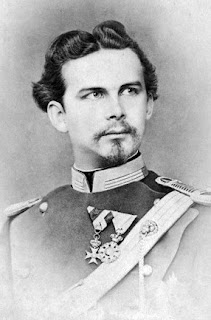
The real King Ludwig
Ludwig is a fascinating look at a fascinating historical figure. Although quite Wagnerian in length, the film is never boring (something you can't say about every Visconti film), although cuts could have been made in the second half. Berger, dubbed by Giancarlo Giannini, plays the role with his customary intensity -- alas his hairstyle looks better on the real Ludwig than on Berger --  and there are also good performances from Romy Schneider (reprising her role from the Sissi films) and John Moulder-Brown (of The House That Screamed) as the ill-fated Prince Otto, Ludwig's younger brother. Also notable are Helmut Griem (who screwed both Liza Minelli and Michael York in Cabaret) as Count Durckheim and Trevor Howard as Richard Wagner. (Opera fans owe Ludwig a great debt as his financial assistance helped the great composer finish his Ring cycle.) Silvana Mangano is cast as Wagner's mistress and later wife, Cosima. 

There is no doubt that Ludwig was homosexual, but whether he was "tormented" or not, despite his Catholicism, is debatable. I believe his alleged romantic love for Elisabeth  -- which is like that of a child -- was invented for this film, as Visconti wanted his hero to be at least perceived as bisexual, be it true or not, for the director's own reasons. (As for Helmut Berger, he was married to both a man and a woman so you can come to your own conclusions. He was Visconti's companion for many years.) 
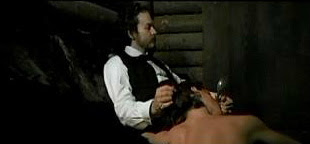
The king and squire at rest
Some might be disappointed that the homoerotic content in the film is rather limited. The gay love scene mentioned above is in the shadows and very brief, and there is an all-male party (left) which could hardly be called an orgy. 

Ludwig was filmed on location and the settings are simply magnificent. The movie doesn't always hit the mark emotionally, but it is literate, opulent, romantic, and generally tasteful. King Ludwig was criticized for building numerous beautiful castles, most of which he never lived in, but today they are great tourist attractions and have certainly enriched the Bavarian coffers. 

Verdict: My next vacation will be in Bavaria. ***1/4. 

Thursday, April 28, 2022

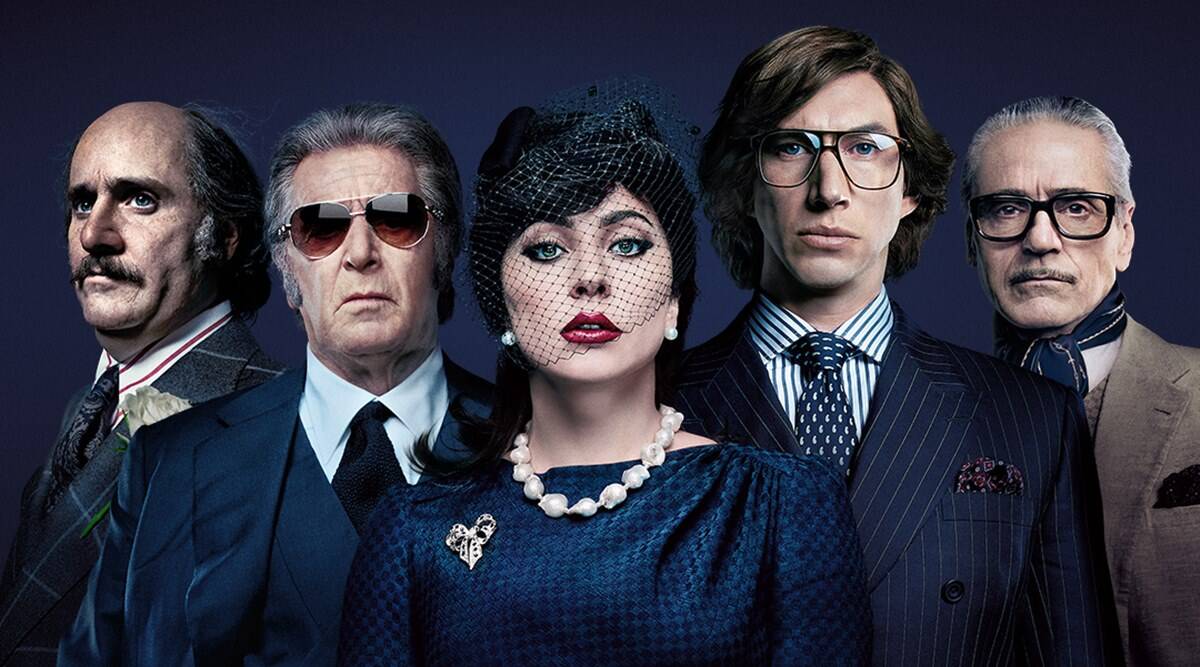
GOOD NEW MOVIE -- HOUSE OF GUCCI:

The cast of House of Gucci
HOUSE OF GUCCI (2021). Director: Ridley Scott.

Maurizio Gucci (Adam Driver) is smitten with the outgoing and ambitious Patrizia (Lady Gaga), and soon afterward they are married. Maurizio's father, Rodolfo (Jeremy Irons) isn't entirely taken with the union, but his brother, Aldo (Al Pacino) welcomes Patrizia and his nephew to New York. Then there's Aldo's son, Paolo (Jared Leto of Urban Legend), who is treated like a moron by his father, and who wants to design his own line. There are behind-the-scenes battles for control of the Gucci company, and then Maurizio has the temerity to have an affair and ask for a divorce. Patrizia is not going to take this lying down ... 

Lady Gaga was a determined Patrizia
House of Gucci
 is an entertaining and well-acted biopic and suspense story (even if you know the outcome) that holds the attention throughout its length. Lady Gaga is good, but I suspect there are other actresses who could have made more of the part. Driver and Leto (although he's initially over the top) are also quite good, but the pic is nearly stolen by a wonderful Pacino and especially Jeremy Irons as the father. If you're hoping to see some courtroom dynamics, be warned that the film ends rather abruptly with the arrest of certain parties -- you'll have to watch details of the murder trial on Dateline, which covered the story more than once.  

Verdict: Well, you may not rush out to buy a Gucci bag, but all the skullduggery in this is fascinating. ***1/4.  

Thursday, February 17, 2022

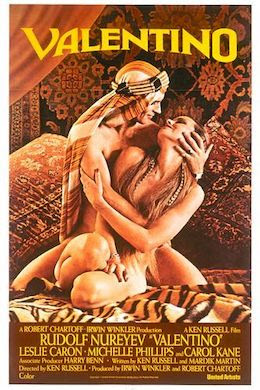
VALENTINO (1977)

VALENTINO
 (1978). Director: Ken Russell. 

Ken Russell takes the life of Rudolph Valentino (Rudolf Nureyev) and gives it the usual camp-grotesque treatment that he favors. Leslie Caron overacts (or was directed to overact) as Nazimova; Michelle Phillips (of The Mamas and the Papas) is barely adequate as Natasha Rambova. Other familiar faces in the cast are Anton Diffring as a cabaret owner; Linda Thorson ("Tara King" of TV's The Avengers) as a dance hall hostess; Huntz Hall of the Bowery Boys as Jesse Lasky; Carol Kane as an actress-friend of Fatty Arbuckle's; Seymour Cassel as an agent; John Ratzenberger of Cheers as a reporter. Russell himself plays Rex Ingram. Hall and Kane are simply mediocre. Some of the bad acting probably has to be attributed to Russell's lack of flair with actors. Nureyev, however, has charm and charisma and sometimes even hits the mark with his acting, but a different director might have brought out an even better performance. The picture really only comes alive when Rudy dances; especially good is Valentino's tango with Nijinski (Anthony Dowell) early in the picture. This is even worse than the 1951 Valentino; there is no attempt at characterization to speak of. Worse, the movie is actually quite boring. Russell wants so bad to be hip, but the dumb, homophobic humor works against it, as does just about everything else. By the way, the climactic boxing match never actually happened, which is true of most of the picture. 

Verdict: Turn it off after the tango. Another freak show from one of the worst film directors ever. *.

Thursday, January 6, 2022

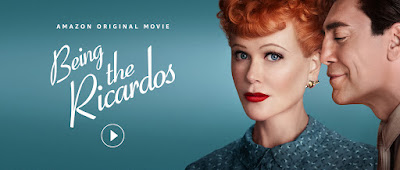
OKAY NEW MOVIE: BEING THE RICARDOS

On the set of I Love Lucy
BEING THE RICARDOS (2021 Amazon streaming video). Written and directed by Aaron Sorkin. 

While preparing an episode of their show I Love Lucy, Lucille Ball (Nicole Kidman of To Die For) and her husband Desi Arnaz (Javier Bardem of Skyfall) learn that powerful columnist Walter Winchell is calling Lucy a communist. In addition to that upsetment, Lucille is convinced that Desi is having affairs with other women, even if a photo published in Confidential proves to be several months old. Lucy, a perfectionist, clashes with her director, writers, husband and fellow cast members as to how certain sequences should be handled, while Vivian Vance (Nina Arianda) suffers angst over how Ethel is continually seen as unattractive when she is married to her "grandfather," Fred, played by William Frawley (J. K. Simmons of Whiplash). The sole female scriptwriter doesn't want Lucy to be depicted as being stupid, but Ball counters that "Lucy" is clever and almost always gets her way -- true! 

Essentially all of this material, none of which is new to the I Love Lucy fanatic (among which I count myself) has already been covered in the 1991 telefilm Lucy and Desi: Before the Laughter. However, Being the Ricardos is still an entertaining, if unnecessary, picture, although if it has people pulling out or buying their complete sets of I love Lucy I'm all for it. Nicole Kidman is better as Lucy than I would have imagined, and while Bardem is not as handsome as Desi was, he is also effective in his portrayal. I wouldn't have necessarily chosen Simmons or Arianda to play Fred and Ethel, but they are also good, especially grumpy Simmons, and the people who play the writers and director are also well-chosen. (Linda Lavin and others play the older versions of these people in mock interviews.) Lucy's children, Lucie and Desi Jr., served as producers. 

Nicole Kidman as Lucille Ball
Just as happened with Judy, the recent film about Judy Garland, some viewers won't be satisfied with any actor portrayal of a beloved figure unless the person themselves gets up out of the grave and, impossibly, plays the part. Nicole Kidman has gotten some serious hatred, and she certainly isn't a brilliant comedienne like Lucy, but she doesn't try to be -- she is rarely shown attempting the physical comedy Ball was famous for. But nevertheless she does a very good job approximating Ball. As for the film itself, there is some attempt to flesh out the characters, although the ultimate result is a tad superficial. Apparently Aaron Sorkin is not a fan of I Love Lucy -- while not every episode was a winner, quite a few were classics that are as funny today as when they first aired. 

Verdict: Whether you like this movie or not, get out your box of I Love Lucy and enjoy Ball and the others dealing with operettas, candy factories, William Holden in the Brown Derby, Lucy stomping grapes to soak up local color, selling salad dressing, attending a country club dance, going to charm school, and dozens of other episodes that will bring a great big smile to your face. And these days we sure need one! ***. 

Thursday, February 18, 2021

LADY WITH RED HAIR

LADY WITH RED HAIR
(1940). Director: Curtis Bernhardt. 

The "true" if fictionalized story of Caroline (Mrs. Leslie) Carter (Miriam Hopkins), who goes on the stage after she is divorced by her husband. The film suggests that Carter became an actress only to get money to fight for custody of her son, but in real life the boy actually stayed with his mother and was cut out of his father's will because of it. In the film Carter unrealistically tries to storm Broadway by coming in at the top instead of climbing from the bottom, but it is true that her association with David Belasco (a magnificent Claude Rains) gave an inestimable boost to her career. The film doesn't make clear that she was considered the American Sarah Bernhardt in her day. Richard Ainley plays her second husband, and as the film suggests, their marriage did signal the end of her association with Belasco (although in the film he comes in at the end to help guide her in one last production). Miriam Hopkins gives a solid performance, but up against Claude Rains there is little she can do to steal the picture. The supporting cast includes such sterling players as Laura Hope Crews, John Litel, Victor Jory, and Cecil Kellaway. A very young Cornel Wilde has a small role, and you probably won't notice Alexis Smith or Craig Stevens.

 Verdict: A lady you might like to make the acquaintance of -- on film, at least. ***.

Thursday, October 15, 2020

GOOD NEW MOVIE: JUDY

Finn Wittrock wtih Zellweger
JUDY (2019). Director: Rupert Goold. 

With her finances in a shambles and her addictions getting the better of her, Judy Garland (Renee Zellweger of Down with Love) is importuned to give a series of concerts in London. As a girl Garland was given pills by the studio to keep her weight down, among other reasons, and she's come to rely on them to get her through the day and night. She wants custody of her smaller children, Lorna and Joey, but ex-husband Sid Luft (Rufus Sewell of Hercules) thinks they would be much better off with him. Her new husband, Mickey Deans (Finn Wittrock) tries to get her a deal that might make her financially secure, but will her bad reputation put paid to that as well?

Loosely based on the stage play End of the Rainbow, this new movie is much more sympathetic than the play, which presented a burlesque of Garland's later years. It doesn't whitewash her, but it does make an attempt to understand her better. This is certainly helped by Zellweger's Oscar-winning performance, as she clearly studied Garland and the lessons paid off. The biggest problem with the film is that Zellweger does her own singing. She has a voice, but she is no Garland, although she mimics Garland's style and approach to a song very capably. The other performances, including those named as well as Jessie Buckley as her handler, Rosalind; Darci Shaw as young Judy; and others, are all quite good. Of course the movie has to include an adoring gay couple as well as other scenes that rely on dramatic license. The ending is contrived but moving. 

Judy got some serious hate from viewers. Most of this hate came from obsessive Judy-fans who will not be satisfied with anyone other than the real Garland, but for that you have to rely on her old movies and recordings. If you are interested in seeing and hearing the real Garland I would recommend the CD Judy at Carnegie Hall and the film A Child is Waiting

Verdict: No masterpiece by any means but an entertaining look at a great entertainer with an outstanding lead performance. ***.

Thursday, July 23, 2020

FEUD: BETTE AND JOAN

Susan Sarandon and Jessica Lange
FEUD: BETTE AND JOAN (8- part 2017 mini-series).

"I can't go into rehab -- I've got the Dean Martin roast!" -- Bette Davis. 

Movie legend Joan Crawford (Jessica Lange of American Horror Story: Asylum) goes to see another movie legend, Bette Davis (Susan Sarandon of The Other Side of Midnight), and offers her the title role in a film version of the novel "What Ever Happened to Baby Jane?" During filming with director Robert Aldrich (Alfred Molina of Prick Up Your Ears), long-simmering resentments and rivalries resurface, and while the two women resolve to have a united front against the twin demons of ageism and sexism, jealousies and insecurities only drive them farther apart. It all culminates when Davis gets an Oscar nod and Crawford doesn't ...

The real Bette Davis and Joan Crawford
Well, this incredibly entertaining and absorbing mini-series could have been a campy and horrible mess, but with intelligent writing and some excellent acting it emerges as a very memorable mini-series. (Feud was not available for viewing while Olivia de Havilland sued the production -- she lost -- but it is now back on Amazon Prime: $11.99 to own all eight Standard Definition episodes.) Let's get one thing out of the way. Feud is highly exaggerated and fictionalized, the actual "feud" between the two ladies being very over-stated to say the least. For much of their lives, Davis and Crawford were busy with careers, children and several bad marriages, and probably didn't think about each other all that much. It was the whole Oscar business -- Davis lost while Crawford accepted the coveted statuette on winner Anne Bancroft's behalf -- that undoubtedly started the "feud," and led to unpleasantness on the set of Baby Jane follow-up Hush ... Hush, Sweet Charlotte.

Now, as to the mini-series itself, once you get past the fabrications and dramatic licenses taken, it manages to go beyond its initial premise and explore the struggles of aging women played out against an industry where an old woman is simply considered a 'hag." The feminist angle is explored but never overwhelms the production, nor does it necessarily excuse the ladies' bad behavior, which could often be chalked up to extreme sensitivity on any number of issues. Of the two lead actresses, Lange comes off the best -- the real Crawford was much better-looking than Lange in her nearly grotesque make up, and had much more authority -- but otherwise Lange proves herself a fine actress and gives a commendable performance. Of the two icons, Davis was imitated much more than Crawford, so Sarandon had a dilemma: how to play a real person without coming off like a drag impersonator. Sarandon succeeds in making Davis seem real, but her performance is also a little dull -- for lack of a better word -- in comparison to Lange's. However, both women are good, although neither of them have the kind of intense power, personality or sheer charisma of the real Crawford and Davis. And when they recreate scenes from Baby Jane? neither are as good as the original stars.

Feud benefits from some superb supporting performances: Alfred Molina as Robert Aldrich; Stanley Tucci as Jack Warner; Alison Wright as Aldrich's assistant Pauline Jameson; Molly Price as Aldrich's wife, Harriet; John Rubinstein as George Cukor; and especially Jackie Hoffman as Crawford's maid and companion, "Mamacita," and a scene-stealing Judy Davis [Life with Judy Garland: Me and My Shadows] as Hedda Hopper. On the other hand, Catherine Zeta-Jones doesn't remind me of Olivia de Havilland at all (although you would think de Havilland would have been flattered that she was played by a much younger and beautiful actress.) And Kathy Bates makes a rather mediocre Joan Blondell. The sections showing them being interviewed about the feud could easily have been jettisoned.

Dominic Burgess seems to think that because his character, actor Victor Buono, was gay that he should play him more as a stereotype than he was in real life. While Buono is a colorful character, it's strange that Feud completely omits Maidie Norman, the black actress who played the murdered maid Elvira in Baby Jane? and who had a very interesting life -- was it because she was a lifelong Republican? Feud is perhaps more sympathetic to Joan than it is to Bette, and suggests that her daughter Christina's hateful memoirs were not entirely accurate, if at all.

It's interesting that the writers for this series must have done research by poring over bios of the two screen idols -- books such as Fasten Your Seat Belts: The Passionate Life of Bette Davis and Joan Crawford: The Essential Biography -- but none are given credit, and that even includes an exaggerated tome entitled Bette and Joan: The Divine Feud!

Verdict: Fascinating, amusing, dramatic, even poignant look at old Hollywood and how stars desperately cling to every inch they've gained while at times losing their humanity in the struggle. ***1/2. 

Thursday, April 2, 2020

A SONG TO REMEMBER

Cornel Wilde and Merle Oberon
A SONG TO REMEMBER (1945). Director: Charles Vidor.

Child piano prodigy Frederic Chopin (Cornel Wilde of The Big Combo) is urged to go to Paris by his teacher, Professor Elsner (Paul Muni). Chopin's parents won't allow the boy to go so it isn't until Chopin is grown, and forced to flee Poland after insulting the Czar, that he finally arrives in Paris. There he and Elsner have trouble convincing others of his greatness. Chopin's patriotic fervor is dampened by the presence in his life of the writer George Sand (Merle Oberon of The Price of Fear), who insists that a true artist must forget about the petty struggles of the "rabble." But Professor Elsner isn't about to let Chopin forget about where he came from nor about the Polish people.

Cornel Wilde as Chopin
A Song to Remember is a very heavily fictionalized version of the life of the great composer, with some incidents simply being made up to propel the story along and add some drama. The funny thing is that the lives of Chopin and Sand were already quite dramatic and full of incident, so the fabrications weren't even necessary. Still, there are basic factoids about the composer in the film, and one could argue that it portrays his essence if not his reality. Cornel Wilde is quite good as the Hollywood version of Chopin and was nominated for a Best Actor Oscar. If there is any problem with his portrayal it is within the script, as it makes Chopin out to be an ungrateful snob who literally snubs the man who has done so much for him. He redeems himself at the end, but still ...

Paul Muni and Maurice Tauzin
George Sand doesn't fare much better, coming off as monstrously self-absorbed. In this case, Oberon doesn't help with her one-dimensional emoting. Oberon is unable to get across the possibility that it is her need for Chopin that turns her into a selfish creature who makes outrageous statements. However, Paul Muni gives an excellent performance as the professor. He can be forgiven some "cutesy" moments because his role borders at times on the comic, but he is otherwise superb. Little Maurice Tauzin [Tarzan and the Huntress] also makes an impression as the great composer at age ten. There is also very good work from Stephen Bekassy as Franz Liszt, George Coulouris as impresario Louis Pleyel, Nina Foch as Chopin's concerned sister, and Howard Freeman as the critic Kalkbrenner. Even if you're unconvinced by the dramatics, the score consists of some of Chopin's most beautiful and memorable pieces -- you might be surprised by how many works you will be familiar with.

Verdict: Fine performances, a beautiful score, and lushly romantic. ***1/4.  

Thursday, August 22, 2019

BILLIONAIRE BOYS CLUB (1987)

Judd Nelson and Raphael Sbarge
BILLIONAIRE BOYS CLUB (1987 two part four hour mini-series). Director: Marvin J. Chomsky.

Charismatic Joe Hunt (Judd Nelson), his best friend Dean Karney (Brian McNamara), and several of their wealthier friends form a group to make big money in investments. Some of the young men may or may not be aware that the whole thing is really just a variation on an illegal ponzi scheme. A con artist named Ron Levin (Ron Silver of Reversal of Fortune) gets involved with the group, allegedly giving them 14 million to play around with, only it's merely a paper account. Then Ron Levin goes missing. The Iranian-born father of one of the boys is found dead. Interspersed with a murder trial are flashbacks that show what happened and reveal the guilty parties.

Ron Silver 
Billionaire Boys Club should have been a riveting, taut, suspenseful and fascinating TV classic, but it never really rises above a mediocre level. For this the actors can't be faulted, as a talented group, led by a terrific Nelson, has certainly been assembled. Rafael Sbarge [Deadly Web] is a stand-out as one of two brothers who hangs on Hunt's every word until he realizes what a bad influence he has become. Fredric Lehne [Wiseguy] as Sbarge's brother, Stan Shaw as a sinister helpmate, Jill Schoelen as Joe's girlfriend, Amy, Allan Miller as a defense attorney, James Sloyan as the D.A., and especially Ron Silver as the ill-fated Levin, among others, are all good as well. Because it's an interesting true story this holds the attention, but that's all. The theatrical remake in 2018 wasn't much better. The real Joe Hunt, serving a life sentence in prison, now claims that Levin went on the run to avoid prosecution and is still alive.

Verdict: Not one of the great mini-series, but well-acted. **1/4. 

Thursday, July 11, 2019

HOUDINI

Tony Curtis
HOUDINI (1953). Director: George Marshall.

Harry Houdini (Tony Curtis) is performing as the "wild man" in a carnival sideshow when he encounters the pretty Bess (Janet Leigh), who finds him a little headstrong. Nevertheless, he wins her over, the two are married, and the couple head for Europe where Harry is determined to become a great magician. Harry manages to escape from a strait-jacket, gets out of a Scotland yard jail cell, and nearly dies when he is caught beneath the ice in the Detroit River. Bess feels some trepidation as Harry prepares to extricate himself from the "Pagoda Torture Cell," which is filled with water and seems inescapable ...

Curtis and then-wife Janet Leigh
Houdini is loosely based on the life of the famous magician, although it does manage to get some of the facts straight. (The Pagoda Torture Cell was actually called the Chinese Water Torture Cell and Houdini escaped from it numerous times. not just once, and the ending to this film is pure fiction). Tony Curtis makes a perfect Houdini, combining brashness with slight nervousness, and giving an energetic performance, while his then-wife Leigh compliments him well as Bess. There are also notable turns by Torin Thatcher [Witness for the Prosecution] as the assistant to a late famous magician who comes to work for Houdini; Mabel Paige [Johnny Belinda] as a phony medium that Houdini exposes; Ian Wolfe [Foreign Correspondent] as the head of a magicians' society; and others. The film is also distinguished by good period atmosphere and the photography of Ernest Laszlo.

Verdict: Entertaining, colorful romp about a fascinating historical figure. ***. 

Saturday, June 29, 2019

BREAKING THE CODE

Derek Jacobi and Julian Kerridge
BREAKING THE CODE (1996). Director: Herbert Wise.

Brilliant mathematician Alan Turing (Derek Jacobi of The King's Speech) knows his knowledge of cyphers and science can help the British war effort during WW2, and he's chosen to find a way to break the code of the German's Enigma machine. His genius also eventually brings about the creation of digital computers, but his work and worth are diminished in his later years simply because he is gay and apparently unapologetic about it. He pays a hard price for his indiscretion.

Prunella Scales and Derek Jacxobi
Breaking the Code is based on the successful and heralded 1986 play by Hugh Whitemore, and Jacobi reprises his acclaimed stage performance in this TV adaptation. Despite Jacobi's being nearly sixty at the time (Turing died at age 42), Jacobi's performance is excellent, although some may feel his frequent deliberate stuttering (not employed by Benedict Cumberbatch, who later played the same role in Imitation Game) is a bit of a distraction. There is also fine work from Prunella Scales [The Wicked Lady] as Turing's concerned mother; Richard Johnson [Zombie] as Knox, who interviews and hires him; Julian Kerridge as a man with whom Turing dallies; and Amanda Root as a colleague who falls in love with him in spite of his orientation. While Jacobi shows the feisty and slightly arrogant side to Turing's nature, he also lets his amiability and sweetness come through as well.

Verdict: Despite some technical explanations that go on a little too long, this is altogether admirable. ***.

Thursday, May 16, 2019

MILLION DOLLAR MERMAID

Esther Williams with Victor Mature
MILLION DOLLAR MERMAID (1952). Director: Mervyn LeRoy.

Despite having to wear braces on her legs as a child, Australian Annette Kellerman (Esther Williams) becomes a swimming champion, winning race after race, in her native land. After her father, Frederick (Walter Pidgeon of Forbidden Planet),  has to close up his music conservatory, the two of them head for London and better prospects, where a impresario named James Sullivan (Victor Mature of Samson and Delilah) hires Annette to swim the Thames to create publicity for his new acquisition, a boxing kangaroo. But Sullivan's grand plan to have Annette star in a water ballet at New York's famed Hippodrome, may hit a snag.

Walter Pidgeon, Williams, Victor Mature
Million Dollar Mermaid is the fictionalized story of the real Annette Kellermann (with two "n"s), who was actually arrested for indecent exposure at Boston's Revere beach and designed a more stylish one-piece bathing suit for women to wear. The movie invents some other stuff to create a little more drama, such as a love rival for Sullivan in the form of Hippodrome manager Alfred Harper (David Brian), arguments between Annette and James, and an accident on a film set -- Kellermann made several silent movies --  in which a tank in which she's swimming cracks apart and she's severely injured. The performances in this are all quite good from the leads down to the supporting cast. Even Jesse White is more likable than usual as Jame's friend and associate, Doc. Howard Freeman also scores as Mr. Aldrich, who wants to book Annette for a lecture circuit. George Wallace [Radar Men from the Moon] shows up briefly as a stunt pilot.

Don't lose your grip, honey! 
Hired to handle the water ballet production numbers for the film, Busby Berkeley, pulled out all the stops. There are men skiing down a slope while the ladies rush below them in a watery funnel; men and women diving off of swings high in the air and slicing smoothly into the huge pool beneath them; Esther rising up out of the water as she holds on to a ring and dancers do their kaleidoscopic thing far, far  down below her. George J. Folsey's cinematography is excellent throughout the film as well. At one point Annette, who'd planned on becoming a ballet dancer, gushes over Paylova (Maria Tallchief), but Williams' efforts to perform some kind of underwater ballet are relatively pitiful.

Verdict: Entertaining biopic with pleasing performers and that certain MGM gloss.***. 

Thursday, December 6, 2018

LOLA MONTES

Martine Carol and Anton Walbrook in the Bavarian Royal palace
LOLA MONTES (1955). Director: Max Ophuls. This is the remastered and completely restored version as it was first made by Max Ophuls.

"When such a woman spends more than five minutes with a man, that's enough to start rumors."

In her later years, the still attractive dancer and notorious lady Lola Montes (Martine Carol), is exhibited as an attraction in a circus, with the various acts presenting tableaus relating to her scandalous life. Now and then she thinks back to things that happened in her past: her affair with Franz Liszt (Will Quadflieg); her early marriage to Lt. James (Ivan Desny of Anastasia), who was her late father's adjutant; and her becoming the mistress of King Ludwig I of Bavaria (Anton Walbrook of Gaslight), a situation which nearly drives the whole country into a civil war before she flees in a coach with a handsome young student (Oskar Werner). Her infamous life and behavior have now literally turned her into a sideshow freak.

Martine Carol and Peter Ustinov
Lola Montes was based on a novel which was a fictionalized version of the life story of the real "Lola Montes," the stage name of the Irish-born dancer and entertainer Eliza Gilbert. Frankly Gilbert's fascinating life should have made a much more interesting picture than Max Ophuls has provided. After its release, the picture was trimmed of about half an hour with the narrative being presented in chronological order. Restoring the movie to its original shape hasn't done it much good, as it never builds up any suspense, introduces characters only to have them disappear a moment later, and has too many of those long and rather boring circus sequences. It doesn't help that in the lead role Martine Carol gives a performance that can only be described as adequate. The other actors make a better impression, especially Walbrook as King Ludwig, and Oskar Werner as the student, who catches Lola's eye but is seen on screen all too briefly.

Martine Carol

Lola Montes is dramatically bankrupt, with one-dimensional characters that never really engage the attention or sympathies of the audience. For much of the movie cinematographer Christian Matras seems to have trouble filling the CinemaScope frame with attractive compositions or even covering the action in a compelling or professional fashion. Faces often seem to be photographed through screens or lattices. For some reason there is s big improvement in the scenes that take place in Bavaria, which are striking. However, most of the settings and the lighting schemes throughout the movie are eye-appealing.

Martine Carol and Oskar Werner
One suspects that the main reason for the circus framing device was that it was cheaper to show Lola "carried off by Cossacks" by using clowns and the like in a theatrical setting than to use scores of men on horseback in a real location. Peter Ustinov has the thankless role of the circus' master of ceremonies. Georges Auric's [Dead of Night] score is occasionally powerful but it can't do enough to save the movie. Lola Montes has its admirers, but despite my admiration for many foreign films, I suspect this would have been much better had it been made in Hollywood. (Speaking of Hollywood, Ophul's best film may well be Letter from an Unknown Woman.) Today Martine Carol is pretty much forgotten (except for this film's enthusiasts) but she amassed fifty credits before dying in her forties and her real life had its own share of scandals.

Verdict: The material was certainly there for a great movie, but this is not the film it should have been. **1/4. 

Thursday, September 27, 2018

THE GENE KRUPA STORY

Sal Mineo
THE GENE KRUPA STORY (1959). Director: Don Weis.

Gene Krupa (Sal Mineo of Crime in the Streets) is fascinated by the syncopated rhythms that are taking the nation by storm and his dream is to be a drummer. His Polish-American and devout parents would rather he become a priest, but while he prepares for that role he comes to realize that it just isn't in him. Eventually moving to New York, Krupa becomes not only a famous drummer, but does solos that astound and excite the audience. Although Gene has a girlfriend named Ethel (Susan Kohner), he lets success go to his head, holds loud and fabulous parties, neglects Ethel (even on her birthday), and takes up with seductive singer Dorissa Dinell (Susan Oliver). In other words, he basically turns into an asshole.

Sall Mineo and Susan Kohner
Krupa gets his comeuppance, however, when reefers are -- according to him -- planted on him and he winds up arrested and jailed. This film has him winding up performing in Chinese restaurants and topless bars as he struggles to get back to the top, but I suspect much of that is fabricated for the movie, although the basic facts of Krupa's life are realistically presented.  Nevertheless, as a show biz bio, this pic leaves no cliche unturned.

Sal Mineo gves a terrific performance in this, and even resembles Krupa a bit (this is the rare case when the real person is as good-looking as the actor portraying him). He really seems to be playing the drums during those sequences when he's really letting loose on the percussion. Susan Kohner, always an excellent actress, also scores as the lovely, loving and disillusioned Ethel. (In real life she divorced Krupa, and then remarried him, living with him until her death.) James Darren [The Brothers Rico] is given the thankless role of Gene's friend, Eddie, but he's good, and gets to pleasantly sing "Let There Be Love" (Darren had some hit records back in the day). Susan Oliver [Looking for Love] saucily slinks around like a perpetually horny pothead and the real Anita O'Day delivers a fine version of "Memories of You" in a cameo. Red Nichols plays himself, but Tommy Dorsey, who had passed away three years earlier, is portrayed by Bobby Troup. Celia Lovksy (the former Mrs. Peter Lorre) portrays another of her patented suffering old European mothers.

Verdict: Entertaining biopic with a charismatic and excellent lead performance. ***. 

Thursday, February 15, 2018

NIGHT AND DAY

Cary Grant and Alexis Smith
NIGHT AND DAY (1946). Director: Michael Curtiz.

"Love can be a delight, a dilemma, a disease, or a disaster." -- Monty Woolley.

Over his grandfather's objections, Cole Porter (Cary Grant) decides to leave Yale and pursue a career as a songwriter instead of as a lawyer. Things don't go smoothly at first, with WW1 interrupting things, but eventually he becomes a big success. Unfortunately, his marriage to his neglected wife, Linda (Alexis Smith), hits the rocks, and he has a horse riding accident that requires operations. Will the rather self-centered composer and his wife ever be reunited? Actually, if there was any threat to Porter's marriage, it was because he preferred gentlemen, but the film glosses over this except for one moment when Porter's friend, Monty Woolley, (played by Monty Woolley, who had indeed been a friend of Porter's and was also closeted) tells him he probably shouldn't have gotten married in the first place. The rest of the film is a mix of truths and half-truths and outright fabrication, little of which is very compelling.

Therefore we're left with Porter's music, of which there is quite a lot: "Miss Otis Regrets;" "In the Still of the Night;" 'I've Got You Under My Skin;" "I Get a Kick Out of You;" "You're the Top;" and many, many others. Jane Wyman [All That Heaven Allows] makes a positive impression as performer Gracie Harris, and Ginny Simms [Hit the Ice], who has a lovely voice, made a bid for stardom as another performer, Carole Hill. Mary Martin  plays herself to perform her signature tune "My Heart Belongs to Daddy" and there are several lively, TechniColor production numbers, including one on the lawn of Porter's massive estate.

As for the acting, Alexis Smith [The Sleeping Tiger] actually fares better than Grant, who is adequate, but seems oddly listless and unconvincing; Porter himself was still alive when the film was made and died in 1964. Eve Arden shows up as a French chanteuse to warble one number. I didn't even recognize Dorothy Malone as Porter's cousin, Nancy. Years later Kevin Kline played Porter in a film that was franker, but not necessarily better.

Verdict: The music is all that matters. **1/2.

Thursday, August 31, 2017

LOVE AND BETRAYAL: THE MIA FARROW STORY

Patsy Kensit as Mia Farrow
LOVE AND BETRAYAL: THE MIA FARROW STORY (1995 telefilm/mini-series). Director: Karen Arthur.

"If this scandal breaks, the media will put your corpse in an envelope and mail it to Roman Polanski."

Based on a biography of Mia Farrow (Patsy Kensit) as well as a tell-all by her former nanny -- but not on her own memoirs -- this telefilm looks at the life of the actress with particular emphasis on her scandalous relationship with long-time partner and artistic associate Woody Allen (Dennis Boutsikaris). Flashbacks reveal Farrow's relationships with Frank Sinatra (Richard Muenz) and Andre Previn (Robert LuPone), both of whom married her whereas Allen did not. The shit hits the fan when Farrow discovers that Allen has been having an affair with her own adopted daughter, Soon-Yi Previn (Grace Una), under her nose, which is betrayal from two people she loves. Soon-Yi is an adult, but later Mia charges that Allen molested a much younger daughter, Dylan (who maintains that to this day). Cynthia A. Cherbak has written an excellent script which intelligently examines this business from both sides, but whatever Farrow's faults (and she has many) it's hard not to see Allen as a sleaze-bucket who showed no restraint but rather slept with his long-time girlfriend's daughter, who was also the sister of his own children (Allen was not the father, adoptive or otherwise, of Soon-Yi). The telefilm is extremely well-acted by a cast that is invariably more attractive than the characters they portray, and along the way we're treated to glimpses of versions of Maureen O'Sullivan (Frances Helm); Dory Previn, Andre's cast-off wife (Lynne Cormack); Roman Polanski (Bruce McCarty); and other personages well-known or not. Kensit actually played Mia Farrow's daughter in The Great Gatsby, and has had many credits, and Boutsikaris has had even more.

Verdict: An entertaining and very well-acted three hours. ***.