Lively, entertaining reviews of, and essays on, old and newer films and everything relating to them, written by professional author William Schoell.
Showing posts with label James Cagney. Show all posts

Thursday, February 26, 2026

KISS TOMORROW GOODBYE

KISS TOMORROW GOODBYE
(1950). Director: Gordon Douglas.

Ralph Cotter (James Cagney) escapes from prison with the help of Holiday Carleton (Barbara Payton), the sister of another inmate, who dies during the break out. With the help of a shifty lawyer named Mandon (Luther Adler), Cotter blackmails a corrupt police inspector named Weber (Ward Bond) into using his resources into committing crimes. All goes smoothly until Cotter falls for Margaret Dobson (Helena Carter), the wealthy daughter of a powerful man ... This is a rather fascinating suspense/crime film, bolstered by excellent performances from the entire cast. Cagney is as mesmerizing as ever, and the tragic Payton, whose private life often overshadowed her acting achievements, proves that she did have genuine talent. The scene when she clings to Cagney and intones "I'm so alone, I'm so alone" is quite affecting. Helena Carter is also quite good in a less showy role. The force of the ending is a bit blunted by the production code, but this is still a very entertaining movie. Kenneth Tobey from It Came from Beneath the Sea, John Litel, and Barton MacLane are also in the cast, and William Frawley from I Love Lucy scores as a nasty if good-humored prison guard.

Verdict: Nifty crime drama with outstanding lead performance and highly creditable supporting cast. ***.

Thursday, October 10, 2024

RAGTIME

Howard E. Rollins Jr. as Coalhouse Walker
RAGTIME (1981). Director: Milos Forman. 

A well-to-do couple (James Olson and Mary Steenburgen) live with their young son and her brother (Brad Dourif) after the turn of the century. They take in a homeless black woman, Sarah (Debbie Allen), and her baby, and become friendly with the child's father, Coalhouse Walker (Howard E. Rollins Jr.). Dourif pursues a relationship with Evelyn Nesbit (Elizabeth McGovern), whose husband Henry Thaw (Robert Joy) shoots and kills her former lover, the architect Stanford White (Norman Mailer). Evelyn also encounters Tateh (Mandy Patinkin) and his little daughter, and winds up starring in the silent films he makes when he goes to Hollywood. When Coalhouse is humiliated by a bunch of Irish firefighters, feces dumped in his model T, he tries to get justice. Failing that, he somehow puts together a virtual militia with many weapons and begins bombing firehouses and shooting firemen. Dourif agrees to supply them with explosives. Nothing good will come of this ...  

Elizabeth McGovern as Evelyn Nesbit
For me Ragtime pretty much falls apart about this time as despite Coalhouse's understandable anger at his treatment, his murderous overreaction seems wildly contrived -- it's not as if these firemen killed anyone after all. (Besides, I have never found any kind of terrorism to be justifiable no matter how legitimate the grievances.) Dourif's character and his actions go undeveloped and unexplored, and the whole notion of mingling the Stanford White/Evelyn Nesbit story and its "trial of the century" with the Coalhouse Walker story (novelist E. L. Doctorow based all this on a German novella entitled Michael Kohlhaas, and claimed Ragtime is a homage to it) is perhaps ill-advised to begin with. What might have worked on the printed page doesn't always work in the cinema. 

Mandy Patinkin, Mary Steenburgen, James Olson
There are good performances in the film -- Rollins (who was Oscar-nominated and died of AIDS-related complications at only 46); an excellent Olson; James Cagney (at 81 playing a real-life police commissioner who was actually in his thirties at the time); Moses Gunn as Booker T. Washington trying to convince Coalhouse of the error of his ways --  and a notable score by Randy Newman. But as a whole I found the movie unconvincing and occasionally ridiculous. Other old-time stars in the film are Pat O'Brien and Donald O'Connor. Later this was turned into a Broadway musical. 

Verdict: Has its pleasures, but overall a misfire. **1/4. 

Thursday, July 13, 2017

CAGNEY!

White Heat
CAGNEY! July 17th, 1899 - March 20th, 1986.

It would be all too easy to dismiss James Cagney as a mere personality who traded too much on his tough guy image and played the same role once too often. In truth, Cagney was a much more talented and versatile actor than he may have been given credit for. True, he was easy to impersonate, and was not exactly the kind of performer who could lose himself in a characterization that was too far from himself. But within his range he was often quite effective, and as adept at drama as he was at comedy. In his early years, he was always arguing with Warner Brothers for better and different scripts (although one senses he kind of liked the tough image, especially as he probably could have been knocked over with a feather by bigger guys, truth be told). On rare occasions he was totally miscast or gave a poor performance, overdoing the nasty shtick and masticating the scenery like a male Bette Davis, but more often he was simply outstanding [Kiss Tomorrow Goodbye; Man of a Thousand Faces]. The characters he played were often unpleasant, and that goes for the "good" guys as well as the bad, as he was a product of a time when manliness was summed up by the frequent use of  one's fists and insensitivity was the rule of the day. But he could also show his gentler side when it was warranted by the script, and he danced his way across many musicals [The West Point Story], which was appropriate, as in his later years he said he always considered himself a dancer first and actor second.

A few Cagney movies have already been reviewed on this blog, but we've got a fresh crop this week.:
Something to Sing About, Lady Killer, White Heat, Tribute to a Bad Man, These Wilder Years, The Strawberry Blonde, and A Lion Is In the Streets, plus a critique of a biography of the actor.


LADY KILLER

Cagney
LADY KILLER (1933). Director: Roy Del Ruth.

Fired from his job as usher, Dan Quigley (James Cagney) falls in with a gang of con artists who later take to robbing houses. Although Dan doesn't want anybody to get killed, the worst happens, and everyone takes it on the lam to California. There Dan becomes a movie extra, and then a star, until his old gang members show up to cause trouble. Lady Killer is another of those cheerfully amoral comedy-dramas with Cagney -- who is excellent -- playing another of his unpleasant if charismatic characters. The two ladies in his life are gang member Myra (Mae Clarke) and actress Lois (Margaret Lindsay of Dangerous); both women give very good performances, and Douglass.Dumbrille [A Life at Stake] is another cast stand-out as the leader of the gang. A repulsive scene has a bullying Cagney cornering a movie critic in a rest room and forcing him to literally eat his review. Cagney would probably have wanted it to be believed that Lady Killer is more or less his life story, but of course most of this is pure fiction, including the bit with the studio wanting to dump Quigley when news of his past leaks out (the studios tended to cover up for their assets). Dan doesn't turn on the gang because they're bad guys but because they threaten his livelihood, but the picture makes him out to be some kind of hero (not to mention he'd be in serious hot water even if he didn't kill anyone because he helped plan and execute the robberies). Still, this is fast, snappy and for the most part, fun, if morally questionable. One highlight is when the director insists Dan eat garlic before his love scene with poor Lois. Leslie Fenton is also in the cast. Clarke and Cagney were famously teamed in The Public Enemy two years earlier.

Verdict: Cagney is on top of his game even if the script is (literally) all over the lot. **1/2.


SOMETHING TO SING ABOUT

Cagney and Evelyn Daw
SOMETHING TO SING ABOUT (1937). Director: Victor Schertzinger.

"A Japanese who speaks better English than I do, with a weakness for wiener schnitzel. It's too much for me in my weakened condition." -- Terry. 

Terry Rooney (James Cagney) is a popular musical theater man who is tapped to go to Hollywood to make his first picture. Planning to send for his singing sweetheart, Rita (Evelyn Daw), he goes to the studio and meets publicity man Hank Meyers (William Frawley) and studio chief B. O. Regan (Gene Lockhart of A Scandal in Paris), as well as major star Stephanie Hajos (Mona Barrie of The Devil's Mask). After a blow out on the set, Terry walks out and marries Rita, only to discover his first film is a big hit and he's a big star himself. The only trouble is that his marriage must be kept secret ... Cagney is, as expected, swell in the picture, as are most of his supporting players, including Dwight Frye as a hairdresser and Philip Ahn, as his butler, Ito. There's an excellent scene when Ahn reveals that he speaks English perfectly (although in real life he was Korean-American and not Japanese). As for leading lady Daw, it's easy to see why she appeared in only one other movie. Despite a heavy chin, Daw was cute, and not unappealing in an amateurish way, but she has one of the the worst soprano voices I've ever heard -- shrill, nasal, and altogether awful (if not quite as bad as Florence Foster Jenkins). Director Schertzinger's discovery, she retired to get married not a moment too soon. Something to Sing About has some nice tunes, including the title number, Cagney does a lovely soft shoe routine with two professional dancers, and of course is given a chance to belt guys around to prove his "manhood." A shipboard sequence features an actual "cat fight" with two real cats boxing one another (!) and a sailor in drag is tossed over the railing!

Verdict: Frothy, mindless, and reasonably entertaining. **1/2.

THE STRAWBERRY BLONDE

James and Olivia
THE STRAWBERRY BLONDE (1941). Director: Raoul Walsh.

In old time New York, Biff Grimes (James Cagney) is a struggling dentist with a wife, Amy (Olivia de Havilland). He gets word that there's a man, Hugo Barnstead (Jack Carson), who has such a severe toothache that he needs to come by on a Sunday and he can name his price. When Biff finds out who his patient is, his mind goes back to years ago. Most of the film consists of a a long flashback that explains why he has good reason to hate the man. Will Hugo get a lethal dose of laughing gas? The Strawberry Blonde is an odd comedy-drama with scenes of low comedy blended not so felicitously with more dramatic ones, and coming up short as a whole. The acting helps put it over: Cagney. playing yet another rather unsympathetic character, is full of his trademark bluster and charisma. De Havilland [Libel] is lovely and generally expert in her portrayal of the woman that Biff first despises. Scoring very big is Rita Hayworth [Salome] as Virginia, the woman Biff had originally wanted but who was stolen by Hugo; as a married couple who hate each other both Hayworth and Carson [The Groom Wore Spurs] are very effective, with the former giving a particularly adept performance (there's more to Hayworth than just sex appeal).Alan Hale, Una O'Connor, and George Reeves are also good as Biff's father, a neighbor lady, and a college boy that Biff has a quarrel with. A big problem with Blonde is that there are just too many really stupid moments, many of them consisting of scenes crafted to show off Cagney's aging tough guy image, including a ridiculous scene when he beats up several college boys at once -- sure! Since most of the film takes place some years in the past, Cagney at 42 is too old to be entirely convincing in the role as well. Still, the movie is fast-paced and unpredictable, and does have a few funny scenes, such as the Grimes and Barnsteads first encounter with spaghetti at the dinner table. The film's main strength is in how it gets across how relationships can turn out far differently than you expected, and in how one's heartbreak over another, initially devastating, often turns out to be the best thing that could have happened. This is a remake of One Sunday Afternoon, with Gary Cooper playing Biff. A musical version in 1948 cast Dennis Morgan as Biff! Raoul Walsh directed that version as well.

Verdict: A little too odd but certainly different. **1/2.

WHITE HEAT

Margaret Wycherly and James Cagney
WHITE HEAT (1949). Director: Raoul Walsh.

Cody Jarrett (James Cagney) is head of a gang that robs a train, a robbery in which four people are murdered. Hiding out with his cronies, as well as his devoted mother, Ma Jarrett (Margaret Wycherly) -- who is nearly as tough as he is --  and not-so-devoted wife, Verna (Virginia Mayo), Cody conceives of a plot to keep him from being sent to death row by copping to a comparatively minor robbery that he didn't commit. In stir for two years, Cody meets a fellow prisoner, Vic Pardo (Edmond O'Brien), who is actually undercover cop Hank Fallon, and learns from his beloved Ma that Verna has run off with Big Ed Somers (Steve Cochran), who wants to take over Cody's gang. Cody makes up his mind to get out and take care of Big Ed and everyone else ... White Heat is a slick, well-directed, and fast-paced crime thriller that features excellent performances across the board, with Cagney charismatically playing a mentally-deranged killer who suffers debilitating attacks from time to time (these sequences are handled very well by Cagney). Wycherly [Keeper of the Flame] manages to etch a highly effective portrait of Cody's mother without descending into caricature, and Mayo offers one of her best performances as the duplicitous if clever Verna; Cochran also makes an impression as her easily-discarded lover. There's also nice work from John Archer [No Man's Woman] as the head cop on the case, and Fred Clark [Back from Eternity] as one of Cody's confederates. Sid Hickox' cinematography is first-rate, and Max Steiner, whose genius wasn't limited to romantic pictures, offers a memorably tense and very exciting score for the picture. This has a classic ending with Cagney hollering "Top of the World, Ma!" at the top of a refinery.

Verdict: Brisk, tense, entertaining crime picture with a powerful Cagney performance. ***.

A LION IS IN THE STREETS

Barbara Hale and James Cagney
A LION IS IN THE STREETS (1953). Director: Raoul Walsh.

In the Louisiana backwoods, Hank Martin (James Cagney) drives his truck around selling all manner of goods to his neighbors. He meets and marries schoolteacher Verity (Barbara Hale) and takes her to his shack -- but he doesn't intend to stay there for long. Hank is convinced that Robert Castleberry (Larry Keating) is short-weighting the cotton brought to his plant and cheating the farmers, a charge strongly denied by Castleberry, creating an incident that leads to more than one death. Then Hank gets it into his head to run for governor, and makes a deal with the devil. Meanwhile his pregnant wife is unaware that Hank has turned the young woman with a crush on him, Flamingo (Anne Francis), into his mistress. This will not end well. In fact, the ending to the movie is the best thing about the picture (literally and figuratively) and perhaps Cagney's only really good acting in the film. It almost seems as if Cagney thinks that if he hollers, blusters and rages enough it will make the audience forget how utterly unconvincing the film is as a whole. A rage that might be appropriate for a gangster doesn't work at all for Hank Martin, and it's one of Cagney's rare forgettable performances. On the other hand, Barbara Hale [Perry Mason] is lovely and convincing as Verity, and Anne Francis also shines as Flamingo, and there are notable turns from Keating [When Worlds Collide]; John McIntire [Shadow on the Wall] as Jeb; and Warner Anderson as Jules. Also in the cast are Cagney's sister, Jeanne, as Jeb's wife; Lon Chaney Jr.; Ellen Corby; Onslow Stevens as a lawyer; and Sara Haden, although I didn't spot her and she seems to have no lines. The wildest scene in the movie has Flamingo trying to feed Verity to a pack of alligators out of jealousy! Franz Waxman's discordant score seems to fit, but can't help, this oddball and unmemorable movie. Apparently Walsh cut out the last third of Luthor Davis' screenplay and came up with a new finale. You also sense that several scenes, especially those pertaining to the relationship between Hank and Flamingo, were left on the cutting room floor. Similar material was already covered in the 1949 All the King's Men.

Verdict: Cagney, shamelessly chewing the scenery, is almost a parody of himself in this. **.

TRIBUTE TO A BAD MAN

 Don Dubbins with his mentor, Cagney
TRIBUTE TO A BAD MAN (1956). Director: Robert Wise.

"You act like a man with a lot of ideas, all of them second-rate and none of them honorable." 

"A man doesn't die of a broken heart from his first love, only from his last."

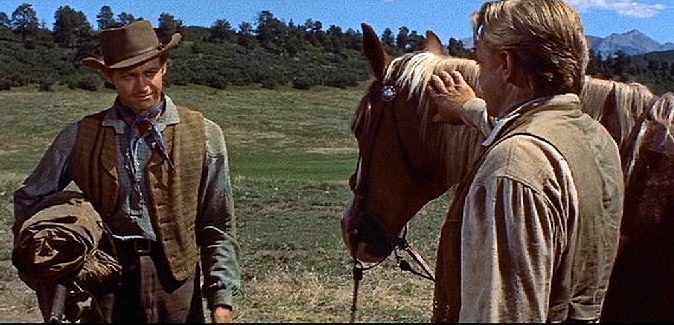
Young Steve Miller (Don Dubbins), who wants to be a cowboy or wrangler, winds up in the territory owned and run by Jeremy Rodock (James Cagney). Rodock has had to put up with people encroaching on his land and stealing horses and livestock for years, and he enacts his own rough justice, including hanging the perpetrators. The latest to earn his enmity is his old partner, L.A. Peterson (James Bell), and his son, Lars (Vic Morrow), but he may be wrong in his belief that either murdered one of his ranch hands. Rodock lives with Jocasta (Irene Papas, in her American debut), a woman with a past who is coveted by McNulty (Stephen McNally) and for whom Steve develops a growing infatuation. Finally tensions begin to boil over and Jocasta fears that Steve may develop the same hardness she sees in Jeremy, but is it possible that Rodock can mend his ways? Tribute to a Bad Man is an interesting western with some intriguing characters, and interactions among them, and the acting is uniformly good. Cagney is marvelous as the crusty autocrat with romantic leanings, and Papas gives a lovely performance as the woman he is devoted to. ("Introduced" in this film, Papas had already made several films overseas.) Don Dubbins was Cagney's protege, and the boyishly handsome actor always gives sensitive portrayals as he does here. McNally [The Lady Pays Off] and Morrow [Great White] make multi-dimensional villains, and James Bell and Jeannette Nolan [My Blood Runs Cold] score as Morrow's parents. Lee Van Cleef, Royal Dano, Peter Chong, and Onslow Stevens also make notable, if briefer, contributions. Cagney's patronage led to Dubbins appearing in this and These Wilder Years with Cagney, but the long career that followed consisted mostly of television work. This has nice widescreen Robert Surtees cinematography, adroit Robert Wise direction, a good Miklos Rozsa score, and a touching ending, although one could argue that the film certainly glosses over certain aspects of Rodock's character and actions.

Verdict: Romance and hangings in the wide open spaces. ***.

THESE WILDER YEARS

THESE WILDER YEARS (1956). Director: Roy Rowland.

Steve Bradford (James Cagney) is a successful businessman who has never married but now misses the son he denied twenty years ago and whom he has never known. Steve butts heads, albeit pleasantly, with Ann Dempster (Barbara Stanwyck), who runs the adoption agency that could help Bradford be united with his child, but Ann is opposed to the idea. Steve tries various tactics, including searching for the birth mother he abandoned years ago, and then taking the agency to court. As Steve fights his battle, he becomes closer to a young, unwed mother, Suzie (Betty Lou Keim), who must give up her baby even though she doesn't want to. These Wilder Years couldn't exactly be classified as unpredictable -- and one senses the whole business could have been handled more intelligently by everyone concerned -- but it's a nice, absorbing picture with very good performances. Stanwyck and Cagney not only got along famously while the film was being made, but play marvelously together -- two solid pros uplifting their material. There is also fine work from Walter Pidgeon [Forbidden Planet] as Steve's lawyer; Edward Andrews [Youngblood Hawke] as another small-town lawyer; Don Dubbins as the young man in question; Dean Jones as the son-in-law of the birth mother; Dorothy Adams [Laura] as Aunt Martha; and others. Mary Lawrence and dancer Marc Platt have not a word of dialogue but they certainly register in that moment when Mr. and Mrs. Callahan are given their new baby by Ann. And there's a nice score by Jeff Alexander, as well. One supposes the title was concocted to make this seem like another story of rebellious youth, which it isn't.

Verdict: Smooth, very well-played, and poignant. ***.

CAGNEY

CAGNEY. John McCabe. Knopf; 1997.

John McCabe was actually the ghost writer for Cagney's memoirs, Cagney by Cagney, and herein fills in some of the gaps based on his knowledge of and conversations with the star and icon. There's Cagney's early days growing up in a tough neighborhood, his early stage career and his dissatisfaction with movie assignments and the money he was making, his hiring his actor-brother William to be his manager, his long-term marriage to wife "Willie," and so on. Apparently his relationship with his two adopted children was far from perfect, perhaps stemming from the fact that they were put in a separate house and didn't receive that much nurturing from their parents. There's just a little gossip -- Merle Oberon allegedly coming on to Cagney and being rebuffed -- and lots of information about Cagney's career. McCabe doesn't love every Cagney performance, and dissects his mannerisms and acting approach to certain roles, right or wrong, but considers him one of the three greatest American actors. While this is a solid and substantial book, one senses that a lot of has been left on the "cutting room floor," so to speak; sometimes being friends with your subject is not the best idea. With lots of illustrations and a filmography.

Verdict: Good, but something's missing ... ***.

Thursday, June 1, 2017

CAGNEY BY CAGNEY

CAGNEY BY CAGNEY. James Cagney. Doubleday; 1976.

James Cagney had no particular interest in writing his memoirs, but he was tired of authors getting the facts wrong and decided he had better tell his own story. The first section of the book features a lot of tales detailing just how tough Cagney was growing up in a bad neighborhood where you had to prove yourself with your fists. Cagney wouldn't be the first song and dance man who felt a need to affect a super-macho image. (Ironically, one of his first jobs had him dancing in drag!) The book is more interesting when Cagney gets into his career, and he makes it clear that he considers himself, first and foremost, a dancer. Cagney felt that making movies was a grind, and he wasn't thrilled with some of the by-the-numbers assignments he was thrown into, nor with the fact that real bullets were originally used in scenes with machine guns! (Oddly, he doesn't acknowledge that he was making much, much more money than the average person.) He writes pleasantly of his fellow actors, with two exceptions: an unnamed leading lady whom he finds condescending: and Horst Buchholz, with whom he appeared in One Two Three. When Buchholz tried one of his "scene-stealing didoes," Cagney was going to "knock him on his ass." Cagey was a rarity in that he wasn't that interested in a typical Hollywood lifestyle, preferring to live in the east, and he was happily married to the same woman, a former actress, for a great many years. Liberal in his youth, Cagney became more conservative as he got older, and also became a conservationist. The book is full of ruminations on how the picture business has changed, as well as the country, and includes many samples of his poetry, which is much better than Jimmy Stewart's. Cagney comes off as a moderately cultured man with some good horse sense, who didn't allow his movie stardom to completely define him. He writes bluntly of movie colleagues who just can't accept the fact that their careers are over and no one is interested in them anymore, a fate that did not ensnare Cagney, as he became an icon instead of a has-been.

Verdict: Probably not the last word, but an interesting look at a very interesting and talented actor. ***.

Thursday, March 30, 2017

THE WEST POINT STORY

James Cagney
THE WEST POINT STORY (1950). Director: Roy Del Ruth.

Nearly washed-up Broadway director "Bix" Bixby (James Cagney) is importuned to help West Point put on its annual show -- which only uses male cadets. Producer Harry Eberhart (Roland Winters of The Sky Dragon) wants his old rival to talk Harry's nephew, Tom (Gordon MacRae), who is a wonderful singer, out of a career in the army, and he enlists the help of old friend and movie star Jan Wilson (Doris Day). Along for the ride is Bix's sort of girlfriend, Eve Dillon (Virginia Mayo), who keeps her old man on his toes. Cadets Hal (Gene Nelson) and Bull (Alan Hale Jr. of Home Town Story) make a contribution as well -- Hall with his fancy footwork, and Bull in drag as the show's "princess." There are all sorts of complications until the show comes off. The West Point Story starts out well, and for about half an hour it's fun and looks like it will stay that way, until they drag in an idiotic plot point wherein Bix has to become a cadet himself (and obey all of the academy's various rules and regulations) or be removed from directing the show. This might be fine for a Jerry Lewis movie but for this picture, it's disastrous. In general, however, the script is pretty bad and gets worse as it goes along. To Cagney's credit, he retains his dignity throughout, and actually gives a marvelous and amusing performance. Mayo, Nelson and MacRae are fine, as is Doris Day, although she seems to have a zillion too-big teeth in her mouth and, as usual, is virtually devoid of sex appeal. Roland Winters is a lot of fun as Bix' not-so-friendly enemy. Aside from "Military Polka" the Jule Styne/Sammy Cahn songs are pretty awful. Oddly MacRae seems to be aping Bing Crosby in a couple of numbers, even though he has a very different voice from Der Bingle's. The dance that Mayo and Cagney do together to "B'klyn" (another lousy tune) is one of the film's few highlights. We can only imagine what West Point officials thought of this movie! Cagney and Day made a better team in the superior Love Me or Leave Me.

Verdict: It's basically all Cagney's show, and while he's excellent he can't do enough to save it. **1/2.

Thursday, March 24, 2016

THE PUBLIC ENEMY

James Cagney and Jean Harlow
THE PUBLIC ENEMY (1931). Director: William A. Wellman.

Tom Powers (James Cagney) and his pal, Matt (Edward Woods), grow up in a tough part of the city, and get in with a bad crowd. Tom becomes a gangster and killer during prohibition, earning the enmity of his brother, Mike (Donald Cook), who has little but contempt for him. Tom is such a creep that at one point he even shoots a horse! Tom and Matt work for Nails Nathan (Leslie Fenton) and Paddy Ryan (Robert Emmett O'Connor), and get involved with such "broads" as Gwen Allen (Jean Harlow), Mamie (Joan Blondell), Kitty (Mae Clarke), who gets a grapefruit in the face, and Nail's unnamed girlfriend (Dorothy Gee), who earns Tom's scorn by getting him drunk and going to bed with him. The Public Enemy is refreshingly frank and well-acted, with Cagney getting high marks, along with Fenton [The House of Secrets], O'Connor, and Beryl Mercer [Jane Eyre] as Ma Powers. Harlow was still considered a lousy actress this early in her career, but she's actually competent, if unexceptional, and her performance is satisfactory. Frankie Darro and "Junior" Coghlan (Frank Coghlan, Jr.) play Matt and Tom as boys and are both good. One of the best scenes is a dinner at the Powers house where ex-soldier Mike can no longer control his anger at his brother and bootleg beer goes flying, and the death of Putty Nose (Murray Kinnell of Charlie Chan in Paris) is also well-handled. That said, The Public Enemy has not really worn well with time -- especially when you take into account the many superior gangster films that came later --   but it still remains an interesting picture. The great final scene of the movie almost makes the whole movie! Handsome Edward Woods was supposed to play Tom Powers, the lead role, but it was given to Cagney instead,; he became a star and Wood's career eventually faded out after only 13 credits.

Verdict: Cagney holds the attention. *** out of 4.

Thursday, January 14, 2016

SHORT CUT TO HELL

Robert Ivers and Georgann Johnson
SHORT CUT TO HELL (1957). Director: James Cagney.

This is the only film ever directed by James Cagney. Kyle Niles (Robert Ivers) is a hit man hired to kill a builder and his secretary. His contact, Bahrwell (Jacques Aubuchon of Twenty Plus Two), makes the mistake of giving Niles marked money in the hopes he'll be arrested. As Ivers makes his way to Bahrwell and his employer, a man known only as A.T. (Richard Hale), he encounters Glory Hamilton (Georgann Johnson), whose boyfriend, Stan, is a cop (William Bishop of Harriet Craig). Glory winds up as Niles' not necessarily unwilling hostage, although her supposed motives are to save Stan's life. The acting is solid in this picture, which is distinguished only in the fact that Cagney directed it -- it is not an auspicious directorial debut. Both Ivers and Johnson were trumpeted as bright new stars in Cagney's introduction to the film, although both, especially Johnson, had several previous credits. They were talented actors but neither became a star. Johnson's rather pudgy face lacked true beauty, but she wound up a well-recognized character actress with many credits. Ivers did mostly television work; he looked like a cross between Jack Kelly and Richard Widmark. The character of Bahrwell is obviously meant to be homosexual, with snide references throughout the film. Hale offers his usual portrait of an absolutely hateful old man; he had a great many credits. Yvette Vickers [What's the Matter with Helen?] offers her typically vivid portrayal of the landlord's daughter in Niles' apartment house. The script has some stupid and psychologically dubious moments given what we know about sociopaths, and Glory's behavior is often ridiculous.

Verdict: Cagney wisely stuck to acting after this. **1/2.

Thursday, March 5, 2015

LOVE ME OR LEAVE ME

LOVE ME OR LEAVE ME (1955)  Director: Charles Vidor.

"You'll never be sorry." -- Ruth

"What do you mean? I'm sorry already." -- Martin

The more or less true story of twenties singer Ruth Etting (Doris Day) and her difficult relationship to her manager and eventual husband, Martin Snyder (James Cagney). Love Me or Leave Me presents a story that was probably old even in its day and continues up until Sonny and Cher and beyond: the ambitious gal who falls in with a man who can help her and who thinks that she owes him her success and wants to control her. Cagney [Kiss Tomorrow Goodbye] is simply excellent in his highly unpleasant portrait of Snyder, although on more than one occasion he manages the significant feat of making the man sympathetic. Day [Pillow Talk] is right on top of things with Cagney  and is also excellent, never overdoing things as other actresses might have done. The biggest surprise comes from Cameron Mitchell [light years from The Toolbox Murders] who is also outstanding as Johnny, the pianist who falls in love with Ruth and vice versa. Day was a talented singer, but she isn't quite a torch singer, and while she has a couple of good numbers -- such as "I'll Never Stop Loving You" and "Look Around" -- you can hear the difference between Day in the movie and Etting's recording of "Ten Cents a Dance." Despite some sentimental hogwash at the end, this is a very good biography.

Verdict: Day and Cagney in top form. ***.

Sunday, January 13, 2008

MAN OF A THOUSAND FACES


MAN OF A THOUSAND FACES (1957). Director: Joseph Pevney.

The life of the great silent actor Lon Chaney, with a focus on his first failed marriage and his love for, and competition with, his son Creighton [later known as Lon Chaney Jr, a talented actor in his own right.] This is one of the best backstage biopics to come out of Hollywood, with a superb performance by James Cagney in the title role. In recreations of scenes from Chaney's hits, Cagney even gets across the style of acting employed by Chaney in the silent days. Jane Greer offers one of her loveliest performances as Chaney's second wife, Dorothy Malone is vivid and pathetic as wife number one, and even Robert Evans is fine as Irving Thalberg. In addition, Marjorie Rambeau has a nice scene as an extra called the “Duchess” who shows new-in-Hollywood Chaney the ropes. If there is a problem with the film it's that there seems to be too much of an effort made to turn wife number one into a villainess. At first Malone seems to be overacting as her character overreacts to the fact that Chaney's parents are deaf mutes, but it becomes evident later on that the picture wants to paint her as being a mite disturbed. The movie works up some sympathy for Malone in the final quarter. According to the film, wife number one was bored being left home alone with a baby, desired a career for herself as a singer, and when she went out and got one was basically told to stay home where she belongs by her disapproving, chauvinistic husband. Her reunion with her son brings about an estrangement between Lon and Creighton that is movingly resolved before the former's death. Whatever its flaws and dramatic licenses, this is an excellent film that features a dead-on Cagney performance. The CinemaScope photography is not really necessary for a more intimate type of story as this, but Frank Skinner's score for the film is one of his finest.
Verdict: Great biopic. ***1/2.