Lively, entertaining reviews of, and essays on, old and newer films and everything relating to them, written by professional author William Schoell.
Showing posts with label Hurd Hatfield. Show all posts

Thursday, January 15, 2026

THE UNSUSPECTED

THE UNSUSPECTED
(1947). Director: Michael Curtiz.

"I detest scenes not of my own making."

Roslyn, the secretary of radio star Victor Grandison (Claude Rains), who narrates tales of mystery and the macabre, is found hanging in the study, apparently the victim of a suicide. Meanwhile, Grandison's niece, Matilda (Joan Caulfield), who was supposedly lost at sea, shows up alive and well, as does Steven Howard (Michael/Ted North), a man she doesn't remember who claims he's her husband. Other members of this strange household include another viperish niece, Althea (Audrey Totter), her husband Oliver (Hurd Hatfield), whom she stole away from Matilda, and snappy assistant Jane (Constance Bennett), not to mention Press (Jack Lambert) a hooligan employed by Grandison. Based on a novel by Charlotte Armstrong, this seems an odd fit for director Curtiz (despite his work on such films as Mildred Pierce) and while it holds the attention and has a fairly exciting finale, otherwise it never quite comes alive. Nice work by Claude Rains (although he seems less inspired by this material than he was in, say, Deception). Audrey Totter is vivid, as usual, as is Constance Bennett. Caulfield is just okay, no more.

Verdict: Okay suspenser. **1/2.

Thursday, May 4, 2017

TARZAN AND THE SLAVE GIRL

Vanessa Brown and Lex Barker
TARZAN AND THE SLAVE GIRL (1950). Director: Lee Sholem.

When people start dropping from an unknown sickness, Tarzan (Lex Barker) leads an expedition headed by Dr. Campbell (Arthur Shields of Daughter of Dr. Jekyll) to find its origins. Meanwhile Jane (Vanessa Brown) and Campbell's nurse, a saucy lady named Lola (Denise Darcel) who is lustful for the ape man, wind up kidnapped with other women by the cult of the Lionians. The women are placed in a harem for their prince (Hurd Hatfield of The Picture of Dorian Gray), whose young son is also dying of the illness. Will Tarzan and party be able to rescue Jane and Lola, save the little boy, and keep everyone from being thrown to the lions? What do you think?  The Lionians camouflage themselves with foliage to sneak up on their enemies, and use blow guns with poisoned darts. As Jane, Vanessa Brown is cute and almost child-like; she has an amusing, if brief, cat fight with Lola over Tarzan. Denise Darcel is a little too plump in this and in some shots resembles a man in drag, although her performance is spirited. Tarzan and Jane rub noses like Eskimos, and the adorable Cheetah gets several good scenes, such as when he (or she?) gets drunk on hooch. Tarzan can put up with a lot of things, but he doesn't like it when Lola picks up a needle and tries to give him an injection. In a thankless role, Robert Alda [The Beast with Five Fingers] plays a colleague of Dr. Campbell's. This was Brown's only appearance as Jane.

Verdict: Kind of ho hum Tarzan adventure, even if Tarzan meets Dorian Gray -- sort of. **.


Thursday, January 5, 2017

JOAN OF ARC

A captive Joan prays: Ingrid Bergman
JOAN OF ARC (1948). Director: Victor Fleming.

"We can win only if we become God's army."

Joan (Ingrid Bergman), a young farm girl in France, claims to hear voices from God, telling her to speak to the Dauphin (Jose Ferrer) -- who would become King of France -- and to rally the French troops to force the British interlopers out of the country. She is on a mission from God to save France. Initially people are skeptical --  she is eventually seen as a witch by some, and a saint by others, and she marches into battle as a kind of unarmed mascot. But Joan's admirers are growing in number, and the French powers-that-be are disturbed ... Joan of Arc was excoriated when it was first released, primarily because it cost more than Gone with the Wind but was a financial bust. It's hard to understand why contemporary critics found the film boring and almost worthless. I am not at all religious, but I was impressed by the film's performances --virtually every well-known character actor working in pictures at the time -- the score (Hugo Friedhofer), and the beautiful color cinematography (Joseph Valentine) which often makes each shot look like a painting. The movie moves quite quickly as well. Bergman gives an Oscar-winning performance, and is wonderful. The only quibble I might have is that in scenes when she is supposed to be utterly exhausted due to no sleep she merely seems mildly fatigued -- even make up would have helped, but one supposes no one wanted to mar her features. Bergman was 33 at the time of filming (Joan was put to the stake at 19) and always wanted to play the role; a younger actress might have lacked the ability and strength the part required. Jose Ferrer, who was introduced in this picture,  also won a Best Actor Oscar, and while he's not on Bergman's level, he is quite good as the rather foppish Dauphin. Of the huge supporting cast there is notable work from Richard Derr as a knight and Joan's first follower; John Emery [Kronos] as the sympathetic Duke d'Alencon; and Jeff Corey [Seconds] as a jailer intent on Joan's rape. There are also appearances by Jimmy Lydon (!) as Joan's brother; Alan Napier (Batman's butler) as the Earl of Warwick; Hurd Hatfield as Father Pasquerel; and brief bits with Henry Brandon, Thomas Brown Henry, George Coulouris, and many others. The worst performance is by Francis L. Sullivan [Hell's Island], who plays Pierre Cauchon, Joan's chief accuser, almost as if he were a villain in a cliffhanger serial. The movie employs a lot of dramatic license, as a great deal is not known about Joan, and the picture simply takes her at face value, with no indication (from the movie's point of view) that she may be either demented, opportunistic or both. Her horrible death is depicted but rather glossed over -- she doesn't even break out into a sweat as the flames supposedly consume her.

Verdict: At times the movie seems to exist in a vacuum, but it is beautiful to look at, well-paced, and features some marvelous performances. ***.

Thursday, March 10, 2016

HARLOW (1965) vs. HARLOW (1965)

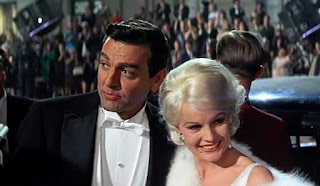
Mike Connors and Carroll Baker
HARLOW (1965). Director: Gordon Douglas.
HARLOW (1965). Director: Alex Segal.

"All the best things in life have to be done alone" -- "Marie Dressler" in Harlow II

In 1965 there were two "dueling" biopics about the star Jean Harlow, who died tragically young at 26, but neither of these films give the actress her due. Right off the bat, it seems like unfair competition, as Harlow I is a technicolor, widescreen epic with the highly publicized Carroll Baker [The Carpetbaggers] in the lead. Harlow II stars the perhaps lesser light Carol Lynley [The Shuttered Room], and was essentially a black and white television production (shot in Electrovision) and blown up to theatrical proportions. The chief difference, among many, is that Baker plays the role so that Harlow comes off as fresh and appealing, while Lynley is in "big bitch" mode throughout most of the movie, making one wonder why anyone would want to work with her. Harlow's mother is played in the first film by a marvelous Angela Lansbury, and Ginger Rogers is also quite good as the mother in Harlow II. In both films Harlow has a shiftless Italian stepfather, Marino. Raf Vallone [A View from the Bridge] is excellent as the character in the first film, while Barry Sullivan, despite not being Italian, manages to score in the second film as well. Both movies are rather slanderous (by 1960's standards as well as 1930's) in the character of first/second husband Paul Bern, who appears at least to be impotent and, it is suggested, homosexual. In the first film Peter Lawford barely registers, while a superb Hurd Hatfield [The Picture of Dorian Gray] gives the best performance in either picture as the same character. Bern had a common law wife who is never seen in the first film, and is played quite well by Audrey Totter in the second; she tells Harlow's mother that although she is Bern's mistress, they have never had physical contact. In both pictures Harlow is so dejected/depressed by the Paul Bern business that she turns herself into a "slut." Harlow I is based on a bio by Irving Shulman that was found by subsequent biographers to be heavily fictionalized. Unfortunately, Shulman's version of Harlow and her circle seems to be the unofficial basis for the second film as well.

Carol Lynley as Jean Harlow
In Harlow I Leslie Nielsen as "Richard Manley" is cast in the Howard Hughes role, while Efrem Zimbalist Jr. [A Fever in the Blood]  plays the counterpart to William Powell in the second; Zimbalist actually gives one of his best performances while Nielsen is acceptable. His near-rape of Harlow in his over-opulent bedroom is one of the best scenes in Harlow I, while Harlow II boasts a funny sequence which depicts her screen test with each take ruined because she can't stand to have the dour, disapproving Zimbalist watching her. There is also a very good scene between Rogers and Totter arguing over Paul Bern. The second version has some famous old actors being impersonated, such as Hermione Baddeley doing a not-bad Marie Dressler, and Celia Lovsky much less successful as a supposed Maria Ouspenskaya. There are interesting performances by Red Buttons and Hanna Landy in the first film, and Michael Dante, Lloyd Bochner, and especially John Williams in the second. Martin Balsam plays a studio head in Harlow I and gives one of his rare unconvincing performances.

As for the leading ladies, both give competent if second-rate performances (especially in the case of Baker), with both failing to capture the essence of Harlow -- her voice, her attitude, that surly, sexy, lovable demeanor that made her so famous. The ladies do the best they can, but as both versions say over and over again, there's only one Jean Harlow. [Both movies fail to get across that Harlow was a good actress.] An unintentionally comical scene occurs at the end of Harlow I when the doctor administering to a very ill Harlow exhibits as much compassion to her mother as a sociopathic iceberg. Oddly, the doctor in the second film is similarly cold, if not quite so stone-faced. In Harlow I Baker/Harlow disgustedly smears cold cream all over her image in her mirror, a scene that also occurs in the earlier Queen Bee with Crawford.

Verdict: Two smutty movies that don't have that much to do with the real Harlow. Both versions: **1/2 out of 4.

Thursday, December 31, 2015

DESTINATION MURDER

Stanley Clements and Myrna Dell
DESTINATION MURDER (1950). Director: Edward L. Cahn.

Jackie Wales (Stanley Clements) is hired by club owner and mob boss Armitage (Albert Dekker) to murder a man named Mansfield. His daughter Laura (Joyce Mackenzie) witnesses the hit, recognizes the shooter, and tries to get more on him for the police by working at Armitage's club as a cigarette girl. Meanwhile Wales thinks nothing of dating the daughter of the man he murdered in cold blood. Wales and Armitage's girlfriend, Alice (Myrna Dell), who actually has a hankering for the club manager Stretch Norton (Hurd Hatfield), have cooked up a very dangerous blackmail scheme. Destination Murder is a snappy and happily unpredictable B crime thriller that just misses being really special. There are good performances by Clements, Hatfield and Dekker [Middle of the Night]; John Dehner as a suspect and potential victim; James Flavin as the Inspector on the case; and especially Myrna Dell [The Lost Tribe] as the calculating and hard-hearted Alice. Dekker takes a belt to Clements' face at one point, and there are other interesting sequences. Hatfield of The Picture of Dorian Gray is quite effective as a gangster type.

Verdict: Absorbing crime thriller with some good and unexpected twists. *** out of 4.

Thursday, March 29, 2012

THE WILD, WILD WEST SEASON 2

Ross Martin and Robert Conrad
THE WILD, WILD WEST Season two. 1966. CBS-television.

James West (Robert Conrad) and Artemis Gordon (Ross Martin) are back for a second [now in color] season of the post-Civil War spy series, The Wild, Wild West. Amidst a plethora of mediocre and plain silly episodes are some more notable stories, such as the exciting "Night of the Raven" with Dr. Loveless (Michael Dunn) and Phyllis Newman [better than you might imagine] as an  Indian princess. "Big Blast" guest-stars Ida Lupino as Dr. Faustino, who uses human bomb duplicates of Artie and Jim to try to blow up Congress! "Ready-Made Corpse" features Carroll O'Connor as a man who provides new faces for wanted criminals. "Man-Eating House" is a weird -- too weird -- but entertaining episode guest-starring Hurd Hatfield as an escaped jailbird in a creepy old haunted house. Dr. Loveless reappears in "Bogus Bandits" -- also guest-starring the inimitable Patsy Kelley -- staging bank robberies yet throwing away the money! The two most memorable episodes feature female antagonists: Delphi Lawrence makes an excellent Lucrece Posey, trying to form a criminal group of hit men in "Poisonous Posey"; and no less than Agnes Moorehead plays a murderous marriage broker in "Vicious Valentine," which probably has the most suspenseful climax of any season two episode. Another notable episode is "Tottering Tontine," in which members of a survivor-takes-all financial concern are wiped out one by one in a sinister old mansion by the sea. The Wild, Wild West was an imperfect series, but almost always entertaining in spite of it. The boys report to a portly colonel in many of the episodes, and President Grant himself appears in at least one story. Artie and Jim are always impeccably dressed in beautiful old-style suits with matching vests, and Conrad continues to wear the tightest pants on television -- for a 19th century secret service man no less! Other interesting guest-stars include Boris Karloff, Sammy Davis, Jr., Leslie Parrish, William Talman, Tom Drake, and Victor Buono. Click here to read about season one of the show.

Verdict: Still fun. ***.

Thursday, March 11, 2010

THE NORLISS TAPES

THE NORLISS TAPES (1973). Director: Dan Curtis.

"Every time the house creaks, my skin crawls."

Publisher Sanford Evans (Don Porter) wonders what happened to his author David Norliss (Roy Thinnes) who was writing a book debunking the occult until he ran smack damn into a genuine supernatural incident: a woman's (Angie Dickinson) husband has come back from the dead and is attacking people, draining their blood like a vampire. The acting from the principals and supporting cast -- which includes Claude Akins as a sheriff and Hurd Hatfield from The Picture of Dorian Gray and Mickey One as an art dealer-- is good, and the movie has its creepy moments. The problem is that just as it begins getting interesting, the darn thing is over. This attempt to make a new series for Thinnes [similar to The Night Stalker] after The Invaders ended its run didn't pan out.

Verdict: Always nice to see Angie. **1/2.

Thursday, April 9, 2009

MICKEY ONE


MICKEY ONE (1965). Director: Arthur Penn.

Mickey One is the stage name of a young comic (Warren Beatty) who is on the run because he owes money to the mob. His landlady -- apparently he owes her money, too -- rents his apartment to a young lady, Jenny (Alexandra Stewart), who sort of becomes Mickey's girlfriend after he refuses to move out. But what difference does it make -- because Alan M. Surgal's screenplay has no real plot and paper-thin characters. Beatty really has nobody to play, but at least he has charisma if little else. Stewart mopes about and makes little impression, probably no fault of hers. Franchot Tone and Hurd Hatfield give vivid, even memorable performances, but their characters are also cyphers and the movie wastes their talents. Director Penn opts for a stylish approach which never disguises the essential emptiness of the film and is remarkably pretentious as well -- Penn is no Fellini. Worse still, the movie is excrutiatingly tedious. An example of the subtlety of the picture is Hatfield, as a club manager, banging on the door behind which stands Beatty and shouting "I want you!" Later Beatty winds up for no real reason in a junkyard and comes across a bunch of derelicts, one of whom campily gives him come-hither looks -- oy vey! This movie is so awful on so many levels it isn't funny.

Verdict: One of the worst movies ever made. 1/2*.

Thursday, February 19, 2009

THE PICTURE OF DORIAN GRAY

THE PICTURE OF DORIAN GRAY (1945). Directed by Albert Lewin. 

"I adore simple pleasures. They're the last refuge of the complex." 

This adaptation of Oscar Wilde's brilliant novel of fantasy and manners may have made some changes from the book -- it's been awhile since I read it -- but it's still a fascinating story and an excellent movie. Hurd Hatfield gives a memorable performance as the young Dorian Gray, who wishes a bit too fervently that he would always stay young while his portrait ages, which is just what happens. His life becomes increasingly wicked (although some of the stuff he's up to surely wouldn't raise an eyebrow in 2009!) but the severity of his crimes intensifies as his portrait becomes increasingly hideous. George Sanders gets to deliver in his inimitable style some of Wilde's wittiest ripostes, such as "When her third husband died her hair turned quite gold from grief" and "To get back my youth I'd do anything except get up early, exercise, and be respectable." Angela Lansbury, Richard Fraser, and Lowell Gilmore are also noteworthy, as are many of the other supporting performers. The various technicolor shots of Dorian's portrait are striking and eventually quite horrific. Completely absorbing, handsomely produced, and adroitly directed. Top-notch! 

Verdict: "To regain one's youth, one most only repeat one's follies." ***1/2.