Lively, entertaining reviews of, and essays on, old and newer films and everything relating to them, written by professional author William Schoell.
Showing posts with label Jean Harlow. Show all posts

Thursday, January 16, 2025

RECKLESS

RECKLESS (1935). Director: Victor Fleming.

By the time agent Ned Riley (William Powell) realizes he's really in love with his client, singer-dancer Mona Leslie (Jean Harlow), Mona is being swept off her feet by the wealthy Bob Harrison Jr. (Franchot Tone). Harrison even goes so far as to buy out every seat for a performance of the show Mona is in. Mona's wise old grandmother (May Robson) scolds and gives sage advice in equal measure. Rosalind Russell turns up as Harrison's kind of forgotten fiancee, Henry Stephenson is his concerned father, and little Mickey Rooney is his usual charming self as an enterprising youngster befriended by Ned (perhaps the film's most touching sequence has Rooney trying to help out Ned when he thinks he's down and out). If that cast weren't enough, we've also got Allan Jones singing a romantic ballad in his inimitable way, Leon Ames turning up both with and without his mustache, Charles "Ming the Merciless" Middleton playing a district attorney, and Margaret Dumont showing up for one line as a heckler in the theater! Powell, Harlow, and Tone are all just marvelous, and Robson almost manages to steal every scene she's in. The story veers in unfortunately melodramatic directions, but the film still manages to be quite entertaining. And that cast! 

Verdict: Crazy script but a feast of fine actors! ***.

Thursday, March 18, 2021

DOUBLE WHOOPEE

Stan Laurel, Jean Harlow, Oliver Hardy
DOUBLE WHOOPEE (1929). Director: Lewis H. Foster. 

In this silent short, Stan Laurel and Oliver Hardy, who have come to the Frontenac Hotel to fill in as doorman and footman, are mistaken for a visiting King (Hans Joby) and his prime minister (Charley Rogers). If that weren't bad enough, the real king takes a header into an elevator shaft not once but thrice! Installed in their new jobs and uniforms, the boys incur the wrath of a taxi driver and a cop, and have an amusing if embarrassing incident with a pretty guest played by no less than Jean Harlow. Hardy's primping when he spots the lovely Harlow is hilarious. Double Whoopee is not a silent classic, but it does show that the fellows had their shtick down pat even in the silent era, and were extremely gifted comic actors. Harlow hasn't much to do but does it with aplomb. 

Verdict: A few good laughs in this silent shortie. **3/4. 
 

Thursday, July 14, 2016

JEAN HARLOW

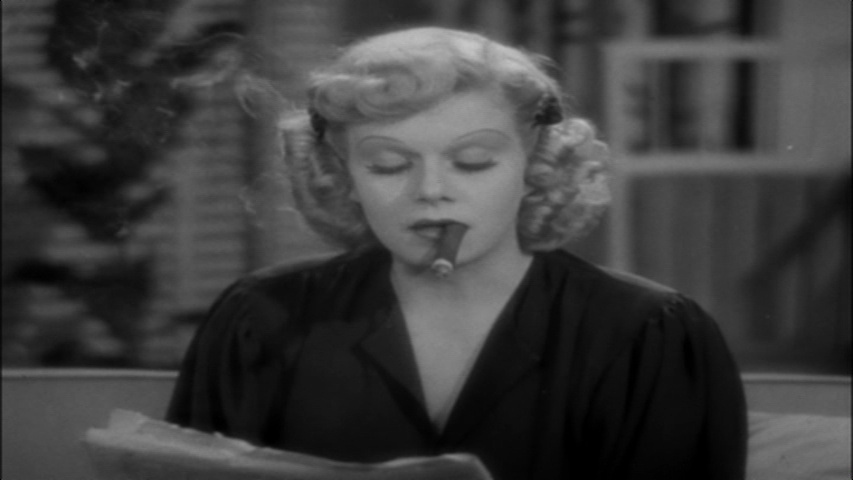
Jean Harlow smokes a stogie in Saratoga
JEAN HARLOW(1911 - 1937).

In her short, ultimately tragic life, Jean Harlow achieved more than most people do in a full lifetime. Initially dismissed as a glamour girl whose success was due entirely to sex appeal, she later emerged as an accomplished actress and comedienne, getting better with each picture and encouraged by her more skillful directors. Jean was the subject of two mediocre film biographies, neither of which fully captured her special quality, and the actresses who played her had little of the Harlow mystique. Harlow was featured to full advantage in such films as Reckless and Dinner at Eight, and while she could be as soft and feminine as any actress, she was always especially delightful when she was telling people off with amusing and righteous indignation. In other words there was no one quite like Harlow.

This week we look at a round up of good and bad Harlow movies, as well as a couple of books that focus on the star.

BOMBSHELL: THE LIFE AND DEATH OF JEAN HARLOW

BOMBSHELL: The Life and Death of JEAN HARLOW. David Stenn. Doubleday; 1993.

After a scurrilous supposed biography of Harlow was published by Irving Shulman, there appeared two biopics about the star that were, unfortunately, in the same vein. Before "Bombshell" was published, there was Eve Golden's "Platinum Girl." a well-researched tome that refuted much that had been said and written about Harlow. "Platinum Girl" was published by Abbeville Press, while the more prestigious Doubleday came out with "Bombshell," automatically giving it more attention, although it is probably no better than Golden's tome. As for "Bombshell," it is a compact, well-written and very entertaining look at a talented lady whose screen image was not what she was actually like in real life (although her penchant for going without underwear and stripping un-self-consciously at the drop of  a hat might give one pause). The book explores Harlow's three failed marriages; the death of second husband Paul Bern (was it really necessary to include a crime scene photo of this tormented man's dead body?); her rather twisted relationship with her obsessive mother; and even a bit about her career. Not being a film historian or critic, Stenn doesn't deal that much with Harlow's actual films or her work on-screen. Still, this is a mostly credible look at the tragic life of this star who probably never had that much desire to even be in the movies. Harlow's films include Dinner at Eight and Reckless.

Verdict: Solid movie star bio. ***.

PLATINUM BLONDE

Jean Harlow and Robert Williams
PLATINUM BLONDE (1931). Director: Frank Capra.

Reporter Stewart Smith (Robert Williams) is told to interview a wealthy family over a breach of promise suit involving the son, Michael (Don Dillaway). Smitten with Michael's pretty sister, Ann (Jean Harlow), Smith forgets all about the colleague, Gallagher (Loretta Young), who's carrying a torch for him and he winds up getting married to Ann. Smith wants Ann to live with him, but she prefers the family mansion and dresses him in monkey suits. Will he rebel and find his way back to Gallagher? You needn't see the movie to be able to answer the question, which even for 1931 is utterly cliche-ridden and thoroughly predictable -- not a single thing happens that you don't expect long before. Young and Harlow both offer expert performances, but Robert Williams is a case of an unlikable (at least in this role) actor playing an unlikable part -- his Stewart Smith is a complete, self-serving jackass that Gallagher should have kicked to the curb long before. Jokes about butlers, snobs and society are less funny than creaky. Louise Closser Hale makes an impression as Ann's mother, who is constantly asking for a double-bicarbonate. Robert Williams made no other films after this, as he died the same year it was released at a tragically young 34. Some see him as stealing the show from his female co-stars in this picture, but I confess that I do not agree -- glib Williams is just not my cup of java. Capra's direction of the film is more than okay, but that script ...!

Verdict: Even Frank Capra can make stinkers. *1/2.

RED-HEADED WOMAN

Jean Harlow in one of her best roles
RED-HEADED WOMAN (1932). Director: Jack Conway.

"Don't be so cynical. It's very depressing this time of the night."

Red-headed Lillian Andrews (Jean Harlow) has decided she wants to live on the right side of the tracks and sets her cap for her boss, Bill Legendre (Chester Morris), despite the fact that he is married to Irene (Leila Hyams). Both Bill and Irene discover that neither of them are a match for the determined, super-sexy Lillian, who generally gets what she wants when it comes to men. When she discovers after she snares Bill that no one in his crowd or family will accept her, she decides to seek greener pastures. But can she manipulate things to her advantage without everything tumbling down around her? Jean Harlow is simply smashing as Lillian in one of her best roles, making the character kind of likable without ever being sympathetic. "I'm in love and gonna get married," Lil tells her best friend, Sally (Una Merkel) -- but not to the same man! There have been dozens of movies about marital triangles both before and after this picture, but what lifts Red-Headed Woman above the crowd is the acting and Anita Loos' excellent script. Lantern-jawed Chester Morris is fine as the conflicted Bill, with very good support from Hyams [Island of Lost Souls] as his wife; Lewis Stone as his father; Henry Stephenson [Cynara] as a family friend and business associate who develops a hankering for Lillian; May Robson as Irene's down-to-earth Aunt May; and even a very young Charles Boyer [The Constant Nymph] as the chauffeur who dallies with Lillian at inopportune moments. Una Merkel offers her usual adroit performance in her typical role of the heroine's ugly best friend. Harlow gives a rivetingly exciting performance in this, in full command of her considerable gifts and beauty.

Verdict: Sassy and frank pre-code comedy-drama. *** out of 4.

WIFE VS. SECRETARY

A pensive Jean Harlow
WIFE VS. SECRETARY (1936). Director: Clarence Brown.

Linda (Myrna Loy) is happily married to publisher Van (Clark Gable), who has a highly efficient and attractive secretary named Whitey (Jean Harlow). Linda doesn't see the pretty Whitey as a threat until her well-meaning mother-in-law, Mimi (May Robson of Bringing Up Baby), puts the thought in her head. As for Whitey, she has an adoring boyfriend in Dave (James Stewart), but she also realizes that she's developed feelings for Van. When Van and Whitey take an unscheduled trip to Havana for business, Linda jumps to conclusions and walks out, making the conflicted Whitey wonder if she has a future with her boss and if she really wants one. Wife vs Secretary is not a bad movie, but its chief appeal lies in the wonderful performances by the entire cast, especially Harlow in a more serious role of a very likable, appealing and decent woman. Myra Marsh of I Love Lucy fame plays a woman who consults with Van, and Gloria Holden of Dracula's Daughter plays Joan, a friend of Van and Linda's.

Verdict: Watch this one for Harlow and other excellent performances. ***.


SUZY

Jean Harlow and Cary Grant's hand
SUZY (1936). Director: George Fitzmaurice.

"I don't dance much and I don't sing so well, but I can be awful cute when I want to be." -- Suzy

Suzy (Jean Harlow), an American entertainer in London on the eve of WW1, eventually finds herself married to two men at the same time: Factory foreman Terry (Franchot Tone), who at one point gets shot by a spy; and wealthy French playboy and war hero, Andre (Cary Grant) who distinguishes himself as a flier -- and a heel. How this bizarre situation came about and how it is resolved is the stuff of Suzy, a wartime soap opera that mixes dogfights, Mata Hari-types, inadvertent bigamy, adultery, German spies, and music halls -- and it's still a meandering bore. Jean Harlow is delightful in the first half of the film but director Fitzmaurice is unable to get her to properly handle some of the tougher scenes in the second half, although she certainly had the ability to do so. Tone and Grant are both fine -- although Tone is as unconvincing as an Irishman as Grant is as a Frenchman! --  but Lewis Stone walks off with the movie as Grant's stern but loving father, who eventually comes to care very much for the showgirl he at first disapproves of. [The picture eliminates Stone from the finale and shouldn't have.] Inez Courtney [The Reckless Way], Una O'Connor [Stingaree], and Benita Hume are also notable as, respectively, Suzy's pal, landlady, and love rival. Fitzmaurice also directed Mata Hari with Greta Garbo. The most unforgivable thing about Suzy is that it tries to rip off the "I was reading a book" scene from Dinner at Eight!

Verdict: Melodramatic claptrap that seems cobbled together from scenes from better movies. **.

DEADLY ILLUSIONS: JEAN HARLOW AND THE MURDER OF PAUL BERN

DEADLY ILLUSIONS: JEAN HARLOW AND THE MURDER OF PAUL BERN. Samuel Marx and Joyce Vanderveen. Random House; 1990.

Samuel Marx was a friend of Paul Bern's and worked at MGM as a story editor at the time of Bern's death. For years he accepted the story that Bern committed suicide because it turned out there was already another woman in his life and a scandal might have derailed both his career and his wife, Jean Harlow's. Paul Bern was horrendously slandered as a monster, abuser, and so on in a phony biography of Harlow as well as two films inspired by it. This book dispels the notions that Bern was impotent (he is described by one doctor  as being "underdeveloped," but not in an abnormal way)  and beat Harlow out of frustration, or that he had no interest in women to begin with. Marx makes clear that the often negative (for the time) rumors about Bern stubbornly persisted for decades with reporters taking the old bio and films as gospel. Dorothy Millette had been involved with Bern years earlier, when she had to be committed to an institution and Bern provided her continual support (and indeed performed many acts of kindness for others). Then Dorothy was released, however delusional, and made her way to Hollywood, expecting she and Bern would continue their relationship and he would groom her for stardom. Unfortunately  ... Marx and Vanderveen make a convincing case that Louis B. Mayer and underlings covered up the murder of Paul Bern in this interesting bio-crime story.

Verdict: Fast read with interesting information. ***.


SARATOGA

Jean Harlow and Clark Gable
SARATOGA (1937). Director: Jack Conway.

Margaret Hamilton to Frank Morgan: "You have no idea what my face looked like before I used your cream."

Frank Morgan to Margaret Hamilton: "I can imagine."

Race track gambler Duke Bradley (Clark Gable) thinks that Carol Clayton (Jean Harlow), the daughter of his friend, Frank Jonathan Hale), is a bit snooty. Carol is engaged to the rich "sucker" Hartley Madison (Walter Pidgeon), but she finds herself drawn to the cruder Duke even as she engages in verbal fisticuffs with him. Will Carol and Duke admit their feelings for one another? This is the slight premise of Saratoga, which also has some bits of business about bidding on horses, switching jockeys at the last minute, and betting on the climactic race, most of which is a little confusing and even a bit on the dull side. This is a shame, because each and every cast member is working at the top of his or her game, and that not only includes the already-named, but Una Merkel as Duke's racing pal; Frank Morgan as her befuddled and jealous husband, who markets cold cream as "Harriet Hale;" Hattie McDaniel as Carol's saucy and lovable maid/companion; Frankie Darro as an obnoxious jockey; and George Zucco (doing a rare turn at comedy) as a slightly strange doctor. Margaret Hamilton also scores in a small role as one of Morgan's unsatisfied customers, and Lionel Barrymore is fine, as usual, working in his befuddled, cranky, old-timer mode.The acting in this is just wonderful and there are some memorable scenes, such as a near-silent one in which Duke communicates to Carol that her father has died. There's a very enjoyable train scene with the various principals taking turns at singing a chorus, their acting skills and personality making up for untrained voices. Despite several genuinely amusing moments, the film has an air of sadness because Harlow died tragically young while making this picture, and her scenes had to be finished with a dubbed double seen only from the back or behind binoculars. The film has an amiable nature, even though the Walter Pidgeon character is treated especially shabby, and Carol doesn't come off like the most likable of creatures.

Verdict: So many fine actors and so many good things in it that it's too bad this really isn't all that memorable. **1/2.

Thursday, March 24, 2016

THE PUBLIC ENEMY

James Cagney and Jean Harlow
THE PUBLIC ENEMY (1931). Director: William A. Wellman.

Tom Powers (James Cagney) and his pal, Matt (Edward Woods), grow up in a tough part of the city, and get in with a bad crowd. Tom becomes a gangster and killer during prohibition, earning the enmity of his brother, Mike (Donald Cook), who has little but contempt for him. Tom is such a creep that at one point he even shoots a horse! Tom and Matt work for Nails Nathan (Leslie Fenton) and Paddy Ryan (Robert Emmett O'Connor), and get involved with such "broads" as Gwen Allen (Jean Harlow), Mamie (Joan Blondell), Kitty (Mae Clarke), who gets a grapefruit in the face, and Nail's unnamed girlfriend (Dorothy Gee), who earns Tom's scorn by getting him drunk and going to bed with him. The Public Enemy is refreshingly frank and well-acted, with Cagney getting high marks, along with Fenton [The House of Secrets], O'Connor, and Beryl Mercer [Jane Eyre] as Ma Powers. Harlow was still considered a lousy actress this early in her career, but she's actually competent, if unexceptional, and her performance is satisfactory. Frankie Darro and "Junior" Coghlan (Frank Coghlan, Jr.) play Matt and Tom as boys and are both good. One of the best scenes is a dinner at the Powers house where ex-soldier Mike can no longer control his anger at his brother and bootleg beer goes flying, and the death of Putty Nose (Murray Kinnell of Charlie Chan in Paris) is also well-handled. That said, The Public Enemy has not really worn well with time -- especially when you take into account the many superior gangster films that came later --   but it still remains an interesting picture. The great final scene of the movie almost makes the whole movie! Handsome Edward Woods was supposed to play Tom Powers, the lead role, but it was given to Cagney instead,; he became a star and Wood's career eventually faded out after only 13 credits.

Verdict: Cagney holds the attention. *** out of 4.

Monday, August 11, 2008

DINNER AT EIGHT


DINNER AT EIGHT (1933). Director: George Cukor.
"You couldn't get into the men's room at the Astor!"

The only thing on the mind of airy Millicent Jordan (Billie Burke) is the dinner party she's planning, so she doesn't realize that her husband Oliver (Lionel Barrymore) has serious business woes and even more serious health problems. But then most of the guests have their own preoccupations. Dr. Talbot (Edmund Lowe) is having an affair with an increasingly clingy Kitty Packard (Jean Harlow, pictured), whose grumpy, much older husband Dan (Wallace Beery) wants to take over Oliver's business. Faded actress Carlotta Vance (Marie Dressler) has money troubles, but not as bad as has-been Larry Renault (John Barrymore), who can't pay his hotel bill and whose agent (Lee Tracy) has to deliver some devastating news. The Jordan's daughter Paula (Madge Evans) has fallen in love with Larry, even though she already has a fiance.

Although the pace sometimes drags, this is a brilliant comedy-drama that has many highly amusing lines and situations but can also slide effortlessly into tragedy as we witness the grim fate of Larry Renault. John Barrymore handles the horrifying situation with his usual aplomb. Harlow and Beery have a great scene battling together and telling each other off, and Marie Dressler is perfection (she has a funny scene with fawning Elizabeth Patterson -- Mrs. Trumble on I Love Lucy -- in a bit.) All the performances are excellent.

Verdict: They really don't make 'em like this anymore. ****.