Lively, entertaining reviews of, and essays on, old and newer films and everything relating to them, written by professional author William Schoell.
Showing posts with label Raf Vallone. Show all posts

Thursday, March 14, 2024

THE CARDINAL

Father Fermoyle (Tom Tryon) faces the KKK
THE CARDINAL (1963). Produced and directed by Otto Preminger.

At his birth it was decided that Stephen Fermoyle (Tom Tryon of The Unholy Wife) would become a priest, and he never questioned it. Seen as being too ambitious by Bishop Glennon (John Huston), Fermoyle is sent to one of the poorest parishes in the nation, where he works with the dying Father Halley (Burgess Meredith). Not certain that he wants -- or ever wanted -- to be a priest, he takes a leave of absence and falls in love with the Austrian woman Annemarie (Romy Schneider) and vice versa, but his faith is reignited and he remains in the priesthood. As he advances at the Vatican due to the patronage of Cardinal Quarenghi (Raf Vallone), he jeopardizes his career by helping a black priest, Father Gillis (Ossie Davis), in Georgia and comes afoul of whip-wielding members of the Ku Klux Klan. Later he goes to Vienna to consult with Cardinal Innitzer (Joseph Meinrad), who has capitulated to the Nazis but is betrayed by them. He manages to escape an attack on Innitzer's quarters and with most of his family present is made a cardinal. 

Raf Vallone with Tom Tryon
Over three hours long, The Cardinal -- which spans WW1 up to the beginnings of WW2 and the rise of Hitler -- is never boring. I only watched the film because I was curious how actor-turned-novelist Tom Tryon would handle such a demanding lead role, and he comes through with flying colors. Unfortunately, The Cardinal was a financial flop, and that adversely affected his career. One of the film's greatest strengths is the performances of the entire cast, although John Huston, despite some solid moments, is as uneven in this as he was in The Other Side of the Wind. Carol Lynley makes her mark as Stephen's sister, who falls in love with a Jewish man, well-played by John Saxon. Broadway star Bill Hayes is also effective as Stephen's brother, Frank, as is Dorothy Gish as their mother. Others in the cast include Patrick O'Neal as a southern bigot, Murray Hamilton as one of the racist group who tries to help Stephen, Chill Wills as a bishop, and Bobby Morse (appearing with the Adora-Belles) as the main performer in a spirited nightclub act. 

Joseph Meinrad with Tryon
One problem with the film is that apparently some scenes had to be left on the cutting room floor, or perhaps were never filmed. The resolutions of storylines involving the sister and her fiance, as well as Annemarie in Nazi-controlled Vienna, are left dangling. Some scenes, such as a confrontation between Stephen and his sister's Jewish fiance after a tragic occurrence, cry out to be recorded but are never shown. On the other hand, there are some powerful moments, such as a chorus of Catholics in Vienna attracting the negative attention of the SS and Hitler Youth, forming a startling contrast, and the sequences when Nazis storm Cardinal Innitzer's quarters, which actually happened. Joseph Meinrad [Sissi: The Young Empress] is excellent as the cardinal, who was a real-life individual. 

Brothers: Tom Tryon with Bill Hayes
The Cardinal does something unusual in that it depicts the Nazi persecution of Catholics. Although ordinary members of the clergy (Protestants as well as Catholics) were sent to concentration camps or killed, higher-ranking clergy were generally left alone so as not to become martyrs. In any case, this doesn't compare to the persecution of Jews, whose ordinary citizenry were slaughtered in appalling numbers. Annemarie's husband has Jewish blood, and comes to a bad end, but otherwise The Cardinal doesn't really deal with antisemitism, another serious flaw of the film. Despite the fact that the film was partially bankrolled by the Vatican (the church's liaison later became Pope Benedict XVI), it is made clear that the church didn't really want to get involved in civil rights, let alone in the troubles of the Jews.  

Whatever its flaws, The Cardinal boasts a beautiful, expressive score by Jerome Moross [The Big Country] and superb cinematography courtesy of Leon Shamroy [The Robe] . 

Verdict: I am not remotely Catholic but I enjoyed this movie -- the religiosity never quite becomes overbearing, it is great to look at, and much more interesting than you might imagine, with a great cast. ***. 

Thursday, March 10, 2016

HARLOW (1965) vs. HARLOW (1965)

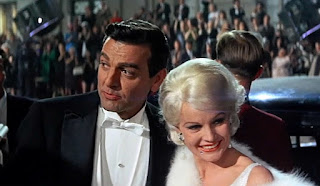
Mike Connors and Carroll Baker
HARLOW (1965). Director: Gordon Douglas.
HARLOW (1965). Director: Alex Segal.

"All the best things in life have to be done alone" -- "Marie Dressler" in Harlow II

In 1965 there were two "dueling" biopics about the star Jean Harlow, who died tragically young at 26, but neither of these films give the actress her due. Right off the bat, it seems like unfair competition, as Harlow I is a technicolor, widescreen epic with the highly publicized Carroll Baker [The Carpetbaggers] in the lead. Harlow II stars the perhaps lesser light Carol Lynley [The Shuttered Room], and was essentially a black and white television production (shot in Electrovision) and blown up to theatrical proportions. The chief difference, among many, is that Baker plays the role so that Harlow comes off as fresh and appealing, while Lynley is in "big bitch" mode throughout most of the movie, making one wonder why anyone would want to work with her. Harlow's mother is played in the first film by a marvelous Angela Lansbury, and Ginger Rogers is also quite good as the mother in Harlow II. In both films Harlow has a shiftless Italian stepfather, Marino. Raf Vallone [A View from the Bridge] is excellent as the character in the first film, while Barry Sullivan, despite not being Italian, manages to score in the second film as well. Both movies are rather slanderous (by 1960's standards as well as 1930's) in the character of first/second husband Paul Bern, who appears at least to be impotent and, it is suggested, homosexual. In the first film Peter Lawford barely registers, while a superb Hurd Hatfield [The Picture of Dorian Gray] gives the best performance in either picture as the same character. Bern had a common law wife who is never seen in the first film, and is played quite well by Audrey Totter in the second; she tells Harlow's mother that although she is Bern's mistress, they have never had physical contact. In both pictures Harlow is so dejected/depressed by the Paul Bern business that she turns herself into a "slut." Harlow I is based on a bio by Irving Shulman that was found by subsequent biographers to be heavily fictionalized. Unfortunately, Shulman's version of Harlow and her circle seems to be the unofficial basis for the second film as well.

Carol Lynley as Jean Harlow
In Harlow I Leslie Nielsen as "Richard Manley" is cast in the Howard Hughes role, while Efrem Zimbalist Jr. [A Fever in the Blood]  plays the counterpart to William Powell in the second; Zimbalist actually gives one of his best performances while Nielsen is acceptable. His near-rape of Harlow in his over-opulent bedroom is one of the best scenes in Harlow I, while Harlow II boasts a funny sequence which depicts her screen test with each take ruined because she can't stand to have the dour, disapproving Zimbalist watching her. There is also a very good scene between Rogers and Totter arguing over Paul Bern. The second version has some famous old actors being impersonated, such as Hermione Baddeley doing a not-bad Marie Dressler, and Celia Lovsky much less successful as a supposed Maria Ouspenskaya. There are interesting performances by Red Buttons and Hanna Landy in the first film, and Michael Dante, Lloyd Bochner, and especially John Williams in the second. Martin Balsam plays a studio head in Harlow I and gives one of his rare unconvincing performances.

As for the leading ladies, both give competent if second-rate performances (especially in the case of Baker), with both failing to capture the essence of Harlow -- her voice, her attitude, that surly, sexy, lovable demeanor that made her so famous. The ladies do the best they can, but as both versions say over and over again, there's only one Jean Harlow. [Both movies fail to get across that Harlow was a good actress.] An unintentionally comical scene occurs at the end of Harlow I when the doctor administering to a very ill Harlow exhibits as much compassion to her mother as a sociopathic iceberg. Oddly, the doctor in the second film is similarly cold, if not quite so stone-faced. In Harlow I Baker/Harlow disgustedly smears cold cream all over her image in her mirror, a scene that also occurs in the earlier Queen Bee with Crawford.

Verdict: Two smutty movies that don't have that much to do with the real Harlow. Both versions: **1/2 out of 4.

Thursday, February 20, 2014

A VIEW FROM THE BRIDGE

Confused triangle: Vallone, Sorel and Lawrence
A VIEW FROM THE BRIDGE (aka Vu du pont/1962). Director: Sidney Lumet.

NOTE: This review discusses important plot points. Eddie Carbone (Raf Vallone of The Other Side of Midnight), his wife Beatrice (Maureen Stapleton of Interiors), and their niece Catherine (Carol Lawrence) live together near the shipyards in Brooklyn. They take into their home two illegal immigrants, Marco (Raymond Pellegrin), who is older and married, and handsome young Rodolpho (Jean Sorel), who is immediately attracted to Catherine and vice versa. This doesn't sit well with Eddie, who has not slept with his wife in months, and who seems to be obsessed with his pretty niece. Eddie never misses an opportunity to cast doubt on Rodolpho's sexuality because he sings, has blond hair, and other ludicrous reasons, but primarily because he sees him as his rival -- or perhaps is attracted to him and must belittle him in classic closet case fashion. It all culminates in a scene when Eddie first kisses Catherine full on the lips, and then does the same to Rodolpho in a supposed attempt to expose his homosexuality [talk about doing things backwards!] And things become even more melodramatic after that... The main strength of this adaptation of Arthur Miller's play is the acting, which is excellent across the board, especially the performances of a passionate Vallone, sympathetic Stapleton, and lovely, confused Lawrence. Unfortunately, it's all a trifle over-baked and coy at the same time, a combination that doesn't work. The double-kiss probably played on the stage, but it's much more of a dramatic device than anything you can take seriously, almost the stuff of soap opera. Since it's hard to believe that this "macho" guy would want to give a hard smack to Rodolpho's lips if he were really straight, critics ever since have speculated on the possibility that Eddie is a repressed homosexual [and indeed with his homophobia and other acts one can see how it could be interpreted that way]. Was Miller afraid to tackle the subject head on when he wrote the play in the fifties, leaving that sort of thing to Tennessee Williams (who probably would have made a better play out of View) and using Catherine as a "beard?" The ambiguity gives the whole movie a dated air, although it does have some powerful moments.

Verdict: Interesting, with a wonderful lead performance, but just misses being really special. ***.

Thursday, April 25, 2013

THE OTHER SIDE OF MIDNIGHT

John Beck and Marie-France Pisier
THE OTHER SIDE OF MIDNIGHT (1977). Director: Charles Jarrott.

Although it was not his first published novel, Sydney Sheldon had his first big bestseller with The Other Side of Midnight, a very entertaining "beach" read that was the first to employ his standard formula: Sheldon would take plots from old romantic movies and then add some intrigue and thriller elements to them. Generally it worked, although -- as one critic put it -- no matter how entertaining it was you forgot the book the minute you were finished with it. Oddly, the film version of Midnight was not a success, either financially or critically. Not so odd, maybe.

In 1939 Marseilles Noelle Page (Marie-France Pisier) discovers that her own father has basically sold her to her employer. Disgusted, Noelle sets off to Paris and heartbreak, where she meets a soldier, Larry Douglas (John Beck), who leaves her with child, and promises to return and marry her. Determined to get revenge on the man who never comes back to her, Noelle becomes a wealthy film star. In the meantime Larry meets and marries an American publicist, Catherine (Susan Sarandon of Twilight), even as Noelle moves from lover to lover to become the mistress of the world's wealthiest man, Greek shipping magnate Constantin Demeris (Raf Vallone of Therese Raquin). But she and Larry Douglas are fated to meet again, with dramatic consequences for all the parties already named ...

In the novel Noelle and Larry are described as gorgeous specimens of female and male pulchritude. Pisier is certainly a strikingly attractive woman, but every time you see lantern-jawed Beck making love to her you can't help but see chin-happy Jay Leno. Beck's performance is competent but not so great that you can understand his casting, but then the producers obviously wanted to save money by using relative unknowns. Sarandon and Pisier certainly earn their paychecks with well-crafted performances -- in addition Pisier is forced into bedroom scenes with one [comparatively speaking] ugly old man after another, making the flesh crawl, and even Larry isn't so great! These sex scenes go on for an excruciatingly long time. The producers wanted to provide long glimpses of Pisier's lovely body, obviously, but forgot that we had to look at her unlovely bed mates as well! 

If you approach the film without ever having read the book, you may find it reasonably entertaining if quite long. [In fact, it takes longer to watch the movie, which is nearly three hours long, than it does to read the book!] The trouble is that Jarrott directs with absolutely no panache, stripping the film of most of its suspense. Though the movie has pretty settings and attractive scenic design, the cinematography is flat and uninspired -- it all looks like a matter-of-fact hastily done TV movie. Jarrott had more success with Mary, Queen of Scots; with Midnight he seems utterly bored with the material.

Despite the film's length, some of the novel's most interesting sequences have been left out. Midnight may not have been a literary masterpiece, but a better film could have been made of it with a little more care and inspiration.

Verdict: Even Sheldon deserves better. **1/2.