Lively, entertaining reviews of, and essays on, old and newer films and everything relating to them, written by professional author William Schoell.
Showing posts with label Carol Lynley. Show all posts

Thursday, March 26, 2026

RETURN TO PEYTON PLACE

RETURN TO PEYTON PLACE
(1961). Director: Jose Ferrer.

In this sequel to Peyton Place, Allison MacKenzie (now played by Carol Lynley) goes to New York with her roman a clef manuscript about the town she grew up in, and falls for her handsome married publisher (Jeff Chandler). Her mother Constance is now married to Mike Rossi (these two are now played by Eleanor Parker and Robert Sterling of Topper TV series fame), and while mama is appalled, Mike wants to place the book in the school library. Selena (now played by Tuesday Weld) is mortified that Allison chose to write about her rape and subsequent trial in her novel, and Roberta Carter (Mary Astor) is outraged that the principal wants to put his step-daughter's filthy book in the library where anyone could read it. 

Mary Astor, Brett Halsey, Luciana Paluzzi
Brett Halsey is Roberta's son Ted, who shows up with a new wife (Luciana Paluzzi, who later did Thunderball) in tow. Meanwhile Selena meets a guy named Nils (Gunnar Hellstrom). (They ignore the fact that Selena and Ted were not just friends but were once engaged). The acting is good and there are a few surprises. Although few would argue that Eleanor Parker was a more talented actress than Lana Turner (despite the latter's fine stint in A Life of Her Own), Turner was actually more suitable for the role of Constance Mackenzie (and it doesn't help that Parker is doing one of her "actressy" turns). Brett Halsey comes off better than usual. It's absolutely no surprise, however, that the whole movie is positively stolen by the superb performance of Mary Astor, who gives the entire cast and everyone who sees the film a lesson in sharp and superlative thesping.

Verdict: A pleasant return to old Sin City. ***.

Thursday, March 14, 2024

THE CARDINAL

Father Fermoyle (Tom Tryon) faces the KKK
THE CARDINAL (1963). Produced and directed by Otto Preminger.

At his birth it was decided that Stephen Fermoyle (Tom Tryon of The Unholy Wife) would become a priest, and he never questioned it. Seen as being too ambitious by Bishop Glennon (John Huston), Fermoyle is sent to one of the poorest parishes in the nation, where he works with the dying Father Halley (Burgess Meredith). Not certain that he wants -- or ever wanted -- to be a priest, he takes a leave of absence and falls in love with the Austrian woman Annemarie (Romy Schneider) and vice versa, but his faith is reignited and he remains in the priesthood. As he advances at the Vatican due to the patronage of Cardinal Quarenghi (Raf Vallone), he jeopardizes his career by helping a black priest, Father Gillis (Ossie Davis), in Georgia and comes afoul of whip-wielding members of the Ku Klux Klan. Later he goes to Vienna to consult with Cardinal Innitzer (Joseph Meinrad), who has capitulated to the Nazis but is betrayed by them. He manages to escape an attack on Innitzer's quarters and with most of his family present is made a cardinal. 

Raf Vallone with Tom Tryon
Over three hours long, The Cardinal -- which spans WW1 up to the beginnings of WW2 and the rise of Hitler -- is never boring. I only watched the film because I was curious how actor-turned-novelist Tom Tryon would handle such a demanding lead role, and he comes through with flying colors. Unfortunately, The Cardinal was a financial flop, and that adversely affected his career. One of the film's greatest strengths is the performances of the entire cast, although John Huston, despite some solid moments, is as uneven in this as he was in The Other Side of the Wind. Carol Lynley makes her mark as Stephen's sister, who falls in love with a Jewish man, well-played by John Saxon. Broadway star Bill Hayes is also effective as Stephen's brother, Frank, as is Dorothy Gish as their mother. Others in the cast include Patrick O'Neal as a southern bigot, Murray Hamilton as one of the racist group who tries to help Stephen, Chill Wills as a bishop, and Bobby Morse (appearing with the Adora-Belles) as the main performer in a spirited nightclub act. 

Joseph Meinrad with Tryon
One problem with the film is that apparently some scenes had to be left on the cutting room floor, or perhaps were never filmed. The resolutions of storylines involving the sister and her fiance, as well as Annemarie in Nazi-controlled Vienna, are left dangling. Some scenes, such as a confrontation between Stephen and his sister's Jewish fiance after a tragic occurrence, cry out to be recorded but are never shown. On the other hand, there are some powerful moments, such as a chorus of Catholics in Vienna attracting the negative attention of the SS and Hitler Youth, forming a startling contrast, and the sequences when Nazis storm Cardinal Innitzer's quarters, which actually happened. Joseph Meinrad [Sissi: The Young Empress] is excellent as the cardinal, who was a real-life individual. 

Brothers: Tom Tryon with Bill Hayes
The Cardinal does something unusual in that it depicts the Nazi persecution of Catholics. Although ordinary members of the clergy (Protestants as well as Catholics) were sent to concentration camps or killed, higher-ranking clergy were generally left alone so as not to become martyrs. In any case, this doesn't compare to the persecution of Jews, whose ordinary citizenry were slaughtered in appalling numbers. Annemarie's husband has Jewish blood, and comes to a bad end, but otherwise The Cardinal doesn't really deal with antisemitism, another serious flaw of the film. Despite the fact that the film was partially bankrolled by the Vatican (the church's liaison later became Pope Benedict XVI), it is made clear that the church didn't really want to get involved in civil rights, let alone in the troubles of the Jews.  

Whatever its flaws, The Cardinal boasts a beautiful, expressive score by Jerome Moross [The Big Country] and superb cinematography courtesy of Leon Shamroy [The Robe] . 

Verdict: I am not remotely Catholic but I enjoyed this movie -- the religiosity never quite becomes overbearing, it is great to look at, and much more interesting than you might imagine, with a great cast. ***. 

Thursday, January 23, 2020

THE STRIPPER

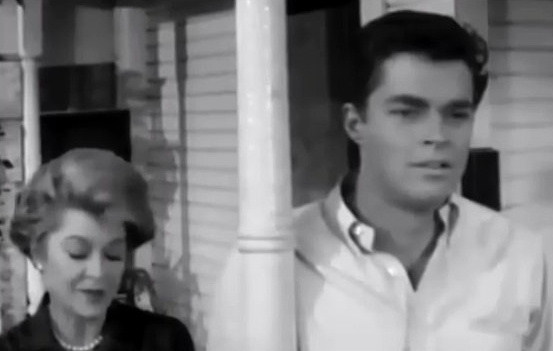
Richard Beymer and Joanne Woodward
THE STRIPPER (1963). Director: Franklin J. Schaffner. Based on the stage play "A Loss of Roses" by William Inge.

Along with her associates in a traveling magic act, Lila Green (Joanne Woodward) comes to the town where she lived as a child, but then is stranded when her boyfriend, Ricky (Robert Webber), runs off to greener pastures with all of their cash. Lila gets a room with a widow, Helen (Claire Trevor), who was her neighbor years ago, and who has a grown son named Kenny (Richard Beymer). Kenny and Lila develop an undeniable attraction to one another, but considering the age difference -- Woodward was eight years older than Beymer -- and everything else, Lila is afraid of being hurt and lonely once again. Then Ricky comes back into her life with a proposition ...

Claire Trevor and Richard Beymer
The Stripper is a lovely and absorbing film with three excellent lead performances. Although never considered a great beauty as such, Woodward [From the Terrace] has never looked better and she is excellent as Lila. (Marilyn Monroe, who was superb in the film adaptation of Inge's Bus Stop and was four years older than Woodward, might have been considered for this role had she not died tragically the previous year.) Beymer [Five Finger Exercise] gives a sensitive and intelligent performance as well, and Trevor [The Velvet Touch] is as adept as ever. Webber makes a very effective slime ball, and others in the cast include Gypsy Rose Lee and the odd Louis Nye as his associates (neither of them are especially memorable) and Carol Lynley, who makes a nice impression as a neighbor who has a crush on Beymer. Michael J. Pollard brings his own brand of quirkiness as a strange buddy of Kenny's who seems to have a thing for Lila but gets nowhere with her. The film could have used more scenes depicting the growing relationship between Kenny and Lila, but otherwise this is a very good movie.

Verdict: Strong cast and interesting situations add up to a memorable picture. ***1/2. 

Thursday, November 2, 2017

BEWARE! THE BLOB

Gwynne Gilford and Robert Walker Jr. 
BEWARE! THE BLOB (aka Son of Blob/1972). Director: Larry Hagman.

Chester Hargis (Godfrey Cambridge) brings home a frozen specimen that defrosts and turns into the Blob, and it rapidly devours the residents of a small town, including bowlers and ice skaters. Beware! The Blob could have been a perfectly good sequel to The Blob if the approach had been different. Larry Hagman, who was in-between I Dream of Jeannie and his career-reviving role on Dallas, decided to turn this into a free-wheeling borderline parody despite the fact that the whole premise already has black comedy aspects to begin with. So Hagman cast some friends and character actors and guest-stars -- such as Carol Lynley, Burgess Meredith, and Shelley Berman -- all of whom seem to be having fun, but not one of whom is actually funny. Most of the death scenes are also played for laughs. The shame of it is that the script is workable and there's genuine suspense in the situation at the climax, with hero Bobby (Robert Walker Jr.) trying to freeze the monster while the cops outside start to set fire to the building. Walker and Gwynne Gilford [Fade to Black] as his girlfriend, Lisa, wisely play their roles straight and are all the more effective for it -- there's also a good scene when their car is engulfed by the creature. The special effects are, if anything, even more low-tech than in the original. Veteran Richard Webb [The Invisible Monster] plays Sheriff Jones and Cindy Williams is a party guest who has one excruciating scene with a guy singing and playing guitar. Hagman directed a few television episodes, but mercifully this is the only film he ever helmed.

Verdict: Almost makes the original look like a masterpiece. *1/2.

Thursday, November 17, 2016

SHOCK TREATMENT (1964)

 Lauren Bacall: Who's crazy?
SHOCK TREATMENT (1964). Director: Denis Sanders.

Harley Manning (Judson Laire) hires actor Dale Nelson (Stuart Whitman) to feign mental problems so that he can be admitted for observation in a mental hospital. It seems that crazy gardener Martin Ashley (Roddy McDowall), who lopped off his elderly employer's head with garden shears, may know where some of the old lady's fortune is hidden. Unfortunately, Dr. Beighley (Lauren Bacall), also has an interest in that money, and has developed a drug that can turn certain people into catatonics ... Made a year after Shock Corridor, in which the hero also feigned mental illness in order to be admitted to an institution, Shock Treatment may not necessarily be a better movie, but it is a lot more fun, a rather absurd melodrama that typically exploits mental illness without ever having anything of note to say about it. However, as a melodrama this works all the way through. While Whitman [Sands of the Kalahari] and Bacall [The Cobweb] are okay, the best performances come from Carol Lynley (as another patient) and McDowall [Fright Night], who gets across the character's anger and madness without chewing the scenery. Ossie Davis and Bert Freed have smaller roles. Everything seems resolved a little too neatly at the end, but the finale is very amusing, if not very believable.

Verdict: Watch out for Bacall and her needle! ***.

Thursday, July 21, 2016

THE PLEASURE SEEKERS

Gardner McKay and Carol Lynley
THE PLEASURE SEEKERS (1964). Director: Jean Negulesco.

"Boy is he confused. He gave his wife the mink coat and me the refrigerator!" -- party guest

Three young ladies living and working in Madrid encounter romantic difficulties: entertainer Fran (Ann-Margret) can't seem to get together with handsome doctor Andres (Andre Lawrence); Susie (Pamela Tiffin) becomes betrothed to a heel, Emilio (Anthony Franciosa), who has no intention of actually marrying her; and Maggie (Carol Lynley) is torn between married editor Paul (Brian Keith) and young reporter Pete (Gardner McKay). Jean Negulesco returns to the foreign soap opera genre he examined ten years earlier in the superior Three Coins in the Fountain, with another trio of mostly unconvincing romances set in Spain instead of Italy. The deceptively titled Pleasure Seekers may have some location shots of Madrid, as well as shots of the masterpieces in the Prado, but other than that it never leaves Hollywood. The acting is good enough, with a very attractive Gene Tierney [Whirlpool] getting a grand total of one good scene as Paul's wife as she tells off infatuated Maggie in a ladies room. Isobel Elsom [Ladies in Retirement] also gets one good scene as Emilio's mother. The movie might be called a semi-musical as there are several numbers for Ann-Margret as she sings during "Fran's" performances, but she also warbles a tune at a picnic; you can miss these. With Ann-Margret's singing, everything is subordinate to sex, and she vocalizes as if she's savagely tearing at a big chunk of lobster. TV star Gardner McKay's character is virtually undeveloped -- to his credit he doesn't just come off like "Adam Troy," the character he played on Adventures in Paradise -- and he made one more movie before becoming a playwright, Little is known about Andre Lawrence, who made his debut in this film and appeared in some Canadian and other productions afterward.

Verdict: Fairly terrible. **.

Thursday, March 10, 2016

HARLOW (1965) vs. HARLOW (1965)

Mike Connors and Carroll Baker
HARLOW (1965). Director: Gordon Douglas.
HARLOW (1965). Director: Alex Segal.

"All the best things in life have to be done alone" -- "Marie Dressler" in Harlow II

In 1965 there were two "dueling" biopics about the star Jean Harlow, who died tragically young at 26, but neither of these films give the actress her due. Right off the bat, it seems like unfair competition, as Harlow I is a technicolor, widescreen epic with the highly publicized Carroll Baker [The Carpetbaggers] in the lead. Harlow II stars the perhaps lesser light Carol Lynley [The Shuttered Room], and was essentially a black and white television production (shot in Electrovision) and blown up to theatrical proportions. The chief difference, among many, is that Baker plays the role so that Harlow comes off as fresh and appealing, while Lynley is in "big bitch" mode throughout most of the movie, making one wonder why anyone would want to work with her. Harlow's mother is played in the first film by a marvelous Angela Lansbury, and Ginger Rogers is also quite good as the mother in Harlow II. In both films Harlow has a shiftless Italian stepfather, Marino. Raf Vallone [A View from the Bridge] is excellent as the character in the first film, while Barry Sullivan, despite not being Italian, manages to score in the second film as well. Both movies are rather slanderous (by 1960's standards as well as 1930's) in the character of first/second husband Paul Bern, who appears at least to be impotent and, it is suggested, homosexual. In the first film Peter Lawford barely registers, while a superb Hurd Hatfield [The Picture of Dorian Gray] gives the best performance in either picture as the same character. Bern had a common law wife who is never seen in the first film, and is played quite well by Audrey Totter in the second; she tells Harlow's mother that although she is Bern's mistress, they have never had physical contact. In both pictures Harlow is so dejected/depressed by the Paul Bern business that she turns herself into a "slut." Harlow I is based on a bio by Irving Shulman that was found by subsequent biographers to be heavily fictionalized. Unfortunately, Shulman's version of Harlow and her circle seems to be the unofficial basis for the second film as well.

Carol Lynley as Jean Harlow
In Harlow I Leslie Nielsen as "Richard Manley" is cast in the Howard Hughes role, while Efrem Zimbalist Jr. [A Fever in the Blood]  plays the counterpart to William Powell in the second; Zimbalist actually gives one of his best performances while Nielsen is acceptable. His near-rape of Harlow in his over-opulent bedroom is one of the best scenes in Harlow I, while Harlow II boasts a funny sequence which depicts her screen test with each take ruined because she can't stand to have the dour, disapproving Zimbalist watching her. There is also a very good scene between Rogers and Totter arguing over Paul Bern. The second version has some famous old actors being impersonated, such as Hermione Baddeley doing a not-bad Marie Dressler, and Celia Lovsky much less successful as a supposed Maria Ouspenskaya. There are interesting performances by Red Buttons and Hanna Landy in the first film, and Michael Dante, Lloyd Bochner, and especially John Williams in the second. Martin Balsam plays a studio head in Harlow I and gives one of his rare unconvincing performances.

As for the leading ladies, both give competent if second-rate performances (especially in the case of Baker), with both failing to capture the essence of Harlow -- her voice, her attitude, that surly, sexy, lovable demeanor that made her so famous. The ladies do the best they can, but as both versions say over and over again, there's only one Jean Harlow. [Both movies fail to get across that Harlow was a good actress.] An unintentionally comical scene occurs at the end of Harlow I when the doctor administering to a very ill Harlow exhibits as much compassion to her mother as a sociopathic iceberg. Oddly, the doctor in the second film is similarly cold, if not quite so stone-faced. In Harlow I Baker/Harlow disgustedly smears cold cream all over her image in her mirror, a scene that also occurs in the earlier Queen Bee with Crawford.

Verdict: Two smutty movies that don't have that much to do with the real Harlow. Both versions: **1/2 out of 4.

Thursday, October 4, 2012

THE NIGHT STALKER

Darren McGavin as Kolchak
THE NIGHT STALKER (1972 telefilm). Drector: John Llewellyn Moxey. Written by Richard Matheson.

Reporter Carl Kolchak (Darren McGavin), hoping to get back to the big time of New York from Las Vegas, latches onto a story about women being found dead drained of every drop of blood, and runs with it, discovering that an actual vampire (Barry Atwater) is on the loose, leading to a tense climax in the bloodsucker's lair. This high-rated telefilm [a "Movie of the Week"] introduced Kolchak, who returned in a second telefilm, The Night Strangler, before getting his own series, which lasted one season. McGavin is fine, bolstered by performances from Carol Lynley as his girlfriend, Claude Akins as a cop, Kent Smith as the D.A., and Simon Oakland as Kolchak's belligerent boss, Vincenzo. Elisha Cook Jr. and Charles McGraw are also in the cast and are notable. An unlikely aspect of the plot is that Vincenzo wants to suppress the story, which makes no sense as he's in the business of selling newspapers, and a story of vampire killings would certainly garner a hell of a lot of attention!

Verdict: Entertaining time passer with a nifty premise. ***.

Thursday, February 25, 2010

THE CAT AND THE CANARY

THE CAT AND THE CANARY (1978). Written and directed by Radley Metzger. Director's Cut. 

This is a disappointing color remake of the old scary silent movies of the same name. In 1934 at Briarcliffe Manor, the heirs are gathered together to find out which of them will get all of the late Cyrus West's money -- from Cyrus West (Wilfrid Hyde White) himself speaking on a film he made before his death. [An interesting aspect of this sequence is that the housekeeper is not only serving dinner to the heirs as they look at West's will-movie, but is also seen serving West in the movie-within-a movie, passing behind the screen in real time and showing up on the screen a second later. The only problem is that the actress doesn't look any younger, even though the will-film was made years before]. An added complication arrives in the form of a doctor (Edward Fox) who tells them all that a madman who thinks of himself as a cat and likes to tear at flesh has escaped from his asylum and they are all in danger. The main problem with this movie, which has an interesting cast, is that it has absolutely no atmosphere and is greatly over-lit. Talky and slow, it gets better in the second half when the Cat makes his appearance, and there's a good, suspenseful climax, but it may be too little too late. Wendy Hiller comes off best as West's lawyer, although Fox, Honor Blackman, Daniel Massey and Peter McEnery are also swell. Michael Callan and Carol Lynley are the nominal hero and heroine. and Beatrix Lehmann is the aged housekeeper. Olivia Hussey of Romeo and Juliet appears as another one of the heirs. Metzger was better known for his erotic features, and was the editor for The Flesh Eaters, which was way more entertaining than this borderline campy movie which never realizes its full potential. 

Verdict: At least the hidden passageways are interesting. **.

Thursday, July 16, 2009

THE HELICOPTER SPIES

THE HELICOPTER SPIES (1968). Director: Boris Sagal.

"Never trust a woman who's always on time. It always indicates a -- much deeper -- problem."

Originally shown on The Man from U.N.C.L.E. television program as Parts 1 and 2 of "The Prince of Darkness Affair," this was turned into a theatrical feature for overseas release. While it has a few too many campy moments, basically it's an entertaining flick with Robert Vaughn in top form, as usual, as super-spy Napoleon Solo. UNCLE makes a deal with the nefarious Luther Sebastian (Bradford Dillman) to help them get a new weapon, a thermal prism, away from its mad inventor, Dr. Karmusi (John Dehner), who is holed up in a desert bunker -- which will self-destruct if his heart stops. But once Sebastian gets his hands on the device, he has no intention of turning it over to UNCLE. There's also a weird cult called The Third Way, a gang of men who all have white hair, the always-amusing Kathleen Freeman as a short order cook, and John Carradine as a guru who hasn't said a word in forty years. Carol Lynley is the feminine innocent caught up in the melodrama, Lola Albright is the bad girl, and Julie London has a nice turn as Sebastian's wife, who seems to bed a different hot guy every night. The film is well-edited and has some exciting scenes and interesting doom-traps. Dillman's performance is odd. H. M. Wynant is fun as all of the handsome Aksoy brothers. This busy actor is still working at eighty-two.

Verdict: Entertaining hokum. **1/2.