| "Beware Their Stare:" Martin Stephens and pals |
Thursday, May 7, 2026
VILLAGE OF THE DAMNED (1960)
Thursday, April 29, 2021
JASON AND THE ARGONAUTS (1963)
| Todd Armstrong |
With a crew of brave and adept champions, including the mighty Hercules (Nigel Green), Jason (Todd Armstrong) sets sail on the Argo to the ends of the earth in an attempt to find the famous golden fleece. Jason is unaware that he has been sent on this journey by his hated enemy, Pelias (Douglas Wilmer), who only wants him out of the way. Also accompanying Jason is Pelias' conniving son, Acastus (Gary Raymond), and Argos (Laurence Naismith), the ship's builder. Jason has been granted several wishes by Hera, queen of the Gods (Honor Blackman) and she greatly enjoys stymying the plans of her husband Zeus (Naill MacGinness). But can even Hera help Jason overcome the incredible challenges he faces?
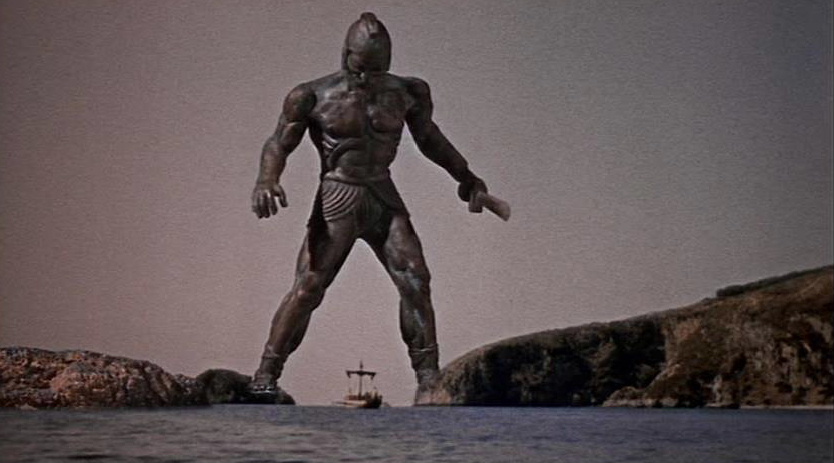
| The humongous Talos bears down on the Argo |
| Jason confronts the gods of Olympus |
Verdict: Jason and the Argonauts gets my vote as the greatest classic fantasy film ever made. ***1/2.
Thursday, March 17, 2016
THE VALLEY OF GWANGI
![]() |
| Gwangi goes to church |
T.J. (Gila Golan) runs a circus in turn of the century Mexico with her older friend, Champ (Richard Carlson). Back into their lives comes T.J.'s old boyfriend, Tuck (James Franciscus), who ran out on T.J. some time before. T.J. has a new act, a cute little horse (or prehistoric eohippus) who was found in the desert. But this attraction is nothing compared to the animals inside a hidden valley where the tiny horse came from. There are pterodactyls, a belligerent triceratops, and most of all, Gwangi, a fearsome combo of allosaurus and T Rex that chomps on one luckless fellow (Gustavo Rojo) and is ready for more before a rock slide helps Tuck and the others capture him. This is another in a long line of movies (stretching from before King Kong to Jurassic World and beyond) in which a dangerous creature is put on display and breaks out of confinement, causing havoc. The chief selling point of this is some absolutely amazing stop-motion effects work by Ray Harryhausen, clearly working on all cylinders. Gwangi is a wonderful creation, angry, confused, hungry, snapping and tearing at anything in its way. The sequence when the cowboys attempt to lasso the monster is superb, seamless -- I mean, who needs CSI? Another stunning sequence has the monster entering a huge Cathedral and stalking Tuck and the others while its heavy footsteps reverberate all through the building. There is the infrequent use of unconvincing props of assorted creatures, but generally the FX work is fluid and exacting. The story is based on a script put together by stop-motion specialist Willis O'Brien (King Kong), and it is serviceable. Carlson [Riders to the Stars] and Franciscus [Great White] are fine, as is Laurence Naismith as a paleontologist. Gila Golan appears to be dubbed, along with little Curtis Arden as the orphan boy, Lope. As for the film's romance between Tuck and T.J., one can only imagine the real melodrama will come afterward considering what happens to the circus.
The DVD for the movie has a featurette in which several CGI (Computer Generated Imagery) specialists are highly complimentary of Harryhausen's influential work on this film, of which they certainly should be.
Verdict: Lively Gwangi, and some superb stop-motion effects, make this a winner. ***1/2.
Thursday, January 29, 2015
RICHARD III
![]() |
| Laurence Olivier as Richard the Third |
"A horse, a horse, my kingdom for a horse."
"Now is the winter of our discontent made glorious summer by this son of York."
Desiring the throne of England, Richard III (Laurence Olivier) schemes and plots to do away with any one who might impede his progress or limit his chances of ascending. His victims include his brother, George (John Gielgud); his little nephews, the princes; his associate, the Duke of Buckingham (Ralph Richardson), who balks a bit at the idea of murdering little boys; and others. Richard covets and seduces The Lady Anne (Claire Bloom), the widow of a man he killed on the battlefield, and suggests that the widow of the king has cast spells against him. He lies, manipulates, and agitates behind the scenes. He is a royal monster. Richard III, based on Shakespeare's masterpiece and preserving most of its text, is itself a masterpiece, a stirring drama that excels in performance, music (Sir William Wharton), direction (Olivier) and photography (Otto Heller). Gielgud and Richardson are superb, Bloom is radiant and excellent, and there are notable performances from Cedric Hardwicke as King Edward; Mary Kerridge as Queen Elizabeth; Laurence Naismith as The Lord Stanley; Michael Gough [Black Zoo] as the murderer Dighton; Alec Clunes as Hastings; Andrew Cruickshank [The Stranglers of Bombay] as Brakenbury; and others. The only problem with this wonderful movie is, oddly, Laurence Olivier [Carrie] in the title role. He plays Richard like a malevolent pixie, humorous and above it all, finding everything funny, an interpretation that isn't necessarily wrong, as such, but doesn't work for everybody. In love with the language and his own voice, he tends to rush through many lines, making them musical but obscuring their meaning, to the detriment of his character. Some will find him flamboyant; others hammy. Still, Olivier is by no means bad -- his performance, whatever its flaws, doesn't detract from the film's brilliance -- and he is so obviously having a ball that it's hard not to settle back and simply enjoy him as this nasty creature, Richard. His death scene is extremely well-played, as is the death of George in the tower; oddly the death of the princes was handled more powerfully in the 1939 Tower of London. Richard has also been played on film by Vincent Price. who was rather good, and Basil Rathbone, in the aforementioned Tower of London. Al Pacino also played the role in a few scenes in Looking for Richard and was also creditable. Modern-day adaptations of the play have to dumb it down for the audience by setting it in fascist fantasy lands or other more contemporary milieus.
Verdict: Who dares say Shakespeare is dull? ****.