Lively, entertaining reviews of, and essays on, old and newer films and everything relating to them, written by professional author William Schoell.
Showing posts with label Jule Styne. Show all posts

Thursday, July 25, 2019

MY SISTER EILEEN (1955)

Janet Leigh and Bob Fosse
MY SISTER EILEEN (1955). Director: Richard Quine.

Ruth Sherwood (Betty Garrett) and her younger and prettier sister Eileen (Janet Leigh of The Spy in the Green Hat) come from Ohio to Greenwich Village to pursue careers as, respectively, a writer and an actress. Eileen becomes entangled with lunch counter waiter Frank (Bob Fosse) and on-the-make reporter Chick (Tommy Rail), while Ruth is involved with prominent magazine editor, Bob Baker (Jack Lemmon). Will the sisters find success and romance?

Bob Fosse and Betty Garrett
My Sister Eileen was originally filmed in 1942 with Rosalind Russell playing Ruth. Russell then reprised the role in a Broadway musical version entitled Wonderful Town with music by Leonard Bernstein. Columbia Pictures, which owned the rights to the original film, wanted to do a film adaptation of Wonderful Town with Judy Holliday stepping into the lead, but the show's producers wanted too much money. Therefore they decided to remake Eileen and add a completely new and different score by Leo Robin and Jule Styne. Meanwhile, Judy Holliday became unavailable and Betty Garrett, oddly, was signed to the part.

Jack Lemmon
Garrett, who was married to the blacklisted Larry Parks, is pleasant and competent enough as Ruth, but she can't hold a candle to Rosalind Russell. My Sister Eileen did not lead to major stardom for Garrett, who had bigger successes on television (All in the Family; Laverne and Shirley). Aside from a film noir feature some years later, Eileen was, in fact, Garrett's last starring role. Everyone in this remake is a step downward from the cast in the earlier film with the exception of Bob Fosse, who is very appealing, and Tommy Rail, who is handsome and adept, although, like Fosse, better known for his dancing (and in Fosse's case, choreography and direction). Ironically, Fosse's role in the original picture was played by Richard Quine, who co-wrote (with Blake Edwards) and directed this remake. Jack Lemmon is also quite nice as the editor, Bob Barker. Lemmon and Quine reunited for How to Murder Your Wife ten years later.

Kasznar, Leigh, Garrett, York
Other roles are filled by Kurt Kasznar as the landlord and Dick York as the off-season football player (which the skinny York scarcely resembles) who lives upstairs. The roles of the sisters' father and grandmother have been eliminated, along with the fortune teller Effie. This remake is not only in Technicolor and CinemaScope but it's been opened up with scenes in Frank's drug store, the El Morocco nightclub, and even the Brooklyn Navy Yard, although the apartment and Village scenes are clearly filmed on a sound stage. The Portuguese merchant marines have become Brazilian sailors. Expanding this sequence just creates a ridiculous scene in which these guys all chase after the not-very-sexy Garrett, something not handled quite so blatantly in the original. The conga scene from the original movie becomes a big production number but loses most of its charm. Another change has Ruth pretending that her stories about Eileen are really about her, an unnecessary development that goes nowhere.

Garrett, Fosse, Leigh, and Rail
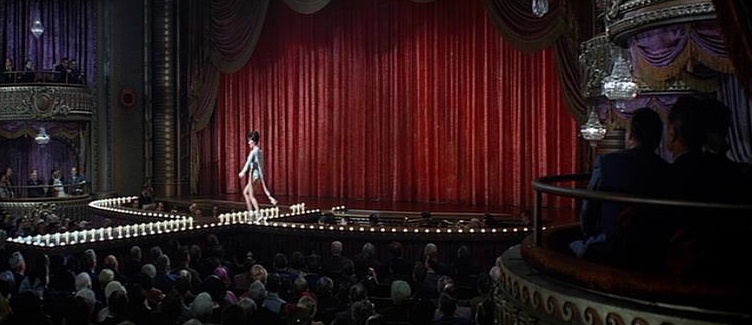
Then there are the songs. Jule Styne, the composer of Funny Girl, Gypsy and Darling of the Day can be counted on for some nice numbers and he delivers such good tunes as "I'm Great But No One Knows It," "There's Nothin' Like Love" and "Give Me a Band and My Baby." One of the best scenes in the movie has Fosse and Rail doing a dancing dual as Eileen goes off for an audition.

Verdict: On its own terms, this can be entertaining, and the musical interludes are generally nice, but on a whole it's a cut below the original. **1/4.

Thursday, January 24, 2019

GYPSY

Ann Jillian, Rosalind Russell, Karl Malden
GYPSY (1962). Director: Mervyn LeRoy.

Rose Hovick (Rosalind Russell of Auntie Mame) is the stage mother to end all stage mothers, and she pushes her daughters Louise and June into the theater whether they want to go or not. Baby June* (Morgan Brittany and Ann Jillian) fears that her mother will never let her grow up, and Louise (Diane Pace and Natalie Wood), forced to dress like a boy, fears that she has no talent and will never please her mother. Acting as their manager is Herbie Sommers (Karl Malden of Time Limit), who wants to marry Rose and tries to keep her wilder aspects in check. When circumstances remove June from the act, Rose sets her sights on Louise, who will wind up attaining stardom in a way no one would ever have anticipated.

Paul Wallace as "Tulsa" with Natalie Wood
Gypsy is one of the most successful adaptations of a hit Broadway musical. The basic material, based on the memoirs of stripper Gypsy Rose Lee, was already there, along with a fine score by composer Jule Styne and lyricist Stephen Sondheim, but the movie is bolstered by several excellent performances, especially from Russell, Malden and Wood. True, the characters are all etched in very, very broad strokes, but it doesn't detract from the enjoyability of the piece.

"You Gotta Get a Gimmick." Bruce, Dane and Arlen
Along with songs that have become standards, such as "Small World," "Everything's Coming Up Roses," "Some People," and "Let Me Entertain You," there are gems like "You'll Never Get Away From Me," and "If Mama Was Married," among others ("Together" was filmed but cut from the final release). Although he doesn't have a great voice as such, Paul Wallace makes a positive impression as Tulsa, who dances in June's act and who inspires romantic feelings in Louise. "You Gotta Get a Gimmick" is one of the zestiest numbers in the movie, sung by a spirited trio of strippers (Betty Bruce, Roxanne Arlen, and particularly Faith Dane who "bumps it with a trumpet.")

Gypsy Rose Lee struts her stuff
Although Rosalind Russell does do a little singing in this (such as the opening of "Rose's Turn"), most of her vocals were performed by Lisa Kirk (Broadway's Allegro), whose husky voice was probably chosen because it was more of a match to Russell's gravelly speaking voice. Unfortunately Kirk's singing is not especially euphonious in this, so they might just as well have let Russell handle all of it. Wood seems to do her own singing, but her off-key warbling perfectly fits her character. (The real Gypsy Rose Lee did not have much of a voice, and she was never as attractive as Natalie Wood!) Harry Stradling Sr.'s [Parrish] widescreen cinematography is a plus. Watch out for an amusing cameo by Jack Benny!

* "Baby June" grew up to become the successful actress June Havoc (not to be confused with June Haver, who married Fred MacMurray). She and her sister were estranged for many years, mostly over Gypsy, even though her depiction was not that negative. Her latter-day achievements after the events of Gypsy were completely eliminated of course. Her last theatrical film appearance was in Can't Stop the Music.

Verdict: Delightful! ***1/2. 

Thursday, March 30, 2017

THE WEST POINT STORY

James Cagney
THE WEST POINT STORY (1950). Director: Roy Del Ruth.

Nearly washed-up Broadway director "Bix" Bixby (James Cagney) is importuned to help West Point put on its annual show -- which only uses male cadets. Producer Harry Eberhart (Roland Winters of The Sky Dragon) wants his old rival to talk Harry's nephew, Tom (Gordon MacRae), who is a wonderful singer, out of a career in the army, and he enlists the help of old friend and movie star Jan Wilson (Doris Day). Along for the ride is Bix's sort of girlfriend, Eve Dillon (Virginia Mayo), who keeps her old man on his toes. Cadets Hal (Gene Nelson) and Bull (Alan Hale Jr. of Home Town Story) make a contribution as well -- Hall with his fancy footwork, and Bull in drag as the show's "princess." There are all sorts of complications until the show comes off. The West Point Story starts out well, and for about half an hour it's fun and looks like it will stay that way, until they drag in an idiotic plot point wherein Bix has to become a cadet himself (and obey all of the academy's various rules and regulations) or be removed from directing the show. This might be fine for a Jerry Lewis movie but for this picture, it's disastrous. In general, however, the script is pretty bad and gets worse as it goes along. To Cagney's credit, he retains his dignity throughout, and actually gives a marvelous and amusing performance. Mayo, Nelson and MacRae are fine, as is Doris Day, although she seems to have a zillion too-big teeth in her mouth and, as usual, is virtually devoid of sex appeal. Roland Winters is a lot of fun as Bix' not-so-friendly enemy. Aside from "Military Polka" the Jule Styne/Sammy Cahn songs are pretty awful. Oddly MacRae seems to be aping Bing Crosby in a couple of numbers, even though he has a very different voice from Der Bingle's. The dance that Mayo and Cagney do together to "B'klyn" (another lousy tune) is one of the film's few highlights. We can only imagine what West Point officials thought of this movie! Cagney and Day made a better team in the superior Love Me or Leave Me.

Verdict: It's basically all Cagney's show, and while he's excellent he can't do enough to save it. **1/2.

Thursday, March 10, 2016

HIT PARADE OF 1943 aka CHANGE OF HEART

John Carroll and Susan Hayward
HIT PARADE OF 1943 (aka Change of Heart/1943). Director: Albert S. Rogell.

"Their cover charge reads like my social security number!"

Aspiring songwriter Jill Wright (Susan Hayward of I'll Cry Tomorrow) discovers that her publisher, Rick Farrell (John Carroll) has appropriated her song for himself and retitled it. Considering that said song is a dreadful concoction called "Tohmboombah" one would think Jill would be happy that someone else took credit. Still she is importuned by Rick into writing more songs for him, planning to step forward and take credit when the songs become hits. They are both hopeful with a forgettable romantic ditty entitled "Change of Heart," which became the film's new title in re-release. Hit Parade of 1943 is amiable enough, although it ends with the heroine's self-abnegation when Rick tries to tell the truth about their songs on the radio. [Wanna bet Jill will change her tune when Rick starts cheating on her, as he will?] Hayward is terrific in the film, with very good support from Carroll, as well as Walter Catlett [Fired Wife] as Rick's dyspeptic associate, and Gail Patrick [Up in Mabel's Room] as the wealthy woman Rick uses in his career ambitions. Eve Arden is fun as always as Jill's friend, who doesn't think much of Rick (along with most of the audience.) The lyrics are by Jule Styne of "Funny Girl" fame and the music by Harold Adamson -- too bad this wasn't reversed, although "Who Took Me Home Last Night?" is a cute number and ""Do These Old Eyes Deceive Me?" isn't bad. A very young Dorothy Dandridge sings with Count Basie's orchestra, and you wouldn't recognize her as the sophisticated beauty she later became. As for Hayward, it was clear she had something special right from the start.

Verdict: A standard Republic musical with some good performances. **1/2.