Lively, entertaining reviews of, and essays on, old and newer films and everything relating to them, written by professional author William Schoell.
Showing posts with label Broadway adaptation. Show all posts

Thursday, July 16, 2026

A DELICATE BALANCE

Katharine Hepburn and Paul Scofield
A DELICATE BALANCE (1973).  Director: Tony Richardson. Play by Edward Albee. AFT [American Film Theatre] production.

"I can't stand the selfishness. Those who want to die and take their whole lives to do it." 

"I was not and never had been an alcoholic. I had nothing in common with them. They were sick. And I was merely willful."

Agnes (Katharine Hepburn) and Tobias (Paul Scofield of A Man for All Seasons) are a married couple who live in an upscale Connecticut community.  Also living with them is Agnes' sister, Claire (Kate Reid of She Cried Murder). who has a "drinking problem" whether she wants to admit it or not, and is continuously berated by Agnes. The couple's daughter, Julie (Lee Remick of The Omen), is also coming home when it looks as if her fourth marriage is going to wind up on the rocks along with the first three. But the strangest house guests are Agnes and Toby's best friends, Harry (Joseph Cotten) and Edna (Betsy Blair), who come over to stay when they suffer a panic attack (over encroaching age, fear of death, fear of losing one another?) that absolutely terrifies them. They move into Julia's bedroom, but when she returns Julia is horrified to realize that her parents aren't going to ask them to leave. They are friends, yes, but she's their daughter. Yet Harry and Edna seem to think they have more right to the room than she has. This situation brings out all the tensions in the family (albeit most of them were out already) making the atmosphere even more poisonous... 

A Delicate Balance
won Edward Albee a Pulitzer Prize --  although it was back in the days when most Pulitzers went to wealthy white guys like Albee. Albee isn't the first person to write about a dysfunctional family and others have done it better (for instance, this in no way compares to O'Neill's brilliant Long Day's Journey into Night). If Delicate Balance  has anything going for it it's some excellent -- if occasionally dated --  dialogue, but the people are perhaps more dreary than interesting. As with Albee's Who's Afraid of Virginia Woolfe the playwright resorts to black comedy -- and much of this is quite funny -- when all else fails. The characters (archetypes that border on stereotypes) are more obscure than well-developed, as if they were all people Albee knew but he isn't able to make them really come alive for anyone who didn't personally experience them. This is left for the actors to do, and they do their best, even if the casting isn't perfect. Hepburn and Scofield are quite good, Remick is fine, Reid quite intense, Cotten actually gives one of the best performances of his career, and Blair, while a cut below the others, has some excellent moments. The acting and situations hold your attention, but ultimately this is unsatisfying, and hardly a really great drama.

Verdict: A lot of talk, some of it interesting, that ultimately goes nowhere. **1/2.

Thursday, April 9, 2026

INHERIT THE WIND

INHERIT THE WIND
(1960). Director: Stanley Kramer.

"Fanaticism and ignorance is forever busy, and needs feeding!"

In 1925 John T. Scopes was arrested in Tennessee for teaching the theory of evolution to his students. Clarence Darrow defended him and William Jennings Bryan acted as prosecutor, while H. L. Mencken covered the "monkey" trial for a newspaper. In a play by Jerome Lawrence and Robert Edwin Lee, which fictionalizes the story, the characters were changed into Henry Drummond (Spencer Tracy) for Darrow; Matthew Harrison Brady (Fredric March) for Bryan; Bertram Cates (Dick York) for Scopes; and E. K. Hornbeck (Gene Kelly) of the Baltimore Herald for Mencken. The play and this film version thereof adds a further complication: Scopes/Cates is engaged to the daughter, Rachel (Donna Anderson), of the local preacher (Claude Akins), who is a borderline fanatic. The main strength of this film, besides the exchange of ideas and the notion of casting off narrow minds, is the acting by the two leads, both of whom are superb. March, in particular, possibly gives the best performance of his career, full of nuances, and giving his character enough charm to understand why people like and enjoy him even when they think he's dead wrong. (Florence Eldridge, who was married to March in real life, is also notable as Brady's wife, Sarah. And Gene Kelly is so good as Hornbeck that he proves to be far more than just a song and dance man and a fine dramatic actor. ) 

Fredric March and Spencer Tracy
There is, perhaps, a little too much dramatic license; for instance, it doesn't make sense that Drummond wouldn't ask for a recess after Brady's brutal examination of Rachel. The movie is serious and sickening under the amusement and banter, as timely today -- if not more so -- than it was in 1960. Its weakest moment is the sop to the religionists with Drummond carrying a bible out of the courtroom at the end. Still, it was brave of Kramer and the others to make the film way back in 1960. Leslie Uggams sings "That Old-Time Religion" over the credits.

Verdict: Powerful stuff with two massive lead performances. *** (half a star taken off for that compromised ending).

Thursday, March 26, 2026

THESE THREE

THESE THREE
(1936). Director: William Wyler.

College friends Karen Wright (Merle Oberon) and Martha Dobie (Miriam Hopkins) decide to open a girl's school together. Into their lives comes a handsome doctor, Joe (Joel McCrea), with whom both fall in love. Joe, however, only has eyes for Karen. (A memorable scene has Martha watching him as he sleeps, with the passage of time indicating that she's done this for hours.) This not being a soap opera, Joe and Martha do not get involved and Martha never makes a play for him. Unfortunately, a nasty little girl named Mary (Bonita Granville) implies that the good doctor spent the night in Martha's room, and forces another child (Marcia May Jones) to confirm it. This leads to disastrous complications.

These Three was based on a play by Lillian Hellman called The Children's Hour. It, too, was about the destructiveness of gossip, but the lie was quite different -- that the two women were lovers (It turned out that Martha was a self-hating lesbian). Naturally Hollywood even in the 30's wouldn't tackle such a subject, so it was toned down and changed to alleged pre-marital sex and infidelity. Years later Wyler filmed the play again (as The Children's Hour) with the original story intact. In that version Miriam Hopkins played Martha's Aunt Lily (played by Catherine Doucet in These Three).

Miriam Hopkins and Merle Oberon
Even in its adulterated version These Three is a powerful story, and the film is well directed and very well played by the entire cast. In addition to those already mentioned, Alma Kruger makes an impression as Mary's grandmother, who starts the word-of-mouth campaign against the two women and their school. Margaret Hamilton plays the woman's stern maid, who can see through Mary, and in perhaps the movie's most satisfying scene, gives her a good slap.

Verdict: Superior, thoughtful drama. ***1/2.

Thursday, July 31, 2025

THE PAJAMA GAME

John Raitt and Doris Day
THE PAJAMA GAME (1957). Directed by George Abbott and Stanley Donen. 

Sid Sorokin (John  Raitt) gets a job in management at a pajama factory and almost immediately comes into romantic conflict with worker and union member Babe Williams (Doris Day). Although the two are clearly attracted to one another, Babe is sure that there will eventually be problems over their taking opposite sides in a struggle over a raise of seven and a half cents. Meanwhile Gladys (Carol Haney), who keeps the books, is exasperated by her boyfriend Vernon's (Eddie Foy Jr. of The Case of the Black Parrot) almost pathological jealousy. When the workers decide to have a slow-down on the job, things come to a head.  

Picture This: Foy and Shaw trip the Light Fantastic
The Pajama Game is based on the Broadway show with songs by Adler and Ross and choreography by Bob Fosse, which is transplanted to the screen along with much of the cast, such as Raitt. Doris Day replaced Janis Paige, but she is quite good, and handsome Raitt is so good -- and has such an outstanding voice -- that it's a wonder he didn't have more film assignments. Haney and Foy are also excellent, as is Reta Shaw, who does a delightful light-on-her-feet number with Foy ("Picture This"). Other musical highlights include Raitt singing the show's most memorable number, "Hey There;" the big production number at the picnic ("Once a Year Day"); and the smoky, insinuating "Hernando's Hideaway." Another well-known number from the show is "Steam Heat," which I confess I've never much cared for. 

John Raitt 
Thelma Pelish makes an impression as Mae, the economy-sized factory worker and wit who certainly stands out in (very) widescreen. Barbara Nichols [Woman Obsessed] as dumb Poopsie is her typical whiny self and even attempts to sing at times. The worst performance is from Ralph Dunn (of The Golden Eye) as boss Myron Hasler, who instead of  being amusing is merely loud and obnoxious, ruining virtually every scene that he's in. It also has to be noted that the secondary love story between Gladys and Vernon has its tiresome moments, especially the nonsense with the latter throwing knives at everyone in the office. Otherwise, Pajama Game is a likable, entertaining, if relatively slight musical comedy with several good scenes and songs. 

Verdict: Fun and tuneful musical with a spirited Day and a rather sexy Raitt. ***. 

Thursday, October 10, 2024

ONCE UPON A MATTRESS (2005)

ONCE UPON A MATTRESS
. Wonderful World of Disney. (2005 ABC telefilm.) Director: Kathleen Marshall. Teleplay: Janet Brownell; based on the Broadway musical. 

This is a delightful version of the Broadway musical starring Carol Burnett, who this time relinquishes the role of the princess to an excellent Tracy Ullman and essays the role of Queen Aggravain. Burnett falls back on some of her typical shtick at times, but otherwise is magnificent. The story, of course, is based on The Princess and the Pea. Aggravain is pathologically determined to prevent her son from marrying (it would undermine her power, for one thing) so she dreams up impossible tests for the female candidates to pass – or rather, fail. The latest hopeful is Princess Winnifred the Woebegone (Ullman) who eventually discovers that she is to prove her “sensitivity” as she sleeps by feeling a pea that has been placed beneath twenty mattresses. Complaints that the leads are too old miss the point that this situation has been going on for years and years and the prince is approaching middle-age, which makes the song during which his father the King explains the facts of life to him even funnier! (Besides, the prince is called Dauntless the Drab, not Harry the Hunk! In any case, it's the secondary love story of Lady Larkin and Harry that features a young, more traditionally attractive couple.) 

The cast of Once Upon a Mattress
Ullman may lack that certain endearing “homeliness” of Burnett and Sarah Jessica Parker, but she manages to make a very effective and amusing Winnifred. Denis O'Hare is splendid as the dorky but appealing prince, and Edward Hibbert as funny as ever as the Wizard. Zooey Deschanel and Matthew Morrison make a convincing Larkin and Harry. As the mostly mute King Tommy Smothers has little to say but he gets his character across admirably nevertheless. The songs – lyrics by Marshall Louis Barer and music by Mary Rodgers – are tuneful and pleasant and occasionally memorable. Rodgers' melodies are easy on the ears, and sometimes better, although none have that magical specialness of her famous father, Richard Rodgers', work. That said, "Happily Ever After" is a swell, jazzy number; "Shy" is a lot of fun; "In a Little While" is sweet; and "Sensitivity" is a riot. On the other hand, I could do without "I'm in Love with a Girl Named Fred." All of the songs are well-sung and well-orchestrated, with no attempt to turn them into generic pop tunes as often occurs. TV versions of Gypsy and South Pacific may not have been very good, but Once Upon a Mattress is a very happy surprise. Oddly, the DVD for this program was released only two days after it premiered on television. 

NOTE: Burnett played Winifred in two earlier versions of Mattress in 1964 and 1972. Once Upon a Mattress is now on Broadway (direct from a production at City Center's "Encores") with Sutton Foster in the lead role. I had completely forgotten about this version until I came across my review -- reposted here -- on an old website!

Verdict: If you can't get to Broadway ... ***1/2. 

Thursday, March 31, 2022

A FUNNY THING HAPPENED ON THE WAY TO THE FORUM

Zero Mostel and Jack Gilford
A FUNNY THING HAPPENED ON THE WAY TO THE FORUM (1966). Director: Richard Lester. Music and lyrics by Stephen Sondheim. 

The slave Pseudolus (Zero Mostel) is hoping to acquire his freedom and comes up with a plan. His master's son, Hero (Michael Crawford), has fallen for a virginal courtesan, Philia (Annette Andre), just installed in Marcus Lycus' (Phil Silvers) brothel next door, and Hero will free Pseudolus if he arranges a relationship between the two. The problem is that Philia has already been bought by the egomaniacal Captain Milos Gloriosus (Leon Greene), who is on his way from Rome that very afternoon to claim his bride. Pseudolus schemes to get Philia away from Gloriosus even as his master Senex (Michael Hordern of Theater of Blood) schemes to get away from his termagant of a wife, Domina (Patricia Jessel).  


The first half hour or so of this adaptation of the Broadway musical A Funny Thing Happened on the Way to the Forum is delightful -- although it takes too long for someone to finally sing a song -- with Mostel fully in charge of his material along with Silvers, Jack Gilford as Hysterium, Hordern and Jessel, and especially Greene as the captain. But after awhile this farce just becomes a bit labored, and the film completely falls apart with a tasteless scene in the arena and especially a drawn-out slapstick sequence that falls completely flat. Others have noted that the film has a typically sixties attitude towards women: they are either young beauties lusted after by ugly old men or old hags unworthy of consideration. One could also argue that anything having to do with roman slavery is not exactly a great subject for the comedic treatment to begin with. I think the main problem is that this is the type of material that works much, much better on the stage. However, the producers wisely kept on Mostel and Gilford from the Broadway production. Unwisely, because they thought big movie musicals were on their way out, they cut most of Stephen Sondheim's tuneful score. What remains is the lovely "Lovely," sung by Philia; the captain's song as he comes into town and the dirge he sings later on; the spritely "Everybody Ought to Have a Maid;" and the infectious opening number "Comedy Tonight."

Leon Greene and Zero Mostel
As the young lovers Michael Crawford (who would find fame on Broadway as The Phantom of the Opera) and Annette Andre fail to make much of an impression. British actor Leon Greene, however, makes quite an impression and went on to have many more credits, mostly in the UK. Buster Keaton [Backstage], in his last role as a man looking for his kidnapped children, is, unfortunately, not good at all. 

Verdict: Some fun to be sure, but it just becomes too silly. **1/2. 

Thursday, January 20, 2022

THE RUNNER STUMBLES

Dick Van Dyke and Kathleen Quinlan

THE RUNNER STUMBLES    (1979). Produced and directed by Stanley Kramer. Based on the play by Milan Stitt.  

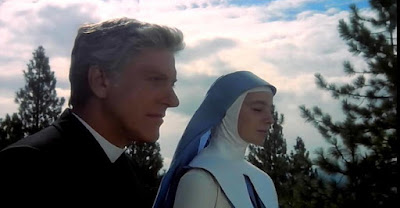
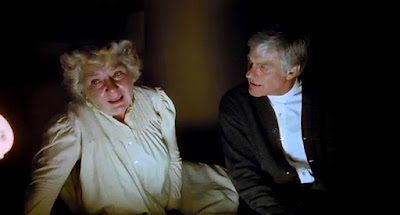
In a small town in the 1920's the brash, young, full-of-life Sister Rita (Kathleen Quinlan of Event Horizon) arrives and meets the somewhat dour Father Rivard (Dick Van Dyke of Bye Bye Birdie) -- who has been banished to the hinterlands because of some of his more controversial views --  the housekeeper Mrs. Shandig (Maureen Stapleton); two grumpy and dyspeptic older nuns; and the children Sister Rita will teach, including mischievous little James (Billy Jayne). Town tongues start to wag when an obvious friendship and closeness develops between the priest and the nun, and even the housekeeper seems a bit scandalized when Sister Rita moves into the rectory with the father after the other nuns develop consumption -- this is against the orders of the Monsignor (Ray Bolger). As romantic feelings between the pair begin to blossom, one knows things will not go well for these star-crossed lovers ... The Runner Stumbles begins with Rivard in jail, arrested for murdering Rita!

Maureen Stapleton and Van Dyke
I admit I had mixed emotions about watching this picture, as I thought it might be overly cute and Catholic in the worst sense of the word. I also questioned the casting of Dick Van Dyke, whose rubbery pickle-faced features hardly qualify him for a career in drama, as a romantic figure no less. But producer-director Kramer also was responsible for the great Judgment at Nuremberg, so I felt it was definitely worth a look. To my surprise I loved the picture, and thought Van Dyke really delivered during his most difficult sequences. Quinlan and Stapleton are also excellent, and Tammy Grimes is quite effective as a friend and parishioner who is devastated by her father's death. 

Kathleen Quinlan and Tammy Grimes
The Runner Stumbles may not be a masterpiece like Judgment at Nuremberg, but it is a lovely, poignant film with well-developed characters -- the incisive screenplay was written by playwright Milan Stitt, whose Broadway play this is based on -- and a sensitive score by Ernest Gold [Unknown World; Exodus), especially the theme that plays over the closing credits (itself derived from a tune, "My Rumble Seat Gal," also composed by Gold). Critics described the film as "old-fashioned" and didn't mean it as a compliment. I think it's old-fashioned in the best sense of the word. The courtroom denouement to the mystery, based on real-life events, packs a wallop, and the closing is remarkably touching. The film doesn't let the Catholic church and its often maddening, hypocritical edicts off the hook, and I imagine devout Catholics might have found this offensive. Too bad. This was the last film for Bolger, who is perfect as the monsignor, and for Kramer.

Verdict: This tragic love story is imperfect, perhaps, but it is also altogether admirable.***1/2.

Thursday, March 18, 2021

HELLZAPOPPIN

Olsen and Johnson
HELLZAPOPPIN' (1941). Director: H. C. Potter 

Ole Olsen and Chic Johnson, playing themselves, are told that in the film version of their (real life) Broadway hit "Olsen and Johnson's Hellzapoppin'" they have to add a little romance to the mix. The screenwriter (Elisha Cook Jr.) concocts a triangle in which aspiring producer Jeff Hunter (Robert Paige) wants to star Kitty (Jane Frazee), the women he loves, in a musical -- only his best friend, Woody (Lewis Howard), is in love with her too. Then there are complications in the form of man-hungry but homely Betty (Martha Raye) and a possible prince named Pepi (Mischa Auer). For reasons not worth recounting Olsen and Johnson want the show to fail and try to sabotage it a la Night at the Opera (a much, much better movie) to somewhat comical results in the last twenty minutes of the film. Meanwhile Olsen and Johnson have a running dialogue with the film's projectionist (Shemp Howard) who keeps screwing things up. 

Mismatch: Martha Raye and Mischa Auer
Hellzapoppin' has its share of laughs (and quite a few groaners) but despite its amiable nature it never quite bursts into full-blown hilarity. Olsen and Johnson are such a comparatively dull comedy team that for much of the film's length I confused one of them with the much more distinctive Hugh Herbert, who plays the giggling Quimby. As the lovers, Paige and Frazee are appealing, and get to sing two lovely numbers entitled "Heaven for Two" and "And You Were There." Martha Raye is wonderful as Betty whether she's running after an aghast Pepi with lust in her heart or warbling the snappy "Watch the Birdie" in a production number. Auer is her match in every way.

Robert Paige and Jane Frazee
Hellzapoppin' breaks through the fourth wall numerous times throughout the movie (this was done in many films afterwards including Gremlins 2) and has a lot of sight gags, some of which succeed (the "coat of arms") and some of which land with a thud. A highlight of the film is a performance by the sensational Harlem Congeroo Dancers and an all-black band that is equally spectacular. Olsen and John had teamed for at least one movie before this one, All Over Town, then got together again for Crazy House and Ghost Catchers, pretty much doing the same shtick that they do in Hellzapoppin'. A little of them goes a long way! To compare them in any way to the Marx Brothers is utterly ludicrous.

Verdict: Silly, frequently stupid, but it earns some genuine chuckles as well. **3/4. 

Thursday, October 15, 2020

ONE TOUCH OF VENUS (1955)

Russell Nype and Janet Blair
 ONE TOUCH OF VENUS (1955 telefilm). Director: George Schaefer. 

Museum owner Whitelaw Savory (George Gaynes) is anxiously waiting for a statue of Venus to arrive in his office when a substitute barber named Rodney Hatch (Russell Nype) places a ring on the statue's finger and she comes to life. Venus (Janet Blair) inexplicably falls in love with the nerdy Rodney, although he resists her charms because he's engaged to the rather witchy Gloria (Mildred Trares). Venus disposes of Gloria even as Whitelaw woos the goddess and still tries to find out where the statue is. Eventually Rodney is accused of Gloria's murder, but fortunately the gal isn't gone forever. Rodney and Venus happily plan for a rather earthbound future on Staten Island. But will these two opposites continue to attract? 

George Gaynes and Janet Blair
One Touch of Venus
 is a TV version of the 1943 Broadway musical, which was turned into a theatrical film in 1948 with Ava Gardner playing Venus. This telefilm is taken from a production of the show done for the Dallas State Fair. This is presumably more faithful to the original stage version as the movie made a great many changes to the plot and dropped most of the score by Kurt Weill and Odgen Nash. Whatever its flaws, this telefilm retains virtually all of the songs, and they are all memorable: "A Stranger Here Myself" sung by Venus; Rodney's "That's How Much I Love You'" and "Wooden Wedding;" Savory's song to his lost love, "West Wind;" Venus' "My Foolish Heart" and "That's Him;" the amusing chorus "The Trouble with Women;" and the love duet "Speak Low When You Speak Love." Savory's secretary, Molly (Laurel Shelby), sings the title tune. Although Janet Blair is the only one of the principal performers who dances, the telecast does include dance numbers and ballets. 

As for the performers, no one really has the light touch that this type of whimsical material requires, making the story pretty silly, but it's saved by the songs. And the singing of the principals really makes this work. I always knew Janet Blair as a competent light dramatic and comedic actress but never knew how really talented she was, as she sings her numbers for all that they're worth. Russell Nype also has a good voice and delivers on his numbers. George Gaynes was a busy Broadway performer and while some may find his voice old-fashioned, I have to say I love his singing style. Nype also did a lot of stage work. Weill's music is lilting; Nash's lyrics clever and funny.

Verdict: This may seem crude compared to the film version, but this has all the songs and they sing! ***. 

Thursday, October 1, 2020

PRODUCER'S SHOWCASE: BLOOMER GIRL

Barbara Cook
BLOOMER GIRL (Producer's Showcase/1956). Directed by Alex Segal. Presented Live

Bloomer Girl was a successful (if now essentially forgotten) Broadway musical that was adapted for television in an abbreviated version for the program Producer's Showcase. Celeste Holm, who had starred on Broadway, was replaced by Barbara Cook, a wise choice. The musical takes place just before the Civil War, and Evalina (Cook) is the only unmarried daughter of hoop (for skirts) manufacturer Horatio Applegate (Paul Ford). Her Aunt Dolly (Carmen Mathews) not only runs the newspaper but is an early feminist. Along comes Southern gentleman Jefferson Calhoun (Keith Andes), who is going to work for Horatio and begins courting an initially unimpressed Evalina. Unfortunately, Calhoun also brings along a slave, Pompey (Roy Spearman), who is hoping to stay North as a free man, something Evalina wants but which his owner may object to.  

Roy Spearman
Bloomer Girl
 dealt with women's rights and black rights in the 1950's, and frankly it's amazing that a live production was shown on television during the same period. Of course Pompey is a polite, somewhat subservient black character, yet he's also given the stirring song "The Eagle and Me," which is all about wanting and needing freedom. The performances in this TV version are all excellent, with Cook as delightful and in as good a voice as ever. Keith Andes adeptly plays the leading man, his charm working to overcome Calhoun's less likable traits, although he eventually triumphs over them. Carmen Mathews and Ford are typically on-target, and Spearman not only has a wonderful voice but imbues the role with a certain dignity.  

In this shortened version of the Broadway show, several of the lesser numbers have been cut. However, there's some gold in what remains: "When the Boys Come Home;" "Evalina;" "Sundays in Cicero Falls;" and the romantic duet "Right as the Rain" -- along with "The Eagle and Me" -- are the most memorable tunes. The lilting music is by Harold Arlen and the lyrics by E. Y. Harburg. Bloomer Girl isn't necessarily one of the all-time great musicals, but it is a worthwhile and interesting show which in some aspects was ahead of its time. 

Verdict: Tuneful, well-done, and sometimes moving. ***. 

Thursday, September 17, 2020

AMAZON PRIME

THE WEIRD AND WONDERFUL WORLD OF AMAZON PRIME MOVIES. 

A few years ago I got a free month of Amazon prime and immediately started adding movies to my watchlist. When my list was compiled you can imagine my surprise when I clicked the tab marked "prime" with my mouse and suddenly most of he movies I'd chosen disappeared. All that was left was stuff like Can't Stop the Music with the Village People. Yikes -- what happened to the good stuff?

What I found instead was some schlock and lots of "B" movies, some of which were terrible, and some of which were terrific. Still I didn't stay past the trial period. But then I decided to try Amazon Prime again and found that, so far, I've decided to keep it. Prime offers other advantages, such as free shipping on selected items, but I'm sticking with it -- so far -- because it has literally thousands of movies to stream. It's not for everyone, but real movie buffs, especially those who love older movies, will find lots of stuff to put on their watchlist. Sure there are lots of Bs and horror films, but also classics like Wuthering Heights and The Little Foxes -- they also have more recent and new movies like Rocketman -- and many others, all of which you can watch for free for a monthly fee. (Some people can get it at half price if they qualify.) I also found rare television specials on Prime, such as an adaptation of A Doll's House that I reviewed last week, as well as TV adaptations of the shows Kiss Me Kate, One Touch of Venus and even the fairly forgotten Bloomer Girl 

But the Amazon Prime movie experience can be odd. Not all "Prime" movies are free. Generally you can tell this if you see a price next to the film's description, but there have been times when I've seen no price, put it on my list, but it disappears when I click on "prime." Stranger still is the fact that some films have more than one listing even if its basically the same version. One listing might be free, while another will cost, say, $3.99! I had the horror anthology film Asylum in my queue, only to discover there was another listing for it, this time a remastered version, the one I watched (why didn't Amazon get rid of the other version? Wouldn't most of us want to look at the remastered print?). It's as if someone just throws every movie they can find into the mix but doesn't bother weeding out the  poorer copies. In at attempt to get as many films as possible, Amazon streams some very poor and occasionally incomplete prints (such as Affair in Monte Carlo, which I reviewed this week).

On the other hand, the prints of most of the films are excellent. You can find pictures you hadn't seen in years or never saw (and always wanted to) on Amazon Prime. I'm always coming across something interesting by looking at the suggested titles (same director or actor or similar types of movies ) listed underneath the screen when I've finished watching a movie or TV program (yes, AP has tons of old and newer TV shows as well). My watchlist is growing to frightening proportions.

NOTE This is not an endorsement for Amazon Prime and they have not paid me for my critique, but they certainly can if they want to. 

Thursday, February 6, 2020

ANNIE GET YOUR GUN (1951)

Howard Keel and Betty Hutton in Technicolor!
ANNIE GET YOUR GUN (1950). Director: George Sidney.

Famed sharpshooter Frank Butler (Howard Keel of Jupiter's Darling) with Buffalo Bill Cody's (Louis Calhern) wild west show, takes on any challenger, but he meets his match in hillbilly Annie Oakley (Betty Hutton), who falls for him but discovers his male pride takes a beating each time she learns a new trick. During their first match she beats him, but she isn't so sure she wants to win the second one at the climax. On this she is advised by none other than Chief Sitting Bull (J. Carroll Naish) of Custer's Last Stand, who comes to see her as his honorary daughter. Will Annie get the man she loves or the prizes?

Naish, Hutton, Calhern
I had trepidation about watching this film because I had always loved the TV version with the wonderful Mary Martin, which was broadcast seven years after this film came out. I was also afraid Betty Hutton would be too overbearing. There are moments in her performance that are borderline, but I must say Hutton is excellent as Annie, capturing both the vulnerability and the pride of the character. Although Hutton does not sing badly (except on "They Say That Falling in Love is Wonderful" in which Howard Keel saves the day), her vocal skills are no match for Mary Martin's (who played Annie in a more feminine and lady-like fashion). In any case, Judy Garland was originally signed for the lead and did a few scenes that survive, and, frankly, she isn't nearly as good as Hutton.

That "handsome devil" Keel
Now we come to Chief Sitting Bull. Although he was in part responsible for the massacre of American soldiers (who attacked first) at Little Big Horn, I guess that even in the 19th century celebrity trumps everything. The chief joined Buffalo Bill's show and stood around signing autographs -- yes! -- and participating in some re-enactments. Annie Oakley did indeed become like a daughter to Sitting Bull, but whether he encouraged her to throw a competition so she'd get her man is debatable. What is not debatable is that Irving Berlin's score is one of his finest, and one of the best of any Broadway musical, responsible for "There's No Business Like Show Business;""" "Doin' What Comes Naturally;" "The Girl That I Marry;" "My Defenses are Down;" "You Can't Get a Man with a Gun;" etc. although it's disappointing that the film excludes "Moonshine Lullaby;" "I Got Lost in His Arms;" "I'm a Bad, Bad Man" (which could have been quite a showcase for that handsome devil Keel); and "Old-Fashioned Wedding."

In addition to Hutton and Keel, there are fine performances from Naish and Calhern [The Asphalt Jungle] and Keenan Wynn, Clinton Sundberg, and little Brad Morrow as Annie's cute baby brother, Jake. Charles Rosher's widescreen, technicolor cinematography is often breathtaking.

Verdict: The cartoon Indians are questionable in this day and age, but the movie has an interesting (if heavily fictionalized) story and lots of great music and performances. ***. 

Thursday, January 23, 2020

COME BACK, LITTLE SHEBA

Oscar-winning Shirley Booth and Burt Lancaster
COME BACK, LITTLE SHEBA (1952). Director: Daniel Mann. Based on the play by William Inge.

"You didn't know I'd get old and fat and sloppy, but I didn't know it, either." -- Lola to Doc.

Lola Delaney (Shirley Booth) is a housewife who is always afraid that her husband, a chiropractor named Doc (Burt Lancaster), will fall off the wagon again. The couple got married years ago when Lola got pregnant, but she lost the baby, and fears that her husband feels trapped and disappointed with life and marriage. Doc does, of course, but he has a bond with Lola, although trouble appears when they take in a pretty young boarder named Marie (Terry Moore of Peyton Place). Marie becomes a symbol to Doc of lost youth and opportunity, just as Lola's old dog, Sheba (who probably ran away to die), is a symbol of her own faded dreams. When Doc comes to believe that Marie is not the sweet innocent he thought she was, he can't resist going to the bottle ...

Richard Jaeckel and Terry Moore
Shirley Booth played the role on the stage, and it would have been criminal for her not to repeat her part on the screen (she won a well-deserved Oscar for it). As she was not seen as being sufficiently box office, Lancaster was secured for the leading male role. Although Doc was always meant to be an older man, Lancaster is not as miscast as you might imagine. He's quite good, in fact, if not up to Booth. (One has to remember that Lola has become chubby and slovenly over the years, and there have been many cases of couples in which the husband is better-looking, or at least in better shape, than the wife.) Terry Moore also does some nice work, as do Richard Jaeckel [The Dark] as a football hero she dallies with and Richard Kelley as her fiance, Bruce. There are other good character performances in the film as well, including Lisa Golm's [Anna Lucasta] as a sympathetic German neighbor.

Terry Moore and Burt Lancaster
Come Back, Little Sheba is full of lovely and sad touches, such as Lola's phone conversation with her mother, when she desperately wants to come home for awhile, but her father, who has never forgiven her for past indiscretions, won't allow it. An amusing moment occurs when Lola tells Doc that she'll prepare him a hot meal if he comes home for lunch, but the "hot meal" turns out to be cottage cheese and buttermilk! The film is well-directed by Daniel Mann, and there's a nice score by Franz Waxman.

NOTE: I could only get a few minutes into a 1977 TV version of the play in which, incredibly, Laurence Olivier is even more miscast (and less effective) than Lancaster, and Joanne Woodward, also miscast, doesn't come even close to approximating Booth's genius. Booth had a pixilated, almost pathetic quality that made her just perfect for Lola.

Verdict: "Some things should never get old" -- A strong and touching drama. ***1/2. 

THE STRIPPER

Richard Beymer and Joanne Woodward
THE STRIPPER (1963). Director: Franklin J. Schaffner. Based on the stage play "A Loss of Roses" by William Inge.

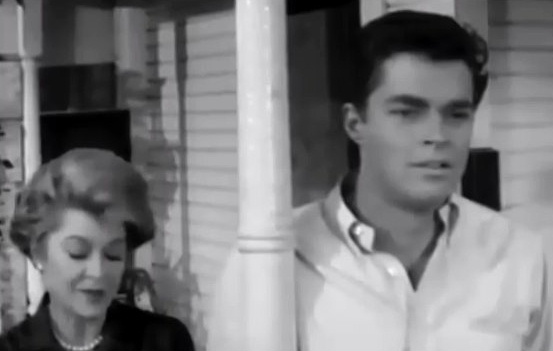
Along with her associates in a traveling magic act, Lila Green (Joanne Woodward) comes to the town where she lived as a child, but then is stranded when her boyfriend, Ricky (Robert Webber), runs off to greener pastures with all of their cash. Lila gets a room with a widow, Helen (Claire Trevor), who was her neighbor years ago, and who has a grown son named Kenny (Richard Beymer). Kenny and Lila develop an undeniable attraction to one another, but considering the age difference -- Woodward was eight years older than Beymer -- and everything else, Lila is afraid of being hurt and lonely once again. Then Ricky comes back into her life with a proposition ...

Claire Trevor and Richard Beymer
The Stripper is a lovely and absorbing film with three excellent lead performances. Although never considered a great beauty as such, Woodward [From the Terrace] has never looked better and she is excellent as Lila. (Marilyn Monroe, who was superb in the film adaptation of Inge's Bus Stop and was four years older than Woodward, might have been considered for this role had she not died tragically the previous year.) Beymer [Five Finger Exercise] gives a sensitive and intelligent performance as well, and Trevor [The Velvet Touch] is as adept as ever. Webber makes a very effective slime ball, and others in the cast include Gypsy Rose Lee and the odd Louis Nye as his associates (neither of them are especially memorable) and Carol Lynley, who makes a nice impression as a neighbor who has a crush on Beymer. Michael J. Pollard brings his own brand of quirkiness as a strange buddy of Kenny's who seems to have a thing for Lila but gets nowhere with her. The film could have used more scenes depicting the growing relationship between Kenny and Lila, but otherwise this is a very good movie.

Verdict: Strong cast and interesting situations add up to a memorable picture. ***1/2. 

A LIFE OF WILLIAM INGE: THE STRAINS OF TRIUMPH

A LIFE OF WILLIAM INGE: The Strains of Triumph. Ralph F. Voss. 1989; University Press of Kansas.

William Inge wrote several noteworthy plays -- Come Back, Little Sheba; Picnic; Bus Stop -- which were also made into excellent motion pictures. He also did an original screenplay for Splendor in the Grass, for which he won an Oscar, as well as the screenplay for All Fall Down. The Stripper was based on his unsuccessful play A Loss of Roses, and one of his one-acts was turned into Bus Riley's Back in Town, a film he later discredited. This in-depth biography looks at Inges' early years growing up in Kansas, his relationships with other family members, his struggles to find success as first an actor and then a playwright, his early Broadway successes, his friendship and rivalry with Tennessee Williams. his negative feelings about his homosexuality, and the post-success periods of the sixties and seventies in which nothing he wrote seemed to work and he tried much too hard to be hip and trendy. Inge's problem wasn't that he was gay, but that he couldn't accept it. He attended AA meanings with the writer Charles Jackson, a fellow self-hater and alcoholic, which was like the blind leading the blind. Inge's internalized homophobia probably reached its nadir in his 1965 play Where's Daddy? which was put out of its misery after only 21 performances. In this the main character, "Pinky Pinkerton," is a gay man who seduces teenage boys and tries to convince one of them to, in essence, go straight with a wife and kid! Inge lived to see Stonewall, but author Voss does not record Inge's reaction to it, if indeed he had one. Despite Inge's negative feelings about himself, he was a gifted playwright who managed to craft works that still resonate and that are still being produced today. This biography, while not without flaws and perhaps with too much (and conversely too little) preoccupation with his sexuality, gives Inge his due as both a man and an artist.

Verdict:  Insightful and absorbing biography of a great playwright. ***1/2. 

Thursday, August 8, 2019

BUS STOP

Monroe and Don Murray
BUS STOP (1956). Director: Joshua Logan. Based on the play by William Inge.

"Ain't it wonderful when somebody so terrible turns out to be so nice." -- Cherie.

Bo Decker is a young rancher who has a lot of energy but little experience with life or women. With his foreman and best friend, Virgil (Arthur O'Connell), he travels to Phoenix, Arizona to compete in a rodeo. He is certain that he will meet the right gal for him, and is convinced that that is just what's happened when he runs into nightclub entertainer Cherie (Marilyn Monroe). The trouble is that while Cherie may think Bo is handsome, she has no intention of marrying a complete stranger that she has just met. Bo, unfortunately, simply won't take no for an answer ...

Don Murray as Bo
Bus Stop was based on a stage play by William Inge, and it was opened up by screenwriter George Axelrod. Joshua Logan also directed the film version of Inge's Picnic the same year, although he had not directed the stage version of Bus Stop as he did Picnic. The movie benefits from inspired casting. Marilyn Monroe is simply outstanding as Cherie -- possibly the best performance of her career -- and is able to bring out the pathos and confusion in her character as well as her more comical aspects. Her interpretation of "That Old Black Magic" which she deliberately sings off-key in the saloon is very funny. Don Murray [Advise and Consent], whose first theatrical film this was, is also excellent, just perfect in fact, as Bo, managing to make a man who seems nearly psychotic at times a bit vulnerable and greatly appealing in some instances.

Arthur O'Connell and Monroe
As for the rest of the cast, Arthur O'Connell offers another of his spot-on performances as father surrogate Virgil. Betty Field [Seventeen] makes an impression, and seems to be channeling Mae West a bit, as the coffee shop owner, Grace. Robert Bray [Never Love a Stranger] has possibly his best role as the bus driver, Carl, who has a yen for Grace, and who has a fateful encounter with Bo. Eileen Heckart and Hope Lange are also effective in smaller roles as, respectively, Cherie's friend and co-worker and a young woman on the bus who befriends Cherie. Like Picnic, this romance has a bittersweet conclusion. Murray was nominated for an Oscar (supporting); Monroe should have been. The TV series Bus Stop was very loosely based on this movie.

Verdict: Very entertaining and well-acted comedy drama. ***. 

Thursday, July 25, 2019

MY SISTER EILEEN (1942)

Rosalind Russell and Janet Blair
MY SISTER EILEEN (1942). Director: Alexander Hall.

Ruth Sherwood (Rosalind Russell) and her younger and prettier sister, Eileen (Janet Blair), feel that they'll get nowhere fast if they stay in small town Ohio, so the gals head for New York City with the encouragement of their grandmother (Elizabeth Patterson) and to the dismay of their father (Grant Mitchell). They manage to find an apartment in Greenwich Village, but soon discover that they're blasting for a new subway tunnel right underneath their feet. Ruth tries to sell her writing to a magazine edited by Bob Baker (Brian Aherne) while Eileen hopes to become an actress. As their money runs out they meet an assortment of characters who live in the building on Barrow Street. These include "Wreck" Loomis (Gordon Jones) and his jealous wife, Helen (Miss Jeff Donnell); the fortune teller Effie (June Havoc), who used to live in the apartment; drug store owner Frank Lippincott (Richard Quine); and slimy reporter Chic Clark (Allyn Joslyn).

Richard Quine with Blair and Russell
My Sister Eileen is based on a play by Joseph Fields and Jerome Chodorov, who also did the screenplay. The movie boasts some very adept performances and is consistently amusing and amiable. Although she was never quite the comic genius that Lucille Ball was, Rosalind Russell is still a fine actress who can not only do comedy well but can reveal the dramatic nuances under the laughs; she's wonderful. Blair is very effective as the not-so-naive Eileen, and once you get used to his blustering over-acting early on, Aherne makes a good foil for Russell. In addition to the others named above, there is also good work from Donald MacBride as a blithering cop; Chick Chandler as a friend of Effie's and an air raid warden; George Tobias as the landlord and wannabee painter, Apoppolous;.and Arnold Stang as the annoying copy boy, Jimmy. There are also the group of handsome Portuguese merchant marines who form a conga line in the village, a delightful sequence. And you must not miss the hilarious cameo by the Three Stooges!

The Fleet's In 
My Sister Eileen was turned into the Broadway musical Wonderful Town -- with a score by no less than Leonard Bernstein -- in 1953. Russell, who had already been a little old for the part in the film, and who couldn't really sing, was cast as Ruth yet again, and the show was a big hit, eventually being televised. In 1955 Columbia did a color and widescreen remake of My Sister Eileen with Janet Leigh and Batty Garrett. This was directed and co-written by Richard Quine [Sunny Side of the Street] , who plays Lippincott. To date there has been no theatrical film version of Wonderful Town, which is rarely revived.


Verdict: Fun movie with a terrific and talented cast. ***. 

WONDERFUL TOWN

"Why did I ever leave Ohio?"  McKeever and Russell
WONDERFUL TOWN (1958 telefilm). Director: Mel Ferber. Directed for the stage by Herbert Ross.

Ruth (Rosalind Russell) and her prettier younger sister, Eileen (Jacquelyn McKeever) come from Ohio to Greenwich Village to find fame and fortune and instead find a apartment house full of characters and the explosive booms from a new subway line below them. They also get involved with a variety of men, chief among them magazine editor Robert Baker (Sydney Chaplin). Despite her many suitors Eileen finds herself falling for Bob without realizing that Ruth has feelings for the fellow as well. Then there's the fact that if they don't get good jobs soon they will have to return to Ohio in disgrace ...

"It's Love!" Rosalind Russell and Sidney Chaplin
Rosalind Russell had already played Ruth in the film My Sister Eileen when she was tapped to star in a musical version for Broadway with music by Leonard Bernstein and lyrics by Comden and Green. Since the musical's producers wanted too much money for the film rights, the studio came out with their own musical version, also called My Sister Eileen, with a totally different score by Jules Styne. Wonderful Town was never filmed, but it was shown on television, nearly intact, although at least one song ('Pass That Football") was dropped. Reprising her role, Russell is as "wonderful" as ever, and McKeever, who has a very nice if imperfect voice, also makes her mark as Eileen. Chaplin, who has a good if not great voice, plays Baker very ably and with charm.

"I Love a Quiet Girl:" Sidney Chaplin
Wonderful Town may not be one of the really great musicals, but it has more than its share of delights, including the score, which includes such standards as "Little Bit in Love" and "It's Love!" as well as the pretty "I Love a Quiet Girl," the plaintive "(Why Did I Ever Leave) Ohio," the Irish ditty "Pretty Eileen," sung by the cops to the young lady, as well as a bouncy conga, a couple of lively jazz numbers, and the snappy "Greenwich Village." The other supporting roles are well cast by enthusiastic performers. McKeever was essentially a stage actress and had only a few other TV credits. Chaplin, the son of Charlie Chaplin, amassed 37 film and TV credits, but his greatest successes were on the stage.

NOTE: There have been at least four audio recordings of this musical. There is the original mono cast recording of the show with Russell and George Gaynes. Then a stereo studio set with Russell and the cast of this TV production was released, with all of the songs included. There is a London cast version that I have not yet heard, and a studio version conducted by Simon Rattle. The stars of this version are the ubiquitous Audra McDonald as Eileen, Kim Criswell (whose voice isn't that much better than Roz Russell's) as Ruth, and no less than operatic baritone Thomas Hampson as Bob Baker. His rendition of "I Love a Quiet Girl" (sung with quite strength and not at all over-done) is this album's highlight. Comden and Green's lyrics are comparatively trite but most of Bernstein's music is memorable if not on the level of, say, West Side Story.

Verdict: Tuneful and bouncy TV adaptation of a hit Broadway musical. ***. 

Thursday, February 21, 2019

GOOD NEWS

Peter Lawford and June Allyson
GOOD NEWS (1947). Director: Charles Walters.

Love is in the air at Tait University. Beef (Loren Tindall) is crazy about Babe (Joan McCracken), but she only has eyes for skinny Bobby (Ray McDonald). Connie (June Allyson) is smitten with football hero, Tommy (Peter Lawford), but he pangs for a new student, the pretentious, money-hungry, French (mis)quoting Pat (Patricia Marshall). Pat resists Tommy because she thinks the stuffy Peter Van Dyne III (Robert E. Strickland) has much more money. Considering who the stars of the picture are, it's no secret who will wind up with whom.

Patricia Marshall and Peter Lawford
Good News is a remake of a 1930's musical that was based on a Broadway show from the twenties. The plot -- such as it is -- was silly and insubstantial for 1930 let alone 1947, so the movie has to get by on its charm, its cast and its music. Neither Peter Lawford nor June Allyson can really sing -- Lawford is especially horrible to listen to; even his speaking voice is overly nasal -- and the other cast members don't have such dulcet tones, either, although Marshall is okay and McCracken (who was on Broadway in Rodger and Hammerstein's Me and Juliet) at least has personality and a voice best described as flavorful. Then there are the songs [De Sylva/Henderson/Brown].

Varsity Drag
Some of the songs are instantly forgettable, but there are a few that stay in the memory. "The Best Things in Life are Free" is, of course, a well-known standard, but there's also "Lucky in Love," as well as "Pass That Peace Pipe", "Just Imagine" and "Varsity Drag," which is the movie's liveliest production number. The performances across the board are all good, even though hardly anyone looks like a college kid with maybe the exception of 27-year- old McDonald. Allyson is certainly much more appealing in this than the rather freakish Penny Singleton in the 1930 version. Lawford has enough charm to get by even though he is hardly perfect casting. Others in the cast include Mel Torme as a student, Connie Gilchrist as a house mother, Donald MacBride as a rapacious coach, and Clinton Sundberg as a French teacher. Patricia Marshall did not appear in another movie for 28 years; she appeared primarily on the stage. McDonald only lived until 37 and McCracken died at 43.

Verdict: Mindless kitsch but fun if you're in the mood. **3/4. 

WHO'S AFRAID OF VIRGINIA WOOLF?

Liz Taylor and Richard Burton
WHO'S AFRAID OF VIRGINIA WOOLF? (1966). Director: Mike Nichols.

"I'd divorce you if you existed." --Martha regarding George.

George (Richard Burton of Becket) is an Associate Professor of History at New Carthage University. His wife Martha (Elizabeth Taylor of Giant) is the daughter of the university president. Married for some years, they are enmeshed in bitter disappointment and alcohol. They were not able to have children, and George had hoped to be head of his department by now. The contempt they feel for themselves and for one another bursts out in lacerating games and accusations.

George Segal and Sandy Dennis
After a party one night they invite a younger couple, new to the university, to their home at two in the morning. Nick (George Segal) is a new biology teacher, and Honey (Sandy Dennis of That Cold Day in the Park) is his wife. The two were only married because of an hysterical pregnancy, and Honey's family is wealthy. Copious amounts of alcohol keep the "games" coming, with Martha pretending that she and George have a son. Before long all four people are lashing out at each other, and George decides it's time to put one rumor to rest.

George notices that Martha has plans for Nick
Who's Afraid of Virginia Woolf? intelligently opens up Edward Albee's play with scenes at a roadhouse and on the lawn, and the film is very well directed by Nichols, who gets excellent performances from the entire cast, and an especially strong one from Oscar-winning Elizabeth Taylor. Alex North's music is used very sparingly but it adds to the grim atmosphere of this black comedy, as does Haskell Wexler's top-notch black and white cinematography.

George fences with Nick
Since the play is much longer than the movie, cuts were obviously made, but I suspect that the movie is better than the play. It is debatable if Virginia Woolf is a great work of theater or more along the lines of kitsch, and in truth it probably lies somewhere in the middle. Although seen as a dissection of typical married life back when it premiered in the sixties,  it was obviously not the first play to deal with dysfunctional marriages. There was a typically sixties frankness and crudity to the language that was different, however, and Albee's dialogue is often very good and very funny.

George and Martha 
The whole business with the "son" doesn't really make much sense, but one's left with a vague air of tragedy because these people seem so pathetic, despite the fact that they are not that likable nor sympathetic. As played (beautifully) by Sandy Dennis, who also garnered an Oscar, even Honey is simply too freaky to engage our sympathies. Although we obliquely learn certain things about the characters -- the whole business with George's book, his parents' (?) deaths and so on is admittedly intriguing if obscure -- it might be said that we don't quite come to know them that well (nor do we want to).

Still, Who's Afraid of Virginia Woolf holds the attention and has its fascinating aspects. Underneath the laughs and bitchy interplay there is genuine pain and loneliness, but other plays have perhaps gone into the same themes with more brilliance and compassion. (Admittedly, there are undoubtedly big differences between the play, which I have not seen in some years, and the film.) Albee based George and Martha on a straight couple he knew -- they were never intended to be a gay couple, which is probably why he nixed an all-male version that Burton and Henry Fonda wanted to do with Jon Voight and Warren Beatty in 1970. True!

NOTE: The film Martha is referring to when she imitates Bette Davis saying "What a dump!" is Beyond the Forest.

Verdict: Who's Afraid of Alcohol Poisoning? ***.