Lively, entertaining reviews of, and essays on, old and newer films and everything relating to them, written by professional author William Schoell.
Showing posts with label Gordon Douglas. Show all posts

Thursday, February 26, 2026

KISS TOMORROW GOODBYE

KISS TOMORROW GOODBYE
(1950). Director: Gordon Douglas.

Ralph Cotter (James Cagney) escapes from prison with the help of Holiday Carleton (Barbara Payton), the sister of another inmate, who dies during the break out. With the help of a shifty lawyer named Mandon (Luther Adler), Cotter blackmails a corrupt police inspector named Weber (Ward Bond) into using his resources into committing crimes. All goes smoothly until Cotter falls for Margaret Dobson (Helena Carter), the wealthy daughter of a powerful man ... This is a rather fascinating suspense/crime film, bolstered by excellent performances from the entire cast. Cagney is as mesmerizing as ever, and the tragic Payton, whose private life often overshadowed her acting achievements, proves that she did have genuine talent. The scene when she clings to Cagney and intones "I'm so alone, I'm so alone" is quite affecting. Helena Carter is also quite good in a less showy role. The force of the ending is a bit blunted by the production code, but this is still a very entertaining movie. Kenneth Tobey from It Came from Beneath the Sea, John Litel, and Barton MacLane are also in the cast, and William Frawley from I Love Lucy scores as a nasty if good-humored prison guard.

Verdict: Nifty crime drama with outstanding lead performance and highly creditable supporting cast. ***.

Thursday, August 3, 2023

CLAUDELLE INGLISH

Arthur Kennedy, Diane McBain, Constance Ford
CLAUDELLE INGLISH (1961). Director: Gordon Douglas.

Claudelle (Diane McBain) lives in a rented farmhouse with her father, Clyde (Arthur Kennedy), and her unhappy mother, Jessie (Constance Ford). Jessie is horrified at the thought of her daughter marrying a poor man, Linn (Chad Everett, who was 24 but looks about 12), and living the same kind of deprived life that she has. Claudelle has nothing to worry about on that score, however, as Linn falls in love with somebody else and she is devastated. Determined not to ever marry anyone, Claudelle embarks on a campaign to date very many boys and acquire gifts from all of them in exchange for you-know-what. In this amusingly lurid soaper, Claudelle's sensuality pits fathers against sons, inflames the lust of her father's boss (Claude Akins), and even starts her mother on the pathway to back seat action! 

Chad Everett, Diane McBain, Will Hutchins
Claudelle isn't really "evil," but the production code insures a "sin and suffer approach" to the proceedings. McBain [Parrish] was very appealing in some roles, and perhaps her casting prevents her from being too slatternly, but she doesn't quite throw herself into the difficult part as other actresses might have done; she's simply a bit too lightweight (although one could argue that she underplays). Arthur Kennedy was always a good actor but sometimes, as in this, he just seems to be going through the motions; Constance Ford is better as his rather desperate wife, and Claude Akins [Tentacles] is just terrific as horny, old Crawford. Claudelle's "suitors" include Will Hutchins, Robert Colbert, Frank Overton, Jan Stine, and an especially charming Robert Logan [77 Sunset Strip]. Claudelle Inglish is trashily entertaining, but it lacks the good dialogue and characterizations that might have lifted it above a soap opera level. Based on the novel by Erskine Caldwell, who also wrote "Tobacco Road." Gordon Douglas also directed the excellent creature feature Them.

Verdict: Lots of fun in spite of itself, but it might as well have been even trashier. ***.

Thursday, March 10, 2016

HARLOW (1965) vs. HARLOW (1965)

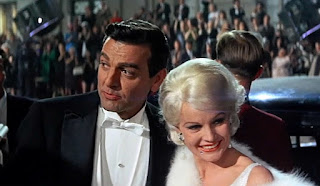
Mike Connors and Carroll Baker
HARLOW (1965). Director: Gordon Douglas.
HARLOW (1965). Director: Alex Segal.

"All the best things in life have to be done alone" -- "Marie Dressler" in Harlow II

In 1965 there were two "dueling" biopics about the star Jean Harlow, who died tragically young at 26, but neither of these films give the actress her due. Right off the bat, it seems like unfair competition, as Harlow I is a technicolor, widescreen epic with the highly publicized Carroll Baker [The Carpetbaggers] in the lead. Harlow II stars the perhaps lesser light Carol Lynley [The Shuttered Room], and was essentially a black and white television production (shot in Electrovision) and blown up to theatrical proportions. The chief difference, among many, is that Baker plays the role so that Harlow comes off as fresh and appealing, while Lynley is in "big bitch" mode throughout most of the movie, making one wonder why anyone would want to work with her. Harlow's mother is played in the first film by a marvelous Angela Lansbury, and Ginger Rogers is also quite good as the mother in Harlow II. In both films Harlow has a shiftless Italian stepfather, Marino. Raf Vallone [A View from the Bridge] is excellent as the character in the first film, while Barry Sullivan, despite not being Italian, manages to score in the second film as well. Both movies are rather slanderous (by 1960's standards as well as 1930's) in the character of first/second husband Paul Bern, who appears at least to be impotent and, it is suggested, homosexual. In the first film Peter Lawford barely registers, while a superb Hurd Hatfield [The Picture of Dorian Gray] gives the best performance in either picture as the same character. Bern had a common law wife who is never seen in the first film, and is played quite well by Audrey Totter in the second; she tells Harlow's mother that although she is Bern's mistress, they have never had physical contact. In both pictures Harlow is so dejected/depressed by the Paul Bern business that she turns herself into a "slut." Harlow I is based on a bio by Irving Shulman that was found by subsequent biographers to be heavily fictionalized. Unfortunately, Shulman's version of Harlow and her circle seems to be the unofficial basis for the second film as well.

Carol Lynley as Jean Harlow
In Harlow I Leslie Nielsen as "Richard Manley" is cast in the Howard Hughes role, while Efrem Zimbalist Jr. [A Fever in the Blood]  plays the counterpart to William Powell in the second; Zimbalist actually gives one of his best performances while Nielsen is acceptable. His near-rape of Harlow in his over-opulent bedroom is one of the best scenes in Harlow I, while Harlow II boasts a funny sequence which depicts her screen test with each take ruined because she can't stand to have the dour, disapproving Zimbalist watching her. There is also a very good scene between Rogers and Totter arguing over Paul Bern. The second version has some famous old actors being impersonated, such as Hermione Baddeley doing a not-bad Marie Dressler, and Celia Lovsky much less successful as a supposed Maria Ouspenskaya. There are interesting performances by Red Buttons and Hanna Landy in the first film, and Michael Dante, Lloyd Bochner, and especially John Williams in the second. Martin Balsam plays a studio head in Harlow I and gives one of his rare unconvincing performances.

As for the leading ladies, both give competent if second-rate performances (especially in the case of Baker), with both failing to capture the essence of Harlow -- her voice, her attitude, that surly, sexy, lovable demeanor that made her so famous. The ladies do the best they can, but as both versions say over and over again, there's only one Jean Harlow. [Both movies fail to get across that Harlow was a good actress.] An unintentionally comical scene occurs at the end of Harlow I when the doctor administering to a very ill Harlow exhibits as much compassion to her mother as a sociopathic iceberg. Oddly, the doctor in the second film is similarly cold, if not quite so stone-faced. In Harlow I Baker/Harlow disgustedly smears cold cream all over her image in her mirror, a scene that also occurs in the earlier Queen Bee with Crawford.

Verdict: Two smutty movies that don't have that much to do with the real Harlow. Both versions: **1/2 out of 4.

Thursday, February 4, 2016

SYLVIA

SYLVIA (1965). Director: Gordon Douglas.

"Before you can save the soul, you gotta feed the body."

Frederic Summers (Peter Lawford) hires private eye Alan "Mack" Macklin (George Maharis) to investigate the background of his fiancee, Sylvia (Carroll Baker). As Mack tracks down the woman's past, he learns about how she was raped by her stepfather, became a prostitute, then a poet, and has favorably impressed many of the people she met along her journey. This includes the librarian, Irma (Viveca Lindfors) and a former "hostess" named Jane (Joanne Dru), whose hospital bills were paid by Sylvia. Mack finally catches up with Sylvia herself, and is drawn to her -- but what will happen when she discovers the truth about him? At first Sylvia seems that it might have serious possibilities, and doesn't just seem like a tawdry exercise despite the subject matter, but as the film proceeds it's clear that it's pretty much junk that isn't lurid enough. The two leads are okay, but small-scale, and hardly give great performances. There is better acting from Lindfors (whose character has often been considered a lesbian although there's nothing in this to indicate it); Dru; and especially Ann Sothern [A Letter to Three Wives] as a slatternly former co-worker of Sylvia's. There are also nice turns by Nancy Kovack as a stripper, Jay Novello as a priest, Edmond O'Brian [Backfire] as a former client of Sylvia's, Connie Gilchrist as a madame, and especially Paul Gilbert [So This is Paris] as a drag queen entertainer/club owner known as "Lola." Lawford is actually quite good and there are appearances by Aldo Ray, Lloyd Bochner, and Majel Barrett, among other familiar faces, as well. Although the story bounces around from Mexico to New York and other places, there is never any sense of time or location, as if everything exists in that certain soap opera void that only Hollywood could produce.

Verdict: There's a reason why certain movies are completely forgotten. **.

Thursday, August 20, 2015

MARA MARU

MARA MARU (1952). Director: Gordon Douglas.

In the Philippines Andy Callahan (Richard Webb of The Invisible Monster) tells his partner, Gregory Mason (Errol Flynn), that he's found a big score and will likely make a million dollars. Not much later, Andy is murdered, and a man named Benedict (Raymond Burr) wants to hire Mason to help him find a batch of diamonds lost in a shipwreck. After some minor misadventures, Mason, Benedict, Andy's widow Stella (Ruth Roman), who was once involved with Gregory, a shady character named Ranier (Paul Picerni), and some others set sail on Benedict's boat, the Mara Maru, in hopes of finding the treasure. Any hope that there might be some excitement or suspense in the movie itself goes pretty much unrealized in this distinctly minor adventure that suffers from undeveloped characters, a weak script, dull direction from Gordon Douglas, and an ending that is so sanctimonious you could choke on it. The acting is okay, with Picerni [The Brothers Rico] and Burr [Pitfall] making the best impression. An unintentionally comical scene has Gregory and Stella practically making out when husband Andy's body is still warm. The best thing about Mara Maru is the score by Max Steiner, who gives the picture a lot more than it deserves. Bar Owner "Big China" is well-played by Michael Ross, who later was the alien giant and the bartender in Attack of the 50 Foot Woman.

Verdict: Manages to make love triangles, murder, undersea exploration, and sunken treasure pretty boring. *1/2.

Thursday, July 9, 2015

IN LIKE FLINT

James Coburn, Thomas Hasson, Lee J. Cobb
IN LIKE FLINT (1967). Director: Gordon Douglas.

"By this time tomorrow, women will be ruling the world."

"Brain and hair-washing at the same time!"

"An actor as President?"

In this sequel to Our Man Flint, super-adventurer Derek Flint (James Coburn) is contacted by Lloyd Cramden (Lee J. Cobb) of Z.O.W.I. E. when he realizes that he was blanked out for three minutes during a golf game with President Trent (Andrew Duggan). During that time Trent was replaced by a double, a plot engineered by a group of women who plan to sabotage missiles -- Project Damocles -- to gain their ends. The main representative of this women's group is Lisa Norton (Jean Hale), who runs a cosmetic outfit called Fabulous Face that has its headquarters in the Virgin Islands, adjacent to the missile base. Unfortunately for the ladies, General Carter (Steve Ihnat), is only pretending to be an ally and turns on them, forcing the women to engage in Operation Smooch ... In Like Flint is sillier than the worst episode of The Man from U.N.C.L.E., slow-paced, unfunny for the most part, and with a climax that seems to go on for four hours. Coburn isn't bad in the part, although both Duggan and Cobb make more of an impression. Anna Lee is fine as Elisabeth, one of the older women in the group, but Jean Hale, while very pretty, isn't much of an actress. Searching for two missing lady cosmonauts, Flint winds up in Moscow, where he gets a standing ovation after dancing in a ballet! Yvonne Craig of Batman fame plays a Russian gal who offers Flint a doped cigarette. That same year saw the release of The Thousand Eyes of Sumuru, which was also about a group of women plotters and which was even worse than In Like Flint. The ladies in Flint never seem very menacing, probably due to typical sixties sexism.

Verdict: This could have killed the parody spy genre altogether. **.

Thursday, April 17, 2014

A NIGHT OF ADVENTURE

Tom Conway


A NIGHT OF ADVENTURE (1944). Director: Gordon Douglas.

NOTE: This review reveals "important" plot points. Lawyer Mark Latham (Tom Conway) has such a busy career and is so diligent with his clients that his wife, Erica (Audrey Long of Desperate), feels neglected. She moves into her own pad and begins seeing a fellow painter named Tony (Louis Borel). Mark goes to Tony's studio, where he discovers a jilted, drunken girlfriend named Julie (Jean Brooks), waiting for Tony with a gun. Attempting to disarm her, Mark winds up accidentally shooting her to death instead. Okay... Does Mark call an ambulance, just in case Julie is still alive? No. He gets his hat and goes home, then winds up being importuned by his wife to defend Tony when he is accused of murdering Julie. Throughout the trial Mark lies to his client, his wife, the police, the D.A. and everyone else -- does the word "disbarment" not mean anything to the man? Through it all Tom Conway shows less emotion or upsetment than if he discovered he's all out of hair dye. A Night of Adventure, based on a play, is meant to be clever but only comes off as increasingly idiotic and illogical, with a "hero" who's supposed to be brilliant and seems only remarkably stupid. At the end Mark flippantly tells Erica how he'll deal with everything without the slightest acknowledgment of the consequences of his actions. Admittedly, you're not supposed to take this frippery seriously, but even so ...! There are no laughs, and the screenplay is too moronic to hold any suspense. And Conway --- although the nominal star of this film he simply heads the cast list under the title and the word "with." He's not even the star of his own movie! It's as if he's being punished for delivering a terrible performance. Conway was George Sanders' brother but was never in his league as an actor, although he did give creditable performances in such films as I Walked with a Zombie. Gordon Douglas' most famous movie is Them.

Verdict: It's because of crap like this that B Movies get a bad rap. *.

Thursday, December 19, 2013

MR. SOFT TOUCH

Glenn Ford and Evelyn Keyes
MR. SOFT TOUCH (1949). Directors: Gordon Douglas; Henry Levin.

A man with the unlikely moniker of Joe Miracle (Glenn Ford) returns from service and discovers that hoods have taken over his nightclub and murdered his partner. We never actually see Miracle learning about this -- we're introduced to him after he steals money (his money rightfully, he feels) from the nightclub safe and is on the run from the police. He eventually winds up befriended by a do-gooder named Jenny Jones (Evelyn Keyes), who works for a settlement house where there are numerous cute youngsters and the comparatively stern but warm-hearted Mrs. Hangale (Beulah Bondi), not to mention a handyman played by Percy Kilbride (The Egg and I). John Ireland (Raw Deal) is cast against type as a bespectacled reporter who wants to get info from Miracle. The trouble with Mr. Soft Touch is that it tries for equal amounts of sentiment, comedy, and action, but these elements simply never jell. Ford's character is so unlikable for the most part that the actor gives one of his few charmless performances. Keyes and Bondi come off better, but the movie just doesn't work, and you find yourself not only not caring for anyone but even for what happens. It seems to take forever to just end.

Verdict: A misfire on virtually all levels, deservedly forgotten. **.

Thursday, July 12, 2012

THEM

THEM (1954). Director: Gordon Douglas.

"A Horror Horde of Crawl-and-Crush Giants Clawing Out of the Earth from Mile-Deep Catacombs!" -- Ad copy.

"You just found your missing persons."

In the desert near where atomic testing took place, several people have gone missing, and a catatonic little girl screams about "Them!" when exposed to formic acid. There are oddly shaped footprints in the sand, as well as strange noises in the distance. Of course, due to the advertising campaign, the audience knows long before the principals do that there are monsters on the loose, specifically giant ants. Sgt. Ben Peterson (James Whitmore), FBI agent Bob Graham (James Arness), scientist Harold Medford (Edmund Gwenn) and his daughter Pat (Joan Weldon) are among the people assembled to combat this deadly menace of huge and carnivorous insects. It has to be remembered that Them was the first movie to deal with this subject matter -- not only giant insects, but the mutated results of atomic testing --  and was fresh, original* and frightening for its day. This was the second early fifties "thrill-picture" for Warner Brothers after The Beast from 20,000 Fathoms, and together the two films, both of which were wildly successful, ushered in what became known as the creature/insect cycle of the fifties. [Oddly the ad campaign for Them is just as lurid as the ones used for subsequent big bug movies like The Black Scorpion and Tarantula.] Although there are moments of humor in the film, the general tone is admirably serious [perhaps making it less" fun" than later films in the genre]. Although they are limited in their mobility, the ants look good and scary, and the sound department has turned them into cackling and chittering horrors. The discovery of the missing persons is still gruesome, and the trip down into the giant ant hole is creepy and memorable. An appropriately eerie musical score by Bronislau Kaper adds to the chilling atmosphere. Smaller roles are taken by the likes of Ann Doran [Meet John Doe] as a child psychologist, Sean McClory [Plunder of the Sun; Valley of the Dragons] as a major, Fess Parker as a man who sees the flying queen ants in his plane, Olin Howland [The Blob's first victim] as a patient in a hospital ward, and, Leonard Nimoy [Zombies of the Stratosphere] as an Air Force sergeant. Joan Weldon had a few movie and TV credits, but was essentially a singer. Gordon Douglas had a long list of credits, but Them was his most memorable film.NOTE: For more about this film and others like it, see CREATURE FEATURES: Nature Turned Nasty in the Movies. * The concept of giant insects was first used in fiction by H. G. Wells in his novel "The Food of the Gods," which also had giant rats, chickens, and children!

Verdict: A sci-fi-horror -- and very influential -- classic. ***1/2.


Wednesday, July 23, 2008

DICK TRACY VS. CUEBALL

DICK TRACY VS. CUEBALL (1946). Director: Gordon Douglas.

Although Ralph Byrd played the famous cartoon strip detective in several cliffhanger serials, when they began making feature-length Tracy movies they first hired Morgan Conway to play the part. Conway isn't bad, but he's not as perfect for the role as Byrd is. In this very fast-paced thriller, Tracy is up against a bald, nasty criminal named Cueball (Dick Wessel, who is very effective) who is after some diamonds or their cash equivalent and strangles anyone who gets in his way (director Douglas includes lots of vivid close ups of people about to be dispatched by Cueball). There are a lot of colorful characters in this, not the least of which is "Filthy" Flora (Esther Howard), proprietress of the Dripping Dagger bar, who mistakenly thinks she can outwit the malevolent Cueball. Anne Jeffreys is Tess Trueheart and Ian Keith is the florid "Vitamin."

Verdict: Minor but fun. **1/2.