Lively, entertaining reviews of, and essays on, old and newer films and everything relating to them, written by professional author William Schoell.
Showing posts with label Efrem Zimbalist Jr.. Show all posts

Thursday, August 6, 2020

HOME BEFORE DARK

Jean Simmons
HOME BEFORE DARK (1958). Director: Mervyn LeRoy.

Charlotte Bronn (Jean Simmons of Dominique) returns home after a year in a mental institution due to a nervous breakdown. Married to the cold fish Professor Arnold Bronn (Dan O'Herlihy), Charlotte had imagined that her husband was really in love with her stepsister, Joan (Rhonda Fleming of The Nude Bomb), and allowed her alleged delusions to get the better of her. When the Bronns got married Arnold moved into Charlotte's house, and the couple lived with Joan and Charlotte's stepmother, Inez (Mabel Albertson). Bad idea!

Simmons with Efrem Zimbalist, Jr. 
Trying to adjust to her new state of freedom, Charlotte finds her husband as cold as ever, and she is somewhat drawn to their boarder, Jacob Diamond (Efrem Zimbalist Jr.), a Jew who was championed  by Arnold against anti-Semitic colleagues until it no longer suited his purposes. Jacob has feelings for Charlotte, as does her old boyfriend, Hamilton  (Stephen Dunne). Their attentions, however, do not prevent additional feelings of paranoia for Charlotte over a possible relationship between Arnold and Joan. Although Home Before Dark is not a thriller, it does work up some suspense over whether or not there is anything between husband and stepsister-in-law before the final revelations.

Rhonda Fleming, Dan O'Herlihy, Mabel Albertson
Home Before Dark is decidedly overlong at nearly two and a half hours. One could argue that there's really not enough plot for such a lengthy motion picture, but despite some tedious moments the picture manages to be absorbing, in no small part to a superb performance by Jean Simmons. There is a particularly good scene worth waiting for in which Charlotte shows up in a Boston restaurant trying to look like a grotesque imitation of her stepsister. Dan O'Herlihy is fine in the thankless role of a seemingly passionless husband; Dunne scores as the cast-off boyfriend from years ago; Fleming and Albertson are memorable as Charlotte's other family members; and even Zimbalist is okay as Jacob, although it's a wonder why this rather sexless and bland actor was constantly cast as a romantic figure in movie after movie. In smaller roles one can find Joan Weldon [Them], Eleanor Audley, and Lucy's mother Kathryn Card in the peppery role of the housekeeper Mattie. Oddly, the score for the film consists of snippets from various previous films by a variety of composers. Photographed by Joseph F. Biroc.

Verdict: Love-starved wives are always entertaining in these kind of movies, but this is on a somewhat higher level than a soap opera. ***.

Thursday, May 28, 2020

BY LOVE POSSESSED

Lana Turner and Efrem Zimbalist, Jr. 
BY LOVE POSSESSED (1961). Director: John Sturges.

Two law partners in a small town have personal problems to go with legal ones. Arthur Winner (Efrem Zimbalist, Jr.) is afraid that his wife, Clarissa (Barbara Bel Geddes) and son Warren (George Hamilton) feel completely disconnected from him. Julius Penrose (Jason Robards of Philadelphia) is afraid to get close to his tippling wife, Marjorie (Lana Turner), because of physical problems which undoubtedly include impotency. Meanwhile Arthur's father-in-law, Noah Tuttle (Thomas Mitchell), the head of the firm, seems to be senile and may have even committed embezzlement. Just as Arthur and Marjorie draw closer for an illicit relationship, Warren is accused of rape by the town tramp, Veronica (Yvonne Craig), with his girlfriend, Helen (Susan Kohner of The Gene Krupa Story) waiting in the wings.

Jason Robards (Jr.) and Lana Turner
Although her part is not even that large, Lana Turner was obviously cast and headlined so that the public would think they had another Peyton Place on their hands, which is not the case. Despite all the heavy breathing (especially on Hamilton's part) and other goings-on, By Love Possessed is neither strong drama nor even a trashy guilty pleasure. Zimbalist, who has the biggest part, is adequate and smooth but as bland and pedestrian as ever. He and Turner and some other cast members give overly earnest line readings as if they thought they were reciting something profound. Sometimes there is some interesting dialogue, such as when Veronica tells Warren "If I get drunk and pass out it's no fun for me, and if you get drunk and pass out it's no fun for me." Later Arthur tells his son: "Your generation doesn't have a monopoly on sex, legal or otherwise -- you just talk about it more."

Unrequited: George Hamilton with Susan Kohner
Jason Robards seems a mite uncomfortable acting with Lana, and his performance is actually only adequate. Bel Geddes [Caught] is playing the wise, warm and womanly role years before she enacted same on Dallas but she does it in a rather bland fashion. Old pros Mitchell and Everett Sloane as a doctor are more impressive, and the younger generation of Hamilton, Kohner, and Craig are also on the money. Jean Willes has a small role as a former prostitute suing her late paramour's estate, and she is fine. As for the story, everything with both couples is neatly resolved by the finale, but Warren's fate in the rape trial is left unrevealed, although it's hard to believe anyone would find Veronica -- who always refers to herself in the third person -- a creditable witness. The audience is supposed to be devastated by the sad fate of Helen, but we never get to know her well enough to feel anything for her. Elmer Bernstein's musical score has a few nice moments, but is also a bit sappy, which is no more than the picture deserves.

Verdict: This talky flick would have been more fun if it were just a blatant trash wallow. **. 

Thursday, May 26, 2016

77 SUNSET STRIP

The cast of 77 Sunset Strip
77 SUNSET STRIP (1958 - 1964).

This hour-long black and white private eye series lasted for six seasons and was one of the most successful and influential of its type on television. The main stars were Efrem Zimbalist Jr. as Stuart Bailey and Roger Smith as Jeff Spencer. Edd Byrnes ["Final Escape"on The Alfred Hitchcock Hour] as Gerald Kookson III or "Kookie," originally parked cars for the real-life Dino's Lodge next door -- the club was owned by Dean Martin who never appeared on the show -- did odd jobs for the detectives, and later became an employee with Bailey and Spencer. When Bourbon Street Beat was canceled Richard Long and the character he played were both moved over to Sunset. Louis Quinn played Roscoe, a horse player who made money also doing odd jobs for the agency; Jacqueline Beer was their secretary, Suzanne; and Robert Logan [Claudelle Inglish] took Kookie's old parking job, hung around the office, and got involved in a case or two. In the last episodes of the final season Stuart Bailey was the only private eye in sight, the others (as well as "Bailey and Spencer," Kooky, the agency's offices, the logo and theme,  and everything and everyone else) were all gone, possibly in a cost-cutting move.

While not every episode was a winner, the show, produced by former actor William Orr [The Hardys Ride High], managed to maintain a high-standard of entertainment value. Some of the most memorable episodes include "The Duncan Shrine," in which the statue of a dead western star is stolen from a cemetery; "Pattern for a Bomb," in which the gang try to stop a clever bomber-extortionist (with Joan Marshall); "The Gemologist Caper," in which a half million in gems disappears from a gallery; "Tarnished Idol," in which Suzanne goes undercover to investigate a paralyzed tennis player (Van Williams; Edgar Barrier); "Never to Have Loved," in which an actress tries to break with her Svengali-like husband/director; "By His Own Verdict," with Joseph Cotten as a lawyer whose acquitted client admits he's guilty; and one of the very best, "White Lie," in which a land claim dispute centers around a mulatto woman who has been passing for white, and who is understandably reluctant to answer tough questions in court (Gene Evans; Elizabeth Montgomery). The show featured many well-known guest-stars, such as Bert Convy, Paula Raymond, Diane McBain, George Petrie, Pat Crowley, Robert Clarke, Joan Taylor, Robert Vaughn, Jay Novello, Gena Rowlands, and many, many others. Orr also produced Surfside 6, which lasted two seasons.

Verdict: Snappy detective show with a finger-snappin' theme and appealing players. *** out of 4.

Thursday, March 10, 2016

HARLOW (1965) vs. HARLOW (1965)

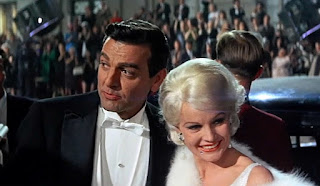
Mike Connors and Carroll Baker
HARLOW (1965). Director: Gordon Douglas.
HARLOW (1965). Director: Alex Segal.

"All the best things in life have to be done alone" -- "Marie Dressler" in Harlow II

In 1965 there were two "dueling" biopics about the star Jean Harlow, who died tragically young at 26, but neither of these films give the actress her due. Right off the bat, it seems like unfair competition, as Harlow I is a technicolor, widescreen epic with the highly publicized Carroll Baker [The Carpetbaggers] in the lead. Harlow II stars the perhaps lesser light Carol Lynley [The Shuttered Room], and was essentially a black and white television production (shot in Electrovision) and blown up to theatrical proportions. The chief difference, among many, is that Baker plays the role so that Harlow comes off as fresh and appealing, while Lynley is in "big bitch" mode throughout most of the movie, making one wonder why anyone would want to work with her. Harlow's mother is played in the first film by a marvelous Angela Lansbury, and Ginger Rogers is also quite good as the mother in Harlow II. In both films Harlow has a shiftless Italian stepfather, Marino. Raf Vallone [A View from the Bridge] is excellent as the character in the first film, while Barry Sullivan, despite not being Italian, manages to score in the second film as well. Both movies are rather slanderous (by 1960's standards as well as 1930's) in the character of first/second husband Paul Bern, who appears at least to be impotent and, it is suggested, homosexual. In the first film Peter Lawford barely registers, while a superb Hurd Hatfield [The Picture of Dorian Gray] gives the best performance in either picture as the same character. Bern had a common law wife who is never seen in the first film, and is played quite well by Audrey Totter in the second; she tells Harlow's mother that although she is Bern's mistress, they have never had physical contact. In both pictures Harlow is so dejected/depressed by the Paul Bern business that she turns herself into a "slut." Harlow I is based on a bio by Irving Shulman that was found by subsequent biographers to be heavily fictionalized. Unfortunately, Shulman's version of Harlow and her circle seems to be the unofficial basis for the second film as well.

Carol Lynley as Jean Harlow
In Harlow I Leslie Nielsen as "Richard Manley" is cast in the Howard Hughes role, while Efrem Zimbalist Jr. [A Fever in the Blood]  plays the counterpart to William Powell in the second; Zimbalist actually gives one of his best performances while Nielsen is acceptable. His near-rape of Harlow in his over-opulent bedroom is one of the best scenes in Harlow I, while Harlow II boasts a funny sequence which depicts her screen test with each take ruined because she can't stand to have the dour, disapproving Zimbalist watching her. There is also a very good scene between Rogers and Totter arguing over Paul Bern. The second version has some famous old actors being impersonated, such as Hermione Baddeley doing a not-bad Marie Dressler, and Celia Lovsky much less successful as a supposed Maria Ouspenskaya. There are interesting performances by Red Buttons and Hanna Landy in the first film, and Michael Dante, Lloyd Bochner, and especially John Williams in the second. Martin Balsam plays a studio head in Harlow I and gives one of his rare unconvincing performances.

As for the leading ladies, both give competent if second-rate performances (especially in the case of Baker), with both failing to capture the essence of Harlow -- her voice, her attitude, that surly, sexy, lovable demeanor that made her so famous. The ladies do the best they can, but as both versions say over and over again, there's only one Jean Harlow. [Both movies fail to get across that Harlow was a good actress.] An unintentionally comical scene occurs at the end of Harlow I when the doctor administering to a very ill Harlow exhibits as much compassion to her mother as a sociopathic iceberg. Oddly, the doctor in the second film is similarly cold, if not quite so stone-faced. In Harlow I Baker/Harlow disgustedly smears cold cream all over her image in her mirror, a scene that also occurs in the earlier Queen Bee with Crawford.

Verdict: Two smutty movies that don't have that much to do with the real Harlow. Both versions: **1/2 out of 4.

Thursday, December 24, 2015

VIOLENT ROAD

Dick Foran and Ann Doran
VIOLENT ROAD (1958). Director: Howard W. Koch.

A runaway missile explodes in a small town, causing many deaths, necessitating the move of the local company that fired the missile to another location. Rocket fuel, which is comprised of many dangerous and acidic chemicals which can "burn a man alive," has to be transported over difficult terrain, and six men are chosen to be the drivers. These include George (Efrem Zimbalist, Jr.) whose family was lost in the blast; Frank (Dick Foran), who has a tragically bitter quarrel with his wife (Ann Doran) before leaving; Manuelo (Perry Lopez of The Steel Jungle), who needs the money from the trip to become an engineer; the world-weary Ben (Arthur Batanides); and Mitch (Brian Keith), a foot-loose adventurer without much of a past.  Ken Farley (Sean Garrison), the sixth driver, replaces his sad, drunken brother (John Dennis) when he's too hungover to drive. Along the way there are harrowing incidents, such as a runaway bus, brake failures, tumbling rocks, and acid spills, as well as flashbacks that tell us more about these individuals. Violent Road is clearly an unacknowledged rip-off of the far superior French film The Wages of Fear -- which was also remade as Sorcerer -- but it has its moments if taken on its own terms. One stand-out sequence is a tender and tragic moment between Frank and his wife, with an outstanding performance from Ann Doran [Meet John Doe]. Dick Foran is also excellent, and Keith also makes his mark, as does John Dennis in the early scenes. Sean Garrison also makes an impression as the handsome and cocky Kenny. If there's any problem with the movie it's that it seems to lack a real climax and ends much too abruptly. Peter Brown has a small but effective role as a marine, and Merry Anders is fine as a woman who picks Mitch up on the road.

Verdict: Not that explosive, and highly unoriginal, but tense and absorbing nonetheless. *** out of 4.

Thursday, May 28, 2015

A FEVER IN THE BLOOD

Efrem Zimbalist Jr. and Jack Kelly
A FEVER IN THE BLOOD (1961). Director: Vincent Sherman.

"I'm only allowed a minute so I'm going to change the habit of a lifetime and be brief."

When a woman is suffocated in her home, her estranged husband (Rhodes Reason of Voodoo Island) is arrested and put on trial. He is almost a supernumerary in a three-way battle for governor between Callahan (Jack Kelly), the D.A. prosecuting the case; Hoffman (Efrem Zimbalist Jr.), the judge assigned to the trial; and Senator Alex Simon (Don Ameche), who wants to give up his seat for personal reasons. The audience knows who the real killer is from the first, but Callahan seems determined to win this case -- and his chance at a governorship -- no matter who is convicted. Then Senator Simon offers Hoffman a bribe if he'll declare a mistrial, postponing Callahan's chances for a prosecutorial and political victory. A Fever in the Blood features a few Warner Brothers contract players who are sometimes effective and sometimes not. Zimbalist isn't bad, but aside from playing Stu Bailey in 77 Sunset Strip, he's a trifle bland, as usual, and strictly a small screen personality. Jack Kelly [Drive a Crooked Road], also a TV regular, is surprisingly good as Callahan, as is Don Ameche [Guest Wife], who manages to overcome his miscasting. Angie Dickinson scores as Simon's wife, who is really in love with Hoffman (she has a very good scene with Zimbalist early in the film), and there are also notable performances from Herbert Mashall as the defendant's father, Carroll O'Connor as a publisher, Ray Danton as defense counsel, and Robert Colbert as the murdered woman's gardener and lover. If there's any problem with the movie it's that with this excellent plot the movie should have had a lot more tension and excitement, but it merely plays out in standard fashion while managing to hold the attention. Ernest Gold's Herrmann-like score is effective.

Verdict: Not bad, but perhaps its temperature should have been raised. **1/2.

Thursday, March 19, 2015

THE CHAPMAN REPORT

THE CHAPMAN REPORT (1962). Director: George Cukor.

"The one thing we must remember: we must be sensible."

"Why?" 

Researcher Dr. Chapman (Andrew Duggan) and his assistant Paul (Efrem Zimbalist Jr.), interview several women about their sex lives. These include Sarah (Shelley Winters), a married woman who is having an affair with a theater director named Fred (played by who else but Ray Danton); Naomi (Claire Bloom), whose nymphomaniacal activities doomed their marriage; Teresa (Glynis Johns), who is happily married but requires one fling with a really hot man (Ty Hardin of Berserk); and Kathleen (Jane Fonda), a widow whose late husband complained of her frigidity. In an unlikely development Paul finds himself drawn into a romantic relationship with Kathleen. While the movie is obviously inspired by the Kinsey report (and a trashy potboiler by Irving Wallace), the types in this movie are no different from women in countless other movies and the really eyebrow-raising stuff in Kinsey's report is avoided. So what we're left with is a reasonably entertaining soap opera with some fine acting. Zimbalist is no better than he ever is, Duggan has nearly a bit part, but the ladies offer something more. Bloom gives an affecting performance as a lonely, semi-alcoholic woman who is gang-raped in one chilling sequence. Winters is excellent as the wife with an unattractive husband (Harold J. Stone) who needs passion in her life with a handsome partner. Johns is okay in a sequence that is played primarily for laughs (John Dehner is her unsuspecting husband). Jane Fonda, always more talented than her father, gives another wonderful performance. Chad Everett shows up briefly as a hunky water man who appears at Naomi's house, and Corey Allen [The Big Caper] is very effective as the slimy musician, Wash Dillon, who casts a sick spell over Naomi. Perhaps the best performance comes from Henry Daniell [The Four Skulls of Jonathan Drake], a psychologist who fears that Chapman may be setting things in motion without the appropriate follow-up.

Verdict: Laughably unscientific but entertaining. ***.

Thursday, March 5, 2015

THE CROWDED SKY

THE CROWDED SKY (1960). Director: Joseph Pevney.

While Captain Dick Barnett (Dana Andrews) and his bitter co-pilot Mike Rule (John Kerr) fly an airliner, a small Navy jet piloted by Dale Heath (Efrem Zimbalist, Jr.) is heading in the same general direction. Heath notes to his passenger McVey (Troy Donahue) that there are "2000 near-misses each year." As the audience tenses itself for the disaster to come, the movie features flashbacks showing the back stories of several of the characters, including crew and passengers. Rhonda Fleming [While the City Sleeps] is Heath's bored and unfaithful wife; Anne Francis is a stewardess in love with Rule; Barnett has a poor relationship with his son, Dick Jr. (Ken Currie); and so on. The Crowded Sky manages to maintain suspense not just over the plane situation, but also over the various characters' inter-relationships. Some of this is soap opera, but it is generally interesting to watch. Keenan Wynn flirts with a passenger, Jean Willes [Desire Under the Elms], whom he jilted years before and whom he doesn't recognize, while Patsy Kelly is an agent for actor Tom Gilson, both of whom feature in scenes of -- on one occasion -- inappropriate comedy relief. Joe Mantell plays the likable navigator, Louis, whose grotesque death is pretty much forgotten (shockingly) by the other characters. There is evidence that much footage was left on the cutting room floor, as Troy Donahue's role practically amounts to a bit, and another major character's death is also not given any kind of moving post script, making it all seem a rather callous exercise. One suspects there's a much better movie left somewhere, but The Crowded Sky is still quite entertaining. Freida Inescort shows up briefly as a woman who may or may not be Kerr's mother. The acting in this is perfectly okay but nobody really stands out as anything special. Pevney also directed The Strange Door.

Verdict: Stay on the ground. ***.

Thursday, March 20, 2014

HOUSE OF STRANGERS

Tense date: Richard Conte and Susan Hayward
HOUSE OF STRANGERS (1949). Director: Joseph L. Mankiewicz.

Gino Monetti (Edward G. Robinson) is the opera-loving head of a bank and has four sons, one of whom, the lawyer Max (Richard Conte of Thieves' Highway), he seems to love unconditionally. The oldest son, Joe (Luthor Adler) is bitter that Gino treats him with disdain and employs him only as a poorly-paid bank teller. Pietro (Paul Valentine of Love Happy) resents the fact that his father thinks he's stupid. Tony (Efrem Zimbalist Jr.) seems more interested in the ladies than in anything else. Although Max has a pretty fiancee named Maria (Debra Paget), he can't help but be attracted to a zesty, very self-confident lady named Irene (Susan Hayward), who comes to him for legal advice and with whom he enters into a sexy if exasperating love-hate affair. Then Gino discovers that his unorthodox approaches to lending have brought him under the scrutiny of bank officials and he may go to jail. Max has a scheme to get his father out of trouble, but he doesn't reckon with Joe's hatred ... House of Strangers is an absorbing, well-acted drama that just misses being really special, but is still quite worthwhile. Although Robinson is miscast as an Italian, he still gives his customary fine performance, and Conte and Hayward make an arresting couple. Luthor Adler almost walks off with the movie with his quietly ferocious portrayal of deceptively steel-hard Joe. Hope Emerson (Peter Gunn) is fun in a small role as Maria's termagant mother, trading verbal and nearly physical blows with Robinson, whom she towers over.

Verdict: Has quite a few memorable and powerful sequences. ***.

Thursday, January 16, 2014

TOO MUCH, TOO SOON [MOVIE]

John (Ray Danton) gives Diana (Dottie Malone) a back rub
TOO MUCH, TOO SOON (1958). Director: Art Napoleon.

"I don't want to write a book about my life. Living it was bad enough." -- Diana Barrymore.

"I am fifty-nine years old. And not as drunk as you think. Why don't you take what I offer and not make me jump through hoops?' --John Barrymore.

In this somewhat sanitized version of Diana Barrymore's memoir of the same name, Diana (Dorothy Malone) wishes she could get to know her father, John Barrymore (Errol Flynn) better, but her mother, Blanche (Neva Patterson) isn't too thrilled with the notion. Diana decides to follow in her great family's footsteps and become an actress, discovering that her famous name opens doors but won't necessarily deliver decent scripts. As he was still alive at the time of filming, her first husband, Bramwell Fletcher, is represented by the made-up character of "Vincent Bryant" (Efrem Zimbalist Jr.), who comes home to find Diana diddling in their bedroom with sleazy tennis bum, John Howard (Ray Danton), a real-life man who becomes her second husband. Diana's third husband, actor Robert Wilcox, is portrayed by Ed Kemmer [Earth vs the Spider];  she and Wilcox become mired in a maze of booze, poverty and blown opportunities. Writer Gerald Frank, who helped craft the memoir, is portrayed by Robert Ellenstein. Too Much, Too Soon is psychologically simplistic, but well-acted, with Malone doing a swell job as Diana, with fine support from Patterson and the others. Errol Flynn is the big surprise, turning in a fine performance as the dissipated Barrymore [ironic, considering what lay in Flynn's future]. Smaller roles are performed by Kathleen Freeman and Martin Milner, and there's a nice score by Ernest Gold.

Verdict: Lurid but quite entertaining and reasonably well-made. ***. 


Thursday, October 3, 2013

WAIT UNTIL DARK

Alone in the dark with a killer
WAIT UNTIL DARK (1967). Director: Terence Young.

Blind Susy Hendrix (Audrey Hepburn) is unaware that some men who have come to her apartment pretending to either be friends of her husband or police officers are actually crooks looking for a drug-filled doll that a woman handed off to Susy's unsuspecting husband, Sam (Efrem Zimbalist Jr.). Gradually she realizes that something is wrong, and prepares to fight for her life when the gentlemen come back from a wild goose chase she's sent them on. The main trouble with Wait Until Dark -- which was based on a stage play by Frederick Knott (Dial M for Murder) -- is that the suspense is minimal because the audience is clued in to what's going on from the very beginning. Hepburn gives a very good performance and the rest of the surprisingly C List cast are fine, although Alan Arkin seems about as threatening as Boris Badenov. Julie Herrod is excellent as the neighbor child Gloria who is alternately helpful and bratty. Henry Mancini's score does what it can to increase the limited excitement. It's hard to figure why Arkin and Crenna were billed above the title along with Hepburn.

SPOILER ALERT: Susy has been encouraged by her husband to be as independent as possible despite her blindness, which leads to two problematical developments. We already know she can walk by herself to her husband's office, so instead of barricading herself in her apartment, why doesn't she just leave and ask for someone to help her get to the nearest precinct? [St. Luke's Place where this takes place runs right into Seventh Avenue and the men watching her place have gone off on the wild goose chase.] At the very end when Sam sees her bloodied and huddled by the refrigerator, he waits for her to get up and make her way towards him, but surely in a situation like this he would forget his independence edict and go hug the woman he's supposed to be in love with after such an ordeal? Also, in a moment that made some nervous nellies in the audience jump in fright, Alan Arkin leaps out of the darkness at Susy after he's been stabbed and falls to the ground unconscious. Maybe he might have been able to painfully lurch after her, but leap? The moment is ludicrous instead of startling.

Verdict: If you want to see a better Frederick Knott adaptation watch Dial M for Murder instead. **.