Lively, entertaining reviews of, and essays on, old and newer films and everything relating to them, written by professional author William Schoell.
Showing posts with label 1947. Show all posts

Thursday, June 18, 2026

THE TWO MRS. CARROLLS

Bogart and Stanwyck in their only film together
THE TWO MRS. CARROLLS (1947). Director: Peter Godfrey.

"Would you like something, officers? A glass of milk perhaps?

Sally (Barbara Stanwyck) meets and falls in love with troubled artist Geoffrey Carroll (Humphrey Bogart), then learns he has a wife. Said wife conveniently dies, and Sally and Geoff are married, the two of them residing in Sally's palatial estate along with Geoff's very self-assured little girl, Beatrice (Ann Carter). Then along comes super-sexy Cecily Latham (Alexis Smith), who wants Geoff to paint her portrait and won't take no for an answer. Before long Sally is getting suspicious, especially when she learns that Geoff's first wife wasn't an invalid as he claimed, and that she's developing similar symptoms to what the first Mrs. Carroll had before she died ... 

Based on a stage play, The Two Mrs. Carrolls is a poor man's Suspicion, which was released six years earlier. There's even some business with a glass of milk. At least this is somewhat superior to the next thriller Stanwyck did with director Peter Godfrey, Cry Wolf with Errol Flynn, and the acting is quite good. Stanwyck is better at getting across the vulnerability and terror of the heroine than you might expect (although she does seem to summon up her bravery at the climax rather suddenly), Bogart is fine in all but his most challenging scenes, little Ann Carter proves a superlative child actress in her portrayal of the highly interesting and mature Beatrice, and gorgeous Smith has wicked fun as the slinky and self-absorbed Cecily, with Isobel Elsom scoring as her mother and Nigel Bruce as -- what else? -- a doctor. Anita Bolster is a riot as the saturnine housekeeper, Christine. Crackling good dialogue from Thomas Job (from Martin Vale's play) and a fine Franz Waxman score help a great deal. The last line provides a little wink at the audience. Bogart and Stanwyck play quite well together.

Verdict: No Suspicion, but fun nevertheless. **1/2.

Thursday, April 23, 2026

LURED

LURED
(1947). Director: Douglas Sirk. 

"I am an unmitigated cad." 

 George Sanders, Boris Karloff, Charles Coburn -- and Lucille Ball -- all in the same movie? Not only that but George Zucco and Sir Cedric Hardwicke, too? Too bad it's such a lousy movie. Lucy is a show girl of sorts whose friend disappears after answering a romantic personal ad. The police employ her as a decoy who will answer different ads and hopefully bring the murderer of several young women, the friend included, to light. George Sanders is a theatrical agent who takes a shine to Lucy. Boris Karloff is a weird, mentally ill clothing designer, Zucco is a police officer (as is Alan Napier of Batman TV fame), and Joseph Calleia is an even weirder friend of Karloff's. Charles Coburn is miscast as a Scotland Yard inspector -- it's one of the few times this wonderful character actor fails to make much of an impression, although he does have his moments (such as a scene with Hardwicke). Lucille Ball does make an impression -- but in the wrong way. 

Although her Lucy characterization was four years in the future, at times the movie resembles "Lucy Meets Jack the Ripper." Her comic gifts and timing are much in evidence, but in the wrong movie. And her whole persona is much too contemporary to be convincing in a period piece. On the other hand, she's the only bright note in the movie, despite solid performances from Sanders and some of the others. However, in no way can it be considered a memorable dramatic performance. There are some atmospheric shots, but Douglas Sirk is no Hitchcock and the music is all wrong. A hilarious aspect is that early in the film one of the victims describes the (fairly obvious) killer as being "handsome." Well ... wait and see, if you care to. 

Verdict: Seems like five hours. *1/2.

Thursday, January 29, 2026

THE FLAME

John Carroll and Vera Ralston

THE FLAME (1947). Director: John H. Auer. Colorized

George MacAllister (John Carroll of Zorro Rides Again) is in love with a nurse named Carlotta (Vera Ralston), who happens to be looking after George's supposedly dying brother, Barry (Robert Paige of Hellzapoppin). Carlotta marries Barry with the full approval of George, who is hoping to wrest his brother's fortune away from him. Complicating matters are another gal pal, Helena (Constance Dowling), and a guy with a big crush on her, Ernie (Broderick Crawford of All the King's Men). Then there's the termagant Aunt Margaret (Blanche Yurka), who casts a dim eye on Carlotta and Barry's marriage. Which of the two brothers will Carlotta ultimately wind up with, and which will be alive at the end? 

Robert Paige and Ralston
The Flame is an interesting if flawed bit of film noir from Republic Studios starring Ralston, the wife of the studio head. She seems to give a more convincing performance in this than in other films, although she'll never be seen as another Barbara Stanwyck. Carroll is excellent, however; Paige is somewhat less notable but good enough, Yurka scores as the aunt, and Crawford and Dowling nearly walk off with the movie. Crawford proves that there's much more to him than Highway Patrol, and Dowling does a snappy and sexy song and dance number in a nightclub. The generally unpredictable film keeps throwing curveballs at the viewer when it comes to the inter-relationships of the characters. Victor Sen Yung is a breath of fresh air and is very effective as George's manservant, Chang. There's also good work from Henry Travers as a doctor and Hattie McDaniel as a cheerful domestic. Reggie Lanning's cinematography and Heinz Roemheld's score are added attractions. It is never specified exactly what is wrong with Barry and he never seems to be "dying" or even ill. Much of the story takes place at Manhattan's tony Hampshire House on Central Park West, which is still standing today. 

Verdict: Some more character development might have helped, but this is intriguing enough in its own way. **3/4. 

UNCLE SILAS

Jean Simmons and Katina Paxinou
UNCLE SILAS
(aka The Inheritance/1947). Director: Charles Frank.

Caroline Ruthyn (Jean Simmons) finds herself at the mercy of her rather batty Uncle Silas (Derrick De Marney) and his psychotic son, Dudley  (Manning Whiley), after her father dies and she becomes the ward of Silas -- who has serious debts and sinister plans. But even more threatening is the very weird governess Madame de la Rougierre (Katina Paxinou), who is positively monstrous. This adaptation of a Sheridan Le Fanu gothic novel tries very hard to be atmospheric and sinister and classy, and it nearly succeeds some of the time, but it also has a decidedly second-rate quality to it that nothing can disguise. The acting is very good, however, with Jean Simmons perfect as the (rather slow) heroine and Paxinou marvelous as the evil Madame, who shows up again to cause mischief at an unexpected moment. Marjorie Rhodes has a small role as Mrs. Rusk and there isn't enough of her. The ultimate effect is one of tedium, however.

Verdict: Strange, rather dull movie despite all the goings-on. **.

Thursday, January 15, 2026

THE UNSUSPECTED

THE UNSUSPECTED
(1947). Director: Michael Curtiz.

"I detest scenes not of my own making."

Roslyn, the secretary of radio star Victor Grandison (Claude Rains), who narrates tales of mystery and the macabre, is found hanging in the study, apparently the victim of a suicide. Meanwhile, Grandison's niece, Matilda (Joan Caulfield), who was supposedly lost at sea, shows up alive and well, as does Steven Howard (Michael/Ted North), a man she doesn't remember who claims he's her husband. Other members of this strange household include another viperish niece, Althea (Audrey Totter), her husband Oliver (Hurd Hatfield), whom she stole away from Matilda, and snappy assistant Jane (Constance Bennett), not to mention Press (Jack Lambert) a hooligan employed by Grandison. Based on a novel by Charlotte Armstrong, this seems an odd fit for director Curtiz (despite his work on such films as Mildred Pierce) and while it holds the attention and has a fairly exciting finale, otherwise it never quite comes alive. Nice work by Claude Rains (although he seems less inspired by this material than he was in, say, Deception). Audrey Totter is vivid, as usual, as is Constance Bennett. Caulfield is just okay, no more.

Verdict: Okay suspenser. **1/2.

Thursday, September 11, 2025

SEVEN WERE SAVED

Richard Denning and Catherine Craig
SEVEN WERE SAVED (1947). Director: William H. Pine. Colorized version

Captain Jim Wilson (Russell Hayden of Lost City of the Jungle) is looking forward to a future with Lt. Susan Briscoe (Catherine Craig of The Pretender), but their plans hit a snag when she finds out he wants to stay in the service and she wants out. Although engaged, they don't really know each other that well. Later Susan is flying as a nurse in a plane that not only carries her patient and others, but a Japanese prisoner, Colonel Yamura (Richard Loo). Yamura tries to get the pilots to fly him to an island, and the plane winds up hitting the ditch. Now the lifeboat is filled to the brim with, among others, the Hartleys (John Eldredge and Ann Doran), and the amnesiac Smith (Keith Richards), who turns out to have a highly surprising connection to Mrs. Hartley. As various problems confront the castaways hoping for rescue, chief among them Captain Danton (Richard Denning), Captain Wilson is on a desperate search for the woman he loves, but a bout of malaria may prevent this. 

Russell Hayden and Don Castle
Seven Were Saved
 begins with a tip of the hat to the Air and Sea Rescue Service, for which this might be considered an advertisement. Although the movie is by no means in the same league as such films as Lifeboat and similar adventures, there is an attempt to create interest with a couple of intriguing characters and situations. The film might have had more impact with a more stellar cast, but a bigger problem is the cutting back and forth between the inflatable lifeboat and the attempts to find it, and there are too many tedious stretches. However, there is some decent acting in this, and a few nice touches. Star Russell Hayden later directed When the Girls Take Over

Verdict: Rather minor sea crash melodrama. **1/2. 

Thursday, January 30, 2025

COPACABANA

COPACABANA  (1947). Director: Alfred E. Green.

Lionel Deveraux (Groucho Marx) is a manager with one client, Carmen Navarro (Carmen Miranda), to whom he's been engaged for ten years. When he tries to get her work at a nightclub owned by Steve Hunt (Steve Cochran), Hunt tells him that he prefers a French singer. Enter the always veiled Mlle. Fifi,  who is Carmen in disguise. Hunt hires the French doll, then decides he wants Miss Navarro as well. So Carmen does her best to keep up a hectic performance schedule without anybody knowing that both performers are actually the same woman. The interplay between Marx and Miranda, who make a great team, is priceless, and the other performers are game. Gloria Jean is charming as Hunt's secretary, Anne, who pines for him even as he pursues Fifi. Singer Andy Russell, who plays himself, has a very nice voice and is easy to take. Miranda may not be a brilliant performer, but it's hard not to like her, and Groucho is as wonderful as ever. Some nice songs include "Strange Things Have Happened." The film is full of chorus cuties who trade wisecracks with Marx, and there are guest appearances by columnists Abel Green, Louis Sobol, and Earl Wilson.

Verdict: This may not be a Night at the Opera, but it's very amusing and charming. ***.

Thursday, February 15, 2024

UNDER COLORADO SKIES

UNDER COLORADO SKIES (1947). Director: R. G. Springsteen. in TruColor

Bank teller and medical student Monte Hale (Monte Hale) is in the bank when it's robbed, and becomes the chief suspect not only in the robbery but the murder of the bank president. One of the real perpetrators is Jeff Collins (John Alvin of This Side of the Law), who happens to be the brother of Monte's fiancee Julia Collins (Lorna Gray of Daughter of Don Q). In a foolish attempt to protect the woman he loves from the truth, Monte runs off and then encounters a group in a runaway wagon, whom he rescues. These men turn out to be members of the Riders of the Purple Sage singing group (actually the Foy Willing band), who sign him  up without even hearing him sing. Hotel and saloon owner Lucky (Paul Hurst) hires the band, and proves generally helpful to Monte and Julia after she is shot during a stage coach robbery perpetrated by the Marlowe gang. After cutting a bullet out of Julia, Monte is forced to do the same thing for Marlowe (William Haade), the head of the gang, who takes a liking to him. For his part, Monte manages to convince Marlowe that he's really on his side. But will Monte be able to pull off this deception? And what will happen when Julia learns the truth about her miserable polecat of a brother?

Monte Hale
Although forgotten by all but classic B western fans, Monte Hale was another popular Republic studios singing cowboy who had quite a following in his day. His comic book lasted eight years. A big attractive lug, if not quite as handsome as Roy Rogers, Hale was not a bad singer in his own right, had a very deep speaking voice, and more of a kind of "macho" presence than Rogers. His acting can best be described as adequate but ingratiating. Showing her versatility, Lorna Gray is quite different in this than she is in the occasionally villainous roles she would play in serials. This was the very first film for Gene Evans [The Giant Behemoth], who adeptly plays one of the gang members. Busy actor Hank Patterson is also in the cast as Slim, and he has an amusing drunk scene. R. G. Springsteen also directed Black Spurs and many others. The best song number -- there are several -- is Holiday for the Blues.

Verdict: Well-turned-out western musical fare with an appealingly gauche Hale in the lead. **3/4. 

Thursday, December 8, 2022

I WALK ALONE

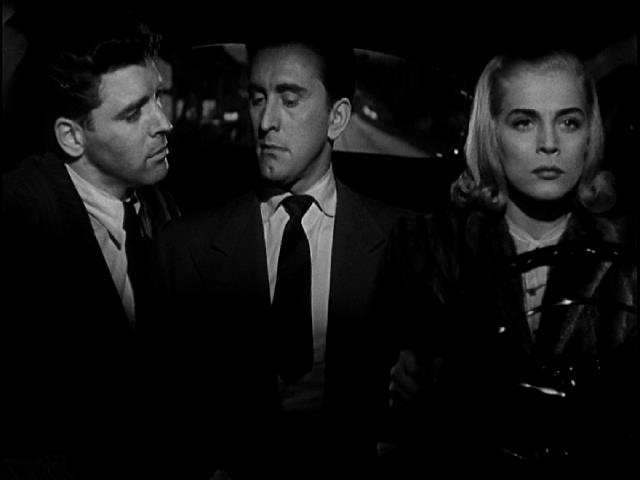
Burt Lancaster, Kirk Douglas, Lizabeth Scott
I WALK ALONE (1947), Director: Byron Haskin.

Frankie Madison (Burt Lancaster) and Noll "Dink" Turner (Kirk Douglas) were partners in a bootlegging operation that went south. Frankie went to prison for fourteen years while Noll opened up his own successful nightclub, and got a girlfriend in singer Kay Lawrence (Lizabeth Scott). Despite his relationship with Kay, Noll plans to marry bitchy socialite Alexis Richardson (Kristine Miller) for business reasons. Frankie makes it clear that what he wants is not just 50% of what's coming to him, but something to make up for all of those years he spent in jail. But even as Frankie and Kay grow closer, Noll may have other, less admirable plans for his old friend ... 

Kirk Douglas in a dramatic moment
I Walk Alone is fair-to-middling film noir. Frankly, it just never becomes as interesting or as explosive as you might hope. The performances are on target,  however, with especially good and slick work from Kirk Douglas, although Lizabeth Scott is a little odd and her romance with Frankie is never quite convincing. Wendell Corey is fine as a friend of Frankie's and an associate of Noll's, and there is also good work from George Rigaud as Maurice, who also works for Noll but isn't quite so  subservient; Mickey Knox as gunsel Skinner; Mike Mazurki as doorman/bodyguard Dan; and Kristine Miller as the delightfully predatory Alexis. When she manages to get Noll to agree to take her to the altar, she suggests that Kay sing "I Lost My Man" to the nightclub patrons -- what a bitch! Corey's death scene on a city street is quite well-handled.

Verdict: Comes so close but somehow misses. **1/2. 

Thursday, May 26, 2022

CARNIVAL IN COSTA RICA

Dick Haymes and Vera-Ellen
CARNIVAL IN COSTA RICA (1947). Director: Gregory Ratoff. 

Luisa Molina (Vera-Ellen), daughter of Costa Rican Rico (J. Carrol Naish) and American Elsa (Anne Revere), is told that she is to have an arranged marriage to Pepe Castro (Cesar Romero). For his part Pepe is already in love with the brash Celeste (Celeste Holm), and pretends to Luisa and her parents that he is too sickly to dance, sightsee or do much else that she might enjoy, hoping they will cancel the engagement. While Luisa is contemplating this possible union with a low-energy, half-dead spouse, she meets Jeff Stephens (Dick Haymes), who practically sweeps her off her feet during Carnival. Neither Luisa's or Pepe's parents have a clue to what is going on as everyone tries to do the right thing -- but what is it?

Celeste Holm and Cesar Romero
Carnival in Costa Rica is, as the title implies, very colorful and full of music, including a few fairly insipid if inoffensive songs by Levanna and Ruby. There isn't much plot beyond what is described in the paragraph above, so the movie sinks or swims on its musical numbers, which are at least energetic if not terribly inspired, and its performances. Everyone in the cast is more than adequate, but I especially enjoyed Anne Revere, sophisticated and stylish as the mother; Romero, who is as charming as ever; and of course the ever-delightful Fritz Feld as a hotel manager who has an amusing scene with the two fathers in question. Dick Haymes' is fine as an actor, and when he opens his mouth out comes one of the smoothest and most attractive voices in popular music. He knows how to put over a song, too (if only the songs had been a bit better). Little red-headed Tommy Ivo plays Luisa's sister even if he doesn't look much like a Costa Rican. Vera-Ellen's dancing is swell, but this could have used an Astaire or Kelly. 

Verdict: A pleasant and perfectly forgettable musical comedy without enough comedy. **1/4.

Thursday, April 1, 2021

SMASH UP: THE STORY OF A WOMAN

Susan Hayward
SMASH UP: THE STORY OF A WOMAN
(1947). Director: Stuart Heisler. 

Angie Evans (Susan Hayward) is an aspiring singer who suffers from stage fright (having a drink or two before going on seems to help) and who gives up her career to marry Ken Conway (Lee Bowman), who later makes a tremendous splash as a crooner. Now Angie has no career, her husband is out on the road most of the time, having a child isn't enough to fill her life, and she's afraid Ken is having an affair with his aggressive assistant, Martha (Marsha Hunt). What's a girl to do? She takes a drink and then another, and then has a few more. This not-too-serious study of a dipsomaniac is well-acted -- Hayward is outstanding -- and quite entertaining. There's a particularly amusing scene when Angie has it out with Martha in the ladies room during a party, smacking her around and pulling her hair. (The movie has some interesting vignettes, such as when the old nurse who works for Angie is shown a baby by its mother in the park. "Cute, isn't he?" says the mother. To which the nurse, frowning, says, "hmm. well ...") The movie has a very unrealistic ending, with one character being overly forgiving after a near-tragedy. Eight years later Hayward played another alcoholic -- this time a real-life singer, Lillian Roth -- in I'll Cry Tomorrow

Verdict: Watch Hayward put on a show! ***.

Thursday, October 29, 2020

SCARED TO DEATH

SCARED TO DEATH (1947). Director: Christy Cabanne.

"My dear Josef, if I allowed myself to be announced, I doubt I would be received anywhere."

Well, this movie has something in common with the later Sunset Boulevard, in that it's sort of narrated by a corpse, but that's as far as it goes. (The original idea for Sunset was for it to begin in the morgue, which this picture actually does.) As the pathologists prepare to perform an autopsy on a woman, we hear her voice, and flashbacks tell us how she wound up dead. Laura (Molly Lamont) lives in a strange household. She thinks her husband Ward (Roland Varno) and father-in-law Dr. Josef (George Zucco) are trying to kill her. Then we have Josef's cousin, Professor Leonide (Bela Lugosi), a once-famous magician, who arrives unexpectedly with a deaf mute dwarf, Indigo (Angelo Rossitto), and hates Josef. Rounding out the cast of characters are the maid Lilly Beth (Gladys Blake), a private dick Bill "Bull" Raymond (Nat Pendleton), a reporter Terry Lee (Douglas Fowley). and his date Joyce (Jane Cornell). And we mustn't forget the odd green face that periodically seems to be peeping through some curtains.

Scared to Death seems to have been conceived as a black comedy, but it isn't remotely funny but for one or two moments, and it hasn't got a single chill. The "Natural Color" it was filmed in doesn't help a bit. Even with all the odd characters and weird goings-on, the movie is slow and dull. But the most criminal thing about it is that it wastes the talents -- and the confrontation between -- those two fine actors George Zucco and Bela Lugosi, both of whom are much better than the picture deserves. Roland Varno also appeared in My Name is Julia Ross and The Return of the Vampire. Douglas Fowley was in Flaxy Martin and many, many other movies.

Verdict: Tough to take even for Lugosi fans. *1/2.

Thursday, October 15, 2020

NIGHT SONG

Dana Andrews and Merle Oberon
NIGHT SONG (1947). Director: John Cronwell.  

Now here's a strange one. Wealthy Catherine (Merle Oberon of A Song to Remember) goes slumming in a nightclub one evening with friends, and is attracted to, and fascinated by, a talented composer, Dan (Dana Andrews), who is also sort of slumming as a piano player. Cathy is initiially distressed to realize that Dan is blind, but decides he needs a patron -- but how to get past his depression and indifference. She hits upon the incredibly tasteless idea of pretending to be blind herself, assuming a new identity and even renting a different apartment from her fancier digs. She is able to inspire Dan to finish his concerto, and in her true identity sponsors him in a competition. Now he has the money to get his eyes operated on, but will he forget all about the blind gal who helped him once he can see the world in all its glory -- including the real Catherine? She wants him to love her as the comparatively drab but steadfast and loving blind girl, not as the glamorous doyenne of the social register. 

James Bond? Hoagy Carmichael
Night Song was made during a period when hopelessly contrived movies came out one after another trading on the romantic and emotional element and the acting of its lead players. Sometimes they worked; sometimes they didn't. Night Song is about half and half. On the plus side are the actors, with Oberon proving once again that she was not just a beautiful face, handling all the cliches and absurdities with aplomb. The same is true of Dana Andrews, who keeps a straight face throughout. Then there's the marvelous Hoagy Carmichael as Dan's friend and clarinetist Chick, who goes along with the deception despite his misgivings (this is another credulity-stretching aspect to the story). Carmichael is charming and makes the most of his thankless role of the best friend. Incidentally, James Bond creator Ian Fleming always thought of 007 as resembling Carmichael, although he never went so far, to my knowledge, as to suggest him for the role. Carmichael gets to warble the snappy number "Who Killed 'Er?" 

A resplendent Merle Oberon
Ethel Barrymore is also excellent as Cathy's Aunt, Miss Willey, who lives with her and acts as her secretary-companion. She is given some of the tartest lines, and the screenplay has some interesting dialogue. Walter Reed [Emergency Hospital] and Donald Curtis [I Love Trouble] have a few moments as two of Cathy's friends and suitors, and Eugene Ormandy and Artur Rubinstein play themselves, with the former conducting Dan's completed concerto and Rubinstein playing the piano. Lucian Ballard's cinematography is first-rate and in some shots Oberon is strikingly gorgeous. The score is by Leith Stevens, who wrote the concerto that the two aforementioned classical musicians supposedly admire. It is perfectly pleasant movie music. This is another movie in which the hero essentially treats his love interest like crap.   

Verdict: You either go with the flow or think "you've got to be kidding me!" **1/2.        

Thursday, September 17, 2020

THE SECRET LIFE OF WALTER MITTY (1947)

Danny Kaye
THE SECRET LIFE OF WALTER MITTY (1947). Director: Norman Z. McLeod.

Walter Mitty (Danny Kaye) is an editor at a pulp publishing house that puts out magazines of horror and crime. His own life -- living with his unpleasant mother (Fay Bainter) and engaged to an unappreciative fiancee (Ann Rutherford) -- is dull  enough for him to indulge in a variety of fantasies. He imagines himself as a brilliant physician, a famous pilot in the RAF, a riverboat gambler, old west cowboy, and so on. But then he meets a beautiful blond (Virginia Mayo) and his life suddenly gets more exciting -- and dangerous. The blond is named Rosalind, and she gets Mitty involved with deadly spies who are after a book that lists the location of art treasures hidden away from the Nazis. In their attempts to get the book, Mitty almost loses his life on more than one occasion.

Virginia Mayo with Kaye
Walter Mitty holds the attention for the most part, is generally well-acted, and has some clever and amusing moments -- a shot of Whistler's Mother in a bathing suit -- but it just isn't that funny. A routine Kaye does in which he imitates an old music professor goes on forever and hasn't a single laugh. The song numbers by Sylvia Fine, Kaye's wife, are pretty awful. The ever under-rated Virginia Mayo is luminescent, however, and there's some good work from Fritz Feld as a European designer of women's hats. (Kaye later does an imitation of him with some characterizing the caricature as "homosexual," but I doubt if that was the intention.) Thurston Hall is fine as Kaye's boss, who is near-apoplectic at times, and Boris Karloff shows up as a very peculiar psychiatrist.

Boris Karloff with Kaye
Rutherford does a nice job as the fiancee, and Florence Bates is typically on-target and amusing as her somewhat disapproving mother. Bainter [The Children's Hour] makes Mitty's mother a borderline harridan, treating her son like he's a ten-year-old, and she isn't funny enough to make the character palatable; a very good actress but not a skilled comedienne. Gordon Jones of The Green Hornet serial plays a man who has a romantic interest in Rutherford; Konstantin Shayne [The Unknown Man] is a nasty character known as the Boot; and the ever-cadaverous Milton Parsons plays his butler.

Verdict: Kaye running around amiably but not that memorably. **1/2. 

Thursday, June 11, 2020

BORN TO KILL

Lawrence Tierney and Claire Trevor
BORN TO KILL (1947). Director: Robert Wise.

In Reno for a divorce, Helen Brent (Claire Trevor) encounters Sam Wilde (Lawrence Tierney), an aptly-named sociopath who murders a rival for his girlfriend, Laurie's (Isabel Jewell), affections, and then kills her, too. Helen discovers the bodies but keeps mum about it so as not to upset high-toned fiance Fred Grover (Phillip Terry). Helen's foster sister Georgia (Audrey Long) is rolling in dough but Helen, the poor relation, sees Fred as her ticket into prosperity. But the animal magnetism of Mr. Wilde -- "most men are turnips, but you're not a turnip," she tells him -- upsets her equilibrium to such an extent that she covers for him no matter how disturbed she becomes over what she finds out about his true nature.

Esther Howard and Walter Slezak
Born to Kill is what might be called ferocious film noir. Once it starts it never lets up under Robert Wise's adroit and classy direction. Lawrence Tierney probably delivers the best performance of his career, and Claire Trevor nearly walks off with the movie with her sterling portrait of the psychologically damaged Helen Brent, who is terribly afraid that her association with Wilde will allow her to give full vent to her very worst instincts. Walter Slezak [Lifeboat] scores as the casually amoral private detective hired by landlady Mrs. Kraft (Esther Howard), a friend of the late Laurie, to find her killer, while Howard herself offers a fascinating portrayal of the beer-tippling, likable, but rather off-putting old woman. Phillip Terry [The Lost Weekend] again proves that he was more than just one of Joan Crawford's exes, and Isabel Jewell and Tony Barrett (as her ill-fated date, Danny) are also notable. Although he seems artificial at first Elisha Cook Jr. makes a decidedly positive impression as Wilde's best friend, although a lot about him remains unexplored. Audrey Long is fine as the fairly superficial heiress who comes to marry Wilde.

Claire Trevor and Phillip Terry
The film is full of memorable sequences, such as the chilling and well-handled double murder of Laurie and Danny, and especially a great sequence when the feisty and tenacious Mrs. Kraft nearly meets her maker in an isolated sand dune. In general the film is taut and fast-paced and holds the attention throughout. I do have a couple of quibbles, however. The police do not make their presence known until the closing moments of the film, but surely there would have been an investigation into the aforementioned double murder, and surely Mr. Wilde would have been the chief suspect. The private eye is clued in to this but not the police? Another problem is that the ending to the film seems rushed and overly melodramatic. It also should be noted that Sam Wilde is also one of your dumber sociopaths; just the fact that he's so unconcerned over his actions and their repercussions makes this abundantly clear. Still, Born to Kill is an exciting and suspenseful picture with some unpredictable moments. The contributions of composer Paul Sawtell and cinematographer Robert de Grasse should also be noted. Both gentlemen also worked on Bodyguard, which also starred Lawrence Tierney.

Verdict: Memorable crime drama with some sensational performances. ***1/2. 

Thursday, May 2, 2019

MOSS ROSE

Peggy Cummins
MOSS ROSE (1947). Director: Gregory Ratoff.

Belle (Peggy Cummins) is a dance hall girl in London who is good friends with a young woman, another entertainer, named Daisy (Margo Woode of Hell Bound). One day Belle discovers Daisy's dead body and sees a man, Michael Drego (Victor Mature), leaving Daisy's room in a hurry. Belle doesn't tell the police what she knows, and Michael assumes she is hoping to be paid blackmail money. But instead she shocks Micheal by asking him to bring her to his estate as a guest. It seems Belle has always wanted to be a "lady" ...

Victor Mature
You might imagine that nothing good can come of this situation -- one also has to keep in mind that heroine Belle becomes an unsympathetic figure in that she's covering up a murder -- but Moss Rose may not be quite as predictable as you might imagine. At the estate Belle interacts with Michael's strange if likable mother, Lady Margaret (Ethel Barrymore of None But the Lonely Heart), and his fiancee, Audrey (Patricia Medina), who is at first quite suspicious of Belle's motives in coming. George Zucco is wasted as the butler, who has but one brief exchange with Belle, and Vincent Price has a little more to do as Inspector Clinner, who is investigating Daisy's murder. Eventually the killer is revealed.

Ethel Barrymore
I believe Alfred Hitchcock had once expressed an interest in doing a film version of Moss Rose -- the title refers to a type of flower pressed in the victim's bible --  and undoubtedly it would have made a far better picture than what we've got here. Price's fans will be disappointed that he has a very subordinate role, although he does have scenes with all of the principals. Cummins makes a good heroine, Medina is fine, and Barrymore walks off with the movie. This is simply not the right kind of material for Mature, who mostly just seems to be reciting lines. The basic material is there for a superior suspense film, but while the picture is absorbing, it has no flair. David Buttolph's musical score helps a bit. Peggy Cummins later stared with Dana Andrews in the classic Night of the Demon.

Verdict: This forgotten movie has some points of interest. **1/2. 

Thursday, February 21, 2019

GOOD NEWS

Peter Lawford and June Allyson
GOOD NEWS (1947). Director: Charles Walters.

Love is in the air at Tait University. Beef (Loren Tindall) is crazy about Babe (Joan McCracken), but she only has eyes for skinny Bobby (Ray McDonald). Connie (June Allyson) is smitten with football hero, Tommy (Peter Lawford), but he pangs for a new student, the pretentious, money-hungry, French (mis)quoting Pat (Patricia Marshall). Pat resists Tommy because she thinks the stuffy Peter Van Dyne III (Robert E. Strickland) has much more money. Considering who the stars of the picture are, it's no secret who will wind up with whom.

Patricia Marshall and Peter Lawford
Good News is a remake of a 1930's musical that was based on a Broadway show from the twenties. The plot -- such as it is -- was silly and insubstantial for 1930 let alone 1947, so the movie has to get by on its charm, its cast and its music. Neither Peter Lawford nor June Allyson can really sing -- Lawford is especially horrible to listen to; even his speaking voice is overly nasal -- and the other cast members don't have such dulcet tones, either, although Marshall is okay and McCracken (who was on Broadway in Rodger and Hammerstein's Me and Juliet) at least has personality and a voice best described as flavorful. Then there are the songs [De Sylva/Henderson/Brown].

Varsity Drag
Some of the songs are instantly forgettable, but there are a few that stay in the memory. "The Best Things in Life are Free" is, of course, a well-known standard, but there's also "Lucky in Love," as well as "Pass That Peace Pipe", "Just Imagine" and "Varsity Drag," which is the movie's liveliest production number. The performances across the board are all good, even though hardly anyone looks like a college kid with maybe the exception of 27-year- old McDonald. Allyson is certainly much more appealing in this than the rather freakish Penny Singleton in the 1930 version. Lawford has enough charm to get by even though he is hardly perfect casting. Others in the cast include Mel Torme as a student, Connie Gilchrist as a house mother, Donald MacBride as a rapacious coach, and Clinton Sundberg as a French teacher. Patricia Marshall did not appear in another movie for 28 years; she appeared primarily on the stage. McDonald only lived until 37 and McCracken died at 43.

Verdict: Mindless kitsch but fun if you're in the mood. **3/4. 

Thursday, September 6, 2018

THE BRASHER DOUBLOON

Nancy Guild and George Montgomery
THE BRASHER DOUBLOON (1947). Director: John Brahm.

Private eye Philip Marlowe (George Montgomery of Street of Sinners) is hired by the formidable Mrs. Murdock (Florence Bates) to recover a very valuable coin which he suspects was taken by her own son, Leslie (Conrad Janis). Marlowe is attracted to Mrs. Murdock's somewhat strange secretary, Merle (Nancy Guild of Somewhere in the Night), who seems to be keeping secrets from him. As Marlowe investigates, he keeps tripping over bodies, and uncovers some family secrets and a mysterious death in the past. Along the way he encounters cops, gangsters and gamblers, most of whom have little respect for his health. It all winds up in his office as he unveils the killer and his motives with a piece of provocative film. The Brasher Doubloon is based on Raymond Chandler's "The High Window," and despite being a little too short, is a very good example of both film noir and the detective story. As Marlowe, George Montgomery is excellent -- smooth, handsome and very adept -- but the critics felt he couldn't compare to Humphrey Bogart in the role and he was again mostly delegated to westerns after that. Guild and Janis are on the money, and Bates offers a ferociously dynamic performance as Mrs. Murdock. Roy Roberts is also effective as Lt. Breeze. The picture is full of amusing and sexy scenes such as when Guild holds a gun on Montgomery and orders him to take his clothes off! Director Brahm keeps the movie atmospheric, fast-paced, and suspenseful. Great ending! The Chandler novel was also filmed as Time to Kill some years earlier with Lloyd Nolan playing not Marlowe but Michael Shayne!

Verdict: This long-forgotten movie is a lost gem. ***. 

Thursday, August 23, 2018

OUT OF THE PAST

Jane Greer
OUT OF THE PAST (1947). Director: Jacques Tourneur.

"You're like a leaf that's been blown from one gutter to another."

Jeff (Robert Mitchum) has a new life running a gas station, as well as a girlfriend named Ann (Virginia Huston), when his past catches up with him in the person of gunsel, Joe (Paul Valentine). Joe works for crooked big shot Whit (Kirk Douglas), and some time ago he hired Jeff to go after his gorgeous gal pal, Kathie (Jane Greer), who not only shot Whit but left town with $40,000 in cash. In flashback we learn how Jeff caught up with Kathie and decided he wanted her for himself. But Kathie may have had other plans. Now she's back with Whit, who wants Jeff to do a favor for him -- or else. Well, Out of the Past should be prime film noir -- it certainly has all of the elements (even if much of it is actually played in sunlight instead of shadows), including a beautiful femme fatale, but somehow this just doesn't add up. The characters are little more than stick figures, brought to life with satisfactory but somehow second-rate thesping. Everyone, especially Douglas, who underplays nicely, is cool and professional but there's something missing, although Paul Valentine [House of Strangers] probably has the best role of his career in this and runs with it. Virginia Huston [Tarzan's Peril] is pleasant and competent but she only had a few credits after this. Dickie Moore [Passion Flower] makes an impression as the deaf and mute boy who works for Jeff at the gas station, as do Ken Niles as the nervous lawyer, Eels, and Rhonda Fleming as his secretary. Others in the cast are Steve Brodie as Jeff's former partner, and Richard Webb as a man who's carrying a long-time torch for Ann. The film is beautifully photographed in crisp black and white by Nicholas Musuraca [Clash By Night], and Roy Webb has contributed an effective theme. There's a certain poignancy to the conclusion, hinging on a not-so-little white lie. (Whether the lie should have been told or not Ill leave up to the individual viewer.) There's so much confusing going back and forth from place to place by the cast that it gets somewhat tiresome after awhile.

Verdict: For a great film noir with Robert Mitchum watch Otto Preminger's Angel Face instead of this. **1/2. 

Thursday, December 7, 2017

THE HAT BOX MYSTERY

Allen Jenkins, Virginia Sale, Pamela Blake, Tom Neal
THE HAT BOX MYSTERY (1947). Director: Lambert Hillyer.

Russ Ashton (Tom Neal of Detour) isn't doing too well as a private investigator, but he has an assistant-fiancee named Susan (Pamela Blake of Highway 13) and another associate named 'Harvard" (Allen Jenkins). The three of them are kept in hamburgers by Harvard's restaurant-owning girlfriend, Veronica (Virginia Sale of Those We Love), who also loans Russ money to go to Washington on a case. Meanwhile Susan takes an assignment herself, to photograph a straying wife as she exits a building for her husband (Leonard Penn) to use in a divorce case. The husband supposedly conceals a camera in a hat box for Susan to use, but she winds up shooting the woman for real -- as it's actually a gun that is hidden in the hat box! Susan finds herself in pretty hot water with the police, while the "husband" disappears ... The Hat Box Mystery is mediocre filler with a mystery that poses no threat to Agatha Christie but it does benefit from the enthusiastic playing of the main quartet of actors -- Sale is especially appealing in this.

Verdict: At least it's only 44 minutes long! **.