Lively, entertaining reviews of, and essays on, old and newer films and everything relating to them, written by professional author William Schoell.

Thursday, November 17, 2011

SANDS OF THE KALAHARI

Stuart Whitman vs. a ticked off baboon


SANDS OF THE KALAHARI (1965). Director: Cy Endfield.

This was one of two heavily promoted desert/plane crash movies released in 1965, the other being The Flight of the Phoenix. In this a group of travelers, told their regular flight has been delayed, decide to continue on in a small charter plane. Unfortunately said plane runs into a swarm of locusts which clog the engines and cause the craft to crash in the middle of the Kalahari desert. Unlike Phoenix, this picture includes a pretty blond (Susannah York) for some of the men to fight over. Stuart Whitman plays a nasty character who forces one older man (Theodore Bikel) to march through the desert at gun point to try to get help after the pilot, who set off on a similar journey, doesn't come back. [What happens to the pilot is quite ironic.] Eventually a battle of wills develops between Whitman and the remaining passengers, especially Mike Bain (Stanley Baker), who rightly sees the man as the dangerous nut that he is. A miscast Whitman is only adequate in the role of the basically sociopathic O'Brien, and at times York doesn't seem to know what to make of her helpless and unsympathetic character. Baker, Bikel, and Harry Andrews as a German passenger are all excellent. Although the advertisements for the film played up the presence of dangerous baboons in the area, these animals really haven't much to do until the very end of the picture. [Killer baboons later showed up in In the Shadow of Kilimanjaro.]

Verdict: Man vs. man with nature waiting in the wings. ***.

GORILLA AT LARGE


GORILLA AT LARGE (1954) Director: Harmon Jones.

When people start getting murdered at a carnival, the police wonder if the culprit is the star attraction, Goliath the gorilla, or someone in an ape suit. Suspects for the latter include the owner Cy Miller (Raymond Burr); his wife, Laverne (Anne Bancroft), who is a trapeze artist who works with Goliath; Joey Matthews (Cameron Mitchell), who has a crush on Laverne; Kovaks (Peter Whitney), Laverne's ex-husband; and a few others. The cops on the case include Lee J. Cobb (The Exorcist), Lee Marvin (Raintree County), and Warren Stevens (Phone Call from a Stranger). [Clearly this is one low-budget movie that has a very interesting cast.] This is a modestly entertaining, generally well-acted thriller that holds the attention if nothing else. Director Hrmon Jones did mostly television work, including a few episodes of Perry Mason. NOTE: Midnite [sic] Movies' remastered DVD looks great in high definition.

Verdict: Fun, even if most of the cast went on to much better things. **1/2.

DANGERS OF THE CANADIAN MOUNTED

DANGERS OF THE CANADIAN MOUNTED  (12 chapter Republic serial/1948), Directors: Fred C. Brannon; Yakima Canutt.

Crooks headed by a mysterious figure known as "The Chief" are after the 700-year-old treasure of Genghis Khan, hidden in Alcana. Homesteaders want to build a road in the area, which the bad guys try to stop as it will interfere with their searching. Deciphering the markings on certain coins may help find the treasure.There are several well-staged and inventive fight scenes, and a climax in "the Cave of 1000 Tunnels." Jim Bannon stars as Sgt. Royal, and stuntman Tom Steele plays several roles. Dorothy Granger and Virginia Belmont are the gals involved in the action. Highlights include the forest fire in chapter two, a fight on a plane and subsequent crash in chapter four, and a derailed train in chapter nine. Bannon was also in The Missing Juror and Unknown World.

Verdict: Snappy fun. ***

MYSTERY ON MONSTER ISLAND


MYSTERY ON MONSTER ISLAND (1981). Director: Juan Piquer Simon.

Jeff Morgan (Ian Sera) wants to see the world before settling down, and goes on a voyage arranged by his Uncle William (Peter Cushing). But the young man winds up shipwrecked on Spencer Island with all manner of beasties, the nervous-nellie instructor Prof. Artelect (David Hatton), and a fellow named Taskinar (Terence Stamp). They encounter everything from giant steam-snorting caterpillars to crazed kelp creatures, as well as phony rubber fish men. Most of the monsters are barely mobile, but for once there's an explanation for this, which I won't give away here. Very loosely based on the novel "L'École des Robinsons" by Jules Verne. There's some charming stuff in this, including a chimp who wears men's shoes, and a good sequence when the group uses primitive weapons to fight off some invaders.

Verdict: Not quite as awful as it could have been. **1/2.

CAPTAIN AMERICA: THE FIRST AVENGER

CAPTAIN AMERICA: THE FIRST AVENGER (2011). Director: Joe Johnston.

The super-hero Captain America first appeared in comics during the golden age of the 1940's. He was brought back in the sixties with the explanation that he had been in suspended animation for decades. Captain America, The First Avenger takes the same tack, but decides to make the movie a long flashback to the forties, presumably hoping sequels and the upcoming Avengers movie will show Cap in action in the modern age. Steve Rogers is a short, skinny but brave and plucky young man who wants to serve his country but is judged 4-F. The character is so likable that you root for him to make it just as he is [the comics never delved too much into Roger's pre-Captain America life], although to be fair it is not his new physique [after he volunteers for an experiment] that wins him admiration, but his actions. For inexplicable reasons the script [by Christopher Markus, Stephen McFeely and others]  includes a dumb middle section in which the new Cap is not sent into action but only used as a poster boy in war bonds advertisements, allowing other characters to call him "Tinkerbell" and "chorus girl." This has absolutely nothing to do with the comics. One intelligent change is that his boy partner, Bucky, has been turned into an adult, another soldier and good friend of Steve's [he never actually becomes a costumed partner, however].

Chris Evans is quite good as Steve Rogers/Captain America. Hayley Atwell is acceptable as Peggy Carter, who was a spy in the comics but here is a drill sergeant [not likely in the forties!]. Tommy Lee Jones, looking like the wreck of the Hesperus, plays an old warhorse colonel. Hugo Weaving is effective enough as Johann Schmidt, better known as the evil Red Skull, Cap's nemesis. [In this the Skull belongs to the evil organization Hydra.] The trouble with Captain America is that it doesn't have much of a story, the action scenes are all kind of blah and are poorly directed and edited for the most part, and it never catches the sheer colorful excitement of the comic book hero. Believe it or not, despite all the money spent on this production, it really isn't much better than that the low-budget Captain America with Matt Salinger. And it's never as thrilling or entertaining as the old cliffhanger serial, Captain America. It also at times has an old-fashioned sensibility that is not really explained away by the time period. NOTE: To read more of the sixties comic book adventures of Captain America, see The Silver Age of Comics.

Verdict: A major disappointment. **.

Thursday, November 10, 2011

THE FLIGHT OF THE PHOENIX

THE FLIGHT OF THE PHOENIX (1965). Producer/director: Robert Aldrich.

"The little men with the slide rules and computers are going to inherit the earth."

This movie gets right into the action, without taking time to even introduce its characters, as a plane develops problems and then crash lands in the desert with veteran pilot Frank Towns (James Stewart) at the helm. However, there's plenty of time to meet the survivors during the rather slow early sections of the film: Towns second-in-command, Lew Moran (Richard Attenborough); by-the-book but admirable Captain Harris (Peter Finch); crazy Cobb (Ernest Borgnine); haughty engineer Dorfmann (Hardy Kruger); and others. During the strangely uninvolving first half of the film you keep hoping that Ursula Andress or Raquel Welch will come parachuting into the scene and all of the men can fight over her, and at least something will happen, but it's not that kind of movie. Instead the film develops an interesting plot line wherein Dorfmann insists that by using the remaining parts of the plane he can build another craft that will take the men out of the Sahara before they die of thirst or starvation. Towns thinks that the plane he'll build won't ever get off the ground. Dorfmann has a rather startling and darkly amusing secret, however. There's a tense sequence involving some Arabs who may or may not be friendly, but the climax when the "phoenix" takes off is surprisingly brief. And there's a lot more that you could quibble about. Stewart seems a bit miscast and out of his element -- although certainly not bad -- as the somewhat defeatist Captain Towns, but Attenborough, Finch, and Kruger are superb, and Dan Duryea, George Kennedy, Ronald Fraser and the others aren't exactly slouches. Like Lifeboat, The White Tower and many other movies Phoenix deals with the cliche of ruthless German efficiency, an aspect that was kind of tiresome, being done to death, by the sixties.   

Verdict: Eventually builds in intensity and interest; some wonderful performances don't hurt. ***.

BLOODY PIT OF HORROR

Mickey Hargitay
BLOODY PIT OF HORROR (1965). Director: Max Hunter [Massimo Pupillo].

A group of photographers and models think an old castle will be the perfect place to have a photo shoot for the covers of Italian horror novels. But they are unaware that Travis Anderson (Mickey Hargitay), the current resident and a former actor and muscleman, has gone insane and thinks he is the medieval Crimson Executioner, a former resident, who was executed and entombed in the castle. Edith (Luisa Barrato) was once engaged to Travis, so he lets the group stay -- and become his victims. Some of these wind up in his torture chamber, where there is a descending canopy outfitted with spikes, or in a death trap maze with a big robot spider with poisoned fangs and a web. This is hardly a great movie, but there are some zesty, colorful sequences. Hargitay was married to Jayne Mansfield and is the father of Mariska Hargitay of Law and Order: SVU.

Verdict: There have been worse. **1/2.

FIEND WITHOUT A FACE


FIEND WITHOUT A FACE (1958). Director: Arthur Crabtree.

In and around a U.S. Air Force base in Manitoba, mysterious things are happening. Strange sloshing sounds are heard and people are suddenly killed by a weird invisible presence. Corpses are found missing their brains and spinal cords. Major Cummings (Marshall Thompson) investigates and comes across an old professor (Kynaston Reeves), and his pretty secretary Barbara (Kim Parker), the former of whom may know more than he realizes about the deaths. This movie may seem to borrow certain concepts from Forbidden Planet, but it was based on a story that pre-dates that great sci fi film. The stop-motion effects to bring the unusual monsters to life at the climax aren't bad at all, although some of the process work is clumsy; the sound effects are great. Kim Parker, who also appeared in Fire Maidens of Outer Space and a few other films, played another secretary in one more film and then was gone from the screen; she is not bad in Fiend. Crabtree also directed the nifty Horrors of the Black Museum. Thompson was "introduced" in Blonde Fever, although it was not his first movie. He did a number of genre items such as First Man into Space. Fiend without a Face takes its place beside The Brain from Planet Arous as a great brain movie. NOTE: You can read more about this movie and others like it in Creature Features: Nature Turned Nasty in the Movies.

Verdict: You can't beat those brains! ***.

I AIN'T DOWN YET: THE AUTOBIOGRAPHY OF MY LITTLE MARGIE GALE STORM

I AIN'T DOWN YET: THE AUTOBIOGRAPHY OF MY LITTLE MARGIE. Gale Storm with Bill Libby. Bobbs-Merrill; 1981.

Gale Storm appeared in some musicals and other movies for Monogram and other studios before finding lasting fame on two hit TV series, My Little Margie and Oh Susanna!. A big problem with this book is that it's less of a performing arts autobiography than it is an inspirational tome about alcoholism. Storm can't figure out why she began drinking [the fact that it got serious when she switched from hit TV shows to dinner theater may have had something to do with it] but she was in serious denial over her problem even when her liver expanded to "three to four times its regular size." The book has a few pages on show business and the people Storm worked with, and many, many more pages that read as a testimonial for an alcoholism clinic that Storm credits with saving her life and for which she eventually became a paid consultant. This book may have some value for people with drinking problems, but if you're expecting something that tears the lid off TV and tinsel town, look elsewhere. Storm doesn't even have that much to say about her co-stars. Sections are written by her husband, four children, and even the head of the aforementioned clinic. Storm's religiosity occasionally becomes borderline cloying. Readable, fast-paced, and not badly done for what it is, it still should have been so much more.

Verdict: Watch an episode of My Little Margie instead. **1/2.

BRICK BRADFORD

FRONT: Noell Neill, Kane Richmond and Rick Vallin
BRICK BRADFORD (15 chapter Columbia serial/1947). Directed by Spencer Gordon Bennet and Thomas Carr.

Kane Richmond stars as the comic strip sci fi hero in this disappointing serial from Columbia. In an early use of the teleportation that later become a major component of Star Trek, a scientist creates a dimensional doorway that manages to transmit people to the moon, where there appears to be a war between two sects. Brick is accompanied by his pal, Sandy (Rick Vallin). In a weird alliance, Earth gangsters join up with some of the moon aliens to try to get their hands on a weapon that can intercept and destroy missiles. In a couple of chapters, the boys wind up traveling through time and encounter pirates seeking treasure. In other words, this serial is all over the lot and never quite gets a handle on anything. Pierre Watkin is a professor and Linda Leighton [aka Linda Johnson] is the daughter who doesn't get much to do. Noel Neill shows up later in the serial as a gal involved with the aforementioned pirates. Serial Queen Carol Forman also doesn't get to do much in her few appearances as Queen Khana of the moon. There are a couple of decent cliffhangers: a fall off a cliff into lava in chapter four; and a batch of acid that spills and flows towards an unconscious Brick.

Verdict: Not one of the more memorable serials. **.

THE BOX

THE BOX (2009). Writer/director: Richard Kelly.

Loosely based on Richard Matheson's short story "Button, Button," this film at least has an intriguing premise: a man (Frank Langella) shows up at the home of a young couple (Cameron Diaz; James Marsden) and gives them a small box. If they push the button in the box, he tells them, they will receive one million dollars, but someone -- they don't know who -- will die. The moral dilemma, uncertainty and sheer strangeness of the situation carry the movie ... for a time. But despite some striking images and not bad acting, the picture is more like a bad dream than anything else -- it's impossible to tell if it's supposed to be taken seriously or not. Ultimately it's a waste of a great idea.

Verdict: Not much point in opening this box. **.

Thursday, November 3, 2011

DICK TRACY'S G-MEN

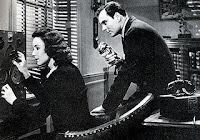
Phyllis Isley [Jennifer Jones] and Ralph Byrd
DICK TRACY'S G-MEN (15 chapter Republic serial/1939). Directors: John English; William Witney.

Criminal genius Zarnoff (Irving Pichel) manages to escape execution, and for 15 chapters matches wits, guns and devious plots with his nemesis, Dick Tracy (Ralph Byrd). Tracy gets out of many of his predicaments in a clever and realistic fashion. The more memorable of these predicaments include a death trap in chapter two; a crane dropping tons of lumber on Dick in chapter seven; a horrifying dirigible fire in chapter nine; and a room with a fiery dynamo in chapter ten. The climax with Tracy and Zarnoff squaring off in the desert is also memorable. Plenty of fisticuffs and a good use of pre-existing locations. Zarnoff tries to sell plans to a foreign power as well as steal a new explosive formula. If there is any problem with the serial it's that Pichel is rather colorless as the villain. Phyllis Isley plays Tracey's secretary and has little to do. There is absolutely nothing about her that would suggest she'd become a major star under the name Jennifer Jones. Not quite as good as Dick Tracy vs Crime Inc.

Verdict: More fun from Republic studios. ***.

NIGHT OF THE LEPUS


NIGHT OF THE LEPUS (1972). Director: William F. Claxton.

"Attention! Attention! There is a herd of killer rabbits heading this way!"

Roy (Stuart Whitman) and Gerry Bennett (Janet Leigh) are scientists who come to Arizona to deal with an explosion in the rabbit population and the dangers this represents to the ecosystem. Trying to curb the rabbits', ahem, appetites, their experiments only result in rabbits that are much larger and astonishingly ferocious. Supposedly remaining vegetarians, they nonetheless go around attacking people, leaving mutilated corpses in their wake. Now, it would have been one thing if the special effects department had come up with some fearsomely mutated rodents with large fangs and grotesque appearances, but all they did was use real cute bunny rabbits stuffed into miniature sets and interacting with people via process shots. Some of these sequences aren't badly done, but the sound effects are what make the cuddly bunnies seem so horrible. The best scene is the climax when Leigh tries to keep the surrounding rabbits away from her and her little daughter after their camper gets a flat tire at night. Rory Calhoun plays a rancher and DeForest Kelley, almost fresh from Star Trek, is a friend of the Bennetts. Played completely straight, the movie is completely absurd but somehow amusing and entertaining, if strictly for monster movie devotees.

Verdict: Stupid, but a lot of fun in spite of it. **1/2.

NIGHT WATCH

NIGHT WATCH (1973). Director: Brian G. Hutton.

Wealthy Ellen Wheeler  (Elizabeth Taylor) is strangely obsessed with thoughts of the death of her philandering first husband, causing concern in her second husband, John (Laurence Harvey) and her best friend, Sarah (Billie Whitelaw), who's there for a visit. Worse, Ellen is convinced that during a storm she saw a corpse in the window in the abandoned house across the way. But nobody seems to believe her, and the police think she's dotty. Night Watch is based on a novel by Lucille Fletcher, who also wrote the original play upon which Sorry, Wrong Number was based. While Night Watch may not be in  that league [and Liz Taylor is no Barbara Stanwyck] and the plot may or may not hold up under close scrutiny, it's still an entertaining picture with a darkly amusing final twist. Taylor (Rhapsody) is okay, but Harvey (Room at the Top) and especially Whitelaw (The Omen) are a lot better. NOTE: This is now available in a remastered edition from Warner Archives.

Verdict: Like an extended episode of The Alfred Hitchcock Hour. ***

PHANTOM FROM SPACE


PHANTOM FROM SPACE (1953). Director: W. Lee Wilder.

A man in a helmet with no head attacks two men and kills them, but primarily because they saw him as a menace and alarmed him. The authorities then enter the picture and try to track down the creature. It seems this "phantom" is an invisible alien who is trying to communicate with earthlings and not having much luck -- or vice versa. A police lieutenant named Bowers (Harry Landers) is one of those trying to get to the bottom of the mystery represented by the phantom. The movie is well-intentioned but rather dull. Director Lee Wilder was the brother of the much better-known and more celebrated Billy Wilder. Most of Lee Wilder's directorial effects were cheapie creepies like this film and the more entertaining Killers from Space but he did nail one out of the ballpark with the excellent Bluebeard's Ten Honeymoons starring George Sanders.  Harry Landers, who looks a lot like Ed Kemmer, did mostly televisions work, and was uncredited as the man with Miss Lonelyhearts in Hitchcock's Rear Window. There are no other name or even near-name actors in Phantom. Nice closing music by William Lava.

Verdict: You can miss it and still have a full life. **.

ZODIAC


ZODIAC (2007). Director: David Fincher.

The true story of the hunt for a serial killer who taunts the very people who are pursuing him, which include Inspector Toschi (Mark Ruffalo); Robert Graysmith (Jake Gyllenhaal), who wrote the book this is based upon; Inspector Armstrong (Anthony Edwards); Paul Avery (Robert Downey Jr.) of the San Francisco Chronicle; and others. The movie details how the case comes to take over the lives of everyone trying to shut the killer down permanently. Zodiac is completely absorbing and very well-acted --- John Carroll Lynch as a suspect is especially notable, among others -- but ultimately it's frustratingly open-ended. Still, there's never a boring moment.

Verdict: Recommended for fans of true crime. ***.

Thursday, October 27, 2011

ANACONDAS: THE HUNT FOR THE BLOOD ORCHID

Johnny Messner
ANACONDAS: THE HUNT FOR THE BLOOD ORCHID (2004). Director: Dwight H. Little.

In this sequel to Anaconda, an expedition is sent to Borneo to get a supply of a flower known as the Blood Orchid, which is believed to contain ingredients that might make it a veritable fountain of youth. It certainly works on the anacondas in the area, not only keeping them alive forever but assuring that they grow to tremendous proportions. Bill Johnson (an intense Johnny Messner) is the leader of the little group, which includes Jack (Matthew Marsdon); "Sam" (KaDee Strickland), Jack's assistant; Cole (Eugene Byrd), who's nervous if likable; and Ben (Nicholas Gonzalez). The cast is pretty good, and the characters seem to care about each other and act bravely for the most part. There's a terrific climax in a giant snake pit. This is much more entertaining than expected, a good old-fashioned "B" movie for monster fanatics.

Verdict: Like an old-time creature feature. ***.  


THE GALE STORM SHOW / OH SUSANNA!

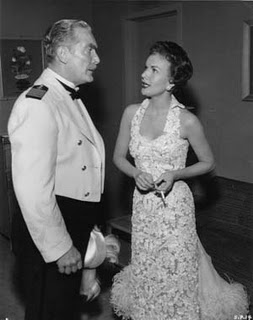
Roy Roberts and Gale Storm
THE GALE STORM SHOW [OH SUSANNA!] 1956 - 1960.

After My Little Margie wrapped up its run, star Gale Storm wasn't especially interested in doing another series, but she was talked into this one, probably because of its simplicity and unlimited potential for story ideas. In this Storm plays Susanna Pomeroy, the social director on a cruise ship. Susanna was basically Margie grown up. Storm had just started a recording career around this time, so she sang at least one number in most of the episodes. Her roommate and best friend was Elvira "Nugie" Nugent (Zazu Pitts), who ran the beauty parlor on board, but the main "relationship" in the show was the love/hate one she had with her boss, Captain Huxley (Roy Roberts). Adversaries from the first, they eventually developed a grudging fondness for each other. British actor James Fairfax was another regular for about half the episodes as the stewart, Cedric. Storm could overact, trying too hard for a laugh -- she was certainly no Lucille Ball or Joan Davis -- but she was still a funny, gifted performer and she had a nice singing voice. In her memoirs, Storm admitted that more people remembered her in Margie than in this show, and maybe the former was "funnier," but The Gale Storm Show had its moments and was in general a very pleasant series. [Apparently the exact title was "The Gale Storm Show: Oh Susanna" and only "Oh Susanna" was used in syndication, but who knows?] Roberts made a perfect foil for Storm, and Pitts was her usual adept and dithery self.

Even when the show wasn't a laugh riot, the stories often held the attention in spite of it. Still, most of the episodes I've seen [about 80 out of 125] never rise above a B+ level. The very few "A" episodes include: "For Money or Love," in which Susanna gets a rich guy on the rebound; "It's Murder, My Dear," which guest-stars a wonderful Boris Karloff [during his tenure on The Veil anthology series] in a dual role; "The Parisian Touch," with some funny tomfoolery over an allegedly valuable painting [with Elvia Allman and Vincent Padula]; and "Singapore Fling," in which a talking mynah bird who says bad things about the captain nearly gets Susanna into hot water; Keye Luke guest-stars. Other memorable episodes include "The Chimpanzee," which features a talented and adorable chimp; "Model Apartment" [Susanna sub-lets, to her regret]; "Love and Kisses" [love between a passenger and a stoker]; "It's Only Money" [Nugie thinks she's inherited a fortune]; "Super Snoop" [Susanna mistakes Nugie for a snitch]; "Heaven Sent" [the gals try to market a supposedly new perfume, with Jacques Bergerac]; "The Magician" [who is also a kleptomaniac]; "Sweepstakes Ticket," in which Dick Miller swipes a winning ticket from a deckhand; and "Card Sharp," which guest-stars William Frawley and could have been sub-titled "Margie Meets Fred Mertz." Other guest-stars on the show included Gene Nelson, Percy Helton, William Bishop, Irving Bacon, Margaret Hamilton, Jay Novello, Ken Clark [a Texas millionaire], Anthony Dexter [gypsy king], Steve Dunne, King Donovan, Edd Byrnes, Jim Backus, Joi Lansing, Pat Boone, and Jerome Cowan.

Although Susanna, Cedric and other crew members often reacted to the captain as if he were an ogre, he never seemed so worthy of their contempt, and frankly, his ire at "Miss Pomeroy" often seemed warranted, as she was a screw-up. While Susanna's schemes were generally for positive reasons, in one episode she seems almost manically determined to expose a phony medium even though most sensible people will agree that anyone who sees a medium as anything other than entertainment deserves to be taken. In the show's final episode, "Show Biz,"  Jack Albertson plays a washed up vaudevillian. Unfortunately, nothing he does when he gets to perform displays the talent the character was supposed to possess [although Albertson himself is a fine actor].

The show lasted for four seasons.

Verdict: A good cast puts this over. ***.

V -- THE FINAL BATTLE (1984)


V: THE FINAL BATTLE (1984). Director: Richard T. Heffron.

In this sequel to the original 1983 mini-series, V,  the war continues between human rebels and the invading force of alien Visitors. In this somewhat more entertaining sequel, Willie (Robert Englund), the "nice" alien, is taken captive by the resistance, even as one of their number, annoying young Robin (Blair Tefkin), discovers that she is pregnant with a half-alien baby. There's a nasty young human traitor named Daniel (David Packer). Julie (Faye Grant) is the leader of the resistance, and the scenes when she is taken captive and tortured and brain-washed go beyond the point of tedium. Mike Donovan (Marc Singer), hero of the first installment, is in a private war with his nasty collaborationist step-mother (Neva Patterson). Andrew Prine, Dick Miller, and Michael Ironside all appear, but the most amusing guest-star is Sarah Douglas as an alien commander named -- get this -- Pamela. It's already remarkable that the aliens use their Earth names to refer to one another even in private, but Pamela shows up from deep space sporting a thoroughly English accent [she even says "lefttenant" instead of "Lieutenant"]! This undercuts any seriousness intended by the producers, and the religiosity of the piece is also a bit irritating. There are some good scenes in this but it was all much, much better done in last year's unfortunately canceled ABC series, V, which lasted for two seasons. Jane Badler, who played head alien Diana in the 80's version, guest-starred as a variation of that character in the more recent series.

Verdict: Looks like those visitors are gone for good. **1/2.

MOON OF THE WOLF

David Janssen
 MOON OF THE WOLF (1972 telefilm). Director: Daniel Petrie.

Louisiana sheriff Aaron Whitaker (David Janssen) investigates the murder of a young woman in his town, and there are several suspects. These include the woman's mad-at-the-world brother, Lawrence (Geoffrey Lewis), Dr. Drutan (John Beradino), who may have gotten her pregnant, the wealthy Andrew Rodanthe (Bradford Dillman), or his wife, Louise (Barbara Rush), old Tom (Royal Dano) or his son (John Chandler), among others. But the injuries make Whitaker wonder if she might have come afoul of a rabid dog -- or something worse, such as a loup garou. The performances aren't bad in this, with Rush, Lewis, Janssen, and Claudia McNeil as Sarah taking top honors, but as werewolf movies go it's fairly minor. The identity of the werewolf seems obvious almost from the first. Moon of the Wolf is very typical of the type of horror telefilms that were being churned out in the seventies; this is neither better nor worse than most.

Verdict: Not badly done for what it is but no surprises. **.

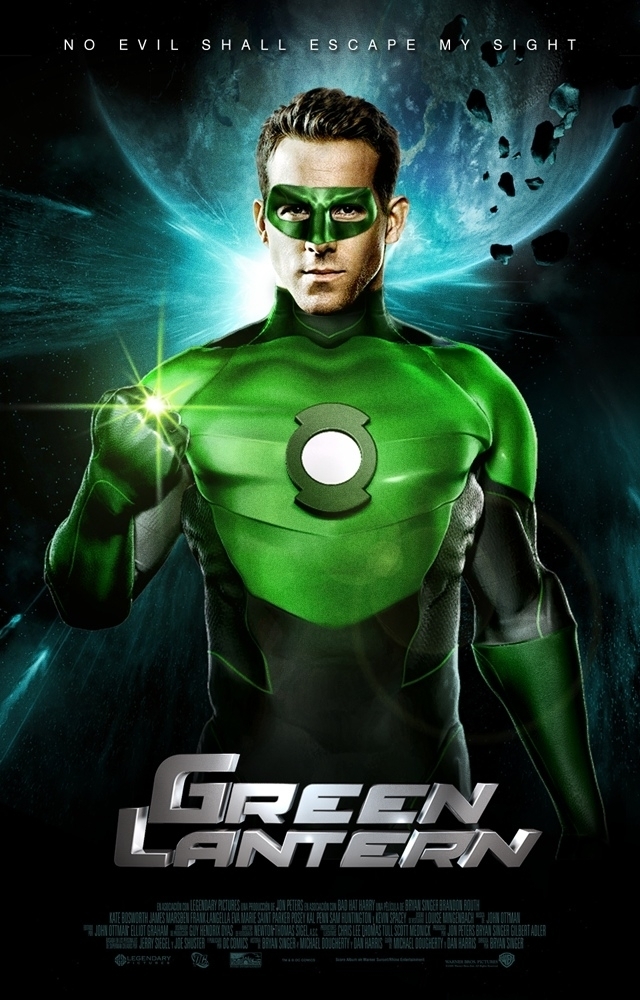
GREEN LANTERN (2011)

GREEN LANTERN (2011). Director: Martin Campbell.

"I've seen you naked. You think I wouldn't recognize you because your cheek bones are covered?" -- Carol Ferris. 

The super-hero Green Lantern of the "silver age" first appeared in comic books in the late 1950's. In this big-screen adaptation, somewhat flighty [pun intended] test pilot Hal Jordan (Ryan Reynolds) is chosen by a dying alien named Abin Sur (Temuera Morrison) to be his replacement in an Intergalactic policing force known as the Green Lantern Corps. Jordan not only has to prove to some skeptical colleagues, including the obnoxious drill instructor Kilowog [voice of Michael Clarke Duncan] and the slightly bitchy Sinestro (Mark Strong), that he has the right stuff, but also himself -- as he doesn't exactly see himself as someone "without fear." In the meantime, the alien blue-skinned Guardians, who formed the Corps, learn that one of their number has been mutated into an evil and monstrous being known as Parallax -- and it's pissed off and coming to Earth. Other characters include Hal's sort of girlfriend, Carol Ferris (sexy Blake Lively), the parrot-like corpsman Tomar-Re (voice of Geoffrey Rush), smarmy Senator Hammond (Tim Robbins), and his weird son Hector (Peter Sarsgaard), who is becoming mutated and dangerous himself after examining the body of Abin Sur. Green Lantern takes a while to get going, looking too much like a video game in the beginning, but once Jordan puts on the uniform it kicks into high gear and becomes quite exciting and entertaining. The cast is quite good, with Reynolds sheer perfection as our hero, although he gets a lot of competition from Strong as an impeccable Sinestro. Great scenic design. 68-year-old Campbell also directed the 2006 Casino Royale, the earlier Bond film Goldeneye, and Criminal Law, among many others. [Moral: You don't have to be a comparative kid to handle a trendy big-screen action flick.] NOTE: You can read more about the early comic book adventures of Green Lantern, Sinestro [originally a bad guy], Tomar-Re and the rest in The Silver Age of Comics.

Verdict: It's great fun watching GL do his "ring thing." ***.

Thursday, October 20, 2011

IMPACT

IMPACT (1949). Director: Arthur Lubin.

Walter Williams (Brian Donlevy) has just had a triumph in the boardroom and hopes to take a trip with his wife, Irene (Helen Walker). Instead he winds up giving a lift to his wife's alleged cousin, Jim (Tony Barrett, a rather unlikely lover boy). The best scene in the picture vividly details the fateful things that happen on the mountain highway between the two men. The problem with Impact is that it starts out as a high-tension thriller, then  halfway through settles into an unconvincing small-town romance, and never quite recovers from this. It is also incredibly illogical, with one character being arrested for murder even though it's clear that the "victim" was killed in an accident -- with witnesses no less [who are never called to testify -- sure!] Donlevy isn't a bad actor, but he lacks the vulnerability to make the romantic scenes work, and Ella Raines, as the woman he falls for, is only adequate. Charles Coburn is miscast as an Irish cop on the case. He isn't terrible, but this is one of his rare unimpressive performances. Anna May Wong [Daughter of Shanghai] has a small but pivotal role as a maid, and Philip Ahn [Red Barry] turns up as her uncle. Clarence Kolb of My Little Margie appears in the opening boardroom scene. As expected, Helen Walker [Nightmare Alley] gives the most vital performance as Walter's wife.

Verdict: Lots of potential in this, but a weak script and some indifferent acting put paid to an interesting premise. **1/2.

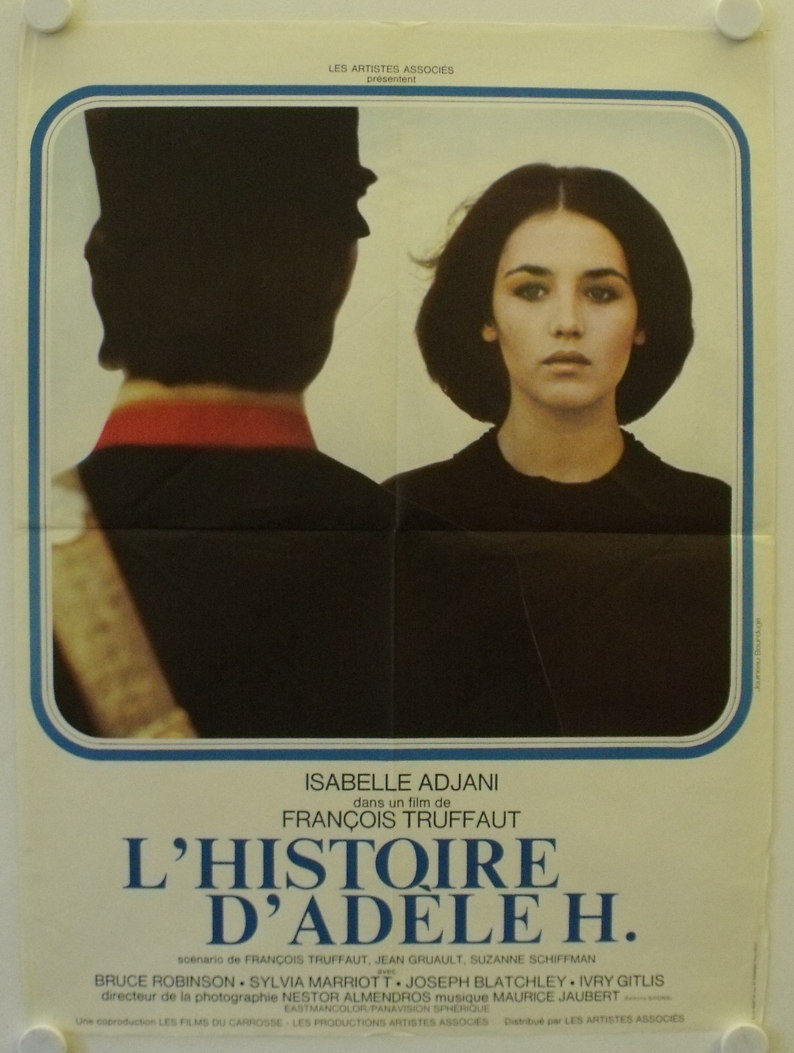
THE STORY OF ADELE H.

THE STORY OF ADELE H. (1975). Director: Francois Truffaut.

Based on true events in the life of Adele Hugo, daughter of Victor Hugo, this absorbing movie shows how the young Adele (Isabelle Adjani) follows a man with whom she had a fling, Lt. Albert Pinson (Bruce Robinson), to Nova Scotia where he has been stationed. The trouble is that Pinson no longer has any feelings for Adele, which the emotionally disturbed woman at first refuses to acknowledge and then simply disregards altogether. Pinson's rejection only seems to exacerbate and hasten the mental instability that was already lurking inside Adele's sensitive mind, and she descends into a pathetic and desperate state. Adjani gives an adept, restrained performance that doesn't clue us in to her incipient dementia too quickly, and Robinson as the object of her obsession, Sylvia Marriott as a sympathetic landlady, Joseph Blatchley as a bookstore owner, and Ivry Gitlis as an alleged hypnotist are all excellent support. The film follows the basic facts pretty closely. Other films of romantic obsession and tragedy include Letter from an Unknown Woman and A Summer Story.

Verdict: One of the over-rated Truffaut's better movies. ***1/2.

TRAUMA (1962)

TRAUMA (1962). Writer/director: Robert Malcolm Young.
Young Emmaline (Lorrie Richards) loses her memory when she sees the murder of her aunt (Lynn Bari) at the family swimming pool. She already had the trauma that same evening of discovering that one of her friends was murdered, so this second death, personally witnessed, puts her over the edge. Some years later she returns to the house with her new husband, Warren (a snippy John Conte), and some memories begin to surface. There's an architect roaming the estate, some other shady characters, and Warren himself may be up to shady business. Will she remember the killer before he does away with her? Richards was "introduced" in this picture although she had previous credits, mostly television work as well as the film The Magic Sword. Her Emmaline is annoyingly hysterical throughout the movie. Conte did a lot of TV and voice-over work, and appeared several times on Perry Mason. Bari had appeared in films and on TV since the early thirties. Young had no subsequent directorial credits but did a lot of writing for television. Trauma holds the attention but it isn't very memorable. An unusual feature is that the credits for the film don't appear until fifteen minutes into the running time. The one-word dramatic title was probably meant to invoke comparisons with Psycho, but this movie is nowhere in the same league.

Verdict: Grade C minor "shocker" with some minor appeal. **1/2.

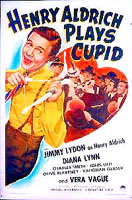
HENRY ALDRICH PLAYS CUPID

HENRY ALDRICH PLAYS CUPID (1944). Director:Hugh Bennett.

Henry (Jimmy Lydon) is in dutch with Principal Bradley (Vaughan Glaser) and figures he might become an old softie if he only had a wife. [Apparently Henry and everyone else forgot that confirmed old bachelor Bradley actually had a wife who appeared in Henry and Dizzy and was played by Maude Ebern, who ironically has a small bit in this picture.] Suspecting that the principal's stern countenance might work against him, Henry encloses a photo of a man he thinks is his uncle when he [unknown to the principal] places a lonely hearts ad for Bradley. Alas, the photo is actually of Senator Caldicott (Paul Harvey), a hated rival of Henry's father (John Litel), and when strange women come rushing up to the married man thinking he's their dreamboat, he's convinced Mr. Aldrich put them up to it. Uh oh. It's Henry who's up to it -- and how! Pretty funny entry in this long-running series, which only had one more picture to go. Vera Vague is one of the women who answers the ad. Charles Smith and Diana Lynn are on hand as Dizzy and Phyllis.

Verdict: More Aldrich fun. ***.

THE ADVENTURES OF SIR GALAHAD

THE ADVENTURES OF SIR GALAHAD (15 chapter Columbia serial/1949). Director: Spencer Bennet.

A strange new knight named Sir Galahad (George Reeves) marches into Camelot, wins a jousting tournament, and is invited to join the Knights of the Round Table by King Arthur (Nelson Leigh) himself. Alas, pressed into guard duty over the mystical sword Excalibur, Galahad is knocked out and the sword stolen. Galahad comes under suspicion, and vows to recover Excalibur and return it to Arthur before its absence causes the destruction of Camelot. Other suspects include the Saxon king Ulric (John Merton), the Black Knight, whose identity is unknown, Morgan le Fay (Pat Barton). and even Merlin the Magician (William Fawcett). With lots of swordsplay, an enchanted forest whose branches grab at victims, and a mysterious Lady of the Lake, you'd think Sir Galahad would make a rousing serial, but for the most part it's routine and unexciting. There are a couple of decent cliffhangers, however, such as when Galahad falls before a stampede of horses, is trapped by a moving wall of spears, and is nearly crushed by a spiked iron ball. But these highlights are few and far between. Reeves, the subject of the film Hollywoodland, seems uncomfortable at times. Rick Vallin plays Sir Gawain.

Verdict: One suspects that if Republic had done this it would have been a lot better. **.

THE PHANTOM PLANET


THE PHANTOM PLANET (1961). Director: William Marshall.

Captain Frank Chapman (Dean Fredericks) winds up on a asteroid that can maneuver through space and upon which the inhabitants are only a few inches high. Chapman shrinks inside his space suit, encounters the space Lilliputians, and winds up embroiled in their conflicts and problems. The women on the asteroid include Colleen Gray as Liara and Delores Faith as Zetha, while the male aliens include Anthony Dexter (Fire Maidens of Outer Space; Valentino; Three Blondes in His Life), former silent star Francis X. Bushman (The Three Musketeers; 12 to the Moon, also with Dexter) and even Richard Kiel (Jaws of the Bond movies) as a silly-looking "Solarite" monster. One good scene shows a lieutenant floating off into space after an accident, and some of the other FX in the film aren't bad. Some interesting ideas in this if nothing else. Gray starred as The Leech Woman a year earlier.

Verdict: Save it for a lazy afternoon. **1/2.

ANAMORPH


ANAMORPH (2007). Director/co-writer: Henry Miller.

New York City detective Stan Aubray (Willem Dafoe) and his sexy new partner Carl (Scott Speedman) investigate when a serial killer starts using the corpses of his victims as art, painting and posing them in specific, generally grotesque tableaus and then cluing the cops in to where they should stand to get the best "appreciation" of his ghastly projects. This aspect of this fair-to-middling serial killer thriller [with few real thrills] is intriguing, although nowadays it's the sort of thing you see every week on CSI and Criminal Minds. The movie is not badly acted, but it's no great surprise that it was released direct-to-video. James Rebhorn is the police chief, and Deborah Harry, formerly of the rock group Blondie, shows up briefly as an unnamed ":neighbor."

Verdict: Good ideas don't always make great movies. **.