Lively, entertaining reviews of, and essays on, old and newer films and everything relating to them, written by professional author William Schoell.
Showing posts with label John Litel. Show all posts

Thursday, April 25, 2024

MYSTERY OF MARIE ROGET

Maria Montez as Marie Roget
MYSTERY OF MARIE ROGET (1942). Director: Phil Rosen.

Notorious actress Marie Roget (Maria Montez of Arabian Knights) goes missing in Paris, and Inspector Gobelin (Lloyd Corrigan) and the famous Dr. Dupin (Patric Knowles of Five Came Back), who solved the case of the Murders in the Rue Morgue, are called in to investigate. After a few days Marie turns up alive, and her grandmother, Cecile (Maria Ouspenkaya of Frankenstein Meets the Wolfman) suspects that Marie's stepsister, Camille (Nell O'Day) may be the subject of a devious murder plot. There is also a faceless corpse of a woman in the river. Dupin accompanies Camille to a party, but when another dead body turns up in the river it may be a surprise to everyone whose it is. Dupin, with the help/interference of the Inspector, uncovers the murderer and his motive. 

Knowles and Corrigan
Mystery of Marie Roget
 is very loosely based on the famous short story by Edgar Allan Poe, which in turn was inspired by a real murder case -- the first mystery story to do this -- although the murder occurred in New York and not in Paris. One problem with this film adaptation is that there aren't enough suspects, which include John Litel as the family lawyer, and Edward Norris as Camille's shady fiance, and even the old grandmother herself. Although the film still has some suspense in spite of this, the solution doesn't come as much of a surprise. As for the cast, Corrigan is as fun as ever, Knowles makes a credible Dupin, Ouspenkaya is suitably peppery (and borderline bitchy with the Inspector), Montez looks classy and actually gives a perfectly good performance, and Litel and Norris are on-target throughout the proceedings. The film is well-paced under Phil Rosen's direction and well-produced. Rosen directed several Charlie Chan movies and many others. 

Verdict: Not Poe perhaps, but entertaining, atmospheric, and well-made. ***.  

Thursday, February 18, 2021

LADY WITH RED HAIR

LADY WITH RED HAIR
(1940). Director: Curtis Bernhardt. 

The "true" if fictionalized story of Caroline (Mrs. Leslie) Carter (Miriam Hopkins), who goes on the stage after she is divorced by her husband. The film suggests that Carter became an actress only to get money to fight for custody of her son, but in real life the boy actually stayed with his mother and was cut out of his father's will because of it. In the film Carter unrealistically tries to storm Broadway by coming in at the top instead of climbing from the bottom, but it is true that her association with David Belasco (a magnificent Claude Rains) gave an inestimable boost to her career. The film doesn't make clear that she was considered the American Sarah Bernhardt in her day. Richard Ainley plays her second husband, and as the film suggests, their marriage did signal the end of her association with Belasco (although in the film he comes in at the end to help guide her in one last production). Miriam Hopkins gives a solid performance, but up against Claude Rains there is little she can do to steal the picture. The supporting cast includes such sterling players as Laura Hope Crews, John Litel, Victor Jory, and Cecil Kellaway. A very young Cornel Wilde has a small role, and you probably won't notice Alexis Smith or Craig Stevens.

 Verdict: A lady you might like to make the acquaintance of -- on film, at least. ***.

Thursday, May 28, 2020

SHE WROTE THE BOOK

Mischa Auer and Joan Davis
SHE WROTE THE BOOK (1946). Director: Charles Lamont.

Jane Featherstone (Joan Davis of Around the World) is a prim and proper, intellectual science professor at the conservative Croydon College. She and everyone else on the faculty are appalled by the publication of a banned tell-all memoir entitled "Always Lulu," in which a woman's many amours are recounted in detail. No one knows that the author is actually the Dean's wife Phyllis (Gloria Stuart of Titanic). Phyllis can't collect the considerable royalties for the book unless she appears in person in New York, so she importunes her friend Jane to impersonate her. But when Jane is knocked out and becomes an amnesiac, she believes what everyone tells her, that she is Lulu, and takes on a whole new glamorous persona.

Joan Davis as "Lulu"
Given the excellent premise of this movie, as well as the cast members, one would think that She Wrote the Book was a laugh riot, but instead it's a disappointment. Joan Davis certainly gives it her all, and she gets some good support from Jack Oakie as the publisher's advertising manager; Mischa Auer as a man hired to woo her for money; Kirby Grant [In Society] as Eddie, a nice young guy who is attracted to Jane but definitely not to Lulu; and Thurston Hall as a wealthy ship builder who is mightily attracted to the supposedly oh-so-sexy and highly experienced "Lulu." John Litel is the dean and Jacquline deWit [The Damned Don't Cry] is the ship builder's jealous wife who threatens more than one person with a gun. The trouble with the film is not necessarily with the players but with a screenplay that lacks wit and never really pulls off the solid laughs it deserves, although there are a few amusing moments here and there. She Wrote the Book still manages to hold the attention and you do wonder how it will all turn out.

Verdict: Cute idea but the execution is only so-so. **1/2. 

Thursday, February 8, 2018

DOUBLE JEOPARDY

Robert Armstrong and Gale Robbins
DOUBLE JEOPARDY (1955). Director: R. G. Springsteen.

Marge (Gale Robbins of Three Little Words) is married to the drunken Sam Baggott (Robert Armstrong), who has trouble coming up with the rent money. Marge gets some comfort from the handsome used car salesman, Jeff (Jack Kelly), and when they discover Sam is getting blackmail payoffs, figure they should get themselves some of the loot. Sam's victim is wealthy Emmett Devery (John Litel), whose daughter, Barbara (Allison Hayes), is dating attorney Mark Hill (Rod Cameron) and who can sense something's up with her father. Then somebody dies ... Double Jeopardy is well-acted for the most part, especially by Armstrong [Sky Raiders] and Litel, and Hayes offers a lovely and sympathetic portrayal for a change, but Robbins is just a bit superficial as the femme fatale and Cameron is as stiff as a board. Minerva Urecal [Who's Guilty?] adds some spice in her portrayal of a disapproving landlady. There are a couple of tense sequences but the script lets the audience down in the long run. There's some suspense but no surprises. From Republic studios.

Verdict: Armstrong steals the show. **1/2.

Thursday, October 20, 2011

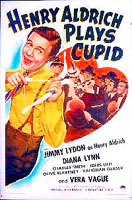
HENRY ALDRICH PLAYS CUPID

HENRY ALDRICH PLAYS CUPID (1944). Director:Hugh Bennett.

Henry (Jimmy Lydon) is in dutch with Principal Bradley (Vaughan Glaser) and figures he might become an old softie if he only had a wife. [Apparently Henry and everyone else forgot that confirmed old bachelor Bradley actually had a wife who appeared in Henry and Dizzy and was played by Maude Ebern, who ironically has a small bit in this picture.] Suspecting that the principal's stern countenance might work against him, Henry encloses a photo of a man he thinks is his uncle when he [unknown to the principal] places a lonely hearts ad for Bradley. Alas, the photo is actually of Senator Caldicott (Paul Harvey), a hated rival of Henry's father (John Litel), and when strange women come rushing up to the married man thinking he's their dreamboat, he's convinced Mr. Aldrich put them up to it. Uh oh. It's Henry who's up to it -- and how! Pretty funny entry in this long-running series, which only had one more picture to go. Vera Vague is one of the women who answers the ad. Charles Smith and Diana Lynn are on hand as Dizzy and Phyllis.

Verdict: More Aldrich fun. ***.

Thursday, September 8, 2011

HENRY ALDRICH, BOY SCOUT

HENRY ALDRICH, BOY SCOUT (1944). Director: Hugh Bennett.

Henry Aldrich (Jimmy Lydon) has become a troop leader in the boy scouts and is hoping to get a promotion by leading his team to victory in some games. Endangering this scheme is young Peter Kent (Darryl Hickman), the obnoxious son of an old classmate (Minor Watson) of Henry's father, Sam (John Litel) -- Henry has been put in charge of the boy. Meanwhile Henry is also hoping to impress his girl, Elise (Joan Mortimer), who is playing hard to get. This is an okay enough entry in the long-running movie series, although the sentimental aspects do become a bit cloying at times. Peter only gets in line after he gets beaten up, a suspect development to be sure. However, the cast --- including Charles Smith as Dizzy and Olive Blakeney as Mrs. Aldrich --  are as proficient as ever, the picture is often amusing, and there's a suspenseful and funny bit when Henry and Peter are caught on a crumbling cliff as Dizzy tries to haul them up on a shredding rope. Yikes! Darryl Hickman's brother Dwayne played Dobie Gillis on TV.

Verdict: Another pleasant saga in the life of the irrepressible Henry Aldrich. **1/2.

Thursday, August 18, 2011

HENRY ALDRICH HAUNTS A HOUSE

HENRY ALDRICH HAUNTS A HOUSE  (1943). Director: Hugh Bennett. 
"Things are looking up for this town -- murder and everything!"  -- Dizzy.
 Henry Aldrich (Jimmy Lydon) is up to his usual tricks in this zany installment of the comedy series.  When school principal Bradley (Vaughan Glaser) disappears while going through an allegedly haunted house, Henry is convinced that his is responsible for his murder due to a certain formula he imbibed; he's certain it temporarily changed him into a hulking ghoul. Henry has fallen for the oh-so-intellectual daughter, Elise (Joan Mortimer), of a scientist, and both she and his pal Dizzy (Charles Smith) help Henry investigate the house and discover the truth. And who's that mummy in the basement? John Litel and Olive Blakeney play Henry's long-suffering parents adeptly; Lydon and Smith are just wonderful. While this isn't quite Hold That Ghost, it does have its moments.

Verdict: Suspenseful and amusing. ***.

Thursday, June 16, 2011

HENRY ALDRICH SWINGS IT

HENRY ALDRICH SWINGS IT  (1943). Director: Hugh Bennett. 

"Yes, all men are like children."

Henry Aldrich (Jimmy Lydon) doesn't think much of classical music until he gets a crush on the pretty new music teacher (Marian Hall), who isn't afraid of a little swing. As usual there are serious complications when Henry gets mixed up in the robbery of famous musician Joseph Altman's (Fritz Feld) highly expensive Stradivarius. Girlfriend Phyllis has been replaced by Mimi (Mimi Chandler) but Dizzy (Charles Smith) is still part of the scene, as is grumpy high school principal Bradley (Vaughan Glaser), who hates "boogie woogie." Broadway composer Jule Styne [Funny Girl] contributed the snappy number "Ding Dong Sing a Song" and little Beverly Hudson nearly steals the show as powerhouse singer Margie. Along with some classical numbers, there's a swing version of Chopin! Lydon and Smith are marvelous, and they get fine support from John Litel and Olive Blakeney as Mr. and Mrs. Aldrich.

Verdict: Pleasant and amusing. ***.

Thursday, June 9, 2011

HENRY ALDRICH, EDITOR


HENRY ALDRICH, EDITOR (1942). Director: Hugh Bennett.

"Do you really think that any boy in his right mind can get into the trouble that you do?" -- Mr. Aldrich

"I have the utmost confidence in myself." --Henry

Henry Aldrich (Jimmy Lydon) becomes editor of the high school newspaper and that's when the trouble begins. He covers a fire, and writes about it so, eh, colorfully, that it's picked up by the regular paper and blown way out of proportion. Worse, the regular paper reports that Mr. Aldrich (John Litel, who is given more comedy to do than usual), is dying. Before long Henry is accused of being the firebug who's on the loose, and attends his own trial dressed in drag! Henry Aldrich, Editor has its cute moments, but it goes awry before the end. I mean, there's nothing particularly funny about Henry being trapped in a deadly warehouse fire. Lydon, Charles Smith as pal Dizzy, Rita Quigley as gal pal Martha and Vaughn Glaser as principal Bradley are all in good form.

Verdict: More hijinks with Henry. **1/2.

Thursday, June 2, 2011

HENRY AND DIZZY


HENRY AND DIZZY (1942). Director: Hugh Bennett.

"I guess I'm just a misfit."

Henry Aldrich (Jimmy Lydon) wrecks a boat that he borrowed when the store owner stepped away, and is told he either has to pay for a new boat or go to jail. In a hilarious sequence Henry and his pal Dizzy (Charles Smith) "clean" -- or rather destroy -- a house that belongs to principle Bradley (Vaughan Glaser; Maude Eburne is fun as his horrified wife). Trevor Bardette and Carl "Alfafa" Switzer play a father and son who compete in a contest with Henry and Mr. Aldrich (John Litel), and Dizzy and his dad (Olin Howlin). Noel Neill of Superman fame appears briefly as a girl that Henry tries to impress with his [lack of] boating skills. Mary Anderson seems a little too old and sex-sophisticated -- not to mention too tall -- to be teenager Henry's girlfriend, but Henry doesn't seem to mind. Litel and the other cast members are great, and Lydon is a very charming performer. This is his second appearance as Henry after Henry Aldrich for President.

Verdict: Another cute picture. ***

Thursday, May 5, 2011

HENRY ALDRICH FOR PRESIDENT


HENRY ALDRICH FOR PRESIDENT (1941), Director: Hugh Bennett.

 Following What a Life and Life with Henry, this introduces Jimmy Lydon as a much nerdier Henry than that essayed by Jackie Cooper in the first two films. However, Lydon is such a good actor that he can take a caricature and make him almost three-dimensional and sympathetic. "Dizzy" Stevens, originally played by Eddie Bracken, is now played by Charles Smith, who is somehow less geeky, and uses a normal voice to play the role. Henry's father, now played by John Litel, is completely changed from before, no longer the distant grump of the second film but more of a "pal" to his boy. As Henry's mother, Hedda Hopper has been replaced by the less-cosmopolitan Dorothy Peterson. The gals in Henry's life include Phyllis (Mary Anderson), who has a crush on him, and Geraldine (June Preisser), a pretty blonde who is enlisted to ensnare Henry in a high school plot. Irwin (Kenneth Howell), the boy running against Phyllis for class president, wants Henry to run as well so that those two will divide the votes and make him the winner. Instead, Phyllis drops out and against his father's advice -- Aldrich Sr. thinks his son is just being used -- Henry mounts a serious campaign with the help of Dizzy, causing expected and amusing complications.

Verdict: More fun with Henry. ***. 

Wednesday, December 3, 2008

NANCY DREW AND THE HIDDEN STAIRCASE

NANCY DREW AND THE HIDDEN STAIRCASE (1939). Director: William Clemens. 

Loosely based on The Hidden Staircase, this uses many of the elements of the novel but is basically a new story. Two elderly sisters live in a mansion and have had to abide for twenty years with their late father's ridiculous will, which says they will inherit the place if they live in the house that entire time and if at least one of the sisters is present in the mansion every night. There's two weeks to go, after which the women intend to give the home to a charitable medical facility. When their chauffeur is murdered, the women panic and Nancy Drew (Bonita Granville) does her best to convince everyone that his death was actually a suicide. She investigates when the old ladies claim items have been stolen from their home even though all the doors and windows were locked. As usual she inveigles the hapless "Ted" Nickerson (Frankie Thomas) into helping her with her schemes. In the books Nancy was brave and occasionally foolhardy but in this she's irresponsible and stupid -- and even screams in fright at a frog! The idiot police chief lets Ted handle the murder weapon. The climax isn't bad, however, and there are some amusing sequences. John Litel is again cast as Carson Drew. 

Verdict: The last of Nancy on the big screen [at that time] -- and not a moment too soon! **.

Friday, November 7, 2008

NANCY DREW -- DETECTIVE

NANCY DREW -- DETECTIVE (1938). Director: William Clemens.

Although the "original" screenplay is attributed to Kenneth Gamet, this was clearly based on one of the original Nancy Drew novels, "Password to Larkspur Lane." A wealthy woman who is on the verge of donating a large sum of money to Nancy's school suddenly disappears, and Nancy (Bonita Granville) tries to find her. In this she is aided or hindered, depending on the situation, by her father Carson (John Litel), her friend Ted Nickerson (it was "Ned" in the books), and the police. Ted is played by Frankie Thomas, and he's basically been turned into comedy relief, even improbably dressing in drag at one point. Hannah Gruen, the housekeeper and mother substitute in the books, has been replaced by the dizzy maid Effie (the oddly-named Renie Riano) in the movie. Granville makes a spirited (perhaps too spirited) Nancy Drew, and the film is decidedly minor but admittedly charming at times.

Verdict: You could do worse. **1/2.

Wednesday, April 16, 2008

DON WINSLOW OF THE NAVY

DON WINSLOW OF THE NAVY (1942). 13 chapter Filmcraft Inc. serial. Directed by Ford Beebe and Ray Taylor.

Despite some okay action set pieces this is not one of the better or more entertaining serials. Dick Foran-type Don Terry is okay as Commander Winslow of US Naval Intelligence, who takes on the forces of saboteur The Scorpion, whose chief aide is played by John Litel. Somehow this Filmcraft production lacks that certain energy and no-how of the Republic and Columbia serials despite the talents at the helm. The Scorpion, who rarely appears, is a completely colorless and unmasked foe [he's still on the loose at the end] and the musical score is terrible, languid and generally inappropriate. A couple of memorable scenes: a hungry shark sets off in pursuit of Don, and Don falling unconscious as a plane he is in dives toward the ocean. But this is not very good all told.

Verdict: Skip it. *1/2.,

Saturday, January 12, 2008

HENRY ALDRICH GETS GLAMOR


HENRY ALDRICH GETS GLAMOR (1943). Director: Hugh Bennett.

The Henry Aldrich series, about a bumbling, girl-crazy teen, was made to cash in on the popularity of the Andy Hardy series. This entry is a charming if mildly amusing time-waster that has Henry winning a date with a glamorous movie star, Hilary Dane, played by Frances Gifford. Hoping to convince her studio that she's innocent enough to play Juliet in a new production of Romeo and Juliet, Gifford decides to string Henry along for a romance and goes to the dance with him. When a photo of him supposedly kissing the star winds up in the paper in Centerville, everyone improbably assumes that Henry has become a big lover boy. Soon he's gotten the reputation of a wolf, and his father's plans to run for office are derailed. His reputation as an unlikely Casanova is cemented when he takes Gifford out to the secluded patio at the dance and walks back in sporting the huge lipstick imprint of a kiss on his face. Jimmy Lydon offers a splendid comic portrayal as Henry Aldrich, and he gets able support from Charles Smith as his loyal buddy “Dizzy” and Diana Lynn as Phyllis, the shy girl who has an unrequited crush on him. John Litel is Aldrich's father; while competent, he's not in the league of Lewis Stone, the “father” of the Hardy series.

Verdict: Mildly amusing and easy to take. **1/2.