Lively, entertaining reviews of, and essays on, old and newer films and everything relating to them, written by professional author William Schoell.
Showing posts with label Gale Storm. Show all posts

Thursday, March 14, 2024

MAN FROM CHEYENNE

Roy Rogers
MAN FROM CHEYENNE (1942). Director: Joseph Kane. 

Roy Rogers (Roy Rogers) has been traveling far from home in Cheyenne, Wyoming when he returns after ten years to renew old acquaintances with the likes of surrogate father Gabby Whittaker (Gabby Hayes). his daughter Sally (Sally Payne), and old crush Judy Evans (Gale Storm). He learns that some mysterious rustlers have been causing problems, and he is asked by a Cattlemen's Association to investigate as he won't be seen as a suspicious stranger. Meanwhile Roy meets up with fellow rancher Marian Hardy (Lynne Carver of Everybody Sing), who is keeping secrets, and Gabby's foreman Bob (Bob Nolan), who seems to have a hankering for Judy. 

Polite dislike: Gale Storm; Lynne Carver
Frankly, there's not much to this semi-musical modern-day cowboy film set in 1941 when it was made. However, it's pleasant enough, as are the actors and the songs. It probably won't be much of a surprise as to who's behind the gang of rustlers. Sally Payne is a homely Una Merkel lookalike, Lynne Carver needs a lot more meat on her bones, and Storm is as proficient and likable as ever. She and Carver have a catfight at one point, with Storm delivering a knock-out kayo to Carver's chin. James Seay plays Sheriff Jim, William Haade is the sinister Ed, and Jack Ingram is the rustler, Chuck. The Sons of the Pioneers play the ranch hands and do some singin'. Gabby Hayes is more bearable than usual in this. Rogers and Payne also appeared in Romance on the Range.  

Verdict: Okay time-passer with good-looking' Roy. **1/4. 

Thursday, June 7, 2018

FRECKLES COMES HOME

Mantan Moreland and Laurence Criner
FRECKLES COMES HOME (1942). Director: Jean Yarbrough.

Summoned by his old pal Danny (Marvin Stephens of Borrowing Trouble), "Freckles" Winslow (Johnny Downs) comes back to Fairfield, Indiana, accompanied on the bus by a stranger named Muggsy Dolan (Water Sande of Blonde Ice). Muggsy pulled off a bank robbery in which a guard was killed, and has taken it on the lam, figuring quiet, isolated Fairfield is as good a place to hide out as any. He gets it into his head to rob the bank and brings in an associate, Quigley (Bradley Page). Danny lost money that he needed to pay bills for his hotel by buying an alleged gold-finding machine, and wants Freckles' help in using old girlfriend Jane Potter (Gale Storm) to convince her banker father, Hiram Potter (John Ince), to build a new highway into town, increasing business. Freckles is irritated because Jane seems to go for Quigley's oily charm. Meanwhile hotel porter Jeff (Mantan Moreland) has fun trying to convince Quigley's chauffeur, Roxbury (Lawrence Criner), to buy his phony machine. Freckles Comes Home has an amiable cast, including Betty Blythe [The Spanish Cape Mystery] as Hiram's wife and Irving Bacon as the ditsy town constable, but the picture is completely stolen by Moreland and Criner, especially in a very funny sequence when the two argue over which of them is to get the more comfortable bed in their hotel room. These are two great comic actors in their prime. Otherwise this is a typical Monogram quickie. Apparently this has nothing to do with the old Freckles newspaper comic strip.

Verdict: Short Monogram flick is fairly easy to take. **3/4.

Thursday, September 15, 2016

SWING PARADE OF 1946

Will Osborne and Mary Treen
SWING PARADE OF 1946 (1946). Director: Phil Karlson.

"... a tender word can mend a lot."

Aspiring singer Carol Lawrence (Gale Storm) is thrown out of her boarding house and can't get a job, so she becomes a process server for a grumpy, disapproving man, Mr. Warren (Russell Hicks of The Flying Saucer), who wants to close down his own son, Danny's, nightclub. Instead. Carol takes a job with Danny (Phil Regan), getting her in trouble with Warren and almost with Danny when he learns about the summons. Middle-aged Marie (Mary Treen), who seems to like Danny, develops a hankering for bandleader Will (Will Osborne) instead and tells off Old Man Warren. Then we have the Three Stooges as terrible waiters, and a couple of pleasant enough song numbers. Storm is perky and efficient, as ever, and once-popular Regan [We're in the Money] is handsome and has a smooth singing voice. Mary Treen [Blonde from Brooklyn] was a likable character actress with about a zillion credits, but although she had a way with a line and was frequently both adept and amusing, she never quite became well-known like, say, Eve Arden. There was something a little more distinctive about Arden, and while she wasn't a raving beauty, either, she was better-looking and more sensual than Treen. Treen has a bit more to do in this film but, alas, it's a Monogram picture. Will Osborne was a bandleader of the time who played himself in a couple of movies and was appealing. Singer Connee Boswell also plays herself; she had a few other credits as well.

Verdict:  Another amiable but third-rate Monogram musical. **.

Thursday, February 5, 2015

CAMPUS RHYTHM

Reaction to a kiss: Gale Storm and Johnny Downs
CAMPUS RHYTHM (1943). Director: Arthur Dreifuss.

Joan Abbott (Gale Storm) sings on the radio for her sponsor, Crunchy Wunchy cereal, but she'd really rather go off to college. When her guardian, Uncle Willie (Douglas Leavitt), renews her contract without her knowledge, she takes off for Raleigh College by assuming the name of the sponsor's high-spirited secretary, Suzie Smith (Marie Blake). There she encounters the oh-so-serious editor of the campus paper, "Scoop" Davis (Johnny Downs); the dreamy, likable lover boy, Buzz (Robert Lowery); the weird if lovable Harold (Candy Candido); saucy, singing Babs (GeGe Pearson); and the venomous Cynthia (Claudia Drake of The Face of Marble), who's out to get her because she caught the eye of Buzz. In an attempt to find their wayward songstress, the sponsor holds a contest, and the funniest scene has to do with Uncle Willie traveling to Raleigh to find his niece and winding up in the hands of the law. The cast, led by a sparkling-as-ever Storm, is more than capable, and the film is pleasant. Babs sings "Oh, you character!" while Joan warbles "But Not You" to Buzz. GeGe Pearson has a nice voice and a lot of personality to go with her horse face; Candy Candido is the weirdest of novelty singers (and speakers) as his voice can go from falsetto to bass all within the same sentence. Both of them later did a lot of voice-over work for television and movies. John Duncan plays one of the fraternity boys; six years later he would team with Robert Lowery for the serial Batman and Robin, wherein he played the latter. The strange thing about this movie is that there's no fade out clinch between Storm and Downs, although it's intimated that they've gotten together again, but considering Scoop's behavior it's even more likely that they didn't. Downs [The Mad Monster] also starred in a movie called All-American Co-Ed, which is also known as Campus Rhythm, but it is not the same picture.

Verdict: Easy to take. **1/2.

Thursday, June 20, 2013

LET'S GO COLLEGIATE

Frankie and Tad have both gotten the kiss-off from their girlfriends


LET'S GO COLLEGIATE (1941). Director: Jean Yarbrough.

Gale Storm! Mantan Moreland! Frankie Darro! What a stellar "B" movie cast this picture has. Frankie (Frankie Darro) and Tad (Jackie Moran), members of the Kappa Psi Delta fraternity of Raleigh U, have promised to deliver a sports hero named Bob Terry in order to give the school a champion rowing team. Then they discover that Terry can't come because he's just been drafted. Now none of this is their fault, but instead of simply telling the truth -- which no reasonable person could blame them for -- they decide to pass off an uneducated burly and surly truck driver named "Herc" Bevans (Frank Sully) as Terry. [Of course, if the boys acted sensibly there would be no movie.] Herc appalls the professors with his stupidity, has a hatred of water which makes rowing problematic, and worst of all steals away the fellows' girlfriends, Midge (Gale Storm) and Bess (Marcia Mae Jones). This idea could have been turned into a very cute picture but the laughs are very sporadic in the movie, and most of them are provided for by Mantan Moreland as an apparent chauffeur named Jeff.  Marguerite Whitten appears as Jeff's girlfriend Malvina, and Tristram Coffin shows up as an alumni and police officer. Keye Luke appears as another student named Buck Wing and he's surprisingly serious, probably trying to hold on to his dignity. The performances in this are good, with Sully effective as the impersonator.  There's even a nice number entitled "Let's Do a Little Dreaming," but this is more of a time-waster than anything else. This is one of several pictures Darro did with Moreland for Monogram. Moran was "Buddy" in the Buck Rogers serial, and Marcia May Jones had a significant role in These Three.

Verdict: Interesting cast given too little of note to do. **.

Thursday, May 2, 2013

IT HAPPENED ON FIFTH AVENUE

IT HAPPENED ON FIFTH AVENUE (1947). Director: Roy Del Ruth.

Aloysius T. McKeever (Victor Moore) is a bum who lives in boarded up mansions while the owners are away for the season. His latest domicile is the Fifth Avenue mansion of Michael O'Connor (Charles Ruggles). A new interloper in the mansion is a homeless soldier, Jim (Don DeFore), and through him a couple of families with children who also need a place to stay. Popping into the mansion for a coat is O'Connor's daughter, Trudy (Gale Storm), who doesn't tell anyone who she is, and when her father and divorced mother (Ann Harding) show up, swears them to secrecy as well. So the world's richest man pretends to be a bum while a hobo dines on his food and wears his clothing ... only in Hollywood! It Happened on Fifth Avenue is meant to be a frothy, hilarious social comedy, but it falls utterly flat. First of all, no movie can convince anyone that it's better to be a homeless hobo than to have money and security -- of course O'Connor is the stereotype of the rich man who has lost touch with real values -- and the film is miscast and not very funny. Don DeFore could be fine in certain roles such as in Too Late for Tears, but he's not exactly Cary Grant. Pretty Gale Storm is equally competent, but this was before she developed a real flair for comedy as on My Little Margie. Victor Moore and Charlie Ruggles are old pros, as is Ann Harding [The Unknown Man], who is pretty much wasted as Trudy's mother; all are given sub-standard material. Grant Mitchell of The Man Who Came to Dinner is his customary tight-assed self. Alan Hale Jr. [Advance to the Rear], later of Gilligan's Island, is fine as one of Jim's soldier buddies. Although Gale Storm could sing and even cut some recordings in later years, her singing voice is dubbed in this.

Verdict: Almost like watching paint dry. *1/2.

Thursday, November 10, 2011

I AIN'T DOWN YET: THE AUTOBIOGRAPHY OF MY LITTLE MARGIE GALE STORM

I AIN'T DOWN YET: THE AUTOBIOGRAPHY OF MY LITTLE MARGIE. Gale Storm with Bill Libby. Bobbs-Merrill; 1981.

Gale Storm appeared in some musicals and other movies for Monogram and other studios before finding lasting fame on two hit TV series, My Little Margie and Oh Susanna!. A big problem with this book is that it's less of a performing arts autobiography than it is an inspirational tome about alcoholism. Storm can't figure out why she began drinking [the fact that it got serious when she switched from hit TV shows to dinner theater may have had something to do with it] but she was in serious denial over her problem even when her liver expanded to "three to four times its regular size." The book has a few pages on show business and the people Storm worked with, and many, many more pages that read as a testimonial for an alcoholism clinic that Storm credits with saving her life and for which she eventually became a paid consultant. This book may have some value for people with drinking problems, but if you're expecting something that tears the lid off TV and tinsel town, look elsewhere. Storm doesn't even have that much to say about her co-stars. Sections are written by her husband, four children, and even the head of the aforementioned clinic. Storm's religiosity occasionally becomes borderline cloying. Readable, fast-paced, and not badly done for what it is, it still should have been so much more.

Verdict: Watch an episode of My Little Margie instead. **1/2.

Thursday, October 27, 2011

THE GALE STORM SHOW / OH SUSANNA!

Roy Roberts and Gale Storm
THE GALE STORM SHOW [OH SUSANNA!] 1956 - 1960.

After My Little Margie wrapped up its run, star Gale Storm wasn't especially interested in doing another series, but she was talked into this one, probably because of its simplicity and unlimited potential for story ideas. In this Storm plays Susanna Pomeroy, the social director on a cruise ship. Susanna was basically Margie grown up. Storm had just started a recording career around this time, so she sang at least one number in most of the episodes. Her roommate and best friend was Elvira "Nugie" Nugent (Zazu Pitts), who ran the beauty parlor on board, but the main "relationship" in the show was the love/hate one she had with her boss, Captain Huxley (Roy Roberts). Adversaries from the first, they eventually developed a grudging fondness for each other. British actor James Fairfax was another regular for about half the episodes as the stewart, Cedric. Storm could overact, trying too hard for a laugh -- she was certainly no Lucille Ball or Joan Davis -- but she was still a funny, gifted performer and she had a nice singing voice. In her memoirs, Storm admitted that more people remembered her in Margie than in this show, and maybe the former was "funnier," but The Gale Storm Show had its moments and was in general a very pleasant series. [Apparently the exact title was "The Gale Storm Show: Oh Susanna" and only "Oh Susanna" was used in syndication, but who knows?] Roberts made a perfect foil for Storm, and Pitts was her usual adept and dithery self.

Even when the show wasn't a laugh riot, the stories often held the attention in spite of it. Still, most of the episodes I've seen [about 80 out of 125] never rise above a B+ level. The very few "A" episodes include: "For Money or Love," in which Susanna gets a rich guy on the rebound; "It's Murder, My Dear," which guest-stars a wonderful Boris Karloff [during his tenure on The Veil anthology series] in a dual role; "The Parisian Touch," with some funny tomfoolery over an allegedly valuable painting [with Elvia Allman and Vincent Padula]; and "Singapore Fling," in which a talking mynah bird who says bad things about the captain nearly gets Susanna into hot water; Keye Luke guest-stars. Other memorable episodes include "The Chimpanzee," which features a talented and adorable chimp; "Model Apartment" [Susanna sub-lets, to her regret]; "Love and Kisses" [love between a passenger and a stoker]; "It's Only Money" [Nugie thinks she's inherited a fortune]; "Super Snoop" [Susanna mistakes Nugie for a snitch]; "Heaven Sent" [the gals try to market a supposedly new perfume, with Jacques Bergerac]; "The Magician" [who is also a kleptomaniac]; "Sweepstakes Ticket," in which Dick Miller swipes a winning ticket from a deckhand; and "Card Sharp," which guest-stars William Frawley and could have been sub-titled "Margie Meets Fred Mertz." Other guest-stars on the show included Gene Nelson, Percy Helton, William Bishop, Irving Bacon, Margaret Hamilton, Jay Novello, Ken Clark [a Texas millionaire], Anthony Dexter [gypsy king], Steve Dunne, King Donovan, Edd Byrnes, Jim Backus, Joi Lansing, Pat Boone, and Jerome Cowan.

Although Susanna, Cedric and other crew members often reacted to the captain as if he were an ogre, he never seemed so worthy of their contempt, and frankly, his ire at "Miss Pomeroy" often seemed warranted, as she was a screw-up. While Susanna's schemes were generally for positive reasons, in one episode she seems almost manically determined to expose a phony medium even though most sensible people will agree that anyone who sees a medium as anything other than entertainment deserves to be taken. In the show's final episode, "Show Biz,"  Jack Albertson plays a washed up vaudevillian. Unfortunately, nothing he does when he gets to perform displays the talent the character was supposed to possess [although Albertson himself is a fine actor].

The show lasted for four seasons.

Verdict: A good cast puts this over. ***.

Thursday, May 5, 2011

CITY OF MISSING GIRLS


CITY OF MISSING GIRLS (1941). Director: Elmer Clifton.

"It's not the disappearance. It's what happens to them after they disappear that's the tragedy."

A series of young women either disappear or are found murdered, and they are all somehow tied to the Crescent School of Fine Arts. ["If that's dramatic acting, I'll take fish," says one wag.]  Philip Van Zandt is snappy as King Peterson, a racketeer who owns the school: "These girls only interest me from the standpoint of profit, understand me?" he snaps. Peterson is apparently more interested in grooming prostitutes than actresses. H. B. Warner is the police captain who's heading up the investigation, and Boyd Irwin is Thompson, Peterson's silent partner, whose daughter, Nora (Astrid Allwyn), is a reporter who is unaware of her father's involvement with the "school." Gale Storm of My Little Margie has a small role as a friend of one of the victims. Kathryn Crawford plays the sarcastic Helen. This film has some good dialogue, including the lines "Do you mind if I smoke?" / "I don't care if you burn" which later wound up on The Honeymooners. When all is said and done, however, City of Missing Girls is a mediocre mystery with some okay performances.

Verdict: Miss it if you can. **

Thursday, July 9, 2009

MY LITTLE MARGIE


MY LITTLE MARGIE (1952 - 1955).

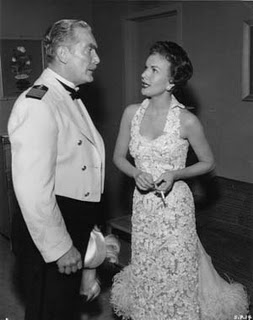
Vivacious Gale Storm, who passed away this past June, was the star of this popular fifties sitcom that presented the comedic trials and tribulations of 21-year-old Margie Albright (Storm was actually around 30) and her late forties father Vern (Charles Farrell, who was actually in the mid-fifties). Vern wants Margie to literally stay out of his business at Honeywell and Todd, an investment firm, and Margie wants Vern to let her date whomsoever she wants, and to stay home like the "old man" he is and be a "nice, old father." Others in the cast included Clarence Kolb, as Vern's boss, Mr. Honeywell; Hillary Brooke as his girlfriend, Roberta; Don Hayden as Margie's steady, Freddie (although Margie practically dated a different man every episode); and Willie Best, as Charlie the elevator boy. Everyone on the show was excellent [except Brooke, who never really had much flair for this sort of thing], but Gertrude Hoffman, an actress in her eighties, stole every episode she was in as Mrs. Odets, who was also in her eighties, and was almost as man-crazy as Margie was.

With over a hundred episodes, you have to expect a few clinkers, and in truth, some episodes of the series are so monumentally silly (without being funny) that they are painful to watch. On the other hand, when the script clicks, it clicks. Some of the funniest include a wild business involving a boxing kangaroo; and an episode with Margie impersonating a fat, male opera singer. As noted, any episode with Mrs. Odets teaming up with Margie generally had more than its share of laughs. Vern made an excellent foil for the effervescent Storm, Hayden was appealing, Best was delightfully daffy, and Kolb was perfection as the contrary Honeywell, who seemed to fire Vern on every other episode. The scripts generally revolved around Vern and Honeywell trying to keep Margie away from some client of theirs, not realizing that she has probably already met the person and fouled things up. Margie often screwed things up for her father, but generally worked everything out before the wind-up.

NOTE: Another popular 50's sitcom was I Married Joan with Joan Davis.

Verdict: Appealing cast and quite a few funny moments. ***.