Lively, entertaining reviews of, and essays on, old and newer films and everything relating to them, written by professional author William Schoell.
Showing posts with label Ralph Byrd. Show all posts

Thursday, July 19, 2018

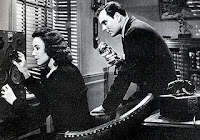
MISBEHAVING HUSBANDS

Ralph Byrd and Harry Langdon
MISBEHAVING HUSBANDS (1940). Director: William Beaudine.

Department store owner Henry Butler (Harry Langdon) has forgotten that it is the 20th anniversary of his marriage to Effie (Betty Blythe). Nevertheless she invites guests to celebrate and waits for him to get home, but a misadventure with a mannequin -- which is mistaken for a real woman by police -- means he gets home very late with a woman's shoe in his pocket. Encouraged by recent divorcee Grace (Esther Muir), Effie hires a sleazy lawyer, Gilbert Wayne (Gayne Whitman), who goes so far as to have his gal pal, Nan (Florence Wright), pretend to be Henry's inamorata so he can get a hefty percentage of the divorce settlement. Meanwhile Henry's niece, Jane (Luana Walters of Drums of Fu Manchu), and Bob Grant (Ralph Byrd of S.O.S. Coast Guard) are instructed to act as chaperons as the divorce proceeds since neither Henry nor Effie will move out of their home; the younger couple try to bring the older pair together even as they fall in love themselves. Misbehaving Husbands is not as provocative nor as funny as the title might suggest, but this cheap PRC production has some spirited players, even if Langdon was far past the days of his successful silent pictures; Betty Blythe [Freckles Comes Home] is terrific as Effie. Some amusing moments but very minor indeed. Billy Mitchell nearly steals the picture as the butler, Memphis.

Verdict: Anything with Byrd in it is always worth a look. **. 

Thursday, July 12, 2018

DICK TRACY SERIAL (1937)

Fred Hamilton, Ralph Byrd and Kay Hughes
DICK TRACY (15 chapter Republic serial/1937). Directors: Alan James; Ray Taylor.

The famous cartoon strip character first appeared on the big screen in this Republic serial starring Ralph Byrd, who would be forever after identified with the character (although at least two other actors also played the role). In this cliffhanger Tracy matches wits with an unknown club-footed figure known alternately as the Lame One or The Spider, since he heads a so-called "Spider Ring" of criminals. With the help of the Lame One's twisted scientist ally Moloch (John Picorri), the Lame One operates on Tracy's brother, Gordon (Richard Beach), and turns him evil, as well as changing his features (he is then played by Carleton Young of Double Deal) so that even his own brother doesn't recognize him. Gordon and his associates fly about in a wide, stylish aircraft known as the Wing, and each week come up with another sinister scheme that Tracy manages to smash after nearly being killed. Tracy is a Federal agent in this and his main assistants are handsome Steve Lockwood (Fred Hamilton) and secretary Gwen Andrews (Kay Hughes of Radio Patrol), who is much more than a secretary and is a scientist who provides her boss with important information. We also have Mike McGurk (Smiley Burnette) and Junior (Lee Van Atta of Undersea Kingdom), who are meant to be comic relief but are more often merely tiresome. Byron Foulger makes an impression as a brave if terrified guy who goes up against the Spider to his regret. The Spider uses a ring to burn an insignia into the forehead of his victims, an idea also used by the famous pulp magazine character, also known as the Spider. Highlights of the serial include the Bay Bridge nearly being destroyed by sonic waves in chapter one; Dick's small boat nearly crushed between two huge ships in chapter three; Dick dropping from the bottom of one plane to land neatly into another far below in chapter four; and Dick being pulled underwater by a submarine because a rope has been tied around his ankle. By the time we learn the true identity of the Lame One, you'll probably have forgotten who the guy is! Dick Tracy is a long but entertaining serial, but the best was yet to come. It was followed by Dick Tracy Returns, Dick Tracy's G-Men, and the best of all, Dick Tracy vs Crime Inc.

Verdict: Nice intro to Dick Tracy on the big screen. **3/4.

DICK TRACY RETURNS

Charles Middleton as Pa Stark 
DICK TRACY RETURNS (15 chapter Republic serial/1938). Directors: John English; William Witney.

This follow-up to Dick Tracy has our hero (Ralph Byrd), an FBI agent instead of a cop, battling the vile villainy of Pa Stark (Charles Middleton of Flash Gordon Conquers the Universe) and his five evil sons, each of whom has a criminal specialty. Over the course of fifteen chapters, Stark and his gang pull off a bank job (in which new agent, Ron Merton -- played by David Sharpe -- is murdered on his first case); try to grab an important lens from an observatory; steal special government planes; get their hands on a dangerous torpedo boat; and work with a foreign agent named Boris Zarkov (Walter Mills). Tracy is joined by agent Steve Lockwood (Michael Kent), and gets help and sometimes interference from comedy relief Mike McGurk (Lee Ford) and young Junior (Jerry Tucker); Lynne Roberts is cast as Tracy's efficient secretary, Gwen. The highlights of this exciting serial include an unconscious Tracy being put in a car that's sent hurtling down the levels of a parking garage; Tracy being thrown out of a plane with a sabotaged parachute; a huge tower falling on a rooftop where Tracy and an enemy are in heated combat; and especially the thrilling sequence when two trains rush towards each other on the same track even as Lockwood is handcuffed to the top of one of the cars. Byrd is perfection as Tracy and Middleton is great as Stark. His "boys" don't get much of a chance to make an impression, with the exception of Ned Glass, who plays the trigger-happy "Kid Stark." Followed by Dick Tracy's G-Men and the superior Dick Tracy vs. Crime Inc.

Verdict: Byrd vs Middleton is a winning combination. ***. 

Thursday, May 11, 2017

RADAR SECRET SERVICE

"Remember me, I'm your boyfriend." Adele Jergens, Tom Neal
RADAR SECRET SERVICE (1950). Director: Sam Newfield.

The "Radar Patrol," which uses radar in its war on crime, is after some uranium which was stolen by Mickey Moran (Tom Neal of Bruce Gentry) and sold to a man named Michael (Tristram Coffin). Hard-boiled blonde Lila (Adele Jergens) is supposedly Mickey's girlfriend, but she's playing up to Michael to help Mickey -- although she may be planning a double-cross just as Michael is. Bill Travis (John Howard) and his partner "Static" (Ralph Byrd) are the agents on the case. Riley Hill is a hood named Blackie; Myrna Dell [Why Men Leave Home] is his girlfriend, a waitress named Marge; and the ever-irritating Sid Melton is "Pill Box," a hypochondriac member of Michael's gang. There's some mild excitement at the climax; a good laugh when Marge makes a comment about how Lila really gets rid of her boyfriends after she sees Michael's corpse; and an inside joke when Ralph Byrd, who played Dick Tracy numerous times, makes a remark about "Dick Tracy's two-way radio." The good guys are called Radar Patrol throughout the movie, and not "Radar Secret Service," possibly because there was a serial called Radar Patrol vs. Spy King two years earlier.

Verdict: Pretty dull cops and robbers, but at least it's less than an hour long. *1/2.

Thursday, January 12, 2017

S.O.S. COAST GUARD

Boroff (Bela Lugosi) ponders who to torture next. 
S.O.S. COAST GUARD (12 chapter Republic serial/1937. Directors; William Witney; Alan James.

"You let him get avay. You have blundered." -- Boroff to Thorg.

Lt. Terry Kent (Ralph Byrd) watches in horror as the hated criminal Boroff (Bela Lugosi) shoots down his brother. Kent vows to get even, even as Boroff tries to sell his disintegrating gas to the highest bidder. Kent's friends include reporter Jean Norman (Maxine Doyle); the photographer, Snapper (Lee Ford); and Jean's scientist brother, Dick (Allen Connor), who rushes to create a counter-gas to the vaporizing formula. Boroff's associates including the bulky Thorg (Richard Alexander of Flash Gordon) and henchman Dodds (Carleton Young of Flight to Hong Kong). Chapter one features an exciting sequence when Kent and the gang are trapped on a ship at sea as it sinks. In chapter two Kent is trapped in a glass chamber as Boroff unleashes his disintegrating gas. There are descending freight elevators, falling water towers, and a fiery truck that hurtles over a cliff. Byrd makes a reliable hero, as usual, while Lugosi, treading water, manages his customary authority but has little energy. 5 years later the serial was released as a 61 minute feature version. NOTE; Okay, this is another film I have reviewed after then discovering that I had already reviewed it on this site -- at least I did remember that I had seen the darn thing before!. For the original review, click here. (Last time I caught some things I missed this time around, for shame!)

Verdict: Average serial. **1/2.

Thursday, July 7, 2016

STAGE STRUCK (1948)

Kane Richmond and Audrey Long
STAGE STRUCK (1948). Director: William  Nigh.

Benny Nordick (John Gallaudet of Docks of New Orleans) who runs a night club and a acting school racket, murders hopeful Helen Howard (Wanda McKay) because she knows too much about his sleazy operation. Nick Mantee (Kane Richmond) helps Nordick cover up the crime and becomes his partner. Ignoring the advice of Lt. Williams (Conrad Nagel of All That Heaven Allows) and his assistant Sgt. Ramey (Ralph Byrd), Helen's sister Nancy (Audrey Long)  takes it upon herself to go undercover at Nordick's school. Dodging persistent passes from Mantee and suspicious glances from Nordick, she tries to find out what she can. Stage Struck is a passable Monogram entry with an interesting cast, most of whom were down on their luck. Lt. Williams' reason for being tough with Helen after she learns of her sister's murder makes no sense, and his piousness gets a little tiresome as well. The leads are fine in this cheap production, and Anthony Warde, Pamela Drake and Evelyn Brent [Holt of the Secret Service] have smaller roles and are equally effective. I've no doubt that acting and modeling schools that are more interested in taking gullible people's money than helping their careers still exist in every major city. Richmond and Byrd, of course, were major serial heroes. Richmond amassed over 100 credits, but this was his last film; he retired from movies to work in the fashion industry. Byrd did a few more films and died rather young in 1952.

Verdict: Distinctive Nagel, Byrd and Richmond help put this over. **.

Thursday, June 16, 2016

DRUMS OF THE DESERT

Ralph Byrd and George Lynn
DRUMS OF THE DESERT (1940). Director: George Waggner.

Paul Dumont (Ralph Byrd) meets up with the pretty Helene Larouche (Lorna Gray) on his way to become a parachute instructor for the French foreign legion and a romance ensues. Once he arrives in Algeria Paul discovers that one of his best friends, Captain Jean Bridaux (George Lynn), is already affianced to Helene. Adding to the complications is an Arab named Abdullah (William Castello), who wants revenge when his brother is executed for attacking Bridaux. The triangle/soldier story has been told many times both before and after this picture, and this version is no more than acceptable. The leads, especially Lynn [The Werewolf], who gives a committed performance, are adequate; Castello makes a striking Abdullah;  and Mantan Moreland adds to the proceedings, as usual, as the head of a contingent of black paratroopers. From Republic.

Verdict: Little more than a time passer but with some appealing players. **.

Thursday, July 23, 2015

THE MEANEST MAN IN THE WORLD

Jack Benny and Priscilla Lane
THE MEANEST MAN IN THE WORLD (1943). Director: Sidney Lanfield.

Richard Clark (Jack Benny) is a struggling small-town lawyer with a fiancee, Janie (Priscilla Lane), who wants him to make good. Janie's father, Arthur (Matt Briggs), suggests that Richard go to New York where there is real opportunity, so he packs up his employee-confidante Shufro (Eddie "Rochester" Anderson) and heads to Manhattan. When business proves just as dismal as it was back home, Richard somehow rents a Park Avenue apartment to impress Janie and her dad, but Shufro advises him that only by becoming "mean" and ruthless can he ever hope to achieve success. Richard is somewhat dubious, but takes Shufro's advice, leading to him taking a lollipop away from a small boy on the sidewalk. Literally taking candy from a baby, Clark becomes known as the Meanest Man in Town. When Janie discovers that he helped toss an old woman into the street, she wants to call off the wedding -- and things get worse from there! -- but maybe the poor sap isn't quite as mean as she and everybody think ... The Meanest Man in the World is a very funny movie, with Benny, Anderson, Lane, and the supporting cast all in fine fettle. Anne Revere [Fallen Angel] is amusing as Clark's slightly acerbic secretary; Edmund Gwenn is great in a surprisingly nasty role as one of his clients; and we've got bits by Nick Stewart as the wide-eyed elevator operator and Ralph Byrd as a reporter. Tor Johnson [The Black Sleep] of Plan Nine from Outer Space infamy even shows up in a long black wig as the Russian wrestler and wannabe bodyguard Vladimir Pulaski! Anderson [Honolulu] is up there with Benny all the while, playing an employee who is never truly subservient, thank goodness, but who displays an inoffensive wise and sassy quality. This is a remake of a silent movie made twenty years earlier.

Verdict: Lots of big laughs in this amiable and often zany movie. ***.

Thursday, November 3, 2011

DICK TRACY'S G-MEN

Phyllis Isley [Jennifer Jones] and Ralph Byrd
DICK TRACY'S G-MEN (15 chapter Republic serial/1939). Directors: John English; William Witney.

Criminal genius Zarnoff (Irving Pichel) manages to escape execution, and for 15 chapters matches wits, guns and devious plots with his nemesis, Dick Tracy (Ralph Byrd). Tracy gets out of many of his predicaments in a clever and realistic fashion. The more memorable of these predicaments include a death trap in chapter two; a crane dropping tons of lumber on Dick in chapter seven; a horrifying dirigible fire in chapter nine; and a room with a fiery dynamo in chapter ten. The climax with Tracy and Zarnoff squaring off in the desert is also memorable. Plenty of fisticuffs and a good use of pre-existing locations. Zarnoff tries to sell plans to a foreign power as well as steal a new explosive formula. If there is any problem with the serial it's that Pichel is rather colorless as the villain. Phyllis Isley plays Tracey's secretary and has little to do. There is absolutely nothing about her that would suggest she'd become a major star under the name Jennifer Jones. Not quite as good as Dick Tracy vs Crime Inc.

Verdict: More fun from Republic studios. ***.

Thursday, July 14, 2011

THE VIGILANTE


THE VIGILANTE (15 chapter Columbia serial/1947.) Director: Wallace Fox.

"These days all you've got to do is take a good-looking guy, give him a hat, black boots and a white horse and you've got a star."

The Vigilante, a super-hero who appeared in Action Comics in the 1940's, gets the serial treatment in this cliffhanger from Columbia. Greg Sanders (Ralph Byrd of the Dick Tracy movies and serials) is a cowboy hero in the movies by day, and the roving action hero Vigilante by night. The plot has to do with a herd of beautiful horses and the curse of the "tears of blood" -- referring to pearls that are secreted in their horseshoes.The mysterious "X-1," whose identity is no surprise and who operates out of a nightclub, wants the horses and the pearls and will kill anyone who gets in his way. Byrd is good, Lyle Talbot is Lyle Talbot, Ramsay Ames (The Mummy's Ghost; Calling Dr. Death) is better than usual as the nominal heroine, and George Offerman Jr. makes for a very amiable sidekick, Stuff. Offerman had small roles in the serials The Master Key and Batman and Robin, and appeared in a great many movies, mostly uncredited. The Vigilante even has a couple of pleasant song numbers but, unfortunately, most of its cliffhangers are very prosaic.

Verdict: Entertaining in spite of itself. **1/2.


Thursday, May 5, 2011

DICK TRACY VS. CRIME INC.


DICK TRACY VS CRIME INC. 15 chapter Republic serial (1941). Directors: John English and William Witney.

In this terrific serial, Tracy's sinister opponent, the unknown "Ghost," almost inundates Manhattan -- and that's only the first chapter. The Ghost is the brother of an executed criminal, but that doesn't mean that Tracy (Ralph Byrd) or anyone else knows his true identity. All he and we know is that he's one of the members of the anti-crime "Council of Eight" [which actually seems to have only five members, but who's counting?] The Ghost can also turn invisible [these FX are well done] whenever he wants to. Sure, there's some recycled footage in this, but that doesn't stop Dick Tracy vs. Crime Inc. from being one of the liveliest serials ever made. Cliffhangers include a trapdoor with a long fall; a coast guard cutter inadvertently blitzing Tracy and his own boat with bullets; Tracy unconscious on a treadmill and heading straight for a fiery furnace, and others just as good. Like the best serials, this also has great stuff in the middle of a chapter, such as a lively battle between Tracy and the Ghost and Tracy rescuing colleague Bill Carr (Michael Owen) from oblivion in a smelter. The climax, with Tracy trying to trap the Ghost via use of an infra-red light bulb, is also smashing. Byrd is great as Tracy; Jack Mulhall, Jan Wiley, Ralph Morgan, and John Davidson are also in the cast.

Verdict: The action never flags! ***1/2.


Thursday, August 27, 2009

DICK TRACY MEETS GRUESOME

DICK TRACY MEETS GRUESOME (1947). Director: John Rawlins. 

The fourth and last of RKO's Dick Tracy features again stars Ralph Byrd -- who is terrific in the part -- as the intrepid detective, this time involved with a gang who use a paralyzing gas to sort of freeze people so that they can walk into banks unobserved and rob them with little effort. The picture is greatly abetted by the presence of Boris Karloff as the killer -- smarter than the usual one, however -- known as Gruesome. A character named X-Ray (Skelton Knaggs) takes one look at Gruesome and says "he certainly is," even though he's even less attractive. A clever bit has Karloff appearing to be dead and waking up in the morgue to smoke a cigarette as an unsuspecting cop goes about his business. Anne Gwynne is perky as Tess Trueheart, if not as sexy as Anne Jeffreys. Cadaverous Milton Parsons is on hand as the frightened Dr. A. Tomic, who's afraid someone is out to kill him. June Clayworth is his assistant I. (Ida) Learned. Byrd saunters through this stuff without ever losing his dignity. These features, while entertaining enough, were never as much fun as the Dick Tracy serials that also starred Byrd. Others in this series were Dick Tracy, Dick Tracy vs. Cueball and Dick Tracy's Dilemma

Verdict: No classic, but don't give it the Byrd. **1/2.

Thursday, August 13, 2009

DICK TRACY'S DILEMMA

DICK TRACY'S DILEMMA (1947). Director: John Rawlins. 

Ralph Byrd takes over -- or rather takes back -- the role of Tracy from Morgan Conway in this, the third RKO Dick Tracy feature film. The villain of the piece is a murderous crook known as "The Claw" (Jack Lambert), who murders a guard during a robbery of expensive furs. The florid Vitamin Flintheart (Ian Keith plays him like a combination of John Barrymore and Cyril Ritchard) gets into the action out of guilt for not taking seriously a man who came to relay information to Tracy. [One of the best scenes has that man, a beggar named "Sightless" (Jimmy Conlin), trying to keep from being murdered in an alley by The Claw.] Tess Trueheart is played in this venture by Kay Christopher. Fast-paced and well-acted. Lambert makes a vital villain. This follows Dick Tracy and Dick Tracy vs. Cueball

Verdict: Acceptable B movie. **1/2.

Wednesday, July 23, 2008

DICK TRACY VS. CUEBALL

DICK TRACY VS. CUEBALL (1946). Director: Gordon Douglas.

Although Ralph Byrd played the famous cartoon strip detective in several cliffhanger serials, when they began making feature-length Tracy movies they first hired Morgan Conway to play the part. Conway isn't bad, but he's not as perfect for the role as Byrd is. In this very fast-paced thriller, Tracy is up against a bald, nasty criminal named Cueball (Dick Wessel, who is very effective) who is after some diamonds or their cash equivalent and strangles anyone who gets in his way (director Douglas includes lots of vivid close ups of people about to be dispatched by Cueball). There are a lot of colorful characters in this, not the least of which is "Filthy" Flora (Esther Howard), proprietress of the Dripping Dagger bar, who mistakenly thinks she can outwit the malevolent Cueball. Anne Jeffreys is Tess Trueheart and Ian Keith is the florid "Vitamin."

Verdict: Minor but fun. **1/2.

Friday, May 9, 2008

S.O.S. COAST GUARD

S.O.S. COAST GUARD (1937). 12-chapter Republic Serial. Directed by William Witney and Alan Jones.

Ralph Byrd is Lt. Terry Kent of the Coast Guard, whose younger brother is murdered while trying to capture the sinister Boroff (Bela Lugosi), who has come to the United States with a formula for a deadly disintegration gas. Maxine Doyle is the intrepid female reporter Jean Norman and Lee Ford is her photographer, Snapper McGee. The music and the pacing help keep things lively in this otherwise second-tier serial with Byrd outwitting the efforts of Lugosi and his gang for chapter after chapter. In one amusing scene Boroff directs his muscular henchman Thorg to shave his master's beard off. Instead of first using a scissors to snip off most of the hair, Thorg covers the entire beard with shaving cream! To his men's incredulity Boroff seems to think the loss of his beard will be a suitable disguise, but naturally neither Byrd nor anyone else recognizes the evil figure. Boroff's henchmen seem smarter than he is. Boroff has no problem with anyone photographing crates full of his disintegration gas, but one of his men reminds him that the radioactive properties of the gas will fog the film, giving away the game. Despite its fairly standard quality, S.O.S. Coast Guard does have some exciting sequences, such as an underwater battle between Byrd and Thorg, and a scene when Byrd rapidly trails a truck which itself is trailing a vapor of disintegration gas. Snapper McGee is meant to be comedy relief but he just isn't particularly funny. Thorg has a great reaction when he's shot by a terribly ungrateful Boroff at the end.

Verdict: Some fun with Byrd and Bela! **1/2.

Sunday, March 16, 2008

BLAKE OF SCOTLAND YARD (1937)

BLAKE OF SCOTLAND YARD (1937). 15 chapter Victory Serial. Director: Bob Hill.

Sir James Blake (Herbert Rawlinson) has invented a “death ray” that can change the course of history, and a masked villain known only as The Scorpion wants to get his hands on it, which he does, more than once [the machine doesn't look like it could successfully send out a radio signal let alone a vaporizer beam]. Ralph Byrd is actually the lead of this serial, cast as Jerry Sheehan, an associate of Blake's. Providing occasionally unwanted assistance are Blake's niece Hope (Joan Barclay) and her little brother Bobby (Dickie Jones). While it is understood that one often has to suspend disbelief while watching a cliffhanger serial, Blake of Scotland Yard asks a little too much of the viewer. Blake has come up with the greatest scientific achievement in decades, but there are no guards watching the death ray [except for one undercover man]? The Scorpion and his henchmen wander in and out and underneath Blake's estate, Mallow Hall, as if they own the place, but Blake still doesn't call in dozens of extra men. The Scorpion plants dynamite under the house and nearly blows it up; although his plot is foiled, Blake leaves the dynamite in the cellar where The Scorpion almost uses it again. How did Blake ever come to prominence in Scotland Yard? Connections? It certainly wasn't due to his intelligence!

Furthermore, no one in the serial – not even the title character – even bothers to attempt a British accent. The Scorpion is meant to be scary but only engenders titters as he wanders about all hunched over with a fake claw that is meant to resemble a scorpion's but looks more like a lobster's. His identity certainly proves to be no surprise. The little boy, Bobby, is cute enough, but he's also a little too precious and affected, overly earnest, and he's allowed to become part of the action way to often. The adults worry about him at times, but do little to protect him; while feisty and intelligent, he's still just a child. The main trouble with Blake of Scotland Yard is that under Hill's stodgy direction, it moves at a pace just slow enough to give the viewer time to be irritated by all these matters. There's no attempt to create atmosphere through lighting and shadows and even the underground scenes are over-lit. On the other hand, there's a lively fight scene wherein the heroes battle their way past some dangerous Apache dancers in the Parisian Cafe by furiously flinging circular serving trays at them. And Byrd and Barclay show their versatility [which the former was rarely if ever allowed to do] by impersonating a drunken older middle-class couple in a bar. There's also a startling shot of a man falling through a skylight and onto a bed, photographed from high above. Blake of Scotland Yard is not a great serial, but it does have a few exciting scenes and a fair amount of suspense at times. Herman Brix/Bruce Bennett has a small role as a Scorpion associate with an eye patch.

Verdict: Not great, but it has its moments. **1/2.