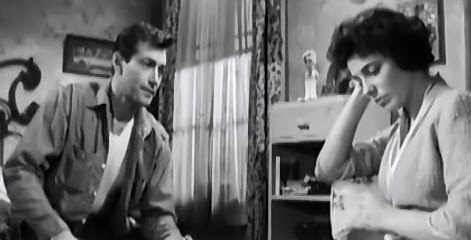
Lively, entertaining reviews of, and essays on, old and newer films and everything relating to them, written by professional author William Schoell.

Thursday, May 13, 2021

AROUND THE WORLD UNDER THE SEA

Wynn, Eaton, Kelly, McCallum, Bridges and Thompson
AROUND THE WORLD UNDER THE SEA (1966). Produced and directed by Andrew Marton.  Produced by Ivan Tors. 

An increasing danger of undersea quakes that could endanger millions on land causes scientists to decide to implant special sensors in various places on the sea bottom, providing a sort of early warning system. To achieve this Doug Standish (Lloyd Bridges) and Craig Mosby (Brian Kelly) gather a team to occupy their sub, the Hydronaut, and voyage around the world. The team members consist of Hank Stahl (Keenan Wynn), Dr. Orin Hillyard (Marshall Thompson), Dr. Maggie Hanford (Shirley Eaton), and Philip Volker (David McCallum), who agrees to help only if they go on a salvage operation that could net millions once all the sensors are planted. But this operation is interrupted by an eruption, and the crew of the Hydronaut may find themselves in really hot water ... 

Shirley Eaton and Brian Kelly
Around the World Under the Sea may have been intended as producer Ivan Tors' answer to Irwin Allen's Voyage to the Bottom of the Sea, but it certainly falls short of providing the same entertainment value. Although there is much talk of the ever-present danger of quakes and the necessity of planting the sensors, there is no sense of urgency and no real suspense until, perhaps, the final sequence. The actors are competent enough for the most part, but not quite up to the challenge in their most intense scenes. 

Lloyd Bridges and Brian Kelly
Tors filled the movie with such TV stars as Bridges from Sea Hunt, Kelly from Flipper, Thompson from Daktari, McCallum from The Man from U.N.C.L.E., who affects the same accent he used as Ilya in that series, and then throws in the irascible Keenan Wynn and the sexy Shirley Eaton to cause some minor tension among the boys. Eaton and Thompson seem to be romantically involved at the beginning of the movie, but halfway through she shifts her attention to Kelly, but there's no major reaction from Thompson. Although one could argue that this avoids a cliche -- although there are plenty in this movie -- it also strips the movie of any melodrama, which it could have used. We do get a gigantic eel that shows up and sniffs around the sub, but the problem with this is that it doesn't really seem to be endangering it or the people aboard. (I thought I spotted a few moments of 3D animation during this sequence and stop-motion expert Jim Danson is listed in the credits.)

David McCallum appeals to Shirley Eaton
The science of the film is suspect as well. At the climax, the water around the sub should have been boiling from the heat, and other things don't make much sense. However, some viewers might enjoy that Shirley Eaton loses the top of her bathing suit at one point where it floats outside of a porthole (or whatever they call it on a sub), and Harry Sukman's score has its effective moments. The screenplay is not well-constructed and hardly takes advantage of a very workable premise. There is no real characterization to speak of. 

Verdict: By no means dreadful, but too blah to be memorable. **1/4. 

THE WAYWARD BUS

Jayne Mansfield, Delores Michaels, Rick Jason

THE WAYWARD BUS (1957). Director: Victor Vicas. 

Johnny Chicoy (Rick Jason of This is My Love) drives his bus on a route across the border into San Juan while his wife, Alice (Joan Collins of Land of the Pharaohs), runs the truck stop diner where the passengers embark. Both are afraid that they are not truly loved by their spouse. As Johnny walks out in anger, he gets involved with some of the passengers, who include the dyspeptic Van Brunt (Will Wright); Mr. and Mrs. Pritchard (Larry Keating and Kathryn Givney); their daughter Mildred (Delores Michaels), who has a yen for Johnny; travelling salesman Ernest Horton (Dan Dailey); and erotic entertainer Camille Oaks (Jayne Mansfield), who dodges passes from both Horton and Pritchard but winds up falling for the former. Not only is there the question of whether or not the passengers' assorted issues can be resolved, but if they'll even survive the trip when very dangerous weather conditions threaten their very lives. 

Rick Jason and Joan Collins
The Wayward Bus, taken from a John Steinbeck novel, is an unusual, imperfect, but ultimately worthwhile picture. With his handsome, masculine features and decided acting ability -- he gives a very strong performance in this -- Rick Jason should have become a major star, but the film was not a big hit. Almost completely deglamorized for this role of a drab housewife and cook, Joan Collins is less miscast than you might imagine and is effective. The romance between Dailey and Mansfield is never convincing, although Dailey is winning and Mansfield is at least competent, but there are dozens of actresses, Monroe included, who would have been stronger. Delores Michaels is lovely in the movie -- making much more of an impression than Mansfield -- but she only had a few credits after this. In addition to the actors already named, we have nice performances from Betty Lou Keim, as Norma the counter girl, and (Mr.) Dee Pollock as Kit, the teenager who assists Johnny and Alice; he had a long career. Robert Bray makes an impression as Morse, who has a hankering for Alice. 

In addition to some very good acting, The Wayward Bus has other plusses, such as the widescreen cinematography by Charles G. Clarke and a fine, evocative and highly interesting musical score by Leigh Harline. There is also a splendid action sequence when the bus must travel over a very, very long and crumbling wooden bridge directly over rushing rapids  -- this sequence is a nail-biter. The film was undoubtedly made just to take advantage of the publicity for the earlier Bus Stop, which starred Monroe, also featured bus trips and truck stops, and even had Robert Bray in the cast. 

Verdict: Memorable "lost" film with some very good performances. ***. 

JAYNE MANSFIELD: THE GIRL COULDN'T HELP IT

JAYNE MANSFIELD: THE GIRL COULDN'T HELP IT. Eve Golden. University Press of Kentucky; 2021. 

Let's face it. Jayne Mansfield, a triumph of tenacity and publicity, didn't have much of a career. She did only a couple of films for major studios, but the rest of her film "career" consisted of a few Grade B to Grade D stinkers, each one more embarrassing than the one before. Focused almost exclusively on being famous for being famous, she loved her children without necessarily being a great mother, and was said to be kind to everyone, although the wives of the men she had affairs with would probably disagree. Had she lived she would undoubtedly have descended into a morass of alcohol and sleaze or wound up on Dr. Phil in her dotage. 

Biographer Eve Golden makes a case that Mansfield was her own worst enemy. Using her most obvious assets, she became a publicity-hound of the first order, and it was this that eventually turned her into a national joke, a boob not just in name only. Her own frenetic publicity-seeking ensured that no one would ever take her seriously, and the very few performances that some people thought had merit were either ignored or not even seen by her detractors. Although she was often compared with Marilyn Monroe, Monroe managed to give some fine performances in genuinely memorable pictures, and she was too adorable to be really vulgar. This was not the case with Mansfield. Frankly, Mansfield has more in common with Anna Nicole Smith than Monroe. Her marriage to Micky Hargitay was based more on hormones and press clippings than anything else, although it may be true that he, at least, genuinely loved Jayne or at least became attached to her. Can narcissists ever really love anyone but themselves? 

Mansfield died in a horrible accident in which two others were killed (but rarely mentioned), the teen boy who was driving (and who had a child and fiancee), and Mansfield's latest boyfriend, a ground slug who left his crippled wife to be with the blond boob. But her life had pretty much become a disaster even before the accident -- she spent more time opening supermarkets than appearing in movies, her nightclub act was seen as a joke by most sensible people, and her brief days of stardom at 20th Century-Fox, the studio that dropped her, were long since over. For much of this book you have to slog through pages and pages of Mansfield's appearances at store openings and other venues to get to the meat, but in spite of that the book is generally entertaining and readable. While clearly being a fan, Golden maintains some objectivity, tries to explain Mansfield's motives and character, separates facts from fan press fiction, and does her best to present the actress as someone deserving of a certain sympathy if not a reappraisal. If some readers may feel that she doesn't quite succeed at some of these goals, it's not for lack of trying. 

Verdict: Interesting, rather exhaustive (and sometimes exhausting), look at a show business casualty and tireless self-promoter. ***. 

THE TIME MACHINE

The Time Traveler in his machine
THE TIME MACHINE (1960). Director: George Pal. 

A Victorian-era scientist in England (Rod Taylor) insists to a gathering of his friends, that he has invented a machine that can break through the fourth dimension -- time. Using his machine to go into the future, he witnesses more than one war and man's destruction of man. Trapped inside rock by a lava flow, he pushes way ahead to the far-flung future and winds up in 802,701 A.D. There he discovers that the human race has divided into two segments: the mindless, bovine Eloi and the meat-eating Morlocks, who live underground, care for the Elois' needs, and use them for their food supply. Weena (Yvette Mimieux), a pretty Eloi, is saved from drowning by the scientist, and shows signs of the humanity that seems to have been bred out of people in this era. 

Morlocks!
The Time Machine
 is a colorful and entertaining picture, although it is essentially a kiddie version of H. G. Wells' novel, which was a masterpiece of both horror as well as of science fiction. The best sequences in the film, which still hold up today, are the depictions of time travel done with time-lapse photography and the like. The Morlocks, alas, look more like the boogie men of Laurel and Hardy's March of the Wooden Soldiers than they do the dark and sinister creatures of Wells' brilliant book. Rod Taylor plays an undeveloped part as well as possible; Mimieux is effective in the nearly mute role of Weena. The film is well photographed by Paul Vogel, and boasts an eerie and attractive score by Russell Garcia. Four years earlier Taylor appeared in another time travel movie, a rip off of Time Machine, entitled World Without End

Verdict: Fun, but hopefully not the last film version of Wells' great novel. ***. 

THE JAYNE MANSFIELD STORY

Loni Anderson
THE JAYNE MANSFIELD STORY (1980 telefilm). Director: Dick Lowry. 

Jayne Mansfield (Loni Anderson), a newly-divorced mom with a young daughter, tries to take Hollywood by storm and succeeds -- for a time. Jayne appears on Broadway in Will Success Spoil Rock Hunter? and is lucky enough to get cast in the film adaptation. Overdoing the publicity bit while waiting for future assignments from her studio, 20th Century-Fox, she discovers that few people take her seriously, except perhaps her new husband, Mickey Hargitay (Arnold Schwarzenegger). Becoming one of those celebrities who would "go to the opening of an envelope," her career rapidly goes on the downslide, doing nude scenes in cheap Grade D movies and club acts in dives.

Arnold Schwarzenegger and Loni Anderson
Although one might wonder if the story of a minor show business casualty is even worth the telling, this telepic succeeds because of some very good performances. Although she overdoes the squealing a bit, Loni Anderson probably gives a better performance than the real Mansfield ever did, turning the actress from a kewpie doll into a pathetic figure who garners some sympathy. (While there may be people far more deserving of our pity, self-absorbed actors who are desperate to stay relevant and employed do suffer in their own way, as evidenced by Mansfield's excessive drinking.) Arnold Schwarzenegger gives a surprisingly appealing and sensitive -- if such a term can be used in conjunction with the body builder -- performance, and Ray Buktenica and Kathleen Lloyd score as, respectively, Mansfield's agent and her friend and companion. G. D. Spradlin also makes an impression as Mansfield's liaison at the studio. 

Verdict:  Possibly more than the poor Mansfield deserves. ***. 

Thursday, April 29, 2021

JASON AND THE ARGONAUTS (1963)

Todd Armstrong
JASON AND THE ARGONAUTS (1963). Director: Don Chaffey. 

With a crew of brave and adept champions, including the mighty Hercules (Nigel Green), Jason (Todd Armstrong) sets sail on the Argo to the ends of the earth in an attempt to find the famous golden fleece. Jason is unaware that he has been sent on this journey by his hated enemy, Pelias (Douglas Wilmer), who only wants him out of the way. Also accompanying Jason is Pelias' conniving son, Acastus (Gary Raymond), and Argos (Laurence Naismith), the ship's builder. Jason has been granted several wishes by Hera, queen of the Gods (Honor Blackman) and she greatly enjoys stymying the plans of her husband Zeus (Naill MacGinness). But can even Hera help Jason overcome the incredible challenges he faces? 

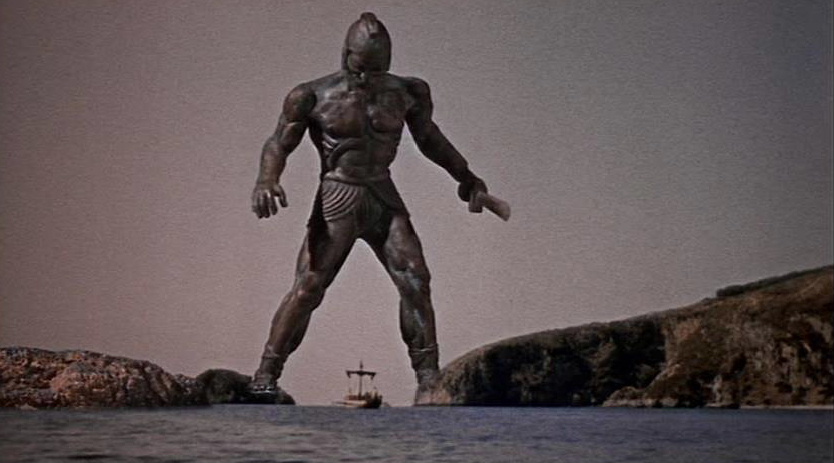
The humongous Talos bears down on the Argo
These challenges, brought to life by the stop-motion wizardry of Ray Harryhausen (possibly his greatest achievement), include the gigantic bronze statue of Talos, which comes to life; tormenting harpies on an island paradise; the many-headed, slithering hydra; the clashing rocks, which would destroy the Argo were it not for the help of a very huge Poseidon; and the living and armed skeletons of the hydra's victims in the bravura climax. Jason is also graced with a rich and exciting score by Bernard Herrmann, excellent production values, skillful photography by Wilkie Cooper; and often stunning costuming and art direction to boot. In fact, Jason looks almost as good as MGM's Captain Sindbad

Jason confronts the gods of Olympus
The actors are also well-chosen. Todd Armstrong makes the perfect Jason. Although he had a perfectly good speaking voice which you can hear in other movies he made, he is dubbed as Jason. Nancy Kovack is also dubbed as Medea, who falls in love with Jason and vice versa when he rescues her from the sea. Blackman, MacGinnes, Naismith, Raymond, Green, Wilmer -- as well as John Cairney as the young and ill-fated Nylas and Jack Gwillim as King Aeetes -- all give flavorful and adept performances. Sadly Jason was not the big box office hit it deserved to be because people confused it with one of the ever-proliferating Italian "peplum" movies of the period when it was on a much, much higher level. The film did not do much good for the career of handsome Armstrong, who tragically committed suicide at 55. 

Verdict: Jason and the Argonauts gets my vote as the greatest classic fantasy film ever made. ***1/2.

MASTER OF THE WORLD

Vincent Price
MASTER OF THE WORLD (1961). Director: William Witney.  

In 1868 a man called Robur (Vincent Price) takes off in a heavier-than-air craft, the Albatross, with an international crew and several prisoners, including agent John Strock (Charles Bronson of Crime Wave), munitions manufacturer Prudent (Henry Hull of Werewolf of London), his daughter, Dorothy (Mary Webster), and her fiance Phillip (David Frankham of The Return of the Fly). Robur has decided the only way to create a lasting peace is to bomb war ships and fighting armies. Strock and the others do their best to ground his ship and put him out of action.

Frankham, Webster, Hull, Bronson
Master of the World
 is loosely based on two late Jules Verne novels. Screenwriter Richard Matheson has turned Robur into a variation of 20,000 Leagues' Captain Nemo. Although Robur may have been a bit crazy in the books, he did not have the same mission as Nemo. Arguably the best thing about this movie is the performance of Vincent Price, who invests the project with a dignity it probably doesn't deserve. Frankham is also good, Bronson is solid, Mary Webster is more decorative than anything else, and Henry Hull is, in a word, awful. Attempting a comic portrayal from the beginning, he is merely annoying. The movie starts out as a light comedy and its transformation into a thriller isn't always convincing. 

the Albatross in flight
William Witney, the great serial director, is at the helm and there are a couple of exciting sequences, most notably when Frankham and Bronson are lowered on ropes from the Albatross and nearly careen into trees and mountain tops. The philosophy of the film is a bit muddled -- no one ever points out the sheer illogic and hypocrisy of Robur's actions. Trying to stop war is an admirable goal but doing it by killing peacetime sailors and blowing up armies is hardly the way to go about it, yet Master tries to turn this idiot into some kind of tragic anti-hero. 

Verdict: Half-baked, modestly entertaining sci fi film actually has little to do with Verne. **1/2. 

THE THREE STOOGES MEET HERCULES

Hercules shows off muscles to Curly
THE THREE STOOGES MEET HERCULES (1962). Director: Edward Bernds. 

The Three Stooges work in a drug store and have befriended a tall if nerdy scientist named Schulyer Davis (Quinn K. Redeker). Davis is working on a time machine, and when the stooges fiddle around with it they, Davis, and his fiancee, Diane (Vicki Trickett), all wind up back in Ithaca in 900 B.C. Greece. Their untimely arrival causes Ulysses to lose the battle against Odius (George N. Neise) with the added help of a rather unpleasant Hercules (Samson Burke). 

The stooges with the phony Herc
The rather brave stooges manage to free Ulysses from prison but for their efforts are turned into galley slaves. This enables Davis to develop muscles that put him on a par with Hercules. After escaping from the ship, Davis masquerades as the demi-god and gives him the reputation of a decent and honorable fellow. But he still has to face the real Hercules in the arena and get his girlfriend away from the odious King Odius. Odius happens to greatly resemble the stooges' boss, Mr. Dismal, back in the 20th century. 

Two-headed cyclops wants to make a meal of Moe
Well, what can you say about The Three Stooges Meet Hercules? You can say that for a full-length Stooges movie it is rather ambitious and has a more complicated storyline than the usual slapstick outing. Moe (Moe Howard) seems even a  bigger bully than usual in this picture, and although Joe DeRita is more than okay in the film, he is not my favorite Curly. Larry Fine (Larry) is as funny as ever, however. Redecker and Trickett are acceptable without making that much of an impression. 6 ft. 4 Samson Burke was a body builder and professional wrestler who turned to acting; he is fine as an unsympathetic and mean-spirited Hercules. George Neise specialized in sleazy and unlikable characters, but he is not notable in this. The movie is not tedious and it has amusing moments, but it couldn't be considered a "laff riot," either. The stooges have been funnier elsewhere, but this flick is not without interest for fans. 

Verdict: If the stooges are not your cup of java, tune out! **1/2.

THE SWORD AND THE DRAGON

Andreyev and Myshkova
THE SWORD AND THE DRAGON/aka Ilya Muromets/1956). Director: Aleksandr Ptushko. 

Ilya Muromet (Boris Andreyev) is a Russian peasant who is dismayed that due to injuries that prevent him from walking, he can not fight against the tyranny of the evil Tsar Kalin (Shukur Burkhanov). This changes when he is healed by a passing stranger and given a sword that used to belong to a great hero of old. Ilya meets his beloved, Vasilisa (Ninel Myshkova) and the two are married. In a misunderstanding with Prince Vanda (Andrei Abrikosov), Ilya winds up put in a dungeon even as his wife is spirited away by the Cossack-like Kalin. As years pass, Vasilia resists Kalin's advances but he does turn her and Ilya's little boy, Falcon, into his "son" and one of his best warriors. Freed from captivity, Ilya not only has to face his own son in combat, but also must face a gigantic, three-headed, fire-breathing dragon unleashed by Kalin.

son against father in mortal combat
While it may not be as much fun as American fantasy flicks of this nature, The Sword and the Dragon is a notable film from Russia with some outstanding widescreen cinematography (Yuli Kun; Fyodor Provorov), which helps provide sweeping vistas and elaborately staged battle scenes. It has an excellent story taken from Russian folklore and a fine score by Igor Morozov. The Sword and the Dragon is not really a kid's film -- there's a scene when four men are impaled on one spear -- although it has some fantastical elements. The dragon is a silly-looking full-scale prop that looks like something out of a funhouse. One amazing scene has Kalin ordering his followers to climb on top of one another in the hundreds to create a "mountain of men." And we mustn't forget the obese envoy who comes to town giving orders from Kalin and ultimately regrets it. 

Verdict: Quite interesting Russian fantasy film is definitely worth a look. ***. 
 

SIX OF A KIND

SIX OF A KIND (1934). Director: Leo McCarey. "

According to you everything I like to do is illegal, immoral, or fattening." -- W. C. Fields. 

 A bank employee, "Pinky" Whinney (Charlie Ruggles), and his wife (Mary Boland) advertise for another couple to share expenses as they go on a second honeymoon and drive all the way from the east coast to California. Who shows up but George (Burns) and Gracie (Allen), an unmarried couple with a humongous, if lovable, dog. The foursome and the beast have assorted, funny misadventures as they travel westward, especially in a small town where John Hoxley (W. C. Fields) is sheriff, Mrs. Rumford (Alison Skipworth) is the hotel proprietress, and "Pinky" is accused of stealing $50,000 from the bank where he works -- and of having a mistress! Fields gets to perform his famous pool routine as he explains how he got the nickname of "Honest" John, and it's a delight to see the formidable Boland squaring off against him. One of the funniest bits has Boland falling off a cliff onto a tree. Everyone in the cast is in top form! 

Verdict: This will put you in a good mood if nothing does! ***.

Thursday, April 15, 2021

DREADED DEADLINE DOOM

Oops. Got behind in my work. Great Old Movies will return in two weeks. 

In the meantime have fun with B Movie Nightmare!

Thursday, April 1, 2021

SMASH UP: THE STORY OF A WOMAN

Susan Hayward
SMASH UP: THE STORY OF A WOMAN
(1947). Director: Stuart Heisler. 

Angie Evans (Susan Hayward) is an aspiring singer who suffers from stage fright (having a drink or two before going on seems to help) and who gives up her career to marry Ken Conway (Lee Bowman), who later makes a tremendous splash as a crooner. Now Angie has no career, her husband is out on the road most of the time, having a child isn't enough to fill her life, and she's afraid Ken is having an affair with his aggressive assistant, Martha (Marsha Hunt). What's a girl to do? She takes a drink and then another, and then has a few more. This not-too-serious study of a dipsomaniac is well-acted -- Hayward is outstanding -- and quite entertaining. There's a particularly amusing scene when Angie has it out with Martha in the ladies room during a party, smacking her around and pulling her hair. (The movie has some interesting vignettes, such as when the old nurse who works for Angie is shown a baby by its mother in the park. "Cute, isn't he?" says the mother. To which the nurse, frowning, says, "hmm. well ...") The movie has a very unrealistic ending, with one character being overly forgiving after a near-tragedy. Eight years later Hayward played another alcoholic -- this time a real-life singer, Lillian Roth -- in I'll Cry Tomorrow

Verdict: Watch Hayward put on a show! ***.

DESTINATION MOON

John Archer and Warner Anderson
DESTINATION MOON (1950). Director: Irving Pichel. Produced by George Pal.  In Technicolor.

General Thayer (Tom Powers), recognizing that the government is reluctant to spend on space travel during peacetime and after one of their rockets exploded, appeals to the private sector in the form of industrialist Jim Barnes (John Archer) for help. Barnes and a select committee of businessmen employ Dr. Charles Cargraves (Warner Anderson of The Star) to build a new rocket that will fly them to the moon. Thayer is afraid that a foreign power will beat them into space and be able to fire missiles from the moon. Learning that the authorities will block them from performing certain tests, causing delays, Thayer, Cargraves and Barnes -- plus technician Joe Sweeney (Dick Wesson of Starlift) -- take off in their rocket, "Spaceship Luna," in a hurry. They encounter some complications in space, and on the moon come to realize that one of them may have to be left behind ... 

pulling away from earth's gravity
Destination Moon
, based on a novel by Robert Heinlein (who co-scripted), was one of the very first big-screen sci fi movies of the fifties. Unlike Rocketship X-M , which debuted the same year, it is generally serious and intelligently told. A scene when one of the men, making repairs, floats away from the ship, is suspenseful, as is the ending, when a fateful decision must be made, and the actors are all satisfactory and credible. The FX, including the fairly elaborate moon set, are quite good for the period, and pretty much hold up well today. The movie is low-key but effective, greatly bolstered by Leith Steven's [Julie] excellent and majestic scoring. A very odd moment occurs when the men argue about who should be left behind and Cargraves never even mentions his wife! Director Irving Pichel also appeared as an actor in many movies. 

Verdict: Absorbing George Pal production that generally avoids melodrama -- and giant spiders. ***.  

THE DEFENDERS (1961): Season One

Robert Reed and E. G. Marshall
THE DEFENDERS (1961 TV series). Season One. 

Lawrence Preston (E. G. Marshall) and his son Kenneth (Robert Reed) are partners in a law firm that represents criminal defendants. The show lasted for four seasons and won numerous awards and accolades. Only the first season has been transferred to DVD and it gives a good taste of the series' good and bad points. Marshall and Reed are both excellent as the highly dignified if personable Lawrence and his comparatively hot-headed son. The interplay between the two, which is often quite argumentative, is one of the best things about the show. 

Marshall with Jack Klugman
The Defenders
 was created by Reginald Rose, who also scripted several of the episodes. The series is unlike Perry Mason because it often deals in social issues and eagerly embraces controversy. One might say it has "depth," although there are times that the show is more pretentious and irritating than anything else and worse, becomes quite preachy and even muddled. The series takes place in Manhattan and was shot at the Filmways Studio in New York, giving it an added veracity and lots of local color with its location filming. The directors who worked on the series include Daniel Petrie, Franklin Schaffner, Buzz Kulik, Paul Bogart, and others. Jack Klugman appeared sporadically as one of the ADAs in the district attorneys office and is quite good in the role. Guest stars on the show included Elizabeth Ashley, Ben Piazza, Frank Gorshin, Pat Hingle, Robert Duvall, Robert Loggia, Sylvia Miles, Ken Kercherval, Gloria De Haven. and Zachary Scott. 

Reed with Salome Jens
Most of the episodes were solid "Bs" with a few that were even better. "The Point Shaver" deals with a college athlete who is accused of taking bribes. "Death Across the Counter" has a vet (Clu Culager) accused of shooting a man during a robbery but Ken is convinced, against all odds, that he is innocent. "The Treadmill" has the Prestons doing their damnedest to save a man from the death penalty for a crime he committed 25 years in the past. "The Search" has a man confessing to a murder that another man was executed for and Larry tries to find out the truth while he and the prosecutor (Jack Klugman) try to figure out what went wrong with the system.  "The Best Defense" is a terrific story in which a mobster is arrested for murder but swears he is innocent -- this has a highly ironic finale. In "The Naked Heiress" a man leaves his money to a stripper (Salome Jens), then falls in front of a train (Glenda Farrell is outstanding as the stripper's mother). "Reunion with Death" has Larry presiding over a mock trial when Korean vets accuse one of their number of selling them out under torture. The very best season one episode is arguably "The Bedside Murder," in which an elderly doctor (Sam Jaffe) is accused of murdering a wealthy old woman because she left him money in her will. 

"The Attack:" Marchand, Barbara Barrie, Kiley
Although not quite as good as the aforementioned episodes, "The Attack" presents an interesting situation when a man (Richard Kiley) goes after the youth who assaulted his little girl, only to learn that he killed the wrong man; Nancy Marchand played the dead man's mother. Hands down, the absolute worst season one episode was "Gideon's Follies," in which a rich man is murdered and all of his many ex-wives are the suspects. Foolish and unfunny, it played like a witless spoof of Burke's Law, a series that did not debut for another two years. It was as if the producers, told that some people found The Defenders too grim, decided to lighten things up for one episode -- but it was a disaster. 

Verdict: Some very good scripts, but not nearly as much fun nor as classy as Perry Mason. **3/4. 

HERCULES (1958)

Steve Reeves
HERCULES (aka Le fatiche di Ercole/1958). Director: Pietro Francisci. 

Hercules (Steve Reeves of Athena) has been summoned by King Pelias (Ivo Garrani) to tutor his insufferable son, Iphitus (Mimmo Palmara), but instead Iphitus winds up being slaughtered by a lion when he rushes ahead of the hero to try to show him up. Pelias is furious at Hercules and orders him to kill the Cretan bull, after which the demi-god encounters his old tutor Chironi (Afro Poli). Chironi tells him that his ward, Jason (Fabrizio Mioni of Girl Happy), Pelias' long-lost nephew, is the true heir to the throne, and legend has it that Jason will destroy his uncle. To prove his identity Jason sets sail with Argo, Ulysses, and of course Hercules, to find the golden fleece, which had been spirited away years before. Meanwhile Hercules and Iole (Sylva Koscina of Deadlier Than the Male), Pelias' daughter, have a love-hate thing going on. 

Canale and Mioni
Hercules, which was a big hit in the U.S. thanks to an expensive ad campaign engineered by producer Joseph E. Levine, brought into being the whole Italian sword and sorcery/mythological epic genre that employed not only Hercules but also Samson and other characters as protagonists, giving work to a lot of handsome guys with great big muscles. Hercules, in widescreen and Cinecolor, is no better or worse than most of them, and is at least watchable, with a strikingly charismatic Reeves filling the bill quite nicely. Oddly, when the gang get to an island of Amazons, it is Jason who romances the queen, Antea (beautiful Gianna Maria Canale), while hunky Hercules sits it out. It is even Jason who tackles the rather pitiful dragon that is guarding the fleece and is quickly dispatched. (The story of the search for the fleece was told much better in the far superior Jason and the Argonauts.) There are also a pack of crazed beast-men to briefly bedevil the argonauts. 

Koscina and Reeves
The cinematography and special effects for the film were done by Mario Bava, later the director of gruesome horror films (and at least one Hercules movie), and his work is good -- aside from that terrible dragon -- if not quite outstanding. Enzo Massetti's score is about on the same level, although it briefly incorporates a bit of ersatz opera when the burly rowers on the ship break into a chorus and the galley master joins in -- more than once. Hercules is a hodge podge of mythology with bits taken from one legend or another and thrown into the mix. 

Verdict: A very attractive cast almost offsets one pretty ugly dragon. **1/2. 

MURDER AT THE VANITIES

MURDER AT THE VANITIES (1934). Director: Mitchell Leisen.

On opening night at Earl Carroll's Broadway revue, the Vanities, a dead body is found far up above the stage dripping blood on chorus girls. Lt. Murdock (Victor McLaglen) investigates while producer Jack Oakie throws a panic. Kitty Carlisle is the star of the show, Ann Ware, who's engaged to the European import -- and her co-star -- Eric Lander (Carl Brisson). Jessie Ralph is the wardrobe mistress-with-a-secret, and Gertrude Michael is the supremely bitchy performer, Rita Ross (she does a lively number on "Marijuana!") Even Charles Middleton -- Ming the Merciless of the Flash Gordon serials -- shows up as another member of the cast. At one point his orchestra playing Liszt is hijacked by a swing/jazz band and he gets even by firing a (prop) machine gun at everyone on stage. Dorothy Stickney, who years later would play the Queen in the Julie Andrews version of Cinderella, steals the show as Norma, Rita's long-suffering maid and punching bag. Danish Brisson was a former boxer who should have stayed with that profession -- his singing voice is grating on the ears (especially in duet with Carlisle's beautiful tones) and he only made a half dozen or so movies. He had a pleasant enough personality and some little acting ability, but major star material he was not.

Verdict: Not exactly murder to sit through but no world-beater, either. **.

Thursday, March 18, 2021

WOMAN OF THE YEAR

Hepburn and Tracy
WOMAN OF THE YEAR
(1942). Director: George Stevens. 

Tess Harding (Katharine Hepburn) and Sam Craig (Spencer Tracy) are columnists for the same newspaper but don't know or care very much for each other. That changes when they actually meet and fall in love -- but can Sam deal with the fact that Tess, eventually named "Woman of the Year," is always on the go and is more celebrated than he is? Frankly, Woman of the Year, while a good and entertaining movie, sort of ducks the question of Sam's ego, making it more about Tess' lack of domesticity and maternal feelings, and despite some attempt at the end to arrive at a compromise, the movie comes off now as rather dated. For a moment it even turns into one of those "woman with amazing career will give it all up to become a devoted wifey" kind of movies. Still both of the stars, in their first pairing, are excellent, as are Fay Bainter as Tess' Aunt Ellen; Minor Watson as her father; and Edith Evanson as her maid, Alma. (Although she was frequently uncredited, Evanson had a long career, and appeared in such films as Journey to the Center of the Earth, Rope and Marnie.) Little George Kezas has a nice turn as Chris, the boy refugee, as does Sara Haden as the head of the home where he resides. Funniest scene has Kate trying to make coffee! 

Verdict: On its own 1940's terms, not bad at all, but boy what it could have been! ***.

MADELEINE

Did she or didn't she? Ann Todd as Madeleine
MADELEINE (1950). Director: David Lean. 

Madeleine Smith (Ann Todd of So Evil My Love) of Glascow is being courted by one William Minnoch (Norman Wooland), a perfectly pleasant if unexciting man whom her father (Leslie Banks) heartily approves of. Mr. Smith can't understand why his oldest daughter keeps putting Minnoch off, but he doesn't know that she has been keeping secret rendezvous with a sexy French shipping clerk named Emile (Ivan Desny), something that would cause a scandal in the Victorian era. Madeleine can't bring herself to tell her father the truth, so she decides to run away with Emile, but he is dismayed at the thought that they would have to live on his comparatively meagre income. When Madeleine gets engaged to Minnoch, Emile threatens to tell her father, ruining her chances for a successful union with the other man. But has Madeleine cooked up a scheme to make absolutely certain that Emile cannot interfere?

Ivan Desny as Emile
Madeleine is based on the famous Madeleine Smith murder case. Todd, who was married to David Lean at the time, had played the role on the stage and importuned her husband to direct her in a film also based on the case (but not on the play). She is quite good in the film, matched by Ivan Desney of Lola Montes and Anastasia -- who never quite reveals if Emile is a complete mountebank or just a man who genuinely loves Madeleine but also simply wishes a better life. In fact, the one major problem with the film is that the characters are not as dimensional as one might like. Wooland and Banks [The Most Dangerous Game] prove good support for Todd, and Andre Morrell offers his customary sharp performance as her lawyer. The same case also inspired the Joan Crawford film Letty Lynton

Verdict: Absorbing true crime story with some fine performances. ***. 

LITTLE CAESAR

Edward G. Robinson
LITTLE CAESAR
(1931). Director: Mervyn Leroy. 

 "Mother of mercy -- is this the end of Rico?" 

 The great Edward G. Robinson became a star with this exciting and entertaining gangster flick. Rico (Robinson) wants to be somebody and have everything while his buddy Joey (Douglas Fairbanks, Jr., who comes off convincingly lower-class) just wants to be a dancer. The two should have just gone their separate ways, but Rico seems obsessed with his pal (any homoerotic aspects of this go unexplored). Rico rises in the rackets until he takes over an important gang, and forces his old pal Joey to help him rip off the establishment where he entertains with his girlfriend, Olga (Glenda Farrell). Rico gets bigger and bigger but there are forces conspiring against him ... Robinson is just terrific, and he has a solid supporting cast, including the aforementioned performers as well as Thomas Jackson as Sgt. Flaherty; William Collier Jr. as Tony; and Sidney Blackmer (who had an important role many years later in Rosemary's Baby) as "Big Boy." 

Verdict: Fun to watch Robinson rise and fall. ***1/2.

HELLZAPOPPIN

Olsen and Johnson
HELLZAPOPPIN' (1941). Director: H. C. Potter 

Ole Olsen and Chic Johnson, playing themselves, are told that in the film version of their (real life) Broadway hit "Olsen and Johnson's Hellzapoppin'" they have to add a little romance to the mix. The screenwriter (Elisha Cook Jr.) concocts a triangle in which aspiring producer Jeff Hunter (Robert Paige) wants to star Kitty (Jane Frazee), the women he loves, in a musical -- only his best friend, Woody (Lewis Howard), is in love with her too. Then there are complications in the form of man-hungry but homely Betty (Martha Raye) and a possible prince named Pepi (Mischa Auer). For reasons not worth recounting Olsen and Johnson want the show to fail and try to sabotage it a la Night at the Opera (a much, much better movie) to somewhat comical results in the last twenty minutes of the film. Meanwhile Olsen and Johnson have a running dialogue with the film's projectionist (Shemp Howard) who keeps screwing things up. 

Mismatch: Martha Raye and Mischa Auer
Hellzapoppin' has its share of laughs (and quite a few groaners) but despite its amiable nature it never quite bursts into full-blown hilarity. Olsen and Johnson are such a comparatively dull comedy team that for much of the film's length I confused one of them with the much more distinctive Hugh Herbert, who plays the giggling Quimby. As the lovers, Paige and Frazee are appealing, and get to sing two lovely numbers entitled "Heaven for Two" and "And You Were There." Martha Raye is wonderful as Betty whether she's running after an aghast Pepi with lust in her heart or warbling the snappy "Watch the Birdie" in a production number. Auer is her match in every way.

Robert Paige and Jane Frazee
Hellzapoppin' breaks through the fourth wall numerous times throughout the movie (this was done in many films afterwards including Gremlins 2) and has a lot of sight gags, some of which succeed (the "coat of arms") and some of which land with a thud. A highlight of the film is a performance by the sensational Harlem Congeroo Dancers and an all-black band that is equally spectacular. Olsen and John had teamed for at least one movie before this one, All Over Town, then got together again for Crazy House and Ghost Catchers, pretty much doing the same shtick that they do in Hellzapoppin'. A little of them goes a long way! To compare them in any way to the Marx Brothers is utterly ludicrous.

Verdict: Silly, frequently stupid, but it earns some genuine chuckles as well. **3/4. 

DOUBLE WHOOPEE

Stan Laurel, Jean Harlow, Oliver Hardy
DOUBLE WHOOPEE (1929). Director: Lewis H. Foster. 

In this silent short, Stan Laurel and Oliver Hardy, who have come to the Frontenac Hotel to fill in as doorman and footman, are mistaken for a visiting King (Hans Joby) and his prime minister (Charley Rogers). If that weren't bad enough, the real king takes a header into an elevator shaft not once but thrice! Installed in their new jobs and uniforms, the boys incur the wrath of a taxi driver and a cop, and have an amusing if embarrassing incident with a pretty guest played by no less than Jean Harlow. Hardy's primping when he spots the lovely Harlow is hilarious. Double Whoopee is not a silent classic, but it does show that the fellows had their shtick down pat even in the silent era, and were extremely gifted comic actors. Harlow hasn't much to do but does it with aplomb. 

Verdict: A few good laughs in this silent shortie. **3/4. 
 

Thursday, March 4, 2021

THE SILENCE

THE SILENCE (aka Tystnaden/1963). Director: Ingmar Bergman.

Two women who appear to be sisters are traveling in Europe with the ten-year-old son of one of them when they stop in a rather dismal little town, Timoka, where one, Ester (Ingrid Thulin), becomes ill. As Ester becomes increasingly overwrought and fears dying alone, Anna (Gunnel Lindblom) goes out of the hotel and finds a man to have sex with, and little Johan (Jorgen Lindstrom) makes his own merriment with a friendly old man and some dwarfs. This is probably fraught with symbolism and deep meaning -- maybe -- but it comes off more as an almost comically underwritten mood piece and little else. Ester has been described as a "repressed lesbian" in several reviews, probably because of the scene where she seems to come on to her sister (similar to scenes in the later Cries and Whispers) but it comes off less as lesbianism or incest than just a kind of mock eroticism-without-a-point, thrown in because it turns Bergman on. Thanks to Sven Nykvist's photography, the film is full of a grim atmosphere, as well as arresting images and faces, as well as the usual fine acting -- if only Bergman had given the players a screenplay that was worthy of their mettle.

Verdict: Half-baked in Timoka. **.

SPIN A DARK WEB

Sister and brother: Domergue and Benson 
SPIN A DARK WEB (1956). Director: Vernon Sewell. 

Jim Bankley (Lee Patterson) hopes to get a start in the fight game, but is willing to take anything. His friend, Buddy (Robert Arden), arranges for Jim to meet his boss, Rico Francesi (Martin Benson), but he particularly ignites the interest of Rico's sexy sister, Bella (Faith Domergue of Where Danger Lives). One of Rico's flunkies, McLeod (Bernard Fox), is told to pay a relatively benign call on a boxer, Bill (Peter Hammond), who refused to take a dive, but violence ensues, and Bill is killed. Jim is also involved with Bill's sister, Betty (Rona Anderson), who is appalled that he is now working for Rico. Things begin spiraling downward from there, with Jim regretting that he ever got involved with this mob, and Bella determined to hold on to him -- at any cost. 

Lee Patterson and Rona Anderson 
Spin a Dark Web is the kind of British thriller I would normally review on my brother blog B Movie Nightmarebut this picture is a little bit different. The main difference is a highly interesting cast. Lee Patterson was a Canadian actor who had quite a list of credits in British "B"s before landing a gig in the American private eye show Surfside Six and doing US TV work and soap operas thereafter. He gives a solid performance in this as a man a bit on the shady side who still has some principles. Faith Domergue [Dah-mure], a Howard Hughes discovery (and more) in her teens, became a cult figure due to appearances in such films as It Came from Beneath the Sea and This Island Earth. She gives a good performance in this although one might have wished she came on a lot stronger in certain sequences, but Joan Crawford she wasn't. Martin Benson was in everything from The Cosmic Monsters to Gorgo to Goldfinger and always fit the bill. Robert Arden was the leading man in Orson Welle's Mr Arkadin/Confidential Agent, and he scores in this supporting part as well. Pleasant and pretty, Rona Anderson appeared in numerous UK movies. 

Spin a Dark Web has a good (if familiar) story and is generally well-paced, although with better and tighter editing and more use of close-ups the climax could have been a real nail-biter. Domergue and Patterson play well together.

Verdict: Domergue is not so "dah mure" in this! ***.

LUCY AT THE MOVIES

LUCY AT THE MOVIES. Cindy de la Hoz

Before she became a super-star with I Love Lucy, Lucille Ball was an honest-to-goodness movie star who appeared in dozens of films, beginning as a chorus girl and extra, moving on to supporting player, and finally emerging as a star in her own right of such films as The Big Street, in which she was teamed above the title with Henry Fonda. Ball displayed her comic gifts – although she was more than "just" a fine comedienne – in film after film, bolstering mediocre efforts and complimenting good ones such as Street, in which she gives an affecting, memorable portrait of a spoiled, frightened singer who is scared she'll never walk again and takes it out on everyone around her, especially the man who is devoted to her. This book looks at every film that Ball appeared in before, during, and after Lucy, everything from The Affairs of Annabelle to Mame. You'll even read about the film she once made with Boris Karloff! Ms. de la Hoz supplies synopses, sample reviews, her own background notes and critique, and loads and loads of photos. This is a huge, heavy, coffee table book on thick paperstock

Verdict: Lucy fans should pounce! ***1/2.

GREMLINS 2: THE NEW BATCH

an evil gremlin on the loose!
GREMLINS 2: THE NEW BATCH (1990). Director: Joe Dante. 

Billy (Zach Galligan) and Kate (Phoebe Cates) from Gremlins are engaged and living in New York City. Both of them work in real estate developer Daniel Clamp's (John Glover) Trade Centre, which is a fully-automated "smart building." Billy discovers that little Gizmo from the first film has been put in a genetics lab in the building after the death of his Chinese owner, Wing (Keye Luke). Billy frees Gizmo from the lab, but the cute little fellow gets wet and before you know it the Trade Centre is over-run with ferocious if fun-loving evil gremlins! Billy comes up with a brilliant if risky plan to get rid of them. 

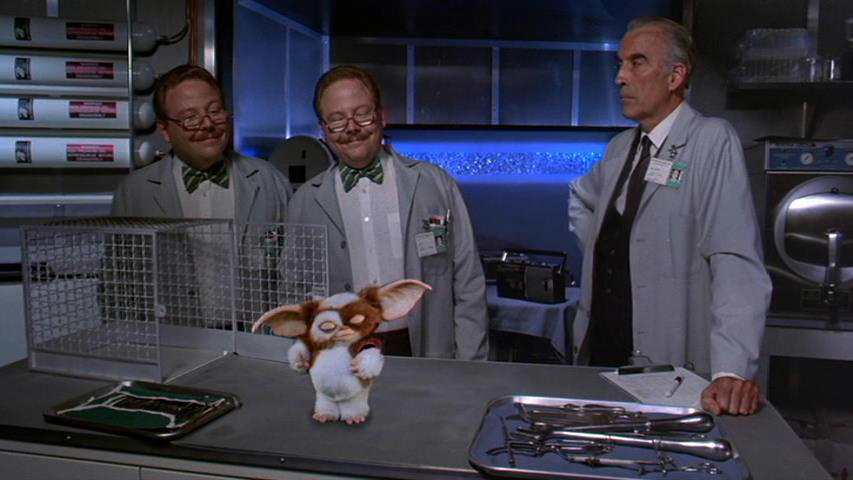
Galligan, Cates and Glover with Gizmo in a box
Like its predecessor, Gremlins 2:The New Batch is a pretty silly movie, but it's hard to dislike because of its constant, generally amusing, references to films and popular culture. Galligan, Cates and Glover are perfectly amiable and adept performers, but they are lost in a virtual sea of weird-looking puppets and aging, lovable character actors. One gremlin drinks a special "brain formula" and turns into an erudite pseudo-British type voiced in great style by Tony Randall. We have a hilarious turn or two by the wonderful Kathleen Freeman, who plays a cooking hostess who loves her cooking sherry and finds a slimy-looking gremlin in her stew. I have no idea why Al Lewis didn't play the horror movie host because the character in this is obviously modeled on "Ole Grandpa" from The Munsters, but Robert Prosky does a good enough job impersonating him. There are also some fun supporting turns from Dick Miller and Jackie Joseph, and a funny bit from Kenneth Tobey. 

Gizmo does a dance for the twins and Lee
Three other performers deserve a special mention: Christopher Lee gets right into the manic spirit of the piece in his portrayal of the head of the genetics lab; Robert Picardo offers a snappy portrait of the no-nonsense heartless corporate assistant type who ignites the passion of the one female (?) gremlin in the bunch; and Haviland Morris is utter perfection as Billy's also-lustful boss who has her eyes on him as well as on the prize. Walking into a web spun by a giant spider-gremlin she says "This is new." Gremlins 2 also features a charming scene when Gizmo comes out of his cage to boogie to some rock music and twin assistants dance along with him as Lee looks on with disapproval. Then there's the very clever bit when the Gremlins invade a projection room and set fire to a print of -- you guessed it -- Gremlins 2!

Two other items I must mention. I enjoyed the stop-motion work in the film, which includes a flying bat-gremlin that attacks Dick Miller and turns into a gargoyle -- this was done by the Doug Beswick studios. And then there are the guest appearances by Bugs Bunny and Daffy Duck, especially the latter. Watch the closing credits to watch lovable Daffy's reaction to how damn long the credits to movies are these days!

Verdict: One could easily denounce this as stupid and note that the pacing is often off, but the darn thing can be inventive and amusing in equal measure. ***.

SWEET SMELL OF SUCCESS

SWEET SMELL OF SUCCESS
(1957). Director: Alexander Mackendrick. 

"You're dead, son. Get yourself buried." 

Powerful newspaper columnist J. J. Hunsecker (Burt Lancaster), who seems to have an incestuous yen for his sister, Susan (Susan Harrison), is determined to keep her from marrying a musician (Martin Milner), and importunes press agent Sidney Falco (Tony Curtis) to help him break the couple up. This study of loathsome and immoral characters isn't really about show biz or newspapers or even columnists but it seems almost as hollow at its center as its protagonist. Part of the problem is that you never really believe Lancaster as Hunsecker, although by no means does he give a bad performance. Then the secondary love story isn't that convincing or moving. Susan Harrison and Barbara Nichols have some nice moments -- Milner is okay if a bit stiff -- but the picture is positively stolen by a ferocious, charismatic and altogether splendid performance by Tony Curtis. That's the main reason to watch the film. 

Verdict: Curtis' finest hour. **1/2.