Lively, entertaining reviews of, and essays on, old and newer films and everything relating to them, written by professional author William Schoell.
Showing posts with label Gary Raymond. Show all posts

Thursday, September 14, 2023

SUDDENLY, LAST SUMMER (1959)

"And this you won't believe:" Albert Dekker and Liz Taylor 
SUDDENLY LAST SUMMER (1959). Director: Joseph L. Mankiewicz. Screenplay by Gore Vidal from the play by Tennessee Williams. NOTE: This review includes important plot details. 

Violet Venable (Katharine Hepburn) is utterly appalled at the tale being told about her son Sebastian's demise by her niece Catherine (Elizabeth Taylor) and "wants that hideous story cut out of her brain." To that end she has called in a neurosurgeon, Dr. Cukrowicz (Montgomery Clift of Lonelyhearts), and promises financial aid to a possible clinic named after her son if the doctor performs a lobotomy on Catherine. Dr. Cukrowicz meets with the distraught woman -- the two are attracted to each other -- and he can clearly see that she is not the kind of hopeless case who would need a lobotomy. Instead he brings Catherine to her aunt's house -- accompanied by her mother (Mercedes McCambridge of All the King's Men) and brother (Gary Raymond of Jason and the Argonauts), who hunger for Sebastian's money -- and administers a truth serum. Catherine then tells the horrifying truth about what happened to Sebastian in the village of Cabeza del Lobo in Spain.

Katharine Hepburn and Montgomery Clift
The problem with Suddenly Last Summer is the same as it is with all plays and films written and produced before Stonewall. The viciously negative stereotypes about homosexuals abound, and it makes no difference that Williams and Gore Vidal were contributors to the picture. Although we never meet or see Sebastian, he hits all the stereotype buttons: vein, superficial, pretentiously "artistic," a bitchy momma's boy, and worst of all, a sexual predator. (One senses that when Taylor refers to boys in relation to her cousin she doesn't mean boys as in "boys and girls," but underage boys.) The production code had a lot of problems with Suddenly Last Summer but ultimately the film was released because, after all, homosexual Sebastian does die, which just proves the "negativity" of the gay lifestyle. (Of course gay men have always had a problem with being cannibalized, LOL!) While a modern interpretation might suggest that Sebastian is gay-bashed, it is much worse than that.  

a tormented Liz Taylor
The laughable notion of the play and movie is that Sebastian, who is supposedly shy, uses good-looking women like his mother (until her stroke) and then cousin to attract men and then presumably pounces on them be these men gay or straight (or offers them money -- or food). Most gay men really don't need this subterfuge to meet other men, even back in the thirties when this takes place -- and the idea of gay men using women to attract hopefully gay men is ludicrous -- although it's also stated that his mother has social connections so I guess Sebastian can meet the "best," well, meat. Of course, there have been self-hating homos who insist only on having sex with "straight" men -- you can see the problem there -- or who buy hustlers who may or may not be gay but are probably at least bi. 

McCambridge, Taylor and Raymond
In any case, playwright Williams was not necessarily being literal when Catherine tells of her snobbish cousin being chased by starving homeless boys who use their musical instruments, made mostly of tin cans, to cut away and eat pieces of their victim after they chase and surround him. The movie however, intimates that this is what actually happened. Could Williams, who had become quite a success by this time, have been thinking about the handsome young actors who wanted to use him so they could get cast in one of his plays? Were they figuratively "devouring" him? Or did he have some guilt over his own behavior? Williams at this time was not exactly what today we would call "out and proud." This was also true of Montgomery Clift, so one can only imagine what the hell he thought of the picture! 

Angry Liz 
Playing in "dragon lady" mode, Katharine Hepburn gives a strong, if imperfect, but very showy performance. Mankiewicz clearly worked with Taylor to help her give as strong a performance as she does. The role is basically beyond the actress' limited range, but she gives excellent line readings, and really delivers during her horrifying climactic speech, giving her readings a frightening urgency and intensity. Clift is basically fine in a not-terribly-interesting part, and McCambridge and Raymond are just about perfect. Albert Dekker, okay as an associate of the doctor's. plays a role that was not in the play. The romantic sub-plot, if that's what you can call it, is expanded, and there are added scenes showing Catherine in a nun's retreat and the state asylum. (A continuity flaw shows a crazy old lady in a rocker in both the nunnery and the asylum.) The film has zero period atmosphere and just comes off as if it takes place in the fifties when it was made. 

Verdict: Yes, this has fascinating aspects but it's terribly dated, quite homophobic, and emerges more as a sick and dirty joke than anything else. **1/2. 

Thursday, April 29, 2021

JASON AND THE ARGONAUTS (1963)

Todd Armstrong
JASON AND THE ARGONAUTS (1963). Director: Don Chaffey. 

With a crew of brave and adept champions, including the mighty Hercules (Nigel Green), Jason (Todd Armstrong) sets sail on the Argo to the ends of the earth in an attempt to find the famous golden fleece. Jason is unaware that he has been sent on this journey by his hated enemy, Pelias (Douglas Wilmer), who only wants him out of the way. Also accompanying Jason is Pelias' conniving son, Acastus (Gary Raymond), and Argos (Laurence Naismith), the ship's builder. Jason has been granted several wishes by Hera, queen of the Gods (Honor Blackman) and she greatly enjoys stymying the plans of her husband Zeus (Naill MacGinness). But can even Hera help Jason overcome the incredible challenges he faces? 

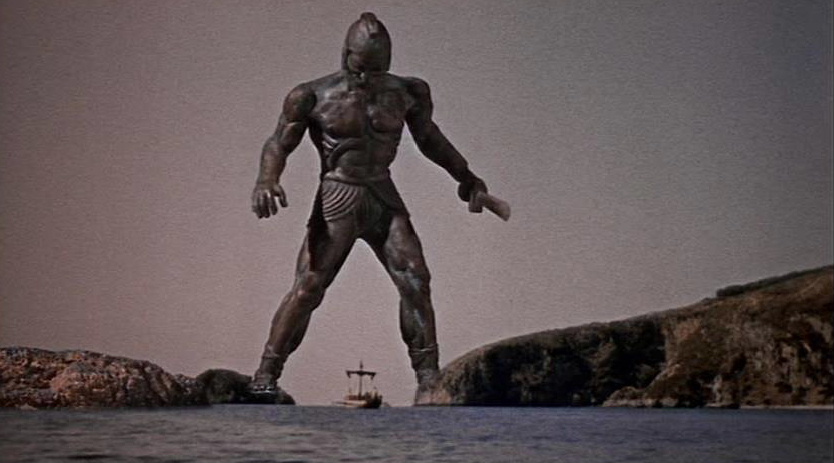
The humongous Talos bears down on the Argo
These challenges, brought to life by the stop-motion wizardry of Ray Harryhausen (possibly his greatest achievement), include the gigantic bronze statue of Talos, which comes to life; tormenting harpies on an island paradise; the many-headed, slithering hydra; the clashing rocks, which would destroy the Argo were it not for the help of a very huge Poseidon; and the living and armed skeletons of the hydra's victims in the bravura climax. Jason is also graced with a rich and exciting score by Bernard Herrmann, excellent production values, skillful photography by Wilkie Cooper; and often stunning costuming and art direction to boot. In fact, Jason looks almost as good as MGM's Captain Sindbad

Jason confronts the gods of Olympus
The actors are also well-chosen. Todd Armstrong makes the perfect Jason. Although he had a perfectly good speaking voice which you can hear in other movies he made, he is dubbed as Jason. Nancy Kovack is also dubbed as Medea, who falls in love with Jason and vice versa when he rescues her from the sea. Blackman, MacGinnes, Naismith, Raymond, Green, Wilmer -- as well as John Cairney as the young and ill-fated Nylas and Jack Gwillim as King Aeetes -- all give flavorful and adept performances. Sadly Jason was not the big box office hit it deserved to be because people confused it with one of the ever-proliferating Italian "peplum" movies of the period when it was on a much, much higher level. The film did not do much good for the career of handsome Armstrong, who tragically committed suicide at 55. 

Verdict: Jason and the Argonauts gets my vote as the greatest classic fantasy film ever made. ***1/2.

Thursday, October 25, 2018

HAMMER HOUSE OF HORROR

Peter Cushing
HAMMER HOUSE OF HORROR (1980 British television anthology series).

This British anthology series of horror stories lasted for one season and 13 episodes. It is a mixed bag with arguably only one really outstanding episode and a lot of stories with intriguing premises that are ruined by weak scripts and flat wind-ups. Peter Cushing stars in what may be the best episode, "The Silent Scream," in which a former Nazi scientist (Cushing) imprisons an ex-con and his wife in a cage along with several animals. There are some interesting twists and turns to the plot, although the ending is a little implausible. Among the more notable episodes are "Rude Awakening," directed by Peter Sasdy, in which a man (Denholm Elliott) has increasingly sinister dreams involving his wife and his mistress. There's an exciting sequence inside a building that is being demolished. "Children of the Full Moon" has to do with a honeymoon couple who encounter the inhabitants of an old house, a cult of werewolves, with a depressing conclusion. "The Two Faces of Evil" is a disquieting episode, well-directed by Alan Gibson,  in which a paranoid woman is besieged by demonic duplicates of her husband (Gary Raymond of The Millionairess) and son. "The House That Bled to Death" details odd occurrences in a house where grisly murders were committed, and bears a resemblance to The Amityville Horror but has its own shrewd and devilish twist.

Diana Dors in "Children of the Full Moon"
One of the most disappointing episodes is "The 13th Reunion," in which plane crash survivors have turned into a cannibal sect, but this great premise is completely muffed.  "Witching Time" is a mediocre story of a 17th century witch who is on the loose in modern times. "Growing Pains," in its story of weird things that happen after a scientist and his wife adopt a strange little boy, is initially absorbing but then becomes too confusing for its own good. An African fetish statue that causes death is the title object in the unoriginal and hum-drum "Charlie Boy," although it has some suspense. Pierce Brosnan is one of the victims of the "Carpathian Eagle," which butchers a series of men, and "Guardian of the Abyss" concerns a young lady in a cult and a supernatural mirror. "The Mask of Satan" is a stupid episode in which a man is convinced that he's been infected with a very strange virus. Kathryn Leigh -Scott of Dark Shadows fame stars in "Visitor from the Grave," in which a woman kills an intruder who keeps appearing wherever she goes; a poor script sinks this one, unfortunately.

Verdict: Not enough great episodes but most are at least reasonably entertaining. **1/2. 

Thursday, September 7, 2017

THE MILLIONAIRESS

Sophia Loren and Peter Sellers
THE MILLIONAIRESS (1960). Director: Anthony Asquith.

Ephifania Pererga (Sophia Loren), the daughter of a late magnate, is a spoiled, haughty heiress who has already had one bad marriage. For her next husband she hopes to land Ahmed el Kabir (Peter Sellers), a selfless doctor who ministers to the poor. Ahmed seems more confused and amazed by the strange woman than especially interested in her, but Ephifania tries to win him over by making something of herself with only a small pittance to start with, and by hoping he'll win her hand by doing the same. Can these two people on such different wavelengths ever get together? Based on a play by George Bernard Shaw, one can only assume that this is a gross bowdlerization and extreme vulgarization of Shaw's original concept, as neither Ephifania or Kabir come off like real people, which is especially true in the former's case. Loren [Boy on a Dolphin] manages to do a nice job even though she's playing an impossible role, and Sellers also acquits himself nicely, with an excellent Indian accent, but it's a wonder that the two actors manage to play so well together in spite of everything. Alistair Sim [The Ruling Class] nearly steals the picture as Ephifania's lawyer, while Gary Raymond, as her first husband, has little to do but run away from the lady while sher's throwing everything she can get her hands on at him. Vittorio De Sica, who later directed Sellers in After the Fox, has a supporting part as Joe, a sweatshop owner, and he's quite good, and Pauline Jameson is also notable as Sim's secretary, Muriel. In addition to a lousy script, the film suffers from the fact that the heroine, if that's what you can call her, despite some admirable qualities, is never a nice person. Judging from the outfits Loren is caparisoned in, one imagines the clothes budget for the picture was roughly equal to her salary.

Verdict: Sellers is far superior to the material in this. **.