Lively, entertaining reviews of, and essays on, old and newer films and everything relating to them, written by professional author William Schoell.
Showing posts with label 1990. Show all posts

Thursday, January 20, 2022

LAW AND ORDER

Sam Waterston as Jack McCoy
LAW AND ORDER. NBC TV series   1990 - 2010. 

 Jack McCoy: "I don't think he's going to   confess."

 Adam Schiff: "Why should he confess?  You'll probably arrest somebody else tomorrow."

Now that Law and Order is coming back after a ten year absence, it's time to look back at this highly-successful and entertaining series, all twenty years of it. The first executive D.A. was Ben Stone, well-played by Michael Moriarty, who resigned when a terrified witness was shot dead in front of an police escort. Stone was replaced by Jack McCoy, the character most associated with the show (after perhaps the late Jerry Orbach), also well-played by Sam Waterston (although Waterson's perpetual head-shaking got to be annoying after a while). The first D.A. depicted on the show was grumpy Adam Schiff (Steven Hill). His performance couldn't be called great acting perhaps, but he was amusingly effective. 

You had to take Law and Order with a grain of salt. To create suspense, far too many episodes had the police and prosecutors arresting more than one person -- sometimes as many as three members of the same family -- for the same murder, something that in real life would never happen (or the ADA wouldn't last very long). I think the writers even saw the silliness of this, prompting the exchange between McCoy and Schiff you can see above. When cops were dressed down by their higher-ups, the latter always came off like incredibly nasty and suspicious super-villains instead of real people.

Jesse L. Martin and Leslie Hendrix as the M.E.
Although I like Waterson, I can't say I liked the character he played. Too many times McCoy would prosecute people when some of these wrongful deaths should have been adjudicated in civil court -- but it made for a good, if implausible, storyline. McCoy would want to take down defendants for their arrogance, but he could be just as arrogant. And hypocritical. I literally laughed at loud during one episode (the notorious one in which McCoy tries to invalidate gay marriage so that he can successfully convict a gay defendant -- don't ask) when McCoy complains of one person involved in the case that "he was hitting on his subordinate!" What's hilarious about this is that if you listen carefully to the dialogue in many previous episodes, McCoy had affairs with many of his female "subordinates." Even if these women initiated the affairs, it was incredibly inappropriate behavior. Occasionally someone would refer to McCoy's indiscretions, but he was never really called on the carpet for it. He eventually married one of his subordinates, the marriage didn't work, and he had a daughter that he hadn't spoken to in ten years!

Then there's the case of ADA Serena Southerlyn (Elizabeth Rohm, who appeared on the show for several seasons). In "Ain't No Love" in which a rap star is murdered, Serena is fired for being too passionate about a case and supposedly acting on emotion instead of evidence. She asks D.A. Arthur Branch (Fred Thompson) if he's firing her because she's a lesbian (which comes out of nowhere). He says "of course not," but when you consider that she had every good reason to think the man on trial was innocent she probably was fired for being gay. McCoy, who sometimes gets so overly passionate about things you think he's demented or will have a stroke, doesn't go to bat for her. 

Over twenty years the show had a huge cast, most of whom gave notable performances. Jerry Orbach as Detective Lennie Briscoe; Jesse L. Martin as Ed Green; S. Epatha Merkerson as Lt. Van Buren; Linus Roache as ADA Mike Cutter (who told Jack off more than once); Chris Noth as Detective Mike Logan; Leslie Hendrix as the taciturn medical examiner; Angie Harmon as ADA Carmichael; Carey Lowell as ADA Ross. Paul Sorvino and George Dzunda also played detectives in the early seasons and were swell. Dianne Weist only lasted one season as the D.A.; she added nothing to the show.

Some of the best episodes of the series include: 

"Misconception." There are terrific twists in this story of a pregnant woman who is attacked on the street. Season 2.

"Manhood." Cops let a gay colleague down by not responding to his calls for help. Season 3.

"American Dream" features Zeljko Ivanek as a killer who gets a new trial and goes up against Ben as his own lawyer. Season 4.

"Snatched." A wealthy man's son is kidnapped -- or was he? Season 4.

"Censure." A man terrorizing a woman and her child turns out to be a respected judge (David Groh). Season 4.

"Sanctuary." A superb episode with multiple points of view about racism and anti-Semitism as a Jew runs over a black boy and a a black man beats a white man to death. Season 4.

"Corruption." Lennie's old colleague (Kevin Conway) is accused of being on the take, then turns around and accuses Lennie. Season 7. 

"Showtime." The trial of a director who murdered and dismembered his ex-wife. Season 7.

"Burden." A doctor murders a disabled boy, but he may be a serial killer and not a mercy killer." Season 8.

""DNR." A lady judge (Lindsay Crouse) is shot by a man who hired her husband; she wants to die but won't condemn him. Season 10.

"Marathon" A woman is shot in broad daylight, but Lennie Briscoe's allegedly hearing the confession of the killer is called into question. Good character development, especially concerning Briscoe. Season 10. 

"Sundown." A man (George Martin) with Alzheimer's is accused of murdering his wife. Season 10. 

"Identity." An elderly man's identity is stolen as well as his home; murder results. Season 14.

"Red Ball." Jack McCoy is forced to make a deal with a loathsome man in order to save a child's life. Season 16.

"Charity case." When a movie star adopts an African baby more than one murder results. Season 17.

"Captive." Sad (if somewhat contrived) episode in which McCoy actually prosecutes a boy for the murder of a child even though he had been kidnapped and molested. Season 17.

"Misbegotten." Interesting if imperfect, twisty episode about a bombing, the gay gene, and a brother-in-law accused of murder. Season 18.

"Quit Claim" Fascinating look at an illegal real estate scheme, who the real mastermind behind it is, and the manipulations of a mysterious female suspect. Season 18.

"Rumble." Jack charges a group of men who had a fight in a park -- with the resulting deaths of innocents -- as terrorists. Season 19.

"By Perjury." Mike (Linus Roache) matches wits with a lawyer (Dallas Roberts) who is representing relatives of victims of an airliner disaster.

"Anchors Away." A Bernie Madoff-inspired episode involving murders, a Ponzi scheme, and television reporters. Season 19.

"Shotgun." A storeowner (Elliot Gould) shoots men robbing his store but there are serious complications. Season 20.

"Innocence." Mike challenges the Innocence Project when they claim he wrongfully convicted a gay-basher. Season 20.

The last two episodes of the series beautifully illustrate the two main types of stories that appeared on the show. "Love Eternal" is an amusing, strange tale with a tacky woman arrested for murdering her masochistic, comics-collecting husband. The final episode, "Rubber Room," is a tense and suspenseful story of everyone trying to track down a boy planning to bomb a high school, while Lt. Anita Van Buren (S. Epatha Merkerson) waits for the results of her MRI regarding her cancer. 

Verdict: Whatever its flaws, this was a compelling and intriguing series "ripped from the headlines." ***1/2. 

Thursday, March 4, 2021

GREMLINS 2: THE NEW BATCH

an evil gremlin on the loose!
GREMLINS 2: THE NEW BATCH (1990). Director: Joe Dante. 

Billy (Zach Galligan) and Kate (Phoebe Cates) from Gremlins are engaged and living in New York City. Both of them work in real estate developer Daniel Clamp's (John Glover) Trade Centre, which is a fully-automated "smart building." Billy discovers that little Gizmo from the first film has been put in a genetics lab in the building after the death of his Chinese owner, Wing (Keye Luke). Billy frees Gizmo from the lab, but the cute little fellow gets wet and before you know it the Trade Centre is over-run with ferocious if fun-loving evil gremlins! Billy comes up with a brilliant if risky plan to get rid of them. 

Galligan, Cates and Glover with Gizmo in a box
Like its predecessor, Gremlins 2:The New Batch is a pretty silly movie, but it's hard to dislike because of its constant, generally amusing, references to films and popular culture. Galligan, Cates and Glover are perfectly amiable and adept performers, but they are lost in a virtual sea of weird-looking puppets and aging, lovable character actors. One gremlin drinks a special "brain formula" and turns into an erudite pseudo-British type voiced in great style by Tony Randall. We have a hilarious turn or two by the wonderful Kathleen Freeman, who plays a cooking hostess who loves her cooking sherry and finds a slimy-looking gremlin in her stew. I have no idea why Al Lewis didn't play the horror movie host because the character in this is obviously modeled on "Ole Grandpa" from The Munsters, but Robert Prosky does a good enough job impersonating him. There are also some fun supporting turns from Dick Miller and Jackie Joseph, and a funny bit from Kenneth Tobey. 

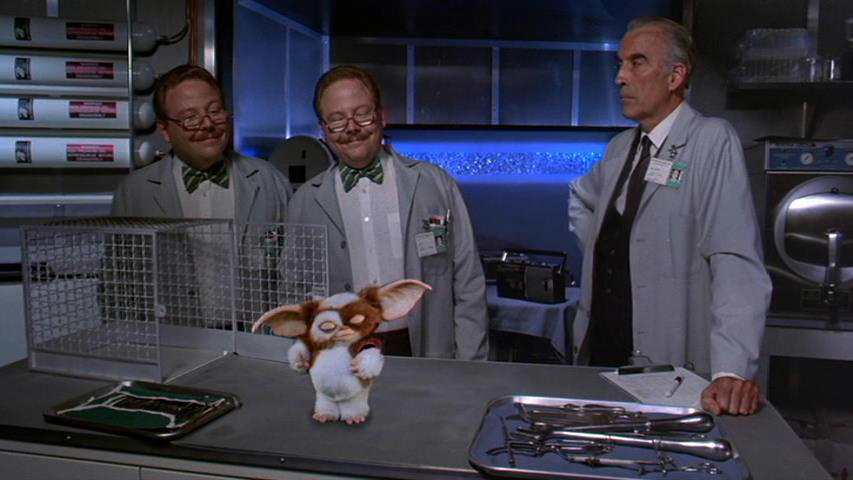
Gizmo does a dance for the twins and Lee
Three other performers deserve a special mention: Christopher Lee gets right into the manic spirit of the piece in his portrayal of the head of the genetics lab; Robert Picardo offers a snappy portrait of the no-nonsense heartless corporate assistant type who ignites the passion of the one female (?) gremlin in the bunch; and Haviland Morris is utter perfection as Billy's also-lustful boss who has her eyes on him as well as on the prize. Walking into a web spun by a giant spider-gremlin she says "This is new." Gremlins 2 also features a charming scene when Gizmo comes out of his cage to boogie to some rock music and twin assistants dance along with him as Lee looks on with disapproval. Then there's the very clever bit when the Gremlins invade a projection room and set fire to a print of -- you guessed it -- Gremlins 2!

Two other items I must mention. I enjoyed the stop-motion work in the film, which includes a flying bat-gremlin that attacks Dick Miller and turns into a gargoyle -- this was done by the Doug Beswick studios. And then there are the guest appearances by Bugs Bunny and Daffy Duck, especially the latter. Watch the closing credits to watch lovable Daffy's reaction to how damn long the credits to movies are these days!

Verdict: One could easily denounce this as stupid and note that the pacing is often off, but the darn thing can be inventive and amusing in equal measure. ***.

Thursday, April 30, 2020

MISERY

Kathy Bates
MISERY (1990). Director: Rob Reiner. Based on the novel by Stephen King.

"If you don't enjoy your own company, you're not fit company for anyone else." -- Annie Wilkes.

"You'll never know the fear of losing someone like you when you're someone like me." -- Ditto.

Novelist Paul Sheldon (James Caan of Games), who made millions writing about a woman named Misery, has just finished a new book with which he hopes to get more respect as an author. After a car accident he winds up at the home of his "number one fan," Annie Wilkes (Kathy Bates of Cheri), who tells him that the roads are impassable due to a blizzard and the phone lines are down. In reality, Annie wants to keep the bedridden, crippled Paul all to herself. As the weeks go by Paul realizes that Annie is keeping him prisoner and cutting him off from the world and everyone who knows him. He also comes to realize that Annie is a truly dangerous sociopath ...

James Caan
Misery is an enjoyable and absorbing picture that focuses on a frightening dilemma for the protagonist who finds his situation becoming more and more sinister with every day. However, the characterization in the film is lacking, with Paul being a one-dimensional "famous author" and not much else -- you really don't learn much about him except that after making lots of money he now wants the critics' respect. You learn a bit more about the psychotic Annie, who has probably had a long career of killing people, but the origins of her psychosis are never explored.

Desperate struggle: Bates vs. Caan
Kathy Bates won a Best Actress Oscar for her work in this film. Although she's good in her own understated way, I didn't think her performance was Oscar-worthy back when the film was first released and I don't think so today. She often seems over-rehearsed. James Caan, who in general (despite some perfunctory moments) gives a more solid performance in a much, much more difficult role, wasn't even nominated. Reiner's direction is good even if it seems by the numbers at times, and the film could have been cut by a good twenty minutes, tightening up the tension and the pacing. Richard Farnsworth is fine as the cop "Buster," as is Frances Sternhagen [Outland] in the tiny role of his wife. Lauren Bacall is similarly good in the small role of Sheldon's agent.  And we mustn't forget Misery the pig, the cutest hog since Babe.

An amusing sequence has Annie railing about how the cliffhanger serials she saw as a girl often cheated, showing a car with the hero apparently trapped inside going off a cliff one week, and then inserting the hero jumping out of the car beforehand in the next episode. On this, the deluded Annie is mostly right, although there were some serials that played fair.

Verdict: Fun movie with some truly horrifying moments and one pretty good shock. ***. 

Thursday, January 10, 2019

GOODFELLAS

Lorraine Bracco and Ray Liotta
GOODFELLAS (1990). Director: Martin Scorsese.

As a boy Henry Hill (Christopher Serrone) admires the mobsters in the neighborhood who play by their own rules (unlike the "suckers") and goes to work for them. As an adult, Henry (Ray Liotta of The Son of No One) realizes he can only go so far because he is part Irish and not full Italian. In spite of this, he makes lots of money and marries a dead-common but feisty gal named Karen (Lorraine Bracco). Henry reports to Paulie Cicero (Paul Sorvino) but his main pals and associates are Jimmy (Robert De Niro) and the psychotic Tommy DeVito (Oscar-winning Joe Pesci). Henry risks Paulie's wrath when he goes against his orders and gets into the drug trafficking business ... 

Paul Sorvino
One thing you have to say about Goodfellas: it is not a dull movie and it is very well-acted by the entire cast. Although many mob films seem to glamorize the mafia, only an idiot can look at this movie and envy the gross lives of the characters who may for a time live in beautiful homes and have lots of moola but generally wind up dead or with long, long jail sentences. While I've no doubt much of the film, based on Nicholas Pileggi's Wiseguy (from Hill's recollections) is true, I also wouldn't doubt that Hill made himself out to be "nicer" than other mobsters and did his best to add to the alleged "glory" of his slimy legend. Entering the witness protection program (from which he was later thrown out), he became a minor celebrity for morons.

Robert De Niro
Goodfellas is undeniably entertaining and well-done, but one has to remember that its basic story -- the rise of a young man in the rackets -- is as old as the hills. The film offers an inside look into the stories of repellent low lives, but Goodfellas doesn't really have any more depth than, say, 1961's Portrait of a Mobster. Of course, when the lead character is a reptile like Hill you can hardly expect much humanism. Goodfellas is completely absorbing, but it's also depressing. Scorsese, De Niro, and Pesci all collaborated on Raging Bull ten years earlier.

Verdict: There really is no honor among thieves. ***. 

Thursday, September 28, 2017

REVERSAL OF FORTUNE

Jeremy Irons and Christine Baranski
REVERSAL OF FORTUNE (1990). Director: Barbet Schroeder.

Claus von Bulow (Jeremy Irons) has already been convicted of twice attempting to murder his wife, Sunny (Glenn Close). Free and at large despite the convictions -- apparently money talks -- Claus hires attorney Alan Dershowitz (Ron Silver) to mount an appeal and even prove that von Bulow did not try to murder his wife. As Alan and his team investigate, Claus keeps company with his mistress, Andrea Reynolds (Christine Baranski), who often allied herself to wealthy and powerful men. If there's any problem with Reversal of Fortune is that it's based on Dershowitz' book about the case, which has a limited and limiting perspective. Frankly, a much more dynamic and suspenseful film could have been made about the von Bulow story. That leaves us with the acting. Jeremy Irons [Swann in Love] is excellent as von Bulow, and won a Best Actor Oscar for his performance. Silver [Wiseguy] is okay, with Close and especially Baranski [Bowfinger] being more on the mark. The screenplay fails to explore many of the people and ramifications in depth, and the actors have to do their best with one-dimensional characterizations. Interestingly enough, von Bulow pretty much discarded Reynolds after he had no more use for her and she died a pitiful, lonely, poverty-stricken death many years later. Reversal of Fortune indeed! The real truth of the case may never be known.

Verdict: Certainly entertaining, but somehow you suspect you're only getting part of the real story. **1/2.

Thursday, April 6, 2017

TOTAL RECALL (1990)

Arnold Schwarzenegger
TOTAL RECALL (1990). Director: Paul Verhoeven.

In the future Douglas Quaid (Arnold Schwarzenegger) goes to a firm that specializes in implanting memories so you can "remember" the perfect vacation -- a stupid idea* if you ask me --  but when they begin the process on Quaid it develops that he has already undergone a memory-altering process -- he is actually a completely different person from whom he thinks he is. When people try to kill him, he winds up on a mining colony on Mars where in his former identity he was involved in a rebellion against Cohaagen (Ronny Cox of The Car), the sinister master of Mars. Total Recall is what might best be called "schlock sci fi" in that it takes many different elements from science fiction stories, films, and comics, and throws them all together to make little more than an Arnold Schwarzenegger Action Flick. On that level the film is entertaining, and it certainly worked for Arnold. He had appeared in action flicks before but Total Recall is the film that really put him over the top.  This was true, too, of European director Verhoeven [Showgirls], who had previously directed Robocop. Some saw this as an interesting filmmaker "selling out" to Hollywood to make crap, a notion that is pretty much born out by his later film projects. (He eventually left Hollywood to make films more along the lines of his earlier work.)

At one point in Total Recall the running Quaid dodges bullets and a perfectly innocent bystander gets shot, with Quaid using the man's body as a shield and then just throwing him at his attackers. Sure, this may be an act of desperation, but can you imagine Jimmy Stewart or Tom Hanks or even Audie Murphy (a real-life hero as opposed to a Hollywood one) not having any reaction to this? There had always been hard-boiled anti-heroes in movies, but by the time of Total Recall the heroes lost any trace of sensitivity and became not ordinary men up against extraordinary odds, but super-heroes (without the costumes) whose success seemed preordained. Compare that to Tom Hanks in the Da Vinci trilogy -- not great films, perhaps, but the hero is strong, intelligent, and recognizably human.

That said, the last quarter of Total Recall is quite exciting and amusing and has some good FX work, but it's never more than a moron movie. Cox is excellent, Sharon Stone (who later appeared in Verhoeven's Basic Instinct) is suitably sexy, Rachel Ticotin is adept, and Schwarzenegger is Schwarzenegger, which was enough for his fans. Jerry Goldsmith's score is one of his least interesting. Remade in 2012.

* If you know your memories are just implanted and never really happened, doesn't it sort of make it all pointless? What makes memories so wonderful is that they were real. Besides, memories can't compare to the actual experience.

Verdict: Arnold builds up the body count along with his muscles. **1/2.

Thursday, March 16, 2017

POSTCARDS FROM THE EDGE

Meryl Streep and Shirley MacLaine
POSTCARDS FROM THE EDGE (1990). Director: Mike Nichols.

Sent into rehab after a nearly fatal overdose, actress Suzanne Vale (Meryl Streep) is told that the insurance company will only allow her to make her next picture if she moves in her with mother, star Doris Mann (Shirley MacLaine), who is an alcoholic! Suzanne and her mother have a loving but difficult relationship with the latter wanting success for her daughter despite the occasional bout of jealousy, and the former bridling against her mother's perpetual, well-meaning "advice.".Based on a semi-autobiographical novel by Carrie Fisher, the daughter of Debbie Reynolds, this is obviously about the two actresses, although it could just as easily be about the real Shirley MacLaine and her daughter, Sachi Parker (not to suggest that Parker was ever in rehab).The two leading ladies are both excellent, perhaps making their characters more sympathetic than they might have been in real life, Dennis Quaid is notable as a man who (seemingly) gets involved with Suzanne, and there's a nice bit from Annette Bening as another of his girlfriends. It's delightful to see Mary Wickes as the grandmother, whose relationship with Doris is as problematic as Doris' with Suzanne. Michael Ontkean [Making Love] is seen all too briefly as Suzanne's co-star in the cop thriller she's making. Rob Reiner, Gene Hackman [The Firm], and Richard Dreyfuss [Piranha] are all effective in important character parts. The musical highlights of this very entertaining movie include MacLaine nailing "I'm Still Here" from Follies, and Streep doing a snappy rendition of "Heartbreak Hotel" for the finale.

Verdict: Mothers and daughters, neurotic Hollywood-style. ***.

Thursday, March 9, 2017

WHAT EVER HAPPENED TO BABY JANE? (1991)

Twisted Sisters: Vanessa and Lynn Redgrave
WHAT EVER HAPPENED TO BABY JANE? (1990 telefilm). Director: David Greene.

"You always were a personality actress. Same performance, different outfit." -- Jane to Blanche.

Former child star Baby Jane Hudson (Lynn Redgrave) lives in a Hollywood mansion where she takes care of her crippled sister, former movie star Blanche Hudson (Vanessa Redgrave). The two sisters -- played by two real-life sisters -- have always had a problematic relationship, but things get worse when Jane discovers that her sister plans to sell the mansion and put her in an institution. Jane begins a campaign of harassment against her sister even as she plans her comeback with video shop owner and part-time drag queen, Billy (John Glover). Meanwhile Blanche does her best to escape her tormentor before the worst can happen. This TV remake of the classic What Ever Happened to Baby Jane? teaming two famous real-life sisters, must have seemed an irresistible notion, but however formidable the talents of Lynn and Vanessa they are "pygmies" compared to the even more formidable Bette Davis and Joan Crawford. That being said, Lynn [Georgy Girl] and Vanessa, with very different acting styles from the two Hollywood movie stars, give good, perhaps more naturalistic, performances. The telefilm has other pleasures, including Bruce A. Young as Blanche's handsome physical therapist (also an aspiring actor) and John Glover's wonderful portrayal of Billy, who tries his damnedest to get Baby Jane back into show business -- which culminates in a "showcase" in a bar which is one of the most memorable scenes in the picture. An in-joke has Blanche/Vanessa watching one of her older movies on television and saying "So many things that Tony could have improved upon" -- Vanessa was married to film director Tony Richardson for five years; she later married her Camelot co-star Franco Nero and they are still married to this day. This version is not as much of a horror film as the original, despite two murder sequences. Peter Manning Robinson's music helps add some pathos to the conclusion, but it still doesn't make sense that Jane would say "you mean all this time we could have been friends" when she finds out Blanche was only crippled trying to kill her sister!

Verdict: Not as good as the original, but not without its peculiar "charms." ***.

Thursday, February 16, 2017

DARK SHADOWS TRIBUTE

Jonathan Frid
DARK SHADOWS TRIBUTE. James Van Hise and Edward Gross. Pioneer; 1990.

"I think (the continued interest in Dark Shadows) is wonderful for the little darlings, only I can't share their enthusiasm at all." --Louis Edmonds.

This fan tribute to the TV show Dark Shadows was compiled some years after the series went off the air, and came out around the time of the remake's premiere. Producer Dan Curtis, who only had the bare bones of an idea, insisted on claiming that he "created" the show, when its premise was really developed by Art Wallace, who provided all of the details. Wallace' credit read: "Story created and developed by Art Wallace." Dark Shadows Tribute, which is packed with behind-the-scenes photos, has sections on all of the people behind the show, the main actors such as Jonathan Frid, Louis Edmonds, and Grayson Hall, who reveals that it was her idea to have Julia Hoffman be in love with Barnabas Collins (which certainly explains some of the woman's actions). Half of the book is devoted to brief synopses of virtually every episode of the series, for those who want to find out what happened without necessarily watching all of the episodes.

Verdict: A must for Dark Shadows fans. ***. 

Thursday, July 14, 2016

DEADLY ILLUSIONS: JEAN HARLOW AND THE MURDER OF PAUL BERN

DEADLY ILLUSIONS: JEAN HARLOW AND THE MURDER OF PAUL BERN. Samuel Marx and Joyce Vanderveen. Random House; 1990.

Samuel Marx was a friend of Paul Bern's and worked at MGM as a story editor at the time of Bern's death. For years he accepted the story that Bern committed suicide because it turned out there was already another woman in his life and a scandal might have derailed both his career and his wife, Jean Harlow's. Paul Bern was horrendously slandered as a monster, abuser, and so on in a phony biography of Harlow as well as two films inspired by it. This book dispels the notions that Bern was impotent (he is described by one doctor  as being "underdeveloped," but not in an abnormal way)  and beat Harlow out of frustration, or that he had no interest in women to begin with. Marx makes clear that the often negative (for the time) rumors about Bern stubbornly persisted for decades with reporters taking the old bio and films as gospel. Dorothy Millette had been involved with Bern years earlier, when she had to be committed to an institution and Bern provided her continual support (and indeed performed many acts of kindness for others). Then Dorothy was released, however delusional, and made her way to Hollywood, expecting she and Bern would continue their relationship and he would groom her for stardom. Unfortunately  ... Marx and Vanderveen make a convincing case that Louis B. Mayer and underlings covered up the murder of Paul Bern in this interesting bio-crime story.

Verdict: Fast read with interesting information. ***.


Thursday, June 2, 2016

FRANKENSTEIN UNBOUND

Pretty Boy: Nick Brimble as the Monster
FRANKENSTEIN UNBOUND (aka Roger Corman's Frankenstein Unbound/1990).

In 2031 a scientist named Buchanan (John Hurt) is developing a kind of disintegration beam that has the side effect of causing severe weather conditions and holes in time. Buchanan winds up back in the days of Victor Frankenstein (Raul Julia) and also encounters Percy Shelley (Michael Hutchence), his girlfriend, Mary (Bridget Fonda), Lord Byron (Jason Patric), and an intelligent if homicidal monster (Nick Brimble). The servant Justine (Catherine Corman) has been accused of murdering little William Frankenstein and Victor refuses to save her by telling the truth about the monster. The formerly callous Buchanan tries to rescue Justine and makes out with Mary (Shelley). It all winds up in a frozen future time period and not a moment too soon. Based on a novel by Brian W. Aldiss (Roger Corman was co-screenwriter as well as director) Frankenstein Unbound emerges as a mish mash of some admittedly interesting ideas, none of which jell in very compelling fashion. Hurt is completely miscast, Julia and Fonda are okay, Brimble does a good job as the monster, Catherine Corman is effective, and Patric makes an interesting Lord Byron. [Some of these real-life characters also appeared in Haunted Summer.] Carl Davis' [Ben-Hur] score is a plus -- much better than the movie deserves -- but the gore scenes are more silly than anything else.

Verdict: Stick with Corman's Attack of the Crab Monsters. ** out of 4.

Thursday, December 24, 2015

STOLEN: ONE HUSBAND aka I WANT HIM BACK

Valerie Harper
STOLEN: ONE HUSBAND (aka I Want Him Back/1990 telefilm). Director: Catlin Adams.

"I don't want what's rightfully mine -- I want what's his!"

Martin Slade (Elliott Gould of Ocean's Thirteen), married for over twenty years to wife Katherine (Valerie Harper), enters into an affair with his daughter's mentor, Samantha (Brenda Bakke), who is much younger of course, and eventually asks Katherine for a divorce. Katherine at first seems to blame her daughter, Jennie (Julie Warner) and spends her time stuffing her face with junk food. Then she and her best friend Lisa (Brenda Vaccaro) begin a harassment campaign against Martin and Samantha, but this begins to backfire when she finds herself legally locked out of her house ... Stolen: One Husband is a very entertaining and quite well-acted (especially by the wonderful Harper) made-for-TV dramedy that explores the situation of middle-aged women who have been cast off by their husbands but still love them. The movie does enter the world of pure fantasy when Katherine is told by an attractive and personable cosmetic surgeon, Peter (Bruce Davison of X-Men), that not only does she not need surgery (which she doesn't), but even asks her out to dinner -- sure, that happens to cast-off wives all the time! Valentina Quinn is fun as Imelda, the housekeeper, and Paul Joseph McKenna has a nice bit as the sympathetic and romantically-inclined bartender, Joe. The main problem with the movie is that Martin treats both women in his life so horribly, never considering their feelings, that it's unlikely that Katherine would ever consider taking him back. The ending makes a good point about divorcees realizing that they don't have to make the husband the center of their existence.

Verdict: Watch out for younger bimbos! *** out of 4.

Thursday, February 19, 2015

THE LOCAL STIGMATIC

Al Pacino and Paul Guilfoyle
THE LOCAL STIGMATIC  (1990). Director: David F. Wheeler.

Cockney roommates Graham (Al Pacino) and Ray (Paul Guilfoyle) are two borderline sociopaths obsessed with dog races and celebrities. One afternoon the two men go to a pub and encounter actor David (Joseph Maher), whom they are jealous of and whom they brutalize. There isn't much else to The Local Stigmatic, which is based on a short play by Heathcote Williams in which Al Pacino appeared in the sixties. While the characters are unmemorable and one-dimensional, the acting can't be faulted, with both gentlemen giving very good performances; Pacino is especially good as a coolly sinister borderline sociopath, even if his accent was criticized. The Local Sigmatic, less than an hour long, was never officially released but was seen in private screenings before being issued on DVD. Guilfoyle (not to be confused with the unrelated older character actor and director of such films as A Life at Stake) has also been a very, very busy actor throughout his career.

Verdict: A mesmerizing Pacino if nothing else. **1/2.