Lively, entertaining reviews of, and essays on, old and newer films and everything relating to them, written by professional author William Schoell.
Showing posts with label fantasy. Show all posts

Thursday, August 18, 2022

ALI BABA AND THE FORTY THIEVES

Jon Hall as Ali
ALI BABA AND THE FORTY THIEVES (1944). Director: Arthur Lubin. 

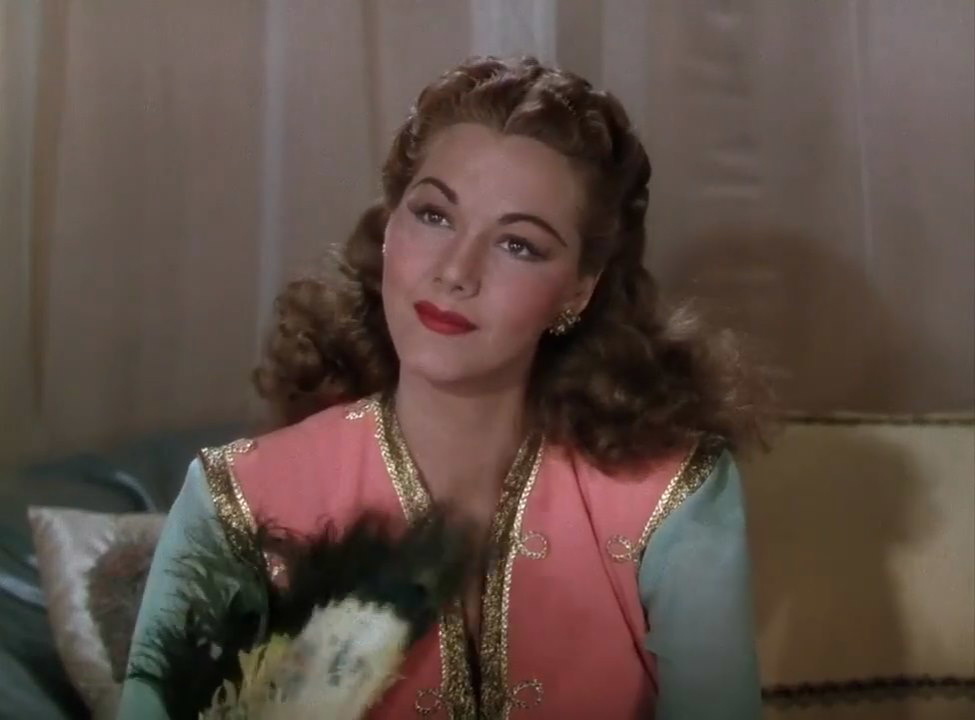
Prince Ali (Scotty Becket) of Baghdad is the son of the king and has a little girlfriend in Amara (Yvette Duguay),  with whom he makes a blood pact. When the King is betrayed by Amara's father, Cassim (Frank Puglia of 20 Million Miles to Earth), Ali manages to escape. Cassim is working with Hulagu Kahn (Kurt Katch of The Mask of Dimitrios), leader of the Mongul hordes and the new king of Baghdad. Ali stumbles upon the cave where the forty thieves keep their booty, and is adopted by them, especially old Baba (Fortunio Bonanova) and the grumpy Abdullah (Andy Devine of Never Say Die), who resents being a "nurse maid" to the boy. The years go by and young Ali Baba, as he is now known, has managed to turn the thieves into freedom fighters (!) who strike swiftly at the Mongolians. Cassin's beautiful daughter, now grown (and played by Maria Montez), is betrothed to Kahn, but falls for the handsome thief, Ali Baba. Eventually they will realize who the other one really is, but in the meantime Kahn is determined to kill one and marry the other ... 

Maria Montez
Ali Baba takes the story from "The Thousand and One Nights" and does its best to turn it into a tale of WW2-style oppression and resistance although it never really loses its fantastic flavoring. Part of this is the casting of Montez -- the only actor with her name above the title despite the fact that even she complained that it was Hall's picture -- and again she proves more than adequate for the proceedings, although much of her part consists of merely reacting to what is going on around her. Hall gives a good performance, as adept at the derring do as he is at pitching the woo. Scotty Becket, as always, is just as good as Ali as a boy. Devine, Bonanova, Puglia, and especially Kurt Katch as the loathsome Kahn, head up the supporting cast, along with Turban Bey, who is fine as a slave boy who assists both Amara and Ali. Like the earlier Arabian Nights, Universal pulled out all the stops for this flick, which is bathed in rich technicolor and has an exciting score by Edward Ward. Arthur Lubin's direction is not quite on the same level but he does keep things moving. 

Verdict: Colorful fantasy flick -- open sesame! ***. 

Thursday, April 29, 2021

JASON AND THE ARGONAUTS (1963)

Todd Armstrong
JASON AND THE ARGONAUTS (1963). Director: Don Chaffey. 

With a crew of brave and adept champions, including the mighty Hercules (Nigel Green), Jason (Todd Armstrong) sets sail on the Argo to the ends of the earth in an attempt to find the famous golden fleece. Jason is unaware that he has been sent on this journey by his hated enemy, Pelias (Douglas Wilmer), who only wants him out of the way. Also accompanying Jason is Pelias' conniving son, Acastus (Gary Raymond), and Argos (Laurence Naismith), the ship's builder. Jason has been granted several wishes by Hera, queen of the Gods (Honor Blackman) and she greatly enjoys stymying the plans of her husband Zeus (Naill MacGinness). But can even Hera help Jason overcome the incredible challenges he faces? 

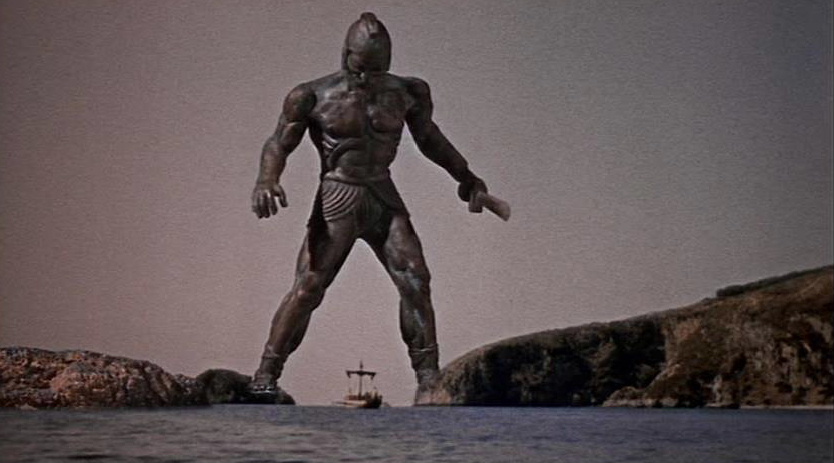
The humongous Talos bears down on the Argo
These challenges, brought to life by the stop-motion wizardry of Ray Harryhausen (possibly his greatest achievement), include the gigantic bronze statue of Talos, which comes to life; tormenting harpies on an island paradise; the many-headed, slithering hydra; the clashing rocks, which would destroy the Argo were it not for the help of a very huge Poseidon; and the living and armed skeletons of the hydra's victims in the bravura climax. Jason is also graced with a rich and exciting score by Bernard Herrmann, excellent production values, skillful photography by Wilkie Cooper; and often stunning costuming and art direction to boot. In fact, Jason looks almost as good as MGM's Captain Sindbad

Jason confronts the gods of Olympus
The actors are also well-chosen. Todd Armstrong makes the perfect Jason. Although he had a perfectly good speaking voice which you can hear in other movies he made, he is dubbed as Jason. Nancy Kovack is also dubbed as Medea, who falls in love with Jason and vice versa when he rescues her from the sea. Blackman, MacGinnes, Naismith, Raymond, Green, Wilmer -- as well as John Cairney as the young and ill-fated Nylas and Jack Gwillim as King Aeetes -- all give flavorful and adept performances. Sadly Jason was not the big box office hit it deserved to be because people confused it with one of the ever-proliferating Italian "peplum" movies of the period when it was on a much, much higher level. The film did not do much good for the career of handsome Armstrong, who tragically committed suicide at 55. 

Verdict: Jason and the Argonauts gets my vote as the greatest classic fantasy film ever made. ***1/2.

THE SWORD AND THE DRAGON

Andreyev and Myshkova
THE SWORD AND THE DRAGON/aka Ilya Muromets/1956). Director: Aleksandr Ptushko. 

Ilya Muromet (Boris Andreyev) is a Russian peasant who is dismayed that due to injuries that prevent him from walking, he can not fight against the tyranny of the evil Tsar Kalin (Shukur Burkhanov). This changes when he is healed by a passing stranger and given a sword that used to belong to a great hero of old. Ilya meets his beloved, Vasilisa (Ninel Myshkova) and the two are married. In a misunderstanding with Prince Vanda (Andrei Abrikosov), Ilya winds up put in a dungeon even as his wife is spirited away by the Cossack-like Kalin. As years pass, Vasilia resists Kalin's advances but he does turn her and Ilya's little boy, Falcon, into his "son" and one of his best warriors. Freed from captivity, Ilya not only has to face his own son in combat, but also must face a gigantic, three-headed, fire-breathing dragon unleashed by Kalin.

son against father in mortal combat
While it may not be as much fun as American fantasy flicks of this nature, The Sword and the Dragon is a notable film from Russia with some outstanding widescreen cinematography (Yuli Kun; Fyodor Provorov), which helps provide sweeping vistas and elaborately staged battle scenes. It has an excellent story taken from Russian folklore and a fine score by Igor Morozov. The Sword and the Dragon is not really a kid's film -- there's a scene when four men are impaled on one spear -- although it has some fantastical elements. The dragon is a silly-looking full-scale prop that looks like something out of a funhouse. One amazing scene has Kalin ordering his followers to climb on top of one another in the hundreds to create a "mountain of men." And we mustn't forget the obese envoy who comes to town giving orders from Kalin and ultimately regrets it. 

Verdict: Quite interesting Russian fantasy film is definitely worth a look. ***. 
 

Thursday, July 9, 2020

BEAUTY AND THE BEAST (1962)

Joyce Taylor and Mark Damon
BEAUTY AND THE BEAST (1962). Diretor: Edward L. Cahn.

Althea (Joyce Taylor) travels with her father, Count Roderick (Dayton Lummis), to a kingdom presided over by the young and recently coronated King Eduardo ( Mark Damon of The Young Racers). Althea, who is affianced to Eduardo, expects a warm greeting but discovers that her fiance is "indisposed" and there is hardly any staff in the castle aside from his chief aide Orsini (Eduard Franz). Althea sees the handsome Eduardo in the morning, but he tells her that their wedding may have to be postponed. It's worse than that -- a curse was placed upon Eduardo by a alchemist who was sentenced to death by Eduardo's father when he refused to share his secrets. Now each night Eduardo grows fur, claws and fangs and becomes a benign if tormented werewolf (of sorts). If Eduardo's nasty Uncle Bruno (Michael Pate) finds out, his regime may come to a decidedly violent conclusion.

Anders, Pate and Burrke
Beauty and the Beast is a rarity in that it's probably the only TechniColor film directed by B Movie maestro Edward L. Cahn. (This was Cahn's last film, as he died the following year.) Mercilessly skewered for its low-budget and a comparison to Cocteau's 1946 film of the same name, on its own terms Beauty and the Beast is a minor but entertaining film that probably works best for young viewers. Taylor and Damon, especially the latter, give good enough performances; Pate and Merry Anders as his gal pal, Sybil, are fine; Franz and Lummis are credible; and Walter Burke gives the most notable performance as the slimy and scheming Grimaldi, servant to Bruno.

Mark Damon. 
The werewolf design is by Ernie Young and the famous Jack P. Pierce. It doesn't look bad, although an unfortunate side effect of the big teeth is that it comically affects Damon's speech. Hugo Friedhofer's musical score is a plus, especially the theme music. A former pop singer and Howard Hughes discovery, Joyce Taylor appeared in Atlantis the Lost Continent and other genre films; her last feature was in 1971. Mark Damon starred in Roger Corman's House of Usher, did many films overseas, and became a producer. Merry Anders was in Hear Me Good and Ib Melchior's The Time Travelers, among others. Beauty and the Beast has a notable climax when the couple race to get married with Bruno's hate-filled followers in rabid pursuit. Edward L. Cahn directed Zombies of Mora Tau and about a zillion others.

Verdict: More than acceptable children's fantasy film. ***. 

Thursday, September 6, 2018

L'ATLANTIDE

Brigitte Helm
L'ATLANTIDE (1932). Director: G. W. Pabst.

Captain Saint-Avit (Pierre Blanchar) and Lt. Morhange (Jean Angelo) are on a mission in the Sahara when they somehow stumble across the lost city of Atlantis. There Saint-Avit becomes pathologically obsessive towards the queen, Antinea (Brigitte Helm of Metropolis), driving him -- at her direction -- to a despicable act against his friend, Morhange. This oddball French production can only be taken seriously if you look at it as a dream or allegory, as little in the movie makes much sense. Although there is some atmosphere in the claustrophobic tunnels through which the cast sometimes travel, there is no attempt at describing or elucidating the realities of this allegedly lost civilization. Brigitte Helm is no raving beauty (as Antinea was in the remake, Siren of Atlantis), but she is quite striking, although it's hard to judge her actual acting ability in this. With his quietly handsome and sensitive features, Pierre Blanchar makes an impression as Saint-Avit, although Jean Angelo is a bit more standard and blustering as his comrade. Vladimir Sokoloff [Beyond the Time Barrier] is excellent as the strange Count Hetman, who was apparently taken to Atlantis from Paris years before -- a long flashback showing him in Paris with Can-Can girls and the like interrupts the main "action," if you can call it that. The movie is strangely sensual, with interesting images throughout, and there are more actual love scenes in the picture than in the remake. What may keep you watching -- even if you can't wait for it to be over -- is Wolfgang Zeller's highly interesting musical score. The novel (by Pierre Benoit) that this was based on was also filmed as the silent film Missing Husbands, the aforementioned Siren of Atlantis, two other Pabst versions also made in 1932 starring Helm but with two different lead actors (Queen of Atlantis and Mistress of Atlantis), a 1972 foreign telefilm and a 1992 French remake, as well as Edgar G. Ulmer's Journey Beneath the Desert.  Pabst is most famous for the silent film Pandora's Box.

Verdict: A curiosity with some interesting elements, but not really an especially good picture. **. 

SIREN OF ATLANTIS

Maria Montez
SIREN OF ATLANTIS (1949). Director: Gregg G. Tallas.

Lt. Andre Saint-Avit (Jean-Pierre Aumont of Carnival of Crime) is found in the desert, delirious, half-starved, wailing about a lost city, an evil queen, and a friend he murdered. In flashback he tells his superiors how after a sandstorm he discovered the lost city of Atlantis -- improbably hidden under the mountains in the Sahara -- where the beautiful Queen Antinea (Maria Montez) loves and disposes of one man after another, and acts cruelly towards her subjects and her slaves. Andre's friend is Captain Jean Morhange (Dennis O'Keefe), who can resist the queen because he's headed for a monastery anyway. Before too long, Andre becomes the favorite of the queen, and presumably does a lot more than play chess with her, but then days go by and Jean is nowhere to be found and the queen isn't calling for Andre ... In his novel "Myron," the sequel to "Myra Breckenridge," Gore Vidal wrote about a Maria Montez flick called Siren of Babylon, and it was probably this picture he was referring to. Not quite a camp classic, it immediately suffers from the fact that it works up absolutely no sense of wonder over this apparently marvelous hidden city, which doesn't seem much different from the kind of places you'd find in those space-babes-on-the-moon epics. Maria Montez is indeed beautiful, if somewhat heavy featured, but her acting is barely adequate. She comes off like a particularly vicious drag queen (not to suggest that most drag queens are vicious). Aumont is fine in an impossible part, and an almost comically miscast O'Keefe doesn't look particularly good in a mustache and goatee. Other characters in the film include Lindstrom (Allan Nixon of Pickup), one of Antinea's cast-off lovers; Cortot (Alexis Minotis of Land of the Pharaohs), an alchemist who had his tongue cut out by the queen; the tragic slave Tanit (Milada Mladova) who dies a horrible death; and Blades (Henry Daniell), the court librarian and philosopher who acts as a kind of butler or assistant and who cackles and belittles the men, primarily acting like the loathsome little cockroach that he is -- Daniell easily offers the best performance in the film. (Movies like this should offer some kind of catharsis, but neither he nor his mistress ever get their comeuppance.) Antinea has her ex-lovers turned into immortal statues. Michel Michelet's score is interesting if a trifle overblown at times, and Karl Struss' photography is fine, especially a sequence in which Andre sees the mirage of an oasis of rushing water in the desert. Aumont and Montez were a real-life married couple from 1946 until 1951 when the Spanish beauty (born in the Domenican Republic) drowned in her bath after possibly suffering a heart attack. She was only 39. Director Tallas also helmed Prehistoric Womenwhich starred Allan Nixon. It is much worse than this.

Verdict: Everyone should see at least one Maria Montez movie. **. 

Thursday, March 29, 2018

THOR: RAGNAROK

Chris Hemsworth and Tom Hiddleston
THOR: RAGNAROK (2017). Director: Taika Waititi.

"Asgard is not a place -- it's a people."

Thor (Chris Hemsworth) manages to defeat the fire demon, Surtur and his impressive dragon, but then learns that he has to take on his sister, Hela (Cate Blanchett), who happens to be the Goddess of Death! (In the early Thor comic books Thor and Hela were not related). But while Hela is wreaking havoc on Asgard, Thor is imprisoned on a strange planet ruled by a weird character named the Grandmaster (Jeff Goldblum), who pits Thor against his special champion in an arena -- the Hulk (Mark Ruffalo)! Will Thor be able to convince his fellow Avenger, as well as his untrustworthy brother Loki (Tom Hiddleston) and a fierce Valkyrie (Tessa Thompson) to escape the Grandmaster and rescue Asgard from Hela? What do you think? Marvel's Guardians of the Galaxy was a huge and unexpected hit, and it was played mostly for laughs, so it was decided to try the flippant, almost campy approach with this latest installment of the Thor series (following Thor and Thor: Dark World). As much as I may lament this approach in most instances, the fact remains that Thor: Ragnarok is better and much more entertaining than the previous Thor films. Although the characters perhaps dally too long on the Grandmaster's planet, the film is fast-paced, colorful, full of some amazing FX (including a gargantuan canine) and well-done action scenes, and features some amusing and lively performances. Hemsworth and Hiddleston make good, somewhat friendly brothers and adversaries, Goldblum is fine as a campy version of an old Marvel cosmic character; and Blanchett [Blue Jasmine] basically steals the movie with her stylish and impressive turn as the dark goddess Hela. There is also nice work from Anthony Hopkins as Odin; Benedict Cumberbatch as Dr. Strange; Karl Urban as Skurge; and Idris Elba as Heimdall. The art direction is striking, as is Javier Aguirresarobe's cinematography; and Mark Mothersbaugh's music is effectively "grandiose" when required. NOTE: To read about the comic book adventures of Thor see The Silver Age of Comics.

Verdict; Too silly and flip perhaps but undeniably well-made, good to look at, and exciting. ***.

Thursday, November 30, 2017

THE PURPLE ROSE OF CAIRO

Jeff Daniels and Mia Farrow
THE PURPLE ROSE OF CAIRO (1985). Writer/director: Woody Allen.

"In New Jersey, anything can happen."

In a dreary small town in 1935, Cecelia (Mia Farrow) has an unhappy marriage with the often out-of-work Monk (Danny Aiello of City Hall). Cecelia seeks refuge in the movies, where she especially loves a film called The Purple Rose of Cairo, and the lead character, Tom Baxter, played by actor Gil Shepherd (Jeff Daniels). In an astonishing turn of events, "Tom Baxter" walks right off the screen and into the real world, leaving the other actors/characters in the movie standing around wringing their hands. "How many times is a man so taken with a woman that he leaves the movie just to meet her," muses Tom. Just as Cecelia, who begins a romance with the charming Tom, is trying to make sense of all this, the real Gil Shepherd, who has heard what's happened, shows up in town ... This movie and its look at how influential movies can be on real life and the necessary escape they offer may not work for everyone, but I found it charming, absorbing, and ultimately moving. The actors offer sensitive and dead-on portrayals. Van Johnson, Edward Herrmann, Zoe Cladwell, and Milo O'Shea, among others, appear in the film-within-a-film.

Verdict: Not perfect perhaps, but it remains one of Allen's most likable movies. ***.

Thursday, August 25, 2016

TARZAN'S MAGIC FOUNTAIN

Lex Baker took over the role of Tarzan
TARZAN'S MAGIC FOUNTAIN (1949). Director: Lee Sholem.

Aviatrix Gloria James (Evelyn Ankers of The Pearl of Death) disappeared twenty years before but her plane and diary are found by Tarzan. Since James' testimony is required to free a jailed man, Tarzan goes to a hidden city -- full of what could best be described as white Aztec-Romans -- to bring Gloria back, and discovers she hasn't aged a day in all those years. Naturally there are unscrupulous people who hope to discover the Fountain of Youth, such as Trask (Albert Dekker) and Dodd (Charles Drake). In a development that borrows from Lost Horizon, Gloria ages as soon as she gets home, and returns to Africa with her husband, Douglas (Alan Napier), where the two hope that Tarzan will guide them back to the Blue Valley where she lived all of those years. But Tarzan is opposed to the plan, and some nasty residents of the hidden city -- against the orders of their leader, the High One (David Bond) -- do their best to kill him and anyone else who knows of the pathway to their valley. Tarzan's Magic Fountain was Lex Barker's first appearance as Tarzan, and he's fine, playing it in the nearly monosyllabic mode popularized by Johnny Weissmuller. Brenda Joyce, who replaced Maureen O'Sullivan as Jane in the last Weissmuller movies, returns as Barker's Jane, but this was her last appearance in the role -- and her last picture, as she promptly retired from the movie business. Johnny Sheffield as Boy had already left the series and turned into Bomba, and he was not replaced in the role. Tarzan's Magic Fountain has an interesting premise, but not a lot is done with it, and the screenplay is mediocre, as is the direction; Lee Sholem mostly directed TV episodes. The ever-versatile Henry Brandon plays one of the Blue Valley natives who wants to kill Tarzan for allegedly giving away the secret location of their city; Rick Vallin is another one of those natives. Elmo Lincoln, one of the first Tarzan's, supposedly plays a fisherman, but he is not credited. Cheetah's cutest scene of many is her encounter with bubble gum. When she regains her youth at the end of the movie, she turns into a different species of ape! Albert Dekker and Charles Drake also appeared together in The Pretender.

Verdict: Barker is fine, but it's an inauspicious debut for him. **1/2.

Thursday, August 11, 2016

GREMLINS

Gizmo, the mogwai
GREMLINS (1984). Director: Joe Dante.

Looking for a special present for his son, Billy (Zach Galligan), Randall Peltzer (Hoyt Axton) buys a strange creature called a mogwai from a Chinatown curiosity shop. Christened "Gizmo,' the adorable creature loves to sing, but certain rules regarding the animal must be followed or disaster will follow. Naturally these rules are inadvertently broken and before long the bucolic town of Kingston Falls is besieged by a horde of nasty, chittering "gremlins" causing utter havoc. Gremlins is a pretty silly movie, but it's also an entertaining and amusing one, with an interesting premise (a take on the dangerous and mythical "gremlins" that allegedly plagued airmen and others), and some superior special effects work, especially in puppetry and make-up effects. Zach Galligan and Phoebe Cates make a charming romantic couple, and Polly Holliday is fun as the town's heartless old woman who takes a deadly trip on a staircase elevator that goes riotously out of control. Jackie Joseph and Dick Miller [A Bucket of Blood] score as neighbors of the Peltzers, and there's a cameo from Kenneth Tobey as well. Keye Luke, Scott Brady [Mohawk] , and Jonathan Banks [Wiseguy] also have significant roles and are fine. Ditto for Mushroom, who plays the dog, Barry, and nearly steals the picture, no easy feat. There is an uncomfortable aspect to the film, however, and that's that the evil gremlins (as opposed to Gizmo, who in a sense, gives birth to these monsters) are dark in color and there are times when they are clearly modeled on certain black stereotypes -- almost as if the movie is depicting an inner city invasion of a mostly Caucasian town [We see only one black inhabitant, a likable school teacher, who comes afoul of the Gremlins.] None of this may have been intended, but it does seem in bad taste. While there are quite a few inventive ideas in this, the picture needs tightening in both the editing and pacing departments. This was a very, very successful picture and engendered one sequel and a whole slew of imitations. Although several people are apparently killed by the end of the film, the Peltzer family, who essentially created the whole mess, seem completely unaffected by it.

Verdict: Hardly for every taste, but this is an often clever black comedy. ***.

Thursday, July 28, 2016

LOST HORIZON (1937)

Jane Wyatt and Ronald Colman
LOST HORIZON (1937). Director: Frank Capra.

Author and foreign secretary Robert Conway (Ronald Colman) winds up shanghaied by plane with his brother, George (John Howard), and several other passengers: fussy paleontologist Lovett (Edward Everett Horton); possible embezzler Barnard (Thomas Mitchell); and a dying, hard-boiled young lady named Gloria (Isabel Jewell of She Had to Choose). The group winds up in the lost city of Shangri-La, which is run by a man named Chang (H. B. Warner of Kidnapped) and ruled by the supposedly wise and benevolent High Lama (Sam Jaffe of The Accused), a 200-year-old priest who discovered and founded the place. The High Lama tells Conway that the most important thing is to "be kind,' but it never occurs to him that it's not exactly "kind" to literally kidnap a bunch of innocents just because the lovely Sondra (Jane Wyatt) has seen Conway's books (and, presumably, his author photo) and developed a yen for him. Understandably, George wants to get back to his own life, while the others find happiness of a sort in Shangri-La. George doesn't believe the High Lama's story, and takes off with a "young" woman, Maria (Margo) in tow with unexpected -- or rather expected -- results. I haven't read James Hilton's novel in a while (I did review certain portions of it after watching the film) but it has to be better than this movie, which takes an interesting premise and dumbs it down to an incredibly superficial level (there are significant differences between the book and the film). Learning that the pilot is dead, the emissaries from Shangri-La -- the guy's own people -- have absolutely no reaction. Presumptuous Sondra has no guilt that her adored one's brother has been dragged along against his will -- after all, why would anyone want to live anywhere besides the rather dull Shangri-La? -- and Robert seems selfishly absorbed in his love for Sondra. The main problem with Lost Horizon isn't that the hypocritical High Lama preaches love and sanity (he also prophecies WW2 and the atom bomb!)  but it never occurs to anyone that running away from the world's problems is hardly the way to solve them -- an influential man like Robert simply wants to drop out! Portraying George as a hot-head, the movie tries its damnedest to strip the character of any dignity or sympathy, and of course Maria has the temerity to lie about her age. [The man who desperately wants to escape from a land that others worship was later borrowed for a plot point in Brigadoon.] The first half of Lost Horizon is quite entertaining, and there are some good adventure scenes in the snowy terrain surrounding Shangri-La, but the movie becomes irritatingly stupid in the second half, so anti-intellectual, in fact, as to be mind-numbing. As in most movies about lost cities, whether in Africa or Tibet, there's a scene when everyone has to walk along a narrow cliff with a mile-high drop inches away -- surely after centuries they would have found a safer way to travel? Capra's direction is swell, but the wrong-headed script ...! The cast, however, is uniformly good. NOTE: This review is of the restored, mostly complete version.

Verdict: Watch the first hour and then turn it off! **.

LOST HORIZON (1973)

Peter Finch seems to be asking: how did I get in this movie?
LOST HORIZON (1973). Director: Charles Jarrott. Produced by Ross Hunter.

A plane carrying several passengers, including peace envoy Richard Conway (Peter Finch) and his brother, George (Michael York), wind up kidnapped to a lamasery called Shangri-La in this musicalized remake of the 1937 Lost Horizon. Larry Kramer [The Normal Heart] seems to have ignored (or never read) the source novel and simply turned in a very slightly modified version of the original screenplay. For instance, in both film versions the two main male characters are brothers, which is not true in the novel. In the book the sole woman on the plane is a prissy missionary, while in both films she's a world-weary gal who's either dying or tired of living; in the color version she tries to commit suicide. This version eliminates a scene when Catherine (Liv Ullmann), who lives in Shangri-La, tells Richard how she wanted him brought to Shangri-La; in fact Ullmann gets few dramatic scenes. Olivia Hussy [Black Christmas] essays Maria (played by Margo in the first version) and is slightly more dimensional than in the original film. George Kennedy's character is very similar to Thomas Mitchell's, but Edward Everett Horton's comedy relief paleontologist has been replaced by an entertainer played by Bobby Van. James Shigeta has a very small role, while John Gielgud and Charles Boyer, of all people, are even better than the actors who played Chang and the High Lama, respectively, in the original film. All of the actors are quite good, in fact. And then there's the music.

Actually aside from a couple of numbers about to be mentioned, Burt Bacharach's score is not bad. His frequently dissonant dramatic music adds much to the picture, and the songs, which might be described as more like lyrical minor arias than show tunes, are generally lilting if on the downbeat side (which may be why so few liked them). Although Liv Ullmann [Cries and Whispers] sang on Broadway in Richard Rodgers I Remember Mama, her songs in this --  "The Circle" and a duet with Finch -- appear dubbed, and so is Finch. Sally Kellerman [Reflection of Fear] seems to be doing her own singing, but I'm not sure about Olivia Hussey when they do a creditable duet, "List of Things I Will Not Miss," in which the former tells of how glad she is to be away from civilization and the latter pines for all the places she's never been (if only more had been made of this aspect of the film). "Peaceful Joys" is a nice enough number, but the decided low-lights of the score include Kellerman's forgettable song, "Reflection," sung to George Kennedy, and Bobby Van's terrible "Question Me An Answer," which is not Van's fault but Bacharach's; this is one number that should have stayed inside his piano bench. Hal David contributed the awful lyrics. [One doesn't expect another "Getting to Know You," but this is just too much!]

The snow/adventure scenes in this are actually inferior to the ones in the original movie, although the trip to Shangri-La seems a bit more realistic. Essentially Lost Horizon in any form comes off like a paean to small-town mentalities, and the High Lama, who has people kidnapped to repopulate his dying city, is not much better than Fu Manchu. The biggest trouble with the movie isn't "Question Me an Answer" but the fact that in both movies -- and I daresay Hilton's novel -- none of the often interesting ideas are explored with any depth.

Verdict: The same length as the original film, although both seem twice as long. **.

Thursday, June 23, 2016

JUDAS KISS

2 sides of the same coin: Richard Harmon; Charlie David
JUDAS KISS (2011). Director: J. P. Tepnapa.

"My Hollywood career has consisted of parties and rehab."

"I even masturbate cinematically!"

Failed screenwriter Zachary Wells (Charlie David) goes back to his old film school, the scene of his first and last triumph, to help judge a competition. He has a one-night stand with a student who turns out to be in this same competition. But a bigger surprise comes when this student reveals his name as Danny Reyes (Richard Harmon) and his film as "Judas Kiss." The trouble is that Danny Reyes is Zachary's real name, and "Judas Kiss" is the film he made that won the competition fifteen years earlier. This is already an intriguing situation but it turns into the Twilight Zone when it develops that Danny Reyes is Zachary's younger self, and he is told by an old man, who is still another version of Danny Reyes, that his life will turn out much better if he actually loses the competition. Naturally younger Danny objects to this idea ... This could have been a gay variation on a whimsical, fantasy film, but the tone is too heavy (without being profound) and the characters don't seem the slightest bit surprised or perplexed by this odd situation. Zach makes love to his younger self -- a bizarre situation in of itself -- but doesn't recognize him or even think he looks familiar. Judas Kiss isn't the first film in which characters are given second chances by going back in time (although it's never made quite clear that this has happened, even when Zach tells a teacher that she "doesn't look a day older"), but its main problem, perhaps, is that it tries to tackle a little too much in one movie. In spite of its overly complicated plot and surplus of characters, the film is well-produced for an independent and is often strangely arresting, although it drags in the final quarter. Many of the actors could be described as talented amateurs, but the leads in this have had a significant body of work, especially Harmon, who has definite presence and is effectively intense, and David (who looks even better without his beard), although he doesn't quite bother to get across his character's desperation, although that may be due to the generally superficial tone of the movie (despite some serious elements). Former (?) porn star Sean Paul Lockhart* certainly makes an impression as a young man, Chris, who wants a relationship with Danny; there's no reason he can't have a solid legitimate acting career. Julia Morizawa, among others, is also notable as Abbey. The entire cast sings the catchy closing credit number, "If I Fall." Some of the male actors overdo the "girlishness" at times.

* Lockhart (also known as Brent Corrigan for his adult films) is the subject of a 2016 James Franco movie entitled King Cobra, which the former disavows.

Verdict: Well, at least it's certainly different .,. **1/2.

Thursday, May 26, 2016

STAR WARS PART VII -- THE FORCE AWAKENS

Mark Hamill as the aged Luke Skywalker
STAR WARS PART VII -- THE FORCE AWAKENS (2015). Director: J. J. Abrams.

Scavenger Rey (Daisy Ridley), former storm trooper Finn (John Boyega), and Poe Dameron (Oscar Isaac) team up with Han Solo (Harrison Ford) and the ridiculous Chewbacca (Peter Mayhew) to find the long-missing Luke Skywalker (Mark Hamill) and to destroy an installation that sends out planet-ravaging death-beams. The main antagonists in this are the First Order, who, naturally, want to take over the universe. Our heroes, under the command of General (formerly Princess) Leia (Carrie Fisher of The Women) also have to contend with one Kylo Ren (Adam Driver of This is Where I Leave You), who happens to be the corrupted son of Solo and Leia. I confess I've never been that carried away with the Star Wars movies, but this one (which sometimes seems like a retread of the original film) is colorful, has some good acting -- Daisy Ridley makes an especially good impression -- striking scenic design, and excellent FX. The man-eating, tentacled Rathtars are interesting creatures, and one of the best scenes is a suspenseful confrontation between Solo and Kylo Ren. It's been forty years since the original Star Wars and it's ironic that of the three leads, the oldest, Harrison Ford, looks the best, looking younger than his years, with Fisher and Hamill not having aged well at all and looking much older. J. J. Abrams also directed the Star Trek reboots.

Verdict: Frankly, despite all the money spent on it this is not nearly as much fun as certain of those classic cliffhanger sci-fi serials that inspired this. but it has its moments. **1/2.

Thursday, May 5, 2016

HOWARD THE DUCK

The "Dark Overlord" about to strike
HOWARD THE DUCK (1986). Director: Willard Huyck.

Due to experiments involving a "laser spectroscope" conducted by Dr. Walter Jenning (Jeffrey Jones), an innocent fellow named Howard (Ed Gale, Chip Zien and others), who lives on a world where ducks are intelligent and capable of speech, is sucked out of his universe and into ours. There he tries to find his way in a strange new world of "hairless apes" while befriended by rock singer Beverly (Lea Thompson) and observed by wannabee scientist Phil Blumburtt (Tim Robbins of Mystic River). Unfortunately Jenning tells them all that his laser beam has also swept up a horrible creature called a Dark Overlord of the Universe, who takes over Jenning's mind even as it hopes to take over the world. Will anyone survive? Well ... Howard the Duck is based on a satirical Marvel comic book and it could easily be dismissed, as it was, as utter schlock were it not for the fact that it has some genuinely amusing moments, good FX, and some good acting from the principals, especially Jones in a funny turn as the possessed, hostile Jenning. The first half of the film, once you get used to the main character being a little guy in a duck outfit, has some minor whimsy to it (as well as a cute scene when a job counselor tells Howard she'll get him a job no matter how weird he tries to look), there's a fairly exciting sequence with Howard and Phil trying to fly off in an odd homemade contraption with wings, and the stop-motion effects [Phil Tippett of Starship Troopers 2] of the giant, slithering, creepy, scorpion-like Dark Overlord are excellent. Unfortunately, this just doesn't add up to a very good movie, and it's often more loud and busy than entertaining. Jorli McLain has a nice bit as a waitress in a diner. John Barry's [Goldfinger] score, including a memorable heroic theme, is better than the movie deserves. Howard was created for the comics by writer Steve Gerber.

Verdict: You want to like it but ...  **.

Thursday, March 31, 2016

FLASH GORDON CONQUERS THE UNIVERSE

The wonderful Charles Middleton as Ming the Merciless
FLASH GORDON CONQUERS THE UNIVERSE (12 chapter Universal serial/1940). Directors: Ford Beebe; Ray Taylor.

The third and final Flash Gordon serial has a plague striking earth, leaving purple spots on victims' foreheads. This is caused by Ming (Charles Middleton) the Merciless' "death dust," which Flash (Buster Crabbe)  and his allies, Dale (Carol Hughes) and Zarkov (Frank Shannon), must stop or else. A cure for the death dust is Polarite, which can be found in the frozen kingdom of Frigia on Mongo. Flash has a few allies in the form of Queen Fria (Luli Deste of The Case of the Black Parrot) of Frigia; Prince Barin (Roland Drew of The Invisible Killer) of the medieval kingdom of Arboria; and Ming's daughter, Princess Aura (Shirley Deane). Aura has a handmaiden named Sonja (Anne Gwynne), who is secretly in league with the bad guys -- she and Dale have a "cat fight" in chapter ten. There are some decent cliffhangers, such as Flash falling into a bottomless pit in chapter one; an avalanche in chapter two; and the electrical ray in chapter four. We see more of Mongo's delightful giant lizards, one of whom snacks on a soldier (off-screen) in Ming's army. Crabbe and Shannon could have acted their parts in their sleep by now; Hughes [Meet the Boyfriend] is perhaps not as glamorous as Jean Rogers  but she's spunky enough. Byron Foulger, Roy Barcroft, Tom Steele, and Donald Curtis are also in the cast.

Verdict: Flash Gordon's last gasp, and not a moment too soon. **.

FLASH GORDON (1980)

Flash and winged Vultan lead the attack on Ming's palace
FLASH GORDON (1980). Director: Mike Hodges.

Flash Gordon (Sam J. Jones) and Dale Arden (Melody Anderson) are shanghaied to Mongo by nutty professor Arkov (Topol of For Your Eyes Only) when Ming (Max von Sydow) begins terrorizing the earth for sport. There Flash meets Ming's daughter, the sexy Princess Aura (Ornella Muti), who has a hankering for the hunky quarterback; Prince Barin of Arboria (Timothy Dalton), who is betrothed to the unfaithful Aura; and Vultan (Brian Blessed), leader of a race of winged warriors. These disparate groups eventually become allies but will even they be able to beat the forces of Ming? While there are many things to like about this version of Flash Gordon, ultimately it's a disappointment. There's no reason to harp about its silliness, as the original serials were pretty silly (but not campy). Jones is acceptable as the heroic Flash, and Anderson isn't bad as Dale, but the acting honors go to von Sydow (although he can't erase the memory of the wonderful Charles Middleton); Dalton as the prince; Peter Wyngarde as Klytus, the masked head of the secret police (Wyngarde's face is never seen but he makes a definite impression); and Mariangela Melato as the nasty General Kala, who wields a mean whip. Muti deserves special mention for her excellent, seductive portrayal of Aura, who switches sides when her own father has her tortured by (unseen) bore worms. Flash Gordon's strength lies in its striking scenic design -- Ming's magnificent palace; the land of Arboria which consists of mile-high trees; Vultan's HQ in the sky -- and a couple of memorable scenes, chief of which is a battle between Flash and Barin atop a floating platform, miles in the air above Mongo, which begins to tilt precariously during the battle and even shoots out spikes from its surface. There's also a crab-like creature that lives below the surface of Arboria and reaches up to ensnare Flash, and an interesting sequence when Zarkov's memories are expunged and we see quick glimpses of his life as it goes backwards. A sobering scene, at odds with the rest of the movie, depicts a boy who tests his manhood in a bizarre ritual, and dies (with hardly anyone giving him a thought). A big problem with the movie is that it has no suspense or real sense of danger -- that the earth itself is about to be destroyed -- until the very final minutes. Rock group Queen's theme music is awful, but it's interesting that Wagner's wedding march from Lohengrin is played even on Mongo! The ending sets up a sequel which never materialized. One wouldn't have considered this an auspicious debut for Jones (he actually had small roles in two previous films), but the actor amassed 76 credits after this film, and starred as The Spirit on TV. Anderson mostly did TV work as well. Muti has had a long career of mostly Italian films. Peter Wyngarde was the star of Burn, Witch, Burn.

Verdict: Opulent, with some good scenes and performances, but one can see why there wasn't a sequel. **1/2.

Thursday, December 24, 2015

IT'S A WONDERFUL LIFE

Jimmy Stewart as George Bailey
IT'S A WONDERFUL LIFE (1946). Producer/director: Frank Capra.

"Youth is wasted on the wrong people."

Facing what he sees as the worst crisis of his life, suicidal George Bailey (James Stewart) attracts the attention of an angel, Clarence (Henry Travers of Dark Victory), who reviews his past history while up above, then descends to earth to show George what life would have been like for everyone if he had never been born. This fantasy comedy-drama is a wonderful if imperfect picture with a terrific performance from Stewart and a marvelous supporting cast. Bailey is certainly a flawed hero, which makes him more interesting -- and perhaps less sympathetic -- as a character. If, to paraphrase, the measure of a man isn't what happens to him him but how he reacts to it, then George certainly fails the test. When $8000.00 disappears and George realizes he and his business can be ruined, and he might even face criminal charges, he takes it out on his wife and children, and even screams at some poor teacher on the other end of the phone when he goes home. In real life people have faced worse situations and still kept their heads, but poor George simply becomes hysterical. Part of this, of course, is because George never wanted to stay in the little town of Bedford Falls and take over his father's business, Bailey Building and Loan, in the first place; and his frustrations have finally caught up with him [it's possible that not quite enough is done with this aspect of the story]. One could also wonder why, if George no longer exists, and no one in town can recognize him, they can still see and talk to him. The business with George's wife, Mary (Donna Reed) turning into a stereotypical old maid (if he was never born) complete with glasses and drab hair is unintentionally comical, and most of the business with Clarence, especially the prologue in heaven, is rather tiresome. Still the movie is well-made, very well-directed by Capra, beautifully photographed [you must see the crisp new digitally remastered version to fully appreciate this], and has several superior performances in addition to Stewart's. Thomas Mitchell is excellent as Uncle Billy, who misplaces the money and is cruelly treated by his nephew. Lionel Barrymore is the cackling personification of hate and greediness as Mr. Potter (who never does get his comeuppance). H. B. Warner [City of Missing Girls] scores in his sad portrait of the druggist, George's employer, who is mourning his son and nearly makes a fatal error. There are also nice moments from Lillian Randolph as the wise Bailey maid, Annie; Robert J. Anderson as young George; and Todd Karns [Andy Hardy's Private Secretary] as George's brother, Harry. The movie is full of interesting touches, such as the menagerie Billy keeps in his office, including that persistent crow, and the squirrel that climbs on his shoulder as if in sympathy.

Verdict: That ending is pure fantasy all right, but if you take it with a grain of salt this is still an entertaining and admirable picture. ***1/2.

Thursday, November 19, 2015

THE THIEF OF BAGDAD (1940)

John Justin and June Duprez
THE THIEF OF BAGDAD (1940). Directors: Michael Powell, Ludwig Berger, and others.

In this first remake of the silent film with Douglas Fairbanks, King Ahmad (John Justin) is dethroned and imprisoned by the evil usurper Jaffar (Conrad Veidt). Ahmad meets a young beggar-thief named Abu (Sabu) in jail, but the two affect an escape. The Sultan (Miles Malleson, who also wrote the screenplay), trades his daughter, the princess (June Duprez of None But the Lonely Heart) for a mechanical horse that flies. This exchange is engineered by Jaffar, who has designs on the princess, who, unfortunately for her, is in love with Ahmad. Confronted by Ahmad and Abu, Jaffur blinds the former and turns the latter into a dog. Human again, Abu encounters a gargantuan genie (Rex Ingram) who helps him steal a fabulous ruby eye from a statue guarded by an enormous and hideous spider. Ahmad gets his sight back, but only in time to face the headsman's sword. Will Abu be able to get back to Bagdad on a flying carpet in time and save the day? The Thief of Bagdad is an excellent fantasy film that boasts amazingly beautiful Technicolor, some wonderful effects work (despite some fuzzy process shots), a very creepy and almost beautiful mechanical spider, and top-notch performances from the appealing Justin and Duprez, and especially Conrad Veight. Sabu is charming as the young thief, and Rex Ingram, although he doesn't exactly sound like something out of the Arabian nights, is terrific as the frightening if personable genie/djinn. While this movie really must have been quite eye-popping in its day, it is still a very memorable and entertaining picture 75 years later. Malleson appeared in the 1959 remake of The Hound of the Baskervilles. This was the first film for John Justin, who played Dorothy Dandridge's lover in Island in the Sun, made quite a few other movies, and often appeared on the stage, including productions of Shakespeare. The Thief of Bagdad was remade again in 1961.

Verdict: Watch out for that giant Djinn! ***1/2.

Thursday, September 10, 2015

FLASH GORDON

The "lobster-clawed dragon" has Flash in its clutches
FLASH GORDON (13 chapter Universal serial/1936). Director: Frederick Stephani.

In this serial based on the Alex Raymond "cartoon strip," the earth is threatened by another planet rushing toward it on a path to destruction. Flying to this planet, Mongo, with Professor Zarkov (Frank Shannon) and lovely Dale Arden (Jean Rogers of The Second Woman), Flash Gordon (Buster Crabbe) encounters Emperor Ming (Charles Middleton of The Town Went Wild) and his horny daughter, Aura (Priscilla Lawson). The original menace of two planets colliding is solved right off the bat, but now Flash and his friends have to deal with a variety of friendly and not-so-friendly Mongo inhabitants, as well as giant, man-eating lizards and a terrible fire dragon with lobster-like claws. Ming is also determined to make Dale his bride, while Aura is equally smitten with Flash and hates Dale, whom he prefers. Prince Thun (James Pierce) is king of the lion men while the obese King Vultan (Jack "Tiny" Lipson) rules the winged Hawkmen. (One can't imagine how Vultan would ever be able to get off the ground!) Flabby-armed and pot-bellied Prince Barin (Richard Alexander) claims to be the rightful ruler of Mongo. An "octosac" is merely an octopus that battles a shark (in footage later used in The Beast from 20,00 Fathoms and probably dozens of other films). There are some exciting scenes and death traps in the serial, such as a electric torture device in chapter six, a tank that fills with water and then an octosac; and a splendid, lengthy sword fight between Flash and Barin in chapter eight. The dragon does double-duty, first appearing in chapter two before becoming a fire-breathing variation in a later chapter. It's interesting that the flying ships of Mongo greatly resemble the design of Arkov's own spaceship, but why on earth does the scientist wear hot pants throughout the serial! The acting is more than acceptable, with Crabbe quite good in fact, and Middleton wisely underplaying instead of chewing the scenery as a lesser actor might do. There are interesting sets and some creative art direction, but some of the supporting players may have you scratching your head All told, however, Flash Gordon, despite its variable pleasures, is not that great a serial.

Verdict: A generally fast pace helps put the absurd material over and much of it is fun. **1/2.