Lively, entertaining reviews of, and essays on, old and newer films and everything relating to them, written by professional author William Schoell.
Showing posts with label Kathleen Freeman. Show all posts

Thursday, March 4, 2021

GREMLINS 2: THE NEW BATCH

an evil gremlin on the loose!
GREMLINS 2: THE NEW BATCH (1990). Director: Joe Dante. 

Billy (Zach Galligan) and Kate (Phoebe Cates) from Gremlins are engaged and living in New York City. Both of them work in real estate developer Daniel Clamp's (John Glover) Trade Centre, which is a fully-automated "smart building." Billy discovers that little Gizmo from the first film has been put in a genetics lab in the building after the death of his Chinese owner, Wing (Keye Luke). Billy frees Gizmo from the lab, but the cute little fellow gets wet and before you know it the Trade Centre is over-run with ferocious if fun-loving evil gremlins! Billy comes up with a brilliant if risky plan to get rid of them. 

Galligan, Cates and Glover with Gizmo in a box
Like its predecessor, Gremlins 2:The New Batch is a pretty silly movie, but it's hard to dislike because of its constant, generally amusing, references to films and popular culture. Galligan, Cates and Glover are perfectly amiable and adept performers, but they are lost in a virtual sea of weird-looking puppets and aging, lovable character actors. One gremlin drinks a special "brain formula" and turns into an erudite pseudo-British type voiced in great style by Tony Randall. We have a hilarious turn or two by the wonderful Kathleen Freeman, who plays a cooking hostess who loves her cooking sherry and finds a slimy-looking gremlin in her stew. I have no idea why Al Lewis didn't play the horror movie host because the character in this is obviously modeled on "Ole Grandpa" from The Munsters, but Robert Prosky does a good enough job impersonating him. There are also some fun supporting turns from Dick Miller and Jackie Joseph, and a funny bit from Kenneth Tobey. 

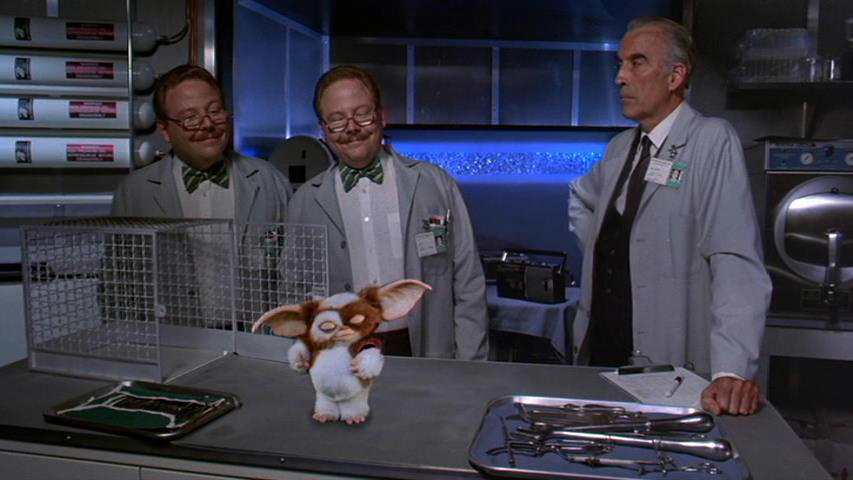
Gizmo does a dance for the twins and Lee
Three other performers deserve a special mention: Christopher Lee gets right into the manic spirit of the piece in his portrayal of the head of the genetics lab; Robert Picardo offers a snappy portrait of the no-nonsense heartless corporate assistant type who ignites the passion of the one female (?) gremlin in the bunch; and Haviland Morris is utter perfection as Billy's also-lustful boss who has her eyes on him as well as on the prize. Walking into a web spun by a giant spider-gremlin she says "This is new." Gremlins 2 also features a charming scene when Gizmo comes out of his cage to boogie to some rock music and twin assistants dance along with him as Lee looks on with disapproval. Then there's the very clever bit when the Gremlins invade a projection room and set fire to a print of -- you guessed it -- Gremlins 2!

Two other items I must mention. I enjoyed the stop-motion work in the film, which includes a flying bat-gremlin that attacks Dick Miller and turns into a gargoyle -- this was done by the Doug Beswick studios. And then there are the guest appearances by Bugs Bunny and Daffy Duck, especially the latter. Watch the closing credits to watch lovable Daffy's reaction to how damn long the credits to movies are these days!

Verdict: One could easily denounce this as stupid and note that the pacing is often off, but the darn thing can be inventive and amusing in equal measure. ***.

Thursday, August 8, 2019

THE AFFAIRS OF DOBIE GILLIS

Bobby Van and Debbie Reynolds
THE AFFAIRS OF DOBIE GILLIS (1953). Director: Don Weis.

Dobie Gillis (Bobby Van) has enrolled in college but he doesn't seem to have much on his mind academically. He is much more interested in girls, especially Pansy Hammer (Debbie Reynolds), who is initially resistant. Pansy's parents, especially her grumpy father (Hanley Stafford), rarely approve of her boyfriends and Dobie is no exception. Further complicating the matter is that Dobie's pal and roommate, Charlie (Bob Fosse), goes for Lorna (Barbara Ruick), who only has eyes for Dobie. Then Dobie manages to get into trouble over and over again, and it seems as if he and Pansy are to be separated forever.

Roomies: Bob Fosse and Bobby Van
The Affairs of Dobie Gillis is a trifle, but what a charming and entertaining trifle it is, with a great cast of talented performers giving their utmost. Bobby Van [The Navy vs the Night Monsters], while not traditionally handsome, proves an adept leading man with both singing and dancing skills, a pleasant, outgoing personality, and plenty of exuberance and charisma. The same could be said for Bob Fosse, who is both cute (if not on a Tab Hunter level) and appealing, but chose to work primarily behind the scenes as a top choreographer in later years. Debbie Reynolds [Singin' in the Rain] is also cute and perky and while this is mostly Van's show, gives him her best in support. Barbara Ruick, who was in the film version of Carousel as well as Rodgers and Hammerstein's Cinderella, scores as the love-sick gal who adores her disinterested Dobie and is given at least one snappy number. 

Reynolds, Van, Freeman
As for the supporting cast, Hans Conreid, as a stuffy professor, reminds one of Mr. Livermore on I Love Lucy. Kathleen Freeman certainly adds to the fun as the comical leader of an all-girl band. Percy Helton shows up as a shop owner, Charles Lane is well-cast as a -- what else? -- grouchy chemistry professor, and there are bits by Alvy Moore,  Almira Sessions, and John Smith. Lurene Tuttle is Debbie's mother, and is fine, but Hanley Stafford as her father is all bluster and no laughs. The songs include "All I Do is Dream of You," "I'm Through with Love;" and "Can't Do Wrong If It's Right," which features some fancy footwork from Van and Fosse. The somewhat episodic film reminds one a bit of a sitcom at times, and indeed it wasn't long before The Many Loves of Dobie Gillis was being telecast every week, although with a completely different cast.

Verdict: Lots of fun, good tunes, and fancy footwork. ***. 

Thursday, April 26, 2018

SINGIN' IN THE RAIN

Gene Kelly and Debbie Reynolds
SINGIN' IN THE RAIN (1952). Directed by Stanley Donen and Gene Kelly.

Silent movie star Don Lockwood (Gene Kelly) has been teamed with Lina Lamont (Jean Hagen of Alexander: The Other Side of Dawn) in movie after movie. Don doesn't particularly like Lina, but she has not only convinced herself that they are in love but engaged. This comes to a head when Gene falls for Kathy (Debbie Reynolds of The Gazebo), who has "theatuh" aspirations but for now spends her time jumping out of cakes. When the first talkie, The Jazz Singer, becomes a tremendous hit, Don's studio insists his latest film with Lamont be turned into a sound picture. The only trouble is -- what to do about Lina's fish-wife screech, which is hardly suitable for sound? Paging Kathy ... but Lina isn't going to take the dubbing lying down, while Kathy is interested in her own career. Singin' in the Rain deservedly has a reputation as one of Hollywood's most memorable musicals with wonderful performances, nice tunes by Freed and Brown, a funny storyline, and a hilarious ending that gives the witchy Lina her full comeuppance. The highlights include Kelly and Donald O'Connor tap dancing to "Fit as a Fiddle;" Kelly, Reynolds and O'Connor performing "Good Mornin';".the "Broadway Melody" production number ("Gotta Dance") with Kelly and Cyd Charisse; and other numbers, such as "You Were Meant for Me," and "You Are My Lucky Star." Then there's Kelly's famous and iconic dance to the title tune. O'Connor's "Make 'Em Laugh" is cute if less successful, and others have noted that the song is very much like "Be a Clown," but I'm not certain which came first. Kathleen Freeman has a brief funny bit as a vocal coach who tries to help Lina talk like a human being, and Millard Mitchell [Thieves Highway] is solid as the studio head, R. F. Simpson.

Verdict: Really a delightful movie. ***1/2.

Thursday, March 16, 2017

BEHIND LOCKED DOORS

Portrait of evil: Douglas Fowley
BEHIND LOCKED DOORS (1948). Director: Budd Boetticher.

Reporter Kathy Lawrence (Lucille Bremer) importunes new private eye Ross Stewart (Richard Carlson) to work with her to find a missing corrupt judge whose capture will net them $5000 a piece. The only problem is that Ross will have to get himself committed to the La Siesta sanitarium where Kathy is sure the judge is hiding. Once inside the institution, Ross discovers there's more corruption and danger than  he ever anticipated. Carlson is fine as the flip, overly insouciant private eye who discovers some situations are more serious than others, and Bremer [Till the Clouds Roll By] is okay, but the most striking performance is from Douglas Fowley [He's a Cockeyed Wonder] as the sadistic and utterly evil attendant, Larson. Thomas Browne Henry is fine as the head of the institution and there's nice work from Ralf Harolde [Night Nurse] as Dobbs, another, nicer attendant. A fully grown Dicke Moore plays a young patient who is actually Dobbs' son. John Holland plays a state psychiatrist, Kathleen Freeman has a bit as a nurse, and Tor Johnson plays another inmate who tries to box Carlson to bits in the film's liveliest sequence. I don't know if Behind Locked Doors was the first film to use the premise of a sane man feigning mental illness to get inside an institution for some purpose, but in the early sixties two movies followed suit. In Sam Fuller's Shock Corridor a reporter hopes to win a Pulitzer and Shock Treatment presents a guy whose intention is to get information about some missing moolah. This movie is barely an hour long.

Verdict: Snappy B thriller with a highly sinister Fowley. ***.

Thursday, November 17, 2016

ATHENA

Jane Powell, Steve Reeves and Edmund Purdom
ATHENA (1954). Director: Richard Thorpe.

Athena Mulvain (Jane Powell) and sister Minerva (Debbie Reynolds) -- two of several siblings -- belong to a family of health nuts, vegetarians, numerologists, and body builders run by Grandpa (Louis Calhern) and Grandma (Evelyn Varden). Grandpa is seventy-eight but can swing around the parallel bars with ease. Athena and Minerva find themselves falling for men who don't quite believe in the same things they do, with the former setting her cap for Adam Shaw (Edmund Purdom), a lawyer running for Congress; and Minerva becoming involved with boyish crooner Johnny Nyle (Vic Damone). Both women already have highly muscular boyfriends, Ed (Steve Reeves) and Bill (Richard Sabre), both of whom compete in the Mr. Universe contest at the end of the movie; and Adam has a sophisticated fiancee named Beth (Linda Christian). Will true love win out in the end, or will Adam and Johnny find themselves in some crushing body blocks? Athena is a very silly and kitschy musical with some pleasant songs by Martin and Blane, the best of which is "Love Can Change the Stars," well-warbled by Powell. Powell also does a creditable job with an aria from Donizetti's "Daughter of the Regiment." Obviously wealthy, the Mulvain family come off at first as free-spirited non-conformists who are at one with the earth and all that, but in one of the better scenes Adam tells Grandpa that they are actually intolerant of (indeed obnoxious toward) others who don't think as they do. Athena is typical of so many movies in which supposedly nice people simply decide they want someone for themselves and don't give a damn for the fact that they are already involved with someone else. The actors in this are all good, but Louis Calhern, as he often did, gives the best performance, and there are notable turns from Kathleen Freeman as Adam's secretary and Ray Collins as a political associate.  Calhern and Collins appeared together in Invitation. Steve Reeves is so handsome it's a wonder he ever bothered with the beard that he wore for most of his career. He was a real-life Mr. America and Mr. Universe, and his American career could have been developed, but he didn't want to slim  down the muscles for the role in Samson and Delilah that was eventually given to Victor Mature. Reeves became a name after the Italian Hercules became a surprise hit, and he was reportedly offered the role of James Bond in Dr. No but turned it down. In all but two films, Reeve's excellent voice was dubbed. NOTE: The body builders of the fifties and sixties were a different breed from what you see today, typified by Arnold Schwarzenegger, whose musculature is so overdone that he resembles something that was mutated in an H-bomb explosion. Steve Reeves had a great physique but he was in no way grotesque.

Verdict: The script is rather annoying, but there are some pleasant moments and performances. **1/2.

Thursday, March 27, 2014

THE COMPANY SHE KEEPS

Jane Greer and Lizabeth Scott
THE COMPANY SHE KEEPS (1951). Director: John Cronwell.

NOTE: Some plot points are revealed in this review. Diane (Jane Greer) is released from prison after passing bad checks and the like, and is assigned to parole officer Joan (Lizabeth Scott). Diane resents kindly Joan from the first, and makes a major play for Joan's boyfriend, Larry (Dennis O'Keefe of Hold That Kiss), which the big lug falls for. Before long Larry and Diane are in love, but they need Joan's approval to marry ... what a weird situation. The problem with The Company She Keeps is that the two lovers are pretty unsympathetic, with Diane returning Joan's friendship by stealing her boyfriend, and Larry betraying the faithful [if eternally busy] Joan, who is too sweet for words -- or reality. Fay Baker [The Star] plays another parolee who works with Diane as a nurse, and Gertrude Hoffman [My Little Margie] has a silent role as a woman on the parole board. Paul Frees is a judge's clerk and Great Old Movies' favorite Kathleen Freeman plays another parolee. Jeff Bridges and his brother Beau supposedly appear as an infant and a small boy. Given Diane's essential nature, it's unlikely that the "happy" ending for this couple is going to last. The acting is generally solid.

Verdict: These two lovers deserve each other. **.

Thursday, January 30, 2014

THE SECOND FACE

Phyllis (Ella Raines) before her makeover.
THE SECOND FACE (1950). Director: Jack Bernhard.

Phyllis (Ella Raines) is a plain but lovely woman who works for a bitter man, Paul (Bruce Bennett), whose pretty wife ran out on him. He sends Phyllis to Los Angeles to stay with a friend, Claire (Rita Johnson of Sleep, My Love), who tries to get her a job with a fashion house as a designer, but since she's required to do some selling on the floor first, she isn't hired due to her appearance. She goes to work for Claire's fiance, Allan (Roy Roberts of The Gale Storm Show), who is fooling around with a client's pretty daughter, and is "romanced" by the slimy Jerry (John Sutton of The Invisible Man Returns), who only wants to use her designs for himself. Phyllis is racing to prevent a possible murder when her car smashes into a truck -- now there's a chance that surgery can make her as attractive as she's always dreamed ... Most of the male characters in The Second Face are pretty loathsome. One guy breaks off with his fiancee by sending a telegram to another person, expecting her to relay the bad news to the rejected woman. An aging businessman (Pierre Watkin) is unspeakably blunt and cruel to Phyllis just to make a point about advertising. Meanwhile no one makes the point that Phyllis' sweet demeanor and feminine, charming aura would certainly make her appealing to some men, and none of her lady friends suggest make up or a new hairdo. In any case, Raines' performance is excellent, and the supporting players are adept enough. Eugene Vale's screenplay is often psychologically astute. Raines also made a good impression in The Strange Affair of Uncle Harry but was less effective in Impact. Kathleen Freeman has a nice bit at the end as a homely-but-happy married lady whose husband likes her just the way she is.

Verdict: An appealing Raines helps put this over. ***.

Thursday, January 16, 2014

TOO MUCH, TOO SOON [MOVIE]

John (Ray Danton) gives Diana (Dottie Malone) a back rub
TOO MUCH, TOO SOON (1958). Director: Art Napoleon.

"I don't want to write a book about my life. Living it was bad enough." -- Diana Barrymore.

"I am fifty-nine years old. And not as drunk as you think. Why don't you take what I offer and not make me jump through hoops?' --John Barrymore.

In this somewhat sanitized version of Diana Barrymore's memoir of the same name, Diana (Dorothy Malone) wishes she could get to know her father, John Barrymore (Errol Flynn) better, but her mother, Blanche (Neva Patterson) isn't too thrilled with the notion. Diana decides to follow in her great family's footsteps and become an actress, discovering that her famous name opens doors but won't necessarily deliver decent scripts. As he was still alive at the time of filming, her first husband, Bramwell Fletcher, is represented by the made-up character of "Vincent Bryant" (Efrem Zimbalist Jr.), who comes home to find Diana diddling in their bedroom with sleazy tennis bum, John Howard (Ray Danton), a real-life man who becomes her second husband. Diana's third husband, actor Robert Wilcox, is portrayed by Ed Kemmer [Earth vs the Spider];  she and Wilcox become mired in a maze of booze, poverty and blown opportunities. Writer Gerald Frank, who helped craft the memoir, is portrayed by Robert Ellenstein. Too Much, Too Soon is psychologically simplistic, but well-acted, with Malone doing a swell job as Diana, with fine support from Patterson and the others. Errol Flynn is the big surprise, turning in a fine performance as the dissipated Barrymore [ironic, considering what lay in Flynn's future]. Smaller roles are performed by Kathleen Freeman and Martin Milner, and there's a nice score by Ernest Gold.

Verdict: Lurid but quite entertaining and reasonably well-made. ***. 


Thursday, September 26, 2013

HOUSE BY THE RIVER

HOUSE BY THE RIVER (1950). Director: Fritz Lang.

"You are a swine, Stephen."

Struggling writer Stephen Byrne (Louis Hayward) makes a pass at a pretty maid, Emily (Dorothy Patrick), and winds up accidentally killing her, then gets his lame, bookkeeper brother, John (Lee Bowman), to help him cover up the crime and put her body in the river beside his house. Meanwhile the mystery over the disappearing maid provides enough publicity for Stephen to capitalize on for his writing career, but his wife, Marjorie (Jane Wyatt), finds his new success a little ghoulish. Then Emily's body is found and one of the brothers is arrested .,.  With moody, beautiful photography from Edward Cronjager, a fine score by George Antheil, and a memorable lead performance by Hayward, House By the River is one of Lang's best pictures. Wyatt is quite good, Bowman also good [if not on Hayward's level], and we even get Ann Shoemaker as a friendly neighbor and Kathleen Freeman as a party guest. Jody Gilbert also scores as John's housekeeper, Flora. In the Lang canon, this falls somewhere between the awful Secret Beyond the Door ...  and the excellent Clash By Night.

Verdict: Brooding, well-done suspense film that just misses being a real classic. ***.

Thursday, June 27, 2013

THE FLY (1958)

THE FLY (1958). Director: Kurt Neumann.

George Langelaan's novelette "The Fly," originally published in Playboy in 1957, is one of the all-time great terror stories, presenting a fascinating scientific notion and elaborating it by piling horror upon horror. The film version, with a screenplay by James Clavell, is very faithful to the story in most respects. Andre Delambre (David Hedison, billed as Al) has invented a matter transmitter [years before Star Trek's teleportation device] that can send things and people from one chamber to the next, and theoretically will be able to ship supplies and individuals to other countries and even planets. Unfortunately, Delambre is careless and allows a common house fly to get into the chamber just as he is about to teleport himself into the next room, resulting in a man with a horrible fly's head [but human brain -- at first] and a fly with a tiny human head and leg [apparently matter transmission can redistribute atoms and change sizes, but no bother]. The film, like the story, unfolds as a mystery, as Delambre's wife Helene (Patricia Owens) tries to explain to her brother-in-law Francois (Vincent Price) and Inspector Charas (Herbert Marshall) why she lowered a crushing mechanical press down onto the body of her husband, nearly obliterating his form. [The shot of the lower half of Delambre sticking out from under the press, a puddle of blood surrounding it, especially gruesome in color, was undoubtedly cut out of television prints.] Hedison is fine as Delambre, although most of the time he has to wear a not-very-convincing mask. Although she gets an A for effort and has a few good moments, Patricia Owens is generally out of her depth as the wife who is nearly driven mad by the grotesque developments of the story. Vincent Price pretty much walks through the movie, seemingly disinterested in the material, but Herbert Marshall is solid and professional, as ever, as the police inspector. The climactic scene with the fly caught in the spider's web still packs a horrifying wallop. Although there are unfortunate elements to the movie that border on burlesque, it works as a mostly effective tragic horror flick. Kurt Neumann's [Carnival Story, Kronos] direction is only standard, however, and the film is not as good as the novella. Paul Sawtell's score, including a generic love theme, is likewise mediocre. Photographed by Karl Struss, who often worked with Neumann. Kathleen Freeman has a small role as a maid who tries to find "the fly with a white head."

Verdict: Imaginative and in some ways rather disgusting. ***.

Thursday, March 7, 2013

THE GLASS WALL

THE GLASS WALL (1953). Director/co-writer: Maxwell Shane.

The explosion in the home video/DVD market has vomited a lot of should-be-forgotten crap onto the unsuspecting viewer, but now and then it has helped film buffs to re-discover a fine film that got lost in the shuffle, such as The Glass Wall. The film was the first American movie for Italian star Vittorio Gassman, and it was hoped that it would lead to a major starring career for the actor in American films. That didn't quite pan out, although Gassman appeared to advantage in other American movies, such as Rhapsody with Elizabeth Taylor and, years later, did an amusing turn in The Nude Bomb with Don Adams as Maxwell Smart. He continued to make many films in Italy and elsewhere.

In The Glass Wall, Gassman plays Peter Kaban, a "DP" [or "displaced person"] who stowaways on a ship heading toward New York after harrowing experiences in concentration camps and the like. Unfortunately, he's denied entry into the U.S. because he has no proof of who he is, and is to be sent back the next day by a tight-assed clerical type. Kaban knows that there is an American soldier, Tom (Jerry Paris), whom he aided overseas, who can identity him, and jumps ship so he can find him. Along the way Peter encounters hungry Maggie (Gloria Grahame), who tries to steal a coat [from Kathleen Freeman] and hides Peter out as they fall in love. [Grahame has a great, beautifully-delivered speech about how deadening her job was putting tips on shoe laces all day long.] Other complications include Tom's selfish fiancee (Ann Robinson of The War of the Worlds) who wishes Tom would stay out of the whole affair despite how much it means to a desperate Peter. It all leads to a dramatic climax on top of the U.N. building. The two leads are terrific, and there's excellent support from Robin Raymond [Girls in Chains] as a dancer who also befriends Peter, as well as Joe Turkel [Tormented] as her brother and Else Neft as her mother, among others. Joseph Biroc's photography is a definite plus. Shane also directed the mediocre Nightmare (1956).

Verdict: A lost film to remember, as they say. ***1/2.

Thursday, December 13, 2012

THE LUCY SHOW SEASON TWO

Lucy and Viv try to get the "world famous Thunderbolt" to move
THE LUCY SHOW Season 2.1963.

The first season of The Lucy Show had its moments but was certainly no I Love Lucy. The second season also has some laughs, but there isn't a single really outstanding episode. The more memorable ones feature Jay Novello as a safe cracker; Robert Alda and John Carradine as art student and instructor [and a very clever bit involving the Mona Lisa]; Lucy's all-woman fire department putting out a fire at the bank; Lucy and Viv opening a restaurant [though it can't compare to "The Diner" episode on I Love Lucy]; Lucy working with Mr. Mooney [Gale Gordon, who is introduced on the fourth episode of the season] at the same bank; the gals competing in a bake-off; and the frenetic couple organizing kiddie parties [the funniest bit has the gals trying to get a recalcitrant dog, "the world-famous Thunderbolt" -- see photo -- to just get up and move]. The problem with The Lucy Show is that everyone thinks that all Ball needs is a little shtick to be hilarious, but the episode with her conducting an orchestra is just plain bad, and there are other overly silly and unfunny episodes with labored and poor material that even the talents of Ball and Vance can't save. However, the gals get some good support from Gale Gordon, Mary Jane Croft, Kathleen Freeman, and others. Ball's second husband, comic Gary Morton, appears in one episode and is quite good. Season three was slightly better. In the introduction to the show, there are nuermous photos of Lucy, and only one of Vivian Vance, who is still billed only as a "co-star."

Verdict: "Ethel Mertz" is one thing, but you can really miss her teaming up with Ethel Merman. **.  

Thursday, July 16, 2009

THE HELICOPTER SPIES

THE HELICOPTER SPIES (1968). Director: Boris Sagal.

"Never trust a woman who's always on time. It always indicates a -- much deeper -- problem."

Originally shown on The Man from U.N.C.L.E. television program as Parts 1 and 2 of "The Prince of Darkness Affair," this was turned into a theatrical feature for overseas release. While it has a few too many campy moments, basically it's an entertaining flick with Robert Vaughn in top form, as usual, as super-spy Napoleon Solo. UNCLE makes a deal with the nefarious Luther Sebastian (Bradford Dillman) to help them get a new weapon, a thermal prism, away from its mad inventor, Dr. Karmusi (John Dehner), who is holed up in a desert bunker -- which will self-destruct if his heart stops. But once Sebastian gets his hands on the device, he has no intention of turning it over to UNCLE. There's also a weird cult called The Third Way, a gang of men who all have white hair, the always-amusing Kathleen Freeman as a short order cook, and John Carradine as a guru who hasn't said a word in forty years. Carol Lynley is the feminine innocent caught up in the melodrama, Lola Albright is the bad girl, and Julie London has a nice turn as Sebastian's wife, who seems to bed a different hot guy every night. The film is well-edited and has some exciting scenes and interesting doom-traps. Dillman's performance is odd. H. M. Wynant is fun as all of the handsome Aksoy brothers. This busy actor is still working at eighty-two.

Verdict: Entertaining hokum. **1/2.

Monday, April 14, 2008

THE STRONGEST MAN IN THE WORLD


THE STRONGEST MAN IN THE WORLD (1975). Director: Vincent McEveety.

Even a host of veteran comics and character actors can't save this Disney comedy that takes a workable premise -- a super-strength formula increases a rivalry between two cereal companies -- and beats it into the ground. Student Dexter Riley (Kurt Russell) is the first one to inadvertently ingest the formula, but the Dean (Joe Flynn) demonstrates its efficacy to a cereal board presided over by no less than Eve Arden. Phil Silvers plays the head of the rival cereal company. It all leads to a weight-lifting competition which will supposedly prove which cereal is the best. Fritz Feld is a board member, Kathleen Freeman plays a cop, Mary Treen is the dean's secretary, and Cesar Romero is a hired crook -- all of them (and Silvers) deserved a better script. Flatly directed by McEveety. A few amusing bits but not enough to sustain a feature. Michael McGreevey is the kid who supposedly invented the formula.

Verdict: A waste of a great cast.