Lively, entertaining reviews of, and essays on, old and newer films and everything relating to them, written by professional author William Schoell.

Thursday, February 2, 2023

ANNOYING NEW MOVIE: TAR

TAR (2022). Written and directed by Todd Field. 
NOTE: This review gives away important plot points

Lydia Tar (Cate Blanchett) has risen far in the field of classical music as both composer and conductor, and now leads the Berlin Symphony. In that city she lives with her wife, Sharon (Nina Hoss), and their adorable daughter, Petra (Mila Bogojevic). Lydia at first seems to be an altogether admirable figure, but the film hints that she may have serious personality flaws or worse. Eventually she is accused of "grooming" young women, using her position for exploitation, and causing a student's suicide. Lydia's life begins to unravel as she's "canceled" ... 

Let's get one thing out of the way immediately. Although it may be wrong to judge a film on what it isn't as opposed to what it is, in this case it's impossible not to do so. Writer-director Todd Field, presumably a straight male, could have written a positive study of a gay woman who rises to the top of her profession against odds and is then unfairly singled out by those who are jealous of her or whom she's ticked off. But Tar -- although it tries unsuccessfully to be subtle about it --  pretty much makes it clear that Lydia is a sexual predator, a tiresome old and homophobic stereotype. The movie distances itself from her misdeeds in an attempt to create thought-provoking confusion in the viewer, which it certainly does. At one point Lydia refers to herself as a "u-haul lesbian" and Cate Blanchett deepens her voice to almost sound like a man, although she never quite comes off as "butch" as she may have intended. More stereotyping. 

Nina Hoss and Cate Blanchett
But let's look at other elements of the movie. The acting is quite good, and for much of the film's length it emerges as a compelling study of a fascinating person. Very late in the movie the accusations start, but the film never really deals with them head on. Perhaps Field did worry about turning his heroine into a predator who acts like many men do when they achieve or are handed power over others, but if that was the case (based on reaction to the film he shouldn't have worried) he simply should have adjusted the script. It is Blanchett who makes Lydia almost three-dimensional, not Field's script. The film is quite long, and although I was happily pulled along for quite awhile, eventually tedium began to set in as I realized Tar was going to sidestep issues and just focus on the heroine's utter debasement. 

Does Tar really deal with cancel culture? In one sense it does, as Lydia is stripped of her job, title, marriage before there's any trial (as far as we know, at least, as in the final quarter the film jumps from event to event with some scenes only lasting half a minute). There's also an early scene at Julliard when a student tells how he can't get behind white European male composers such as Bach because they don't fit into his 21st century ideologies, which is absurd. Lydia rightly challenges him, but in a contrived scene he storms off and calls her a bitch when her behavior is not nasty nor does she put the young man down in any concrete fashion. Later on someone edits this encounter at Julliard to make Lydia come off much worse than she really did, but this is just dropped in and then completely dropped

There are other interesting characters in the film such as cellist Olga (Sophie Kauer), whom Lydia seems attracted to; Lydia's assistant Francesca (Noemie Merlant), who ultimately betrays her; and Sebastian (Allan Corduner), Lydia's conducting associate who thinks he's being replaced by Francesca. I was intrigued by the fact that many reviewers of the film made Lydia seem much worse than she is actually portrayed. She is not nasty to the Julliard student; she is loving to her daughter; she does use her position to influence decisions regarding the orchestra, but that hardly makes her a villain. It's almost as if, being told by the filmmaker that Lydia is a bad girl, they have to see evil in everything she does. And let's face it, even nowadays there are people who will see Lydia as evil simply because she's an out and proud lesbian. 

Cate Blanchett also starred in a much more pro-lesbian movie entitled Carol, which scrupulously avoided stereotyping and was all the better for it. At that time Blanchett gave interviews in which she seemed almost contemptuous of gay people who "shout it from the rooftops." So I'm not surprised she had no trouble with this script. Tar presents its long, long end credits at the very beginning of the movie, backed up by some rather awful vocalizing. Most people will fast forward over that. Tar would probably benefit from re-editing, trimming, putting back some scenes that may have been left on the cutting room floor, and possibly rethinking the entire last quarter. I know that Field and company will argue that Lydia is just a study of one lesbian, not the entire gay community, but it's so ironic that just when Hollywood figures promised to present more positive depictions of minority characters, including gay people, Tar presents one of the most negative gay stereotypes to come along in quite a while. But then Hollywood recently has a history of championing "gay" movies such as Call Me By Your Name and Moonlight that are not that pro-gay if at all. 

Verdict: Initially interesting, this meanders too much and is shockingly reactionary when it comes to LGBT characters. **1/4. 

Thursday, January 19, 2023

SEPARATE TABLES

Rita Hayworth and Burt Lancaster

SEPARATE TABLES (1958). Director: Delbert Mann.

"I have no curiosity about the working classes." -- Mrs. Railton-Bell.

"Being alone in a crowd -- it's so painful ... frightening." -- Ann Shankland.

At the seaside Beauregard Hotel in Bournemouth, England -- where several people are permanent residents -- certain little dramas are unfolding. The highly snobbish Mrs. Railton-Bell (Gladys Cooper) has discovered the inappropriate behavior of Major Angus Pollock (David Niven), who has bored everyone with fictional stories of his allegedly heroic wartime exploits. Mrs. R-B gathers the other residents to vote on whether or not to insist that the man be thrown out of the hotel. Mrs. R-B's neurotically shy daughter, Sibyl (Deborah Kerr), who is exceptionally fond of the major, undergoes an emotional crisis when she learns of his illicit activities. Meanwhile, the proprietress, Pat Cooper (Wendy Hiller), who has become the lover of American resident John Malcolm (Burt Lancaster), discovers that his ex-wife, Ann (Rita Hayworth) is still in love with him and has taken a room in the hotel.   

David Niven and Deborah Kerr
Separate Tables
 was originally two plays by Terence Rattigan, sharing several supporting characters, that took place in the same location and were presented together on one evening in the theater, Although Rattigan was importuned to change this before the play debuted, the Major was originally a closeted homosexual and not a pervert who bothered women in a movie theater. (Although the movie is quite sympathetic to the major, it's a question how this would play in these post- MeToo days.) 

Separate tables indeed
The two plays have been intelligently put together and opened up (but not too much) and the film never appears stage bound or too talky, undoubtedly because Rattigan's dialogue is often excellent and perceptive. David Niven won a Best Actor Oscar for his portrayal and Deborah Kerr, who is outstanding, should have won but was only nominated. (Niven is quite good but a cut below Kerr. Hiller won Best Supporting Actress but was surprised by this, as she isn't onscreen very long and complained that her best scenes were cut.) Playing a comparatively superficial if vulnerable character, Rita Hayworth is effective as Ann, as is Burt Lancaster, although he really can't compare to some of these venerable British actors. Gladys Cooper and Cathleen Nesbitt as her friend are exemplary, as are Hiller, Felix Aylmer as Mr. Fowler, and Mary Hallatt as the brisk and self-sufficient Miss Meacham. Rod Taylor and Audrey Dalton have the thankless roles of a young couple temporarily staying in the hotel, their lines undoubtedly cut back to make room for the emoting of Hayworth and Lancaster.  Delbert Mann also directed the beautiful Middle of the Night and many others. 

Verdict: Superior British drama with some excellent performances. ***1/4. 

CONVERSATION PIECE

Burt Lancaster
CONVERSATION PIECE (aka Gruppo di famiglia in un interno/1974). Director: Luchino Visconti. 

In an absolutely gorgeous old house in Rome, there lives a professor (Burt Lancaster), a widower, who only wants to be left alone with his books, his art, and his housekeeper. An aggressive and vulgar woman, the Marchesa Brumonti (Silvana Mangano), importunes him to rent her the upstairs apartment for her daughter, Lietta (Claudia Marsani), Lietta's boyfriend Stefano (Stefano Patrizi), and the marchesa's younger lover, the German Konrad (Helmut Berger of Ludwig), who is also sleeping with Lietta. To his horror the professor discovers that this "family" is making wholesale changes to the apartment's very structure. In spite of his annoyance over this and other matters, the lonely professor comes to see these people as a surrogate family and seems to develop unspecified feelings for Konrad, who may not be as frivolous as he seems, leading to a literally  explosive finale.

Aging gay prostitute? Helmet Berger as Konrad
 
Visconti's penultimate film, Conversation Piece, which was filmed in English and has an English soundtrack (a dubbed Italian version is also available), is a modestly interesting failure that never realizes its potential. Although Burt Lancaster should be given credit for trying something challenging as a character actor in his later years, he is still too young and robust to make a convincing fussy old professor. The next most important character is Konrad, played by Visconti's then-boyfriend, but although Konrad is apparently strictly a hetero gigolo, he comes off -- as Berger generally did -- as a kind of sleazy aging gay prostitute, making his characterization rather unconvincing. We can hear his real voice for a change, but his accent is often too thick to be understood, and his acting in this is only adequate. 

Patrizi, Marsani and Mangano on the professor's balcony
Silvano Mangano can perhaps be forgiven for going over the top at times because she's playing an imperious, overbearing wealthy woman who is constantly jealous of the young man she actually seems to despise. Claudia Marsani is a bit too perky for my taste, but Stefano Patrizi makes a creditable Stefano. At one point the young couple and Konrad engage in a strictly straight menage-a-trois which is not terribly sexy. The lack of homoerotic material, aside from the vague intimation that the professor might be attracted to Konrad, actually makes the film seem more dated than daring. I confess that because the characters, including the professor, are so underwritten and the film so half-baked, that when somebody dies I actually laughed out loud. Dominique Sanda and Claudia Cardinale have cameos as, respectively, the professor's mother and wife. 

Verdict: Hardly Visconti at his best. **. 

G. I. BLUES

Elvis with a not-quite-regulation haircut
G. I. BLUES (1960). Director: Norman Taurog.

Soldier Tulsa McLean (Elvis Presley) and his buddies Cookie (Robert Ivers) and Rick (James Douglas) have a combo and hope to raise money to open their own nightclub back in the states. In Frankfurt Tulsa is importuned to try and win some money by taking part in a bet: he has to thaw out an ice maiden, a dancer named Lily (Juliet Prowse) and "be alone with her." Reluctantly, Tulsa begins romancing Lily, but he finds her so charming and attractive that guilt sets in. As Cookie and Rick deal with their own lovely ladies, Tina (Leticia Roman of The Spy in the Green Hat) and Marla (Sigrid Maier), Tulsa debates whether or not to break it off with Lily. But is he falling in love? 

Juliet Prowse and Robert Ivers
While it is true that G. I. Blues is one of Presley's formula musicals, it is so well done and so entertaining that I can see why it was popular with both Elvis fans and many others. The songs, not all of which are rock numbers, are snappy and engaging; these include the title tune, "The Frankfurt Special," "Midsummer Night's Dream," "Wooden Heart," "Rainbow" and others. I wouldn't be surprised if the soundtrack album sold like hot cakes. Presley delivers all of these songs with his trademark swagger and charisma as well as total command of his performing abilities.  

Elvis sings a lullaby for adorable baby
As for his supporting players, Prowse is excellent, displaying not only gorgeous legs and figure but wonderful dancing  skills, which she shows off in two nightclub numbers. Robert Ivers was "introduced" in Short Cut to Hell (James Cagney's only directorial credit) playing a hit man, the lead role, but he only had a brief career in movies. James Douglas was best-known as Steven Cord on TV's Peyton Place. Arch Johnson is fine as Tulsa's often disgruntled sergeant. Edson Stroll and Jeremy Brett are introduced early on as rivals in the bet concerning Lily, but the former is sent to Alaska, and Brett simply disappears! Bill Hudson, Beach Dickerson, Britt Ekland, and Ron Starr have much smaller roles. Bill's interplay with Rick's infant son, whom he babysits, is funny, and an utterly charming moment occurs when Elvis sings a lullaby to put the baby boy to sleep! The basic premise of G. I. Blues is taken from such movies as The Fleet's In and others. 

Verdict: Why the public kept flocking to Elvis Presley musicals. ***. 

FANNY BY GASLIGHT

Stewart Granger and Phyllis Calvert
FANNY BY GASLIGHT (aka Man of Evil/1944). Director: Anthony Asquith. 

In 19th century London young Fanny (Phyllis Calvert of Madonna of the Seven Moons) is unaware that her father, Hopwood (John Laurie), isn't her real father, and that he owns the brothel next door. When he is killed by a disgruntled patron, Lord Manderstroke (James Mason), the truth comes out and Fanny and her mother are ostracized. Fanny eventually reunites with her biological father, a cabinet minister named Clive Seymour (Stuart Lindsell) whose marriage to Fanny's mother was annulled by the family. After another tragedy, Fanny draws close to her father's business partner, Harry Somerford (Stewart Granger), but his hateful sister Kate (Cathleen Nesbitt) may destroy their plans for a union. Then there is Lord Manderstroke, who keeps popping up in Fanny's life when she least expects it ...

Margaretta Scott and James Mason
Fanny By Gaslight, is a good, old-fashioned, British "will our Fanny ever find happiness" rags to riches tale that is absorbing, entertaining, and very well-played. In addition to the actors already named, there is also good work from Margaretta Scott [Crescendo] as Seymour's unfaithful wife, Alicia, and Amy Veness as Mrs. Heaviside, the loving servant and former nanny to Clive, among others. If the convoluted plot weren't enough, there are also hookers doing the can can, a ballet sequence, and a duel with pistols outside Paris. Although sinister Mason doesn't have that much screen time, he nearly steals the show. Anthony Asquith also directed The Browning Version and many others. 

Verdict: Solid cast in an engaging melodrama. ***. 

THE DELICIOUS LITTLE DEVIL

THE DELICIOUS LITTLE DEVIL (1919). 

Mary (Mae Murray) loses her job as a coat check girl when she lingers too long and lovingly on a beautiful fur piece, so she reinvents herself as the notorious real-life Gloria Du Moine, who was in a scandal with the equally notorious Duke De Sauterne. Through this subterfuge she manages to get a job as a dancer at the Peace Tree Inn roadhouse. There she captivates a frequent patron, Jimmy Calhoun (Rudolph Valentino), who's the son of a millionaire contractor (Edward Jobson). Hoping she'll prove too crass for the boy, the elder Calhoun throws a party for "Gloria" -- and who should show up? This is a cute if minor comedy with Murray in good form and Valentino, in an early appearance, looking dapper and handsome. The sprightly musical score helps a lot. 

Verdict: Not that delicious but definitely appetizing. **1/2.

Thursday, January 5, 2023

THE GROUP

THE GROUP (1963). Director: Sidney Lumet. 

"Who'da thunk it?" -- various.

"Sacrifice is dated. You don't reform a man. They just drag you down." -- Dottie.

In 1933 a group of women friends graduate from Vassar. The first to get married is Kay (Joanna Pettet), whose husband is a philandering playwright named Harald (Larry Hagman) whose mistress, Norine (Carrie Nye), also went to Vassar (but is not part of the group). Helena (Kathleen Widdoes) is the one who sends out a newsletter detailing the activities of the others. Priss (Elizabeth Hartman of The Beguiled) gets married to a controlling doctor, while Dottie (Joan Hackett) disillusioned by her first lover (Richard Mulligan), marries a much older man. Although she seems man-hungry, the bitchy Libby (Jessica Walter) reveals that she's a virgin when one suitor tries to assault her. Lakey (Candice Bergen) turns out to be a committed lesbian who comes back from Europe with a German baroness in tow. Polly (Shirley Knight) dallies with a married publisher (Hal Holbrook) before uniting with a doctor (James Broderick) who befriends her somewhat unusual father (Robert Emhardt). Pokey (Mary Robin-Redd) is a friendly and plump gal who seems a bit on the fringes of the group.  As the years go by the women interact, have babies, divorces, break-ups and react to world events such as communism and Hitler. Then one of their lives takes a decided and tragic turn for the worse. 

Lidia Prochnicka as the baroness with Bergen 
The Group
 is an interesting if very talky movie with some well-drawn characters and excellent performances. In the early scenes, of course, the actors all seem too old for their parts, but that isn't a problem in the later sequences. You expect -- and get -- memorable  performances from such as Joan Hackett, Jessica Walter (although perhaps a bit too arch and brittle at times), Kathleen Widdoes, and Hartman, but there's also good work from Candice Bergen and excellent work from Joanna Pettet, who is essentially the main character and is on top of things every step of the way. 

Bill Fletcher (seated) with some of the ladies
Larry Hagman has some good moments, as do the other fellows, with Broderick perhaps getting the most time on screen. Doreen Lang (of The Birds) makes a highly sympathetic nurse in one sequence. Bill Fletcher makes an impression as a rude actor who takes on Harald at a party. Sidney Buchman's screenplay seems to be fairly faithful to the novel (judging by a synopsis) while Sidney Lumet's direction covers the action competently but isn't especially inspired. There are no wipes, dissolves or other segues in the movie and nothing whatsoever to denote the passage of time, although there is period atmosphere. The ladies all had many credits after this film, with Bergen, Hackett, Knight, and Walter having the highest profiles. Kathleen Widdoes did work on the soaps. 

Verdict: If you can take all the cute nicknames -- what, no "Pukey?" -- this is an absorbing film with some fine performances. ***.  

X, Y AND ZEE

X, Y AND ZEE (aka Zee and Co./1972). Director: Brian G. Hutton. 

"I got expelled at school because I fell in love with one of the nuns." -- Stella. 

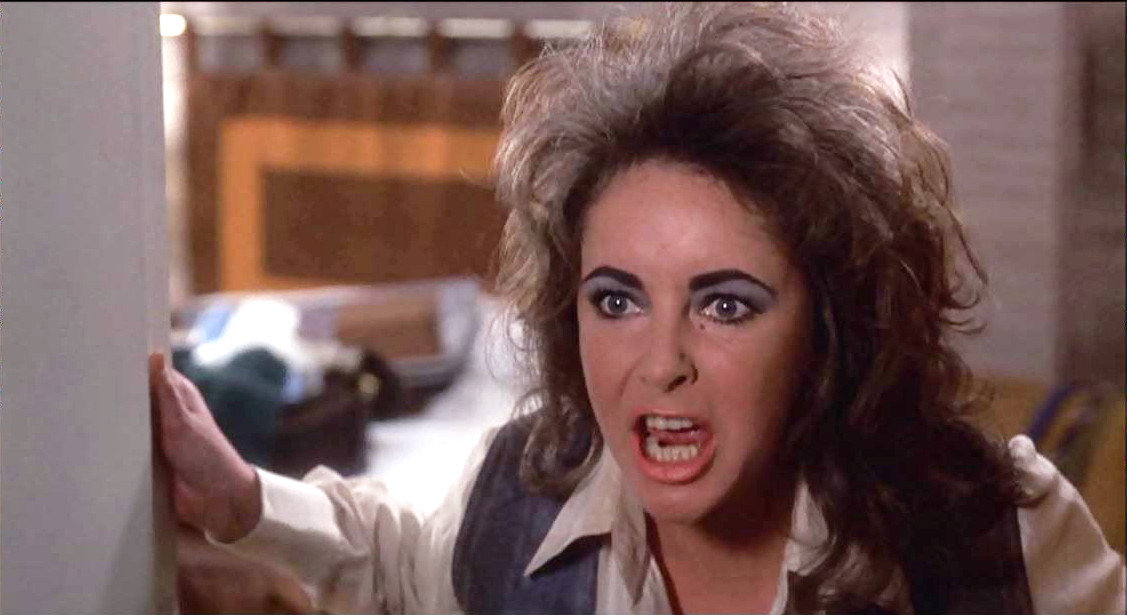
Zee (Elizabeth Taylor) and Robert (Michael Caine of Dressed to Kill) have a toxic marriage that seems to run on ennui and liquor. At a party Robert meets the widow Stella (Susannah York), and while he hopes for just another cheap affair winds up supposedly falling in love with her. Zee seems to have a casual and world-weary reaction to this, but then comes to see Stella and her two small boys -- she and Robert can't have children -- as a threat. Robert makes up his mind to move out and have a life with Stella. What's a wife to do?  Wondering exactly how old Stella might have been when she kissed a nun and got expelled at school, Zee pays a call on her when Robert is out ... 

Frankly X,Y and Zee is over just when it starts to get interesting. For most of its length, it is a fairly dreary marital drama -- wife vs. mistress with a cad caught in the middle -- that has good performances and some good dialogue along with two-dimensional characters. Unlike the "bisexual" comedy Score, which came out the following year, X, Y and Zee turns coy and basically cops out at the end. Made only three years after Stonewall X, Y and Zee has a fairly negative attitude towards homosexuality, with stereotypical gay characters being referred to as "fags" (even right in front of them), so it's hard to think of it as ahead of its time (now if the trio had turned into a "thrupple!"). One also has to remember that Susannah York had already starred in The Killing of Sister George, which was much more explicit on lesbian matters and was released four years earlier.

Liz on the rampage!
Another problem with the movie is that none of the characters are likable. While we can imagine how she became that way, Zee is overbearing and superficial. Stella is, in a word, stupid to even begin a relationship with a man like Robert, who is -- in another word -- a pig. The movie doesn't so much as explore sexual options as exploit them, although many might find the ending amusing. Margaret Leighton (of The Winslow Boy) provides a little bit of fun as an intoxicated party host. Taylor and director Hutton also worked together on Night Watch

Verdict: Who's Afraid of Virginia Mayo? Heads in an interesting direction, and then completely muffs it. **. 

CAUSE FOR ALARM!

CAUSE FOR ALARM (1951). Director: Tay Garnett. 

Although Ellen (Loretta Young ) was sort of keeping company with handsome Dr Ranney Grahame (Bruce Cowling of Song of the Thin Man), she is swept off her feet by army officer and flier George Jones (Barry Sullivan), whom she marries. Years later George is a paranoid who's taken to his bed and is certain that his wife is carrying on with the dreamy doctor, who thinks he should be in a hospital. George writes a letter detailing his unfounded suspicions to the district attorney, and when a tragedy occurs, Ellen has a devil of a time trying to get the letter back from the whining, complaining mailman (Irving Bacon) before it reaches the D.A. -- she is fully aware of how things look. 

Loretta Young gives an outstanding performance in this minor suspense film that never quite gets up to the level of nail-biting tension. It's one of those movies in which someone just assumes someone is dead without checking a pulse or calling an ambulance. The other actors are all on target, with a very effective Sullivan and a stalwart Cowling, and there are nice turns from Margalo Gillmore (of Elopement) and Georgia Backus playing a kindly neighbor and George's aunt (although I confess I'm not certain which is which). Irving Bacon (Ethel's dad on I Love Lucy), Don Haggerty as a business associate of George's, and little Brad Morrow (of Annie Get Your Gun as the little boy, Billy, who lives next door, round out the cast. 

Verdict: Reasonably engaging suspense film bolstered by fine performances. ***. 

ESTHER AND THE KING

ESTHER AND THE KING (1960). Director: Raoul Walsh.  

King Ahasuerus (Richard Egan of Wicked Woman) of Persia returns home from battle and rewards Simon (Rik Battaglia of Raw Wind in Eden), who saved his life, with a symbolic sword. Simon is engaged to Esther (Joan Collins of Land of the Pharaohs), the beautiful niece of adviser Mordecai (Denis O'Day). The faithless Queen Vashti (Daniela Rocca), the lover of the evil Prince Haman (Sergio Fantoni of Diabolically Yours), is kicked out on her keester while the search is on for a new queen. Wouldn't you know that Esther would be one of the women rounded up by barbaric soldiers, and that the king would find her most comely? Although still in love with Simon, Esther does feel great admiration for the king, and goes along with it when Mordecai tells her what good she can do for her people, the Jews, if she becomes the new queen. But Haman and his ally, the brutal Klydrathes (Renato Baldini), won't take this lying down.  

Richard Egan and Joan Collins
Loosely based on the biblical story (which itself is not really based on historical facts)
Esther presents a compelling situation and tangled love story but the execution is only fair-to-middling. Essentially an Italian production filmed in Rome and with an all-Italian cast (aside from the two leads), it has that low-budget look despite some impressive crowd sequences and advancing armies. Although not the best casting in either case, Egan and Collins give good enough performances, although Sergio Fantoni steals the movie with his skillful and sinister turn as the ever-plotting Haman. Handsome Rik Battaglia as Esther's original lover also causes one to wonder which man our sweet Esther will ultimately wind up with. 

Caught between two loves: Collins with Rik Battaglia
Daniela Rocca sizzles a bit as the disloyal queen who tries to win over her husband's favor with a sexy court dance (supposedly done not by Rocca but a dancer), and Rosalba Neri also scores as another one of Haman's lovers, Keresh, who steals a golden cape given to Esther by the eunuch Hegai (Walter Williams) and winds up strangled in Esther's place. Mario Bava, later best-known as a horror filmmaker, did the cinematography, and there is an interesting score by Angelo Francesco Lavagnino and Roberto Nicolosi. 

Verdict: By no means a terrible movie, but you may wish a Ray Harryhausen monster would show up now and then. **1/2. 

Thursday, December 22, 2022

LUDWIG

Helmut Berger as King Ludwig II
LUDWIG (1973). Director: Luchino Visconti. Original four-hour Italian version.

"The greatest gift you can give to your people is to enrich their souls." -- King Ludwig II

King Ludwig II of Bavaria (Helmut Berger of The Bloodstained Butterfly) has much more interest in art, culture, and architecture than he does in matters of state. Supposedly in love with his cousin, the Empress Elisabeth of Austria (Romy Schneider), he gets engaged to Elisabeth's sister, Sophie (Sonia Petrovna). Elisabeth suspects where her cousin's true interests lie, but feels that Ludwig will grow out of these feelings with Sophie's help; the two never get married, however. Ludwig is Catholic and tells his priest that he will subdue any "unnatural" feelings he has, right after which he is playing footsie with his footman, Richard Horning (Marc Porel). Whether it's the King's erotic tendencies or the alleged "degeneration" of his mind that are the problem, the members of the Bavarian government are determined to get "Mad" King Ludwig out of his castle. This leads to two deaths that are still a mystery today.

The real King Ludwig
Ludwig is a fascinating look at a fascinating historical figure. Although quite Wagnerian in length, the film is never boring (something you can't say about every Visconti film), although cuts could have been made in the second half. Berger, dubbed by Giancarlo Giannini, plays the role with his customary intensity -- alas his hairstyle looks better on the real Ludwig than on Berger --  and there are also good performances from Romy Schneider (reprising her role from the Sissi films) and John Moulder-Brown (of The House That Screamed) as the ill-fated Prince Otto, Ludwig's younger brother. Also notable are Helmut Griem (who screwed both Liza Minelli and Michael York in Cabaret) as Count Durckheim and Trevor Howard as Richard Wagner. (Opera fans owe Ludwig a great debt as his financial assistance helped the great composer finish his Ring cycle.) Silvana Mangano is cast as Wagner's mistress and later wife, Cosima. 

There is no doubt that Ludwig was homosexual, but whether he was "tormented" or not, despite his Catholicism, is debatable. I believe his alleged romantic love for Elisabeth  -- which is like that of a child -- was invented for this film, as Visconti wanted his hero to be at least perceived as bisexual, be it true or not, for the director's own reasons. (As for Helmut Berger, he was married to both a man and a woman so you can come to your own conclusions. He was Visconti's companion for many years.) 

The king and squire at rest
Some might be disappointed that the homoerotic content in the film is rather limited. The gay love scene mentioned above is in the shadows and very brief, and there is an all-male party (left) which could hardly be called an orgy. 

Ludwig was filmed on location and the settings are simply magnificent. The movie doesn't always hit the mark emotionally, but it is literate, opulent, romantic, and generally tasteful. King Ludwig was criticized for building numerous beautiful castles, most of which he never lived in, but today they are great tourist attractions and have certainly enriched the Bavarian coffers. 

Verdict: My next vacation will be in Bavaria. ***1/4. 

THE KILLERS

Virginia Christine, Burt Lancaster, Ava Gardner
THE KILLERS (1946). Director: Robert Siodmak.

Torpedoes Max (William Conrad) and Al (Charles McGraw) come to the town of Brentwood and (improbably) announce to people in the diner that they are going to kill a guy known as the Swede or Pete Lund (Burt Lancaster), which they do. The rest of the film presents assorted flashbacks from various points-of-view as insurance investigator Jim Reardon (Edmund O'Brien) tries to find out more about "Lund" and the reasons for his murder. Reardon hooks up with former cop Sam Lubinsky (Sam Levene) and discovers that the latter's old friend the Swede, actually Ole Anderson, a former boxer, was mixed up in a robbery plot as well as with a beautiful if duplicitous female named Kitty (Ava Gardner). But before Reardon's investigation is over, those two torpedoes just may have more work to do. 

Waiting for death: Burt Lancaster
The Killers is a fine and memorable piece of film noir. In his very first film, Lancaster gives a strong performance and he is backed up by an old pro in O'Brien. Conrad and McGraw certainly make in impression in their brief but chilling appearances. Levene and Virginia Christine (Anderson's old girlfriend and now Lubinsky's wife) are solid as well. And then there's Ava Gardner in her 27th film, but clearly still growing as an actress. She makes a good impression in the early scenes but doesn't quite cut it in her climactic moments. There are good turns from Phil Brown [Weird Woman] as Nick Adams, Vince Barnett as old Charleston, Albert Dekker as the architect of the robbery plot, Donald MacBride as Reardon's boss, Jack Lambert [The Unsuspected] as a member of the gang, Queenie Smith as Queenie, Anderson's sole beneficiary, and especially Jeff Corey as Blinky. (Charles Middleton plays a farmer but I didn't spot him.) Although Anderson is in some ways an unsympathetic character, you can't help but feel sorry for the miserable way in which he is played for a sucker. The Killers boasts an evocative score by Miklos Rozsa and fine photography by Elwood (Woody) Bredell. 

Verdict: Totally absorbing, very well-acted crime drama. ***1/4. 

ELVIS (1979)

Kurt Russell as Elvis
ELVIS (1979 telefilm). Director: John Carpenter.

Elvis Presley (Kurt Russell), inspired by black musicians, develops his own singing style and frenetic dancing movements. He rises to the top of the recording and film industry with the help of Colonel Tom Parker (Pat Hingle), but is frustrated by the insipid scripts that he is given. Marrying Priscilla (Season Hubley), whom he meets when she is fourteen, he develops a dependency on prescription drugs that alter his personality and make him paranoid. He attempts a comeback by appearing at the International Hotel and Casino in Las Vegas, but will this lead to a revitalization of his career or will he fall flat on his face as hundreds of fans await his entrance?

Russell with Shelly Winters
Kurt Russell gives a terrific performance as Elvis in this long but entertaining telefilm, which also stars Shelley Winters as Elvis' mom, and Bing Russell (Kurt's real-life father) as Elvis' dad. (To keep it all in the family Kurt Russell later had a short marriage to Season Hubley, who plays Elvis' wife). There's way too much of Winters in the first half of the movie, especially as she is giving one of her kind of twitchy  and breathless performances in what one could call her fat and whiny period. Pat Hingle isn't really given much to do as Parker, his character being shunted into the background most of the time, unlike in the 2022 Elvis

Russell with Season Hubley
The last fifteen minutes or so of the movie are given over to Elvis' triumphant concert at the International, where Russell performs the pants out of songs like "Burning Love" and displays the King of Rock at his most energetic. Credit also must be given to Ronnie McDowell, who does a fine job providing Elvis' singing voice. Ironically, the first movie Kurt Russell ever appeared in was an Elvis flick, It Happened at the World's Fair, where the king asks a boy (Russell) to kick him in the shins. This telefilm began a long association between Kurt Russell and John Carpenter, who also directed him in The Thing and many others. 

Verdict: Good approximation of the King. ***. 

THE MOUSE ON THE MOON

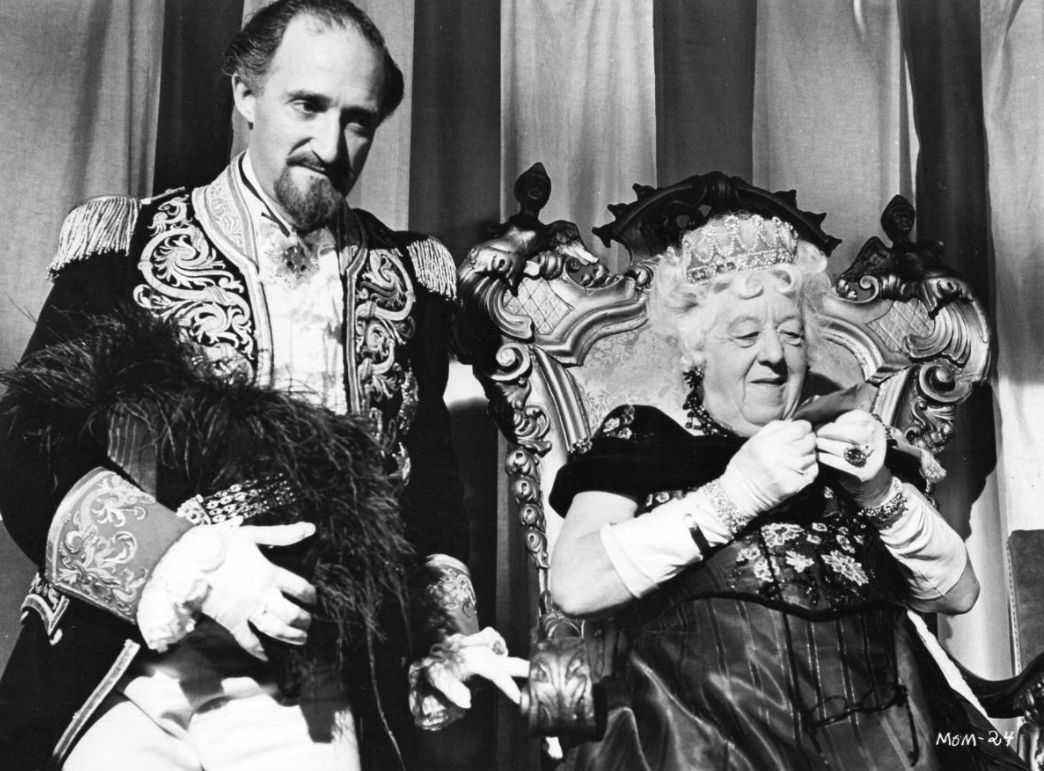
Ron Moody and Margaret Rutherford
THE MOUSE ON THE MOON (1963). Director: Richard Lester.

A crisis develops in the little duchy of Grand Fenwick, the smallest nation in the world, when their chief and only export, wine, inexplicably develops explosive properties. The Prime Minister, Count Mountjoy (Ron Moody) hopes to borrow half a million from the United States to install modern-day plumbing throughout the duchy, but tells the government that they need the money for their space program so as not to sound silly. The U.S. gives Grand Fenwick a million dollars -- a ploy by the Secretary of State. Not to be outdone, the Russians send a rocket to the country, which Mountjoy hopes to transform into indoor plumbing. However, scientist Kokintz (David Kossoff) decides to use the wine as fuel so as to send the rocket on a trip to the moon. Delegates from the US and USSR arrive to see if the professor can actually pull it off. Going with him on the trip is Mountjoy's son, Vincent (Bernard Cribbins of Frenzy).

The Mouse on the Moon
, a sequel to The Mouse That Roared, has a cute idea, and there are quite a few laughs, especially in the first half, but it still comes off as second-rate. Margaret Rutherford as the dotty Grand Duchess is as fun and appealing as ever, but she isn't given nearly enough to do. Ron Moody gets the lion's share of the action, and he's fine, but not quite as amusing as you might hope. Once the rocket heads for the moon, the picture turns into a poor imitation of First Men in the Moon with its equally unscientific voyage into space. Terry-Thomas is cast as a spy, and June Ritchie is Mountjoy's niece, who gets involved with Vincent. Twenty years later Richard Lester directed Superman III. In The Mouse That Roared Peter Sellers played both the Grand Duchess and Count Mountjoy! 

Verdict: Very pleasant -- and pleasantly satirical -- in spots, but overall a disappointment. **1/2. 

OK NEW MOVIE: ELVIS

Austin Butler as Elvis
ELVIS (2022). Director: Baz Luhrmann. 

"Every dream I ever dreamed has come true a hundred times." -- Elvis.

Influenced by black musicians, Elvis Presley (Austin Butler) rises from obscurity to become one of the most famous men in the world, his career as singer and actor guided by "Colonel Tom Parker" (Tom Hanks), a mysterious figure who turns out to be ripping him off and making bad decisions due to a secret he has. Elvis' devotion to his fans and his love of performing cause problems in his marriage to Priscilla (Olivia DeJonge), and he may have more trouble breaking away from the Colonel than he thinks. 

Tom Hanks as the alleged colonel
There is only one way to take Elvis and that is as a tribute to a very influential and talented performer. That's really the only way the movie works as it is far too superficial to work as a biopic. Director Baz Luhrmann throws images at the viewer as in a rock video, and there is some creativity in the way the film is presented, although the overly busy style is initially off-putting. Austin Butler is a terrific Elvis impersonator -- although the real Presley has a better voice --  but if you're hoping to find a more in-depth look at Presley the Man you'll be disappointed. I'm not sure what to make of Tom Hanks, who affects a kind of Dutch accent that Parker actually did not have in real life (interviews with the man attest to this -- didn't Hanks do his research?) Other than that Hanks' performance is okay but it often seems little more than a stunt. 

Priscilla (Olvia DeJonge) with Elvis
Elvis is more interested in spectacle and presenting an overview of Elvis' life and career than anything else so there aren't that many truly dramatic scenes -- one of them, which is well played, has Elvis firing his manager, the colonel, while performing on stage in Las Vegas. The movie spends all of two minutes on Elvis' film career, which is strange as he did give some fine performances in early movies and even the later campy flicks had their highlights. Elvis recreates the singer's last performance singing Unchained Melody -- I believe halfway through the scene the real Elvis is substituted for Butler. The ending is undeniably moving, and Elvis fans will undoubtedly find themselves choking up. 

Verdict: Not really a  great biopic but admirable as a tribute to Elvis. ***.  

Thursday, December 8, 2022

M (1931)

Peter Lorre pleads his case
M (1931), Director: Fritz Lang.

In Germany a series of young girls have been abducted and presumably murdered. The police. headed by Inspector Lohmann (Otto Wernicke), are using all of their resources to track down this fiend, but can't zero in on him. Members of the underworld, represented by Schranker (Gustaf Grundgens), himself a murderer, gather together to try to deal with the fact that the search for the child-killer is drastically and negatively interfering with their own operations. The crooks determine to find the maniac themselves, and employ the beggars of the city to help them do so. A blind balloon seller who recalls a man whistling when one child goes missing is able to direct the thieves and cutthroats to one Hans Beckert (Peter Lorre), and he is put on trial by the city's underworld. 

Determined to catch the killer: Otto Wernicke
Frankly, M, long considered a classic and a masterpiece (I never held with the latter opinion), does not hold up well. The movie is rather slow, often primitive -- with long stretches of silence (sometimes strikingly interrupted by noise) -- although there are certainly touches of mild cinematic virtuosity. The final section of the film, the underground trial, presents Beckert as mentally ill and unable to control himself, an attitude that would not be that well-received today. (Some people would rather shoot themselves than hurt a child, and why couldn't Beckert have sought help when he realized he had these impulses?) The sequence can also be taken as a plea against capital punishment, with three mothers at the very end saying "it won't bring our children back." Having the killer judged by criminals also enables the film to supposedly take a moral high road it doesn't deserve. At times M has a light touch that is at odds with the proceedings. Peter Lorre gives a very good performance, however. Lohmann apparently played the same role two years later in Lang's Testament of Dr. Mabuse. The prolific Fritz Lang directed everything from genuine masterpieces like Clash By Night and Scarlet Street to stinkers like Secret Beyond the Door ... There was an American remake of M twenty years later. 

Verdict: I don't care what some so-called film scholars say -- this is a bit dull all told. **, 

BURT LANCASTER: AN AMERICAN LIFE

BURT LANCASTER: An American Life. Kate Buford. Knopf; 2000. 

Tracing his pathway from the rough streets of New York's Harlem to a stint as an acrobat to his making his mark in motion pictures rather quickly, pretty much attaining stardom in his first film The Killers, this well-written and very absorbing biography offers a fascinating portrait of a complex individual. Lancaster was driven to succeed, something he achieved, but not without cost. Some friends and co-workers describe him with lavish affection while to others he was cold, distant, and occasionally cruel. While his wife nearly drank herself to death, Lancaster apparently did little or nothing to help her while he had numerous affairs and a long-time mistress (a passed-out spouse can be a convenience). On the plus side, Lancaster was dedicated to his art and tried his best to make worthwhile pictures instead of just appearing in junk for money (although eventually he would have to do that as well). 

Although Lancaster was not a kid when he became a bona fide movie star, he was young enough -- and it happened quickly enough -- for such rapid success to go to his head. There was one shocking report of violence against women while under the influence. The term "bisexual" is used over and over again in the book, but  Buford never really deals with it head on or provides any solid evidence of homosexual relationships, although eyebrows were raised in certain instances. Lancaster did have several gay friends and co-workers, and did an ad for AIDS awareness -- "Think Before You Act -- Don't Get Aids." Lancaster had several children but his relationship with his children isn't really examined that significantly (and we never learn the contents of his will). 

Whatever good or bad points Lancaster had, he made some memorable, or at least, famous motion pictures during his career, and gave some solid performances. From Here to Eternity, Come Back Little ShebaThe Swimmer (my favorite Lancaster film and performance), A Child Is Waiting, Elmer Gantry, and many, many others. However Buford is not a film critic, so don't expect in-depth analysis of his films, although she does go behind the scenes of many of the movies. 

Verdict: Imperfect but notable bio that delves a bit more than others into the life of this enduring star. ***1/2. 

ALL MY SONS

Burt Lancaster and Edward G. Robinson
ALL MY SONS (1948). Director: Irving Reis. Based on the play by Arthur Miller.

Industrialist Joe Keller (Edward G. Robinson) was acquitted of deliberately selling defective plane parts to the army during WW2, but his partner, Herb Deever (Frank Conroy), wound up in jail.  21 planes crashed, killing the pilots and crews, because of the faulty parts. Now Deever's daughter, Ann (Louisa Horton), is engaged to Keller's son, Chris (Burt Lancaster). Adding to the awkwardness of the situation is the fact that Ann used to be engaged to Chris' late brother, who died fighting overseas, a fact which his mother, Kate (Mady Christians), refuses to acknowledge. Into this gathering comes Ann's angry brother, George (Howard Duff), who believes that Joe is the true guilty party and let his own father take the fall. With so much at stake Chris confronts first Herb and then Joe, but what he finds out may not be at all to his liking. And then there's a letter written to Ann from Chris' brother overseas just before his death ... 

Lancaster, Horton, Fraser, Morgan
All My Sons
 is a powerful, well-written and well-acted drama of the kind you rarely see these days. An outstanding Edward G. Robinson heads the cast and etches a strong portrait of a man who just doesn't get it until he finally does. The other cast members, including Lancaster, are all impressive as well. The supporting cast includes Arlene Francis and Lloyd Hough as one set of neighbors and Elisabeth Fraser and Harry Morgan as another; these are also interesting characters even if their appearances are brief. Howard Duff is a pleasant surprise as George, a sad figure who only felt truly at home when he was with the Kellers and now must cut himself off from them forever. Louisa Horton, who was married to George Roy Hill for twenty years, debuted in this film and years later appeared in Alice, Sweet, Alice. Helen Brown has a nice bit as an alcoholic woman whose husband died, and who confronts Joe in a restaurant and calls him a murderer. Despite being opened up in an intelligent fashion, the film is at times stagey, with some wrong choices in line readings and the like, but mostly this is a superior and memorable drama. 

Verdict: Fascinating situations explored in depth and with compassion. ***1/4. 

THE ROSARY MURDERS

Wary in the confessional: Donald Sutherland
THE ROSARY MURDERS (1987). Director: Fred Walton.

"We're saving souls -- not lives."

Father Robert Koesler (Donald Sutherland of Invasion of the Body Snatchers) discovers that someone is targeting members of the clergy, shooting a priest and faking a nun's suicide. In a steal from Hitchcock's I Confess, the killer confronts Father Koesler in the confessional, and after surviving the encounter, the priest does his own investigation. He learns who the killer probably is but doesn't inform the police, not wishing to betray the sanctity of the confessional. (While it makes sense that a more conservative priest, like Father Nabors, played by Charles Durning of Sisters, would adhere to canonical law, Koesler is portrayed as being more liberal.) Because of his inaction, there are several more deaths, for which Lt. Koznicki (Josef Sommers) clearly blames him. 

Charles Durning
The Rosary Murders, based on the novel by former priest William X. Kienzle, has an interesting storyline, but there's something strangely unsatisfying about the movie. The film is directed by Fred Walton, best known for When a Stranger Calls -- he also co-wrote the screenplay with Elmore Leonard -- but you get the feeling that he's holding back, that he really wanted to craft an all-out horror film instead of a suspense picture, but felt too restricted. There are a couple of creepy scenes in the movie, but a kind of almost amateurish sheen that makes the whole project seem second-rate, despite its good points and the fact that it is fast-paced and absorbing. The movie completely lacks a sense of urgency, even though people, including police officers, are dropping like flies! (I would have loved to have seen what Italian giallo director Dario Argento could have done with this material!)

James Murtaugh
Another problem is that Donald Sutherland isn't well cast and gives an unremarkable performance, possibly because the character is irritating in some ways and contradictory. Durning is fine, as always, and James Murtaugh scores as a parishioner whose teenage daughter committed suicide. Belinda Bauer is given the thankless role of a reporter who becomes friends with Father Koesler and apparently falls in love with him -- one of the least convincing "romances" in the history of the movies ( and which should have been left on the cutting room floor). The movie at times seems vastly over-scored. Kienzle wrote many more books in the Father Koesler series, turning the priest into an amateur sleuth, and engendering the Protestant Reverend Randollph novels as well. 

Verdict: Intriguing plot carries this along despite deficiencies. ***.

I WALK ALONE

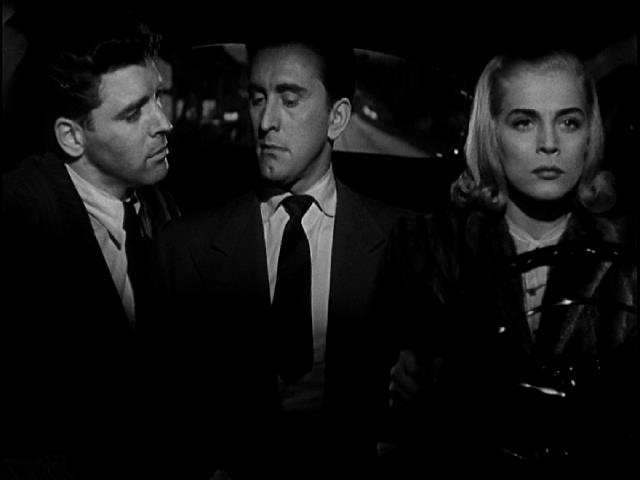
Burt Lancaster, Kirk Douglas, Lizabeth Scott
I WALK ALONE (1947), Director: Byron Haskin.

Frankie Madison (Burt Lancaster) and Noll "Dink" Turner (Kirk Douglas) were partners in a bootlegging operation that went south. Frankie went to prison for fourteen years while Noll opened up his own successful nightclub, and got a girlfriend in singer Kay Lawrence (Lizabeth Scott). Despite his relationship with Kay, Noll plans to marry bitchy socialite Alexis Richardson (Kristine Miller) for business reasons. Frankie makes it clear that what he wants is not just 50% of what's coming to him, but something to make up for all of those years he spent in jail. But even as Frankie and Kay grow closer, Noll may have other, less admirable plans for his old friend ... 

Kirk Douglas in a dramatic moment
I Walk Alone is fair-to-middling film noir. Frankly, it just never becomes as interesting or as explosive as you might hope. The performances are on target,  however, with especially good and slick work from Kirk Douglas, although Lizabeth Scott is a little odd and her romance with Frankie is never quite convincing. Wendell Corey is fine as a friend of Frankie's and an associate of Noll's, and there is also good work from George Rigaud as Maurice, who also works for Noll but isn't quite so  subservient; Mickey Knox as gunsel Skinner; Mike Mazurki as doorman/bodyguard Dan; and Kristine Miller as the delightfully predatory Alexis. When she manages to get Noll to agree to take her to the altar, she suggests that Kay sing "I Lost My Man" to the nightclub patrons -- what a bitch! Corey's death scene on a city street is quite well-handled.

Verdict: Comes so close but somehow misses. **1/2.