Lively, entertaining reviews of, and essays on, old and newer films and everything relating to them, written by professional author William Schoell.
Showing posts with label Margaret Leighton. Show all posts

Thursday, January 5, 2023

X, Y AND ZEE

X, Y AND ZEE (aka Zee and Co./1972). Director: Brian G. Hutton. 

"I got expelled at school because I fell in love with one of the nuns." -- Stella. 

Zee (Elizabeth Taylor) and Robert (Michael Caine of Dressed to Kill) have a toxic marriage that seems to run on ennui and liquor. At a party Robert meets the widow Stella (Susannah York), and while he hopes for just another cheap affair winds up supposedly falling in love with her. Zee seems to have a casual and world-weary reaction to this, but then comes to see Stella and her two small boys -- she and Robert can't have children -- as a threat. Robert makes up his mind to move out and have a life with Stella. What's a wife to do?  Wondering exactly how old Stella might have been when she kissed a nun and got expelled at school, Zee pays a call on her when Robert is out ... 

Frankly X,Y and Zee is over just when it starts to get interesting. For most of its length, it is a fairly dreary marital drama -- wife vs. mistress with a cad caught in the middle -- that has good performances and some good dialogue along with two-dimensional characters. Unlike the "bisexual" comedy Score, which came out the following year, X, Y and Zee turns coy and basically cops out at the end. Made only three years after Stonewall X, Y and Zee has a fairly negative attitude towards homosexuality, with stereotypical gay characters being referred to as "fags" (even right in front of them), so it's hard to think of it as ahead of its time (now if the trio had turned into a "thrupple!"). One also has to remember that Susannah York had already starred in The Killing of Sister George, which was much more explicit on lesbian matters and was released four years earlier.
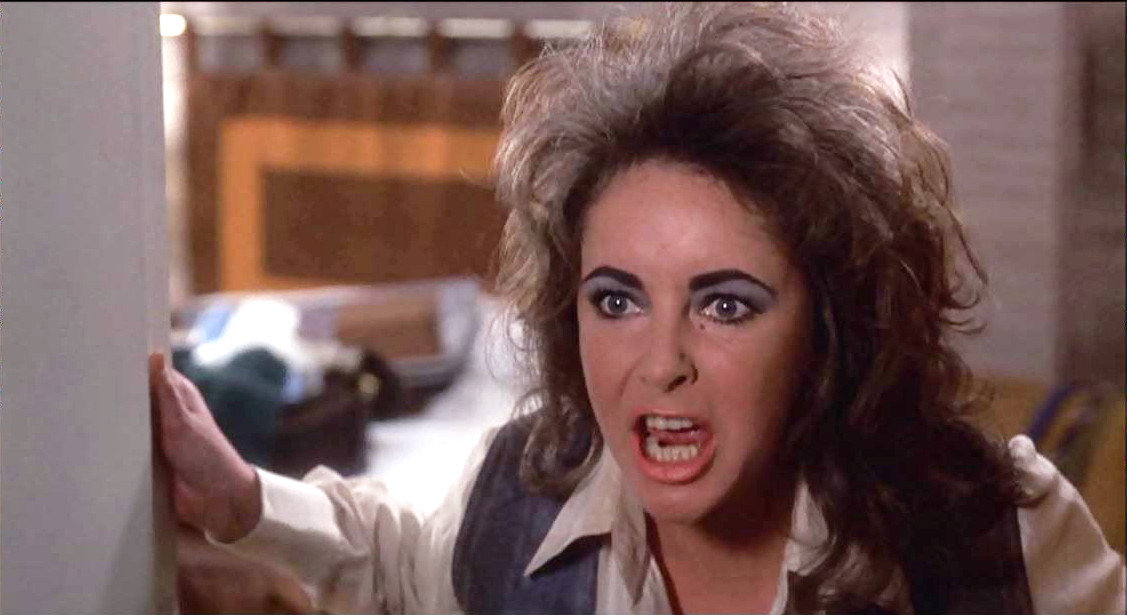
Liz on the rampage!
Another problem with the movie is that none of the characters are likable. While we can imagine how she became that way, Zee is overbearing and superficial. Stella is, in a word, stupid to even begin a relationship with a man like Robert, who is -- in another word -- a pig. The movie doesn't so much as explore sexual options as exploit them, although many might find the ending amusing. Margaret Leighton (of The Winslow Boy) provides a little bit of fun as an intoxicated party host. Taylor and director Hutton also worked together on Night Watch

Verdict: Who's Afraid of Virginia Mayo? Heads in an interesting direction, and then completely muffs it. **. 

Thursday, January 21, 2021

THE ASTONISHED HEART

THE ASTONISHED HEART (1949). Director: Terence Fisher.

"The capacity to love is stronger in some people than in others and it's dangerous to deny it or to encourage it -- for the wrong reasons."

Put on film four years after Brief Encounter, this play was probably meant to look at infidelity from the husband's point of view instead of the wife's, but it is no way in the league of Brief Encounter. Psychiatrist Christian Faber (Noel Coward, pictured) treats patients who are tormented by affairs then winds up having one himself with an old friend of his wife's. The wife, Barbara, is played by Celia Johnson, who also appeared n Brief Encounter; the other woman, Leonora, is played by Margaret Leighton. Although there are some good scenes and interesting dialogue in the movie, it is generally much too talky and Coward proves (in this at least) a much better writer than actor. His performance as the husband isn't terrible but it's often stilted and passionless, and one can't imagine what on earth the very pretty and vivacious Leonora would have seen in the comparatively boring Christian. Johnson and Leighton are more on the mark. The film's final moments are bolstered by Coward's own heavy scoring, and the last scene is somewhat poignant. Coward's observations about married life and love are often on the money, but the framework is just too insufficient. As for director Terence Fisher, he had better luck with some of his zesty Hammer horror films some years later. 

Verdict: Watch Brief Encounter instead. **1/2.

Thursday, June 2, 2016

FRANKENSTEIN: THE TRUE STORY

The Three faces of Michael Sarrazin
FRANKENSTEIN: THE TRUE STORY (1973 telefilm). Director: Jack Smight.

"Violence may be unavoidable, but clumsiness is inexcusable."

This re-imagining of the Frankenstein story certainly has an interesting cast, with James Mason stealing the picture as Dr. Polidori (an acquaintance of Mary Shelley's who was not in her novel, as well as the tragic author of The Vampyr). Leonard Whiting is Victor Frankenstein, with Michael Sarrazin [The Reincarnation of Peter Proud] as the creature. Jane Seymour [Sinbad and the Eye of the Tiger] turns in sterling work as both Agatha, and Prima, sort of the Bride of Frankenstein, who falls to pieces in the film's grossest, most bravura sequence. Other notable performances come from David McCallum as Henri Clerval; Agnes Moorehead as Mrs. Blair; and Ralph Richardson as Mr. Lacey. The telefilm also employs the talents of John Gielgud, Tom Baker [The Vault of Horror], Michael Wilding, and Margaret Leighton, but even an impressive cast can't disguise the fact that this in no way compares to the original story. This is more akin to Marvel Comics than to Mary Shelley, and often borders on the burlesque.

Verdict: Fun enough for non-discriminating Frankenstein fans. **1/2.

Thursday, April 14, 2016

FROM BEYOND THE GRAVE

FROM BEYOND THE GRAVE (1974). Director: Kevin Connor.

This anthology, based on the work of R. Chetwynd-Hayes, features stories that are loosely tied in with an antique shop run by an elderly proprietor (Peter Cushing). The first story deals with a mirror  with a demonic inhabitant who urges the owner, Edward Charlton (David Warner) to butcher women. In the second story Christopher Lowe (Ian Bannen), a man saddled with a harridan of a wife (Diana Dors,) encounters an old fellow veteran (Donald Pleasance of You Only Live Twice), and his rather odd daughter (Angela Pleasance) who falls for him -- or so he thinks. The third story is about a man (Ian Carmichael) and his wife (Nyree Dawn Porter) who hire a medium, Madame Orloff (Margaret Leighton of The Astonished Heart), to get rid of an "elemental" that is causing havoc. The fourth and final episode, which is easily the best and most suspenseful, has a man (Ian Ogilvy of And Now the Screaming Starts) affixing an antique door to a cupboard and discovering that it now opens into a cobwebbby and sinister old room that is kept alive by human sacrifices, one of whom almost becomes his wife (Lesley-Anne Down).

Verdict: Well-produced Amicus film with some good actors and generally mediocre scripts. **1/2 out of four.

Thursday, June 11, 2009

THE WINSLOW BOY (1948)


THE WINSLOW BOY (1948). Director: Anthony Asquith. Screenplay by Terence Rattigan, from his play.

Retired for health reasons, Arthur Winslow (Cedric Hardwicke) is disturbed to learn that his 12-year-old son Ronnie (Neil North) has been thrown out of the Royal Naval Cadets on a charge of stealing. Ronnie insists that he is innocent, and his father believes him -- and becomes increasingly angry at the fact that his son was never given a real chance to defend himself in a trial. Enter solicitor Sir Robert Morton (Robert Donat) a heavyweight who decides to take the case-- after grilling the boy intensely, almost savagely -- but the first hurdle will be to get past the fact that it is unheard of to, in effect, sue the Queen. We see the effect all the publicity has on the rest of the family, especially sister Catherine (Margaret Leighton) who may lose her fiance over the brouhaha. Even Ronnie's mother wonders if it's worth the financial cost and everything else to pursue the matter. The film works up quite a bit of suspense in wondering what will happen and what the outcome of the trial -- if there is one -- will be.

The Winslow Boy is the real deal. The characters are real, living, breathing, three-dimensional human beings, not stereotypes (even Morton, who at first does come off as a "type"). The acting by the entire cast is uniformly excellent, with Donat and Hardwicke neck and neck in the competition for most superb performance. And the movie rivets your attention from start to finish. Composer William Alwyn has contributed an almost [Richard] Straussian score. If I have any quibble with the film it's that I wish we were shown more details of the trial, considering the circumstances. NOTE: There was a creditable remake in 1999 as well as at least two television versions.

Verdict: Pounce! ****.