Lively, entertaining reviews of, and essays on, old and newer films and everything relating to them, written by professional author William Schoell.
Showing posts with label 1979. Show all posts

Thursday, February 16, 2023

LADD: THE LIFE, THE LEGEND, THE LEGACY OF ALAN LADD

LADD: The Life, The Legend, The Legacy of Alan Ladd. Beverly Linet. Arbor House; 1979. 


Although it may seem hard to realize today, once upon a time Alan Ladd was a major star who for many years consistently topped popularity polls, appeared on magazine covers, and was considered one of the most bankable players in Hollywood. Although many of his co-workers would disagree, critics often thought he was less a fine actor than a personality who had "It," that indefinable something that added up to chemistry in spades. His fans were both men and women. Because of his short stature (although he was hardly the only short star in Hollywood), perhaps he was seen as attainable by women and non-threatening to men. 

In any case, Ladd toiled in many B movies and minor roles until achieving stardom with his first big picture, This Gun for Hire, teaming him for the first time with Veronica Lake. Following what seems like a dishonorable Hollywood tradition, Ladd dumped his first wife in favor of his second, an aggressive woman named Sue Carol who was also his agent. (Not the first or last time in Hollywood in which relationships have been career moves.) In spite of this Ladd essentially portrays the star as a "nice guy" who even started a campaign to get people to write letters to hospitalized WW2 vets who had no families. Ladd came off as cold or disinterested to many of his leading ladies -- Lake, Sophia Loren -- and it may have been because his wife was keeping a sharp lookout. Ironically, the one co-star he fell for -- although apparently it did not lead into an affair -- was the bland, utterly sexless June Allyson! June Allyson!  What was he thinking of?! (True his wife was no beauty.)

Ladd in Shane
Ladd finally achieved some critical acclaim with the western Shane, but that was virtually his last triumph, although he was quite good in his final picture The Carpetbaggers. Neurotic as hell, always lacking confidence, Ladd became more and more of a nervous wreck the older he got, and when he inevitably started slipping at the box office, it got worse. He also had that certain bloated appearance of the alcoholic and looked older than his years. Ladd had numerous minor "accidents" which may have indicated that he was drinking quite awhile before people began to notice, and there was a highly suspicious incident in which he "accidentally" shot himself in the chest. There is still uncertainty over whether his death at fifty was suicide or an accident. 

Ladd came to regret turning down the role played by James Dean in Giant because it was supposedly not the lead, but director George Stevens hated working with Dean and also regretted that Ladd didn't play the part; Ladd's wife may have had something to do with that. In the book the widow claims that Ladd was a very happy man with a very happy marriage, but the book is riddled with details that call all of that into question. Linet paints Ladd's life as a tragedy, but he had many good years, four loving children, reached the heights of stardom, and had plenty of money even when he began slipping. He is hardly the only movie star who takes to heart "you're only as good as your last picture," and despite his early death made out better than some. One suspects that his problems were often self-inflicted. Ladd is a very good and sympathetic biography but one flaw is that it rarely analyzes Ladd's films or his performances. 

Two of Ladd's children were in the business. The late Alan Ladd Jr. became head of 20th Century-Fox years after his father's death, and David Ladd was a child actor who appeared with his father in The Proud Rebel, among other films.  

Verdict: Page-turning bio with many interviews with friends and family members. ***1/2. 

Thursday, December 22, 2022

ELVIS (1979)

Kurt Russell as Elvis
ELVIS (1979 telefilm). Director: John Carpenter.

Elvis Presley (Kurt Russell), inspired by black musicians, develops his own singing style and frenetic dancing movements. He rises to the top of the recording and film industry with the help of Colonel Tom Parker (Pat Hingle), but is frustrated by the insipid scripts that he is given. Marrying Priscilla (Season Hubley), whom he meets when she is fourteen, he develops a dependency on prescription drugs that alter his personality and make him paranoid. He attempts a comeback by appearing at the International Hotel and Casino in Las Vegas, but will this lead to a revitalization of his career or will he fall flat on his face as hundreds of fans await his entrance?

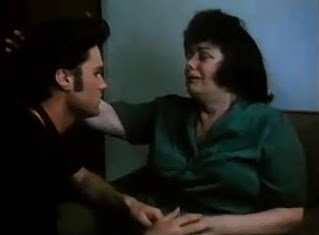
Russell with Shelly Winters
Kurt Russell gives a terrific performance as Elvis in this long but entertaining telefilm, which also stars Shelley Winters as Elvis' mom, and Bing Russell (Kurt's real-life father) as Elvis' dad. (To keep it all in the family Kurt Russell later had a short marriage to Season Hubley, who plays Elvis' wife). There's way too much of Winters in the first half of the movie, especially as she is giving one of her kind of twitchy  and breathless performances in what one could call her fat and whiny period. Pat Hingle isn't really given much to do as Parker, his character being shunted into the background most of the time, unlike in the 2022 Elvis

Russell with Season Hubley
The last fifteen minutes or so of the movie are given over to Elvis' triumphant concert at the International, where Russell performs the pants out of songs like "Burning Love" and displays the King of Rock at his most energetic. Credit also must be given to Ronnie McDowell, who does a fine job providing Elvis' singing voice. Ironically, the first movie Kurt Russell ever appeared in was an Elvis flick, It Happened at the World's Fair, where the king asks a boy (Russell) to kick him in the shins. This telefilm began a long association between Kurt Russell and John Carpenter, who also directed him in The Thing and many others. 

Verdict: Good approximation of the King. ***. 

Thursday, May 26, 2022

BLOODLINE

Audrey Hepburn
BLOODLINE
(1979). Director: Terence Young. 

"People who don't pay up end with their knees nailed to the floor." 

When her father, the head of an international pharmaceutical firm, is murdered, Elizabeth Roffe (Audrey Hepburn of The Unforgiven) takes over the company with the help of Rhys Williams (Ben Gazzara of The Young Doctors), whom she marries. But virtually all of the board members, all of whom are Elizabeth's relatives, are desperate for money, and appalled that she refuses to make the firm public, whereupon they could get ready cash. Before long, there are several attempts on Elizabeth's life, including an elevator crash that kills her secretary (Beatrice Straight). Who is the culprit: Ivo (Omar Sharif), whose mistress is demanding money; Helene (Romy Schneider), a ruthless race car driver; Sir Alec (James Mason), whose wife (Michelle Phillips) has run up huge gambling debts; or someone else? And who is responsible for the murders of several young women in snuff films? 

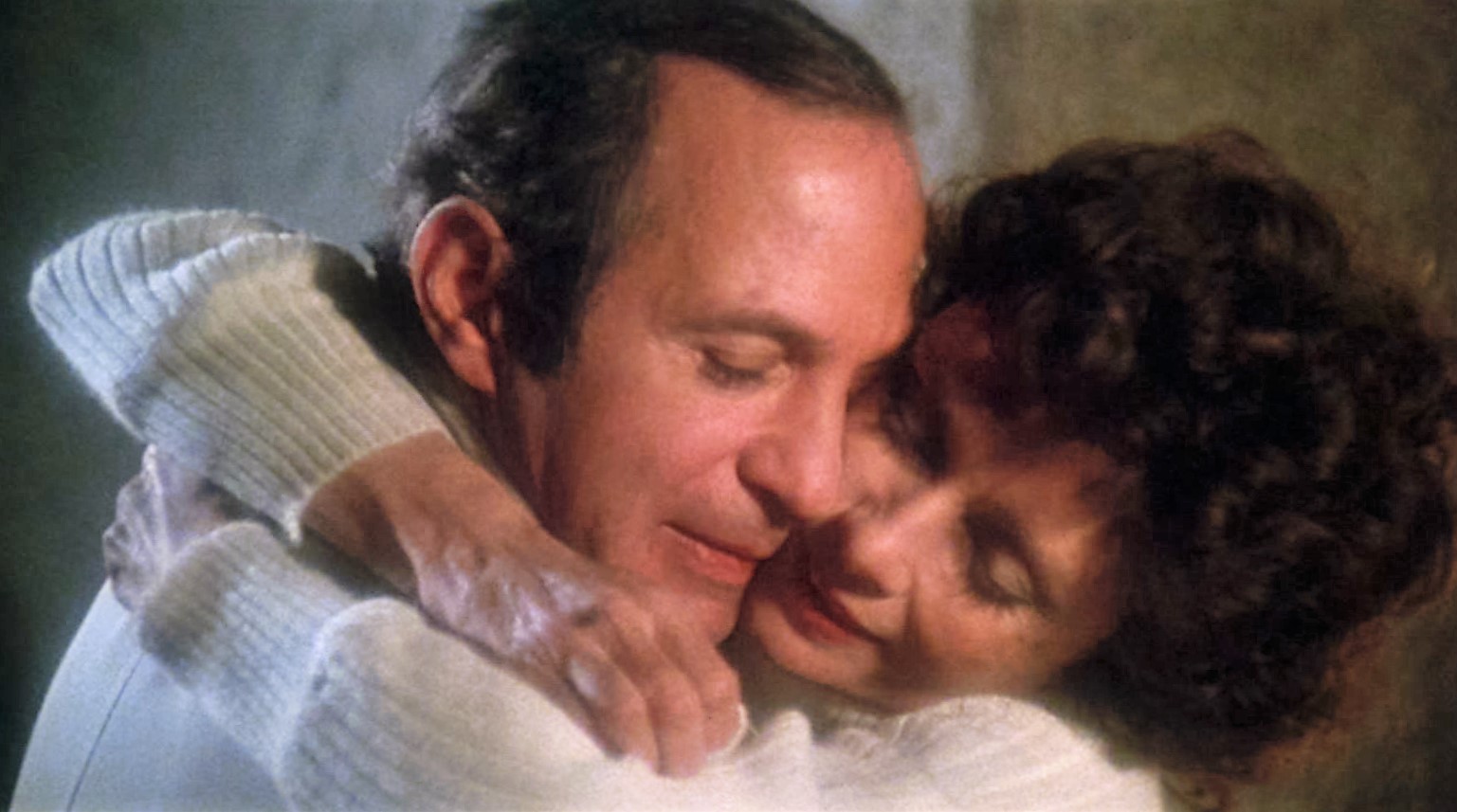
Ben Gazzara and Audrey Hepburn
Certainly an entertaining movie could have been made from Sidney Sheldon's absorbing page-turner, but this is a by-the-numbers effort with some unfortunate casting, slack direction, and an obnoxious musical score by Ennio Morricone, who simply layers the same treacly tune over every scene whether it is appropriate or not.  Director Young seems to have forgotten all he knew about directing, and despite an okay climax, Bloodline has virtually no suspense. The aforementioned elevator crash sequence is so brief and inept that it's positively comical. The best passages in the book, which concern Elizabeth's grandfather's ordeals in a Polish ghetto and the origins of Roffe Industries, get only a little screen time. This was sort of the second "comeback" picture for Hepburn, who gives a competent performance and looks good, if a little scary-skinny with, as one viewer put it, "ribs up to her neck." Gert Frobe from Goldfinger plays an inspector who tries to track down the culprit, but James Mason positively walks off with the picture, which is no surprise. 

Verdict: So much happening and still so dull. **.

Thursday, January 20, 2022

THE RUNNER STUMBLES

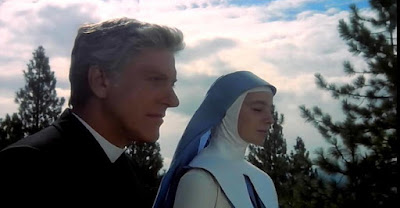
Dick Van Dyke and Kathleen Quinlan

THE RUNNER STUMBLES    (1979). Produced and directed by Stanley Kramer. Based on the play by Milan Stitt.  

In a small town in the 1920's the brash, young, full-of-life Sister Rita (Kathleen Quinlan of Event Horizon) arrives and meets the somewhat dour Father Rivard (Dick Van Dyke of Bye Bye Birdie) -- who has been banished to the hinterlands because of some of his more controversial views --  the housekeeper Mrs. Shandig (Maureen Stapleton); two grumpy and dyspeptic older nuns; and the children Sister Rita will teach, including mischievous little James (Billy Jayne). Town tongues start to wag when an obvious friendship and closeness develops between the priest and the nun, and even the housekeeper seems a bit scandalized when Sister Rita moves into the rectory with the father after the other nuns develop consumption -- this is against the orders of the Monsignor (Ray Bolger). As romantic feelings between the pair begin to blossom, one knows things will not go well for these star-crossed lovers ... The Runner Stumbles begins with Rivard in jail, arrested for murdering Rita!

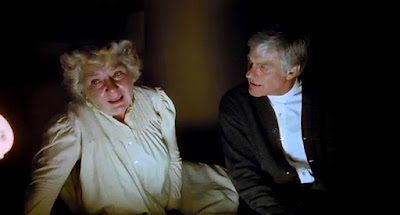
Maureen Stapleton and Van Dyke
I admit I had mixed emotions about watching this picture, as I thought it might be overly cute and Catholic in the worst sense of the word. I also questioned the casting of Dick Van Dyke, whose rubbery pickle-faced features hardly qualify him for a career in drama, as a romantic figure no less. But producer-director Kramer also was responsible for the great Judgment at Nuremberg, so I felt it was definitely worth a look. To my surprise I loved the picture, and thought Van Dyke really delivered during his most difficult sequences. Quinlan and Stapleton are also excellent, and Tammy Grimes is quite effective as a friend and parishioner who is devastated by her father's death. 

Kathleen Quinlan and Tammy Grimes
The Runner Stumbles may not be a masterpiece like Judgment at Nuremberg, but it is a lovely, poignant film with well-developed characters -- the incisive screenplay was written by playwright Milan Stitt, whose Broadway play this is based on -- and a sensitive score by Ernest Gold [Unknown World; Exodus), especially the theme that plays over the closing credits (itself derived from a tune, "My Rumble Seat Gal," also composed by Gold). Critics described the film as "old-fashioned" and didn't mean it as a compliment. I think it's old-fashioned in the best sense of the word. The courtroom denouement to the mystery, based on real-life events, packs a wallop, and the closing is remarkably touching. The film doesn't let the Catholic church and its often maddening, hypocritical edicts off the hook, and I imagine devout Catholics might have found this offensive. Too bad. This was the last film for Bolger, who is perfect as the monsignor, and for Kramer.

Verdict: This tragic love story is imperfect, perhaps, but it is also altogether admirable.***1/2.

Thursday, June 27, 2019

WHEN A STRANGER CALLS (1979)

Carol Kane
WHEN A STRANGER CALLS (1979). Director/co-writer: Fred Walton.

Babysitter Jill Johnson (Carol Kane of The Mafu Cage) is terrorized by a caller who keeps asking her if she's checked on the kids. When the police manage to trace the call Jill gets an unpleasant surprise. Years later John Clifford (Charles Durning), a former cop on the case, is hired by the children's father to find Curt Duncan (Tony Beckley), the psychopath who turned his life upside down and who has escaped from an asylum. Clifford tracks Duncan down, but can he stop him permanently before he goes after the terrified babysitter, Jill, who is now a grown woman with children of her own?

Charles Durning
I believe that When a Stranger Calls was expanded from a short film, The Sitter, which comprised only the chilling opening sequence of this movie. The middle section of this film stills holds interest, as it focuses on Duncan, his interactions with barfly (but not drunken) Tracy (Colleen Dewhurst of Annie Hall), and Clifford's efforts to track down Duncan, whom he intends to murder. (A powerful scene has Clifford telling Tracy exactly how Duncan killed two innocent young children.) The final section of the film is another chilling sequence with Duncan, Jill, and her family. In fact the climax may outdo the prologue in creepiness.

Colleen Dewhurst and Tony Beckley
When a Stranger Calls manages to sustain tension via generally good direction and Dana Kaproff's simple but very effective musical score. There are also solid performances, with Beckley and Dewhurst as standouts, although there is very good work from Durning [Sisters] and a mush-mouthed Carol Kane. Rachel Roberts has one scene as a psychiatrist in the institution that Duncan escaped from, and Ron O'Neal is on the mark as a cop colleague of Clifford's. The atmospheric photography is by Don Peterson. One wishes that there was more character development, however, both of the psycho and of Tracy. What little we learn of the latter is due chiefly to Dewhurst's performance. This was busy British actor Tony Beckley's last film; he died the following year.

A very good sequel, When a Stranger Calls Back, came out in 1993. And there was a remake in 2006.

Verdict: Absorbing horror-suspense film. ***. 

Thursday, June 14, 2018

ZOMBIE

Tisa Farrow encounters zombies but no Woody
ZOMBIE (aka Zombi 2/1979). Director: Lucio Fulci.

In some disquieting opening scenes, a seemingly abandoned yacht floats around New York City harbor, where a Coast Guard officer is attacked by a demonic figure. The owner of the ship has disappeared, and his daughter, Anne (Tisa Farrow), goes off with reporter Peter West (Ian McCulloch) to find him. They set sail with Brian (Al Cliver) and his girlfriend, Susan (Auretta Gay), to the mysterious island of Matul, where something strange is happening to the natives. Dr. Menard (Richard Johnson), who was working with Anne's father, is dealing with a plague of the recently diseased coming back from the dead. He refuses to believe that this has anything to do with voodoo, but it isn't long before ancient corpses are rising from their graves, turned into flesh-eating ghouls. It's a question if anyone will survive to get off the island. Fulci clearly took his cue from Night of the Living Dead and its sequels, but arguably Zombie is a better horror-thriller than any of them. The performances are professional, but the pic's selling point is decidedly the very grisly FX and make ups, with the gross-out factor as prevalent in this as in more recent movies. The film's "highlights" include an underwater battle between a zombie and a shark, the attack on Menard's wife (Olga Karlatos), featuring a sadistic scene when her head is slowly pulled toward a sharp piece of wood which impales her eye -- she is later feasted on by the ghouls -- and the climax when many zombies attack Renard's jungle hospital. Say what you will about Zombie (which I have no doubt is Fulci's best film), it is creepy, fast-paced and even, at times, suspenseful. Tisa Farrow is the sister of Mia Farrow, but her career certainly took a different direction. She has only a few credits and did a number of Italian thrillers. The best-known actor in the cast, Richard Johnson (ex-husband of Kim Novak), starred in The Haunting, and as Bulldog Drummond in Deadlier Than the Male and its dreadful sequel Some Girls Do.

Verdict: Effective  and very gory Italian horror film. ***.

Thursday, January 18, 2018

MURDER BY NATURAL CAUSES

Katherine Ross and Barry Bostwick
MURDER BY NATURAL CAUSES (1979 telefilm). Director: Robert Day.

Arthur Sinclair (Hal Holbrook) is a famous "mentalist" who claims psychic powers that may or may not be real. His younger wife, Alison (Katharine Ross), is having an affair with the struggling actor, Gil Weston (Barry Bostwick), and she urges him to help her carry out a plot to kill Arthur. Of course nothing runs smoothly, but there are other players in the drama who may have their own schemes at work ... Murder By Natural Causes has a typically twisty and satisfying plot by Richard Levinson and William Link, and boasts top performances by Holbook and Bostwick, who really score in a cat and mouse sequence inside Arthur's imposing mansion. Ross [Games] and Richard Anderson [The Night Strangler], who plays the Sinclairs' lawyer, are competent and effective but a cut below the other two. In addition to many other mystery scripts, Levinson and Link also wrote That Certain Summer, which also starred Holbrook.

Verdict: This pic won't make you "mental." ***.

Thursday, October 19, 2017

THE KILLER NUN

Joe Dallesandro and Anita Ekberg
THE KILLER NUN (aka Suor Omicidi/1979). Director: Giulio Berruti.

Sister Gertrude (Anita Ekberg) is the head nurse in a hospital that also seems to function as a convalescent home. Gertrude is convinced that she is dying, even though there is no medical evidence to suggest this, and she seems to be unraveling in other ways. She causes the head doctor, Poirret (Massimo Serato) to lose his job, and Dr. Roland (Joe Dallesandro) takes his place. Periodically Gertrude ditches her habit, goes into town, and picks up a man for hot sex, but of more concern is that she seems to be murdering the patients at the hospital. Is she losing her mind, or is someone else responsible for the deaths? The Killer Nun has a good idea but its execution is poor, as the film is saddled with weak direction, slovenly editing, a poor musical score, and a lack of basic coherency. As for the cast, any film that boasts both Anita Ekberg [Back from Eternity] and Joe Dallesandro [Wiseguy] in the same picture has to have its interesting moments, and it does. And the Mother Superior, whom Gertrude calls a bitch at one point, is played by no less than Alida Valli of Hitchcock's The Paradine Case! The Killer Nun might have been a superior horror picture but it has absolutely no style, and the murder sequences have no suspense or panache. Ekberg is okay, and still looks great, if a little more zoftig, at 48; she did a few more films after this one. The film introduced Paola Morra, who plays Sister Mathieu, a nun who is in love with Gertrude but has sex with Dr. Roland when he discovers she's stolen some morphine. Gertrude tells Mathieu that she prefers men, but will sleep with women if they wear silk stockings! If Dario Argento had directed this picture, it might have amounted to something.

Verdict: Anita Ekberg as a nun! Not since Frank Sinatra as a priest in Miracle of the Bells (which also starred Alida Valli) has their been such delightfully absurd casting. If only the movie were better! **.

Thursday, July 20, 2017

MANHATTAN

Allen, Keaton, Murphy, Hoffman
MANHATTAN  (1979 ). Director: Woody Allen.Written by Allen and Marshall Brickman.

"I think people should mate for life, like pigeons or Catholics."

"My first wife was a kindergarten teacher. She got into drugs, moved to L.A. became a moonie. Now she's a William Morris agent."

41-year-old Isaac (Woody Allen), whose wife, Jill (Meryl Streep), left him for another woman, Connie (Karen Ludwig), is now dating an adoring 17-year-old named Tracy (Mariel Hemingway). Isaac's buddy, Yale (Michael Murphy), who is married to Emily (Anne Byrne Hoffman), is having an affair with Mary (Diane Keaton), but Isaac and Mary find themselves drawn to each other, especially as Yale shows no signs of leaving his wife, and Isaac is all too aware of the age difference between him and Tracy. As Manhattan begins, it seems to be a love valentine to New York City, but as the movie proceeds it becomes clear that it is just another Woody Allen Movie with the same fake, self-serving Woody Allen-type characters.you see in most of his movies. This "Manhattan" is strictly for and about rich white upper eastsiders -- you won't see a Black, Latino or Asian face throughout the movie (although there is a gay couple, as mentioned)! 

As expected, there's some good dialogue, and the acting is mostly on target, although Keaton tries to be amusing and generally fails. A built-in problem with Allen's movies is that, while the real Allen probably has no problem getting dates because he's rich and famous, having all these women throwing themselves at a less successful fellow who looks like Allen is highly improbable. Given what we now know of Allen's private life, it's easy to see why the plot goes in certain directions. Bella Abzug has a cameo and the repulsive Wallace Shawn, even less attractive than Allen, shows up very briefly as Keaton's ex-husband. Back in the seventies, Allen's films were seen as sharp and sophisticated and altogether wonderful, dealing frankly with adult subject matter, or what passes for same, but many of them don't really hold up and are due for reevaluation. Manhattan does its best to avoid the real dramatic scenes, especially in the depiction of Yale's discarded wife. The ending to the film makes Isaac seem even yuckier.

Verdict: Allen has made some good movies, but this isn't one of them. This should have been called A Nerd's Fantasy Life. **.

Thursday, April 13, 2017

THE BLACK HOLE

Yvette Mimieux and Anthony Perkins
THE BLACK HOLE (1979). Director: Gary Nelson.

On an exploratory trip in space, a ship discovers what at first appears to be a derelict vessel floating near a deadly black hole. But inside this huge ship, the Cygnus, the crew come across Dr. Reinhardt (Maximilian Schell of Return From the Ashes), who claims to be the only survivor. Reinhardt is determined to actually take the Cygnus inside the black hole and hopefully discover some of the secrets of the universe. Dr. Durant (Anthony Perkins) is anxious to go with Reinhardt on the trip, but psychic Dr. MacCrae (Yvette Mimieux)  and the others -- Captain Holland (Robert Forster), Lt. Pizer (Joseph Bottoms), and Harry Booth (Ernest Borgnine) -- desperately try to talk him out of it. The Black Hole features some fine scenic design and FX, but its schizoid script, tediously stretched-out climax, unfortunate comedy relief involving cute robots playing video games and the like, and a disappointing finale (reportedly the Disney studio ran out of either time, money, or both to create the Black Hole sequence in the intended manner), make this a disappointing effort to say the least. Slim Pickens [Night Gallery] and Roddy McDowall [Fright Night] voice the two overly precious robots who help the team and seem modeled on R2D2 from Star Wars. A lot more could have been made of the fact that some of Reinhardt's "robots" actually turn out to be sort-of lobotomized crew members. Some of the more exciting scenes involve an asteroid shower and a harrowing journey through a tunnel. The acting is generally good (even if Perkins is doing his usual "spooky" routine), with Schell taking top honors.

Verdict: Good idea just misses. **1/2.

Thursday, January 14, 2016

THE DAY TIME ENDED

Dorothy Malone and Jim Davis
THE DAY TIME ENDED (1979. Director: John "Bud" Cardos.

When a triple super-nova occurs 200 light years away, it finally has an effect on earth, particularly a family living in an isolated home in the desert. Strange space ships fly through the air, there's a weird little stop-motion Gumby in the little girl's bedroom, and two giant pudgy behemoths have it out outside the living room. It occurs to Grant (Jim Davis of Monster from Green Hell and Dallas) that the property is in the middle of a time-space warp or vortex, which is why so many bizarre things are happening. It all leads into the family traveling to a new world or dimension -- as well as to a rather stupid ending. There is some decent stop-motion animation (Randy Cook; David Allen; Paul W. Gentry), uninteresting monsters of mediocre design, and assorted light shows over the desert. One too many scenes are illogically staged (who just stands there when you think the family car is being stolen?). The best scene has Grant stepping outside and discovering dozens of missing aircraft of all kinds in the front yard, but even this is sort of borrowed from Close Encounters of the Third Kind. One might wonder how Dorothy Malone [Written on the Wind] wound up in this 99 cent production, but she gives a solid performance, and the others, including Christopher Mitchum as her son-in-law, are okay. To say this is far, far below the level of a Ray Harryhausen production is a major understatement. Cardos also directed The Dark the same year.

Verdict: Some good things and a bit of suspense in this. **1/2.

Thursday, October 8, 2015

DOMINIQUE

DOMINIQUE (1979). Director: Michael Anderson.

Dominique Ballard (Jean Simmons) is convinced that her husband, David (Cliff Robertson), is trying to drive her out of her mind. She importunes the chauffeur, Tony (Simon Ward), to help her, but he knows upon which side his bread is buttered. Dominique then apparently commits suicide -- but who is that that David sees walking around both outside his office and inside their estate? There are no big surprises in this ersatz ghost story which doesn't have a bad plot, although it's not very original. Simmons and Ward come off best, with good performances from Jenny Agutter as David's half-sister, Flora Robson as the housekeeper, Ron Moody as the family doctor, and David Tomlinson as the family lawyer. Robertson [Obsession] tries to act "British" but he's not exactly Herbert Marshall. Dominique is professional enough on all levels, but it still comes off like a forgettable made-for-TV movie. Anderson also directed The Wreck of the Mary Deare and many others. A much, much better thriller starring Jean Simmons is Angel Face.

Verdict: Simpering ersatz horror. **1/2.

Thursday, July 30, 2015

MOONRAKER

Hero vs villain: Roger Moore and Michael Lonsdale
MOONRAKER (1979). Director: Lewis Gilbert.

"Mr. Bond, you arrive with the tedious inevitability of an unloved season." -- Hugo Drax

When a Moonraker shuttle built by Drax Industries is hijacked in midair, James Bond (Roger Moore) is assigned to the investigation. He discovers that Hugo Drax (Michael Lonsdale) is behind a scheme to wipe out the earth's population and replace it with perfect specimens over which he, of course, will rule. After a variety of misadventures, Bond -- assisted by CIA agent Holly Goodhead (Lois Chiles) -- winds up on a space station for the final battle. Moonraker was the ultimate live-action cartoon and science fiction version of 007, but it's great fun on that level. There are major action setpieces in the film, such as a prologue in which Bond is forced out of an airplane; a scene when Bond is caught in a whirling thingamajig that registers acceleration pressure; a battle with metal-toothed Jaws (Richard Kiel) high atop a cable car over Rio; a chase on a river with a waterfall, Bond's glider at the ready; and another boat chase on a canal in Venice. [Bond's gondola is outfitted with wheels and an outboard motor!] Moore plays his own version of a lighter-hearted Bond and plays it well. The other two main performers underplay to good effect: Lonsdale is neither hysterical nor flamboyant but radiates a quiet menace; and while Chiles could be considered bland, even wooden at times, she gets across her character's strength, avoids making her a Kewpie doll (despite her dirty joke of a name), and only succumbs to Bond's charms when she is ready. John Barry's majestic music is on the money, including an excellent title tune very well-sung by Shirley Bassey of Goldfinger fame. A very colorful and exciting picture with some fascinating settings.

Verdict: More silly than it needs to be, but highly entertaining. ***.

Thursday, June 26, 2014

PROPHECY

Talia Shire, Richard Dysart and Robert Foxworth
PROPHECY (aka Prophecy: The Monster Movie/1979). Director: John Frankenheimer.

Dr. Robert Vern, who usually works in the ghettos of Washington D.C., accepts an assignment to do a survey for the Environmental Protection Agency in the timber lands of Maine, where a dispute is raging between the Original People [Indians] and factions in the lumber industry. Not only does Vern discover that the natives are being seriously affected by something in the area, with an alarming number of still-births and deformed babies, but he suspects a huge mutant creature has already resulted from toxicity caused by the sawmill on the river. To make matters worse, his wife Maggie (Talia Shire) hasn't yet told him of her pregnancy, but she's eaten the same fish the Indians have; it contains a poison that "jumps the placental barrier" and lodges in the fetus. Then that monster comes a'calling ... David Seltzer's paperback novelization of his own screenplay for Prophecy was released several months before the film came out, and it was such an excellent horror novel that monster movie fans awaited the movie with anticipation. The trouble is, there hasn't been a more disappointing monster since The Giant Claw. The FX people came up with a mere lumpy and unconvincing disfigured bear instead of the creature described in the book or depicted in the movie's poster, something that bore traces of every step of the evolutionary ladder. But despite this serious deficit, Prophecy is not a complete waste because the story pulls the viewer along, the acting is solid, and the movie has genuine suspense in good measure. Along with Foxworth [Falcon Crest] and Shire, Richard Dysart [The Thing] is notable as a lumber man and Armand Assante [Human Target] scores as a militant Native American known as John Hawks. In real life methyl mercury poisoning did have very adverse effects on Indians in Canada, though so far no monsters have been sighted. John Frankenheimer also directed Seconds and other first-rate movies. NOTE: You can read more about movies like this in Creature Features: Nature Turned Nasty in the Movies.

Verdict: Good in spite of itself. ***.

Thursday, March 7, 2013

THE AMITYVILLE HORROR (1979)

James Brolin and Margot Kidder


THE AMITYVILLE HORROR (1979). Director: Stuart Rosenberg.

After a real-life multiple murder case in a house in Amityville, Long Island, the new owners, George and Kathleen Lutz, claimed that the place was haunted, that they had horrendous experiences, and had to flee to a motel in the middle of the night, never to return. Writer Jay Anson cobbled together a book telling of their "true" experiences, and enough gullible people bought it to make it of interest to Hollywood. Even American-International was surprised when Amityville turned into a monster hit; it's spawned two theatrical sequels, a remake, and a host of direct-to-video movies. In the meantime, only the intellectually challenged believe this is anything other than fiction. Even the stars of the movie thought the Lutzes' story was, well, not quite believable. The lawyer for the real-life murderer later sued the Lutzes for a cut and claimed they all dreamed the whole thing up while drinking wine.

In the film, the Lutzes move into the house although they know of its bloody history. A priest (Rod Steiger) who comes to bless the house is assailed by flies and nearly gets in a car accident, then becomes blinded by an accident in his church [apparently the "evil" in the house has a long reach]. Other odd things happen, such as the doors of the house being blasted off in the night, and they discover a walled-up chamber in the basement which is supposed to lead to Hell. [No one can say the Lutzes weren't ambitious in their fantasizing!] The implication is that the house's evil force is taking over the mind of George Lutz (James Brolin)  as it supposedly did the man who murdered all those people in the house [apparently his defense lawyer didn't bring that up at trial.] Kathy Lutz (Margot Kidder) looks up a photo of the murderer and he resembles her husband, even though George is approaching middle-age and the killer (Ronald Defeo) was only 23 at the time of the murders. It all meanders along not very suspensefully until a conclusion that has a couple of minor harrowing moments. The Amityville Horror is basically an inept bit of horror fiction with passable performances and a score by Lalo Schifrin that rips off Psycho at key "shock" moments. It's also quite tedious. The best scene of the movie has a bunch of priests being bitchy with each other when Steiger talks about the evil in the house and his superior (Murray Hamilton) basically tells him he's nuts.

Verdict: A stinker for the sub-literate. *.

Thursday, January 3, 2013

THE CHINA SYNDROME

Jack Lemmon, Michael Douglas and Jane Fonda
THE CHINA SYNDROME (1979). Director: James Bridges.

Reporter Kimberly Wells (Jane Fonda) is doing a routine story at a nuclear power plant in Southern California, when an "accident" occurs that has everyone working there quite nervous. Kimberly and her brash photographer, Richard (Michael Douglas), are convinced that there was more to the incident than anyone is saying, but Kimberly's superiors are understandably afraid of lawsuits or worse. Still, it develops that plant employee Jack Godell (Jack Lemmon) has uncovered certain unsafe conditions that could lead to disaster if the facility goes back up to full power, leading to a tense confrontation with the higher-ups and a delicate situation in the control room. The China Syndrome became famous when the incident at Third Mile Island happened not long after its release, turning the picture into a must-see at the time. Although it's well-made and well-acted -- Lemmon is especially good, with Fonda on the money as well -- time has somewhat blunted its impact. Scott Brady [Mohawk] is fine as one of Lemmon's associates at the plant, and for better or worse Wilford Brimley, as another plant employee, also got a higher profile from this picture. Michael Douglas is okay, but doesn't make that much of an impression. The Stephen Bishop song that plays over the opening credits is pretty awful and almost sinks the movie from the start.

Verdict: Has its moments. ***.

Thursday, October 18, 2012

ALIEN [2003] "DIRECTOR'S CUT"

The crew of the Nostromo make an amazing discovery -- but things get worse.
ALIEN (1979). Director: Ridley Scott.

"This place gives me the creeps."

When Twentieth-Century Fox re-released Alien, they asked director Ridley Scott to prepare a new version incorporating footage that had been excised when the film was first released. Scott complied, but had always liked the original cut, and found the new cut to be too long and lumbering. So he did a final edit and came out with an alternate version that was a minute shorter than the original. But any way, you slice it, this is Alien, and it's good.

The crew of the Nostromo are awakened early by what they assume is a distress signal and land on a foreboding, stormy planet wherein they discover a derelict spaceship with a dead economy-sized navigator [see photo]. In the bowels of the derelict ship they find a mass of strange eggs, one of which unleashes a creature that attaches itself to the faceplate of crewman Kane (John Hurt). Ripley (Sigourney Weaver) is concerned about admitting Kane to the ship due to possible contamination -- it turns out she's right to be concerned -- but compassion overrides directives and Kane is taken to the medical center. From then on it's a mounting spiral of horror as the alien creature proves to be deadly and nearly unkillable. Alien admirably sustains tension throughout and works up a beautifully creepy atmosphere. The acting is good, with the ladies Weaver and Veronica Cartwright (who was in The Birds as a child) taking top honors. H. R. Giger's biomechanical alien design is intriguing and the film has superior art direction and scenic design. Dramatic license allows for the sounds of explosions and so on in space even if the ads claimed "In space no one can hear you scream." Jerry Goldsmith's musical score is a plus.

New scenes include one in which Cartwright gives Weaver a smack in the face and calls her a bitch. And one late in the movie when Ripley comes across cocoons containing some of the crew members, and toasts Captain Dallas (Tom Skerritt) when he begs her to kill him.

Alien was an influential movie, even as it was itself influenced [in script, incident, and design] by such B movies as It, the Terror from Beyond Space! and Mario Bava's Planet of the Vampires. It was followed by Aliens. In 2012 Ridley Scott made a prequel entitled Prometheus.

Verdict: Very well-dressed and absorbing popcorn movie. ***1/2.

Thursday, April 26, 2012

BEING THERE

Peter Sellers
BEING THERE (1979). Director: Hal Ashby.

"Nobody likes a dying man, Chance, because nobody knows what death is."

"You always gonna be a little boy, ain't ya?"

"It's a white man's world in America for sure" -- Louise, the black maid, after she sees Chance on TV. 

Based on a novel by Jerzy Kosinski, this is the story of the simple-minded gardener Chance (Peter Sellers), who has to move out of the house where he worked after his elderly employer dies. By chance -- no pun intended -- his is hit by a limo, injures his leg, and is taken in by the very wealthy Eve Rand (Shirley MacLaine) and her ill, much older husband, Ben (Melvyn Douglas) who is friends with the President (Jack Warden). Before long Chance is "advising" the leader of the free world on policy, even though he really has no idea what he's talking about and can only relate everything to a garden. Instead of recognizing that Chance is mentally challenged, everyone thinks he's the height of profundity and he winds up on TV and being toasted by the media and intelligentsia. In this variation of Hans Christian Anderson's "The Emperor's New Clothes" -- which essentially said the same thing with more economy -- Ashby skewers the stupidity and superficiality of the rich, powerful, political, and influential, although one has to suspend disbelief that no one he meets after leaving his home seems to get that Chance is, well, just plain stupid. Sellers is fine, although he isn't really given the opportunity to go wild as he does in the Inspector Clouseau films. MacLaine and Douglas are marvelous, and there are notable supporting performances from Jack Warden, Richard Dysart as Ben's doctor, and Ruth Attaway as the maid, Louise, among others. As for the ending -- everyone can make up their own mind what that's about.

Verdict: Absorbing and sadly amusing satire. ***.

Thursday, July 2, 2009

THE BROOD

THE BROOD (1979). Director: David Cronenberg. 

Frank Carveth (Art Hindle) has a young daughter Candy (Cindy Hinds) and a wife, Nola (Samantha Eggar) who is getting a bizarre form of therapy from a psychological wunderkind named Hal Raglan (Oliver Reed) who runs an outfit called Psychoplasmics. Carveth has no idea that Nola's treatment has some odd side effects. First her mother is killed, and then her father, by what appears to be a little boy in a hood but actually turns out to be an odd creature with no naval -- meaning it wasn't born in the usual sense ... what's going on? There are some interesting concepts and dialogue in this movie as there generally are in Cronenberg's films, but the film is awfully draggy and talks itself out long, long before the not-very-thrilling wind-up. Even the murder sequences aren't handled with that much flair. Busy actor Henry Beckman gives a terrific performance as Nola's father, Barton. Eggar is fine in a thankless, somewhat embarrassing role. Hindle and Reed are also good, as are some of the supporting players, but this picture just doesn't move

Verdict: If you need a good night's sleep ... *1/2.

Monday, April 14, 2008

LA LUNA aka LUNA


LA LUNA (1979) . Director: Bernardo Bertolucci. Released as Luna in the U.S.

Jill Clayburgh stars as opera singer Catherina Silveri, whose husband (a briefly seen Fred Gwynne) drops dead, leaving her alone with her fourteen-year-old son Joe (Matthew Barry, who was actually 17 at the time). Before long, they are living in Italy, where Silveri sings in Verdi's operas. (When Clayburgh sings by herself in her home early in the film, one can't imagine she would ever be able to sing in an opera house. During the opera scenes, of course, her singing voice is dubbed.) Joe makes his way by himself through Rome as his mother essentially neglects him, until halfway through the movie the two begin a sexual relationship that starts with them making out in her car, then hitting the sheets -- yuck! This (unfortunately) non-judgmental incest drama could have gone in far more interesting directions but instead becomes a ponderous, pretentious mess about the mother of all bad mothers -- incest and pedophilia, no less -- and is far too repellent to sustain serious interest. A sub-plot with Joe meeting his real father doesn't help matters much. One of Bertolucci's all-time worst movies. The acting isn't bad, but common sense should have told Clayburgh -- and young Barry's parents -- to stay away from this movie! This also goes for Alida Valli, who appears in a small role.

Verdict: Yuck! *.