Lively, entertaining reviews of, and essays on, old and newer films and everything relating to them, written by professional author William Schoell.
Showing posts with label sequel. Show all posts

Thursday, March 26, 2026

RETURN TO PEYTON PLACE

RETURN TO PEYTON PLACE
(1961). Director: Jose Ferrer.

In this sequel to Peyton Place, Allison MacKenzie (now played by Carol Lynley) goes to New York with her roman a clef manuscript about the town she grew up in, and falls for her handsome married publisher (Jeff Chandler). Her mother Constance is now married to Mike Rossi (these two are now played by Eleanor Parker and Robert Sterling of Topper TV series fame), and while mama is appalled, Mike wants to place the book in the school library. Selena (now played by Tuesday Weld) is mortified that Allison chose to write about her rape and subsequent trial in her novel, and Roberta Carter (Mary Astor) is outraged that the principal wants to put his step-daughter's filthy book in the library where anyone could read it. 

Mary Astor, Brett Halsey, Luciana Paluzzi
Brett Halsey is Roberta's son Ted, who shows up with a new wife (Luciana Paluzzi, who later did Thunderball) in tow. Meanwhile Selena meets a guy named Nils (Gunnar Hellstrom). (They ignore the fact that Selena and Ted were not just friends but were once engaged). The acting is good and there are a few surprises. Although few would argue that Eleanor Parker was a more talented actress than Lana Turner (despite the latter's fine stint in A Life of Her Own), Turner was actually more suitable for the role of Constance Mackenzie (and it doesn't help that Parker is doing one of her "actressy" turns). Brett Halsey comes off better than usual. It's absolutely no surprise, however, that the whole movie is positively stolen by the superb performance of Mary Astor, who gives the entire cast and everyone who sees the film a lesson in sharp and superlative thesping.

Verdict: A pleasant return to old Sin City. ***.

Thursday, December 22, 2022

THE MOUSE ON THE MOON

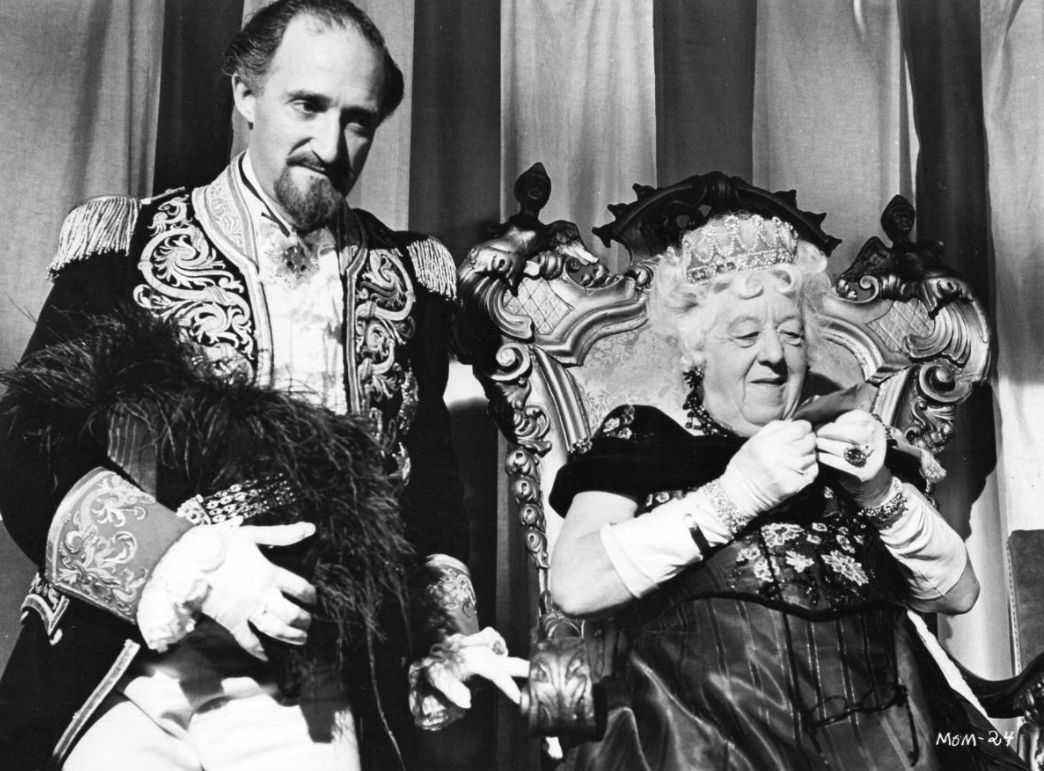
Ron Moody and Margaret Rutherford
THE MOUSE ON THE MOON (1963). Director: Richard Lester.

A crisis develops in the little duchy of Grand Fenwick, the smallest nation in the world, when their chief and only export, wine, inexplicably develops explosive properties. The Prime Minister, Count Mountjoy (Ron Moody) hopes to borrow half a million from the United States to install modern-day plumbing throughout the duchy, but tells the government that they need the money for their space program so as not to sound silly. The U.S. gives Grand Fenwick a million dollars -- a ploy by the Secretary of State. Not to be outdone, the Russians send a rocket to the country, which Mountjoy hopes to transform into indoor plumbing. However, scientist Kokintz (David Kossoff) decides to use the wine as fuel so as to send the rocket on a trip to the moon. Delegates from the US and USSR arrive to see if the professor can actually pull it off. Going with him on the trip is Mountjoy's son, Vincent (Bernard Cribbins of Frenzy).

The Mouse on the Moon
, a sequel to The Mouse That Roared, has a cute idea, and there are quite a few laughs, especially in the first half, but it still comes off as second-rate. Margaret Rutherford as the dotty Grand Duchess is as fun and appealing as ever, but she isn't given nearly enough to do. Ron Moody gets the lion's share of the action, and he's fine, but not quite as amusing as you might hope. Once the rocket heads for the moon, the picture turns into a poor imitation of First Men in the Moon with its equally unscientific voyage into space. Terry-Thomas is cast as a spy, and June Ritchie is Mountjoy's niece, who gets involved with Vincent. Twenty years later Richard Lester directed Superman III. In The Mouse That Roared Peter Sellers played both the Grand Duchess and Count Mountjoy! 

Verdict: Very pleasant -- and pleasantly satirical -- in spots, but overall a disappointment. **1/2. 

Thursday, October 13, 2016

DR. GOLDFOOT AND THE GIRL BOMBS

Who cares? Just give me the check!
DR. GOLDFOOT AND THE GIRL BOMBS (aka Le spie vengono dal semifreddo/1966). Director: Mario Bava.

Probably due to the ad campaign, the spy craze of the period, and the presence of Vincent Price, Dr. Goldfoot and the Bikimi Machine was a hit for AIP. A year later the inevitable sequel materialized, with Price reprising his role of the diabolical doctor who has escaped death and is now blowing up horny generals by using beautiful robot girls full of explosives. Instead of Frankie Avalon, we have another teen idol, Fabian, playing spy, and there are two Italian alleged comedians who also play bumbling agents. Goldfoot's ultimate scheme is to drop a super-hydrogen bomb on Moscow, bringing about WW3. Goldfoot also has a pool full of piranha who never figure in the plot, as well as another general who happens to be Goldfoot's twin -- nothing much happens with that, either. Despite the fact that Dr. Goldfoot and the Girl Bombs has one more laugh-out-loud moment than Bikini Machine -- bringing the total up to half a dozen (that's one laugh every fifteen minutes) -- it's an even worse movie than its predecessor. Price, with both eyes on his paycheck and certainly not on the script, gives a gleefully hammy performance and probably never sat through this crapola himself -- if only his fans had been spared! As an actor, Fabian [A Bullet for Pretty Boy] actually amassed 48 credits. Possibly Mario Bava's worst movie.

Verdict: Just awful. 1/2*.

Thursday, May 12, 2016

THREE SMART GIRLS GROW UP

Bob Cummings with the three smart girls.
THREE SMART GIRLS GROW UP (1939). Director: Henry Koster.

In this inferior sequel to Three Smart Girls, the "girls" are now young ladies with romantic problems. Their parents (Charles Winninger; Nella Walker) are back together and Joan (Nan Grey) is happily affianced to Richard (William Lundigan of Andy Hardy's Double Life). Unfortunately sister Kay (Helen Parrish) has fallen in love with Richard herself, a rather interesting situation that, unfortunately, never becomes entertainingly melodramatic. Sister Penny (Deanna Durbin) keeps throwing Harry Loren (Robert Cummings) in Kay's direction, to take her mind off Richard, but Harry rather rudely makes it clear that his interest is strictly in Penny. Durbin [It Started with Eve], the sole name to appear above the title, showing how her status had grown, gives a good performance, as does Winninger, and the rest are all more than competent.

Verdict: Pleasant if forgettable. **1/2.

Thursday, October 29, 2015

DR. PHIBES RISES AGAIN

"Hackett isn't saying anything!"
DR. PHIBES RISES AGAIN (1972). Director: Robert Fuest.

In this sequel to The Abominable Dr. Phibes, the not-so-good doctor (Vincent Price) is after certain Egyptian scrolls that he hopes will bring his beloved Victoria (Caroline Munro) back to life, but first he has to get rid of anyone who might get to the scrolls first. Phibes' chief adversary is archaeologist Darrus Biederbeck (Robert Quarry of A Kiss Before Dying and Count Yorga, Vampire), but Phibes has absolutely no problem ridding himself of everyone in Biederbeck's party by various inventive, diabolical -- and often quite funny-- means. There's a fog that melts away flesh; a phone device that snaps a spike through the caller's ear; a body- crushing device; an attack by falcon; crawling scorpions; and the like, all served up with ghoulish and amusing relish. Peter Cushing, Beryl Reid, Fiona Lewis, Hugh Griffith, and Terry-Thomas have smaller roles, while Price himself seems to be having a ball.

Verdict: Gruesome and funny in equal measure, this is a sequel that's as good as the original. ***.

Thursday, September 24, 2015

DEAR WIFE

DEAR WIFE (1949). Director: Richard Haydn.

In this sequel to Dear Ruth, Bill Seacroft (William Holden) is happily married to Ruth (Joan Caulfield) and living with his in-laws in their big house in New York. Bill's young, naive, but politically active sister-in-law, Miriam (Mona Freeman), doesn't like the current administration in her town and rallies against it before she discovers that her father, Judge Wilkins (Edward Arnold), is going to run for state Senate. Worse, Miriam has started a petition nominating Bill for the same seat! At first Bill, a bank clerk, has no interest in running, but when he learns that a new airport will leave many people homeless, he decides to challenge the judge, a situation which becomes increasingly awkward and threatens his marriage. Dear Wife is predicated on an amusing and interesting situation and builds upon it with its funny script and some fine acting. Holden [Executive Suite] makes the perfect leading man in this, Caulfield [The Unsuspected] is fine, and Arnold and Mary Philips as her parents are wonderful. Mona Freeman plays her part with perhaps too much self-conscious cuteness, but Billy De Wolfe positively walks off with the movie with his irresistible portrayal of Bill's boss and love rival, Albert. There are also memorable bits from Irving Bacon, Harry von Zell, amiable and adept William Murphy, Arleen Whelan, Raymond Roe, and Ida Moore [The Egg and I] as a drunken old lady in court. The best cameo is a sleepy neighbor played by Richard Haydn, who also directed the film.

Verdict: Cute and funny picture with some great performances. ***.

Thursday, August 27, 2015

LIFE AT THE TOP

Laurence Harvey and Jean Simmons
LIFE AT THE TOP (1965). Director: Ted Kotcheff.

"You say you want a better life, but when you do step up a peg or two you hate yourself for it."

"He was smart enough to knock up the boss's daughter in days gone by, and that, mate, is real social security."

In this sequel to Room at the Top, some years have passed since Joe Lampton (Laurence Harvey) married the boss's daughter, Susan (now played by Jean Simmons). He works for his father-in-law, Abe Brown's (Donald Wolfit) firm, and is finishing up a report that he feels will be important to the company. Abe wants Joe to run for the council, but Joe's more liberal attitudes toward the working poor are at odds with the attitudes of his father-in-law. When Susan enters into an adulterous relationship with one of Joe's best friends, Joe finds himself increasingly drawn to TV commentator Norah Hauxley (Honor Blackman of Goldfinger). But will he find that he can achieve new success so quickly on his own, or did everything simply come too easily due to his connections? Life at the Top is not the masterpiece of the original film, but the performances are uniformly excellent, with Harvey, Simmons, and Wolfit [Blood of the Vampire] in splendid form. Michael Craig is fine as Joe's insouciant friend, Mark, although Margaret Johnstone [The Psychopath] as his wife, Sybil, seems a little unreal. An interesting early scene has Joe inviting the paper boy into the house for a warm cup of tea while he and his own son, Harry (Paul A, Martin), look at each other warily due to the class differences.

Verdict: Absorbing drama with differing points of view and outstanding performances. ***.

Thursday, October 17, 2013

HOT PEPPER

Lowe and McLaglen
HOT PEPPER (1933). Director: John G. Blystone.

In this sequel to the silent What Price, Glory?, friendly enemies Harry Quirt (Edmund Lowe) and Jim Flagg (Victor McLaglen) are out of the Army and still maintaining their rivalry over women and everything else. Harry uses phony badges to get money from Jim and other victims. Jim, who's in the nightclub business during prohibition, discovers that one of his ships has a stowaway, Pepper (Lupe Velez), who has come from South America to be a star in New York. Harry opens his own club and makes Pepper the starring attraction. and the pursuit for her is on. [Alas, the spirited Velez offers energy and little else in her number, and her legs and especially knees are nothing to crow about.] You want to like Hot Pepper, for the performers if nothing else, but it just isn't that funny, even though the trio of lead actors give their all. Velez also arrived from a boat to be a performer in Manhattan in Redhead from Manhattan ten years later. Lowe was also in Honeymoon Deferred, while McLaglen was in The Quiet Man. Blystone also directed the vastly superior Swiss Miss with Laurel and Hardy. Some funny moments, but not enough.

Verdict: Disappointing. comedy with leads who deserve a better script. **.

Thursday, March 28, 2013

TO PLAY THE KING

Urquhart betrays his low opinion of the king
TO PLAY THE KING (4 part BBC mini-series/1993). Director: Paul Seed.

Francis Urquhart (Ian Richardson) of House of Cards is back and now he's prime minister! Urquhart is hoping that the new king (Michael Kitchen) will just stay out of his way and support his policies, but the king has a mind of his own and is much more liberal than Urquhart. Before long there's a not-so-cold war going on between the two. In the meantime, Urquhart has a new young lady under his thrall, Sarah (Kitty Aldridge), who falls for Urquhart -- the seduction of power? -- even though she already has a husband. On the king's staff, David (Nicholas Farrell) is coming out of the closet after finding true love with Ken (Jack Fortune) after his marriage falls apart. And is something going on between the king and Chloe (Rowena King) who helps fire up his compassion for the downtrodden, all of whom Urquhart only sees as bums? Then there's the former member of the Royal Family who is dictating her scandalous memoirs to a sleazy publisher. Urquhart is even more ruthless in this exploration of what would happen if a politician with old-fashioned sensibilities applied the murderous tactics of Merrie Olde England to modern-day London. [One senses Urquhart would have people beheaded if he could.] Richardson is as marvelous as ever, and Colin Jeavons makes an impression as his loyal (?) assistant, Tim Stamper, who has secrets of his own. We see more of Urquhart's Lady Macbeth-type wife, Elizabeth (Diane Fletcher), although she still remains a bit shadowy. The other cast members are all on the money. Although you sometimes get the sense that a lot had to be left on the cutting room floor, this is still very absorbing. Followed by The Final Cut.

Verdict: Even more intriguing than House of Cards. ***1/2.

Thursday, March 7, 2013

DAMIEN: OMEN 2

Elizabeth Shepherd and a malevolent raven
DAMIEN: OMEN 2 (1978). Director: Don Taylor.

In the first sequel to The Omen, the devilish little boy is now 13 and living with his "father's" brother Richard Thorn (William Holden), Thorn's second wife, Ann (Lee Grant), and his son by a first marriage, Marc (Lucas Donat), in the suburbs of Chicago. Damien (Jonathan Scott-Taylor) is surrounded by Satanists who are anxious to reveal to him his identity and his destiny. At first Damien is rather horrified by these revelations, but he seems to grow into the role with relative ease. The movie doesn't tackle any of this on an intellectual level (which might be impossible in any case) but functions primarily as a slick thriller with some exciting and gruesome set pieces as the devil, represented by a black crow or raven, disposes of anyone who might be a threat to Damien (although it seems like definite overkill if not paranoia in certain cases.) A snoopy reporter (Elizabeth Shepherd) is attacked by the raven and blinded, then hit by a semi in one well-handled if brutal sequence. A doctor (Meshach Taylor) is cut in two during a horrific elevator "accident." But possibly the most disturbing and effective death scene has Thorn's colleague Bill Atheron (Lew Ayres) disappearing under the ice during a hocky game on the Thorn's frozen lake; this is a particularly powerful sequence. The performances from the entire cast are on the money, which certainly helps the audience to suspend disbelief in the absurd goings-on, and it all moves fast so there's no time to wonder what these Satanists expect to get when Damien, the trickster, takes over. Scott-Taylor is excellent as Damien; Lucas Donat, great-nephew of Robert Donat, is quite good but apparently only made this one movie. Other well-known names in the cast include Robert Foxworth (Falcon Crest) as one of Thorn's ambitious employees and Lance Henriksen [Alien vs. Predator] as an instructor at Damian's military academy. Nicholas Pryor makes an impression as the terrified curator Charles, as does Sylvia Sidney as Thorn's disapproving (of Damien) sister, Marion. The movie benefits greatly from a terrific score by Jerry Goldsmith, who recognized that while The Omen was a chiller, the sequel is a thriller, and scored it appropriately. Followed by The Final Conflict. Director Taylor was originally an actor in such films as The Girls of Pleasure Island and I'll Cry Tomorrow. Most of his directorial assignments were for television.

Verdict: Well-produced, entertaining, and energetic hokum. ***.

Sunday, July 15, 2012

WAR OF THE WORLDS 2: THE NEXT WAVE

WAR OF THE WORLDS 2: THE NEXT WAVE (2008). Director: C. Thomas Howell.

C. Thomas Howell both directs and stars in this sequel to the direct-to-video movie War of the Worlds (2005). Dr. George Herbert (Howell) is in the thick of things when the martians return to earth and kidnap humans using zap beams that seem to disintegrate them but actually teleport them into bizarre holding pens. The martian ships, like the creature in Alien, turn out to be a kind of bio-technological living being, and the martians want to homogenize human blood so its microbes won't infect them as before. When Herbert's son is zapped, Herbert gets himself kidnapped and finds himself some unlikely allies in the war against the aliens, not to mention his search for his son. War of the Worlds 2: The Next Wave is a little more involving than the first film, has some interesting [if derivative] ideas and sequences, and Howell gives a very good performance, but there seem to be confusing narrative gaps and a little too much talk, especially in the first half. The climax has some real suspense, however.

Verdict: Bleak and tedious at times despite some good moments. **1/2.