Lively, entertaining reviews of, and essays on, old and newer films and everything relating to them, written by professional author William Schoell.
Showing posts with label Rita Hayworth. Show all posts

Thursday, March 14, 2024

CIRCUS WORLD

Rita Hayworth and John Wayne
CIRCUS WORLD (1964). Director: Henry Hathaway. 

Matt Masters (John Wayne) decides to pack up his tents and take his circus on a European tour. His associate and buddy Cap (Lloyd Nolan) suspects that Matt's real reason for going is to find Lily (Rita Hayworth), who ran off fourteen years ago and hasn't been seen since. Lily left behind a daughter, Toni (Claudia Cardinale), who was taken in by Matt, who has become her surrogate father. Matt is a bit disturbed by Toni's feelings for Steve (John Smith), who hopes to become Matt's partner and Toni's husband. But just as the troupe arrives in Paris, there's a disaster when their ship capsizes. 

Wayne with John Smith
Circus World
 may not be a great movie, but it's quite colorful and entertaining. Hayworth and Wayne, two very different kinds of actors, actually play quite well together, with Hayworth being handled the more difficult role and running with it. Cardinale of the whiskey voice also acquits herself nicely, although one could argue that she's more decorative than anything else. John Smith makes a decidedly positive impression as Steve, but he did much more work on television shows such as Laramie. Lloyd Nolan arguably comes off the best in his peppery and engaging performance as Cap. Richard Conte is also good in an underwritten role as Hayworth's former brother-in-law, a clown. Miles Malleson and Katherine Kath are also notable in smaller roles.

Claudia Cardinale with Wayne
Despite some terrific circus and animal acts involving horses, highwire acts, lions and tigers, the most outstanding sequence is when the boat capsizes at the dock in France. This scene is remarkably well-handled and wakes up anyone who might have been sleeping beforehand. An elaborate sequence when a tent catches fire is also notable, if not quite as impressive. Dimtri Tiomkin's theme song is pretty awful. Other major circus movies include Trapeze, Jumbo, The Big CircusCarnival Story, and The Greatest Show on Earth, not to mention numerous films of varying genres that use the circus as a backdrop. 

Verdict: Even when Hayworth is down and out and deglamorized she is still beautiful. ***. 

Thursday, January 19, 2023

SEPARATE TABLES

Rita Hayworth and Burt Lancaster

SEPARATE TABLES (1958). Director: Delbert Mann.

"I have no curiosity about the working classes." -- Mrs. Railton-Bell.

"Being alone in a crowd -- it's so painful ... frightening." -- Ann Shankland.

At the seaside Beauregard Hotel in Bournemouth, England -- where several people are permanent residents -- certain little dramas are unfolding. The highly snobbish Mrs. Railton-Bell (Gladys Cooper) has discovered the inappropriate behavior of Major Angus Pollock (David Niven), who has bored everyone with fictional stories of his allegedly heroic wartime exploits. Mrs. R-B gathers the other residents to vote on whether or not to insist that the man be thrown out of the hotel. Mrs. R-B's neurotically shy daughter, Sibyl (Deborah Kerr), who is exceptionally fond of the major, undergoes an emotional crisis when she learns of his illicit activities. Meanwhile, the proprietress, Pat Cooper (Wendy Hiller), who has become the lover of American resident John Malcolm (Burt Lancaster), discovers that his ex-wife, Ann (Rita Hayworth) is still in love with him and has taken a room in the hotel.   

David Niven and Deborah Kerr
Separate Tables
 was originally two plays by Terence Rattigan, sharing several supporting characters, that took place in the same location and were presented together on one evening in the theater, Although Rattigan was importuned to change this before the play debuted, the Major was originally a closeted homosexual and not a pervert who bothered women in a movie theater. (Although the movie is quite sympathetic to the major, it's a question how this would play in these post- MeToo days.) 

Separate tables indeed
The two plays have been intelligently put together and opened up (but not too much) and the film never appears stage bound or too talky, undoubtedly because Rattigan's dialogue is often excellent and perceptive. David Niven won a Best Actor Oscar for his portrayal and Deborah Kerr, who is outstanding, should have won but was only nominated. (Niven is quite good but a cut below Kerr. Hiller won Best Supporting Actress but was surprised by this, as she isn't onscreen very long and complained that her best scenes were cut.) Playing a comparatively superficial if vulnerable character, Rita Hayworth is effective as Ann, as is Burt Lancaster, although he really can't compare to some of these venerable British actors. Gladys Cooper and Cathleen Nesbitt as her friend are exemplary, as are Hiller, Felix Aylmer as Mr. Fowler, and Mary Hallatt as the brisk and self-sufficient Miss Meacham. Rod Taylor and Audrey Dalton have the thankless roles of a young couple temporarily staying in the hotel, their lines undoubtedly cut back to make room for the emoting of Hayworth and Lancaster.  Delbert Mann also directed the beautiful Middle of the Night and many others. 

Verdict: Superior British drama with some excellent performances. ***1/4. 

Thursday, April 28, 2022

TALES OF MANHATTAN

TALES OF MANHATTAN (1942). Director: Julien Duvuvier. 

This very entertaining film is a series of tales connected by a tailcoat that proves lucky or disastrous for whoever wears it, including an actor (Charles Boyer) who is in love with a married woman (Rita Hayworth); a man (Cesar Romero) who is about to get married and who has a jealous fiancee (Ginger Rogers) and a friend (Henry Fonda) who tries to help him; a musician (Charles Laughton) whose wife (Elsa Lanchester) gets him the tailcoat to wear on the night he conducts his symphony, to disastrous (and somewhat unlikely) results; and a down-on-his luck lawyer (Edward G. Robinson) who wears the coat to a reunion of his ivy league college buddies who have no idea of how far he's fallen. The final sequence stars Paul Robeson, Ethel Waters, and Eddie Anderson in a charming tale of poor folk (who are not exactly in Manhattan) who have to decide how to spend the money that falls out of the tailcoat. A brief but amusing sequence with W. C. Fields (appearing with Margaret Dumont!) lecturing society folk was cut out for the initial theatrical release, but has been wisely reinstated. The entire cast is good, with special honors going to Boyer, Robinson, and Fields. 

Verdict: Who knew a movie about a coat could be such fun? ***.

Thursday, July 13, 2017

THE STRAWBERRY BLONDE

James and Olivia
THE STRAWBERRY BLONDE (1941). Director: Raoul Walsh.

In old time New York, Biff Grimes (James Cagney) is a struggling dentist with a wife, Amy (Olivia de Havilland). He gets word that there's a man, Hugo Barnstead (Jack Carson), who has such a severe toothache that he needs to come by on a Sunday and he can name his price. When Biff finds out who his patient is, his mind goes back to years ago. Most of the film consists of a a long flashback that explains why he has good reason to hate the man. Will Hugo get a lethal dose of laughing gas? The Strawberry Blonde is an odd comedy-drama with scenes of low comedy blended not so felicitously with more dramatic ones, and coming up short as a whole. The acting helps put it over: Cagney. playing yet another rather unsympathetic character, is full of his trademark bluster and charisma. De Havilland [Libel] is lovely and generally expert in her portrayal of the woman that Biff first despises. Scoring very big is Rita Hayworth [Salome] as Virginia, the woman Biff had originally wanted but who was stolen by Hugo; as a married couple who hate each other both Hayworth and Carson [The Groom Wore Spurs] are very effective, with the former giving a particularly adept performance (there's more to Hayworth than just sex appeal).Alan Hale, Una O'Connor, and George Reeves are also good as Biff's father, a neighbor lady, and a college boy that Biff has a quarrel with. A big problem with Blonde is that there are just too many really stupid moments, many of them consisting of scenes crafted to show off Cagney's aging tough guy image, including a ridiculous scene when he beats up several college boys at once -- sure! Since most of the film takes place some years in the past, Cagney at 42 is too old to be entirely convincing in the role as well. Still, the movie is fast-paced and unpredictable, and does have a few funny scenes, such as the Grimes and Barnsteads first encounter with spaghetti at the dinner table. The film's main strength is in how it gets across how relationships can turn out far differently than you expected, and in how one's heartbreak over another, initially devastating, often turns out to be the best thing that could have happened. This is a remake of One Sunday Afternoon, with Gary Cooper playing Biff. A musical version in 1948 cast Dennis Morgan as Biff! Raoul Walsh directed that version as well.

Verdict: A little too odd but certainly different. **1/2.

Thursday, June 1, 2017

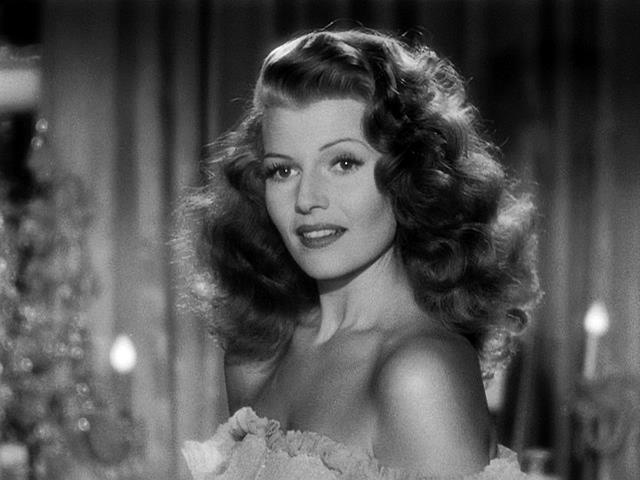
GILDA

Rita Hayworth
GILDA (1946). Director: Charles Vidor.

"Hate can be an exciting emotion. Very exciting. Hate is the only thing that can ever warm me." -- Ballin Mundson.

"If I'd been a ranch, they'd have named me the bar nothing." -- Gilda.

Down Argentine way just at the end of WW2, a hustler and crooked gambler named Johnny Farrell (Glenn Ford) is nearly robbed when a stranger on the docks with a spear in his cane comes to his rescue. The stranger is casino owner Ballin Mundson (George Macready), who hires Johnny to look after his interests. Some time later Ballin introduces Johnny to his beautiful wife, Gilda (Rita Hayworth), and both feign ignorance of the fact that they were once involved. Johnny and Gilda have a real love-hate relationship to add to the stew, and Ballin has a consortium with a bunch of Germans to add to the confusion. After a man is murdered in the casino, Ballin seems to commit suicide in his plane ... What to make of the modestly entertaining and often silly Gilda? Artificial and Hollywoodish as all get-out, with one-dimensional characters and one of the shortest climaxes in the history of the movies, Gilda has a few interesting twists and turns and is distinguished by the sex appeal and fine, constantly insinuating performance of Rita Hayworth, who makes the most of a standard role of the good-bad girl who is kept by wealthy men while loving the poor fellow she truly adores. Ford is not bad, if miscast, as the grubby borderline lowlife who winds up a kind of bodyguard/ersatz gunsel to Ballin (the narration he's given is unnecessary). Macready gives a good performance -- probably the longest and most famous of his career -- although some of his line readings are a little too matter-of-fact; one can think of other actors who might have played it in a somewhat more colorful and poetically sinister fashion. Steven Geray, Gerald Mohr, and Joseph Calleia all score as, respectively, a lowly casino employee who knows where the bodies are buried; a slimy guy with a hankering for Rita; and the police inspector who is concerned with the doings of the German consortium (even if no one in the audience is).

Some people* have had a different reading on Gilda, claiming that Johnny Farrell is a literal hustler on the bisexual side, Ballin's boyfriend, in fact, and that Johnny's self-hatred forced him to walk away from Hayworth before the story begins. This theory has it that Ballin needs to have power over attractive people of both sexes (one is reminded of Clifton Webb's character in Laura). Unfortunately, this take on the film makes it seem like a bad, regressive gay novel of the forties -- the tormented "queer" pulls away from the guy he's with and walks off into the sunset with a woman -- and while some advocates of this theory can point out certain lines and situations in scene after scene (and they may even have a point), they forget that many, many movies featured bad (and good) guys with live-in bodyguards and buddies, and this was never necessarily considered homoerotic. The proponents of this theory would have a lot to make of the Gilda imitation, Forbidden and many others as well.

Rudolph Mate has contributed some fine cinematography, but you would never know that the story takes place in Buenos Aires, as it has little Argentinian atmosphere. Gilda might be considered film noir except for the fact that its crime aspects are comparatively minimal. The pseudo-clever dialogue is often amusing.

* such as film noir specialist Eddie Muller on the Gilda DVD.

Verdict: Anyway, it's fun watching Hayworth do her "Put the Blame On Mame" number. **1/2.

Thursday, February 2, 2017

SALOME

Rita Hayworth as Salome
SALOME (1953). Director: William Dieterle.

Salome (Rita Hayworth) falls in love with Roman soldier Marcellus Fabius (Rex Reason), but his uncle Tiberius Caesar (Sir Cedric Hardwicke) not only forbids the union, but banishes Salome from Rome. Sailing to Galilee where her mother, Herodias (Judtih Anderson), awaits, Salome encounters another Roman soldier, Claudius (Stewart Granger). The two fall in love, but there are complications. Claudius is secretly a Christian and a friend to John the Baptist (Alan Badel), who preaches compassion versus Roman tyranny. Herodias is furious that her husband, King Herod (Charles Laughton) allows John to live after his attacks on her morals, but he is afraid that if he kills John it will result in his own death due to a prophecy. Salome takes her mother's side ... at first. It seems incredible that with those characters and storyline Salome is a big technicolor bore for much of its length, but, sadly, this is not based on Oscar Wilde's controversial play. Instead it was cobbled together by Hollywood scriptwriters anxious to turn this into just another pious biblical spectacle to impress the rubes, even though the movie's main selling point is not religion but the sex appeal of Rita Hayworth. As usual in films of this type, the Roman hero is turned into a "good guy." At least we have the performances. Hayworth is really quite good as the heroine, and she does a very sexy "dance of the seven veils" near the end. Granger [Blanche Fury] is fine, although it might have been better had his part gone to Rex Reason [This Island Earth], who isn't even credited in the film. Laughton, Anderson, Hardwicke, Badel (who was "introduced" in this film), Arnold Moss [Hell's Island] as Micah, and Basil Syndey as Pontius Pilate, are all excellent. The film perks up in the final minutes with the sudden appearance of a severed head. In this version it is Herodius who calls for the beheading of John, not Salome. Al Pacino starred in and directed a very creditable version of Wilde's Salome many years later.

Verdict: Despite fine actors and some good scenes, this is a distinctly minor biblical "epic." **.

Thursday, May 12, 2016

MUSIC IN MY HEART

Tony Martin and Rita Hayworth
MUSIC IN MY HEART (1940). Director: Joseph Santley.

"The bicarbonate interferes with the brandy."

Wealthy Charles Gardner (Alan Mowbray of Dante) considers himself engaged to the beautiful Patricia O'Malley (Rita Hayworth), but despite Gardner's kindness she might have other plans, especially when she runs into handsome Robert Gregory (Tony Martin), who ingratiates himself with her family. To break up the budding romance between those two, Gardner's butler, Griggs (Eric Blore of Swiss Miss), comes up with a nasty scheme to separate them by employing a fake newspaper article. Will true love find a way? The cast is game, the plot is thin, the songs by Wright and Forrest are unmemorable, but there are some bizarre developments at the very end. Tony Martin [Here Come the Girls] looks great, is not a bad actor, and has a very, very good voice; he should have had a much bigger career in pictures.

Verdict: Easy to take Columbia musical that you'll forget five seconds after it's over. **1/2.

Thursday, August 6, 2015

THE LONE WOLF SPY HUNT

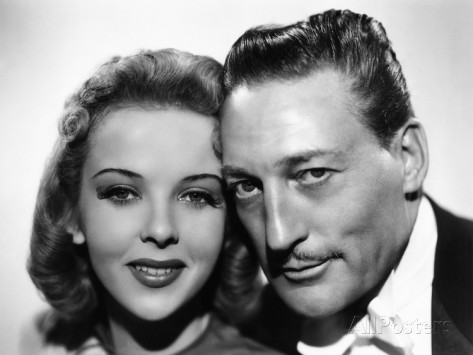
Ida Lupino and Warren William
THE LONE WOLF SPY HUNT (1939). Director: Peter Godfrey.

Michael Lanyard (Warren William), who is known as the "Lone Wolf," is a retired thief who is embroiled in a plot by an enemy to steal secret plans and frame him. This man, Spiro (Ralph Morgan), wants revenge, but just why is never explained. Spiro and his associates, including the beautiful Karen (Rita Hayworth), force Lanyard to crack a safe, but he manages to put one over on the gang, for a time at least. Meanwhile Inspector Thomas (Don Beddoe of Mandrake the Magician) and Sergeant Devan (Tom Dugan of The Galloping Ghost) are hoping they can finally arrest the infamous Lone Wolf. I believe this character had been around quite awhile before William starred in this film series, in which he is a retired widower with a young daughter, Patricia (Virginia Weilder), and a marriage-minded gal pal named Val (Ida Lupino of Private Hell 36). The movie is well-acted and pleasant enough, but it never rises above the level of a not-terribly-eventful programmer. The child Patricia is a somewhat irritating character and doesn't really fit in with the rest of the movie. There were several sequels and a TV series with Louis Hayward in the fifties.

Verdict: Has possibilities, but not one of the classics of 1939. **.

Thursday, January 15, 2015

CHARLIE CHAN IN EGYPT

Warner Oland and Rita Cansino (Hayworth)
CHARLIE CHAN IN EGYPT (1935). Director: Louis/Luis King.

Charlie Chan is investigating the theft and forgery of certain antiquities when he discovers that archaeologist Professor Arnold (George Irving) has been missing for weeks. Then the professor turns up in an unexpected place, setting in motion a series of often clever murders. There's the tomb that has hidden secrets and time-lost chambers that hold their own promise of death. Characters include Arnold's daughter, Carol (Pat Paterson), her sensitive violin-playing brother, Barry (James Eagles of The Story of Temple Drake), the family physician Dr. Anton Racine (Jameson Thomas of The Curtain Falls), Carol's fella Tom Evans (Thomas Beck), and Snowshoes, the whiny if lovable servant (Stepin Fetchit of Show Boat). A young Rita Hayworth, billed here as Rita Cansino, plays a servant girl, and is fine. There are perhaps not enough suspects, and some of the cast members over-act badly, but Charlie Chan in Egypt is fun.

Verdict: Not even dank tombs can stop Charlie. ***.


Thursday, October 4, 2012

THE LADY FROM SHANGHAI

Welles and Hayworth in the famous funhouse finale
THE LADY FROM SHANGHAI (1947). Director: Orson Welles.

"Is this what you people do in the evenings? Sit around toasting marshmallows and calling each other names?"

Michael O'Hara (Orson Welles) is hired by Elsa Bannister (Rita Hayworth) and her husband Arthur (Everett Sloane) to help run their boat, but he winds up smack dab in the middle of a convoluted murder plot -- but who's trying to kill whom? It would be criminal to give away any of the twists and turns for those who may never have seen the film; suffice it to say this is a smooth suspense thriller with flavorful characters and fine performances from a stellar cast; arguably Hayworth as the femme fatale has never been better or better-cast. Glenn Anders is also notable as Bannister's weird business partner and Ted de Corsia scores as the sinister Broome. The fascinating picture leads up to a highly memorable sequence in an amusement park with the exciting climax taking place in a mirror maze. One could argue that Welles isn't quite on Hitchcock's level and some scenes -- such as a courtroom scene -- are perhaps a little too busy, but Lady from Shanghai is nonetheless audacious and compelling. Welles, directing himself, is outstanding in the lead role. You can't look at the plot -- or some of the events -- with close scrutiny [O'Hara not being recognized by a policeman at one point!] -- the movie has its absurd moments -- but it all moves too fast for you to care. Beautifully photographed by Charles Lawton Jr. and some uncredited associates. William Castle was one of the producers of this classic.

Verdict: Film Noir par excellance! ***1/2.