Lively, entertaining reviews of, and essays on, old and newer films and everything relating to them, written by professional author William Schoell.
Showing posts with label Byron Haskin. Show all posts

Thursday, December 8, 2022

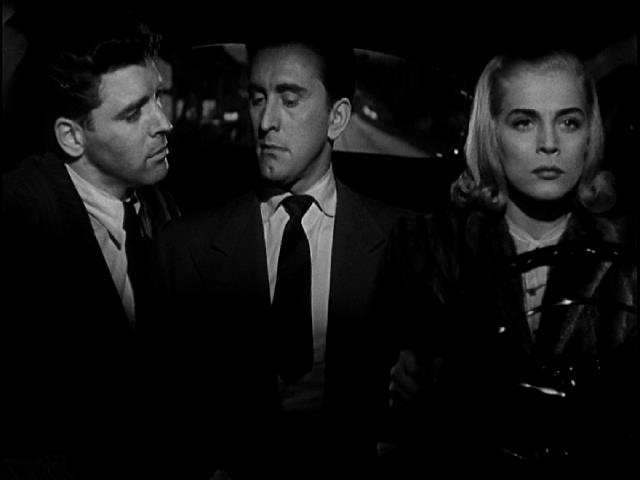
I WALK ALONE

Burt Lancaster, Kirk Douglas, Lizabeth Scott
I WALK ALONE (1947), Director: Byron Haskin.

Frankie Madison (Burt Lancaster) and Noll "Dink" Turner (Kirk Douglas) were partners in a bootlegging operation that went south. Frankie went to prison for fourteen years while Noll opened up his own successful nightclub, and got a girlfriend in singer Kay Lawrence (Lizabeth Scott). Despite his relationship with Kay, Noll plans to marry bitchy socialite Alexis Richardson (Kristine Miller) for business reasons. Frankie makes it clear that what he wants is not just 50% of what's coming to him, but something to make up for all of those years he spent in jail. But even as Frankie and Kay grow closer, Noll may have other, less admirable plans for his old friend ... 

Kirk Douglas in a dramatic moment
I Walk Alone is fair-to-middling film noir. Frankly, it just never becomes as interesting or as explosive as you might hope. The performances are on target,  however, with especially good and slick work from Kirk Douglas, although Lizabeth Scott is a little odd and her romance with Frankie is never quite convincing. Wendell Corey is fine as a friend of Frankie's and an associate of Noll's, and there is also good work from George Rigaud as Maurice, who also works for Noll but isn't quite so  subservient; Mickey Knox as gunsel Skinner; Mike Mazurki as doorman/bodyguard Dan; and Kristine Miller as the delightfully predatory Alexis. When she manages to get Noll to agree to take her to the altar, she suggests that Kay sing "I Lost My Man" to the nightclub patrons -- what a bitch! Corey's death scene on a city street is quite well-handled.

Verdict: Comes so close but somehow misses. **1/2. 

Thursday, May 4, 2017

TARZAN'S PERIL

Dorothy Dandrige
TARZAN'S PERIL (1951). Director: Byron Haskin.

Radjeck (George Macready), a bad guy who escaped from jail, is up to no good with his less bloodthirsty companions, Trask (Douglas Fowley) and Andrews (Glenn Anders). One of Radjeck's victims is Commissioner Peters (Alan Napier). Before realizing what a crumb he was, Jane (Virginia Huston) had befriended Radject, but now Tarzan (Lex Barker) is out to snare him. Radjeck wants to sell weapons to a nasty native tribe; Queen Melmendi (Dorothy Dandridge) represents a tribe of friendlier natives. Tarzan's Peril is a poor Tarzan entry, badly directed by Haskin, who fails to give the film any kind of pacing or suspense. (This is strange, as Haskin also directed The War of the Worlds and Too Late for Tears, among others, both excellent movies.) Dandridge [Change of Heart] is as criminally wasted as she usually was, even after her Oscar nomination some years later for Carmen Jones. Macready is strangely subdued (for him) as the villain throughout most of the running time. There's a mechanical snake that nearly eats Cheetah (who has little to do in the pic), and man-eating plants that ensnare both Tarzan and a baby elephant with their vines. Jane looks like she'd be more at home on Park Avenue than in the jungle!

Verdict: Not Tarzan's finest hour. **.

Thursday, November 17, 2016

CONQUEST OF SPACE

effects of acceleration on astronaut Andre (Ross Martin)
CONQUEST OF SPACE (1955). Director: Byron Haskin. Produced by George Pal.

A giant space wheel has been erected above earth whose purpose is twofold -- as an observation post and as a platform to launch a ship to the moon. However, General Samuel Merritt (Walter Brooke) is informed by his superiors that there will be no test flight to the moon, but a direct trip to Mars where it is hoped they will find a way to replenish the earth's diminishing resources and find more land for a growing population. Merritt leads the expedition with his son, Barney (Eric Fleming), as second-in-command. The others on board include Andre (Ross Martin); the crude technical expert Sgt. Siegle (Phil Foster); the Japanese Sgt. Imoto (Benson Fong); and a stowaway, Sgt. Mahoney (Mickey Shaughnessy), who was told he was too old to go along. Trouble begins when the elder Merritt starts wondering if Man has any right to "invade" space, which, in his opinion, is the province of God. Conquest of Space is a more "serious" science fiction film with character-based melodrama substituting for sexy space-babes, giant spiders, and other far-out elements of fifties outer space epics. Although the human drama is not always convincing in this, it does make the picture more entertaining than it might have been. The special effects are quite good considering this was made in a pre-CGI time period, and the science itself, while far from perfect, is more reasonable than in the more outlandish sci fi flicks made around the same time. There are some good actors in this even if it has what might be called a C level cast. Walter Brooke is fine as the general; he was actually only ten years older than Eric Fleming [Queen of Outer Space], who plays his son. As the dead-common Siegle, Phil Foster isn't terrible, but his character and style of acting make him less comedy relief than extreme irritant. Fong and Shaughnessy are pretty much the same as always, and Ross Martin [The Twilight Zone: "Death Ship"], always a very good actor, isn't given enough to do. The best scenes have to do with a humongous asteroid that almost smashes into the spaceship, and the grim sequence when a dead astronaut's body, still attached to the end of its lifeline, floats outside the porthole. Filmed in technicolor,  the Martian landscape is striking. This ambitious picture led the way to the better -- and more macabre -- Forbidden Planet the following year.

Verdict: Highly interesting and well-done early science fiction film. ***.

Thursday, February 18, 2016

THE BOSS

THE BOSS (1956). Director: Byron Haskin.

Matt Brady (John Payne) comes back from WW1, and has a love-hate relationship with his older brother, Tim (Roy Roberts of Oh, Susannah!). Driving away his girlfriend, Elsie (Doe Avedon) with his drunken behavior, Matt impulsively marries a sad barfly named Lorry (Gloria McGhee), while his best friend, Bob (William Bishop of Harriet Craig), marries Elsie. After Tim's death, Matt rises as a crooked political boss with the aid of Bob, who's become a lawyer. A reformer named Millard (Rhys Williams) represents a problem to Brady, even as his ill-advised marriage to Lorry proceeds on its dismal course. John Payne gives perhaps the best performance of his career as the bitter, unpleasant, unhappy if powerful Brady, and there are also fine performances from McGhee, Bishop, and Roberts, as well as from Robin Morse as gangster Johnny Mazia, and William Phipps [Five] as the killer, Stitch. Percy Helton and Joe Flynn have smaller roles. One of the best scenes is a massacre of hoods in Union Station. Albert Glassers' score is also effective. Neither Gloria McGhee (also spelled McGehee) or Doe Avedon amassed too many credits.

Verdict: Payne makes his mark in an absorbing crime drama. ***.

Thursday, November 13, 2014

SEPTEMBER STORM

SEPTEMBER STORM (1960). Director: Byron Haskin.

In Majorca Joe Balfour (Mark Stevens of The Dark Corner) and his buddy Ernie (Robert Strauss of Here Come the Girls) hope that model Anne Traymore (Joanne Dru) will use her feminine charm to convince handsome young Manuel Montoya (Asher Dann) to let them use his boat to find some lost treasure of doubloons. They don't realize that Manuel only pretends to be a wealthy playboy and the boat is really owned by his employer, LeClerc (Jean-Pierre Kerien). A bigger problem is that Ernie may not really be the buddy that Joe thinks he is. September Storm is okay enough, but is much too leisurely-paced to build up much suspense, and is rather slipshod all told. Dru is odd casting. Supposedly this was shot in 3D, but you'd never know it. This was charming Dann's first movie; his other four credits were in television. Kerien made mostly French films.

Verdict: Not even three dimensions could save this. **.

Thursday, April 19, 2012

CAPTAIN SINDBAD

Guy Williams as Sindbad
CAPTAIN SINDBAD (1963). Director: Byron Haskin.

In the mythical kingdom of Baristan, the evil El Karem (Pedro Armendariz), who's taken the throne from the elderly king, tries to kill off the Princess Jana's (Heidi Bruhl) lover, the dashing hero Captain Sindbad (Guy Williams). Easier said than done, although El Karem puts Sindbad in an arena with an invisible monster [we only see its footprints a la Forbidden Planet] and has the distinct advantage of being unkillable. Commanded by El Kerim, the court wizard Galgo (Abraham Sofaer) has magically placed the former's heart in a tower in the middle of a swamp, protecting him from death. Sindbad and his men brave the swamp and face hungry gators, whirlpools that suck down the men, man-eating vines, and a mechanical hydra [this last creation is a well-made and busy beastie but it takes a far second to the stop-motion Ray Harryhausen hydra in Jason and the Argonauts, which came out the same year]. The movie wisely intercuts from the desperate race to smash El Karem's heart in the tower to the approaching execution of the princess, whose head is to be stepped on by an elephant! Although the effects aren't in the same league, this is one of the better fantasy films made in the wake of The 7th Voyage of Sinbad [the correct spelling of the Arabian nights hero's name is actually with a "d"]. Williams makes a properly dashing Sindbad, Bruhl is very pretty and capable, and Armendariz is a fairly zesty bad guy. Sofaer's comedy relief antics are somewhat tiresome. Colonel Kabar, El Karim's right hand man, is well played by the incredibly versatile Henry Brandon: Barnaby in Babes in Toyland, Fu Manchu in Drums of Fu Manchu, and the hermit in The Land Unknown. The musical score seems to be a steal from a Borodin piece popularly known as "Stranger in Paradise." Excellent scenic design, especially in the colorful and sinister swampland. Bruhl appeared mostly in German films, while most of Williams' appearances were on television. After making a great many Mexican and American films, Armendariz died the same year of this film's release at 51 [he committed suicide to avoid a painful death from cancer, possibly contracted while working on The Conquerer] after making a final screen appearance in From Russia With Love.

Verdict: Highly entertaining fantasy with some decent effects work and generally good performances. ***.