Lively, entertaining reviews of, and essays on, old and newer films and everything relating to them, written by professional author William Schoell.
Showing posts with label Loretta Young. Show all posts

Thursday, January 5, 2023

CAUSE FOR ALARM!

CAUSE FOR ALARM (1951). Director: Tay Garnett. 

Although Ellen (Loretta Young ) was sort of keeping company with handsome Dr Ranney Grahame (Bruce Cowling of Song of the Thin Man), she is swept off her feet by army officer and flier George Jones (Barry Sullivan), whom she marries. Years later George is a paranoid who's taken to his bed and is certain that his wife is carrying on with the dreamy doctor, who thinks he should be in a hospital. George writes a letter detailing his unfounded suspicions to the district attorney, and when a tragedy occurs, Ellen has a devil of a time trying to get the letter back from the whining, complaining mailman (Irving Bacon) before it reaches the D.A. -- she is fully aware of how things look. 

Loretta Young gives an outstanding performance in this minor suspense film that never quite gets up to the level of nail-biting tension. It's one of those movies in which someone just assumes someone is dead without checking a pulse or calling an ambulance. The other actors are all on target, with a very effective Sullivan and a stalwart Cowling, and there are nice turns from Margalo Gillmore (of Elopement) and Georgia Backus playing a kindly neighbor and George's aunt (although I confess I'm not certain which is which). Irving Bacon (Ethel's dad on I Love Lucy), Don Haggerty as a business associate of George's, and little Brad Morrow (of Annie Get Your Gun as the little boy, Billy, who lives next door, round out the cast. 

Verdict: Reasonably engaging suspense film bolstered by fine performances. ***. 

Thursday, March 21, 2019

THEY CALL IT SIN

Loretta Young and David Manners
THEY CALL IT SIN (1932). Director: Thornton Freeland.

New Yorker Jimmy Decker (David Manners of Crooner), supposedly a "nice guy", is engaged to Edith Hollister (Helen Vincent). On a business trip to Kansas, he meets up with church organist Marion (Loretta Young) and begins a romance with her. After Jimmy returns to Manhattan, Marion's hateful mother (Elizabeth Patterson) tells her that she is not only "sinful" but was adopted and not wanted in the first place. Marion takes off to New York to find David, as well as work as a musician, but she doesn't know that the guy has a fiancee ...

Loretta Young and George Brent 
In New York Marion gets involved with two other men, Jimmy's friend, Dr. Travers (George Brent) and theatrical impresario Ford Humprhies (Louis Calhern of Athena). The latter character, who hits on women shamelessly and fires them if they don't play ball, is meant to be the true "bad guy" to make Jimmy look better, but that doesn't quite work. In any case, the film has an abrupt, surprising and unconvincing wind-up that -- despite this being a "pre-code" film -- smacks of compromise, although most viewers will be glad that Marion winds up with the man she eventually chooses. There are also some melodramatic and rather absurd complications before the fade-out.

Hateful: Elizabeth Patteron. 
Young gives an excellent performance, which is no surprise. Manners and Brent are both fine, but it is Calhern who nearly steals the movie from the better-looking gentlemen. Elizabeth Patterson is sterling as usual in a very unsympathetic part that is a far cry from the babysitter on I Love Lucy. The scene when she reveals the truth to her "daughter" is one of the best in the movie. Jimmy is such a clueless idiot that he actually asks his fiancee to take Marion under her wing -- this before either lady even knows what's going on! Una Merkel [Red-Headed Woman]  is also in the cast as a chorus girl friend of Marion's and she is even more ugly and grotesque than usual. George Brent is top-billed with Young even though Manners has the much, much bigger role.

Verdict: Morally ambiguous, but at least it's unpredictable for the most part. **1/4. 

Thursday, January 24, 2019

SECOND HONEYMOON

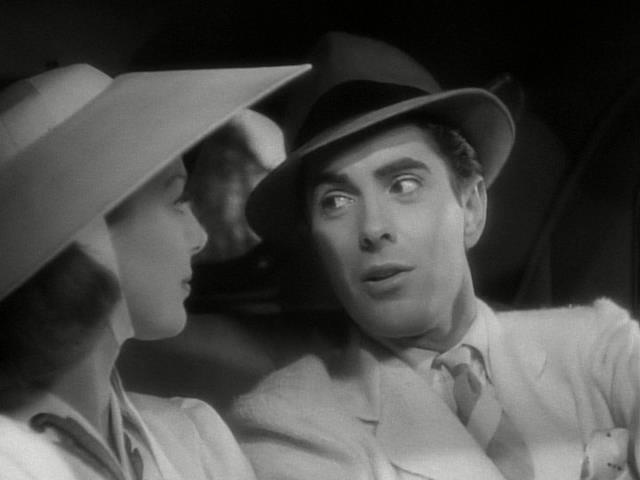
Loretta Young and Tyrone Power
SECOND HONEYMOON (1937). Director: Walter Lang.

Vicky Benton (Loretta Young of The Accused) and her second husband Bob (Lyle Talbot of Jail Bait) are on vacation in Florida when they run into Vicky's first husband, Raoul (Tyrone Power), who is still in love with her. Vicky has nagging feelings of affection for Raoul as well, but tries to suppress them. Then Bob is called to New York on business and Vicky stays behind. From the very first frame you know whom Vicky will wind up with, I mean -- Tyrone Power vs Lyle Talbot? If only the audience had been spared sitting through the 80 minutes that it takes for the two leads to realize whom they really wanted to be with.

Ty Power
Second Honeymoon aspires to be a frenetic screwball comedy, but the script is pedestrian, unfunny, and hopeless. Casting very, very skilled comic actors might have helped a bit, but Young, Power and Talbot are not highly skilled comic actors, although they certainly do the best they can with the material, and Talbot isn't quite as dull as usual. Surely Vicky had very good reasons for divorcing Raoul in the first place, but the movie glosses over them -- sex appeal triumphs as usual! Aside from a possible tendency to chase other women, second husband Bob doesn't seem that bad, at least not bad enough to deserve all the derision that is heaped upon him at the end. But he's not as good-looking as Power, so of course the film must make him the scapegoat.

Violet the raccoon goes a callin'
The film has only one laugh, and that is when Violet, Raoul's pet raccoon (given him by Bob) gets loose on an airplane and crawls curiously all over an old lady. Other actors trapped in this cinematic loser include Stuart Erwin as Raoul's valet; Claire Trevor (!) as Vicky's married friend, Marcia; and Marjorie Weaver as Joy, a personality-plus type gal who inexplicably marries Erwin. With her too-big lips and rather out-sized teeth, Young is definitely not as pretty as Power, but at least the raccoon is cute. The DVD of this is beautiful to look out, sharply remastered, but the movie is just pitiful. Mary Treen has a bit role as Joy's friend and co-worker. Walter Lang directed a great many much better movies, including Desk Set.

Verdict: One honeymoon too many. *. 

Thursday, January 10, 2019

HOLLYWOOD MADONNA: LORETTA YOUNG

HOLLYWOOD MADONNA: LORETTA YOUNG. Bernard F. Dick. University Press of Mississippi; 2011.

This career study posing as a biography briefly looks at Young's early days, then documents the movies she made on her way up [Platinum BlondeThe Hatchet Man; Wife, Husband and Friend], before emerging as the major star of such films as Orson Welles' The Stranger and Rachel and the Stranger with William Holden. In her last days of movie stardom, she began to appear in such "B" movies as The Accused and Paula, before she accepted it was time to throw in the towel and flee for television. There she had the successful Loretta Young Show for several seasons, an anthology in which she played various parts with well-known co-stars. When she got tired of that she tried to reinvent herself as a sitcom star, but The New Loretta Young Show, in which she played a widow with several children, only lasted one season. Young had no desire to go the fright flick route a la Davis and Crawford, which is one reason why she is not an icon today. She did sign to star in the prime time reboot of Dark Shadows, but backed out (as did Joan Fontaine after her), with the role eventually going to Jean Simmons. Two late-in-life telefilms years later capped her career, but she spent most of her time devoted to her Catholic faith and in humanitarian works. Her first husband was the actor Grant Withers [Jungle Jim serial], and both of her sisters were also actors, Polly Ann Young and Sally Blane [She Had to Choose].

Frankly, most fans find more fun and fascination in the "bad girls" such as Davis, with Young -- if she's thought of at all today -- as the somewhat sanctimonious hypocrite who had a child out of wedlock with the married Clark Gable, then didn't tell her daughter the truth of her birth for many decades. At times Young almost seems demented in her piousness. The shame of it is that whatever you think of Young's character or private life, she was a very good actress and gave strong performances in many movies. This book, however, doesn't delve into her true character that much; there are few if any back stage anecdotes or interviews, and it's hard for the reader to get a true sense of just what the woman was like. On the other hand, author Dick does examine her career with thoroughness, even devoting a chapter to her radio appearances wherein she reprised her performances in some of her movies and took on other actress's movie roles as well.

Verdict: Superficial as biography, but worthwhile as career study with some biographical details. ***. 

Thursday, July 14, 2016

PLATINUM BLONDE

Jean Harlow and Robert Williams
PLATINUM BLONDE (1931). Director: Frank Capra.

Reporter Stewart Smith (Robert Williams) is told to interview a wealthy family over a breach of promise suit involving the son, Michael (Don Dillaway). Smitten with Michael's pretty sister, Ann (Jean Harlow), Smith forgets all about the colleague, Gallagher (Loretta Young), who's carrying a torch for him and he winds up getting married to Ann. Smith wants Ann to live with him, but she prefers the family mansion and dresses him in monkey suits. Will he rebel and find his way back to Gallagher? You needn't see the movie to be able to answer the question, which even for 1931 is utterly cliche-ridden and thoroughly predictable -- not a single thing happens that you don't expect long before. Young and Harlow both offer expert performances, but Robert Williams is a case of an unlikable (at least in this role) actor playing an unlikable part -- his Stewart Smith is a complete, self-serving jackass that Gallagher should have kicked to the curb long before. Jokes about butlers, snobs and society are less funny than creaky. Louise Closser Hale makes an impression as Ann's mother, who is constantly asking for a double-bicarbonate. Robert Williams made no other films after this, as he died the same year it was released at a tragically young 34. Some see him as stealing the show from his female co-stars in this picture, but I confess that I do not agree -- glib Williams is just not my cup of java. Capra's direction of the film is more than okay, but that script ...!

Verdict: Even Frank Capra can make stinkers. *1/2.

Thursday, May 19, 2016

AND NOW TOMORROW

Susan Hayward and Loretta Young
AND NOW TOMORROW (1944). Director: Irving Pichel.

Socialite Emily Blair (Loretta Young) has become deaf due to meningitis, and pursues different doctors to find a cure. Family friend Dr. Weeks (Cecil Kellaway) gets Emily together with Merek Vance (Alan Ladd), who is working on a serum that may cure Emily, but who has a chip on his shoulder regarding her wealth and privilege. Adding to the complications is the fact that Emily's fiance, Jeff (Barry Sullivan), has fallen in love with her somewhat selfish sister, Janice (Susan Hayward), and vice versa. If she gets her hearing back, Emily may be in for a big surprise ... And Now Tomorrow is an entertaining soap opera that probably has little to do with the realities of hearing loss, and might even be considered a heartless fantasy for the deaf. On the other hand, it's very well-acted, with Young, Hayward, and Kellaway [Love Letters] taking the top honors, although Ladd [Boy on a Dolphin] and Sullivan [Jeopardy] also acquit themselves nicely. Beulah Bondi, Grant Mitchell and Helen Mack have smaller roles, and all are fine. The movie borders on the absurd at times but never quite goes overboard. and is well-paced and entertaining. Young is excellent, but Hayward comes close at times to stealing the movie from her.

Verdict: Having a handsome doctor is half of it. ***.

Thursday, November 6, 2014

MOTHER IS A FRESHMAN

Rudy Vallee, Loretta Young and Van Johnson
MOTHER IS A FRESHMAN (1949). Director: Lloyd Bacon.

Since her trust fund can't be accessed for several months, Abigail Fortitude Abbott (Loretta Young), a widow with a college-age daughter, has to figure out how to pay her bills. Most people would get a job, but instead Abigail decides to take advantage of a bizarre clause in her grandmother's will which allows anyone with her exact name to get a scholarship to her alma mater. So Abigail goes to classes at the same school as her daughter, Susan (Betty Lynn of Cheaper By the Dozen), but the two keep their relationship a secret. Wouldn't you know that both mother and daughter fall for the same handsome and charming Professor Michaels (Van Johnson)? Mother is a Freshman is highly-contrived but cute, with excellent performances, but it doesn't quite sustain the fun, although it's consistently pleasant. Barbara Lawrence [Kronos] plays another co-ed, and Rudy Vallee, once a singing idol, is again cast in middle-age as a stuffy unattractive-to-women type, in this case Abigail's lawyer, as he was in Unfaithfully Yours and other movies.

Verdict: Perky Loretta and dreamy Van make a good combo. **1/2.

Thursday, May 22, 2014

THE ACCUSED

Douglas Dick and Loretta Young
THE ACCUSED (1949). Director: William Dieterle.

"What do you think suicides are? Some little person thinks their little problems are all that matter in the world." -- Dr. Tuttle

College psychology professor Dr. Wilma Tuttle (Loretta Young) is concerned with a brilliant but brash and difficult student named Bill Perry (Douglas Dick). When Bill forces a smooch on her at an isolated spot, she reacts by hitting him repeatedly and killing him. Instead of coming clean, she covers up and hopes his death will be attributed to a bad dive off of a cliff into the water below; he was wearing swimming trunks. Perry's lawyer, Warren Ford (Robert Cummings), who didn't really know Perry that well nor especially like him, comes to town and begins a romance with Wilma even as homicide detective Lt. Ted Dorgan (Wendell Corey) begins to get suspicious ... The Accused features a good lead performance from Young [Because of You], fine support from an especially notable Douglas Dick and the wry, sardonic Corey [The Big Knife], but Bob Cummings is horribly miscast [as he always was in movies like this] and is terrible. Another  problem with the movie is that while Perry does kiss Wilma forcibly and without permission, it doesn't necessarily mean he would have sexually assaulted her, and her viciously hitting him over and over again seems like literal overkill. Sara Allgood and Ann Doran are also in the cast, and Sam Jaffe offers a flavorful performance as Dr. Romley, whom Wilma finds ghoulish. Victor Young's score is a plus, and Ketti Frings' screenplay has some interesting dialogue. Unfortunately The Accused runs out of gas long before it's over. Dieterle directed Dark City and many, many others.

Verdict: Physician, heal thyself. **.

Thursday, March 13, 2014

PAULA

Teaching Davey to speak: Rettig, Knox and Young
PAULA (1952). Director: Rudolph Mate.

After a miscarriage Paula Rogers (Loretta Young) is told by her doctor that she can't have any more children, and it is in this distracted mental state that she accidentally hits a young boy, David (Tommy Rettig), while driving home. Although she immediately gets out of her car and rushes to the child, an old man, Bascom (Will Wright)  -- who actually contributed to the accident -- decides unfairly that she is drunk and forbids her to accompany them to the hospital. As Paula's husband, John (Kent Smith) may lose a coveted position if there's any hint of scandal, Paula hides the truth and decides to help the boy behind the scenes. She becomes a kind of nurse's aid, befriends the boy -- who has lost his ability to speak due to the trauma, and is an orphan -- and eventually takes him into her home. But what happens when and if he recognizes her from that night? And there's still that horrible old man who claimed she was inebriated ...  Young gives a good performance and Rettig (Elopement), with his little, expressive face, is just marvelous. Alexander Knox (Son of Dr. Jekyll) plays a doctor who tries to get Davey to speak, and Kathryn Card (I Love Lucy) is cast as a nurse. While this is more of a light drama than a suspense film, it definitely has a lump-in-your-throat finale. Mate also directed the classic D.O.A.

Verdict: Minor but effective enough on its own terms. **1/2.

Thursday, March 6, 2014

HALF ANGEL

Joseph Cotten and Loretta Young
HALF ANGEL (1951). Director: Richard Sale.

"What the night shift has done to what was once irresistible beauty!"  -- Nurse Kay

Now here's a weird one. Nurse Nora Gilpin (Loretta Young) is engaged to her boyfriend Tim (John Ridgely), but at night she enters a trance state and pays lascivious calls on a man she normally hates, a lawyer named John Raymond (Joseph Cotten). John is convinced he knows Nora from somewhere, but when he tries to speak to her during the daytime, she becomes apoplectic, leading to a trial and various complications. Half Angel seems to be using an old screwball script from the 1930's but it just doesn't work twenty years later, even though both Young and Cotten give good performances. Cecil Kellaway is Nora's father, and Irene Ryan of The Beverly Hillbillies adds a slight bit of fun as Nurse Kay. Jim Backus also has a supporting role. As usual in movies of this nature, Ridgely's character is treated very badly.

Verdict: Sleepwalking and multiple personalities given the allegedly comedic approach. **1/2.

Thursday, August 29, 2013

BECAUSE OF YOU

Jeff Chandler gives one of his best performances
BECAUSE OF YOU (1952). Director: Joseph Pevney.

Flashy Christine Carroll (Loretta Young) is given a package by her fiance, Mike (Alex Nicol), and suddenly finds herself arrested and in jail despite her truthful protestations of innocence. She trains to be a nurse in prison and winds up ministering to a handsome vet named Steve Kimberly (Jeff Chandler), with whom she falls in love and vice versa. Her parole officer (Helen Wallace) warns her that Steve must be informed of her prison record before they can marry, so an apprehensive Christine manages to get around this, and a child soon follows. Then Mike comes back into her life and everything starts unraveling ... Because of You is an entertaining soap opera that soon becomes a study of frustrated mother love, with good performances from Young (in a Joan Crawford-type role) and Chandler, who is at his best in this. Notable supporting players include Alexander Scourby as a doctor at the veteran's hospital; Frances Dee as Steve's lovely sister, Susan; Lynne Roberts as his friend, Rosemary; Gayle Reed as little Kim; and Arthur Space as a judge. Pevny also directed Chandler in Female on the Beach and Foxfire.

Verdict: Pleasant enough if unremarkable soaper with two solid lead performances. **1/2. 

Thursday, August 30, 2012

THE STRANGER

Powerhouse combo: Welles and Robinson
THE STRANGER (1946). Director: Orson Welles.

Wilson (Edward G. Robinson), who works for an Allied commission that brings war criminals to justice, is after the notorious Franz Kindler, who is hiding out in the small town of Harper as a teacher named Charles Rankin (Orson Welles). Rankin is just about to get married to judge's daughter Mary Longstreet (Loretta Young), when another Nazi from Kindler's past shows up, leading Wilson to his door. First Wilson must confirm his suspicions (the audience is clued in pretty early) and keep Kindler from removing any other obstacles in his path, including people  -- and even his wife. Considering the talent involved and the story line, one would think The Stranger would be a much stronger picture, but it certainly isn't bad. Of the three leads, Robinson comes off best, although Welles is a close second and Young has her moments. The excellent supporting cast includes Martha Wentworth as a housekeeper, and Billy House as a drug store owner. Philip Merivale doesn't seem to summon up the proper concern as Mary's father (the script doesn't help here), and Richard Long is a bit perfunctory as her brother, Noah; Red the Irish Setter, is on top of things, however. One of the best scenes has Wilson interrogating Mary even as he shows her footage (mostly unseen) of concentration camp atrocities. The movie has gaps in logic and Welles seems only sporadically interested in the material; the movie picks up as it goes along and has a fairly exciting climax in a clock tower.

Verdict: Some very good moments but lacks greatness. ***. 

Thursday, January 28, 2010

THE HATCHET MAN

THE HATCHET MAN (1932). Director: William Wellman. Wong (Edward G. Robinson) is a "hatchet man" or enforcer [or hit man] for his local Chinese Tong in Chinatown. He is at first horrified to discover that his next assignment is to kill a man who is his best and oldest friend, Sun [a superb J. Carroll Naish, who is nearly unrecognizable under his excellent make up]. Wong inherits Sun's wealth, business -- and daughter Toya (Loretta Young), who years later becomes his wife. Unfortunately, Toya develops a yen for her bodyguard. Robinson basically eschews Oriental make up, while Young does look somewhat Chinese. "Ming the Merciless" Charles Middleton has a part in this film, but I confess I didn't spot him. This film is interesting and different, has a clever ending, but it's very morally ambiguous and we never learn how Toya would react if she learned exactly what happened when she was a child. Verdict: Well-acted but not exactly a Chinese Godfather. **.

Thursday, September 24, 2009

A NIGHT TO REMEMBER (1942)


A NIGHT TO REMEMBER (1942). Director: Richard Wallace.

Writer Jeff Troy (Brian Aherne) and his wife, Nancy (Loretta Young), movie into an apartment at 13 Gay Street in Greenwich Village in a building that was once a speakeasy. Nancy hopes it will provide the right atmosphere for his new book, but they get more than they bargained for. Troy has an altercation with a guy at a nearby restaurant (presided over by Lee Patrick), and the fellow winds up dead as a doornail on their patio the next morning. Sidney Toler of Charlie Chan fame plays the detective assigned to the case. A very large turtle that Jeff knew as a boy wanders around the apartment. Gale Sondergaard, James Burke and Blanche Yurka are in the cast. There are some laughs, Aherne and Young are okay doing the "cutesy" bit, but the film is not that memorable.

Verdict: A bit too precious. **1/2.

Thursday, March 12, 2009

WIFE, HUSBAND AND FRIEND and EVERYBODY DOES IT


WIFE, HUSBAND AND FRIEND (1939). Director: Gregory Ratoff.
EVERYBODY DOES IT (1949). Director: Edmund Goulding.

Ten years apart, these two movies used the exact same characters and script (with minor differences.) Nunnally Johnson adapted a novel by James M. Cain (one hopes it wasn't Serenade, which has to do with opera but has a completely different plot -- it was bowdlerized enough in the official film version with Mario Lanza.)

In both versions Leonard Borland is dismayed to learn that his wife Doris wants to take up singing again, because he doesn't think she's terribly good. His opinion is confirmed by a professional soprano, Cecil Carver, who takes a shine to him, and discovers that he actually has a magnificent baritone voice. So Leonard winds up with a singing career while his wife winds up booed at movie theaters. And worse things happen.

I saw the 1949 remake first, which may give it an edge in my mind, but I think in all fairness that it's the better of the two versions. Mainly it has to do with the cast. Loretta Young is fine in the original, but Celeste Holm really sparkles and has an added bite in the remake. Warner Baxter is not at all bad as the first Leonard, but he has an elegance that makes him seem at home in a classical environment whereas Paul Douglas seems more convincingly ill-at-ease in a monkey suit. Helen Westley and George Barbier are certainly amusing as Doris' parents in the first version, but Lucile Watson and especially Charles Coburn are hilarious in the remake. Although adequate, Binnie Barnes, in my opinion, makes little impression as the diva in version one but Linda Darnell makes a big impression in the remake. The final sequence in the opera house is longer and funner in version two. The same is true of the sequence in which Doris confronts Leonard after finding out he has had a whole singing career behind her back. In the remake Doris practically tries to murder him!

Neither picture is necessarily a huge Laugh Riot a la Night at the Opera, but the story is consistently amusing and cute. Although it may have been necessary to provide some conflict, the anti-music (at least anti-classical/operatic music) tone is a little off-putting, although Coburn's distressed reactions to singing are very funny.

Verdict: Wife, Husband and Friend -- **1/2.
Everybody Does it -- ***.

Wednesday, February 6, 2008

RACHEL AND THE STRANGER


RACHEL AND THE STRANGER (1948). Director: Norman Foster. Screenplay by Howard Fast and Waldo Salt.

After his beloved wife dies, Ohio rancher Dave (William Holden) buys and marries a bond servant named Rachel (Loretta Young) to look after his young son Davey (Gary Gray) and help with the chores. Unfortunately, his grief makes it impossible for him to act like a real husband with the woman. A wandering friend named Jim (Robert Mitchum) sees the problem and decides that Rachel should marry him. This lovely film features one of Holden's best performances as the widower who tries too hard to remain faithful to his dead wife. One might not see Loretta Young in the deglamorized role of Rachel, but she is also excellent. Robert Mitchum fails to get across his character's internal emotions, but is otherwise competent. Gary Gray is quite good as young Davey. The theme of loneliness resonates throughout the movie.
Verdict: This is a “little” picture but a memorable one. ***.