Lively, entertaining reviews of, and essays on, old and newer films and everything relating to them, written by professional author William Schoell.
Showing posts with label Trevor Howard. Show all posts

Thursday, July 6, 2023

BRIEF ENCOUNTER -- Another Viewing

Celia Johnson and Trevor Howard
BRIEF ENCOUNTER (1945). Director: David Lean. Produced and written by Noel Coward from his play. 

"So easy to lie when you're trusted implicitly. So easy -- and so degrading."

"Thank you for coming back to me."

Laura Jesson (Celia Johnson) is happily married to husband Fred (Cyril Raymond), with whom she has two children. One afternoon at a train station a helpful doctor -- also married with children -- Alec Harvey (Trevor Howard) gets something out of her eye for her. They meet again quite accidentally, but sparks strike, and romantic feelings develop. Although the relationship remains emotional and never becomes sexual -- although it almost does -- both Laura and Alec are convinced they are in love. But the guilt they are feeling over their respective spouses almost ruins whatever happiness the relationship is giving them. Finally a choice has to be made. But will Laura be able to accept it?

Johnson and Howard
Brief Encounter is no cheap soap opera but a brilliant examination of a difficult situation that is all too common now as it was back then. Laura and Alec are decent people who do love their spouses, but who can't help but react to a sudden and intense romantic infatuation that seems to come out of nowhere and is nearly overpowering. (Is it really true love? Possibly not.) The movie neither accepts nor judges, but merely presents this situation and its joys and agonies primarily from Laura's point of view. This is not about the heartbreak of the spouses because they don't know what's happening. This is one movie in which the narration is not intrusive but only adds to our understanding. What makes Brief Encounter a masterpiece is not only the sensitive direction, the superb performances from Johnson and Howard and indeed the entire cast, but Robert Krasker's first-rate cinematography. It doesn't hurt that everything is soaked in the strains of Rachmaninoff's Piano Concerto No. 2. 

Stanley Holloway and Joyce Carey
The humor in the film comes from the antics of station master Stanley Holloway and the lady who runs the food and drink counter, Myrtle (Joyce Carey). Holloway does his best to charm the lady, who is rather common but tries her damnedest not to appear that way. There is also fine work from Everley Gregg as Dolly, the chatty and annoying woman who ruins Laura's last moments with her lover, and Valentine Dyall has a splendid scene with Alec as his friend Stephen, whose flat Alec is using temporarily. "I'm not angry," Stephen tells Alec when he realizes a woman ran out of the flat just before he entered, "just disappointed." One of the film's most trenchant observations is when Laura realizes that even if she were to only tell Fred about Alec decades later when they were both old and gray, it would still hurt him horribly. The movie has a lovely and moving conclusion. 

Verdict: Truly another great movie that just seems to get better and better each time you see it. ****. 

Thursday, March 30, 2023

WHITE MISCHIEF

Greta Scacchi
WHITE MISCHIEF (1987). Director: Michael Radford.

In 1940 beautiful young Diana (Greta Scacchi of Shattered) has married the much-older Jock Broughton (Joss Ackland of Crescendo) and moves with him to Kenya. There the couple are part of a wealthy or would-be wealthy social set that includes rampaging lover boy Joss, Lord Errol (Charles Dance of Alien 3). It isn't long before Diana and Joss begin a highly indiscreet affair that has tongues wagging, and reaches the ears of Jock. Apparently resigning himself to the fact that his wife and Joss are in love, he agrees to step aside and even toasts the couple. But that same night one of these three people is found dead on a highway, and a murder trial ensues ... 

Scacchi with Charles Dance
White Mischief
 is inspired by true events that led to a fictionalized book of the same title. The characters are all one-dimensional, but that may be because they are especially superficial people, the two illicit lovers in particular. The performances, however, are quite good, with Ackland a stand-out. This is another movie which tries to present Charles Dance -- a good actor who is not especially good-looking -- as a male sex symbol. The real Lord Errol was actually better-looking than Dance -- the same is true of the real Broughton and Ackland -- although the glamorized Scacchi is much sexier than the real Diana. 

Old pals: Joss Ackland and Trevor Howard
The movie has a few intriguing scenes, such as a party in which the guests, both men and women, are required to dress in drag. A very bizarre, even gross, scene, has Alice (Sarah Miles) pleasuring herself as she stands over a corpse of a man she once loved. Murray Head plays Alice's boyfriend, and John Hurt is a weird farmer named Colville who is also attracted to Diana. Geraldine Chaplin flits in and out of the action without making much of an impression, and Trevor Howard -- who nearly got fired because of his drinking -- is fine as a dissolute friend of Broughton's. Hugh Grant appears briefly at the beginning of the film as one of Diana's lovers. White Mischief holds the attention but never fully engages the viewer. 

Verdict: Rich Caucasians behaving badly. **1/2. 

Thursday, December 22, 2022

LUDWIG

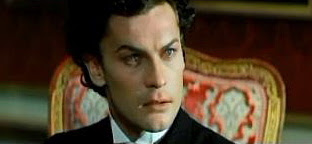
Helmut Berger as King Ludwig II
LUDWIG (1973). Director: Luchino Visconti. Original four-hour Italian version.

"The greatest gift you can give to your people is to enrich their souls." -- King Ludwig II

King Ludwig II of Bavaria (Helmut Berger of The Bloodstained Butterfly) has much more interest in art, culture, and architecture than he does in matters of state. Supposedly in love with his cousin, the Empress Elisabeth of Austria (Romy Schneider), he gets engaged to Elisabeth's sister, Sophie (Sonia Petrovna). Elisabeth suspects where her cousin's true interests lie, but feels that Ludwig will grow out of these feelings with Sophie's help; the two never get married, however. Ludwig is Catholic and tells his priest that he will subdue any "unnatural" feelings he has, right after which he is playing footsie with his footman, Richard Horning (Marc Porel). Whether it's the King's erotic tendencies or the alleged "degeneration" of his mind that are the problem, the members of the Bavarian government are determined to get "Mad" King Ludwig out of his castle. This leads to two deaths that are still a mystery today.
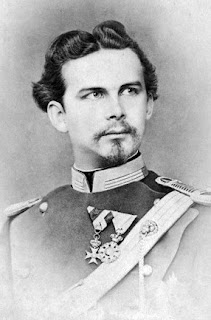
The real King Ludwig
Ludwig is a fascinating look at a fascinating historical figure. Although quite Wagnerian in length, the film is never boring (something you can't say about every Visconti film), although cuts could have been made in the second half. Berger, dubbed by Giancarlo Giannini, plays the role with his customary intensity -- alas his hairstyle looks better on the real Ludwig than on Berger --  and there are also good performances from Romy Schneider (reprising her role from the Sissi films) and John Moulder-Brown (of The House That Screamed) as the ill-fated Prince Otto, Ludwig's younger brother. Also notable are Helmut Griem (who screwed both Liza Minelli and Michael York in Cabaret) as Count Durckheim and Trevor Howard as Richard Wagner. (Opera fans owe Ludwig a great debt as his financial assistance helped the great composer finish his Ring cycle.) Silvana Mangano is cast as Wagner's mistress and later wife, Cosima. 

There is no doubt that Ludwig was homosexual, but whether he was "tormented" or not, despite his Catholicism, is debatable. I believe his alleged romantic love for Elisabeth  -- which is like that of a child -- was invented for this film, as Visconti wanted his hero to be at least perceived as bisexual, be it true or not, for the director's own reasons. (As for Helmut Berger, he was married to both a man and a woman so you can come to your own conclusions. He was Visconti's companion for many years.) 
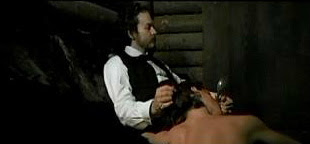
The king and squire at rest
Some might be disappointed that the homoerotic content in the film is rather limited. The gay love scene mentioned above is in the shadows and very brief, and there is an all-male party (left) which could hardly be called an orgy. 

Ludwig was filmed on location and the settings are simply magnificent. The movie doesn't always hit the mark emotionally, but it is literate, opulent, romantic, and generally tasteful. King Ludwig was criticized for building numerous beautiful castles, most of which he never lived in, but today they are great tourist attractions and have certainly enriched the Bavarian coffers. 

Verdict: My next vacation will be in Bavaria. ***1/4. 

Thursday, September 3, 2020

CONDUCT UNBECOMING

Michael York
CONDUCT UNBECOMING (1975). Director: Michael Anderson.

In Colonial India, two young British men whose fathers were also in the military, arrive to begin a three month probationary period in their distinguished regiment. Arthur Drake (Michael York) is anxious to make good while blase and cynical Edward Millington (James Faulkner) hopes to get thrown out as soon as possible. But there may be more serious consequences when Millington is accused of assaulting Marjorie Scarlett (Susannah York), widow of a legendary hero, and Drake is tapped to defend him in a special private hearing. As the trial progresses, many disturbing revelations come to light ...

James Faulkner and Susannah York
Although based on a stage play, Conduct Unbecoming is not stage-bound or overly talky but is suspenseful, intriguing, and holds the attention throughout. Part of this is due to a compelling story line, and part to some excellent performances.  Michael York and Faulkner are perfection, and Georgia-born Stacy Keach does a dead-on English accent and is absolutely splendid as Captain Harper, who oversees the private hearing. Christopher Plummer, Michael Culver [Goodbye, Mr. Chips], and Richard Attenborough offer riveting portraits of various officers, and Trevor Howard makes a strong and convincing Colonel Strang. Persis Khambatta of Star Trek: The Motion Picture appears briefly as a woman who may have been another victim.

Stacy Keach and Michael York
Susannah York [The Killing of Sister George] is not quite up to the level of the gentlemen, unfortunately, and a stronger actress should have been chosen. York just does her scenes as written in the script but never adds any nuances or layers -- she doesn't make the most of her one big climactic outburst; she has given better performances elsewhere. One could also argue that the inexperienced Drake manages to arrive at certain conclusions as if he were a veritable Perry Mason! -- undoubtedly he has a legal career in front of him. An interesting touch is the role reversal between the two young soldiers, as well as the examination of how keeping one's "honor" is not always so honorable. Director Michael Anderson directed the much less successful Doc Savage the same year and worked with Michael York again the following year on Logan's Run.  By the way, Michael York and Susannah York were not related and were never married to one another.

Verdict: Absorbing, very well-acted courtroom-military drama with some interesting twists. ***. 

Thursday, May 3, 2018

PICKUP ALLEY

Anita Ekberg and Trevor Howard
PICKUP ALLEY (1957). Director: John Gilling.

Drug enforcement agent Charles Sturgis (Victor Mature of Kiss of Death) is still recovering from the death of his sister, Helen (Dorothy Alison) -- who was working undercover and wound up strangled by dope smuggler Frank McNally (Trevor Howard) -- when he learns that McNally is now in London. Sturgis discovers that McNally is using a beautiful woman named Gina (Anita Ekberg of The Killer Nun) to run certain errands for him, so Sturgis decides to follow her. The trail goes to Lisbon to Rome to Athens -- the film is an exciting scenic travelogue with location shooting -- until he catches up to her and tries to convince her to tell what she knows. The trouble is, she thinks she murdered an associate of McNally's who tried to rape her in London. Pickup Alley  -- a lousy title for a good movie -- is borderline film noir, proceeds at a fast pace, and is very well-acted, with Howard underplaying as the slimy drug dealer. Gorgeous Ekberg has little to do but look uncertain and frightened and sometimes a little defiant, and she pulls if off competently. Victor Mature is quite good as the battered, sad and obsessive drug agent. Pickup Alley is also distinguished by first-rate widescreen photography by Ted Moore, and there's a good score by Richard Bennett, although one might have wished it was a little more intense at times. A problem with the picture is that most of the characters are completely one-dimensional, with Ekberg in particular never developed beyond a shadowy femme fatale type. Bonar Colleano [Pool of London] scores as Amalio, a transplanted New Yorker trying to make a living selling souvenirs at the catacombs in Rome and who tries to pick up some extra money as a leg man for Strugis; Martin Benson and Andre Morell also have smaller roles and are typically adept. In an early scene in a nightclub the beautiful singer Yana does a very nice rendition of the snappy "Anyone For Love."

Verdict: Vivid crime thriller with very interesting settings. ***.

Thursday, February 18, 2016

THE PASSIONATE FRIENDS

Claude Rains and Ann Todd
THE PASSIONATE FRIENDS (1949). Director: David Lean.

Professor Steven Stratton (Trevor Howard) has always been in love with Mary (Ann Todd), and vice versa, but she's afraid of losing her identity and freedom in a romantic match with him and marries the wealthy Howard Justine (Claude Rains) for practical reasons instead. Years later, Mary and Steven reignite their passion and Mary's marriage almost ends, but she decides to stay with Howard. In what could only be termed an improbable and utterly amazing coincidence, Mary and Steven inadvertently wind up in adjoining rooms in the same resort at the exact same time, leading a disbelieving (of their innocence) Howard to file for divorce, even though Steven has since married another. This leads to some powerful and emotional sequences as husband and wife face the worst crisis in their lives, and an older-but-wiser Mary must make a supreme sacrifice. With direction from David Lean [Doctor Zhivago], and a script by Eric Ambler (from one of H. G. Wells' non-science fiction stories) The Passionate Friends isn't as good as Lean's earlier romantic drama Brief Encounter, but comes close. The performances by Claude Rains and Ann Todd [The Paradine Case] are simply superb, and Trevor Howard, while a cut below the other two, is also excellent. (It is probably because of the strength of the cast that it was decided not to use different actors for the varying ages of each character.) The film also boasts outstanding cinematography by Guy Green, and a fine score by Richard Addinsell, as well as a quite moving conclusion. The film is so good and so well-acted, in fact, that one can forgive the incredible coincidence that leads into the dramatic events that follow.

Verdict: Superior romantic drama with top talents involved. ***1/2.

Thursday, August 28, 2014

MUTINY ON THE BOUNTY (1962)

Marlon Brando
MUTINY ON THE BOUNTY (1962). Director: Lewis Milestone.

Sailing to Tahiti in 1787 to get breadfruit, the crew of the Bounty eventually rebel against what they see as the heartless tyranny of their captain. This second film version [of three] of the famous story is also based on the novel whose fictionalized events have sometimes replaced the true story in the mind of the public. For some reason, Marlon Brando chose to portray Fletcher Christian as an affected fop, possibly the only way he could keep up the British accent -- other than that, his performance isn't bad, although it is not as good as Trevor Howard's as the notorious Captain Bligh or Richard Harris' as a sailor named Mills. Hugh Griffith, Richard Hadyn [The Lost World], Percy Herbert and Tim Seely as young midshipman Ned, are also notable, among others. The movie is long and bloated and follows the mutineers onto Pitcairn Island, where they settled, but a framing sequence that takes place on the island with Haydn and Torin Thatcher was excised from the film and can be seen on the DVD. As Maimiti, the king's daughter, who falls for Christian, Tarita strikes the right note [as she obviously did with Brando, who married her]; Frank Silvera is convincing as her father. One problem with the movie is that at times it has a very fortyish tone, becoming awfully "cute." However Milestone keeps things moving and Bronislau Kaper's score is very effective.  Originally shown in ultra-Panavision 70. Ultimately, this is not a bad picture, although it's no better than the other versions, the original Mutiny on the Bounty and The Bounty.

Verdict: If you can't get enough of Christian and Bligh. ***.

Friday, August 15, 2008

RUN FOR THE SUN

RUN FOR THE SUN (1956). Director: Roy Boulting

Although this will probably hold your attention if you're unfamiliar with earlier versions, this is a fairly lamentable remake of the far superior Most Dangerous Game. Whereas the first film got us right into the action, this variation takes forever to get to the main event, with a protracted sequence wherein Jane Greer plays a magazine reporter trying to find out why famous writer Michael Latimer (Richard Widmark) vanished to Mexico when he was at the top of his game. After an hour or so of this, Widmark offers to fly Greer out of the village he's buried himself in but they crash land in an even more remote area where Trevor Howard and Peter van Eyck have taken up residence. The bad guys in this picture don't actually hunt humans as the villain did in The Most Dangerous Game -- stripping this version of the story's most interesting aspect -- they just don't want Widmark and Greer to get away knowing their secret (which isn't much anyway, although one can understand why they don't want their uninvited guests going off and telling anyone). The scene when the plane nearly crashes is well done, but the climactic chase is slack and unexciting. Roy Boulting was never a good choice to direct thrillers; years later he made a botch of Twisted Nerve. Jane Greer radiates her usual refined sexiness and Widmark, while never a great actor, is full of his usual insolent authority. Trevor Howard is merely wasted in a throwaway part. The music is okay but the widescreen cinematography is unimpressive. It all looks like it was shot on a back lot anyway. 

Verdict: Watch The Most Dangerous Game instead. **.

Sunday, March 2, 2008

BRIEF ENCOUNTER

BRIEF ENCOUNTER (1945/British). Director: David Lean. Written by Noel Coward from his play Still Life.

Superb drama is one of the finest romantic films ever made. A married woman (Celia Johnson) meets a married man (Trevor Howard) at a train station, and the two soon realize they've found the soul mates that they haven't found in their spouses, whom they nevertheless love. Will they find a way to find happiness with each other or face a certain bleak reality? A sort of secondary love story is played out between the station agent (Stanley Holloway) and the lady who runs the tea shop (Joyce Carey) where the other two lovers first meet. Beautifully directed, acted and photographed, with appropriate background music from Rachmaninoff's Piano Concerto # 2, this is no mere soap opera but but a finely realized and uncompromising adult drama. The supporting cast is excellent right down to the smallest roles.

Verdict: A poignant, not-to-be-missed masterpiece! ****.