Lively, entertaining reviews of, and essays on, old and newer films and everything relating to them, written by professional author William Schoell.
Showing posts with label John Carpenter. Show all posts

Thursday, December 22, 2022

ELVIS (1979)

Kurt Russell as Elvis
ELVIS (1979 telefilm). Director: John Carpenter.

Elvis Presley (Kurt Russell), inspired by black musicians, develops his own singing style and frenetic dancing movements. He rises to the top of the recording and film industry with the help of Colonel Tom Parker (Pat Hingle), but is frustrated by the insipid scripts that he is given. Marrying Priscilla (Season Hubley), whom he meets when she is fourteen, he develops a dependency on prescription drugs that alter his personality and make him paranoid. He attempts a comeback by appearing at the International Hotel and Casino in Las Vegas, but will this lead to a revitalization of his career or will he fall flat on his face as hundreds of fans await his entrance?

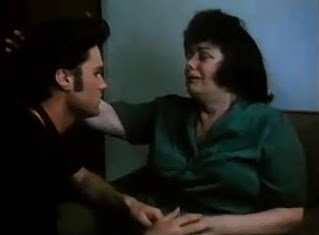
Russell with Shelly Winters
Kurt Russell gives a terrific performance as Elvis in this long but entertaining telefilm, which also stars Shelley Winters as Elvis' mom, and Bing Russell (Kurt's real-life father) as Elvis' dad. (To keep it all in the family Kurt Russell later had a short marriage to Season Hubley, who plays Elvis' wife). There's way too much of Winters in the first half of the movie, especially as she is giving one of her kind of twitchy  and breathless performances in what one could call her fat and whiny period. Pat Hingle isn't really given much to do as Parker, his character being shunted into the background most of the time, unlike in the 2022 Elvis

Russell with Season Hubley
The last fifteen minutes or so of the movie are given over to Elvis' triumphant concert at the International, where Russell performs the pants out of songs like "Burning Love" and displays the King of Rock at his most energetic. Credit also must be given to Ronnie McDowell, who does a fine job providing Elvis' singing voice. Ironically, the first movie Kurt Russell ever appeared in was an Elvis flick, It Happened at the World's Fair, where the king asks a boy (Russell) to kick him in the shins. This telefilm began a long association between Kurt Russell and John Carpenter, who also directed him in The Thing and many others. 

Verdict: Good approximation of the King. ***. 

Tuesday, October 30, 2018

THE FOG (1980)

THE FOG (1980). Director: John Carpenter.

As the California coastal town of Antonia Bay prepares for its centennial, most of the town's citizens are unaware of its truly tragic origin. The town's founders, learning that a wealthy man was planning to build a leper colony near the town, deliberately sank the schooner that the lepers were sailing on and took the wealthy man's gold for themselves. Now it's one hundred years later and the ghosts of the lepers want revenge. Noticing the glowing fog at sea, along with some other strange occurrences, are several townspeople, including: Stevie (Adrienne Barbeau), who runs the local radio station out of a lighthouse; hitchhiker Elizabeth (Jamie Lee Curtis) and the fisherman, Nick (Tom Atkins), who gives her a lift; the tippling Father Malone (Hal Holbook), whose grandfather was one of the town's founders; and Mrs. Williams (Janet Leigh), who tries to stay in charge of the ceremonies even as she deals with the fact that her husband is missing.


Adrienne Barbeau
This was the second theatrical film after Halloween for both director Carpenter and Jamie Lee Curtis, who has a supporting part in this. I was not all that impressed with The Fog when it was released, and it hasn't grown on me, although it is by no means a terrible picture, especially when compared to some of the horror schlock released at the same time. The main problem with the film is its too-deliberate pacing, which should at least give the movie time to develop its characters but doesn't. The main premise is quite good, but Carpenter, who co-scripted, just doesn't do enough with it, and viewers often get the impression that the movie is over just when it starts to get really interesting -- although to be fair there are some eerie sequences and a couple of startling moments. It also has some mood and atmosphere, and Dean Cundey's cinematography is notable. The picture cries out for a much better score than the one that composer Carpenter has provided, however. Janet Leigh gives a very obvious performance, but Barbeau [Two Evil Eyes] is better, along with most of the other cast members. Barbeau and John Carpenter were married at the time; their marriage lasted five years. I found it hard to believe that Barbeau's character would stay at the radio station instead of going to her little boy's rescue. Remade in 2005.

Verdict: If you like movies with creepy things in the fog, watch The Crawling Eye instead. **1/2.

Thursday, September 20, 2012

THE CHARM OF EVIL: TERENCE FISHER

Terence Fisher
THE CHARM OF EVIL: The Life and Films of Terence Fisher. Wheeler Winston Dixon. Scarecrow Press; 1991. Introduction by John Carpenter.

This is an exhaustive, superbly-researched look into the life and work of British director Terence Fisher, who helmed a great variety of films but is today best remembered for his work for Hammer Studios, including Horror of Dracula, The Two Faces of Dr. Jekyll, The Gorgon, and many others. More a career study than a biography proper, there is still much of his personal life, with recollections from his widow and those who worked with Fisher. Dixon looks into Fisher's pre-Hammer work, interesting films such as Stolen Face and Portrait from Life, as well as such curiosities as Four-Sided Triangle and Blackout. While an obvious admirer of his subject, Dixon doesn't slavishly love everything the director did, [although one might wonder about his defense of such comparative drek as The Earth Dies Screaming.] Some might feel Fisher isn't worthy of such intensive scrutiny as Hitchcock, but Fisher's best films show a firm directorial hand and are both vivid and dramatic. The book is written in an academic style that isn't too off-putting, although Dixon betrays a certain prissiness at times. Some might eschew the somewhat tedious shot by shot analysis that Dixon occasionally goes in for and just look at the movies themselves. Basically, this is a well-done, scholarly and admirable labor of love.

Verdict: For Fisher fans this is the "reel" deal. ***1/2.