Lively, entertaining reviews of, and essays on, old and newer films and everything relating to them, written by professional author William Schoell.
Showing posts with label Barry Sullivan. Show all posts

Thursday, August 28, 2025

QUEEN BEE

Joan as Eva Phillips
QUEEN BEE (1955). Written and directed by Ranald MacDougall. Colorized version.      

"Really that Dr. Pearson is absurd. He actually trembles when he talks to me. You'd think he'd never seen a beautiful woman before." -- Eva. 

Although dating Jud Prentiss (John Ireland of The Ceremony), the Yankee Eva (Joan Crawford) sets her cap for Jud's boss, Avery Phillips (Barry Sullivan of Pyro), a wealthy Southern gentleman, and follows him home. Eva lies and tells Avery that she's pregnant, and the "gentleman" literally leaves his fiancee, Sue (Fay Wray), at the church door to run off with Eva. Years later the two are trapped in a miserable, dysfunctional marriage with Avery spending most of his time in his bedroom getting drunk. Ironically, Avery is nicknamed "Beauty" but now has a large scar on his face due to a drunken driving accident. Meanwhile the aforementioned Jud has fallen for Avery's sister, Carol (Betsy Palmer), who positively loathes Eva. Into this miasma of Southern rage and scandal comes Eva's sweet cousin, Jennifer (Lucy Marlow of He Laughed Last), who is moving into the mansion completely unaware of the goings-on. When Eva, who never lets go of a man, finds out that Jud and Carol are engaged, things in the household will get even tenser, if such is possible ... 

Mrs. Vorhees meets Lucy Harbin
Queen Bee
 is certainly not a perfect movie, but it is a strangely compelling melodrama with a lot going on in the background. Joan Crawford dominates the picture, of course, as she should, and gives a highly effective performance as a rather nasty character who admits what she is but still can't help making excuses for her behavior. If you don't quite believe her when she's showing vulnerability, it's because you can't quite imagine Eva ever being vulnerable in any real sense, although she is not above playing on people's sympathies. 

Cocktails and savagery at the Phillips
As for the rest of the cast, Betsy Palmer stands out as Carol, standing up to Eva/Joan on occasion even as you realize she is just no match for her strong-willed, highly neurotic sister-in-law. Lucy Marlow, with her odd square face, has a couple of unconvincing moments but is basically solid as the ultimately disillusioned Jennifer. (You're not quite certain how or why she falls for the dissolute Avery, and any actress might have a hard time making that convincing.) Fay Wray has one scene as Sue, the jilted fiancee, who seems to have lost herself in never-got-over-it vagueness. Wray is good, but it's hard to imagine that she would ever want anything to do with this couple, let alone have cocktails with them in their drawing room. 

Barry Sullivan with Crawford
The men don't fare as well. John Ireland and Barry Sullivan give rather stilted, rushed line readings as compared to the ladies. William Leslie makes an impression, however, as the handsome and charming Ty, and Jennifer seems demented in preferring Avery, on the verge of cirrhosis of the liver, over this hunk. Katherine Anderson is suitably hard and unpleasant as the nurse who takes pleasure in being nasty to the little boy (Tim Hovey) who suffers nightmares, until the little guy knows "how [the nightmare] ends" at the violent climax. Hovey is as adorable and adept as ever. (A sobering postscript is that the fellow committed suicide at only 44.) Willa Pearl Curtis, as a maid, has a nice vignette when she expresses sympathy to Jennifer over being dumped and muses about her own romantic missteps. Years later Crawford and Palmer both played deranged murderesses, Crawford in Strait-Jacket (at the opening) and Palmer in Friday the 13th. Handsomely shot by Charles Lang. 

Verdict: Crawford in a compelling portrait of a woman who deservedly hates herself. ***. 

Thursday, March 14, 2024

PLANET OF THE VAMPIRES

Angel Aranda and Barry Sullivan
PLANET OF THE VAMPIRES (aka Terrore nello spazio/1965). Director: Mario Bava.

Two spaceships, the Argos and the Galleon, led respectively by Mark (Barry Sullivan of Pyro) and his brother, Toby (Alberto Cevenini), respond to a distress signal from an isolated planet. When the Argos lands, the crew members inexplicably begin attacking each other, and the crew of the Galleon, which already landed, are eventually found dead. Regaining control of their minds, Mark, crewmembers Wes (Angel Aranda), Sonya (Norma Bengell), Tiona ((Evi Marandi), and others, are baffled and terrified when some of the dead appear to them, seemingly alive. Something on this planet is a decided enemy of theirs ...

Trapped with the giant alien skeleton
The highly influential Planet of the Vampires is as colorful and entertaining as an E.C. sci fi comic book of the fifties. Perhaps the best scene has Mark and Sonya trapped inside an alien spaceship -- which also responded to a distress call centuries ago -- inside which is the skeleton of a creature three times their size. Something starts sucking the air out of the chamber as the two try desperately to find a way out. But their true enemy is more or less invisible and that much more dangerous. 

the crew of the Argos
Planet of the Vampires, along with It, the Terror from Beyond Space,  undoubtedly stirred the imaginations of the creators of Alien. The similarities are numerous: in both films the protagonists respond to a distress signal; the shape of the spaceships, including orifice-like exits; the derelict spaceship and the huge alien skeleton found inside. One could argue that its sequences in which colleagues and loved ones come back from the dead are reminiscent of the later Night of the Living Dead, as well. 

Angel Aranda
Director Mario Bava cleverly expands a small budget with his trademark attractive, even garish color schemes, the use of shadows and fog, and camera angles that add to the eerie atmosphere. The spacemen wear black leather outfits that come off as perhaps a little too stylish. Barry Sullivan, whose real voice is heard in this Italian production, is professional although the role is not really a good fit for him. He shows little reaction when he finds out his brother is dead -- or "alive." The other actors all seem adept. Angel Aranda reminds one of Mark Damon of House of Usher. The downbeat "surprise" ending is also typical of fifties sci fi comics. 

Verdict: Very interesting sixties science fiction. ***. 

Thursday, May 11, 2023

DUFFY'S TAVERN

Ed Gardner
DUFFY'S TAVERN (1945). Director: Hal Walker.

Archie (Ed Gardner), the manager of the old-fashioned saloon Duffy's tavern, has hired 14 soldiers as waiters in the owner's absence because the record factory where they worked has closed down. O'Malley (Victor Moore) tries to raise money to reopen the factory but the bank won't extend him credit. His daughter, Peggy (Marjorie Reynolds of Up in Mabel's Room), meets and falls for one of the out of work soldiers, Danny (Barry Sullivan), not knowing that Archie is in love with her. Archie finally gets the idea of getting celebrities from a nearby hotel to put on a show and raise the needed capital. Archie acts as master of ceremonies, introducing sketches and song numbers with such guest artists as Betty Hutton, Brian Donlevy, Alan Ladd, Veronica Lake, and other performers from Paramount studios. 

Billy DeWolfe, Bing, and Betty Hutton
I can imagine how the public must have felt back in 1945 when they went to see a film allegedly starring Bing Crosby, and Der Bingle doesn't even show up until after 80 minutes into the running time! Instead we are treated to dull alleged comedy from Ed Gardner and Victor Moore, one of the unfunniest pairings in film history. Gardner had starred in the radio show Duffy's Tavern, and this picture was a film adaptation; ten years later Gardner starred in a TV sitcom of the same title. Based on his performance in this movie, I can see why Gardner has been completely forgotten -- he also contributed to the largely unfunny screenplay. He might be better known as Shirley Booth's first husband. 

Buck-toothed and brassy: Cass Daley
The last third of the film is somewhat of an improvement although much of it is also nearly unwatchable. Betty Hutton hollers her way through one number, and her less attractive clone Cass Daley (of Red Garters) also screams through a similar number -- both women lamenting the lack of interest they inspire in men. (The question is did Hutton rip off Daley or vice versa?) A terrific dance team temporarily lifts the audience's spirits and there's a quick, mildly amusing sketch with Paulette Goddard, Sonny Tufts, and Brian Donlevy.  The finale features Bing Crosby, first in a cute bio of his life with special guest-stars, and then his rendition of "Swingin' on a Star" with Dorothy Lamour and others joining in. The other generally forgettable songs are by Burke and van Heusen. This is one of the worst of the all-star studio films. Star Spangled Rhythm was a far superior Paramount compendium. 

Verdict: Put on any show but this one! **. 

Thursday, January 5, 2023

CAUSE FOR ALARM!

CAUSE FOR ALARM (1951). Director: Tay Garnett. 

Although Ellen (Loretta Young ) was sort of keeping company with handsome Dr Ranney Grahame (Bruce Cowling of Song of the Thin Man), she is swept off her feet by army officer and flier George Jones (Barry Sullivan), whom she marries. Years later George is a paranoid who's taken to his bed and is certain that his wife is carrying on with the dreamy doctor, who thinks he should be in a hospital. George writes a letter detailing his unfounded suspicions to the district attorney, and when a tragedy occurs, Ellen has a devil of a time trying to get the letter back from the whining, complaining mailman (Irving Bacon) before it reaches the D.A. -- she is fully aware of how things look. 

Loretta Young gives an outstanding performance in this minor suspense film that never quite gets up to the level of nail-biting tension. It's one of those movies in which someone just assumes someone is dead without checking a pulse or calling an ambulance. The other actors are all on target, with a very effective Sullivan and a stalwart Cowling, and there are nice turns from Margalo Gillmore (of Elopement) and Georgia Backus playing a kindly neighbor and George's aunt (although I confess I'm not certain which is which). Irving Bacon (Ethel's dad on I Love Lucy), Don Haggerty as a business associate of George's, and little Brad Morrow (of Annie Get Your Gun as the little boy, Billy, who lives next door, round out the cast. 

Verdict: Reasonably engaging suspense film bolstered by fine performances. ***. 

Thursday, February 4, 2021

A LIFE OF HER OWN

A LIFE OF HER OWN (1950). Director: George Cukor. 

Lily James (Lana Turner) leaves her dead-end small town for a life of glamor, modeling, and excitement in New York and gets a little more than she bargained for. After a variety of adventures and mis-adventures, she becomes involved with a married man (Ray Milland) who has a crippled wife (Margaret Phillips). Dismissed as soap opera and "fluff" by the critics at the time of its release and after, this is actually a hard-hitting drama with an excellent script and dialogue by Isobel Lennart. Cukor, well-known as an actors' director, certainly worked his magic on the cast. Lana Turner is first-class throughout, giving what may have been her best performance in films, and Ray Milland, often a Great Stone Face, is much more impressive than usual. Ann Dvorak almost walks off with the movie as the aging model, Mary Ashlon, who is hoping for a comeback that even she realizes is unlikely. Tom Ewell, Louis Calhern, Margaret Phillips and Sara Haden (as a nurse) are also notable. Barry Sullivan superbly delivers a great super-cynical speech near the end of the film. Although one could argue that the movie sticks to a dated sin-and-suffer formula, it actually is true to its essentially dark tone (even though the original ending was softened quite a bit). 

Verdict: Fascinating stuff in its own way and very well-performed. ***1/2.

Thursday, March 21, 2019

MR. IMPERIUM

Ezio Pinza as the prince
MR. IMPERIUM (1951). Director: Don Hartman.

Showgirl Fredda Barlo (Lana Turner) is performing in a nightclub in Italy when she encounters a dashing stranger named Mr. Imperium (Ezio Pinza). Imperium is actually Prince Alexis, heir to the throne of an unspecified nation, as well as the widowed father of a twelve-year-old boy. Alexis' father dies and he is called to duty. Several years later, Alexis makes plans to abdicate and  reunites with Fredda, who is now a famous movie star, in Palm Springs. They stay in separate rooms at an inn run by Mrs. Cabot (Marjorie Main) and her niece, Gwen (Debbie Reynolds). But just as the two lovers are planning their film-making future together, they get a visitor from the dour prime minister (Sir Cedric Hardwicke) with bad news ...

Pinza ands Lana Turner
Mr. Imperium was a starring vehicle for famous Metropolitan opera bass Ezio Pinza, who had also conquered Broadway with his role in South Pacific (he died the same year the film version was released). Pinza and Lana Turner, while obviously not the perfect pairing, still play well together, and both give good performances, as do the other actors in the film, including Barry Sullivan as Lana's producer and would-be lover. A more subdued Marjorie Main and a very young Debbie Reynolds are also notable. One problem with the picture is that in the earlier part of the film the prince nearly comes off as a kind of creepy stalker, overly confident of his somewhat oily charm and appeal. The situation at the end has its moving aspects, but the script is a bit too superficial to make this more than a reasonably pleasant time-passer. Pinza gets to sing some nice songs, including "Let Me Look at You" and "Andiamo," a duet with a dubbed Turner. Has the usual MGM gloss but it doesn't look like this had a tremendous budget.

Verdict: Always a pleasure to hear Pinza sing. **3/4. 

Thursday, February 21, 2019

SMART WOMAN (1948)

Constance Bennett
SMART WOMAN (1948). Director: Edward A. Blatt.

Prosecutor Robert Larrimore (Brian Aherne) is brought to town to clean up after the corrupt district attorney Bradley Wayne (Otto Kruger). In Wayne's employ is Frank McCoy (Barry Sullivan), who pressures attorney Paula Rogers (Constance Bennett of What Price Hollywood?) into helping them by suggesting harm could come to her young son, Rusty (Richard Lyon). Larrimore and Bennett face each other in court, but in spite of this a romance develops. But just when things are getting good for the couple, they find themselves on opposite sides again when McCoy is accused of murder.

Mad as a wet hen: Otto Kruger and Brian Aherne
Larrimore is convinced that McCoy is guilty, but while Paula knows McCoy is a crumb she doesn't believe he is a murderer. During the trial, a secret comes out about the relationship between Paula and McCoy, further threatening her future with Larrimore. Smart Woman is billed as a "Constance Bennett Production," but she should have been smarter and chosen a better script. Despite romance, murders and other assorted skulduggery, as well as dramatic courtroom revelations, the main feeling you get from Smart Woman is how overlong, hopelessly contrived, and essentially dull it is. Aherne seems miscast, Bennett is good if a little too breathless at times, but Otto Kruger is as good as ever, Sullivan [Pyro] makes a decided impression, and there's nice work from Isobel Elsom as Paul's dithery mother, Richard Lyon as Paula's appealing son, and Selena Royle [The Big Hangover] as Mrs. Wayne. James Gleason and Michael O'Shea have smaller roles. Bennett has some good moments in court and talking to her son about his father.

Verdict: There's a reason why some movies are forgotten today. **. 

Thursday, December 13, 2018

JULIE

Doris Day and Louis Jourdan 
JULIE (1956). Written and directed by Andrew L. Stone.

Julie Benton (Doris Day) is married to her second husband, Lyle (Louis Jourdan), a famous concert pianist. However, Lyle is not only pathologically jealous, but Julie comes to realize that he may have murdered her first husband, who was supposedly a suicide. Julie seeks help from old friend Cliff Henderson (Barry Sullivan), as well as the police, but their hands are tied. She is convinced that Lyle is going to kill her as he promised ...

Doris Day and Barry Sullivan 
Julie is unusual in that the movie seems to begin in the middle of the story. More often pictures of wives with sinister husbands show the courtship, wedding, and early days of the marriage until it starts going south, but Julie gets off with a bang: our girl rushes off after Lyle has caused an off-screen scene at a gathering. This is followed by a well-done and exciting sequence in which Lyle and Julie drive off and Lyle nearly causes the car they're in to crash as it goes crazily careening down a coastal highway.

Day is in control!
The often under-rated Doris Day gives a very vivid and convincing performance as the tormented and frightened heroine, who finds herself in a terrifying position faced by many women whose husbands and boyfriends refuse to let them go and are psychopathic to boot. Jourdan may underplay too much, but he's effective enough as Lyle, and Sullivan is more than solid as the concerned Henderson. The movie's climax, in which stewardess Day winds up piloting an airliner, may seem absurd (although it actually plays out convincingly), but it's generally tense and very well acted by all. One could argue, however, that it might have been better if the wife vs psychopath scenario had played out in a more intimate manner.

Julie is well-directed by Andrew L. Stone, who keeps things moving so the audience won't ask too many questions, and Leith Stevens' [The Bigamist] score is effective backup to the proceedings. Frank Lovejoy (a cop), Ann Robinson (another stewardess on the plane), Jack Kelly ( a co-pilot) and Barney Phillips (a doctor on the flight), among others, are good in supporting parts. Aline Towne, Pamela Duncan, and Mae Marsh appear in smaller roles. Four years later Day played another terrified spouse in the equally entertaining Midnight Lace. Stone also directed the creditable Steel Trap.

Verdict: Doris in the cockpit! ***.

Thursday, March 8, 2018

PYRO

Barry Sullivan and Martha Hyer
PYRO (aka Feuge aka Pyro ... The Thing Without a Face/1964). Director: Julio Coli.

"I won't rest until you and all of your family are dead ... my breath on your back will be like a cold wind from Hell." -- Vance.

Vance Pierson (Barry Sullivan of Suspense) travels to Spain with his wife, Verna (Sherry Moreland of Fury of the Congo) and their daughter so he can work on a special project with his associate, Julio (Fernando Hilbeck). Unfortunately, Vance meets up with Laura Blanco (Martha Hyer) when he goes to see a house -- resulting in a very strange and awkward sequence -- and the two begin an affair. Vance admits that he'd marry Laura if only he didn't already have a family. Supposedly wracked with guilt -- although with the cool, disaffected Sullivan it's hard to tell -- Vance breaks off the affair, but Laura is not the type to take no for an answer, leading to more than one tragedy ... Pyro is misnamed, because while there are fires and arxonists aplenty in the movie, there are no genuine pyromaniacs. Pyro has an interesting plot so it holds the attention, but it's not that well-produced or directed, sometimes has the appearance of a travelogue, has a too-weird musical score, and never becomes the fascinating nail-biter it might have been with a master director at the helm and a much better script. As well, certain aspects of the story line defy credibility. Sullivan and Hyer are both competent -- Sullivan is at times better than that -- but Hyer lacks the real acting chops to make her portrayal anything more than another vicious kitten as she was in Picture Mommy Dead. A Spanish film, this was picked up for US release by American International, but it was not a success.

Verdict: This had real possibilities ... **1/2.

Thursday, May 19, 2016

AND NOW TOMORROW

Susan Hayward and Loretta Young
AND NOW TOMORROW (1944). Director: Irving Pichel.

Socialite Emily Blair (Loretta Young) has become deaf due to meningitis, and pursues different doctors to find a cure. Family friend Dr. Weeks (Cecil Kellaway) gets Emily together with Merek Vance (Alan Ladd), who is working on a serum that may cure Emily, but who has a chip on his shoulder regarding her wealth and privilege. Adding to the complications is the fact that Emily's fiance, Jeff (Barry Sullivan), has fallen in love with her somewhat selfish sister, Janice (Susan Hayward), and vice versa. If she gets her hearing back, Emily may be in for a big surprise ... And Now Tomorrow is an entertaining soap opera that probably has little to do with the realities of hearing loss, and might even be considered a heartless fantasy for the deaf. On the other hand, it's very well-acted, with Young, Hayward, and Kellaway [Love Letters] taking the top honors, although Ladd [Boy on a Dolphin] and Sullivan [Jeopardy] also acquit themselves nicely. Beulah Bondi, Grant Mitchell and Helen Mack have smaller roles, and all are fine. The movie borders on the absurd at times but never quite goes overboard. and is well-paced and entertaining. Young is excellent, but Hayward comes close at times to stealing the movie from her.

Verdict: Having a handsome doctor is half of it. ***.

Thursday, February 11, 2016

LIGHT IN THE PIAZZA (1962)

Olivia de Havilland and Rosanno Brazzi
LIGHT IN THE PIAZZA (1962). Director: Guy Green.

Meg Johnson (Olivia de Havilland) is in Italy with her daughter, Clara (Yvette Mimieux), when the latter meets and falls for a young Italian named Fabrizio (George Hamilton), who returns Clara's feelings. The problem is that not everyone is aware that the free-spirited, fun-loving Clara, who is in her mid-twenties, never advanced emotionally beyond ten or so years of age due to a childhood accident. Clara's father, Noel (Barry Sullivan) wants to put Clara in a home in an attempt to repair his marriage, while Meg thinks the real answer is for Clara to marry Fabrizio. But there may be other roadblocks to their nuptials. Light in the Piazza features some especially good performances from Mimieux [Wonderful World of the Brothers Grimm] and Hamilton (in the days before he turned himself into a smarmy joke), but Sullivan [Forty Guns] mostly walks through his smaller part and de Havilland is terribly affected and a bit unreal. Rosanno Brazzi [Legend of the Lost] is better as Fabrizio's father. This is a movie that you want to like and be moved by, but there's just something off about it, especially a strange business involving a man killed by cannon fire during a sporting exhibition. Nice location footage of Florence. Many years later this was turned into a musical.

Verdict: Some good performances help ... **1/2.

Thursday, August 20, 2015

ANOTHER TIME, ANOTHER PLACE

Sean Connery and Lana Turner as lovers
ANOTHER TIME, ANOTHER PLACE (1958). Director: Lewis Allen.

"Odd, how the presence of someone you love can make a whole place beautiful."

In 1945 London reporter Sara Scott (Lana Turner) falls in love with BBC journalist Mark Trevor (Sean Connery). Unfortunately, Mark tells Sara that he is already married. Sara will never find out if Mark would have stayed with Sara or gone back to his wife, Kay (Glynis Johns), because he's killed in a plane crash shortly after his disclosure. After some time recuperating from her grief in a sanitarium, Sara travels to Cornwall where Mark lived and in a rather contrived development winds up meeting, and then living with, Mark's widow and his young son, Brian (Martin Stephens). The plot is pure soap opera, but it does present an intriguing situation, if only the characters were more dimensional (especially Sara) and if the script rose above its fairly trite level. Turner is okay, but she only indicates whatever her character is feeling without really exploring it, but Glynis Johns [The Vault of Horror] is excellent as Mark's widow. Although Sean Connery [Marnie] was "introduced"in this film, he'd appeared in several movies before this, and gives a more than satisfactory performance as Mark, convincingly making love to Turner, who was ten years or so older at the time. Barry Sullivan [Night Gallery] has the thankless role of Sara's boss, who has been in love with Sara for some time, and was even engaged to her before she met and fell in love with Mark. Sullivan is meant to be a stoic type who keeps his emotions to himself, but he adds no nuances or complexities to his performance, albeit his part is also underwritten. Johns and Connery come off the best, with a nod to little Martin Stephens, who is very good and charming as Brian.

Verdict: "Another Movie" -- or script --  might have helped, but this has its moments. **1/2.

Thursday, August 13, 2015

THE MAN FROM U.N.C.L.E. Season 4

The Fiery Angel: Madylyn Rhue
THE MAN FROM U.N.C.L.E. Season Four. 1967.

  
Seventh Wonder: Eleanor Parker
Toning down some of the more absurd situations and comedy of season three episodes, Uncle's truncated fourth and final season was a big improvement. Virtually every episode was well-worth watching and a few were outstanding. "J for Judas" featured Broderick Crawford and Chad Everett in a tale of THRUSH wanting to take over a business run by a combative father and son. The episode was serious, well-acted and well-done. "Test Tube Killer" starred Christopher Jones as a top THRUSH specimen sent to wipe out an entire Greek village. Jack Lord and Nehemiah Persoff try to outwit one another in a THRUSH battle of power in "Master's Touch." Michael Rennie tries to brainwash and/or murder people in his exclusive, private casino in the "THRUSH Roulette Affair." In "The Fiery Angel" an excellent Madlyn Rhue plays a besieged but feisty and independent Democratic lady president of Querida. A THRUSH double agent causes mayhem at the UNCLE "Survival School" with Richard Beymer and Charles McGraw. Will Kuluva and George Macready guest-star in a story in which THRUSH wants to work with two old Nazis. THRUSH wants a deadly molecular gun invented by scientist William Marshall in the clever "Maze Affair." In the two-part "Seven Wonders of the World" -- the series' final episode -- Barry  Sullivan plays a scientist who hopes to create peace with a docility gas, but doesn't realize that his faithless wife (Eleanor Parker) is working with THRUSH.

    The Man from U.N.C.L.E.  again became a very worthwhile show in its forth year, but alas, the damage had been done and it was canceled halfway through the season. It was followed by the telefilm The Return of the Man from U.N.C.L.E.and the new theatrical film many years later.

Verdict: Highly entertaining spy series. ***.

Thursday, March 5, 2015

MY BLOOD RUNS COLD

Troy Donahue and Joey Heatherton
MY BLOOD RUNS COLD (1965). Producer/Director: William Conrad.

"Oh, father, you sound like something out of East Lynne." 

Julie Merriday (Joey Heatherton) meets a handsome and brooding young man named Ben (Troy Donahue) who tells her that they are the reincarnation of past lovers: Julie's lookalike great-great-grandmother and the sailor she was separated from. Naturally Julie's father, Julian (Barry Sullivan), thinks that Ben is a fortune hunter while her Aunt Sarah (Jeanette Nolan) at first can't seem to make up her mind between Ben and Julie's fella, Harry (Nicolas Coster). Julie, who thinks she might be "a trifle over-bred,"  finds herself drawn to the strange young man even as Julian protests, and then the corpse of the caretaker (of their retreat, Spindrift) is washed up on shore... My Blood Runs Cold hasn't got a bad plot, but its interesting elements never really jell. Although Heatherton is the better actress, both she and Donahue [Live Fast, Die Young] appear to have the IQs of doorstops. The dialogue is cliched and the ending drawn out and tedious. Heatherton has given better performances elsewhere, but Sullivan [Suspense] and Nolan [The Big Heat] are excellent as the arguing brother and sister, and Coster is also effective. A major problem with the film, and one that in this case really sinks the movie, is Donahue's lousy acting. Scenes that might have been touching or bristled with tension or passion, are just frittered away by an actor who can say his lines, look pretty and gloomy, but little else. In this, at least, Donahue is a model, not an actor.

Verdict: This had possibilities, but ... **.

Thursday, February 26, 2015

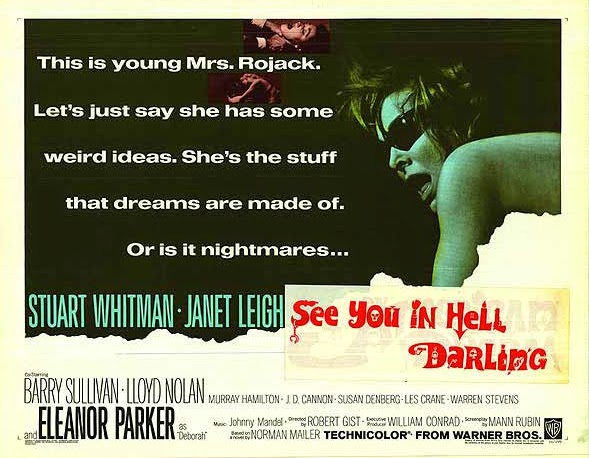
AN AMERICAN DREAM aka SEE YOU IN HELL DARLING

AN AMERICAN DREAM (aka See You In Hell Darling/1966). Director: Robert Gist.

When TV host Stephen Rojack (Stuart Whitman) pays a call on estranged wife, Deborah (Eleanor Parker), the vicious, drunken woman winds up falling off her balcony to her death. Rojack, grilled by police, does the sensible thing after his wife has just died and shacks up with old gal pal, Cherry (Janet Leigh). Rojack's father-in-law (Lloyd Nolan) contemplates pushing Stephen off of a balcony, and detectives Barry Sullivan and J. D. Cannon act like they'd like to tear his throat out. And we mustn't forget the whole host of mafia boys headed by Eddie Ganucci (Joe De Santis) and Johnny Dell (Warren Stevens) who have their own beef with Rojack. Whitman isn't bad, Parker [Lizzie] is vivid, Leigh plays it all in the key of bitter, Nolan is, frankly, terrible, Cannon over-acts in stock TV fashion, and Sullivan [Suspense] isn't much better. There are some interesting elements to An American Dream -- which is very loosely based on a novel by Norman Mailer -- but the movie is pretty much a melodramatic and at times even laughable mess. Acrophobes in the audience may have a few tense moments. Richard Derr has a bit as a producer while Murray Hamilton has a little more to do as an associate of Stephen's. Harold Gould and George Takei also have bits as lawyers. Whitman and Leigh appeared together in the monster bunny movie Night of the Lepus, which was actually a lot more entertaining than this.

Verdict: Everyone seems to be yelling -- or simmering -- to little effect. **.

Thursday, January 30, 2014

SUSPENSE

Barry Sullivan and Belita in Suspense
SUSPENSE (1946). Director: Frank Tuttle.

A down-and-out drifter named Joe (Barry Sullivan) gets a job hawking peanuts at an ice show. The star attraction is a blonde named Roberta (Belita), who is married to the owner of the show, Frank Leonard (Albert Dekker of Dr. Cyclops). Roberta fights her attraction to Joe until certain circumstances develop that lead the pair into some vaguely macabre situations ... Suspense does have some suspense of a minor kind -- and its main strength is that it's unpredictable -- but its chief flaw among many is that the central plot twist is so utterly implausible that it throws everything else out of whack. Joe is such a confusing and underwritten character that Sullivan, who has given some very good performances elsewhere, can do little but say his lines as written and try to deal with the contradictions [which might have been interesting in another movie] as best he can. Belita was basically a figure skater -- and a very good one -- and not a bad actress, either. She was similar in looks and deportment to Marsha Hunt. Unfortunately she got her start basically playing herself in movies from Monogram studios, so her career in films was a short one. Suspense is also a Monogram production -- and Belita's first thriller --  albeit it appears that the studio spent more money than usual on the picture. Dekker and Eugene Pallette [First Love] as a manager give their usual adept performances. A grown-up Bonita Granville [Nancy Drew -- Detective] plays one of Joe's former flames and is more than satisfactory. At least one of the big production numbers sort of stops the movie dead. Tuttle's direction is okay, but even Hitchcock might have had problems bringing this script to life. There is some mildly inventive business involving Roberta skating her way through a gauntlet of sharp swords, but not enough is done with it.

Verdict: Half-baked Alaska. **1/2.

Thursday, September 5, 2013

JEOPARDY

Ralph Meeker sexily enjoys Stanwyck's discomfiture
JEOPARDY (1953). Director: John Sturges.

Doug Stilwin (Barry Sullivan), his wife, Helen (Barbara Stanwyck), and their young son, Bobby (Lee Aaker), are vacationing in Mexico at an isolated beach where Doug used to fish with Army buddies. A big piece of timber on a wobbly jetty falls and pins Doug's leg to the ground, and he can't pull it out or wiggle free no matter how hard he tries. There are about four hours before the tide comes in and completely covers his head, so Helen takes off in the car to get help. Unfortunately, she goes from the frying pan to the fire when she enlists the aid of Lawson (Ralph Meeker), a murderer who is wanted by the police... Jeopardy is a harrowing suspense film bolstered by good performances and some frightening situations. Although one could argue that Stanwyck may not always get across the variety of emotions Helen must be feeling as she deals with Lawson and worries about her husband, she adds an interesting sub-text of sexuality to her scenes with Meeker, as if Helen -- despite the inappropriateness of it -- can't help but find virile, sexy bad boy Lawson quite attractive [she doesn't resist all that much when he grabs her and hungrily kisses her]. Sullivan gives one of his best performances, a man understandably close to panic, completely dependent on his wife, and who has to remain strong for the sake of his plucky son. Little Lee Aaker is an especially talented child actor and the perfect complement to the actors playing his parents, and Meeker manages to make his character a little more dimensional than others might have. Jeopardy is a good, suspenseful movie, but it could have used another twenty minutes and even more character development.

Verdict: As unsettling at times as it is entertaining. ***.

Thursday, February 21, 2013

NIGHT GALLERY (1969)

Joan Crawford in a dramatic moment
NIGHT GALLERY (1969 telefilm). Hosted and scripted by Rod Serling. Directors: Boris Sagal; Steven Spielberg; Barry Shear.

Rod Serling's follow-up to The Twilight Zone was a new fantasy-horror series in which Serling introduced each episode from a gallery of paintings, each painting tied in to one of the night's stories. This telefilm was the pilot for the show, and featured three tales of the bizarre. In the first, "The Cemetery," Roddy McDowall murders his decrepit wealthy uncle (George Macready), then freaks out as he sees the old man apparently breaking out of his grave in stages in a painting that hangs on the wall -- is the corpse coming after him with murder on its mind? The manservant, Portifoy (Ossie Davis), figures in an amusing climax. In the second story, "Eyes," filthy rich Miss Menlo (Joan Crawford), who has been blind since birth, pays a poor fool (Tom Bosley) to give her his eyes for money even as her doctor (Barry Sullivan) tells her she'll only have sight for about eleven hours. The story is deliciously ironic if quite improbable. [This was one of Steven Spielberg's earliest assignments; Crawford thought he was the coffee boy!] The third tale, "The Escape Route," is a highly satisfying tale in which a Nazi war criminal (Richard Kiley) in South America dreams of finding peace from "persecution" [!] in a pastoral painting hanging in the local museum, but winds up in a much more fitting scenario. Serling has scripted some fine dialogue for the stories, and gotten some top-flight actors to give their all for the all-important pilot. Roddy McDowall and Ossie Davis both deliver the goods in the first segment; Crawford and Sullivan are terrific in the second [with solid support from Bosley]; and Kiley, in an unusual turn for him, is splendid as the Nazi Strobe, with Norma Crane making quite a positive impression as the contemptuous prostitute, Gretchen. Serling is as adept a host as ever and the three directors are on top of things.

Verdict: Easy to see why this went to series. ***.

Thursday, November 22, 2012

PERRY MASON SEASON 8

Raymond Burr
PERRY MASON Season 8. 1965.

Perry (Raymond Burr) and the gang are back for another season of this highly popular courtroom drama -- one of the best seasons in the series' long history. Phyllis Hill and Robert Brown give outstanding performances in "The Case of the Sleepy Slayer," a clever story in which a woman must live with her hated uncle. "Wooden Nickles" with Will Kuluva features skulduggery over a valuable confederate coin. "Ruinous Road" examines the hoopla over tearing a house down to build a needed thoroughfare. Joyce Meadows [Brain from Planet Arous] and Gary Crosby appear in "Frustrated Folksinger," about a show biz dilettante accused of murdering an exploitative agent. "Thermal Thief," in which a woman tries to honor her late husband despite complications, features fine performances from Joyce Van Patten and Barry Sullivan [Queen Bee]. Jeanne Bal scores as a viciously scheming woman in "Tell Tale Tap." Minerva Urecal [Who's Guilty?] shows up in "Lover's Gamble" about a doctor with romantic issues. "Murderous Mermaid" has an Esther Williams-type dealing with a show biz hopeful and a strange publicity plot. In "Careless Kitten," in which there is no trial or even a courtroom sequence, Perry investigates whether or not a man missing for ten years is still alive, and confronts suspects in a living room; Percy Helton and an excellent Louise Latham [Marnie] are in the cast. In the season's most bizarre moment, Perry faces down a big ape in "Grinning Gorilla" with Victor Buono [Hush ... Hush, Sweet Charlotte] and Lurene Tuttle [The Manitou]. And there were many other memorable episodes.

Verdict: Still one of the most enjoyable and well-acted programs ever made. ***1/2.

Thursday, May 6, 2010

QUEEN BEE


QUEEN BEE (1955). Director [and screenplay]: Ranald MacDougall. From a novel by Edna L. Lee.

"Never come between me and my liquor. You might get knocked down." -- Avery.

"You can't imagine the things they've made me do trying to protect myself." -- Eva.

Well ... what to make of this picture? We have a bitter Eva Phillips (Joan Crawford), who is still smarting over the way her southern in-laws treated her when she came from Chicago; her heavy-drinking husband, Avery (Barry Sullivan) who has a big scar on his cheek from a car accident and is nicknamed "Beauty;" cousin Lucy (Jennifer Stewart), who comes for a lengthy stay and is caught between neurotic factions; sister Carol (Betsy Palmer), who only wants to marry Eva's cast-off lover Jud (John Ireland), but is tempting fate; and poor batty Sue (Fay Wray), who was literally left at the altar on her wedding day when Avery ran off with Eva. This is the kind of over-baked melodrama in which characters stand around and talk about the problems that define them at the drop of a hat. To say it lacks subtlety is a massive understatement. At the same time it's quite entertaining and oddly riveting, and works itself up to a dramatically horrifying climax. Everyone in the film seems to have studied at the School of Unnatural Acting, but most are effective, with Crawford being quite authoritative and giving her fans a good show. She is wise enough to show the vulnerability beneath her character's bitchiness. After her, Betsy Palmer comes off best, but both Ireland and Sullivan have their moments, and Katherine Anderson makes a mean nurse in Miss Breen. Years later Palmer played deranged maniac Mrs. Voorhees in the original Friday the 13th.

Verdict: Not exactly Tennessee Williams, but strangely compelling. ***.