Lively, entertaining reviews of, and essays on, old and newer films and everything relating to them, written by professional author William Schoell.
Showing posts with label Larry Hagman. Show all posts

Thursday, January 5, 2023

THE GROUP

THE GROUP (1963). Director: Sidney Lumet. 

"Who'da thunk it?" -- various.

"Sacrifice is dated. You don't reform a man. They just drag you down." -- Dottie.

In 1933 a group of women friends graduate from Vassar. The first to get married is Kay (Joanna Pettet), whose husband is a philandering playwright named Harald (Larry Hagman) whose mistress, Norine (Carrie Nye), also went to Vassar (but is not part of the group). Helena (Kathleen Widdoes) is the one who sends out a newsletter detailing the activities of the others. Priss (Elizabeth Hartman of The Beguiled) gets married to a controlling doctor, while Dottie (Joan Hackett) disillusioned by her first lover (Richard Mulligan), marries a much older man. Although she seems man-hungry, the bitchy Libby (Jessica Walter) reveals that she's a virgin when one suitor tries to assault her. Lakey (Candice Bergen) turns out to be a committed lesbian who comes back from Europe with a German baroness in tow. Polly (Shirley Knight) dallies with a married publisher (Hal Holbrook) before uniting with a doctor (James Broderick) who befriends her somewhat unusual father (Robert Emhardt). Pokey (Mary Robin-Redd) is a friendly and plump gal who seems a bit on the fringes of the group.  As the years go by the women interact, have babies, divorces, break-ups and react to world events such as communism and Hitler. Then one of their lives takes a decided and tragic turn for the worse. 

Lidia Prochnicka as the baroness with Bergen 
The Group
 is an interesting if very talky movie with some well-drawn characters and excellent performances. In the early scenes, of course, the actors all seem too old for their parts, but that isn't a problem in the later sequences. You expect -- and get -- memorable  performances from such as Joan Hackett, Jessica Walter (although perhaps a bit too arch and brittle at times), Kathleen Widdoes, and Hartman, but there's also good work from Candice Bergen and excellent work from Joanna Pettet, who is essentially the main character and is on top of things every step of the way. 

Bill Fletcher (seated) with some of the ladies
Larry Hagman has some good moments, as do the other fellows, with Broderick perhaps getting the most time on screen. Doreen Lang (of The Birds) makes a highly sympathetic nurse in one sequence. Bill Fletcher makes an impression as a rude actor who takes on Harald at a party. Sidney Buchman's screenplay seems to be fairly faithful to the novel (judging by a synopsis) while Sidney Lumet's direction covers the action competently but isn't especially inspired. There are no wipes, dissolves or other segues in the movie and nothing whatsoever to denote the passage of time, although there is period atmosphere. The ladies all had many credits after this film, with Bergen, Hackett, Knight, and Walter having the highest profiles. Kathleen Widdoes did work on the soaps. 

Verdict: If you can take all the cute nicknames -- what, no "Pukey?" -- this is an absorbing film with some fine performances. ***.  

Thursday, February 8, 2018

SOME ENCHANTED EVENINGS

SOME ENCHANTED EVENINGS: The Glittering Life and Times of MARY MARTIN. David Kaufman. St. Martin's; 2016.

Mary Martin went to Hollywood early in her career, but although she appeared and even starred in a few movies, she was dissatisfied with her film work and had much greater success on Broadway. Like many artists, this very talented woman lived for her work, and had a problematic, but ultimately loving, relationship with at least one child, her son Larry Hagman, famous as "J. R" on Dallas. Martin's marriage to her son's father did not last long, but she had a much longer union to her second husband, the mostly gay Richard Halliday, who guided her career when he wasn't alienating people with his temper and his alcoholism. Her shows included One Touch of Venus, South Pacific, Peter Pan, The Sound of Music, and for my money made the best Annie Oakley when she did Annie Get Your Gun on the road and for television. Some Enchanted Evenings also looks at Martin's work in less successful shows, such as the musical Jennie, and the play Legends, in which Martin was teamed with Carol Channing. The book hints at a "special relationship" between Martin and Janet Gaynor (Gaynor's husband, interestingly enough, is the only person quoted in the book who knocks Martin), as well as Jean Arthur, without ever really elaborating.When a reporter spoke to Martin about Larry Hagman, and asked what it's like having an icon for a son, she responded, "My dear, my son is a star. I am an icon." Although the author mentions his husband in the acknowledgments, the book does on occasion betray a kind of amusingly old-fashioned take on LGBT issues.

Verdict: Exhaustive, well-researched, imperfect, but very readable bio of the venerable entertainer. ***1/2.

Thursday, November 2, 2017

BEWARE! THE BLOB

Gwynne Gilford and Robert Walker Jr. 
BEWARE! THE BLOB (aka Son of Blob/1972). Director: Larry Hagman.

Chester Hargis (Godfrey Cambridge) brings home a frozen specimen that defrosts and turns into the Blob, and it rapidly devours the residents of a small town, including bowlers and ice skaters. Beware! The Blob could have been a perfectly good sequel to The Blob if the approach had been different. Larry Hagman, who was in-between I Dream of Jeannie and his career-reviving role on Dallas, decided to turn this into a free-wheeling borderline parody despite the fact that the whole premise already has black comedy aspects to begin with. So Hagman cast some friends and character actors and guest-stars -- such as Carol Lynley, Burgess Meredith, and Shelley Berman -- all of whom seem to be having fun, but not one of whom is actually funny. Most of the death scenes are also played for laughs. The shame of it is that the script is workable and there's genuine suspense in the situation at the climax, with hero Bobby (Robert Walker Jr.) trying to freeze the monster while the cops outside start to set fire to the building. Walker and Gwynne Gilford [Fade to Black] as his girlfriend, Lisa, wisely play their roles straight and are all the more effective for it -- there's also a good scene when their car is engulfed by the creature. The special effects are, if anything, even more low-tech than in the original. Veteran Richard Webb [The Invisible Monster] plays Sheriff Jones and Cindy Williams is a party guest who has one excruciating scene with a guy singing and playing guitar. Hagman directed a few television episodes, but mercifully this is the only film he ever helmed.

Verdict: Almost makes the original look like a masterpiece. *1/2.

Thursday, September 14, 2017

DALLAS REDUX

Jon Ross (Josh Henderson) faces his father J. R. (Larry Hagman)
DALLAS (2012).

After Dallas wrapped up its fourteen year run, it turned out that there was still life left in those enduring characters. First there were two telefilms, J. R. Returns (1996) and War of the Ewings (1998), both of which had continuity problems and both of which were forgettable, below the level of the best episodes of the series. There was also a prequel telefilm I have not yet seen and  a reunion special which brought together several of the cast members to reminisce, with host Larry Hagman amusingly referring to the show's thirteen years when the series actually lasted fourteen seasons. Then came the reboot in 2012, which was a whole different story. The show wisely focused -- at least at first -- on the younger generation, which included J. R.'s son Jon Ross (Josh Henderson) and Bobby's adopted son, Christopher (Jesse Metcalf of Beyond a Reasonable Doubt), who were each billed first in the credits on alternating episodes. The show was also smart enough to retain Bobby Ewing (Patrick Duffy), Sue Ellen (Linda Gray), and especially J. R. (Larry Hagman). We first see J,. R. despondent in a nursing home, but he gets out of his funk, shows up at the Oil Baron's Ball on a walker, then throws that walker away and gets back into the action, which includes a whole love-hate thing with Jon Ross.

It's terrific that the show has several vital cast members who are now seniors, but annoying that Duffy, Gray and Hagman -- despite their very large parts -- are not listed as bonafide stars of the show but only listed under "with." Hagman wheeled and dealed for the first two seasons, but then passed away, as did his character. Frankly I had always thought that Gray and Duffy, while competent, were lightweights, but in their senior years these two actors really stepped up their game. Gray has a superb scene when she is hungover at J. R.'s grave site, and Duffy, out of J. R.'s long shadow, not only delivers an impassioned knock-out performance, but becomes the true star of the show and its most important and pivotal character. That's saying a lot when there are so many younger, good-looking and talented co-stars, especially Josh Henderson as Jon Ross, a devilishly charismatic "bad boy" who has a lot more sex appeal than his father ever did (if they ever remake Hud, Henderson would make you forget Paul Newman). Brenda Strong (who was mostly unseen in Desperate Housewives, although her deceased character was the narrator), Mitch Pileggi [Shocker], who was also in the final seasons of the original show, and especially the wonderful Judith Light [Save Me] as a mother from Hell also make a strong impression. Watch her getting turned on as she insists a drug dealer do a body search on her for hidden wires!

Ken Kercheval, who managed to appear in every season of the original show, as well as the two telefilms, is back as Cliff Barnes. Cliff always seemed vaguely demented, and in this reboot, he is clearly demented, his actions those of a lunatic, such as allowing his own daughter to be nearly blown up and killing his unborn grandchildren because he still wants to strike back at those damn Ewings. Kercheval seems to be having fun playing a man who has been turned, a bit improbably, into a hateful villain.

Dallas only lasted three abbreviated seasons (ten episodes for the first season, and fifteen apiece for the last two) and ended on a cliffhanger that will never be resolved. I think there was way too much of those Mexican drug dealers in the final season, and they were simply not that interesting. The writers, who managed to make the characters more dimensional than in many soap operas, certainly had enough material to work with without dragging in an ever-present drug cartel, and that may have hastened the series' abrupt cancellation. Still, Dallas was a fun ride while it lasted.

Verdict: Some fine acting, interesting developments, and good scripting help put this over. ***.

Thursday, August 10, 2017

FAIL-SAFE

Frank Overton
FAIL-SAFE (1964). Director: Sidney Lumet.

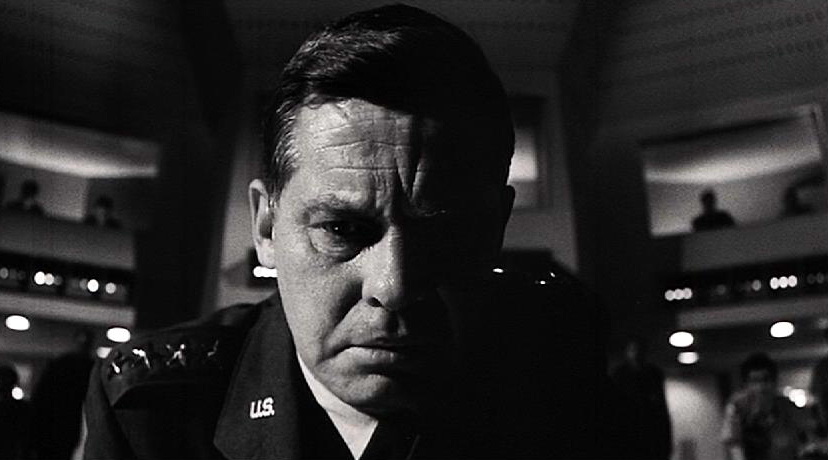
The American president (Henry Fonda) discovers that the U.S. air force accidentally launched a bomber squadron against Moscow. Now his job is two-fold: to convince his Russian counterpart that this strike was indeed accidental and prevent retaliation; and to stop or even shoot down the U.S. planes before they can drop the bombs and start WW3. The tension is thick as various characters react to what is an untenable and horrifying situation. The acting from the entire cast is first-class: Dan O Herlihy  [King of the Roaring 20's] as General Black, who must discharge the most distasteful duty of his career, to put it mildly; Fritz Weaver (who was introduced in this film) as Colonel Cascio, who is nearly driven mad by the situation and has a violent breakdown; Walter Matthau (in one of his early dramatic roles) as Groeteschele, who is coldly pragmatic when it comes to the numbers of projected casualties and the like; and especially Frank Overton [Desire Under the Elms], in the performance of his career, as the conflicted but duty-bound General Bogan. Janet Ward certainly scores in a small but pivotal role as Mrs. Grady, who desperately tries to tell her husband, the lead pilot, to turn back before it's too late. Nancy Berg, Dom DeLuise [Diary of a Bachelor]  and Larry Hagman (as a translator), among others, also do well in some flavorful supporting roles. One of the best scenes has Bogan reacting after the men in the war room cheer the downing of one of the planes -- "this isn't a football game!" I don't know if I find the controversial ending to this to be especially believable, but it certainly packs a wallop. I have no doubt that when this was released people left the theater shivering in shocked silence. This was released the same year as the satirical Dr. Strangelove, which has more or less the same plot, but the more somber Fail-Safe has the edge on it. The movie could have been cut by ten or so minutes and tightened a bit, however.

Verdict: Disturbing, high-impact, and infinitely depressing. ***1/2.

Thursday, July 27, 2017

DALLAS: THE FINAL SEASONS

Larry Hagman and Gayle Hunnicutt
DALLAS Season 12 - 14. 1988 - 1991.

I was never the biggest fan of Dallas, but like most people (including my late mother who never watched the show ever) I tuned in for "Who Shot J.R?" but the show never became a guilty pleasure until the last couple of seasons, which were fast-paced fun. J. R. Ewing (Larry Hagman) got involved in a near-shotgun wedding with Callie (Cathy Podewell), had himself committed to a mental institution to get some papers (from Alexis Smith!), got shot again by his ex-wife Sue Ellen (Linda Gray), who used her money to finance a biopic about him. While this roman a clef film took center stage in season 12, the sub-plot never really amounted to much. Sue Ellen simply told J. R. that she wouldn't release the film as long as he behaved himself. We never saw the reaction from the cast or even the director (whom she married off-screen) when they found out the public would never even see the movie. George Kennedy [Strait-Jacket] showed up as a business rival with his own inner demons, and Gayle Hunnicutt [The Legend of Hell House] appeared in more than one season as J. R.'s lost and long-time love (when she finally breaks off her engagement to him, J. R. doesn't try very hard to get her back). Meanwhile Bobby (Patrick Duffy of The Last of Mrs. Lincoln) lost his wife, Pam, who first ran off after being disfigured in a car crash and then got a terminal illness, but decided not to tell anyone; Bobby's next wife was shot and killed on their honeymoon. Hagman wasn't a great actor, but he made the most of J. R. and offered a very effective portrayal. The performers on Dallas sometimes phoned in their performances, but at other times they were really on target. For instance, George Kennedy had a great scene when he's talking to his son on the phone and expressing how overjoyed he is that he's being released from a Mexican prison. Season 13 introduced the charming Sasha Mitchell as J. R.'s son (by Hunnicutt, who was quite good), who crosses both wits and swords with his father. Mitchell was not a seasoned performer, but he had an appealing, inoffensive arrogance that complimented his good looks and made him an asset to the show. A mention should be made of the two very talented child performers, Omri Katz and Joshua Harris, as the sons, respectively, of J.R. and Bobby. It was fun to see Barbara Eden, Hagman's co-star from I Dream of Jeannie, as an oil woman who really puts J. R through the wringer in season 14. Ken Kercheval was fine as J. R.'s bitter rival, Cliff Barnes, but the character could be so irritating (and always looked like an unmade bed) that it's a wonder he lasted fourteen seasons when others were sent packing! The disappointing last episode of the show had J. R. contemplating suicide while a demon played by Joel Gray (!) showed him what life would have been like for the other members of his family if he had never been born. Ted Shackleford as Gary Ewing (of Knots Landing) probably had more footage in this episode than in all the other seasons combined. The final season was followed by three TV movies and the show was revived in 2014 with some of the original players.

Verdict: Big hair, bad marriages, cat fights, bar fights, bed-hopping, philandering, plotting and co-plotting, and a little something about the oil industry, ***